- Product Description Description
- Table of Contents TOC
- List of Table & Figure LOT
- Get Free Sample PDF Sample PDF
Market Size, 2025
$63.61 BnMarket Estimate, 2026
$74.93 BnMarket Forecast, 2034
$277.86 BnCAGR, 2026–2034
17.8%Global Healthcare Cloud-Based Analytics Market Size, Growth, Trends & Forecast (2026–2034)
The size of the global healthcare cloud-based analytics market was valued at USD 63.61 billion in 2025, is anticipated to reach USD 74.93 billion in 2026, and is projected to scale up to USD 277.86 billion by 2034, registering a compound annual growth rate (CAGR) of 17.8% during the forecast period from 2026 to 2034. Driven by the exponential growth of healthcare data, a regulatory push toward interoperability, and the transition to value-based care models, the cloud-based analytics industry continues to expand steadily worldwide.
Key Executive Metrics (At-a-Glance)
- 2025 Base Valuation: USD 63.61 Billion
- 2026 Current Valuation: USD 74.93 Billion
- 2034 Forecast Valuation: USD 277.86 Billion
- Compound Annual Growth Rate (CAGR): 17.8% (2026–2034)
- Dominant Technology Segment: Predictive Analytics (holding 40.1% of the market share in 2024)
- Fastest-Growing Technology Segment: Prescriptive Analytics (projected at a 24.3% CAGR)
- Dominant Component Segment: Software (holding 55.3% of the market share in 2024)
- Fastest-Growing Component Segment: Services (projected at a 22.3% CAGR)
- Dominant Region: North America (accounting for 38.3% of the global share in 2024)
Core Market Drivers
- Exponential Data Volume: Massive data generation from electronic health records (EHRs), medical imaging, genomics, and wearables requiring scalable cloud storage and real-time insights.
- Value-Based Care & Interoperability: Government policies and regulations mandating seamless health information exchange and supporting value-based reimbursement models.
- AI and ML Integration: Growing adoption of artificial intelligence and machine learning tools for diagnostics, treatment personalization, and predictive public health modeling.
Primary Market Restraints & Challenges
- Privacy and Security Concerns: Stringent regulations like HIPAA and GDPR, combined with risks of cloud misconfigurations and data breaches affecting user trust.
- Implementation Complexity & Costs: High upfront migration expenses, integration hurdles with legacy systems, and a shortage of specialized data science personnel.
- Data Standardization Issues: Lack of uniform data formats, terminologies, and cross-platform interoperability protocols across healthcare IT systems.
Global Healthcare Cloud-Based Analytics Market Segmentation Breakdown
| Segment Category | Leading Sub-Segment (2024/2025 Base) | Fastest-Growing Sub-Segment |
|---|---|---|
| By Technology | Predictive Analytics (dominant with 40.1% share) | Prescriptive Analytics (fastest-growing at a 24.3% CAGR) |
| By Component | Software (holding 55.3% share) | Services (fastest-growing at a 22.3% CAGR) |
| By Application | Clinical Data Analytics (holding 45.3% share) | Research Data Analytics (fastest-growing at a 26.3% CAGR) |
| By Region | North America (leading contributor with 38.3% share) | Asia Pacific (fastest-growing regional market) |
Major Industry Players Profiled
Key enterprises shaping the competitive global healthcare cloud-based analytics market include Allscripts Healthcare Solutions, Cerner Corporation, HP, McKesson, Oracle (Oracle Health), CitiusTech, IBM, Optum Health, and Verisk Analytics.
 Download Free Sample Report
Global Healthcare Cloud-Based Analytics Market Size
The size of the global healthcare cloud-based analytics market was worth USD 63.61 billion in 2025. The global market is anticipated to grow at a CAGR of 17.8% from 2026 to 2034, reaching USD 277.86 billion by 2034, up from USD 74.93 billion in 2026.

The healthcare cloud-based analytics is the integration of cloud computing technologies with advanced data analytics tools specifically tailored for healthcare applications. This market enables healthcare providers, payers, and pharmaceutical companies to store, manage, analyze, and derive actionable insights from vast volumes of health-related data in real time. The adoption of electronic health records (EHRs), increasing volume of genomic and wearable data, and growing emphasis on value-based care are key factors propelling this expansion. In addition, as noted by Deloitte, nearly 70% of healthcare organizations have migrated or plan to migrate their analytics infrastructure to the cloud within the next two years to enable faster scalability and interoperability across systems. Moreover, the World Health Organization (WHO) has emphasized the role of digital health solutions in achieving universal health coverage, further reinforcing the importance of robust analytical capabilities in modern healthcare ecosystems.
MARKET DRIVERS
Rising Volume of Healthcare Data and Demand for Real-Time Insights
One of the most significant drivers fueling the growth of the Healthcare Cloud-Based Analytics Market is the exponential increase in healthcare data generated from diverse sources such as electronic health records (EHRs), medical imaging, genomics, wearables, and remote monitoring devices. Traditional on-premise systems are often incapable of handling such massive datasets efficiently, prompting healthcare institutions to adopt scalable cloud-based analytics platforms.
Cloud-based analytics allows for centralized storage, seamless integration, and real-time processing of heterogeneous data streams. As reported by Frost & Sullivan, approximately 62% of healthcare providers have cited improved operational efficiency and faster diagnostic accuracy after implementing cloud analytics. Additionally, the demand for real-time analytics has surged due to the need for rapid response in public health crises, such as the recent pandemic, where timely data aggregation and analysis were crucial for resource allocation and policy-making. These advancements are encouraging healthcare organizations worldwide to invest heavily in cloud analytics infrastructure, thereby driving market growth.
Regulatory Push Toward Interoperability and Value-Based Care Models
A second major driver of the Healthcare Cloud-Based Analytics Market is the regulatory push toward interoperability and the transition from fee-for-service to value-based care models. Governments and regulatory bodies across developed and emerging economies are enforcing policies that mandate seamless exchange of health information between providers, payers, and patients. For instance, the U.S. Centers for Medicare & Medicaid Services (CMS) introduced the Interoperability and Patient Access Rule in 2020, requiring healthcare entities to provide patients with secure access to their health data via standardized application programming interfaces (APIs). According to a study published by the Office of the National Coordinator for Health Information Technology (ONC), over 80% of hospitals in the U.S. had adopted certified EHR technology by 2022, significantly enhancing data liquidity. Cloud-based analytics plays a pivotal role in aggregating and analyzing this data across disparate systems, supporting risk stratification, preventive care, and personalized treatment plans.
MARKET RESTRAINTS
Data Privacy and Security Concerns in Cloud Environments
Despite its transformative potential, the Healthcare Cloud-Based Analytics Market faces substantial restraints, primarily stemming from data privacy and security concerns. Healthcare data is highly sensitive and subject to stringent regulations such as the Health Insurance Portability and Accountability Act (HIPAA) in the U.S., the General Data Protection Regulation (GDPR) in Europe, and similar frameworks globally. A breach in cloud-based systems can lead to unauthorized access to patient records, identity theft, and legal repercussions for healthcare providers. Over 43% of these breaches involved cloud misconfigurations or vulnerabilities in third-party cloud services. Additionally, the Healthcare Information and Management Systems Society (HIMSS) found that nearly 60% of healthcare IT professionals perceive cloud environments as less secure than traditional on-premise systems, citing lack of control over encryption standards and vendor compliance issues. These concerns deter smaller healthcare institutions from migrating to cloud analytics platforms, particularly in regions with underdeveloped cybersecurity infrastructure.
High Implementation Costs and Technical Complexity
Another critical restraint impeding the Healthcare Cloud-Based Analytics Market is the high initial implementation cost coupled with the technical complexity of deploying and integrating cloud analytics solutions. While cloud computing offers long-term cost savings, the upfront investment required for system migration, staff training, and integration with legacy systems can be prohibitively expensive for small and mid-sized healthcare providers. These integration hurdles often result in workflow disruptions and extended downtimes, negatively affecting operational efficiency. Additionally, the shortage of skilled personnel capable of managing complex cloud infrastructures and interpreting advanced analytics outputs remains a pressing issue. A 2023 survey by the American Medical Informatics Association (AMIA) revealed that only 30% of healthcare facilities have dedicated data scientists or cloud specialists on staff. This skills gap limits the effective utilization of cloud analytics tools by reducing return on investment and slowing market penetration, especially in developing economies.
MARKET OPPORTUNITIES
Expansion of Telehealth and Remote Monitoring Services
One of the most promising opportunities for the Healthcare Cloud-Based Analytics Market lies in the rapid expansion of telehealth and remote patient monitoring (RPM) services. The global shift toward decentralized care delivery models, accelerated by the pandemic, has led to a surge in the use of connected medical devices and wearable sensors that generate continuous streams of health data.
Cloud-based analytics enables healthcare providers to aggregate and analyze patient vitals, medication adherence, and behavioral patterns remotely, facilitating early intervention and chronic disease management. As reported by Accenture, cloud analytics has already helped reduce hospitalizations by 20% among diabetic patients enrolled in RPM programs. As telehealth continues to gain mainstream acceptance, the demand for cloud analytics to support data-driven decision-making in virtual care settings will rise significantly, opening new avenues for market growth.
Adoption of AI and Machine Learning in Clinical Analytics
Another transformative opportunity for the Healthcare Cloud-Based Analytics Market is the growing integration of artificial intelligence (AI) and machine learning (ML) into clinical analytics workflows. AI-powered cloud analytics tools are increasingly being used for diagnostics, drug discovery, treatment personalization, and predictive modeling of disease outbreaks. Much of this growth is attributable to cloud-based AI platforms that allow healthcare organizations to process large-scale datasets without heavy capital investments in local infrastructure. For example, Google Health and Mayo Clinic have collaborated on cloud-based AI models that can detect breast cancer with greater accuracy than conventional radiologists.
Moreover, as per the Journal of Medical Internet Research, AI-enhanced cloud analytics reduced diagnostic errors by 18% in pilot studies conducted across multiple hospitals in the U.K. and Singapore. These technologies are also playing a vital role in epidemiological modelling Johns Hopkins University leveraged cloud-based ML tools during the pandemic to predict infection trends with 92% accuracy.
MARKET CHALLENGES
Lack of Standardization Across Cloud Platforms and Data Formats
A major challenge facing the Healthcare Cloud-Based Analytics Market is the lack of standardization across cloud platforms, data formats, and integration protocols. Unlike other industries, healthcare data comes in a wide variety of structured and unstructured formats including clinical notes, lab results, imaging scans, and genetic profiles making it difficult to harmonize and analyze consistently across different systems.
According to a white paper issued by the International Health Terminology Standards Development Organisation (IHTSDO), fewer than 40% of healthcare institutions use fully standardized terminologies like SNOMED CT or LOINC for data encoding. This inconsistency hampers interoperability between cloud-based analytics tools and electronic health record (EHR) systems, leading to fragmented insights and inefficient data utilization. Furthermore, as noted by KLAS Research, nearly half of healthcare providers experience delays in analytics reporting due to incompatible data structures across cloud vendors.
This fragmentation not only complicates data aggregation but also increases the cost and complexity of deploying analytics solutions. Without universally accepted data standards and API protocols, healthcare organizations struggle to ensure seamless data flow and meaningful analytics output. Addressing this challenge requires coordinated efforts among regulators, cloud service providers, and healthcare institutions to establish uniform data governance frameworks that facilitate smooth integration and maximize the value of cloud-based analytics.
Regulatory Heterogeneity and Compliance Burden Across Geographies
Another significant challenge confronting the Healthcare Cloud-Based Analytics Market is the regulatory heterogeneity and compliance burden across different geographies. Healthcare data is subject to varying national and regional laws concerning data localization, consent management, and cross-border data transfers, making it difficult for multinational cloud service providers to maintain consistent compliance strategies.
For instance, the European Union’s General Data Protection Regulation (GDPR) imposes strict requirements on data processing and mandates explicit patient consent for data usage, while countries like China enforce stringent data localization laws under the Cybersecurity Law, requiring sensitive health data to be stored within national borders. Additionally, the U.S. Department of Health and Human Services (HHS) frequently updates HIPAA guidelines, adding layers of complexity to data handling procedures. These regulatory inconsistencies delay market entry, increase operational costs, and limit innovation, posing a considerable hurdle to the widespread adoption of cloud-based analytics in global healthcare systems.
REPORT COVERAGE
| REPORT METRIC | DETAILS |
| Market Size Available | 2025 to 2034 |
| Base Year | 2025 |
| Forecast Period | 2026 to 2034 |
| Segments Covered | By Technology, Application, Component, and Region. |
| Various Analyses Covered | Global, Regional and Country-Level Analysis, Segment-Level Analysis, Drivers, Restraints, Opportunities, Challenges; PESTLE Analysis; Porter’s Five Forces Analysis, Competitive Landscape, Analyst Overview of Investment Opportunities |
| Regions Covered | North America, Europe, Asia Pacific, Latin America, the Middle East, and Africa |
| Market Leaders Profiled | Allscripts Healthcare Solutions, Cerner Corporation, Hp, Mckesson, Oracle, Citiustech |
SEGMENTAL ANALYSIS
By Technology Insights
The predictive analytics segment was the largest and held 40.1% of the Healthcare Cloud-Based Analytics Market share in 2024. One of the leading drivers behind the prominence of predictive analytics is the growing adoption of value-based care models. According to a report by McKinsey, approximately 65% of U.S. hospitals have transitioned to or are piloting value-based payment arrangements, which rely heavily on predictive modeling to manage population health and reduce hospital readmissions. Predictive tools enable providers to identify high-risk patients early, allocate resources more efficiently, and improve clinical decision-making. Another key driver is the increasing integration of artificial intelligence (AI) into cloud-based predictive platforms. As noted by Frost & Sullivan, AI-driven predictive analytics has improved diagnostic accuracy by up to 18% in oncology applications. Additionally, during the pandemic, institutions using predictive analytics for ICU bed allocation and ventilator demand planning experienced a 22% reduction in mortality rates, according to the CDC.

The prescriptive analytics segment is projected to grow with a with a CAGR of 24.3% during the forecast period. A major factor fueling this expansion is the rising deployment of precision medicine initiatives that require advanced analytics to determine optimal therapeutic interventions. As per the National Institutes of Health (NIH), personalized treatment plans generated through prescriptive analytics have led to a 27% improvement in medication adherence among chronic disease patients. Furthermore, the integration of real-time data from wearable devices and electronic health records (EHRs) enables clinicians to receive dynamic, evidence-based recommendations directly at the point of care. Additionally, healthcare payers are increasingly adopting prescriptive analytics to optimize claims processing and fraud detection.
By Component Insights
The software segment dominated the Healthcare Cloud-Based Analytics Market by holding 55.3% of the share in 2024. One of the key factors propelling the software segment is the widespread implementation of electronic health records (EHRs) and health information exchanges (HIEs). According to the Office of the National Coordinator for Health Information Technology (ONC), over 96% of U.S. hospitals had adopted certified EHR technology by 2022. These systems generate massive datasets that necessitate sophisticated cloud-based analytics software for interpretation and decision support.
Moreover, the shift toward value-based care models is accelerating the adoption of analytics software capable of risk stratification, population health tracking, and outcome prediction. As reported by Deloitte, healthcare organizations utilizing such software have seen a 20–30% improvement in care coordination efficiency. Additionally, vendors like Cerner and Epic have integrated AI-powered analytics modules into their cloud-based software platforms, further enhancing functionality.
The services segment is expected to grow with a CAGR of 22.3% during the forecast period. One of the primary drivers of this growth is the complexity associated with migrating legacy systems to cloud-based environments. As per Gartner, nearly 60% of healthcare organizations lack in-house expertise to deploy and manage cloud analytics effectively, prompting them to outsource to managed service providers. For instance, IBM Watson Health and Oracle Health offer end-to-end consulting and managed services that assist clients in optimizing their cloud analytics deployments.
Additionally, the rise in regulatory compliance requirements is boosting the demand for specialized services such as data governance, security audits, and system validation. According to a PwC survey, healthcare institutions spending on IT compliance services increased by 18% in 2023 compared to the previous year.
By Application Insights
The clinical data analytics segment was accounted in holding 45.3% of the Healthcare Cloud-Based Analytics Market share in 2024. One of the primary drivers is the increasing integration of cloud-based analytics into electronic health record (EHR) systems to enhance real-time clinical decision-making. As reported by the American Medical Informatics Association (AMIA), over 70% of U.S. hospitals now use EHR-integrated analytics tools to support diagnostic accuracy and treatment planning. Another key factor is the growing adoption of remote monitoring technologies and digital therapeutics. According to the Journal of Telemedicine and e-Health, cloud-enabled clinical analytics platforms have improved early intervention rates for heart failure patients by 28%.
The research data analytics segment is swiftly emerging with a projected CAGR of 26.3% from 2026 to 2034. One of the main catalysts is the exponential increase in genomic data generation. According to the National Human Genome Research Institute (NHGRI), the cost of sequencing a human genome has dropped below USD 1,000, enabling large-scale studies that produce terabytes of data requiring cloud-based analytical tools. For example, the All of Us Research Program by the NIH leverages cloud analytics to process genetic and lifestyle data from over one million participants to advance personalized medicine. Additionally, pharmaceutical companies are increasingly adopting cloud-based analytics to accelerate drug development timelines.
REGIONAL ANALYSIS
North America Healthcare Cloud-Based Analytics Market Analysis
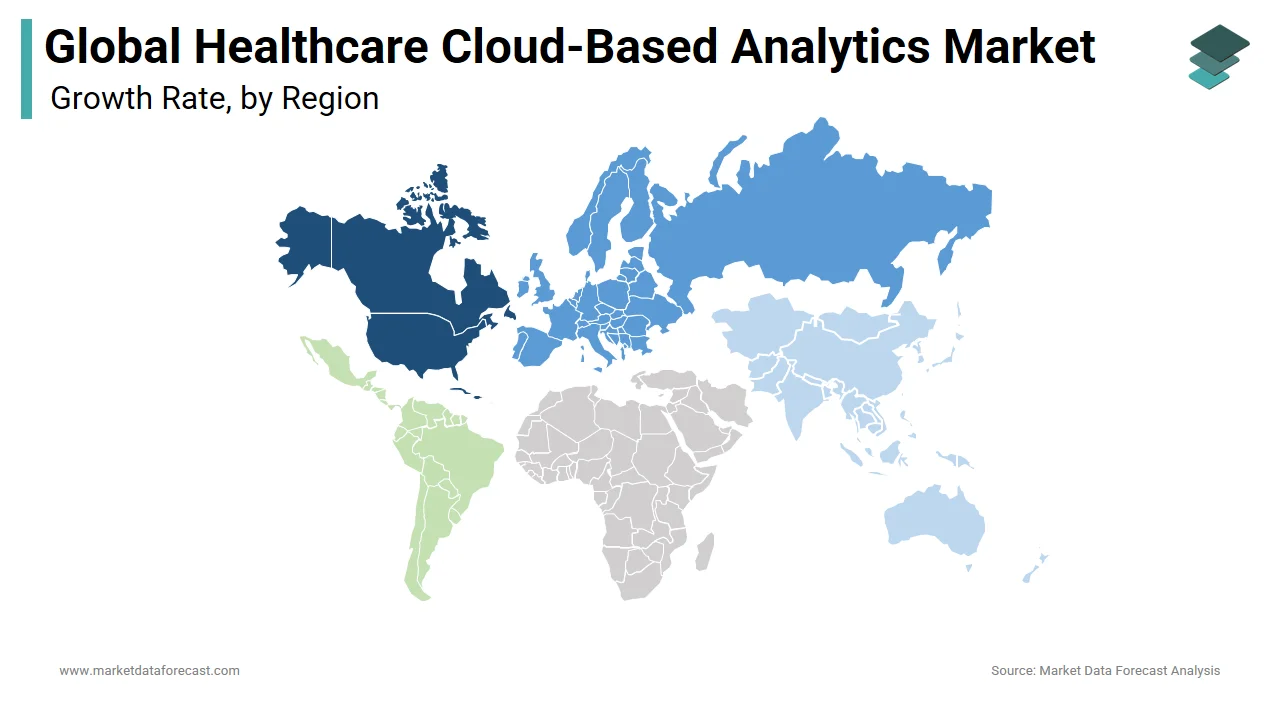
North America was the largest contributor in the global Healthcare Cloud-Based Analytics Market by accounting for 38.3% of the share in 2024. One of the key drivers is the widespread implementation of value-based care models. According to the Centers for Medicare & Medicaid Services (CMS), nearly 60% of healthcare payments in the U.S. were tied to value-based arrangements in 2023, necessitating advanced analytics capabilities to track outcomes and optimize reimbursements. Additionally, the Interoperability and Patient Access Rule introduced by CMS mandates healthcare providers to adopt standardized APIs, further boosting cloud analytics adoption for seamless data exchange. Another major factor is the presence of leading analytics solution providers such as IBM, Oracle Health, and Epic Systems, which are continuously innovating cloud-based offerings.
Europe Healthcare Cloud-Based Analytics Market Analysis
Europe was positioned second with 25.3% of the Healthcare Cloud-Based Analytics market share in 2024. One of the primary drivers is the European Union’s Digital Transformation of Health and Care initiative, which encourages member states to invest in interoperable digital health systems. Additionally, the General Data Protection Regulation (GDPR) has prompted healthcare providers to adopt secure cloud analytics platforms that ensure compliance with stringent data protection standards. A report by Deloitte notes that healthcare organizations in Germany and France have increased their cloud analytics budgets by 18% and 22%, respectively, since 2021.
Asia Pacific Healthcare Cloud-Based Analytics Market Analysis
Asia Pacific is emerging with a highest CAGR throughout the forecast period. One of the key drivers is the increasing government initiatives aimed at modernizing healthcare infrastructure. In India, the Ayushman Bharat Digital Mission launched in 2021 aims to create a unified digital health ecosystem, promoting the use of cloud analytics for better health outcomes. According to the Ministry of Health and Family Welfare, over 400 million citizens have been registered under the program as of 2023. Another major factor is the surge in private healthcare investments and telemedicine adoption post-pandemic.
Latin America Healthcare Cloud-Based Analytics Market Analysis
Latin America Healthcare Cloud-Based Analytics Market is swiftly growing with gradual adoption of digital health solutions, driven by public health reforms and increasing private sector participation.
One of the major growth drivers is the expansion of digital health initiatives in Brazil and Mexico. In Brazil, the Ministry of Health has launched the "Saúde+ Digital" strategy, aiming to integrate cloud-based analytics into primary care services. Additionally, the rise in medical tourism and private healthcare investments is encouraging the use of advanced analytics tools to enhance service quality. Although challenges such as regulatory fragmentation and limited IT infrastructure persist, Latin America presents untapped potential for market expansion in the coming decade.
Middle East and Africa Healthcare Cloud-Based Analytics Market Analysis
The Middle East and Africa Healthcare Cloud-Based Analytics Market growth is with the adoption levels remain lower compared to other regions, certain Gulf Cooperation Council (GCC) countries are spearheading digital health transformation. In Africa, the situation is more fragmented, though countries like South Africa and Kenya are showing progress. The African Union’s Digital Transformation Framework encourages member states to invest in digital health infrastructure.
COMPETITIVE LANDSCAPE
The Latin America Dicamba Herbicide Market is characterized by a competitive landscape driven by both multinational agrochemical giants and regional players. The market sees active participation from established firms investing heavily in research, formulation development, and sustainable application technologies. With increasing demand for high-yield crops and growing adoption of genetically modified herbicide-tolerant crops, competition is intensifying in terms of product differentiation and pricing strategies. Companies are also focusing on expanding distribution networks and enhancing technical support services to gain an edge. However, regulatory scrutiny around environmental safety and volatility concerns associated with dicamba pose challenges that influence competitive dynamics.
KEY MARKET PLAYERS
Some of the noteworthy companies operating in the global healthcare cloud-based analytics market include Allscripts Healthcare Solutions, Cerner Corporation, Hp, Mckesson, Oracle, Citiustech, IBM, Optum Health, Verisk Analytics, CitiusTech, and others.
TOP LEADING PLAYERS IN THE MARKET
- IBM has been a long-standing leader in healthcare cloud analytics, primarily through its Watson Health division. The company contributes significantly to the market by integrating artificial intelligence with cloud-based data analytics to enhance clinical decision-making, population health management, and drug discovery. IBM’s solutions support hospitals, payers, and life sciences firms in deriving actionable insights from vast amounts of health data. Its strategic partnerships and continuous innovation in AI-driven analytics have reinforced its global presence.
- Oracle plays a pivotal role in the healthcare analytics space through its comprehensive suite of cloud-based solutions under Oracle Health. The company offers integrated electronic health records, enterprise analytics, and revenue cycle management tools that enable providers to streamline operations and improve patient outcomes. Oracle's strength lies in its scalable cloud infrastructure and interoperability capabilities, which support seamless data exchange across disparate systems, making it a key enabler of digital transformation in healthcare.
- Prior to its acquisition by Oracle in 2022, Cerner was a dominant player in healthcare IT and analytics, known for its robust EHR platform and population health analytics tools. Post-acquisition, the combined entity has further strengthened its analytics offerings by embedding advanced cloud technologies into existing clinical workflows. Cerner’s contributions include enabling real-time analytics for care delivery, risk stratification, and value-based care initiatives, positioning the merged organization as a formidable force in global healthcare analytics.
TOP STRATEGIES USED BY KEY MARKET PARTICIPANTS
Key players in the Latin America Dicamba Herbicide Market employ several strategies to promote their market positions. One major approach is product innovation, where companies continuously develop new formulations and application techniques to enhance herbicidal efficiency and reduce environmental impact. Another strategy is strategic partnerships, including collaborations with local distributors and agrochemical firms to expand market reach and ensure better supply chain integration. Regulatory engagement is crucial, as companies work closely with agricultural authorities to ensure product compliance, secure approvals, and promote responsible use, thereby maintaining a strong foothold in the region.
GLOBAL HEALTHCARE CLOUD-BASED ANALYTICS MARKET NEWS
- In February 2023, Microsoft Azure expanded its healthcare data analytics portfolio by launching a dedicated cloud environment tailored for HIPAA-compliant health data processing. This move aimed to provide healthcare organizations with enhanced security and scalability for managing complex analytics workloads.
- In May 2023, Google Cloud partnered with Mayo Clinic to develop AI-driven clinical analytics tools hosted on a secure cloud infrastructure. The collaboration focused on accelerating medical research and improving diagnostic accuracy through real-time data analysis.
- In September 2023, Amazon Web Services (AWS) introduced a new suite of machine learning models specifically designed for healthcare analytics. These tools were integrated into AWS’s cloud ecosystem to help providers derive deeper insights from patient data while ensuring compliance with global privacy regulations.
- In December 2023, Oracle Health launched a next-generation cloud analytics platform that enables seamless integration of clinical, financial, and operational data across hospital systems. This initiative was aimed at improving decision-making and supporting value-based care delivery.
- In March 2024, IBM Watson Health announced a strategic alliance with Cleveland Clinic to co-develop predictive analytics tools for early disease detection and personalized treatment planning. The partnership leveraged IBM’s AI capabilities and Cleveland Clinic’s clinical expertise to advance precision medicine through cloud-based analytics.
MARKET SEGMENTATION
This research report on the global healthcare cloud-based analytics market has been segmented and sub-segmented into the following categories.
By Technology
- Predictive Analytics
- Prescriptive Analytics
- Descriptive Analytics
By Component
- Software
- Services
- Hardware
By Application
- Clinical Data Analytics
- Administrative Data Analytics
- Research Data Analytics
- Others
By Region
- North America
- Europe
- Asia Pacific
- Latin America
- The Middle East and Africa