- Product Description Description
- Table of Contents TOC
- List of Table & Figure LOT
- Get Free Sample PDF Sample PDF
Market Size, 2025
$22.21 BnMarket Estimate, 2026
$24.02 BnMarket Forecast, 2034
$44.96 BnCAGR, 2026–2034
8.15%Global Immunodiagnostics Market Size
The size of the global immunodiagnostics market was worth USD 22.21 billion in 2025. The global market is anticipated to grow at a CAGR of 8.15% from 2026 to 2034 and be worth USD 44.96 billion by 2034, up from USD 24.02 billion in 2026.

Immunodiagnostics is a branch of in-vitro diagnostics that focuses on using antigen-antibody reactions to diagnose various disorders. It's a common way to diagnose infectious diseases, chronic diseases like cancer and heart disease, autoimmune diseases, and endocrinology, among other things. The capacity to target specific locations to diagnose disease progression has improved because of considerable advancements in immunodiagnostics technology. Antibodies that are specific to a particular antigen can be coupled with a radiolabel, fluorescent label, or color-forming enzyme and used as a probe to detect it. As a result, Immunodiagnostics delivers highly sensitive insights into a wide range of ailments, from infectious diseases and malignancies to metabolic disorders and cardiac health, allowing the creation of targeted treatments and therapies.
MARKET DRIVERS
The rise in infectious diseases, cardiovascular diseases, cancer, gastrointestinal, and other chronic diseases worldwide and changes in demographics and lifestyle are primarily driving the global immunodiagnostics market.
Furthermore, technological advancements in diagnosis kits, assays, and analyzers and increased patient and medical professional awareness of preventative health measures contribute to increased demand for immunodiagnostics products, driving the market's growth. Furthermore, the growing interest of major players in advancements in immunodiagnostic technologies such as automated systems, bespoke integrated laboratory systems, on-site testing, and the expansion of immunodiagnostic laboratories have aided the growth of the global immunodiagnostic market.
In addition, technical improvements such as developing next-generation immunodiagnostics platforms are expected to propel the market forward. These advanced point-of-care testing (POCT) tools improve diagnostic capabilities for sepsis, acute cardiac abnormalities, and other medical conditions with a higher death risk. Other factors, such as the growing demand for medications among the public and significant advances in healthcare infrastructure, particularly in developing nations, are expected to propel the market forward.
MARKET RESTRAINTS
On the other hand, government regulations, the high cost of complex immunodiagnostics testing such as analyzers and assays, and emerging nations' unwillingness to accept newer technologies all expected the growth rate of the global immunodiagnostics market. The shortage of competent specialists for this testing is expected to be a significant challenge in the coming years.
REPORT COVERAGE
| REPORT METRIC | DETAILS |
| Market Size Available | 2025 to 2034 |
| Base Year | 2025 |
| Forecast Period | 2026 to 2034 |
| Segments Covered | By Product, Application, End-User, and Region. |
| Various Analyses Covered | Global, Regional, and Country-Level Analysis, Segment-Level Analysis, Drivers, Restraints, Opportunities, Challenges; PESTLE Analysis; Porter’s Five Forces Analysis, Competitive Landscape, Analyst Overview of Investment Opportunities |
| Regions Covered | North America, Europe, Asia Pacific, Latin America, Middle East & Africa |
| Market Leaders Profiled | Abbott Laboratories, Arkray Inc., bioMérieux SA, Bio-Rad Laboratories Inc., DiaSorin S.p.A., F. Hoffmann-La Roche AG, Immunodiagnostic Systems Holdings PLC, Johnson & Johnson, Siemens AG, Sysmex Corporation, Thermo Fisher Scientific Inc., and others. |
SEGMENTAL ANALYSIS
By Product Insights
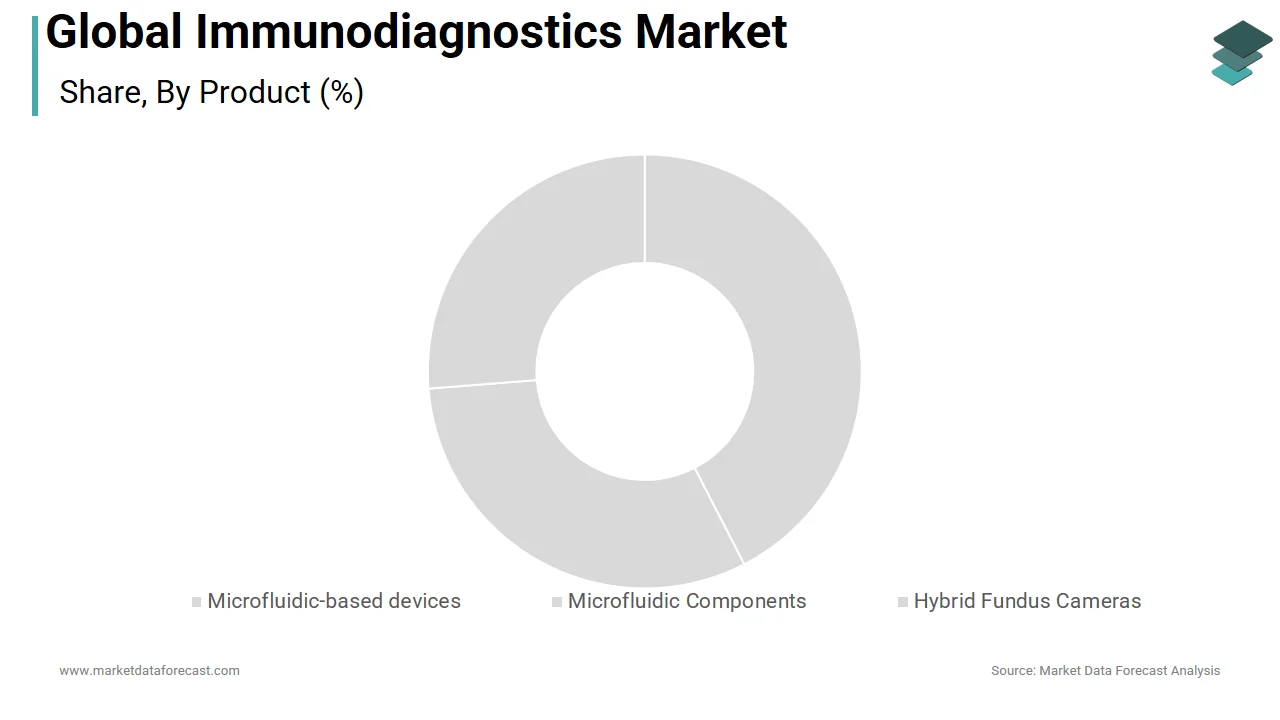
Because of the high replacement rate and because many reagents are single-use products, the reagents segment is expected to grow at the quickest rate throughout the forecast period.
By Application Insights
Infectious diseases are a significant part of the worldwide immunodiagnostics market, and this is likely to continue during the forecast period. The rise in popularity of automated and next-generation immunodiagnostics platforms can be linked to physicians' growing use of and preference for accurate, quick, and accurate results.
By End-User Insights
The hospital segment is expected to hold a dominant share of the immunodiagnostics market during the forecast period due to the rise in hospital visits and growth in the number of multispecialty hospitals with advanced diagnostics facilities. In addition, the surge in research & development expenditure and demand for technically advanced immunodiagnostic assays are expected to boost the global immunodiagnostics market during the forecast period.
REGIONAL ANALYSIS
Due to improvements in public and private healthcare facilities, favorable legislative reforms, a large population pool, and the prevalence of chronic diseases, the Asia-Pacific region has the fastest CAGR during the forecast period. Furthermore, the rising number of new product approvals and suitable reimbursement for tests and products are likely to propel the immunodiagnostics market in this area forward. Moreover, the immunodiagnostics market in the Asia Pacific will be driven by an increasing number of players in the region, raising awareness and improvements in the healthcare industry. In the Asia Pacific, China and India are expected to have a high need for immunodiagnostics. This is because the region has unmet medical needs.

North America dominates the immunodiagnostics market next to Asia because of the rising demand for immunodiagnostics tests, an aging population, and the increasing prevalence of chronic and infectious diseases. Furthermore, an increase in customer awareness about early disease management, which would encourage them to have frequent tests and check-ups, will promote the growth of the immunodiagnostics market in the area throughout the forecast period.
The market in Latin America, the Middle East, and Africa is predicted to rise throughout the forecast period due to increased investments by immunodiagnostics market participants and the prevalence of immunological ailments in these regions.
The high incidence rate of complicated diseases such as cancer and cardiovascular diseases, the quickly expanding aging population, and the rapid development of cancer and cardiac markers, which aid in speedy diagnosis using antigen-antibody interaction, have supported market growth in Europe.
KEY MARKET PARTICIPANTS
Some of the companies that are playing a dominating role in the global immunodiagnostics market include
- Abbott Laboratories
- Arkray Inc.
- bioMérieux SA
- Bio-Rad Laboratories Inc.
- DiaSorin S.p.A.
- F. Hoffmann-La Roche AG
- Immunodiagnostic Systems Holdings PLC
- Johnson & Johnson
- Siemens AG
- Sysmex Corporation
- Thermo Fisher Scientific Inc.
MARKET SEGMENTATION
This global immunodiagnostics market research report is segmented and sub-segmented into the following categories.
By Product
- Reagents
- Instruments
- Software & Services
By Application
- Infectious diseases
- Oncology & endocrinology
- Hepatitis & retrovirus
- Bone & Mineral
- Autoimmunity
- Cardiac biomarker
By End-User
- Clinical laboratories
- Hospitals
- Academic & Research Centers
- Pharmaceutical & Biotechnology Industry
By Region
- North America
- Europe
- Asia Pacific
- Latin America
- Middle East and Africa