- Product Description Description
- Table of Contents TOC
- List of Table & Figure LOT
- Get Free Sample PDF Sample PDF
Market Size, 2025
$639.3 MnMarket Estimate, 2026
$666.41 MnMarket Forecast, 2034
$929 MnCAGR, 2026–2034
4.24%Executive Summary: Laboratory Incubators Market
- Market Scope: Global laboratory incubators market analysis covering equipment types, application verticals, end-user settings, regional leadership frameworks, and life sciences adoption metrics.
- Market Valuation: Valued at USD 639.3 million in 2025, estimated at USD 666.4 million in 2026, and projected to reach USD 930.0 million by 2034, registering a CAGR of 4.24% from 2026 to 2034.
- Primary Growth Drivers: Increasing investments in life sciences research, expanding pharmaceutical and biotechnology industries, rising demand for cell culture and microbiological testing, and growing applications in drug discovery, regenerative medicine, and clinical diagnostics. Key technological trends include the adoption of advanced CO₂ incubators, energy-efficient equipment, and automated incubation systems.
Key Market Segment Metrics (2026–2034)
| Category | Leading Segment (2025 Position) | Fastest-Growing Segment |
|---|---|---|
| By Equipment Type | Carbon dioxide (CO₂) incubators segment (accounted for the largest share in cell culture and stem cell research) | Intelligent incubation systems and IoT-enabled monitoring equipment |
| By Application | Pharmaceutical and biotechnology application segment (driven by R&D, biologics, and vaccine production) | Regenerative medicine and advanced precision medicine research |
| By End User | Research laboratories (represented the leading segment supported by biomedical investments and grants) | Hospitals and specialized clinical diagnostics centers |
| By Region / Country | North America (held the largest regional share due to advanced research infrastructure and strong biotech industry) | Asia-Pacific (expected to register the fastest growth due to expanding research infrastructure and biopharma manufacturing) |
Major Market Players & Market Structure
Market Structure: Competitive global laboratory equipment landscape focused on intelligent incubation systems, precise temperature and CO₂ control technologies, contamination prevention, energy-efficient designs, IoT-enabled laboratory monitoring, and next-generation solutions.
Key Companies: Thermo Fisher Scientific Inc., Eppendorf AG, BINDER GmbH, PHC Holdings Corporation (PHCbi), Memmert GmbH + Co. KG, ESCO Technologies Inc., NuAire Inc., Sheldon Manufacturing Inc., Bellco Glass Inc., and CARON Products & Services, Inc.
Global Laboratory Incubators Market Size
The global laboratory incubators market size was valued at USD 639.3 million in 2025 and is predicted to witness a CAGR of 4.24% from 2026 to 2034. The global market size is expected to be valued at USD 929 million by 2034 from USD 666.41 million in 2026.
Laboratory Incubators are used to maintain or grow microbiological cultures. Laboratory Incubators are insulated boxes that maintain optimal temperature, humidity, and gaseous content, following the requirements. In cell biology, these devices have special priority in experimenting with cell culture. Modern equipment has various features that automatically and appropriately set the application's temperature.
The laboratory incubator market is growing robustly. North America dominates the industry and followed by Europe and the Asia Pacific. In the past few years, microscopy has transformed the research and examination of dynamic living cells. Standard incubators provide steady ecological conditions like pH, humidity, and temperature to carry out long-term live cell imaging. Other solutions are also available, such as stage-top incubators. In addition, today’s cell culture has advanced towards accurate and strict control and monitoring of environmental situations. In the field of cell biology, the time-lapse technique has grown with immense popularity because it allows experts and researchers unparalleled access to dynamic cellular behaviors.
Several technological developments have happened in laboratory incubators, like AI-driven monitoring systems. This offers live cell growth analysis and maintenance of an ideal environment for various cell types. Furthermore, there is a growing emphasis on ecological sustainability. Modern incubators consume less energy and still deliver the desired functionality. This involves the integration of automatic shutdown features and the application of high-insulation materials. Additionally, the emergence of new technologies like 3D printing is presenting more prospective opportunities for the application of laboratory incubators. Likewise, 3D printing incubators can be devised to make specific surroundings and atmospheres for raising and holding particular biological specimens.
MARKET DRIVERS
Growing Support from Private and Public Organizations for Laboratory Incubators
The focus of governmental and private organizations on expanding applications of laboratory incubators in various fields such as research, medical, and industrial has considerably increased. The emergence of more pharmaceutical companies worldwide is another major factor that is fuelling the growth rate of the laboratory incubators market. A rising account of research and development activities in the field of biotechnology is also fuelling the growth rate of the laboratory incubators market. Increasing demand for laboratory incubators in hospitals, research, and diagnostic centers also boosts the growth of the Global Laboratory Incubators Market.
Increasing Number of R&D Activities in the Biotechnology Field
The rise in the number of pharmaceutical companies, an increase in the healthcare centers' investments by private and public organizations, and rising demand for analyzing cell culture from the agriculture sector also drive the need for laboratory incubators and contribute to the expansion of the global market. The growing healthcare expenditure and emerging economies of countries like the U.S, China, Canada, India, the UK, Japan, and other developed and developing countries across the world, owing to technological advancements and globalization, are expected to create lucrative opportunities for the market players in the world during the forecast period. The rise in research and development activities from private and public organizations for developing advanced laboratory incubator mechanisms and devices is likely to expand growth opportunities for the laboratory incubators market during the forecast period. The increasing demand for laboratory incubators due to the rise in the adoption of these systems in the agriculture sector provides many opportunities for the growth of the global laboratory incubators market.
MARKET RESTRAINTS
However, the primary factor limiting the growth of the global laboratory incubator market is the initial installation and maintenance costs of the laboratory incubator devices. The shortage of skilled labor to handle the systems effectively is another major factor restraining the market's growth. The cost for installation and maintenance of the devices is a little high, and this factor is slowly restricting the market demand. The lack of skilled labor to operate the systems correctly is hindering the growth of the laboratory incubators market.
REPORT COVERAGE
| REPORT METRIC | DETAILS |
| Market Size Available | 2025 to 2034 |
| Base Year | 2025 |
| Forecast Period | 2026 to 2034 |
| Segments Covered | By Product, Application, End User, and Region. |
| Various Analyses Covered | Global, Regional and Country-Level Analysis, Segment-Level Analysis, Drivers, Restraints, Opportunities, Challenges; PESTLE Analysis; Porter’s Five Forces Analysis, Competitive Landscape, Analyst Overview of Investment Opportunities |
| Regions Covered | North America, Europe, APAC, Latin America, Middle East & Africa |
| Market Leaders Profiled | Bio Radlaboratories, Binder, Biotek Instruments, BMT USA, Eppendorf, Esco Global, Memmert, Panasonic, Remi Laboratory Instruments, Shanghai Yiheng, Shimadzu Corporation, Thermo Fischer Scientific, Thermolab Scientific Instruments and VWR.
|
SEGMENTAL ANALYSIS
By Product Insights
The incubation/growth chambers segment had 20.7% of the global market share in 2023 and is expected to continue the trend during the forecast period due to factors such as the increasing prevalence of premature babies, the growing need for health analysis of babies due to low birth weight, and hypothermic infants. The growing research activities in life sciences, agriculture, and environmental science, and the increasing need for precise and reproducible experimental conditions are contributing to the expansion of the incubation/growth chambers segment in the global market.
The standard incubators segment is another significant contributor to the global market and is projected to grow rapidly during the forecast period. Factors such as continuously increasing investments in life sciences research and drug discovery, Y-o-Y growth in the biotechnology and pharmaceutical industries, and technological advancements in standard incubator design, such as improved temperature uniformity, enhanced user interfaces, and energy-efficient features, are promoting the growth of the standard incubators segment in the global market.
By Application Insights
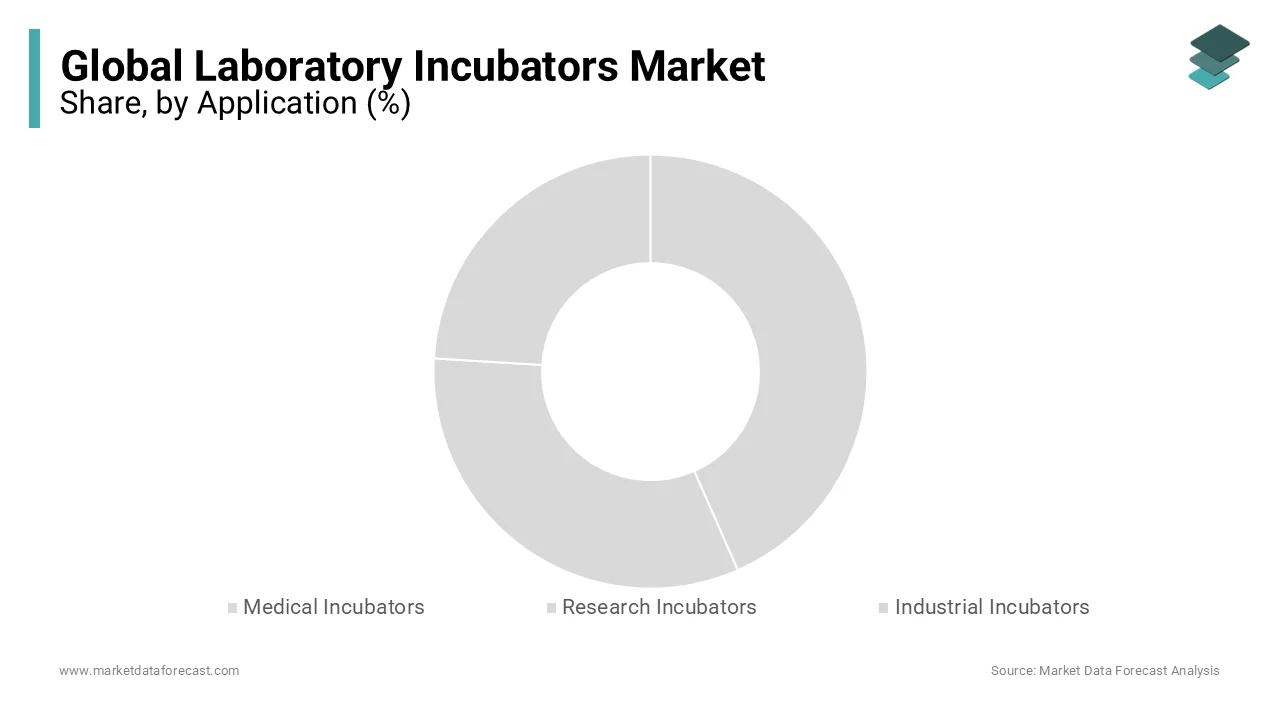
The research incubators segment held the major share of the global market in 2023, with 47.4% of the global market share, and is expected to grow at a healthy CAGR during the forecast period. The growing investments in biomedical research and life sciences innovation that drive demand for CO2 and temperature-controlled incubators for cell culture and molecular biology experiments are propelling the growth of the research incubators segment in the global market. The rising emphasis on stem cell research, tissue engineering, and organoid cultures that fuel demand for specialized CO2 and humidity-controlled incubators in regenerative medicine and developmental biology studies is further contributing to the growth of the research incubators segment in the worldwide market.
By End-User Insights
The hospitals and diagnostic laboratories segment dominated the market, accounting for 24.7% of the global market share in 2023and is likely to grow at a prominent CAGR during the forecast period owing to factors such as continually increasing the birth rate of premature babies in the hospitals, increasing healthcare expenditure and investments in the developing countries, the growing population of the countries like China, India, Brazil and rise in need of advanced healthcare systems. The pharmaceutical segment is contributing a significant share of the global laboratory incubators market. It is foreseen to grow at a high pace due to the expansion of the pharmaceutical sector and the rise in companies worldwide.
REGIONAL ANALYSIS
North America Laboratory Incubators Market Analysis
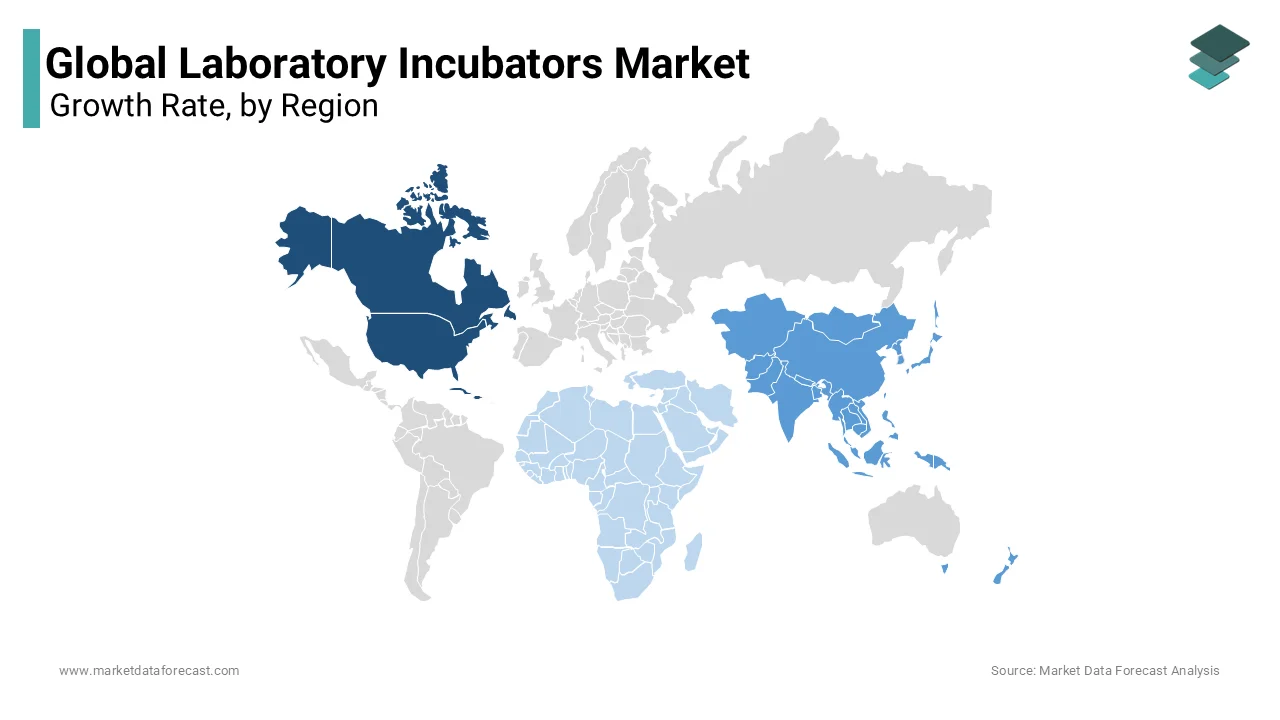
North America accounted for 32.8% of the global market share in 2025 and played the role of the most dominating regional segment in the global market. The domination of the North American region is likely to continue throughout the forecast period. CROs in the North American region have made heavy investments in life sciences study in recent years, which is one of the factors contributing to the North American market expansion. The expanding demand for technological developments, the need for customized medicine, modern therapeutics, research activities, and the growing pattern of new drug creation are expected to drive up the industry’s progress. Moreover, the increasing number of bioengineering and technology organizations and firms are further influencing the market growth in the region. There is a strong presence of prominent industry players with high budgets for extensive research and development programs.
Asia-Pacific Laboratory Incubators Market Analysis
Asia-Pacific was the second-largest regional segment in the global market and is currently witnessing rapid growth. The factors contributing to the market expansion in the region are the increase in healthcare spending, the rapid expansion of the pharmaceutical industry, and the rising demand for modern and cutting-edge medical systems. Apart from this, the availability of huge skilled manpower and swift industrialization are also fuelling the APAC market growth. Moreover, the region has become a notable player in cell culture. It is also experiencing an increased financial inflow into life sciences research, the increased requirement for biopharmaceuticals, and developments in medical and pharma infrastructure. All these factors are taking the regional market forward.
Europe Laboratory Incubators Market Analysis
Europe is another region that is strongly positioned in the laboratory incubators market. This is because the favorable attitude and increased emphasis on the R&D department are pushing the industry forward. Also, Good Laboratory Practices (GLP) in Europe are regulated by the Organization for Economic and Co-operative Development (OECD), whereas in the United States, it is done by two agencies: the Food and Drug Administration (FDA) and the Environmental Protection Agency (EPA). Another important element is document requests in both regions. In Europe, all the documents are demanded either before or during the inspection process, and after drug approval, there is a need to retain the records for 5 years. On the other hand, they might or might not ask for whole documents, and the period for holding records after drug approval is 2 years.
Middle East and Africa Laboratory Incubators Market Analysis
The Middle East and Africa will have a steady growth rate in the coming years. It emphasizes elevating the quality of laboratory diagnostic services and improving patient care. Besides this, the growing prevalence of communicable diseases and is driving the application of quality management systems with initiatives like the Stepwise Laboratory Quality Improvement Process Towards Accreditation (SLIPTA) in medical laboratories.
KEY MARKET PLAYERS
Notable companies dominating the global laboratory incubators market profiled in this report are
- Bio Rad Laboratories
- Binder
- Biotek Instruments
- BMT USA
- Eppendorf
- Esco Global
- Memmert
- Panasonic
- Remi Laboratory Instruments
- Shanghai Yiheng
- Shimadzu Corporation
- Thermo Fisher Scientific
- Thermolab Scientific Instruments
- VWR
GLOBAL LABORATORY INCUBATORS MARKET NEWS
- Relanto opened the AI-first Lab in Bangalore (India). It is an artificial intelligence-driven management consulting and advisory service. Also, it has committed to invest 1 million dollars in the Relanto Cares project and has grown on a global scale. This AI lab is planned with the aim of supporting research and cooperation for advanced innovations and creating next-generation artificial intelligence solutions.
- In November 2023, Carrier launched their fourth i3 Lab Innovation Incubator in Shanghai (China) at its research and development center.
- In October 2023, the WETO recently declared 1.65 million dollars for a wind research and development incubator program for the Department of Energy national laboratories to study novel innovation thoughts, concepts, and research theories. Wind Energy Technologies Office financially supports 18 initiatives within 75000 and 150000 per subject area. This includes novel wind energy architectures, components R&D, data synthesis/artificial intelligence, approaches, and systems incorporation to move forward in the wind energy sector's overall user fields.
MARKET SEGMENTATION
This research report on the global laboratory incubators market has been segmented and sub-segmented based on the product, application, end-user, and region.
By Product
- Standard Incubators
- Carbon Dioxide Incubators
- Dry Bath Incubators
- Hybridization Incubators
- Microbial Incubators
- Laboratory Bioreactors and Fermentors
- Incubation/Growth Chambers
- Refrigerated Incubators
- Other Incubators
By Application
- Medical Incubators
- Hematology Testing
- Microbial Testing
- Sample Preparation
- Other Medical Applications
- Research Incubators
- Industrial Incubators
- Pharma-Biotech Testing
- Food and Beverage Testing
- Water Testing
- Potable
- Waste Water
- Environmental Testing
- Other Industrial Applications
By End User
- Hospitals and Diagnostic Laboratories
- Blood Banks, Cell Banks, Tissue Banks, IVF Clinics
- Pharmaceutical, Cosmeceutical, and Biotechnology Companies
- Food and Beverage Manufacturers
- Environmental Testing Laboratories
- Government Agencies and Organizations
- Research and Academic Institutes
- Other End-users
By Region
- North America
- The U.S.
- Canada
- Rest of North America
- Europe
- UK
- France
- Spain
- Germany
- Italy
- Rest of Europe
- Asia Pacific
- India
- China
- Japan
- South Korea
- Australia & New Zealand
- Rest of APAC
- Latin America
- Brazil
- Mexico
- Argentina
- Chile
- Rest of Latin America
- Middle East and Africa