- Product Description Description
- Table of Contents TOC
- List of Table & Figure LOT
- Get Free Sample PDF Sample PDF
Market Size, 2025
$759.4 MnMarket Estimate, 2026
$786.1 MnMarket Forecast, 2034
$1,036.8 MnCAGR, 2026–2034
3.52%Executive Summary: Latin America Cashew Nuts Market
- Market Scope: Comprehensive analysis of the Latin America cashew nuts market covering product forms, functional usage applications, retail distribution channels, regional country dynamics, growth drivers, and competitive landscapes.
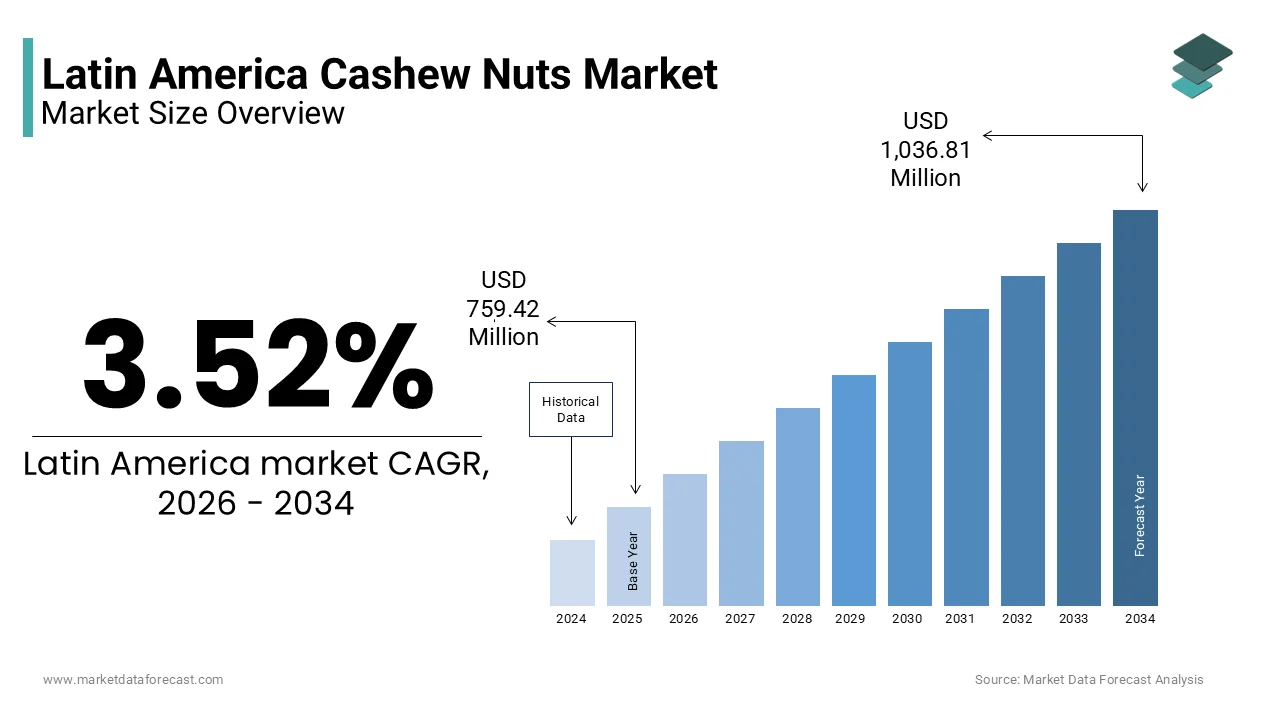
- Market Valuation: Valued at USD 759.42 million (2025), estimated at USD 786.15 million (2026), and projected to reach USD 1,036.81 million by 2034, registering a steady CAGR of 3.52% during the forecast period (2026–2034).
- Primary Growth Drivers: Rising demand for healthy convenience foods and ready-to-eat snacks, growing consumer adoption of vegan and plant-based diets (substituting meat and dairy), rapid urbanization, and increasing per-capita health expenditures across the middle-class population.
Key Market Segment Metrics (2026–2034)
| Category | Leading Segment (2025 Position) | Fastest-Growing Segment |
|---|---|---|
| By Form | Whole Cashews (dominant format utilized widely in direct snacking, packaging, and gourmet food applications) | Pastes & Powders (driven by surging popularity in plant-based dairy substitutes like cashew milk, cheese, and butter) |
| By Usage | Snacks & Confectioneries (captures the largest consumption volume across retail and impulse-buying markets) | Dairy Products & Bakery (propelled by clean-label food manufacturing and vegan dietary formulations) |
| By Distribution Channel | Supermarkets & Hypermarkets (dominate retail volume with extensive multi-brand shelf assortments) | Specialist Stores & Online Retailers (expanding rapidly through specialized organic and health-focused food channels) |
| By Region / Country | Brazil (anchors the region as the primary producer, processor, and consumer market) | Argentina, Chile, & Peru (driven by expanding urban middle classes and rising demand for healthy imported snacks) |
Major Market Players & Market Structure
Market Structure: Moderately fragmented agricultural trading and nut-processing landscape featuring regional agricultural cooperatives, specialized food processors, and international distributors competing on flavor innovations, packaging formats, and quality grading.
Key Companies: Ajanta Industries, Achal Cashew Nuts, Agrocel Industries, Alien Green, Bata Food, Cascade Agroindustrial S.A., CBL Natural Foods (Pvt) Ltd, Divine Foods, Delphi Organic, Aryan International, Tierra Farm, and others.
 Download Free Sample Report
Latin America Cashew Nuts Market Size
The Latin America cashew nuts market size was valued at USD 759.42 million in 2025 and is expected to reach USD 1,036.81 million by 2034 from USD 786.15 million in 2026. The market is projected to grow at a CAGR of 3.52%.
The Latin America cashew nuts market encompasses the cultivation, processing, and commercialization of Anacardium occidentale kernels, primarily within Brazil, which serves as the regional production hub. According to the Food and Agriculture Organization of the United Nations, Brazil produced about 130,000 metric tons of cashew nuts in shell in 2023, placing it among the leading global producers and anchoring regional supply chains. This market extends beyond raw agricultural output to include value-added derivatives such as cashew butter, oil, and snacks that cater to evolving dietary preferences across the continent. According to the Brazilian Institute of Geography and Statistics, Brazil's estimated cashew nut production reached 145,300 metric tons in 2024, up 24.4% from the previous year, demonstrating the importance of domestic agricultural capacity to regional supply. These figures illustrate how agricultural capacity directly supports both export competitiveness and internal demand expansion within the Latin America cashew nuts market while distinguishing it from generic nut commodity trends through region-specific agronomic and socioeconomic dynamics.
MARKET DRIVERS
Rising Health-Conscious Consumer Demand for Plant-Based Nutrition
Consumer preference shifts toward nutrient-dense, plant-based foods significantly fuel the Latin America cashew nuts market expansion by elevating cashews as a functional food ingredient. According to the Food and Agriculture Organization of the United Nations, nuts and seeds are important sources of plant protein and dietary fats within diversified diets, supporting continued interest in nutrient-dense plant foods. This nutritional alignment translates into demand for cashews in retail and food service applications. The statistical correlation between health awareness and purchase behavior demonstrates that consumer education campaigns about micronutrient benefits directly amplify market volume. Furthermore, food manufacturers reformulate products to include cashew-based dairy alternatives responding to this demand signal, which reinforces upstream farmgate prices and incentivizes expanded orchard investments. Consequently, the Latin America cashew nuts market benefits from a self-reinforcing cycle where public health messaging drives product innovation, which in turn sustains agricultural profitability and regional economic resilience without reliance on volatile international commodity speculation.
Expansion of Domestic Processing Infrastructure and Value Addition
Investment in local shelling and roasting facilities further strengthens the Latin America cashew nuts market expansion by reducing postharvest losses and capturing higher-margin segments domestically. According to the National Supply Company of Brazil, Brazil produced 159,200 metric tons of fresh cashew nuts in 2024, representing a 24.5% increase from 2023 and demonstrating the scale of the domestic supply base available to processors. This infrastructural growth correlates with improved opportunities for local value addition. Higher processing yields mean more saleable product per hectare harvested, which lowers unit costs and enhances price competitiveness against imported nuts. Additionally, localized value addition reduces dependence on raw nut exports, which historically faced quality degradation during maritime transit. The resulting availability of consistent-grade kernels encourages domestic confectioners and snack brands to source regionally rather than import, thereby deepening vertical integration within the Latin America Cashew Nuts Market. This structural transformation not only boosts farmer incomes but also aligns with national food sovereignty objectives, making the sector less vulnerable to external trade shocks.
MARKET RESTRAINTS
Climate Volatility Disrupting Flowering and Nut Set Cycles
Erratic rainfall patterns and rising temperatures impedes the Latin America cashew nuts market expansion by disrupting critical phenological stages essential for yield formation. According to the Brazilian Institute of Geography and Statistics, cashew production estimates for 2024 increased 14.5% from 2023 after the previous year experienced significant climatic and pest-related problems affecting cashew plantations. Cashew trees require suitable climatic conditions during flowering and fruit development, and deviations from favorable conditions can cause crop losses. Such climatic instability increases financial risk for smallholder farmers who lack irrigation infrastructure, thereby discouraging new plantings and accelerating land abandonment. Moreover, weather-related production fluctuations can increase financial uncertainty for producers and processors. These interlinked biophysical and economic pressures constrain supply reliability and inflate input costs throughout the Latin America Cashew Nuts Market, making long-term planning difficult and deterring institutional investment despite strong underlying demand fundamentals.
Labor Shortages in Manual Harvesting and Postharvest Handling
Insufficient skilled labor for delicate harvesting operations critically hampers the Latin America cashew nuts market growth by increasing postharvest losses and limiting scalability. Cashew apples must be handpicked at precise ripeness to prevent kernel damage, yet delayed collection due to labor gaps can reduce product quality. Mechanization remains challenging because cashew peduncles vary in attachment strength and bruising compromises nut quality, rendering automated systems economically difficult for many producers. Consequently, farms can operate below optimal harvest intensity, which depresses effective yields even when trees are productive. Wage inflation can compound the problem by increasing seasonal harvesting costs and eroding profit margins for mid-sized growers. This persistent human capital deficit restricts the Latin America Cashew Nuts Market from scaling responsively to demand spikes and perpetuates reliance on informal labor arrangements that can undermine social compliance standards required by premium export buyers.
MARKET OPPORTUNITIES
Growing Export Potential to North American Specialty Food Channels
Untapped access to premium specialty retail and foodservice segments in North America presents a substantial opportunity for the Latin America cashew nuts market by leveraging geographic proximity and sustainability credentials. According to World Integrated Trade Solution data, the United States imported approximately 2.28 million kilograms of cashew nuts from Brazil in 2024, making the United States an important destination for Brazilian cashew exports. This trend aligns with certification expansions and growing demand for traceable food ingredients. North American distributors can benefit from Latin American-origin nuts through shorter transportation routes and faster replenishment cycles. Additionally, the rise of clean-label snacking brands seeking single-origin ingredients creates niche pricing opportunities for exporters. By targeting these differentiated channels, Latin American exporters can bypass commoditized bulk markets and build brand equity tied to terroir and ethical sourcing. This strategic repositioning enables the Latin America Cashew Nuts Market to capture higher value streams while insulating against global price volatility through relationship-based contracting and traceability-driven trust.
Integration of Cashew Orchards into Regenerative Agroforestry Systems
Adoption of diversified agroforestry models offers the Latin America cashew nuts market a pathway to enhance ecological resilience and unlock ecosystem service revenues. According to the Brazilian Agricultural Research Corporation, disease-resistant and tolerant cashew clones can contribute to more resilient production systems and reduce production risks associated with important fungal diseases. This system diversifies farm income streams as participating households can combine cashew production with complementary crops. Buyers in Europe and North America increasingly require deforestation-free and biodiversity-positive sourcing, making these integrated farms preferential suppliers. The synergy between productivity stability and environmental monetization transforms cashew cultivation from a standalone crop enterprise into a landscape-level solution. For the Latin America Cashew Nuts Market, this means reduced exposure to climate shocks, enhanced access to green finance, and alignment with emerging regulatory frameworks like the EU Deforestation Regulation, thereby future-proofing supply chains against tightening sustainability mandates.
MARKET CHALLENGES
Persistent Fungal Pathogen Pressure during Humid Growing Seasons
Widespread incidence of anthracnose and black mold diseases poses a notable challenge to the Latin America cashew nuts market expansion by degrading kernel quality and increasing phytosanitary rejection rates. According to the Brazilian Agricultural Research Corporation, anthracnose is present across cashew-producing regions in Brazil and can cause production losses of up to 40% under favorable conditions for the disease. High humidity during nut maturation creates ideal conditions for fungal disease development, which can reduce both yield and product quality. Control measures include resistant clones and registered fungicides together with cultural management practices. Postharvest contamination can further escalate losses when drying and storage conditions are inadequate. These quality failures damage reputation among international buyers who enforce strict quality and food safety requirements. Smallholders lacking access to integrated pest management extension services bear disproportionate burdens as they cannot always afford preventive spraying or adequate drying infrastructure. Consequently, the Latin America Cashew Nuts Market faces chronic supply inconsistency and elevated compliance costs that hinder entry into regulated high-value markets despite favorable agronomic potential.
Inadequate Cold Chain and Storage Facilities Leading to Quality Degradation
Deficient temperature-controlled logistics infrastructure critically further challenges the Latin America cashew nuts market expansion by accelerating rancidity and microbial spoilage during storage and transport. According to the Brazilian Agricultural Research Corporation, proper postharvest handling and drying are important for maintaining cashew kernel quality and preventing deterioration. Rancidity develops when kernels are exposed to unfavourable moisture and temperature conditions, compromising flavor and shelf life. Export containers can experience condensation during maritime transit, exacerbating quality risks unless moisture is properly controlled. Domestic retailers similarly reject shipments showing quality defects, forcing processors to discount or divert stock to lower-value applications. Without coordinated investment in suitable storage facilities, transportation systems, and moisture control infrastructure, the Latin America Cashew Nuts Market cannot reliably meet stringent quality specifications demanded by modern supply chains, thereby capping its ability to move up the value ladder and retain earnings within the region.
REPORT COVERAGE
| REPORT METRIC | DETAILS |
| Market Size Available | 2025 to 2034 |
| Base Year | 2025 |
| Forecast Period | 2026 to 2034 |
| CAGR | 3.52% |
| Segments Covered | By Form, Usage, Distribution Channel, and Region |
| Various Analyses Covered | Global, Regional, & Country Level Analysis; Segment-Level Analysis; DROC; PESTLE Analysis; Porter’s Five Forces Analysis; Competitive Landscape; Analyst Overview of Investment Opportunities |
| Regions Covered | Latin America include Brazil, Argentina, Mexico, and the Rest of Latin America |
| Market Leaders Profiled | Ajanta Industries, Achal Cashew Nuts, Agrocel Industries, Alien Green, Bata Food, Cascade Agroindustrial S.A., CBL Natural Foods (Pvt) Ltd, Divine Foods, Delphi Organic, Aryan International, Tierra Farm, and others |
SEGMENTAL ANALYSIS
By Form Insights
The whole cashew nuts segment dominated the market by holding the largest share of the Latin American market in 2025 due to their versatility in culinary applications and consumer preference for minimal processing. The demand for whole cashews is driven by a strong cultural inclination toward natural snacking formats that require no further preparation. According to the International Nut and Dried Fruit Council, whole cashew kernels remain an important traded product category within the global cashew industry because of their broad food and snack applications. This preference aligns with health trends and demand for minimally processed foods. The statistical dominance of whole nut sales directly supports higher profit margins for retailers who can command premium pricing for intact kernels. Furthermore, whole cashews serve as a staple in hospitality sectors where they are used for garnishing and plating, enhancing their institutional demand. This dual-channel demand from retail and hospitality solidifies the leading position of whole cashews by ensuring consistent volume off-take regardless of seasonal fluctuations in industrial baking or confectionery cycles.
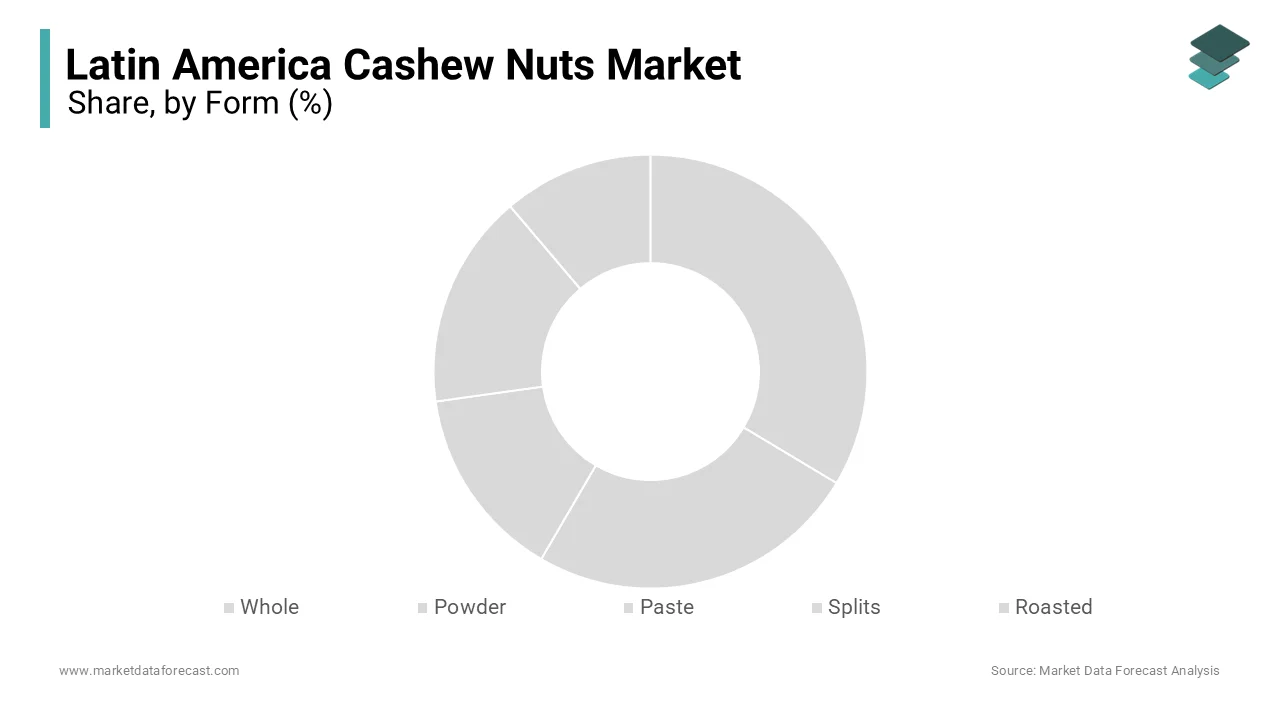
On the other end, the cashew paste segment is the fastest-growing segment in the Latin America cashew nuts market and is predicted to record a CAGR of 10.4% over the forecast period owing to its adoption in plant-based dairy alternatives and gourmet culinary applications and its critical role in producing creamy vegan cheeses, yogurts, and milk substitutes, which are gaining traction across Latin America. According to the Good Food Institute, plant-based foods continue to expand across Latin American markets as consumers and food manufacturers seek alternatives to conventional animal-based products. This growth is supported by consumer shifts toward dairy-free options, prompting manufacturers to increase procurement of plant-based ingredients. The statistical correlation between plant-based diet adoption and paste demand demonstrates that cashew paste is becoming a foundational ingredient rather than a niche additive. Furthermore, local startups are leveraging regional cashew availability to create affordable alternatives to imported almond or coconut bases, thereby reducing costs. This surge in end-user adoption forces large food conglomerates to integrate cashew paste into their production lines and this accelerates market growth and establishing it as the fastest-expanding form segment in the Latin America Cashew Nuts Market.
By Usage Insights
The snacks segment had the leading share of the Latin America cashew nuts market in 2025 due to the convenience culture and the popularity of healthy on-the-go eating options. The dominance of the snacks segment is further propelled by busy urban lifestyles that prioritize portable and nutritious food options requiring no preparation. According to the International Nut and Dried Fruit Council, tree nuts are widely consumed as snacks as well as ingredients in food products, supporting the importance of snack applications for cashews. This behavior is supported by retail accessibility and the increasing availability of packaged nut products. The statistical prevalence of snacking occasions directly translates to high-volume sales for cashew producers who benefit from repeat purchase cycles. Furthermore, marketing campaigns emphasizing energy-boosting properties resonate with students and professionals alike, driving brand loyalty. This broad demographic appeal ensures that the snacks segment remains the largest consumer of cashew nuts in the region by maintaining steady baseline demand irrespective of economic fluctuations.
However, the energy and nutrition bars segment is estimated to record a healthy CAGR of 11.2% over the forecast period owing to the functional food trends and active lifestyle adoption. The rapid growth of cashew-based bars is driven by their inclusion in pre- and post-workout nutrition regimes, which are gaining popularity across Latin America. According to the International Nut and Dried Fruit Council, nuts are widely incorporated into snack and nutrition products because of their nutritional profile and versatility. This growth is fueled by the expanding fitness community and demand for convenient functional foods. The statistical rise in physical activity directly correlates with increased bar consumption as athletes seek convenient protein sources. Furthermore, sports brands are launching co-branded nutrition products, leveraging athlete endorsements to drive trial. This synergy between fitness culture and product innovation accelerates the adoption of cashew bars, making them the fastest-growing usage segment in the Latin America Cashew Nuts Market.
REGIONAL ANALYSIS
Brazil Market Analysis
Brazil is likely to maintain its dominant position in the Latin America Cashew Nuts Market over the next few years, supported by its large production base and established processing infrastructure. According to the National Supply Company of Brazil, the country produced 159,200 metric tons of fresh cashew nuts in 2024, representing 3.8% of global production and a 24.5% increase from the previous year. The country serves as the primary production hub for the regional industry. The statistical strength of production capacity allows Brazil to influence regional supply chains and quality standards. Furthermore, Brazil has a substantial domestic consumption base. According to IndexBox, Brazil accounted for approximately 79% of Latin American and Caribbean cashew consumption by volume in 2024 and about 78% of regional production, confirming its dominant regional position. These factors collectively ensure Brazil maintains its leadership status in the Latin America Cashew Nuts Market through integrated supply chain control and strong domestic fundamentals.
Mexico Market Analysis
Mexico is likely to experience continued development in the Latin America Cashew Nuts Market over the next few years, supported by its large consumer market and established connections with North American food supply chains. The country serves as a value-addition and distribution node for regional and international nut trade. According to World Integrated Trade Solution data, Mexico imported approximately 15,720 metric tons of cashew nuts in 2024. This trade flow supports domestic availability and processing opportunities. Furthermore, Mexico benefits from its proximity to the United States market and established food processing infrastructure. The statistical increase in imports supports opportunities for processors and distributors seeking to serve both domestic and export markets. Additionally, Mexico benefits from established trade relationships with North America. These dynamics position Mexico as a critical growth engine in the Latin America Cashew Nuts Market through trade integration and processing efficiency.
Argentina Market Analysis
Argentina is likely to develop gradually in the Latin America Cashew Nuts Market over the next few years, supported by consumer demand and opportunities for value-added food processing despite limited domestic production. The country relies heavily on imports but shows potential for value-added product development. According to World Integrated Trade Solution data, Argentina imported approximately 880.7 metric tons of cashew nuts from Brazil in 2024, demonstrating an established regional trade relationship. This demand is supported by consumer interest in premium healthy snacks. Furthermore, local manufacturers can create opportunities through roasting, packaging, and formulation of cashew-based products. The statistical rise in imports reflects the availability of regional supply for downstream applications. Additionally, demand for plant-based products can support cashew-based dairy alternatives. These factors indicate that Argentina can continue transitioning toward greater localized value addition within the Latin America Cashew Nuts Market.
Chile Market Analysis
Chile is likely to maintain a stable and higher-value position in the Latin America Cashew Nuts Market over the next few years, supported by developed retail infrastructure and established trade connections. The country serves as a destination for imported cashew products and a potential gateway to other Pacific Alliance markets. According to World Integrated Trade Solution data, Chile imported approximately 464.9 metric tons of cashew nuts from Brazil in 2024, demonstrating an established bilateral trade flow. This trade relationship supports the availability of cashews for domestic consumption and food processing. Furthermore, Chilean retailers can provide access to premium nut products and differentiated varieties. The statistical focus on trade connectivity allows Chile to participate in regional value chains despite its limited domestic cashew production. Additionally, Chile serves as a gateway to other Andean markets due to its trade agreements. These attributes ensure Chile remains a high-value segment in the Latin America Cashew Nuts Market driven by quality standards and regional trade connectivity.
COMPETITIVE LANDSCAPE
The competition in the Latin America Cashew Nuts Market is characterized by a mix of large multinational corporations and numerous small to medium sized local processors who compete on price quality and sustainability credentials. Multinational entities leverage their global distribution networks and financial resources to dominate export channels while local players focus on domestic markets and niche premium segments. The barrier to entry remains moderate due to the capital intensive nature of processing infrastructure but low for raw trading activities. Competitive intensity is high as firms strive to differentiate through certifications such as organic and fair trade which command higher prices. Price volatility in global commodity markets further intensifies competition as buyers seek reliable suppliers with consistent quality. Innovation in product formats such as cashew butter and milk alternatives creates new battlegrounds for market share. Companies also compete on sustainability metrics with buyers increasingly preferring suppliers who demonstrate environmental stewardship and social responsibility. This dynamic landscape forces participants to continuously invest in efficiency technology and brand building to maintain relevance and profitability in the evolving market structure.
KEY MARKET PLAYERS
Some of the key players in the Latin America cashew nuts market are
- Ajanta Industries
- Olam International
- Achal Cashew nuts
- Agrocel Industries
- ALIEN GREEN
- BATA FOOD
- Blue Diamond Growers
- Cascade Agroindustrial S.A
- CBL Natural Foods (PVT) LTD
- DIVINE FOODS
- Delphi Organic
- Aryan International
- Archer Daniels Midland Company
- Tierra Farm
Top Players in the Market
- Olam International maintains a robust presence in the Latin America Cashew Nuts Market through its extensive sourcing network and advanced processing facilities in Brazil. The company focuses on sustainable supply chain practices by partnering directly with local farmers to ensure quality and traceability. Recently Olam expanded its shelling capacity in the Northeast region to reduce postharvest losses and improve kernel recovery rates. This investment allows the firm to offer consistent premium grades to global buyers while supporting rural livelihoods. Their commitment to environmental standards aligns with increasing regulatory demands for deforestation free products. By integrating digital tools for farmer training Olam enhances productivity and strengthens long term supplier relationships. These actions solidify their role as a key enabler of market growth and quality assurance in the region.
- Blue Diamond Growers leverages its global distribution expertise to promote Latin American cashews in international markets particularly in North America and Europe. The company emphasizes brand building and value addition by introducing innovative flavored and roasted cashew products sourced from the region. They recently launched a sustainability initiative that supports agroforestry projects in Brazil helping farmers diversify income and improve soil health. This strategy enhances supply resilience while appealing to ethically conscious consumers. Blue Diamond also invests in marketing campaigns that highlight the unique taste profile of Latin American cashews. Their focus on product differentiation and consumer education drives demand for higher value segments. These efforts contribute to market expansion by creating new consumption occasions and strengthening brand loyalty among premium buyers.
- Archer Daniels Midland Company plays a critical role in the Latin America Cashew Nuts Market by providing integrated logistics and ingredient solutions to food manufacturers. The company utilizes its vast network to facilitate efficient export operations ensuring timely delivery of high quality kernels. They recently upgraded their storage infrastructure in key ports to maintain optimal humidity levels and prevent spoilage during transit. This improvement reduces waste and ensures product integrity for industrial clients. ADM also collaborates with local processors to develop customized cashew ingredients such as flours and butters for the plant based food sector. Their technical support helps manufacturers innovate with cashew based alternatives. These initiatives enhance supply chain efficiency and drive industrial demand positioning ADM as a vital partner in market development.
Top Strategies Used by Key Market Participants
Key players in the Latin America Cashew Nuts Market primarily employ vertical integration strategies to control quality and reduce costs throughout the supply chain. Companies invest directly in processing facilities and farmer cooperatives to secure raw material access and improve kernel recovery rates. This approach minimizes dependency on intermediaries and ensures consistent product standards for export markets. Another major strategy involves product differentiation through value addition such as roasting flavoring and packaging innovations that cater to niche consumer preferences. Brands focus on organic and fair trade certifications to appeal to health conscious and ethically driven buyers in developed markets. Additionally participants leverage digital platforms for direct to consumer sales bypassing traditional retail channels to capture higher margins. Strategic partnerships with local governments and NGOs help secure funding for sustainability projects which enhance brand reputation and comply with emerging environmental regulations. These combined tactics enable firms to build resilient supply chains and capture premium pricing in a competitive landscape.
MARKET SEGMENTATION
This Research Report on the Latin America cashew nuts market is segmented, and sub segmented into following categories.
By Form
- Whole
- Powder
- Paste
- Splits
- Roasted
By Usage
- Dairy Products
- Confectionaries
- Bakery Products
- Snacks
- Bars
- Cereals
- Desserts And Beverages
By Distribution Channel
- Hypermarkets
- Supermarkets
- Specialist Stores
- Convenience Stores
- Retailers
By Region
- Brazil
- Argentina
- Chile
- Peru