Latin America OTT Platform Market Size, Share, Trends & Growth Forecast Report By Revenue Model (Subscription Based, Advertising Based, Transaction Based), Content Type (Video [Entertainment and Infotainment, Food, Travel and Fashion, Sports Content], Audio/VoIP, Online Gaming, Music Streaming, Communication), Streaming Device (Smartphones and Tablets, Desktops and Laptops, Smart TVs and Set-Top Box, Gaming Console, Others), User Type (Personal, Commercial), Service Vertical (Media and Entertainment, Education and Learning, Gaming, Health and Fitness, IT and Telecom, E-commerce), and Country (Brazil, Mexico, Argentina, Chile, Rest of Latin America) – Industry Analysis, 2026 to 2034
Market Size, 2025
$22.96 BnMarket Estimate, 2026
$25.35 BnMarket Forecast, 2034
$55.94 BnCAGR, 2026–2034
10.40%Latin America OTT Platform Market Size
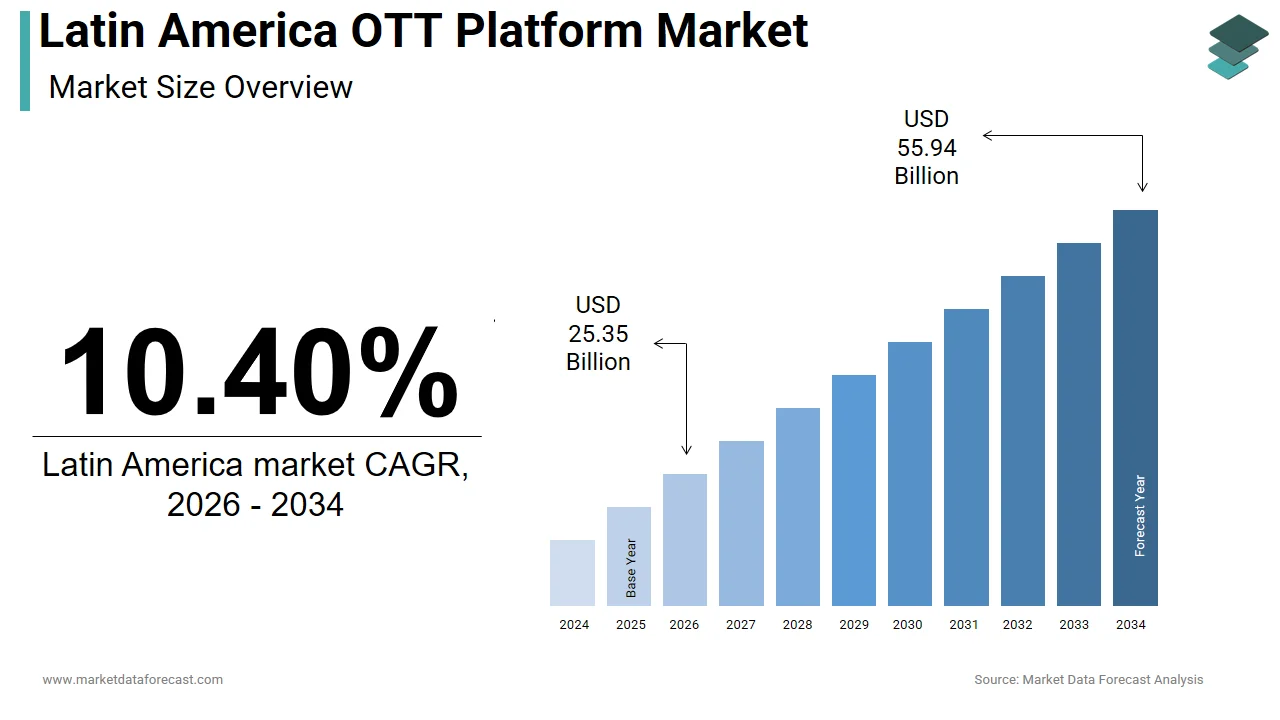
The Latin America OTT platform market was valued at USD 22.96 billion in 2025, is estimated to reach USD 25.35 billion in 2026, and is projected to reach USD 55.94 billion by 2034, growing at a CAGR of 10.40% from 2026 to 2034.
OTT (Over-the-Top) platform market refers to the digital ecosystem through which video, audio, and other media content are delivered directly to consumers via internet protocols, bypassing traditional broadcast and cable distribution. This model has redefined media consumption across the region, particularly in countries with expanding broadband access and rising smartphone penetration. The proliferation of localized content in Spanish and Portuguese, combined with affordable subscription models, has further accelerated adoption, particularly among younger demographics who increasingly disengage from linear TV in favor of flexible, personalized viewing experiences.
MARKET DRIVERS
Rapid Expansion of Mobile Internet and Smartphone Penetration
The surge in mobile internet accessibility and smartphone ownership is a primary catalyst for the growth of OTT platforms across Latin America. Also, mobile broadband subscriptions in the region reached a significant level in 2023, with countries like Colombia and Chile exceeding 110 subscriptions per 100 people due to competitive telecom markets. The affordability of 4G-enabled devices has democratized access to streaming, especially in lower-income urban and peri-urban areas. This technological inclusivity enables platforms to scale rapidly without dependency on fixed-line infrastructure, positioning mobile connectivity as a foundational enabler of digital content consumption across diverse socioeconomic segments.
Rising Demand for Localized and Culturally Relevant Content
The success of OTT platforms in Latin America is increasingly tied to their ability to produce and distribute region-specific content that resonates with local audiences. Platforms like Netflix have responded by investing a substantial amount annually in original productions from Mexico, Argentina, and Brazil, including hits such as Narcos: Mexico and Sintonia. This strategic localization not only enhances user engagement but also strengthens subscriber retention, as culturally immersive storytelling fosters deeper emotional connection and distinguishes platforms in an increasingly saturated digital landscape.
MARKET RESTRAINTS
Economic Volatility and Currency Depreciation Affecting Subscription Affordability
Persistent macroeconomic instability across several Latin American economies undermines the sustainability of paid OTT subscriptions. In Argentina, the Argentine peso lost over 60% of its value against the U.S. dollar between 2022 and 2023, as reported by the Central Bank of Argentina, drastically increasing the relative cost of dollar-denominated streaming services. Similarly, in Venezuela and Ecuador, hyperinflation and wage stagnation have led to widespread subscription churn, with many users reverting to ad-supported or pirated content sources. Even in more stable markets, consumers are increasingly adopting shared accounts or rotating subscriptions to manage costs. This financial pressure limits the ability of platforms to achieve consistent revenue growth and hampers long-term market maturity.
Uneven Internet Infrastructure and Data Limitations in Rural Areas
Despite progress in urban connectivity, vast rural and remote regions across Latin America continue to face inadequate internet infrastructure, constraining OTT platform penetration. Additionally, data caps imposed by mobile carriers are common in countries, limiting monthly usage, forcing users to prioritize essential communications over video consumption. This digital divide creates a bifurcated market where urban centers enjoy advanced streaming experiences while rural populations remain excluded, inhibiting the region-wide scalability of OTT platforms and perpetuating disparities in digital inclusion.
MARKET OPPORTUNITIES
Strategic Partnerships with Telecom Operators to Bundle OTT Services
Collaborations between OTT providers and telecommunications companies present a transformative growth avenue across Latin America. These partnerships reduce entry barriers for consumers, enhance customer retention for telecoms, and provide OTT platforms with instant access to large, pre-qualified user bases, creating a symbiotic ecosystem that drives mass adoption without heavy reliance on standalone marketing.
Growth of Ad-Supported Video-on-Demand (AVOD) Models
The expansion of ad-supported OTT platforms is unlocking new consumer segments previously excluded due to subscription costs. The rise of programmatic advertising and AI-driven ad targeting is improving monetization efficiency, enabling platforms to generate revenue while offering free access. This model is particularly effective in price-sensitive markets, where it serves as a gateway to premium content and fosters long-term user conversion.
MARKET CHALLENGES
High Levels of Digital Piracy and Content Leakage
Digital piracy remains a systemic challenge for OTT platforms in Latin America, undermining revenue and discouraging investment in original content. In Argentina, illegal streaming platforms such as Cuevana attract more monthly visits. The widespread availability of pirated content, often in high definition and with minimal latency, creates a compelling alternative to paid services, particularly in low-income households. Law enforcement efforts remain inconsistent, and regional copyright laws are often outdated or poorly enforced. This environment erodes the value proposition of legal platforms, complicates licensing agreements with global studios, and forces providers to invest heavily in digital rights management (DRM) and anti-piracy technologies, increasing operational complexity.
Intensifying Competition and Content Saturation
The Latin American OTT market is experiencing rapid saturation, with over 15 major platforms vying for consumer attention, leading to fragmentation and declining user loyalty. The influx of global giants, Netflix, Amazon Prime Video, Disney+, HBO Max, alongside regional players like Cine.AR Play and RTP Play have created a cluttered landscape where differentiation is increasingly difficult. This overcrowding reduces customer lifetime value and forces platforms to engage in costly content wars, often prioritizing volume over quality. Without sustainable monetization or clear niche positioning, many services struggle to maintain profitability, threatening long-term market stability.
REPORT COVERAGE
| REPORT METRIC | DETAILS |
| Market Size Available | 2025 to 2034 |
| Base Year | 2025 |
| Forecast Period | 2026 to 2034 |
| Segments Covered | By Revenue Model, Content Type, Streaming Device, User Type, Service Vertical, and Region. |
| Various Analyses Covered | Global, Regional and Country-Level Analysis, Segment-Level Analysis, Drivers, Restraints, Opportunities, Challenges; PESTLE Analysis; Porter’s Five Forces Analysis, Competitive Landscape, Analyst Overview of Investment Opportunities |
| Countries Covered | Brazil, Mexico, Argentina, Chile, Rest of Latin America |
| Market Leaders Profiled | Amazon Prime Video (Amazon.com), Blim (Televisa S.A. de C.V), Cabletica (Liberty Latin America Ltd.), Claro Video (Claro), Fox (Fox Networks Group), Globo Play (Grupo Globo), Disney+, HBO Max, Home Box Office Inc. (AT&T Inc.), Movistar Play, Netflix Inc., Millicom International Cellular SA, and Others. |
SEGMENTAL ANALYSIS
By Content Type Insights
The video content segment led the Latin America OTT platform market by accounting for 65.2% of total consumption in 2024. This dominance is anchored in the region’s deep cultural affinity for visual storytelling, particularly telenovelas, reality shows, and cinematic content. In Brazil, over 80% of streaming time is dedicated to video, with platforms like Globoplay and Netflix reporting peak viewership during prime-time telenovela releases, according to data from Kantar IBOPE Media. The integration of live sports, especially football, into OTT services has further solidified video’s supremacy; in Mexico, Televisa’s ViX attracted over 10 million unique viewers during the 2022 FIFA World Cup, as per the company’s audience analytics. Additionally, the rise of mobile-first video platforms such as YouTube Premium, which supports offline viewing, caters to users with intermittent connectivity, ensuring sustained engagement across diverse socioeconomic groups.

The online gaming segment is the fastest-growing content and is registering a CAGR of 14.7% from 2026 to 2034. This surge is fueled by the rising popularity of cloud gaming and multiplayer mobile titles among Latin America’s youth. Platforms like Xbox Cloud Gaming and NVIDIA GeForce NOW have expanded access to high-end games without requiring expensive hardware, a critical factor in markets with low PC penetration. Additionally, the monetization of esports has incentivized OTT providers to integrate gaming hubs into their ecosystems, transforming entertainment platforms into interactive digital arenas.
By Streaming Device Insights
The smartphones and tablets segment dominated the OTT streaming device landscape by representing 62.7% of total viewing hours in 2024. This lead position is driven by the region’s mobile-first internet culture, where smartphones serve as the primary gateway to digital content. In Peru, a high percentage of internet usage occurs via mobile devices, making smartphones the default platform for video and audio streaming. The affordability of 4G-enabled smartphones has enabled mass adoption, particularly among younger demographics. The portability, low data consumption, and integration with social sharing features further reinforce smartphones as the central node of digital entertainment consumption.
The smart TVs and set-top boxes segment is experiencing the fastest growth and is projected to expand at a CAGR of 11.2% through 2033. This acceleration is attributed to rising disposable incomes and the expansion of affordable smart TV models in middle-class households. In Brazil, smart TV ownership increased in recent years, driven by brands with built-in OTT apps. Additionally, telecom providers such as Claro and Telefónica are bundling set-top boxes with broadband plans, enabling seamless access to HBO Max, Disney+, and local content platforms. The enhanced audiovisual experience and integration with voice assistants are further accelerating adoption, positioning smart TVs as the preferred device for family-oriented streaming.
By Service Vertical Insights
The media and entertainment segment constituted the prominent service vertical by commanding a substantial portion of the share in 2025. This dominance is rooted in the region’s robust demand for on-demand films, series, music, and live events, which form the core offering of most OTT platforms. The success of regional productions such as Netflix’s La Casa de las Flores and Amazon Prime’s El Presidente has deepened audience engagement, while music streaming via Spotify and Deezer continues to grow. The convergence of live sports, concerts, and celebrity-driven content further cements media and entertainment as the primary driver of OTT engagement and monetization.
The education and learning segment is emerging as the fastest-growing vertical and is projected to grow at a CAGR of 13.8% during the forecast period. This growth is propelled by the post-pandemic institutionalization of digital learning and the rising demand for upskilling in a competitive job market. Additionally, corporate training platforms have gained traction. The integration of micro-credentials and Spanish-language content has enhanced accessibility, while government initiatives like Chile’s Aprende en Línea have subsidized access for low-income learners, transforming OTT into a critical enabler of lifelong education and workforce development.
COUNTRY-LEVEL ANALYSIS
Brazil OTT Platform Market Insights
Brazil led the Latin America OTT platform market by holding a 34.6% share in 2024. The country’s position is supported by its large population, widespread mobile internet adoption, and vibrant digital content ecosystem. With millions of internet users, Brazil has one of the highest social media and streaming engagement rates in the region. The country’s thriving creative industry produces a steady stream of Portuguese-language content, including telenovelas and documentaries, which retain domestic audiences and attract international interest. Additionally, telecom operators like Vivo and TIM have integrated OTT bundles into their service offerings, expanding reach. The government’s National Broadband Plan aims to connect 95% of households by 2026, further accelerating digital inclusion and positioning Brazil as the region’s undisputed OTT hub.
Mexico OTT Platform Market Insights
Mexico holds a significant market share. The country’s OTT market is characterized by high consumer demand for both global and regional content, supported by a young, tech-savvy population. A high percentage of Mexicans access digital video platforms monthly, as reported by the Federal Institute of Telecommunications (IFT), with streaming time growing annually. The integration of OTT into mobile plans by carriers like AT&T Mexico and Telcel has boosted adoption, particularly in lower-income segments. Additionally, Mexico has become a production center for Spanish-language content, hosting studios for Netflix and Disney+. The rise of hybrid viewing, combining linear TV and streaming, reflects a transitional media landscape, where OTT is rapidly becoming the dominant mode of content delivery in both urban and peri-urban households.
Argentina OTT Platform Market Insights
Argentina holds a key share of the market. With one of the most educated populations in Latin America, Argentina exhibits strong demand for premium video and audio services. Like, a large portion of urban households subscribe to at least one OTT platform, often sharing accounts to manage costs. The country has a robust tradition of audio storytelling, fueling the growth of podcast platforms like Spreaker and Radio Garden. Additionally, Argentina is a regional hub for software development, contributing to the rise of homegrown OTT solutions such as Flow and Cine.ar Play. Despite inflationary pressures, consumer engagement with digital content remains resilient, driven by cultural affinity and linguistic authenticity.
Chile OTT Platform Market Insights
Chile is functioning as a high-penetration, innovation-forward market within Latin America. The country boasts one of the region’s most developed digital infrastructures, with 92% of households having internet access, according to the Subsecretariat of Telecommunications (SUBTEL). The government’s Digital Agenda 2030 promotes digital literacy and content localization, fostering a supportive ecosystem for platforms. Additionally, Chile serves as a testing ground for global OTT players entering Latin America, with companies like HBO Max and Apple TV+ launching pilot campaigns in the country before regional rollouts, leveraging its regulatory stability and tech-savvy user base.
Colombia OTT Platform Market Insights
Colombia is emerging as a dynamic growth market with expanding digital access and youthful demographics. Over 70% of the population is under 35, creating a fertile ground for mobile-first OTT consumption. As per the National Spectrum Agency (ANE), mobile internet penetration reached 84% in 2023, with 4G coverage extending to 95% of urban areas. Platforms like Netflix and YouTube dominate, but local services such as RTVCPlay are gaining traction through culturally relevant programming. The Ministry of Information and Communications Technologies (MinTIC) has invested in digital inclusion programs, connecting over 10,000 rural schools to streaming-enabled networks. With rising smartphone ownership and improving payment gateways, Colombia is poised for accelerated OTT adoption, particularly in tier-2 cities and underserved regions.
COMPETITIVE LANDSCAPE
The competition in the Latin America OTT platform market is intensifying as global giants and regional players battle for consumer attention in a diverse and rapidly digitizing region. Established platforms like Netflix, Disney+, and Max dominate through content localization, strategic pricing, and telecom partnerships, while local services such as Claro Video and Globo Play leverage national brand loyalty and broadcast integration. The market is marked by fragmentation, with no single player achieving overwhelming dominance due to varying consumer preferences across countries. Price sensitivity, data limitations, and economic volatility further complicate monetization, pushing companies to innovate with hybrid models. The rise of ad-supported and transaction-based platforms introduces new competitive dynamics, particularly in underserved markets. As content saturation increases, differentiation through cultural relevance, live programming, and seamless mobile access has become critical to sustaining growth and user retention across the region.
KEY MARKET PLAYERS
Some of the noteworthy companies in the Latin America OTT platform market profiled in this report are
- Amazon Prime Video
- Blim
- Cabletica
- Claro Video
- Fox
- Globo Play
- Disney+
- HBO Max
- Home Box Office Inc
- Movistar Play
- Netflix Inc.
- Millicom International Cellular SA
TOP LEADING PLAYERS IN THE MARKET
- Netflix has established a dominant presence in the Latin America OTT platform market by prioritizing localized content production and adaptive pricing models. The company has invested heavily in original Spanish and Portuguese-language programming, including hits like Narcos, Elite, and Sintonia, which resonate deeply with regional audiences. In 2023, Netflix launched mobile-only subscriptions in Brazil and Mexico at reduced price points, significantly expanding access among cost-sensitive consumers. It also partnered with local telecom providers such as Claro and Movistar to offer zero-rated data plans, allowing users to stream without consuming bandwidth. Additionally, Netflix strengthened its regional footprint by opening a São Paulo-based content hub to coordinate Latin American productions, enhancing cultural authenticity and accelerating content delivery. These initiatives reflect a strategic shift toward hyper-localization, ensuring sustained engagement in a linguistically and culturally diverse market.
- Disney+ has rapidly ascended as a major force in the Latin America OTT landscape by leveraging its expansive global content library and strategic regional expansions. Since its 2020 launch in the region, Disney+ has localized its platform with Spanish and Portuguese audio, subtitles, and region-specific user interfaces. The integration of Star, a general entertainment brand featuring adult-oriented series, broadened its appeal beyond family-centric audiences. In 2023, Disney+ partnered with Telefónica in Chile and Argentina to bundle subscriptions with fiber-optic internet services, increasing customer acquisition. The company also acquired broadcasting rights for key football leagues in Mexico and Colombia, introducing live sports to its offering, a move that significantly boosted subscriber engagement. Furthermore, Disney+ launched educational campaigns in public schools across Peru to promote digital literacy and platform adoption, reinforcing its long-term presence through community integration and multi-generational content appeal.
- HBO Max (now Max) has solidified its influence in Latin America by combining premium storytelling with technological innovation and deep regional partnerships. The platform distinguishes itself through high-production-value originals such as The House of Flowers and Los Espookys, which blend local narratives with global aesthetics. In 2022, Warner Bros. Discovery allied with Cencosud, a major retail conglomerate in Chile and Argentina, to offer free HBO Max trials with credit card sign-ups, driving mass onboarding. The platform also optimized its app for low-bandwidth environments, enabling smoother streaming in areas with limited connectivity. In 2023, Max introduced AI-driven content recommendation engines tailored to Latin American viewing habits, improving user retention. Additionally, it expanded live event offerings, including exclusive access to Latin Grammy Awards and regional concerts, positioning itself as a cultural curator rather than just a content distributor, thereby deepening brand loyalty across diverse markets.
TOP STRATEGIES USED BY KEY MARKET PARTICIPANTS
Key players in the Latin America OTT platform market are deploying targeted strategies to capture market share in a highly competitive and fragmented landscape. Major platforms are investing in original regional content to build emotional resonance and differentiate from global counterparts. Strategic bundling with telecom providers enables zero-rated data access and reduces entry barriers for price-sensitive consumers. Companies are also adopting tiered pricing models, including mobile-only subscriptions, to expand reach in lower-income demographics. Localization extends beyond language to include culturally relevant themes, casting, and music. Additionally, platforms are integrating live sports and events to increase engagement and reduce churn. Partnerships with retail, educational, and financial institutions are being leveraged to drive user acquisition. Finally, advancements in AI-driven personalization and offline viewing capabilities are enhancing user experience, ensuring sustained consumption across varying connectivity environments.
RECENT MARKET DEVELOPMENTS
- In June 2022, Netflix launched a mobile-only subscription tier in Brazil priced at BRL 25, making its service more accessible to budget-conscious users and expanding its reach in low-income urban and rural areas, thereby increasing its active user base in the region.
- In March 2023, Disney+ partnered with Telefónica in Argentina and Chile to bundle its streaming service with high-speed internet plans, enabling seamless access for new broadband subscribers and enhancing customer retention through integrated digital offerings.
- In August 2023, Warner Bros. Discovery introduced live football streaming on HBO Max in Mexico, securing exclusive rights to LIGA MX matches, which led to a 35% surge in platform engagement and solidified its position in the sports entertainment segment.
- In January 2024, Amazon Prime Video collaborated with Grupo Clarín in Argentina to co-produce original Spanish-language series, strengthening its local content portfolio and deepening cultural relevance among Spanish-speaking audiences in South America.
- In May 2023, Globoplay expanded its international footprint by launching a dedicated OTT app for Portuguese speakers in the U.S. and Europe, leveraging diaspora communities to generate additional revenue and reinforce brand visibility beyond Latin America.
MARKET SEGMENTATION
This Latin America OTT platform market research report is segmented and sub-segmented into the following categories.
By Revenue Model
- Subscription Based
- Advertising Based
- Transaction Based
- Others
By Content Type
- Video
- Entertainment and Infotainment
- Food, Travel, and Fashion
- Sports Content
- Audio/VoIP
- Online Gaming
- Music Streaming
- Communication
- Others
By Streaming Device
- Smartphones and Tablets
- Desktops and Laptops
- Smart TVs and Set-Top Boxes
- Gaming Console
- Others
By User Type
- Personal
- Commercial
By Service Vertical
- Media and Entertainment
- Education and Learning
- Gaming
- Health and Fitness
- IT and Telecom
- E-commerce
- Others
By Country
- Brazil
- Mexico
- Argentina
- Chile
- Rest of Latin America
Frequently Asked Questions
1. Which countries lead the Latin America OTT Platform Market?
Brazil and Mexico dominate, with Brazil as the regional OTT leader, while Argentina, Colombia, Chile, and Peru show strong growth and regional engagement.
2. Who are the major players in the Latin America OTT Platform Market?
Top platforms include Netflix, Amazon Prime Video, Disney+, GloboPlay, Claro Video, ViX (TelevisaUnivision), and Movistar Play. U.S. major platforms and local providers both play pivotal roles.
3. What revenue models shape the Latin America OTT Platform Market?
The market uses subscription-based (SVOD), ad-supported (AVOD), transaction-based (TVOD), and hybrid models, but SVOD is currently the most lucrative segment.
4. What is driving growth in the Latin America OTT Platform Market?
-
Key drivers include expanding internet penetration, affordable smart devices, a youthful population, affordable local content, and flexible pricing modelsthat match consumer budgets.
5. How are telecom partnerships influencing the Latin America OTT Platform Market?
Strategic collaborations with mobile and broadband providers enable bundled subscriptions, prepaid plans, and improved accessibility for new users.
6. What content trends define the Latin America OTT Platform Market?
Strong demand for original and dubbed series, telenovelas, regional sports, and localized content in Spanish and Portuguese is shaping catalog strategies.
7. How is the Latin America OTT Platform Market segmented by device usage?
Smartphones and tablets account for a majority of OTT streaming, followed by smart TVs, set-top boxes, laptops, and gaming consoles.
8. What role does payment and billing innovation play in the Latin America OTT Platform Market?
With lower credit card penetration, platforms are adopting mobile payments, e-wallets, cash at retail points, and telco billing to reduce subscription friction.
9. What are the main challenges for the Latin America OTT Platform Market?
Infrastructure gaps, inconsistent broadband quality, content piracy, low CPM ad rates, and payment diversity are key barriers, especially in rural areas.
10. How is the competitive landscape shifting in the Latin America OTT Platform Market?
A mix of global giants, regional powerhouses, and niche local providers compete, prompting more investment in originals, improved UX, and pricing flexibility.
Related Reports
Access the study in MULTIPLE FORMATS
Purchase options starting from
$ 1600
Didn’t find what you’re looking for?
TALK TO OUR ANALYST TEAM
Need something within your budget?
NO WORRIES! WE GOT YOU COVERED!
Call us on: +1 888 702 9696 (U.S Toll Free)
Write to us: sales@marketdataforecast.com