- Product Description Description
- Table of Contents TOC
- List of Table & Figure LOT
- Get Free Sample PDF Sample PDF
Market Size, 2025
$9.28 BnMarket Estimate, 2026
$9.66 BnMarket Forecast, 2034
$13.33 BnCAGR, 2026–2034
4.11%Global Luxury Watches Market Size, Growth, Trends & Forecast (2026–2034)
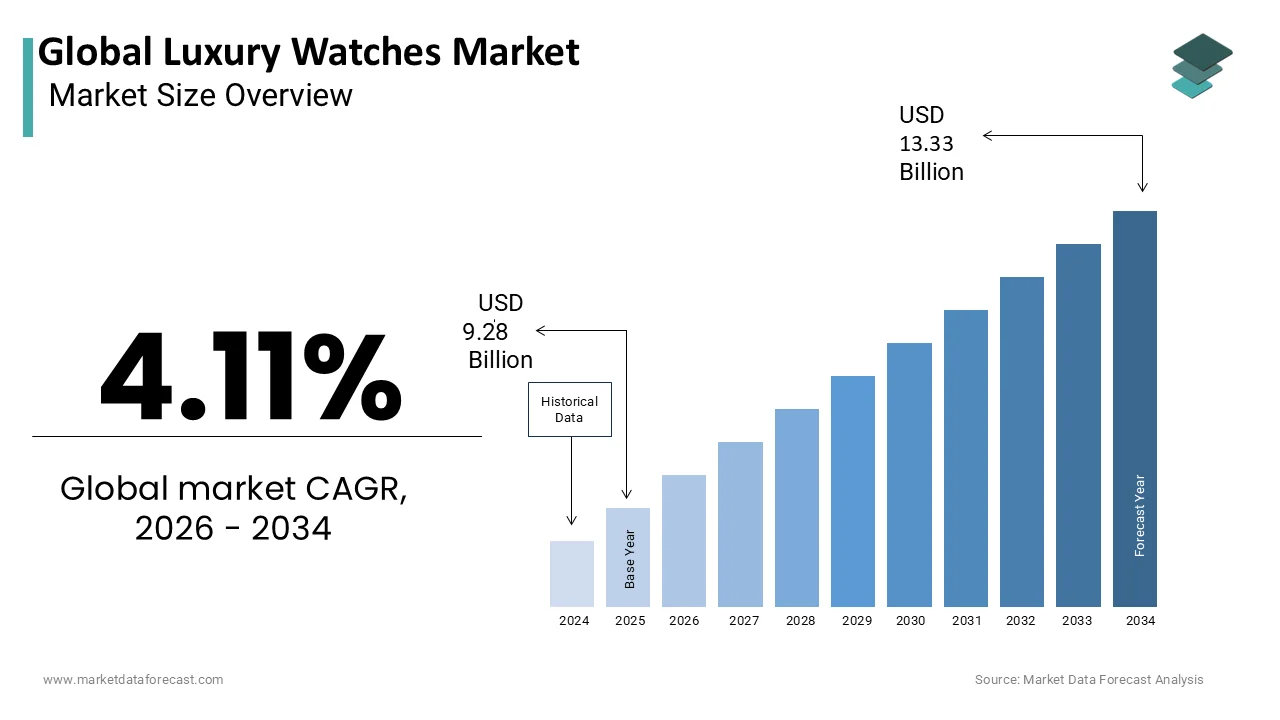
The global luxury watches market size was valued at USD 9.28 billion in 2025, is anticipated to reach USD 9.66 billion in 2026, and is projected to scale up to USD 13.33 billion by 2034, registering a compound annual growth rate (CAGR) of 4.11% during the forecast period from 2026 to 2034. Driven by the rising affluent population, increasing disposable incomes in developing economies, and strong cultural perception of luxury timepieces as status symbols, the luxury watch industry continues to expand steadily worldwide.
Key Executive Metrics (At-a-Glance)
- 2025 Base Valuation: USD 9.28 Billion
- 2026 Current Valuation: USD 9.66 Billion
- 2034 Forecast Valuation: USD 13.33 Billion
- Compound Annual Growth Rate (CAGR): 4.11% (2026–2034)
- Dominant Product Type: Mechanical Watches (holding 61.4% market share backed by craftsmanship and intricate artisanal work)
- Fastest-Growing Product Type: Electronic Watches / Luxury Smartwatches (propelled by tech collaborations and younger demographic adoption)
- Dominant End-User Segment: Male (holding major market share supported by traditional status symbols and heritage designs)
- Fastest-Growing End-User Segment: Female (fueled by rising female participation in the workforce and targeted marketing)
- Dominant Distribution Channel: Stores / Multi-Brand Shops (occupying 64.8% share for experiential physical luxury buying)
- Fastest-Growing Distribution Channel: Online Platforms (surging through brand social media marketing and e-commerce partnerships)
- Dominant Region: North America (capturing 31.9% share supported by high disposable income and established collector bases)
- Fastest-Growing Region: Asia-Pacific (surging due to rising affluence in China, India, and Southeast Asia)
Core Market Drivers
- Status Symbol & Prestige: Strong consumer association of luxury watches with social distinction, high net worth, and personal achievement.
- Rising Affluent Populations: Growing numbers of high-net-worth individuals across both developed nations and emerging markets like China and India.
- Demand for Vintage and Limited Editions: Surging global interest in rare collector items, heritage-inspired designs, and bespoke craftsmanship.
Primary Market Restraints & Challenges
- Competition from Smartwatches: Intense market disruption from mainstream smartwatches and health-tracking wearables.
- Counterfeiting and Replicas: Proliferation of fake imitation products threatening brand integrity and consumer trust.
- High Import Duties & Taxes: Stringent regulatory frameworks, import tariffs, and restrictions on exotic manufacturing materials.
Global Luxury Watches Market Segmentation Breakdown
| Segment Category | Leading Sub-Segment (2025 Base) | Fastest-Growing Sub-Segment (2026–2034) |
|---|---|---|
| By Product Type | Mechanical Watches (dominant 61.4% share leader driven by artisanal craftsmanship) | Electronic Watches (fastest-growing segment driven by tech-luxury collaborations and smart features) |
| By End-User | Male (historically dominant consumer segment shaped by traditional status marketing) | Female (fastest-growing demographic fueled by professional empowerment and expanding female collections) |
| By Distribution Channel | Stores (dominant multi-brand and flagship retail channel holding ~64.8% share) | Online Platforms (fastest-growing digital channel boosted by social media and e-commerce partnerships) |
| By Region | North America (dominant regional market capturing 31.9% share) | Asia-Pacific (fastest-growing regional market propelled by Chinese, Indian, and Southeast Asian affluence) |
Major Industry Players Profiled
Key enterprises shaping the competitive global luxury watches market include Rolex SA, The Swatch Group Ltd, Compagnie Financiere Richemont SA, Patek Philippe SA, Audemars Piguet, and Richard Mille.
 Download Free Sample Report
Global Luxury Watches Market Size
The global luxury watches market was valued at USD 9.28 billion in 2025, is estimated to reach USD 9.66 billion in 2026, and is projected to reach USD 13.33 billion by 2034, growing at a CAGR of 4.11% from 2026 to 2034.
Current Scenario of the Global Luxury Watches Market
The price range of luxury watches is considered from USD 1200 and more and the main quality of luxury watches is a social distinction as they are limitedly available and top-notch quality at high prices.
The affluent population in the developed countries are the major consumers of luxury watches. However, the demand for luxury watches is also increasing in developing countries with the growing disposable income among people. Considering the increasing demand, the manufacturers of luxury watches have also increased their manufacturing efforts and investments in R&D. People’s desire to hold premium quality products has seen an upward shift in recent times and is resulting in the increased demand for luxury watches.
MARKET DRIVERS
An estimated 33% of the luxury consumers in the North American region said that they bought a luxury watch in the third quarter of 2022.
The affluent population considers luxury watches as a status symbol and consider it as prestige, which is primarily propelling the luxury watches market growth. Millennials and Generation Z are the major consumers of luxury goods. The majority of the sales for luxury watches have happened in the U.S. in the recent past with China standing right next to the U.S. An increase in the affluent population is expected to contribute to the increasing demand for luxury watches and propel the global market growth.
An increase in brand awareness, influence the of Western lifestyle and the inherent need for exclusivity are primarily propelling the growth of the global luxury watches market. Features in these watches are in-built music storage, GPS tracking, step count, and notifications, we can connect to phones, and they also feature wrist-based heart rate and pulse oximeter sensors and water resistance. The sales of luxury watches have increased by a staggering 74%. These luxury watches are manually manufactured for premium quality and at a high price. The use of high-materials, and premium products like steel, bi-metallic, and precious metals, attract more consumers.
The growing demand for vintage luxury watches is on the rise worldwide, which is expected to favor the global market growth. Not just in developed countries, the demand for luxury watches has also considerably increased in developing countries such as China and Middle East countries.
MARKET RESTRAINTS
An intense competition from smartwatches and wearables is impeding the demand for luxury watches and hampering the global market growth. The presence of counterfeiting products and fake replicas is another notable restraint in the luxury watch market. High import duties and taxes, changes in the preferences of consumers for digital accessories, and stringent regulations on exotic materials are further hindering the global market growth.
REPORT COVERAGE
| REPORT METRIC | DETAILS |
| Market Size Available | 2025 to 2034 |
| Base Year | 2025 |
| Forecast Period | 2026 to 2034 |
| Segments Covered | By Product Type, End User, Distribution Channel, and Region |
| Various Analyses Covered | Global, Regional, and country Level Analysis, Segment-Level Analysis, DROC, PESTLE Analysis, Porter’s Five Forces Analysis, Competitive Landscape, Analyst Overview of Investment Opportunities |
| Regions Covered | North America, Europe, Asia Pacific, Latin America, Middle East & Africa |
| Market Leaders Profiled | Rolex SA, The Swatch Group Ltd, Compagnie Financiere Richemont SA, Patek Philippe SA, Audemars Piguet, and Richard Mille |
SEGMENTAL ANALYSIS
By Product Type Insights
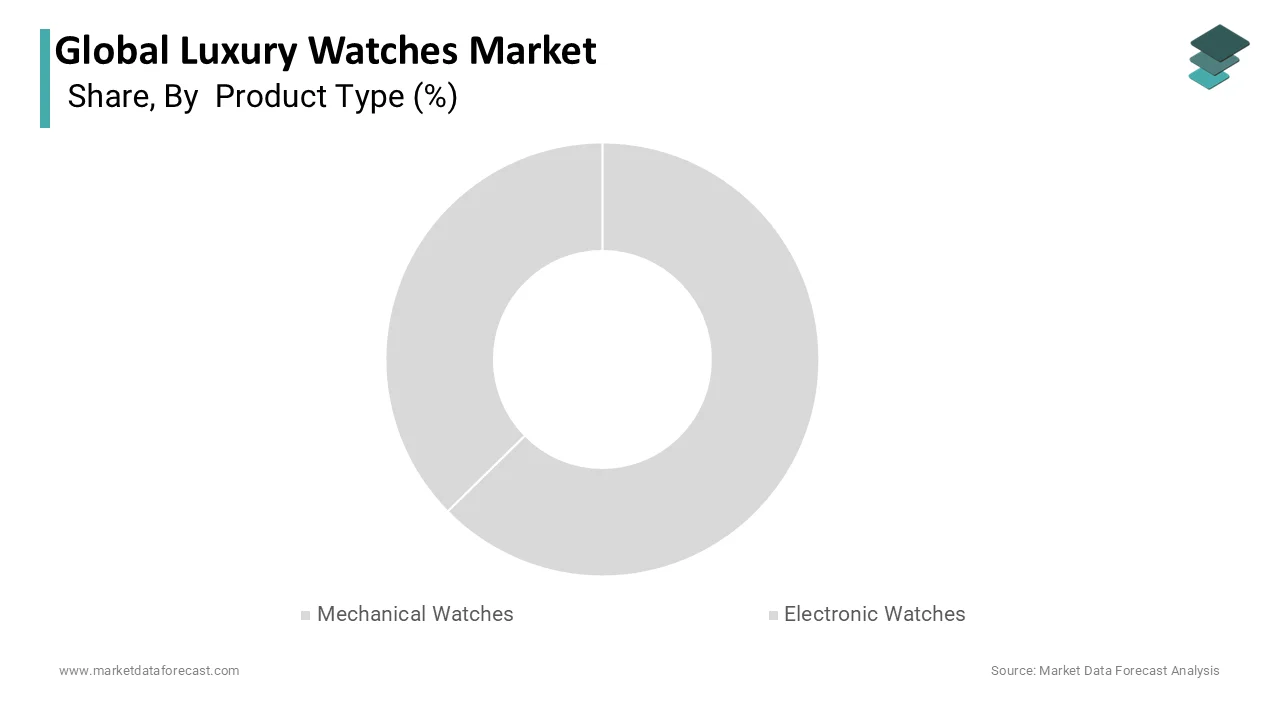
Based on product type, the mechanical watches segment dominated the market and accounted for 61.4% of the global market share in 2025.
During the forecast period, the mechanical watches segment is anticipated to showcase steady growth. The making of watches is complicated and requires expertise and professionalism. Watches comprise numerous features including weather, shock resistance, water, GPS, alarms, and displays. Mechanical luxury watches are preferred more, as electronic watches are more complicated. Luxury mechanical watches have a larger no of tiny moving parts inside and require hours and hours of painstaking labor to make. The growing demand for mechanical watches from collectors and connoisseurs, limited editions, and exclusivity are majorly driving the growth of the mechanical watches segment in the global market.
On the other hand, the electronic watches segment held a substantial share of the global market in 2022 and is anticipated to grow considerably during the forecast period owing to the increasing demand for luxury smartwatches, increasing number of collaborations between luxury brands and tech companies and rapid adoption of electronic watches from younger demographics are primarily propelling the growth of the electronic watches segment in the worldwide market.
By End-User Insights
Based on end-user, the male segment dominated the luxury watches market in 2022 and the domination will continue throughout the forecast period.
The male segment is historically dominant and even the brands of luxury watches are designing and marketing their products primarily for males. The tradition of wearing watches as a status symbol is more common among men compared to women, which is one of the major factors contributing to the growth of the male segment in the global market. The growing demand for vintage and heritage-inspired designs among men and increasing endorsements by celebrities the luxury brands are contributing to the growth of the male segment in the worldwide market.
The female segment captured a considerable share of the worldwide market in 2022 and is expected to grow steadily during the forecast period.
By Distribution Channel Insights
Based on the distribution channel, the stores segment occupied 64.8% of the worldwide market in 2022 and is expected to witness a healthy CAGR during the forecast period.
Multi-brand shops promote more than one luxurious watch brand, which can help buyers discover their preferences with more than one fashion of specific brands. The manufacturing companies prefer to sell their products in multi-brand shops to own high sales and high scope in promoting their products.
The online segment is estimated to grow at a promising CAGR during the forecast period owing to the increasing availability of luxury watches of various luxury brands and growing promotional activities of luxury brands on online platforms, especially on social media platforms. The strategic collaborations between luxury brands and e-commerce giants are another significant factor propelling the growth of the online segment in the worldwide market.
REGIONAL ANALYSIS
North America had 31.9% of the worldwide luxury watches market share in 2022 and the domination of the North American region in the global market is expected to continue throughout the forecast period.
The presence of high disposable income in the North American region is primarily boosting the regional market growth. The presence of several established luxury watch brands and the rising interest of people in limited editions and vintage watches in North America is further fuelling the growth rate of the North American market. The U.S. led the luxury watches market in the North American region in 2022.
The Asia-Pacific regional market is estimated to grow at a promising CAGR during the forecast period. China has the most competitive market share, to compete in the market it offers huge potential for manufacturing luxury watches which help to have huge growth in the market. China imported from the Swiss watch Industry of total 2.1 billion Swiss francs in 2020, an increase of 17.1 % from the same period, in 2021 based on the Federation of the Swiss Watch Industry. The growing demand for luxury watches from China and Southeast Asia and increasing sales for luxury watches from e-commerce portals in the Asia-Pacific countries are propelling the APAC market growth. In countries such as India, these watches slowly targeted men in the initial stages later the increased female participation in the workforce, the demand for female luxury watches increased.
Europe tends to be the predominant luxury watch market and is estimated to continue the pace during the foreseen period. Europe has a prominent demand for Swiss-made luxury watches, which is contributing to the European market growth. The rising demand for personalized and limited-edition watches is further fuelling the growth rate of the European market. Switzerland remains a key hub for luxury watch manufacturing and is a notable regional market in Europe.
Regions such as Latin America, the Middle East, and Africa are predicted to register a notable growth rate in the coming years.
KEY MARKET PLAYERS
Companies such as Rolex SA, The Swatch Group Ltd, Compagnie Financiere Richemont SA, Patek Philippe SA, Audemars Piguet, and Richard Mille are some of the major players in the global luxury watches market.
RECENT HAPPENINGS IN THE MARKET
- In April 2021, Hermes launched the Watch Collection Hermes H08 has five 39 references. Four in titanium and one piece with a grapheme-filled composite case. The unique cushion-shaped series had a sporting-inspired diagram that mingles taut and flowing lines, whilst the round dials are framed by means of a case with softened edges.
MARKET SEGMENTATION
This research report on the global luxury watches market has been segmented and sub-segmented based on the product type, end-user, distribution channel, and region.
By Product Type
- Mechanical Watches
- Electronic Watches
By End-User
- Male
- Female
By Distribution Channel
- Stores
- Online platforms
By Region
- North America
- Europe
- Asia Pacific
- Latin America
- Middle East and Africa