- Product Description Description
- Table of Contents TOC
- List of Table & Figure LOT
- Get Free Sample PDF Sample PDF
Market Size, 2025
$17.37 BnMarket Estimate, 2026
$19.90 BnMarket Forecast, 2034
$59.03 BnCAGR, 2026–2034
14.56%Executive Summary: Global Manufacturing Execution System (MES) Market
- Market Scope: Comprehensive analysis of the global MES sector, evaluating software and service offerings, on-premises and cloud deployments, process and discrete industry verticals, and regional adoption dynamics.
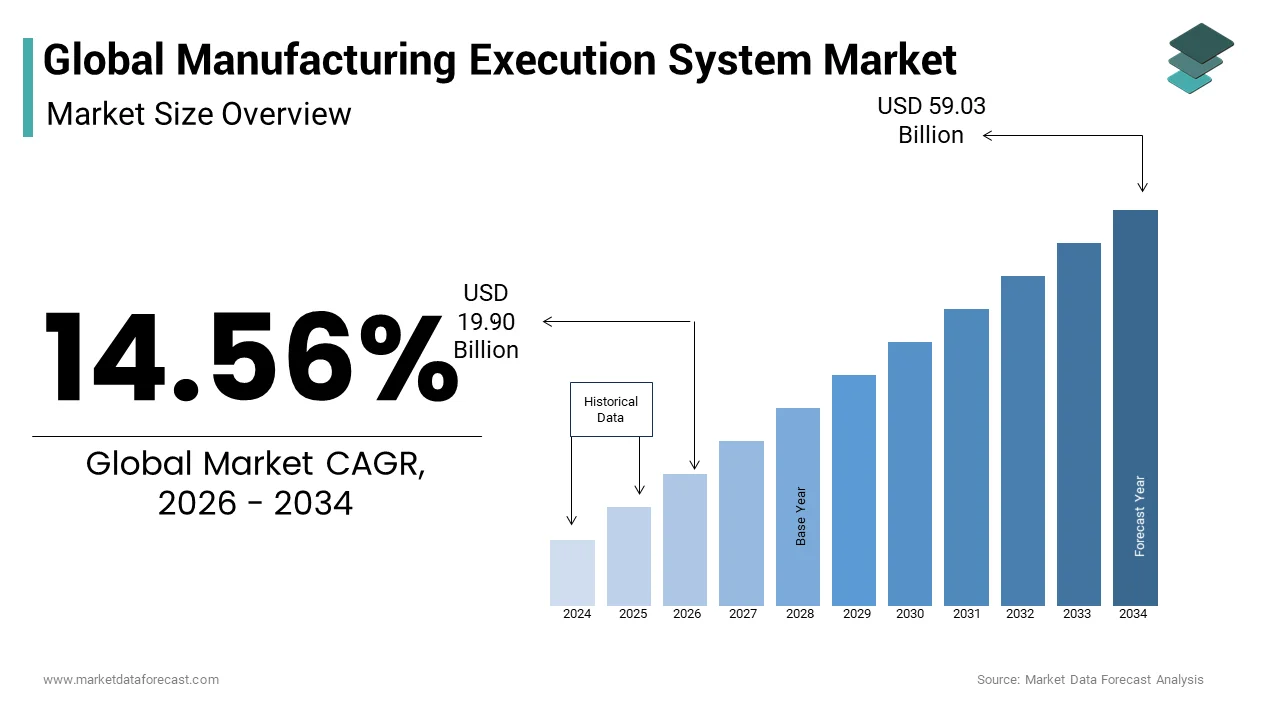
- Market Valuation: Valued at USD 17.37 billion in 2025, reaching USD 19.90 billion in 2026, and projected to scale up to USD 59.03 billion by 2034, registering a robust CAGR of 14.56% during the forecast period.
- Primary Growth Drivers: Escalating demand for real-time operational visibility, stringent regulatory compliance in life sciences and pharmaceuticals, and the convergence of MES with Industry 4.0, IoT, and AI technologies.
Key Market Segment Metrics
| Category | Leading Segment (Base Year Position) | Fastest-Growing / High-Impact Segment |
|---|---|---|
| By Offering | Software Solutions (dominant backbone segment providing core scheduling, job tracking, and quality management capabilities) | Services Segment (high-impact implementation, training, and maintenance services ensuring seamless integration) |
| By Process Industry | Pharmaceutical & Life Sciences (leading segment driven by strict Good Manufacturing Practices and batch traceability) | Food & Beverage (high-growth sector relying on MES for supply chain traceability and safety regulations) |
| By Region | North America (leading regional market anchored by advanced manufacturing infrastructures and strict quality standards) | Asia-Pacific (fast-expanding market driven by smart manufacturing and robust automotive/electronics sectors) |
Major Market Players & Market Structure
Market Structure: Highly competitive global industrial automation ecosystem featuring tier-1 software enterprises and automation conglomerates driving digital transformation.
Key Companies: Siemens AG, Rockwell Automation Inc., Honeywell International Inc., Dassault Systèmes, SAP SE, ABB Ltd, Emerson Electric Co., and General Electric Company.
Global Manufacturing Execution System Market Size
The global manufacturing execution system market size was valued at USD 17.37 billion in 2025 and is anticipated to reach USD 19.90 billion in 2026 to reach USD 59.03 billion by 2034, growing at a CAGR of 14.56% during the forecast period from 2026 to 2034.
A Manufacturing Execution System (MES) is a computerized solution crucial in manufacturing for real-time supervision and coordination of production activities. It acts as a bridge between planning and actual production, gathering and analyzing data across various manufacturing stages. MES offers features like scheduling, job tracking, resource allocation, quality management, and performance analysis. It also provides insights into production efficiency and resource utilization; it aids in making informed decisions. This system enhances overall operational efficiency by facilitating communication and coordination among different elements of the production process.
MARKET DRIVERS
The growth of the global manufacturing execution system market is mainly driven by the rising demand for operational efficiency in manufacturing processes.
It plays a very crucial role in real-time monitoring, tracking, and control of various manufacturing processes, which leads to improved operational efficiency and optimal resource utilization. MES also enables swift decision-making by providing comprehensive data on production processes and equipment performance. However, as industries embrace the era of Industry 4.0 and smart manufacturing, MES becomes a key in integrating advanced technologies such as IoT and AI. As a result, the emphasis on regulatory compliance was added to the rising complexity of supply chains, further fuelling the adoption of MES for streamlined and synchronized production operations.
The growing focus on regulatory compliance, particularly in industries such as pharmaceuticals and aerospace, is contributing to the growth of the manufacturing execution system market. These sectors face tough regulatory requirements, making adherence to industry standards paramount for product quality and safety. MES systems play a pivotal role in assisting manufacturers to meet these compliance standards by providing comprehensive monitoring and control capabilities throughout the production lifecycle. As these industries strive to uphold the highest quality and safety standards, the adoption of MES becomes instrumental in navigating the complex landscape of regulatory requirements, fostering trust, and ensuring compliance with the evolving regulatory environment.
The global market is poised for substantial opportunities for integration with Industry 4.0 technologies. This convergence positions MES as a central element in the evolution of intelligent, connected factories. By exploiting IoT sensors and devices, MES facilitates real-time data collection, offering extraordinary visibility into manufacturing processes. The integration of AI enables predictive analytics, optimizing production workflow, and minimizing disruptions. Additionally, MES's establishment of big data analytics enhances decision-making by extracting valuable insights from vast datasets. As industries embrace the digital era, MES stands at the forefront, empowering organizations to enhance overall efficiency, embrace data-driven strategies, and navigate the complexities of modern manufacturing with heightened demand.
MARKET RESTRAINTS
The manufacturing execution system market growth encounters a significant restraint in the form of high initial implementation costs, comprising software, hardware, and integration expenses substantial upfront investment can affect, particularly for smaller organizations. The financial burden associated with MES implementation often includes costs related to software licensing, specialized hardware infrastructure, and the intricate process of integrating the MES with existing systems like Enterprise Resource Planning (ERP). This financial barrier may limit the accessibility of MES solutions to smaller players in the manufacturing sector, impeding their ability to harness the operational advantages that MES offers. However, addressing this restraint requires industry stakeholders to explore cost-effective solutions, financing options, and scalable MES offerings to make the technology more accessible and appealing to a broader spectrum of manufacturers.
Cybersecurity concerns act as a challenge to the downfall of the market. Organizations hesitate to adopt MES without robust cybersecurity measures due to the potential risks posed by cyber threats. Breaking into manufacturing systems can lead to intellectual property theft, operational disruptions, and compromised product quality. Addressing these concerns necessitates MES providers to prioritize the development of advanced cybersecurity features, including secure access control and continuous monitoring. Therefore, establishing trust in the security of MES solutions is essential for encouraging widespread adoption, particularly in industries where the protection of proprietary information and operational integrity is of utmost importance.
REPORT COVERAGE
| REPORT METRIC | DETAILS |
| Market Size Available | 2025 to 2034 |
| Base Year | 2025 |
| Forecast Period | 2026 to 2034 |
| CAGR | 14.56% |
| Segments Covered | By Offering, Deployment, Process Industry, Discrete Industry, and Region |
|
Various Analyses Covered | Global, Regional & Country Level Analysis, Segment-Level Analysis, DROC, PESTLE Analysis, Porter’s Five Forces Analysis, Competitive Landscape, Analyst Overview on Investment Opportunities |
| Regions Covered | North America, Europe, APAC, Latin America, Middle East & Africa |
| Market Leaders Profiled | Tebis Technische Informationssysteme AG (Germany), Honeywell International Inc. (US), Dassault Systèmes (France), Rockwell Automation Inc. (US), Siemens AG (Germany), Applied Materials Inc. (US ), W erum IT Solutions GmbH (Germany), Emerson Electric Co. (US), S AP SE (Germany), ABB Ltd (Switzerland), General Electric Company (U),) and Others. |
SEGMENTAL ANALYSIS
By Offering Insights
Based on offering, the software segment dominated the market in 2022 and is expected to register prominent growth during the forecast period. Software is often considered the backbone of MES and the leading segment by providing the core functionalities for real-time monitoring, data analysis, production scheduling, and quality control. MES software is crucial for optimizing manufacturing processes and improving overall operational efficiency.
The services segment holds a substantial share of the global market during the forecast period. It includes implementation, training, and support, which are indispensable for successful MES deployment. These services ensure that the MES solution aligns with the unique needs of the organization, facilitates smooth integration with existing systems, and maximizes user adoption.
By Deployment Insights
Based on the deployment, the on-premises segment is anticipated to hold the leading share of the global market during the forecast period. On-premises MES solutions have been prevalent, especially in industries with stringent security and compliance requirements, such as pharmaceuticals and aerospace. These deployments involve installing the MES software and infrastructure on the organization's servers and data centers.
By Process Industry Insights
Based on the process industry, the pharmaceutical and life sciences segment is estimated to hold the largest share of the worldwide market during the forecast period. The Pharmaceutical & Lifesciences sector often sees a dominant presence of MES solutions. The stringent regulatory requirements, the need for precise quality control, and adherence to Good Manufacturing Practices (GMP) drive the demand for MES. The focus on compliance and batch tracking positions MES as a critical tool for ensuring product quality and safety.
The F&B segment accounted for the second biggest share of the global market in 2023 and is predicted to grow considerably during the forecast period. The Food & Beverage industry is the second significant adopter of MES, especially for managing complex production processes, ensuring traceability, and maintaining quality standards. MES helps streamline operations, manage inventory, and comply with food safety regulations. The industry's emphasis on real-time data for quality assurance contributes to the prominence of MES.
By Discrete Industry Insights
Based on the discrete industry, the automotive segment is expected to account for the largest share of the global market during the forecast period.
REGIONAL ANALYSIS
North America stands out as the most dominant market for MES, driven by the region's advanced manufacturing landscape, stringent quality standards, and a high degree of technology adoption. Industries such as automotive, aerospace, and pharmaceuticals extensively leverage MES for operational optimization, compliance, and real-time monitoring.
Europe is a significant player in the MES market, with a strong emphasis on manufacturing excellence and adherence to regulatory standards. Industries like automotive, pharmaceuticals, and food and beverage drive MES adoption.
Asia-Pacific holds the third-largest market share due to the automotive, electronics, and semiconductor industries that contribute significantly to MES demand. The push towards smart manufacturing and Industry 4.0 initiatives is accelerating MES adoption in the region.
Latin America is experiencing a gradual increase in MES adoption, particularly in countries like Mexico and Brazil. The automotive and food industries are among the key drivers.
The Middle East and Africa show emerging adoption of MES, driven by sectors such as oil and gas, aerospace, and automotive. The push for economic diversification and technology modernization in countries like the United Arab Emirates contributes to the growing interest in MES solutions.
KEY MARKET PLAYERS
Companies playing the leading role in the global manufacturing execution system market include
- Tebis Technische Informationssysteme AG (Germany)
- Honeywell International Inc. (US)
- Dassault Systèmes (France)
- Rockwell Automation Inc. (US)
- Siemens AG (Germany)
- Applied Materials Inc. (US)
- Werum IT Solutions GmbH (Germany)
- Emerson Electric Co. (US)
- SAP SE (Germany)
- ABB Ltd (Switzerland)
- General Electric Company (US).
RECENT MARKET NEWS
-
In 2023, Siemens is a major player in the industrial automation and MES space. They have been actively involved in providing solutions that align with Industry 4.0 principles, including IoT integration.
-
In 2023, ABB offers MES solutions with a focus on digitalization and Industry 4.0. Their MES solutions aim to connect production processes, people, and assets for improved efficiency.
-
Honeywell announced that it had received a multi-million dollar order from Aluminum Bahrain to supply a manufacturing execution system for the company's Production Line 5 expansion project.
-
Rockwell Automation, Inc. (NYSE: ROK) today announced a set of new features for FactoryTalk InnovationSuite, powered by T Ct, that simplify, scale, and accelerate the digital transformation of industrial organizations.
MARKET SEGMENTATION
This research report on the global manufacturing execution system market has been segmented and sub-segmented based on the Offering, Deployment, Process Industry, Discrete Industry, and Region.
By Offering
-
Software
-
Services
-
Implementation
-
Software Upgrade
-
Training
-
Maintenance
-
By Deployment
-
On-premises
-
On-demand
-
Hybrid
By Process Industry
-
Food & Beverages
-
Fish, Meat, and Poultry
-
Fruits & Vegetables
-
Dairy Products
-
Bakery Products & Confectionery
-
Snacks & Breakfast Cereals
-
Prepared Meals & Dishes
-
Prepared Animal Feeds
-
Beverages
-
Others (edible oil and agribusinesses)
-
-
Oil & Gas
-
Chemicals
-
Pulp & Paper
-
Pharmaceutical & Life Sciences
-
Energy & Power
-
Water & Wastewater Management
-
Others (Packaging, Cement, and Aluminum & Steel)
By Discrete Industry
-
Automotive
-
Aerospace & Defense
-
Medical Devices
-
Consumer Packaged Goods
-
Others (Electronics & Semiconductor, Textile, Solar & Photovoltaic Cells, Printing & Publishing, Furniture & Wood Products, And Metals & Mining)
By Region
-
North America
-
Europe
-
Asia Pacific
-
Latin America
-
Middle East and Africa