- Product Description Description
- Table of Contents TOC
- List of Table & Figure LOT
- Get Free Sample PDF Sample PDF
Market Size, 2025
$2.89 BnMarket Estimate, 2026
$3.18 BnMarket Forecast, 2034
$6.80 BnCAGR, 2026–2034
9.98%Global Medication Management System Market Size
The global medication management system market was valued at USD 2.89 billion in 2025, is estimated to reach USD 3.18 billion in 2026, and is projected to reach USD 6.80 billion by 2034, growing at a CAGR of 9.98% from 2026 to 2034.

As its name suggests, a medication management system is a system of adequately assigning and distributing the right amount of medication to the right patients at the right time. The system uses the support of various IT services to accomplish this task. Pharmacies across the globe use this management system to avoid errors in assigning dosages, especially as many chronic therapy patients require long prescriptions. This system uses automated software and robotics mechanisms to accurately prescribe the right number of drugs, making it easier for doctors and workers to do their job. Several errors can be avoided using this system. For example, it is easy to understock, overstock, have dispensing errors, drug adversities, and increased drug prices when operating large pharmacies and retail drug stores. A management system allows pharmacies not to make such operational errors and to have a systematic dosage distribution for patients. The system stores all the necessary data and utilizes it to optimize the accurate patient experience. It stores data about the patient's medical history, the prescription, the details of the medication, and product-related information.
Medicinal overdoses and taking the wrong medication can lead to serious side effects and sometimes even death. A management system is a monitoring system that ensures such disasters do not happen. It is designed to ensure the safety and efficiency of medicines. This system helps patients have more faith in medication and doctors have more ease when writing up a prescription. This system helps improve health outcomes and the growth of the medicine market.
MARKET DRIVERS
The increasing need for demand for efficient and accurate prescriptions is majorly propelling the global medication management system market.
This system helps in avoiding medical errors, thus ensuring patient safety. As the number of the aged population keeps rising and the number of healthcare professionals is not enough, this IT management system market is required to fill the gap. Another driving factor is the list of prescriptions for patients, which keeps getting longer with the advent of chronic diseases. This market makes it easier for doctors and nurses to manage long medications. As the number of patients keeps increasing, so does the cost of healthcare. Reducing healthcare costs is another major factor boosting the growth rate of the medication management system market. This automated system helps in maintaining workflow and providing easy maintenance of records. With the invention of new medications and new diseases, recorded data of the same is made, and this system helps save and use those large data files.
The medication management market prevents adverse drug events (ADEs), which occur when there is a drug overdose, ingestion of the wrong drug, untimely drug intake, etc., thus increasing the healthcare systems. In addition, the rise in the investment of hospitals in management pieces of software is another driving factor for the market. One such example of a hospital is the Saudi German Hospital - in Dubai, which, in 2017, included automated medication management with Omnicell’s solutions into its work system.
Additionally, the government is also working towards introducing new reforms and policies to make people adapt to the IT healthcare system. One such initiative is the German national medication plan, which aims to improve IT medication management in hospitals in Germany. This government involvement is also a driving factor. According to WHO statistics, medication error costs US$ 42 billion annually worldwide. These increasing medical errors indicate a clear requirement for a medication management system. Furthermore, increased technology, the internet, and mobile devices drive the market. In addition, the medication management system helps provide services to remote patients through a tracking facility. Thus, a demand for cost-efficient medication systems drives this market.
MARKET RESTRAINTS
Even though the medication management system is very efficient software, it is very high-working software and has high service costs. The hospital systems in many developing countries cannot afford the high maintenance costs. In addition, some lack the knowledge required to understand drug management systems. Thus, increased costs and lack of expertise hinder the development of the medication management system market.
REPORT COVERAGE
| REPORT METRIC | DETAILS |
| Market Size Available | 2025 to 2034 |
| Base Year | 2025 |
| Forecast Period | 2026 to 2034 |
| Segments Covered | By Software, Mode of Delivery, End-User, and Region. |
| Various Analyses Covered | Global, Regional and Country-Level Analysis, Segment-Level Analysis, Drivers, Restraints, Opportunities, Challenges; PESTLE Analysis; Porter’s Five Forces Analysis, Competitive Landscape, Analyst Overview of Investment Opportunities |
| Regions Covered | North America, Europe, Asia Pacific, Latin America, Middle East & Africa |
| Market Leaders Profiled | CareFusion Corporation, McKesson Corporation, Allscripts Healthcare Solutions, Cerner Corporation, Siemens Healthcare, Becton, Dickson, And Company (BD), GE Healthcare, Omnicell, Quadra Med Affinity Corporation, Arxium, Epic Systems Corporation, and United Health Group. |
SEGMENTAL ANALYSIS
By Mode of Delivery Insights
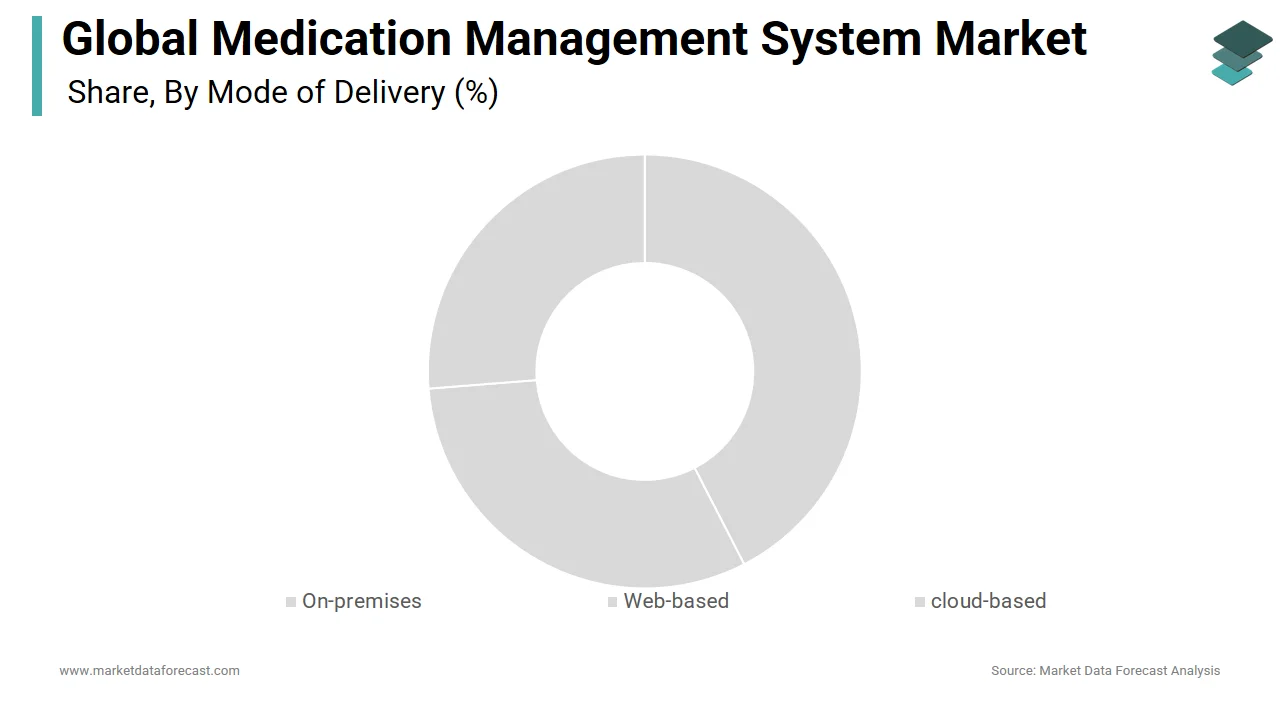
Based on the mode of delivery, the cloud-based segment is becoming more included and used by many players in the medication management industry. In 2016, the share of the cloud-based segment in the medication management system market was about 47.8%.
REGIONAL ANALYSIS
Geographically, the North American market had a share of 52.57% in the global medication management system market in 2022. North America is a dominant region in the medication management system market because of its adoption of technology and IT in health care, the prevalence of chronic diseases in the region, and a severe lack of physicians. The US in North America is currently the most advanced and avid user of medication management systems. This is also because the US lacks a considerable amount of healthcare professionals.
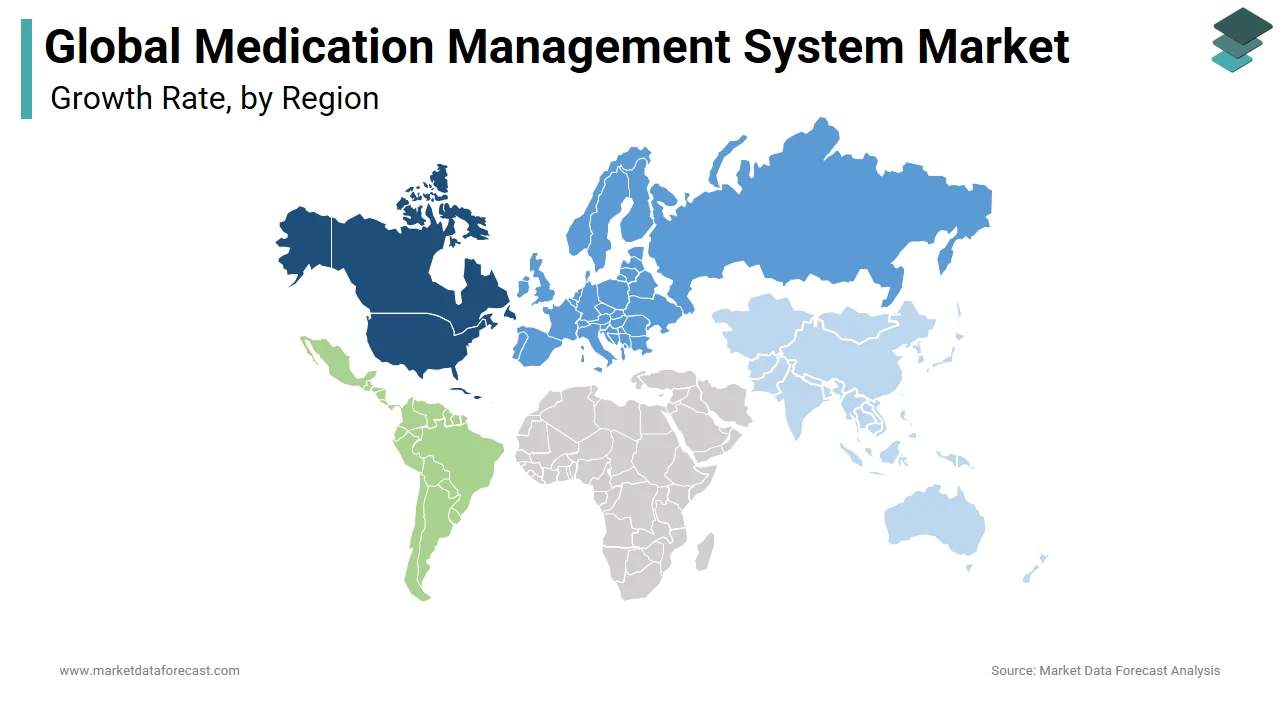
European countries like the UK are only second to the US and are rapidly adapting to the medication management market. Even though the scarcity of physicians is not as high as in the US or Canada, it is still in dire need of healthcare staff and thus utilizes the benefits of medication management systems.
The Asia Pacific region is expected to grow faster than other regions on the list. It is estimated to have a CAGR of 20.9% during the forecast period of 2018-2022.
Latin America and MEA are even less involved with medication management systems as the requirement is minimized. In addition, these regions include many developing countries for whom the knowledge and budget for this software are low.
KEY MARKET PLAYERS
Some of the companies that are playing a dominating role in the global medication management system market include
- CareFusion Corporation
- McKesson Corporation
- Allscripts Healthcare Solutions
- Cerner Corporation
- Siemens Healthcare
- Becton, Dickinson and Company (BD)
- GE Healthcare
- Omnicell
- QuadraMed Affinity Corporation
- Arxium
- Epic Systems Corporation
- UnitedHealth Group
GLOBAL MEDICATION MANAGEMENT SYSTEM MARKET NEWS
- BD (Benton, Dickson, and company) is set to release an Alaris system software version 12.1.2 to remediate the software, giving troubles like delay options programming and low battery alarm failure.
- Cerner has closed the deal to take over Oracle's software maker for a $28 billion charge. The deal is set to close next week.
- The founder of All scripts, Paul black, has resigned from his position as Allscripts starts to focus on Veradigm, its data analytics business.
- Omnicell is set to introduce innovative IVX station robotic compounding technology in the winter of 2022.
MARKET SEGMENTATION
This research report on the global medication management system market has been segmented and sub-segmented into software, delivery mode, end-user, and region.
By Software
- Computerized Physician Order Entry
- Clinical Decision Support System Solutions
- Electronic Medication Administration Record
- Inventory Management Solutions
- Others
By Mode of Delivery
- On-premises
- Web-based
- cloud-based
By End-User
- Pharmacies
- Hospitals
- Others End-User
By Region
- North America
- Europe
- Asia-Pacific
- Latin America
- Middle East and Africa