- Product Description Description
- Table of Contents TOC
- List of Table & Figure LOT
- Get Free Sample PDF Sample PDF
Market Size, 2025
$14.93 BnMarket Estimate, 2026
$16.14 BnMarket Forecast, 2034
$30.16 BnCAGR, 2026–2034
8.13%Global Membranes Market Report Summary
The global membranes market was valued at USD 14.93 billion in 2025 and is expected to be worth USD 16.14 billion in 2026 and USD 30.16 billion by 2034, growing at a CAGR of 8.13% during the forecast period from 2026 to 2034. Market growth is driven by rising global demand for clean and safe water, stringent environmental regulations, increasing industrialization, and rapid advancements in separation and filtration technologies. Expanding applications across water and wastewater treatment, food & beverage processing, pharmaceuticals, biotechnology, and semiconductor manufacturing are further accelerating market expansion worldwide.
Key Market Trends
-
Rising adoption of membrane bioreactors (MBRs) and advanced filtration systems to improve wastewater reuse and sustainability.
-
Increasing investments in desalination projects, boosting demand for reverse osmosis (RO) and nanofiltration membranes in water-scarce regions.
-
Growing focus on eco-friendly, durable, and anti-fouling membrane materials to enhance operational efficiency and lifespan.
-
Expansion of smart water management systems and IoT-enabled monitoring solutions to optimize membrane performance and reduce operational costs.
Segmental Insights
-
By type, the polymeric membranes segment dominated the global membranes market in 2025 due to its cost-effectiveness, versatility, ease of fabrication, and compatibility with a wide range of industrial applications. Materials such as polysulfone, polyethersulfone (PES), and polyvinylidene fluoride (PVDF) remain widely used for their durability and filtration efficiency.
-
By technology, reverse osmosis (RO) held the largest market share in 2025, driven by its extensive use in seawater desalination, industrial water purification, and wastewater recycling applications.
-
By application, the water and wastewater treatment segment accounted for the largest share in 2025, supported by strict water quality regulations, rapid urbanization, and growing investments in sustainable water management infrastructure.
Regional Insights
-
The Asia Pacific region emerged as the largest membranes market in 2024 and is expected to be the fastest-growing region during the forecast period.
-
Strong growth in Asia Pacific is driven by rapid industrialization, population growth, large-scale infrastructure development, and increasing government initiatives to improve clean water access in countries such as China, India, and Southeast Asian nations.
Competitive Landscape
The global membranes market is highly competitive, characterized by the presence of multinational corporations and specialized technology providers focusing on innovation, capacity expansion, and strategic partnerships. Leading companies are investing in advanced materials, high-performance membranes, and sustainable solutions to strengthen their global footprint. Prominent players operating in the global membranes market include Dow Chemical Company, LG Water Solutions, Merck Millipore, Pentair plc, Toray Industries, Koch Membrane Systems, Inc., Carlisle SynTec Systems, Asahi Kasei Corporation, Danaher Corporation, Firestone Building Products Company, LLC, GE Water & Process Technologies, and Hydranautics.
Global Membranes Market Size
The global membranes market size was valued at USD 14.93 billion in 2025, and the market size is expected to be worth USD 30.16 billion by 2034 from USD 16.14 billion by 2026. The market is growing at a CAGR of 8.13% during the forecast period.
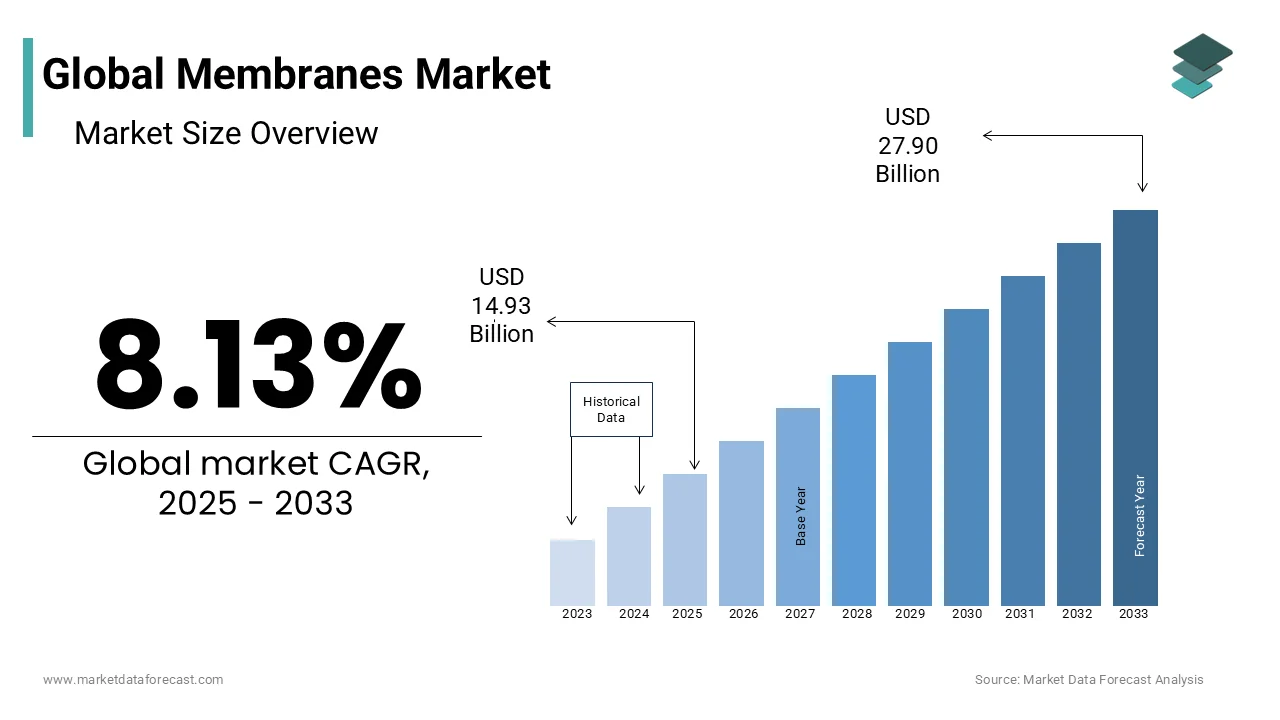
Membranes are semi-permeable materials engineered to facilitate selective separation of components in liquid and gaseous streams across industrial, medical, and environmental applications. These membranes, fabricated from polymers, ceramics, or composites, are pivotal in processes such as reverse osmosis, dialysis, gas separation, and biopharmaceutical purification. Their functionality hinges on precise pore size and material compatibility, enabling efficient filtration without phase change or excessive energy input. As per the International Desalination Association, there are around 21,000 desalination plants globally, and not all of them use membranes exclusively. Additionally, membrane bioreactors are used in several hundred U.S. municipal wastewater treatment plants, reflecting their integration into sustainable infrastructure. The technological maturity of polymeric membranes, combined with emerging advancements in nanocomposite materials, continues to expand their operational envelope across sectors demanding high-purity separation.
MARKET DRIVERS
Escalating Global Water Scarcity Driving Membrane Adoption
Water stress now affects billions of people worldwide, a large share of the population uses unsafe water. This crisis has intensified the deployment of membrane-based water purification systems, particularly reverse osmosis (RO) and ultrafiltration (UF) technologies. Desalination capacity has surged, with global installed capacity exceeding 100 million cubic meters per day, according to the International Desalination Association. Middle Eastern nations like Saudi Arabia and the UAE are among the largest global users of desalination, with the majority of their drinking water coming from desalination. Furthermore, urban Singapore has achieved reuse rates of around 40% through NEWater initiatives. The scalability and reliability of membranes in producing high-quality effluent make them indispensable in municipal and industrial water reclamation, directly amplifying demand as governments prioritize water security under climate volatility.
Stringent Regulatory Mandates in Pharmaceutical and Biotech Sectors
The pharmaceutical industry’s shift toward single-use systems and sterile filtration has significantly elevated the demand for precision membranes. membrane filtration is widely used in biologics manufacturing. Regulatory frameworks such as EU GMP Annex 1 mandate absolute pore-rated membranes (0.22 µm or smaller) for aseptic processing, compelling manufacturers to adopt high-integrity filtration solutions. The biopharmaceutical landscape is heavily dependent on TFF and PES/cellulose membranes. Besides, monoclonal antibody production requires large membrane surface areas. These compliance-driven requirements ensure sustained investment in high-performance membranes, reinforcing their centrality in ensuring product safety and regulatory adherence.
MARKET RESTRAINTS
High Capital and Operational Costs Limiting Widespread Adoption
The economic burden associated with membrane systems remains a critical barrier, particularly in developing economies. Installation of RO plants can exceed $1.5 million per 1,000 m³/day capacity. Ongoing expenses, including energy consumption and membrane replacement, further strain budgets; energy is the dominant operational cost in desalination, according to the International Energy Agency. Ceramic membranes, while durable, can cost up to ten times more than polymeric alternatives, limiting their deployment outside niche applications. Also, India treats a small fraction of wastewater with membrane bioreactors. These financial impediments hinder scalability, especially in regions where funding for advanced water infrastructure remains inconsistent.
Membrane Fouling and Degradation Reducing System Efficiency
Fouling, caused by organic, inorganic, or biological deposits, remains a persistent technical challenge, diminishing membrane lifespan and increasing maintenance frequency. Studies in the Journal of Membrane Science show fouling can cause severe flux decline in wastewater treatment without pretreatment. This necessitates frequent chemical cleaning, which accelerates material degradation; polymeric membranes may require replacement every 3–5 years under high-fouling conditions, compared to the ideal 7–10 year lifespan. Biofouling can raise desalination energy consumption by 15–25%. Furthermore, Polyamide RO membranes are highly sensitive to chlorine and harsh pH conditions, leading to performance decline. These operational inefficiencies elevate lifecycle costs and reduce process reliability, constraining broader implementation.
MARKET OPPORTUNITIES
Advancements in Nanomaterial-Enhanced Membranes
The integration of nanomaterials such as graphene oxide, carbon nanotubes, and zeolites into membrane matrices is unlocking unprecedented separation efficiencies. Graphene-based membranes can achieve higher permeability and strong salt rejection. These materials enable ultra-thin selective layers with tunable pore architecture, reducing energy demands in desalination. Pilot studies suggest nanocomposite membranes can reduce energy consumption. Besides, the U.S. Department of Energy funds advanced membrane R&D. With global R&D spending on advanced membranes surpassing $1.2 billion annually, these innovations promise transformative gains in flux, durability, and selectivity across industrial separations.
Expansion of Zero Liquid Discharge (ZLD) Systems in Industry
Industries facing stringent effluent discharge regulations are increasingly adopting ZLD systems, where membranes play a central role in achieving near-total water recovery. As per global estimates, hundreds of ZLD facilities are operational, with China and India leading in new deployments. These systems rely on a cascade of membrane technologies, ultrafiltration, reverse osmosis, and forward osmosis, followed by evaporators to crystallize residual solids. In the power sector, Indian coal-fired plants have implemented ZLD and high-recovery membrane systems to reduce freshwater use. Similarly, the U.S. Environmental Protection Agency regulates industrial wastewater discharge. This regulatory and environmental push positions membranes as core enablers of circular water economies in heavy industry.
MARKET CHALLENGES
Scaling Limitations in High-Volume Industrial Applications
While membranes offer precision separation, their deployment in high-throughput industrial settings is constrained by scalability issues. Large refineries or chemical plants processing millions of liters daily require vast membrane surface areas, often exceeding 50,000 m², leading to complex module arrangements and hydraulic imbalances. Also, scaling very large membrane desalination plants introduces flow distribution and fouling challenges. The pandemic caused serious shortages of single-use bioprocessing supplies, including membranes, and availability dropped by around 30%. Furthermore, the lack of standardized module designs across vendors complicates retrofitting and expansion, limiting operational agility in dynamic production environments.
Supply Chain Vulnerability for Critical Membrane Materials
The production of high-performance membranes depends on specialized polymers such as polyvinylidene fluoride (PVDF), sulfonated polyether ether ketone (SPEEK), and interfacial monomers like m-phenylenediamine (MPD). Geopolitical disruptions have exposed vulnerabilities in this supply chain; China is the dominant producer of PVDF, with market share estimates above 60%, and 2022 restrictions pushed global prices higher by around 40%. Similarly, MPD sourcing is concentrated in a few Asian producers, creating supply risks. Natural disasters or trade tensions can severely disrupt availability, like, the 2021 Suez Canal blockage disrupted global shipping and delayed deliveries of chemicals and membrane components. This fragility undermines production planning and increases inventory costs, compelling manufacturers to seek alternative materials or regionalize supply networks.
REPORT COVERAGE
| REPORT METRIC | DETAILS |
| Market Size Available | 2025 to 2034 |
| Base Year | 2025 |
| Forecast Period | 2026 to 2034 |
| CAGR | 8.13% |
| Segments Covered | By Type, Technology, Application, and Region. |
| Various Analyses Covered | Global, Regional & Country Level Analysis, Segment-Level Analysis, DROC, PESTLE Analysis, Porter’s Five Forces Analysis, Competitive Landscape, Analyst Overview of Investment Opportunities |
| Regions Covered | North America, Europe, APAC, Latin America, Middle East & Africa |
| Market Leaders Profiled | Dow Chemical Company (U.S.), LG Water Solutions (U.S.), Merck Millipore (Germany), Pentair plc (U.K.), Toray Industries (Japan), Koch Membrane Systems, Inc. (U.S.), Carlisle SynTec Systems (U.S.), Asahi Kasei Corporation (Japan), Danaher Corporation (U.S.), Firestone Building Products Company, LLC (U.S.), GE Water & Process Technologies (U.S.), Hydranautics (U.S.), and Others. |
SEGMENTAL ANALYSIS
By Type Insights
The polymeric membranes segment commanded the largest share of the global membranes market in 2025. This dominance is supported by their cost-effectiveness, ease of fabrication, and adaptability across diverse separation processes. Polymeric materials such as polyethersulfone (PES), polyvinylidene fluoride (PVDF), and cellulose acetate are widely used in water treatment, biopharmaceuticals, and food processing due to their tunable pore structures and scalable manufacturing. Also, PVDF membranes are widely used in North American ultrafiltration systems. Furthermore, the global polymeric membrane production capacity is very large (tens of millions of square meters annually), reflecting entrenched industrial reliance. Their compatibility with automated module assembly lines and lower energy footprint compared to thermal separation methods further solidify their leadership in both mature and emerging markets.
The ceramic membranes segment is witnessing the most rapid expansion and is projected to grow at a CAGR of 9.4% from 2026 to 2034. This acceleration stems from their superior thermal and chemical stability, enabling operation in aggressive environments where polymeric membranes degrade. Moreover, ceramic membranes are far more durable than polymeric membranes under high temperature and harsh environments. Their resistance to chlorine, ozone, and extreme pH levels makes them ideal for zero liquid discharge (ZLD) systems; these membranes are increasingly adopted in ZLD systems in China. Furthermore, the EU’s Green Hydrogen Strategy involves tens of billions of euros in funding, and ceramic membranes (oxygen transport) play a role in hydrogen purification.
By Technology Insights
The Reverse Osmosis (RO) segment stood as the prominent technology within the membranes market by capturing an estimated 46.2% share of total revenue in 2025. Its dominance is primarily driven by its irreplaceable role in seawater and brackish water desalination, where it achieves salt rejection rates exceeding 99.5%. There are many thousands of desalination plants worldwide and RO provides about two-thirds to ~70% of global desalinated output, typically reported by desalination industry sources (e.g., IDA/GWI). Several Middle Eastern countries depend heavily on RO for desalinated supply, with Jubail 3A is reported around 600,000 m³/day. Energy recovery devices have further enhanced RO efficiency; State-of-the-art SWRO plants can reach ~2.5 kWh/m³ with energy recovery. Coupled with stringent regulations on groundwater extraction in India and California, RO’s centrality in municipal and industrial water security ensures sustained market preeminence.
The pervaporation segment is emerging as the rapidly growing membrane technology and is anticipated to expand at a CAGR of 10.2% between 2026 and 2034. This surge is fueled by its unique ability to separate azeotropic and close-boiling mixtures without phase change, offering a sustainable alternative to distillation in chemical manufacturing. Pervaporation can concentrate ethanol to fuel-grade and save energy than conventional distillation. Europe hosts numerous industrial pervaporation units, particularly in pharmaceutical synthesis where moisture-sensitive reactions demand ultra-dry conditions. Moreover, pervaporation is a key enabler in green chemistry initiatives, noting a reduction in CO₂ emissions. With increasing demand for high-purity chemicals and tightening carbon regulations, its niche advantages are translating into broader industrial adoption.
By Application Insights
The water and wastewater treatment application segment dominated the membranes market by representing a 55.2% of total demand in 2025. This lead position is rooted in escalating water stress and regulatory enforcement on effluent quality. Billions of people live in countries experiencing water scarcity, prompting widespread adoption of membrane bioreactors (MBRs) and reverse osmosis systems for municipal reuse. Singapore’s NEWater program, which recycles substantial share of its wastewater using ultrafiltration and RO, exemplifies this trend. U.S. regulations tighten effluent limits for sensitive waters, encouraging advanced treatment. China’s 14th FYP includes major wastewater spending and treatment targets. These systemic investments, combined with drought-induced water rationing in regions like California and South Africa, ensure water treatment remains the cornerstone of membrane demand.
The medical and pharmaceuticals segment is expanding at the fastest pace and is projected to grow at a CAGR of 11.3% through 2034. This growth is propelled by the rising production of biologics, vaccines, and sterile injectables, all requiring high-integrity membrane filtration. Also, mAb manufacturing widely uses TFF, and large membrane areas can be required. The global vaccine landscape relies on depth filtration and sterilizing-grade membranes (0.22 µm) to ensure pathogen-free final products. During the pandemic, global demand for sterilizing filters surged, exposing supply chain gaps and prompting capacity expansion. Additionally, regulatory emphasis on process validation under FDA’s Process Analytical Technology (PAT) framework has institutionalized membrane use in quality control, reinforcing long-term demand.
REGIONAL ANALYSIS
Asia Pacific Membranes Market Insights
Asia Pacific held a commanding position in the global membranes market by securing an estimated 34.2% share of total revenue in 2025. The region’s position is anchored in rapid urbanization, industrialization, and acute water stress across densely populated nations. China alone accounts for over half of Asia’s membrane demand, driven by its national water security strategy and aggressive pollution control policies. Japan maintains technological leadership in hollow-fiber membrane production. Hence, the region’s infrastructure buildout will sustain membrane demand.
North America Membranes Market Insights
North America is also a key player in the market. The region’s maturity is characterized by high regulatory standards, advanced municipal infrastructure, and strong R&D investment in next-generation materials. The United States leads in adoption of zero liquid discharge systems. California’s Title 22 regulations have mandated advanced water recycling, resulting in an increase in RO installations since 2020. Canada has integrated membrane bioreactors into some of new wastewater plants in Ontario and British Columbia to meet stringent Great Lakes protection standards. This confluence of regulation, environmental awareness, and technological leadership solidifies North America’s sustained influence.
Europe Membranes Market Insights
Europe holds a significant share of the global membranes market, with a strong emphasis on sustainability and circular economy principles. The European Union’s Urban Wastewater Treatment Directive mandates tertiary filtration for all cities above 10,000 inhabitants, driving widespread deployment of microfiltration and reverse osmosis systems. France has integrated nanofiltration into some of its bottled water production to reduce mineral scaling and energy use. This integration of membranes into environmental policy and high-value manufacturing underscores Europe’s strategic market position.
Middle East Membranes Market Insights
The Middle East commands a notable share of the global membranes market, with desalination serving as the primary growth engine, as reported by the Gulf Research Center. The region produces over 50% of the world’s desalinated water, almost entirely through reverse osmosis and multi-stage flash hybrid systems. Al Khobar is among large SWRO plants, while UAE depends heavily on desalination. The Dubai Electricity and Water Authority has achieved a specific energy consumption of around 2.9 kWh/m³ in its latest RO plants, aligning with global best practices. Furthermore, Kuwait’s Ministry of Public Works has mandated membrane pre-treatment for all new desalination projects to extend membrane life and reduce fouling. Thus, the Middle East remains a critical growth corridor.
Latin America Membranes Market Insights
Latin America accounts for a small share of the global membranes market, with Brazil and Mexico leading adoption. The region’s growth is driven by expanding industrial sectors and increasing awareness of water quality issues. Brazil has a significant sewage treatment gap. RO used in mining to reduce freshwater use. Mexico City, facing subsidence due to aquifer depletion, is investing in water reuse projects using ultrafiltration. Despite financial constraints, public-private partnerships and multilateral funding are accelerating membrane deployment across the region.
COMPETITIVE LANDSCAPE
The membranes market is characterized by intense technological rivalry and strategic maneuvering among global and regional players. Competition is driven less by price and more by performance differentiation, durability, and integration capabilities with digital monitoring systems. Multinational corporations such as Toray, Asahi Kasei, and Veolia maintain leadership through continuous innovation and large-scale project execution, while emerging players from China and India are gaining traction with cost-optimized solutions. The race to develop sustainable membranes—resistant to fouling, chemical degradation, and energy-intensive operation—has intensified R&D investments. Partnerships with academic institutions and government bodies are becoming critical for scaling pilot technologies. Regional customization, regulatory compliance, and after-sales service networks are increasingly defining competitive advantage, creating a dynamic and evolving market landscape.
KEY MARKET PLAYERS
Companies playing a prominent role in the global membranes market include
-
Dow Chemical Company (U.S.)
-
LG Water Solutions (U.S.)
-
Merck Millipore (Germany)
-
Pentair plc (U.K.)
-
Toray Industries (Japan)
-
Koch Membrane Systems, Inc. (U.S.)
-
Carlisle SynTec Systems (U.S.)
-
Asahi Kasei Corporation (Japan)
-
Danaher Corporation (U.S.)
-
Firestone Building Products Company, LLC (U.S.)
-
GE Water & Process Technologies (U.S.)
-
Hydranautics (U.S.)
TOP PLAYERS IN THE MARKET
- Toray Industries has been a cornerstone of membrane innovation in the Asia Pacific region, leveraging its expertise in synthetic fibers and polymer science to dominate sectors such as water treatment and biopharmaceuticals. The company’s ultrafiltration and reverse osmosis membranes are widely deployed in municipal and industrial applications across Japan, China, and Southeast Asia. It also expanded its production capacity in Thailand to meet rising demand from ASEAN countries. Collaborating with Singapore’s Public Utilities Board, Toray contributed to pilot projects for advanced water reclamation using multi-barrier membrane systems. Its investment in R&D, exceeding ¥150 billion annually, underscores its commitment to sustainable separation technologies and solidifies its influence in shaping regional infrastructure standards.
- Asahi Kasei has established a robust footprint in the Asia Pacific membranes landscape through its high-performance microfiltration and ultrafiltration hollow-fiber modules, particularly under the Aqualza brand. These membranes are extensively used in municipal wastewater treatment and industrial recycling across Japan, India, and Indonesia. Asahi Kasei also partnered with Thailand’s Department of Industrial Works to integrate membrane bioreactors into industrial estates, reducing effluent discharge. The company introduced an antifouling-enhanced UF membrane in 2024, extending operational cycles. With a focus on decarbonization, Asahi Kasei is developing membranes for hydrogen separation, aligning with Japan’s Green Growth Strategy and reinforcing its role as a technology pioneer in the region.
- Suez, now fully integrated into Veolia, has played a transformative role in advancing membrane-based water solutions across Asia Pacific, particularly in China, South Korea, and Australia. The company’s expertise in membrane bioreactors and reverse osmosis systems has been instrumental in large-scale municipal and industrial projects. In China, the technology was adopted in Shanghai’s Qingpu wastewater facility to meet stringent discharge norms. The integration has enabled accelerated deployment of digital monitoring platforms like Oxydia, optimizing membrane performance. Suez’s legacy of engineering excellence, combined with Veolia’s regional expansion strategy, continues to drive innovation in smart, energy-efficient membrane systems tailored to Asia’s growing urban and industrial demands.
TOP STRATEGIES USED BY KEY MARKET PLAYERS
Key players in the membranes market are prioritizing technological innovation, strategic partnerships, and geographic expansion to consolidate their positions. Companies are investing heavily in R&D to develop fouling-resistant, energy-efficient membranes using advanced materials such as nanocomposites and biomimetic polymers. Mergers and acquisitions are being leveraged to integrate complementary technologies, particularly in digital process monitoring and modular system design. Collaborations with government agencies and research institutions are accelerating commercialization of next-generation solutions. Expansion into high-growth regions, especially in Asia Pacific and the Middle East, is being pursued through localized manufacturing and joint ventures. Additionally, firms are adopting circular economy models, offering membrane recycling and performance-as-a-service contracts to enhance customer retention and lifecycle value.
RECENT HAPPENINGS IN THE MARKET
- In January 2022, Toray Industries launched a next-generation reverse osmosis membrane at its Shiga Research Center, designed for high-salinity feedwater and improved fouling resistance, enhancing its competitiveness in desalination projects across Southeast Asia.
- In June 2022, Asahi Kasei expanded its hollow-fiber membrane production capacity at the Mizushima Plant in Japan by 30%, enabling increased supply to wastewater treatment projects in India and Indonesia.
- In September 2022, Veolia completed the full integration of Suez’s membrane technologies, deploying Zenon® ZeeWeed*500 modules in major water recycling plants in Australia and China to strengthen its operational footprint.
- In March 2024, Hydranautics, a Nitto group company, introduced the ESPA10 MAX membrane element with higher flux and lower energy consumption, targeting municipal desalination plants in water-stressed regions of the Middle East and North Africa.
- In November 2024, LG Chem announced a $200 million investment to build a state-of-the-art membrane production facility in Daegu, South Korea, focusing on ultrafiltration and nanofiltration modules for industrial and pharmaceutical applications.
MARKET SEGMENTATION
This research report on the global membranes market has been segmented and sub-segmented based on type, application, and region.
By Type
- Polymeric
- Ceramics
- Others
By Technology
- Ultrafiltration (UF)
- Reverse Osmosis (RO)
- Gas Separation
- Nanofiltration (NF)
- Pervaporation
- Microfiltration (MF)
- Others
By Application
- Water & Wastewater Treatment
- Food & Beverages
- Medical & Pharmaceuticals
- Industrial Gas Processing
- Others
By Region
- North America
- Europe
- Asia Pacific
- Latin America
- Middle East & Africa