- Product Description Description
- Table of Contents TOC
- List of Table & Figure LOT
- Get Free Sample PDF Sample PDF
Market Size, 2025
$2.85 BnMarket Estimate, 2026
$3.01 BnMarket Forecast, 2034
$4.60 BnCAGR, 2026–2034
5.46%Executive Summary: Middle East and Africa Fragrance Ingredients Market
- Market Scope: Comprehensive Middle East and Africa fragrance ingredients industry analysis covering application categories, ingredient types, regional country leadership frameworks, strategic developments, and competitive landscapes.
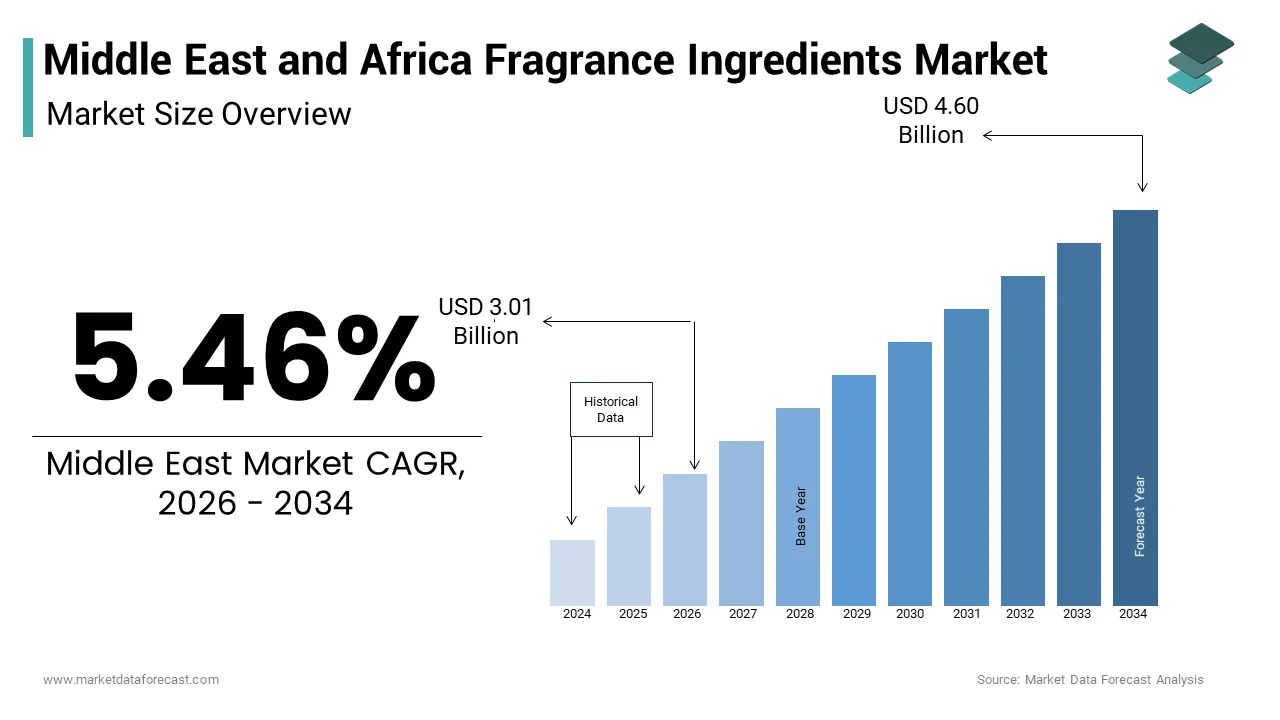
- Market Valuation: Valued at USD 2.85 billion (2025), estimated at USD 3.01 billion (2026), and projected to reach USD 4.60 billion by 2034, registering a steady CAGR of 5.46% (2026–2034).
- Primary Growth Drivers: Deep-rooted cultural significance of perfumery in GCC countries, rapid urbanization across African nations, increasing demand for natural and Halal-certified ingredients, rising disposable incomes, and expanding personal care industries. Restraints include raw material price volatility, supply chain disruptions, and counterfeit product prevalence.
Key Market Segment Metrics (2026–2034)
| Category | Leading Segment (2025 Position) | Fastest-Growing Segment |
|---|---|---|
| By Application | Fine fragrances (largest application category in 2025 due to traditional scent layering practices) | Consumer products (witnessing the highest CAGR of 8.2% driven by urbanization and hygiene awareness) |
| By Ingredient Type | Synthetic fragrance ingredients (account for significant market share due to consistency and cost-effectiveness) | Natural and Halal-certified ingredients (rising demand across emerging consumer formulations) |
| By Region / Country | Saudi Arabia (led the regional market with a 22.1% share in 2025) | United Arab Emirates (followed with an 18.8% share as a global luxury retail hub) |
Major Market Players & Market Structure
Market Structure: Regional fragrance ingredients landscape anchored by multinational flavoring and fragrance leaders supplying high-grade materials tailored to traditional scent practices and expanding personal care manufacturing.
Key Companies: Firmenich International SA, BASF SE, Frutarom Industries Ltd., International Flavors and Fragrances Inc., Givaudan SA, Mane SA, Symrise AG, Robertet SA, Takasago International Corp, and T. Hasegawa Co. Ltd.
Middle East and Africa Fragrance Ingredients Market Size
The Middle East and Africa fragrance ingredients market size will reach USD 2.85 billion in 2025 and is anticipated to reach USD 3.01 billion in 2026 to reach USD 4.60 billion by 2034, growing at a CAGR of 5.46% from 2026 to 2034.
Introduction to the Middle East and Africa Fragrance Ingredients Market
Fragrance ingredients are natural extracts or synthetic chemical compounds that give consumer products their distinct scent. This region is historically renowned for its deep cultural affinity toward fragrances particularly in the Gulf Cooperation Council countries where scent is integral to social identity and hospitality. According to data from the United Nations Department of Economic and Social Affairs, Africa's population is projected to reach approximately 2.5 billion by 2050, which will account for more than 25% of the total global population. As outlined by the World Health Organization, public health frameworks require hand hygiene to be practiced globally using plain soap and water, or an alcohol-based hand rub containing at least 60% alcohol when hands are not visibly dirty. The market is characterized by a unique blend of traditional preferences for heavy oriental notes such as oud musk and amber alongside growing interest in modern western floral and citrus profiles. Regulatory frameworks vary significantly between developed nations like South Africa and emerging markets influencing the adoption of synthetic versus natural ingredients. The rise of local manufacturing capabilities in countries like Egypt and Morocco further supports the regional supply chain reducing reliance on imports. This dynamic landscape is shaped by increasing urbanization rising disposable incomes and a burgeoning youth demographic that drives trends in personal expression through scent.
MARKET DRIVERS
Deep Rooted Cultural Significance and High Per Capita Consumption of Perfumes
The profound cultural significance of fragrances in the Middle East drives the sustained demand for high quality fragrance ingredients. This in turn propels the Middle East and Africa fragrance ingredients market. In many Arab cultures the application of perfume is considered a daily ritual and a sign of respect and hospitality leading to some of the highest per capita consumption rates globally. According to research, Saudi Arabia and the UAE represent the largest and fastest-growing markets for luxury cosmetics and premium fragrances within the GCC, driven by a strong consumer preference for high-end lifestyle products. As per a study, regional fragrance traditions heavily rely on layering multiple scents, blending rich notes of oud, incense, patchouli, and natural resins, which shapes a highly demanding local market for both premium raw ingredients and specialized presentation. This cultural imperative ensures that fragrance manufacturers prioritize the region for product launches and ingredient sourcing. The preference for long lasting and intense scents drives the need for high concentration ingredients and robust base notes which require specialized aromatic compounds. Furthermore the gifting culture during religious festivals and weddings sustains year round demand for premium fragrance formulations. This unwavering cultural attachment guarantees a stable and lucrative market for both traditional and modern fragrance ingredients across the Gulf states.
Rapid Urbanization and Expansion of the Personal Care Industry
Rapid urbanization and the concurrent expansion of the personal care industry across the region further accelerate the growth of the Middle East and Africa fragrance ingredients market. As populations migrate to urban centers lifestyle changes drive increased spending on grooming products such as shampoos body lotions deodorants and laundry detergents all of which rely heavily on scent for consumer appeal. According to data cited by the African Development Bank and UN-Habitat, Africa’s urban population is projected to double by 2050, adding an estimated 600 million people to cities and bringing the continent's total urban populace to roughly 1.2 billion. Manufacturers are increasingly investing in local production facilities to cater to this growing demand necessitating a steady supply of cost effective and compliant fragrance ingredients. The competitive nature of the personal care sector forces brands to differentiate their products through unique scent profiles driving innovation in ingredient formulation. This structural shift toward urban living and enhanced personal grooming habits ensures continuous growth in the volume of fragrance ingredients required by the regional manufacturing sector.
MARKET RESTRAINTS
Volatility in Raw Material Prices and Supply Chain Disruptions
The inherent volatility in the prices of key natural raw materials and frequent supply chain disruptions are significant restraints on the Middle East and Africa fragrance ingredients market. Many prized fragrance ingredients such as rose oil jasmine absolute and oud wood are agricultural products subject to climatic variations political instability and harvest fluctuations. According to reports by the Food and Agriculture Organization (FAO), severe agricultural land degradation and climatic shifts across North Africa restrict optimal crop performance, leaving a critical yield gap for oil crops unless large-scale soil restoration efforts are implemented. As per the World Bank Group, geopolitical tensions, regional trade corridor vulnerabilities, and port congestion disproportionately drive up systemic transit and inland logistics costs for developing economies heavily reliant on imported goods. These factors lead to unpredictable pricing structures making it difficult for local manufacturers to maintain consistent profit margins and product availability. When the cost of critical inputs like Bulgarian rose or Indian sandalwood spikes unexpectedly formulators are forced to either absorb the losses or reformulate products with cheaper alternatives which may compromise quality. This instability discourages long term investment in new product development and limits the ability of smaller local players to compete with multinational corporations that have more resilient global supply chains.
Stringent Regulatory Compliance and Import Restrictions
Stringent regulatory compliance requirements and complex import restrictions are substantial hurdles for the seamless operation in the Middle East and Africa fragrance ingredients market. Each country in the Middle East and Africa maintains distinct regulatory frameworks for chemical safety labeling and environmental impact which often lack harmonization. According to official compliance portals of the Saudi Food and Drug Authority (SFDA), cosmetic and perfumery imports must be pre-notified electronically and obtain a strict Certificate of Conformity verifying adherence to GSO technical regulations (such as GSO 1943) regarding safe chemical limits and labelling. In several African countries inconsistent customs procedures and high tariffs on imported chemical intermediates increase the final cost of fragrance ingredients making them less competitive against illicit or lower quality alternatives. The lack of standardized regional guidelines means that manufacturers must navigate a fragmented regulatory landscape duplicating efforts and resources for each target market. This bureaucratic complexity stifles innovation and restricts the availability of advanced and safer fragrance ingredients particularly for small and medium sized enterprises that lack the legal and financial capacity to manage complex compliance burdens.
MARKET OPPORTUNITIES
Growing Demand for Natural and Organic Fragrance Ingredients
The shifting consumer preference toward natural and organic products sets the stage for the expansion of the Middle East and Africa fragrance ingredients market. Consumers are becoming increasingly aware of the potential health risks associated with synthetic chemicals and are actively seeking products labeled as natural clean or eco friendly. According to the Organic Trade Association, the organic and natural products market continues to expand due to strong consumer interest in transparency, clean labels, and environmental sustainability. As per the Ministry of Agriculture of Morocco, the country's strategic investments in sustainable farming support its position as a major producer and exporter of specialized agricultural products, including high-quality argan oil and essential aromatic botanical extracts. Local manufacturers have the opportunity to leverage indigenous botanical resources such as hibiscus baobab and shea butter to create unique scent profiles that appeal to both local pride and international export markets. The development of certified organic fragrance lines allows brands to command premium pricing and build strong customer loyalty among affluent urban consumers. Furthermore partnerships with local farmers to source sustainable raw materials support rural economies and align with corporate social responsibility goals. This trend toward naturality opens new avenues for innovation and differentiation in a crowded market.
Expansion of Halal Certified Fragrance and Personal Care Products
The expansion of Halal certified fragrance and personal care products offers a lucrative opportunity for ingredient suppliers in the Middle East and Africa fragrance ingredients market. With a predominantly Muslim population in the region and a growing Muslim demographic globally there is increasing demand for products that comply with Islamic law which prohibits the use of alcohol and certain animal derived ingredients. According to the State of the Global Islamic Economy Report the Halal economy is valued at over 2 trillion USD with personal care being one of the fastest growing sectors. As per the Gulf Standardization Organization strict guidelines govern the certification of Halal cosmetics requiring that all fragrance ingredients be free from intoxicants and non Halal animal derivatives. Ingredient manufacturers can capitalize on this trend by developing alcohol free perfume bases and synthetic musks that mimic animal notes without ethical concerns. Obtaining Halal certification enhances brand credibility and opens access to a loyal consumer base that prioritizes religious compliance in their purchasing decisions. Furthermore the export potential of Halal certified fragrance ingredients to other Muslim majority countries in Asia and Europe provides a significant growth avenue. Suppliers can secure a dominant position by specializing in Halal-compliant formulations. This allows them to capture a significant share of a niche, rapidly expanding market segment.
MARKET CHALLENGES
Prevalence of Counterfeit and Illicit Fragrance Products
The widespread prevalence of counterfeit and illicit fragrance products slows down the growth of the Middle East and Africa fragrance ingredients market. This poses a severe challenge to the legitimate fragrance ingredients industry in the region. Counterfeit perfumes often use substandard and potentially harmful synthetic ingredients that undercut the prices of authentic products damaging brand reputation and consumer trust. According to the Organisation for Economic Co-operation and Development (OECD), the international trade in counterfeit and pirated goods is a massive global challenge valued at hundreds of billions of dollars annually, heavily impacting consumer safety and stripping revenue from legitimate brand owners. As per the International Chamber of Commerce (ICC), weak local intellectual property protection and inconsistent enforcement mechanisms severely undermine business innovation, allowing illicit trade networks to compromise international supply chains. These illicit products not only erode the market share of genuine brands but also pose health risks to consumers due to the use of unregulated and toxic chemical substitutes. Legitimate ingredient suppliers struggle to compete with the artificially low prices of counterfeit operations which do not bear the costs of compliance quality control and ethical sourcing. This underground market distorts pricing dynamics and discourages investment in innovation as companies fear their proprietary formulations will be copied and sold illegally. Combating this issue requires coordinated efforts between governments industry bodies and law enforcement agencies which remains a complex and ongoing challenge.
Limited Technical Expertise and Infrastructure for Local Production
The limited technical expertise and inadequate infrastructure for local production of high quality ingredients hinder the growth and self sufficiency of many nations within the Middle East and Africa fragrance ingredients market. While the region is rich in aromatic raw materials the capacity to process these into refined essential oils and aroma chemicals is often lacking due to a shortage of skilled chemists and advanced extraction technologies. According to the United Nations Industrial Development Organization many Sub Saharan African countries rely heavily on the export of raw agricultural commodities rather than value added processed ingredients resulting in lost economic potential. Without adequate laboratory facilities and technical know how local manufacturers struggle to produce consistent and high purity ingredients forcing them to import finished blends from Europe or Asia. This dependency increases costs and reduces the competitiveness of local products in the global market. Bridging this skills gap requires significant investment in education and technology transfer which is often constrained by limited public funding and private sector hesitation. The region relies on external suppliers for sophisticated fragrance ingredients. This dependency will continue until local capabilities are strengthened.
REPORT COVERAGE
| REPORT METRIC | DETAILS |
| Market Size Available | 2025 to 2034 |
| Base Year | 2025 |
| Forecast Period | 2026 to 2034 |
| CAGR | 5.46% |
| Segments Covered | By Type, Application, and Region. |
| Various Analyses Covered | Global, Regional and Country Level Analysis; Segment-Level Analysis, DROC, PESTLE Analysis, Porter’s Five Forces Analysis, Competitive Landscape, Analyst Overview of Investment Opportunities |
| Regions Covered | KSA, UAE, Israel, rest of GCC countries, South Africa, Ethiopia, Kenya, Egypt, Sudan, rest of MEA |
| Market Leaders Profiled | Firmenich International SA, BASF SE, Frutarom Industries Ltd., International Flavors and Fragrances Inc., Givaudan SA, Mane SA, Symrise AG, Robertet SA, Takasago International Corp, T. Hasegawa Co. Ltd. |
SEGMENTAL ANALYSIS
By End User Insights
Fine Fragrances
The fine fragrances segment was the largest in the Middle East and Africa fragrance ingredients market and occupied a significant share in 2025. This leading position of the segment was attributed to the deep cultural integration of personal perfumery and the widespread tradition of scent layering across the Middle East. In many Arab societies the application of perfume is an essential daily ritual and a fundamental aspect of social etiquette and hospitality. According to sources, consumers in the Gulf region exhibit the highest per capita expenditure on personal fragrances globally reflecting the profound societal value placed on olfactory presentation. The cultural imperative ensures that fine fragrance remains the most lucrative application sector for both rare natural extracts and advanced synthetic aroma chemicals. The constant desire for unique and personalized scent signatures drives consumers to purchase extensive collections of perfumes. This unwavering cultural devotion to personal scent guarantees the enduring dominance of the fine fragrances segment in the regional market.
Furthermore, a crucial part keeping this segment in the lead is the high disposable income and the aggressive expansion of luxury retail infrastructure in the Gulf states. The affluent demographic in countries like the United Arab Emirates and Saudi Arabia possesses significant purchasing power to acquire premium and niche perfume brands. Consumers in this segment are highly willing to pay a premium for artisanal craftsmanship and exclusive raw materials such as pure oud and natural ambergris. The continuous investment in luxury tourism and retail experiences further amplifies the visibility and sales of high end perfumes. This robust economic environment and luxury retail ecosystem ensure that fine fragrances remain the primary revenue driver for the fragrance ingredients market.
Consumer Products
The consumer products segment is predicted to witness the highest CAGR of 8.2% over the forecast period owing to rapid urbanization and the increasing prioritization of personal hygiene and home care. As massive populations migrate to urban centers across Africa and the Middle East lifestyle changes trigger a surge in the consumption of daily use commodities such as scented soaps body washes laundry detergents and household cleaners. According to the United Nations Department of Economic and Social Affairs (UN DESA), rapid urbanization continues to reshape the global demographic landscape, with urban populations projected to expand significantly across developing markets over the coming decades. Manufacturers are heavily incorporating advanced fragrance ingredients into these functional products to enhance the user experience and differentiate their brands on crowded supermarket shelves. This structural demographic shift toward urban living and enhanced hygiene routines guarantees the rapid and sustained expansion of the consumer products segment.
This segment's fast growth is supported by the aggressive expansion of local manufacturing facilities for daily use commodities across emerging African and Middle Eastern nations. Multinational and regional fast moving consumer goods companies are increasingly establishing production plants closer to the end consumer to reduce logistics costs and bypass import tariffs. Local production requires a steady and cost effective supply of synthetic and natural aroma chemicals to formulate products tailored to specific regional scent preferences. The ability to manufacture these goods domestically allows companies to offer affordable scented products to the mass market. This ongoing industrialization and localization of consumer goods manufacturing ensures that the demand for fragrance ingredients in this segment will grow at the fastest pace.
REGIONAL ANALYSIS
Saudi Arabia Fragrance Ingredients Market Analysis
Saudi Arabia led the regional market and captured a 22.1% share in 2025. This leading position of the country’s market was driven by its massive population and deep rooted cultural affinity for perfumery. The market status in this country is characterized by an exceptionally high per capita consumption of fine fragrances and a rapid diversification of the economy under national vision programs. According to data from the General Authority for Statistics (GASTAT), Saudi Arabia’s wholesale and retail trade, alongside restaurants and hotels, continues to show strong, consistent growth as a pillar of non-oil GDP, heavily bolstered by national initiatives to expand international tourism under Vision 2030. As per the World Bank, Saudi Arabia has undergone a rapid economic transformation under Vision 2030, with female labor force participation more than doubling since 2017 to reach over 33% by the mid-2020s. The government is also heavily investing in local manufacturing capabilities to reduce reliance on imported consumer goods. Furthermore, the strong preference for traditional oriental scent profiles incorporating oud and musk ensures a continuous demand for specialized raw materials. The combination of high purchasing power cultural traditions and economic diversification guarantees that Saudi Arabia remains the undisputed leader in the regional fragrance ingredients market.
United Arab Emirates Fragrance Ingredients Market Analysis
The United Arab Emirates followed closely behind in the Middle East and Africa fragrance ingredients market and accounted for an 18.8% share in 2025. This growth of the UAE market was propelled by its status as a global luxury retail hub and a major re export center. The market status in this country is heavily influenced by a highly diverse expatriate population that brings a wide array of global scent preferences creating a highly dynamic and cosmopolitan fragrance landscape. According to the Dubai Chambers, Dubai serves as a leading global trade and investment hub, providing international businesses with a strategic logistics and corporate gateway to access more than 2.2 billion consumer markets across the broader region. As per the United Nations Conference on Trade and Development (UNCTAD), the United Arab Emirates remains one of the top global recipients of Foreign Direct Investment (FDI) in the West Asia region, driven by its highly liberalised economic policies and state-of-the-art infrastructure. The high concentration of affluent residents and tourists drives immense volume in the fine fragrances segment. Furthermore the government proactive approach to business setup and free trade zones attracts numerous multinational ingredient suppliers to establish regional headquarters. This strategic geographic location and luxury retail dominance ensure that the United Arab Emirates remains a critical and highly lucrative market.
Israel Fragrance Ingredients Market Analysis
Israel occupies a strong position in the regional market due to its advanced chemical industry and strong research and development capabilities. This country's market is known for a discerning consumer base that demands dermatological safety, natural ingredients, and eco-friendly packaging. According to the Israel Export Institute, Israel's cosmetics and life sciences sectors are recognized globally for exporting high-tech skincare formulations, advanced delivery systems, and unique therapeutic mineral products derived from the Dead Sea. As per the Ministry of Environmental Protection, strict environmental regulations and licensing frameworks govern the registry, management, and reduction of hazardous chemical substances to protect local ecosystems and public health. The local population exhibits a strong preference for light fresh and citrus based scent profiles reflecting the Mediterranean climate and lifestyle. Furthermore the thriving startup ecosystem continuously generates novel biotechnological solutions for extracting and stabilizing natural aromatic compounds. This unique blend of technological innovation stringent environmental standards and sophisticated consumer preferences ensures that Israel remains a vital and highly advanced player in the regional market.
South Africa Fragrance Ingredients Market Analysis
South Africa witnessed a steady growth in the regional market owing to its well-established manufacturing sector and sophisticated retail infrastructure. The country’s market is highly segmented, serving a diverse consumer base with varying purchasing power across both mass and premium categories. According to data from Statistics South Africa (Stats SA), the manufacturing sector remains a core pillar of the national economy, with the production of chemicals and chemical-based products historically standing as one of the largest sub-sectors contributing to overall industrial output. The consumer preference leans toward a mix of international designer brands and locally inspired botanical scents featuring indigenous flora like rooibos and buchu. Furthermore, stringent national regulations regarding cosmetic safety and labeling ensure high product quality standards. This mature industrial base and diverse consumer landscape ensure that South Africa remains the primary hub for fragrance ingredient distribution and manufacturing in Sub Saharan Africa.
Ethiopia Fragrance Ingredients Market Analysis
Ethiopia is an emerging country in the Middle East and Africa fragrance ingredients market due to vast agricultural potential and a growing domestic consumer base. The nation boasts rich biodiversity. Capitalizing on this, its market offers lucrative avenues for the production and harvesting of exclusive aromatic botanicals. According to the Ethiopian Ministry of Agriculture the country is a major producer of high quality essential oils including frankincense and myrrh which are highly sought after by international fragrance houses. As per the World Bank, rapid urbanization and demographic shifts in major economic centers like Addis Ababa present both critical development challenges and immense structural opportunities for expanding local service delivery, infrastructure, and job creation. The government is actively promoting the agro processing sector to add value to raw agricultural exports before they leave the country. Furthermore the large and youthful population presents a massive long term opportunity for mass market consumer goods manufacturers. Although the current industrial infrastructure for chemical synthesis is limited the abundant natural resources and growing domestic demand ensure a progressive growth trajectory for natural fragrance ingredients.
COMPETITIVE LANDSCAPE
The competition in the Middle East and Africa Fragrance Ingredients Market is characterized by intense rivalry among multinational corporations and emerging regional suppliers. Global giants leverage their extensive research capabilities and broad product portfolios to dominate the high end luxury and fine fragrance segments. Local players compete by offering cost effective solutions and leveraging indigenous botanical resources to create unique regional scent profiles. Price sensitivity remains a critical factor in the mass market segment prompting companies to optimize production efficiencies. Intellectual property protection around proprietary aroma molecules provides a competitive edge for innovators. Strategic alliances with local distributors and manufacturers are essential for navigating complex regulatory landscapes and ensuring market access. Customer loyalty is driven by consistent quality reliable supply and technical support services. The market sees continuous innovation in natural extraction techniques and sustainable sourcing practices. Collaborative ecosystems involving suppliers regulators and growers accelerate the adoption of eco friendly ingredients. Differentiation through cultural relevance and customization is key to success in this diverse region.
KEY MARKET PLAYERS
Some of the major companies leading the Middle East & Africa market share include
- Firmenich International SA
- BASF SE,
- Frutarom Industries Ltd.
- International Flavors and Fragrances Inc.
- Givaudan SA
- Mane SA
- Symrise AG
- Robertet SA
- Takasago International Corp
- T. Hasegawa Co. Ltd.
Top Players In The Market
- Givaudan SA operates as a leading global flavor and fragrance company with a significant footprint in the Middle East and Africa region. The company leverages its extensive portfolio of natural and synthetic ingredients to cater to diverse cultural preferences and luxury market demands. Recent actions include expanding its creative centers in Dubai and Johannesburg to better serve local clients with customized scent solutions. Givaudan actively collaborates with regional suppliers to source sustainable raw materials such as frankincense and rose oil. Their investment in digital tools for scent discovery enhances customer engagement and accelerates product development. By focusing on sustainability and innovation, Givaudan strengthens its position as a trusted partner. This commitment serves major personal care and fine fragrance brands across the region.
- Firmenich & Cie SA is a major player in the fragrance ingredients market known for its commitment to sustainability and natural sourcing. The company serves a wide range of industries including fine fragrances consumer products and home care with high quality aromatic compounds. Recent actions involve strengthening partnerships with local farmers in Morocco and Egypt to secure ethical supplies of essential oils. Firmenich invests heavily in biotechnology to develop novel aroma molecules that meet strict regulatory standards. They also launch initiatives to support biodiversity conservation in key sourcing regions. Through these efforts Firmenich enhances its reputation for responsible sourcing and scientific excellence ensuring long term growth and customer loyalty in the Middle East and Africa markets.
- International Flavors & Fragrances Inc provides a comprehensive range of fragrance ingredients and solutions tailored to the unique needs of the Middle East and Africa consumers. The company utilizes its global expertise to create culturally relevant scent profiles that resonate with local traditions and modern trends. Recent actions include upgrading its manufacturing facilities in South Africa to increase production capacity and improve supply chain efficiency. IFF focuses on developing cost effective synthetic alternatives to rare natural ingredients to meet mass market demand. They also engage in extensive consumer research to identify emerging preferences in personal care and home hygiene. By merging technical innovation with deep market insights, IFF continues to evolve the regional fragrance industry. Consequently, the company has solidified its position as a key supplier.
Top Strategies Used By Key Market Participants
Key players in the Middle East and Africa Fragrance Ingredients Market primarily focus on strategic partnerships with local agricultural producers to secure sustainable and ethical sources of natural raw materials. Companies invest heavily in research and development to create innovative synthetic molecules that replicate rare and expensive natural scents while ensuring cost effectiveness. Market participants prioritize regulatory compliance by adapting their formulations to meet diverse national standards across the region. Expansion of local manufacturing and blending facilities reduces logistics costs and improves supply chain resilience. Digitalization through virtual scent technologies enhances customer experience and accelerates product development cycles. Sustainability initiatives including carbon neutral production and biodiversity protection are central to brand positioning. Educational programs for local formulators help drive adoption of advanced ingredients. These multifaceted strategies enable companies to navigate complex market dynamics and capture growing demand.
MARKET SEGMENTATION
This research report on the Middle East and Africa fragrance ingredients market is segmented and sub-segmented into the following categories.
By Type
- Essentials oils
- Orange
- Mentha Arvensis
- Eucalyptus
- Cedarwood
- Citronella
- Aroma Chemicals
- Terpenes
- Benzenoids
- Musk chemicals
By Application Insights
- Cosmetics & Toiletries
- Fine fragrances
- Soaps and detergents
By Country
- KSA
- UAE
- Israel
- Rest of the GCC countries
- South Africa
- Ethiopia
- Kenya
- Egypt
- Sudan
- Rest of MEA