- Product Description Description
- Table of Contents TOC
- List of Table & Figure LOT
- Get Free Sample PDF Sample PDF
Market Size, 2025
$271.93 MnMarket Estimate, 2026
$288.03 MnMarket Forecast, 2034
$456.31 MnCAGR, 2026–2034
5.92%North America Camelina Sativa Market Report Summary
The North America Camelina sativa market was valued at USD 271.93 million in 2025, is estimated to reach USD 288.03 million in 2026, and is projected to reach USD 456.31 million by 2034, growing at a CAGR of 5.92% during the forecast period from 2026 to 2034. The growth of the North America Camelina sativa market is driven by increasing demand for sustainable biofuel feedstocks, rising adoption of renewable energy solutions, and expanding applications in animal feed, food ingredients, and industrial products. Growing interest in low-input oilseed crops, supportive government initiatives for biofuel production, and increasing investments in sustainable agriculture are further supporting market growth. Additionally, the high omega-3 content and favorable agronomic characteristics of Camelina sativa are contributing to its increasing commercial adoption across North America.
Key Market Trends
-
Rising demand for sustainable and renewable biofuel feedstocks is driving the adoption of Camelina sativa across North America.
-
Increasing use of camelina oil in biodiesel, sustainable aviation fuel (SAF), and renewable diesel production is supporting market growth.
-
Growing demand for omega-3-rich ingredients in animal nutrition and food applications is expanding commercial opportunities.
-
Increasing focus on sustainable agriculture and low-input crop cultivation is encouraging Camelina production.
-
Government initiatives promoting renewable energy and carbon emission reduction are accelerating market expansion.
Segmental Insights
-
Based on product type, the industrial grade segment dominated the North America Camelina sativa market by accounting for 58.1% of total market revenue in 2025. The segment's leadership is attributed to the increasing use of industrial-grade camelina oil in biofuels, lubricants, and other renewable industrial applications.
-
Based on application, the biodiesel segment held the largest share of the North America Camelina sativa market by accounting for 45.1% of total industry revenue in 2025. The segment's dominance is driven by rising demand for renewable transportation fuels, favorable government policies supporting biofuel production, and Camelina's suitability as a sustainable feedstock.
Regional Insights
-
The North America Camelina sativa market is witnessing steady growth due to increasing renewable energy investments, expanding biofuel production, and rising interest in sustainable oilseed crops.
-
The United States dominated the North America Camelina sativa market by accounting for 62.1% of the regional market share in 2025. The country's leadership is supported by strong investments in renewable fuels, extensive agricultural research, favorable government policies, and increasing commercial cultivation of Camelina for biofuel and industrial applications.
-
Canada remains a significant market due to growing biofuel initiatives, favorable climatic conditions for Camelina cultivation, and increasing research into sustainable oilseed crops.
Competitive Landscape
The North America Camelina sativa market is moderately competitive, with manufacturers and producers focusing on expanding cultivation, improving seed varieties, and developing high-value applications to strengthen their market positions. Companies are investing in agricultural research, biofuel partnerships, and sustainable crop production technologies to meet the growing demand from renewable energy, industrial, animal feed, and food sectors. Key players operating in the North America Camelina sativa market include Shxchangyu, Shunyou, and Xasinuote.
 Download Free Sample Report
North America Camelina Sativa Market Size
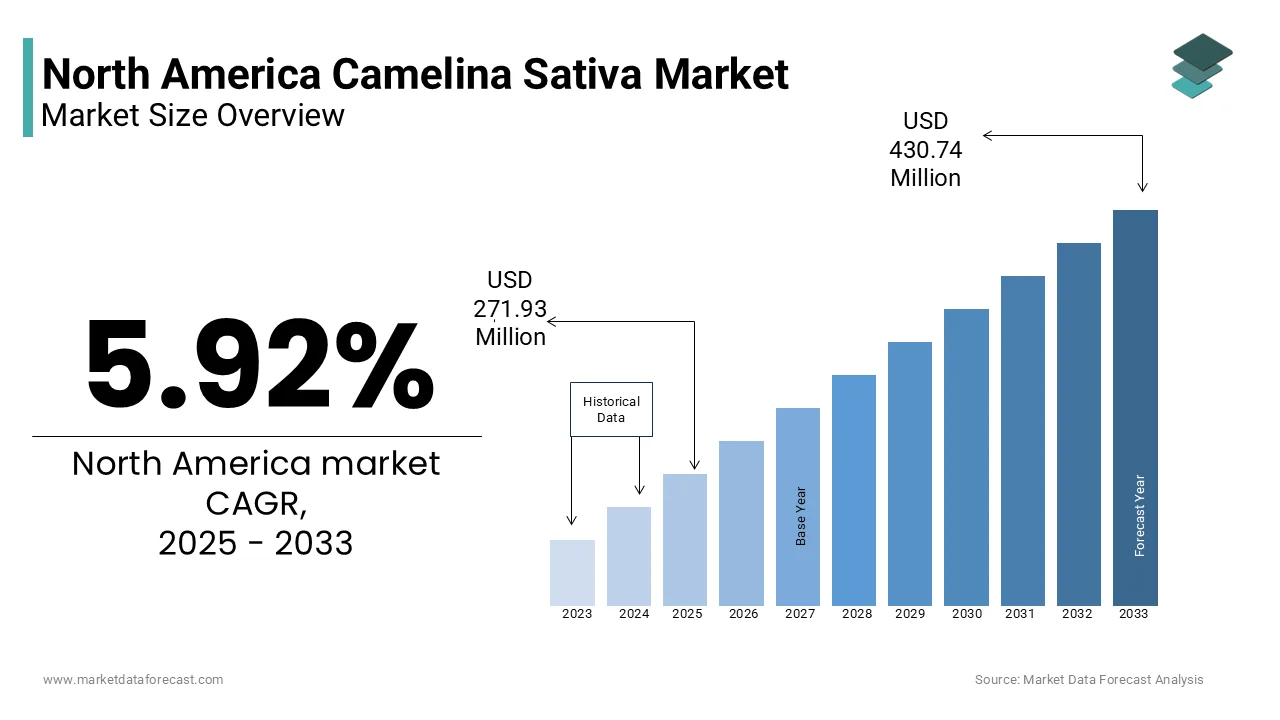
The camelina sativa market size in North America was valued at USD 271.93 million in 2025 and is predicted to be worth USD 456.31 million by 2034 from USD 288.03 million in 2026, growing at a CAGR of 5.92% from 2026 to 2034.
Camelina sativa, commonly known as false flax or gold-of-pleasure, is an oilseed crop belonging to the Brassicaceae family. It has gained significant attention in North America due to its adaptability to marginal lands, low input requirements, and high omega-3 fatty acid content. Also, camelina is cultivated for a variety of applications including biofuels, animal feed, human nutrition, and industrial lubricants. Its seeds contain up to 40% oil, making it a viable alternative to conventional oilseeds like canola and soybean, especially in sustainable agricultural systems.
The North America Camelina Sativa Market has been growing steadily, driven by increasing demand for renewable energy sources and plant-based nutritional supplements. According to the United States Department of Agriculture (USDA), camelina cultivation has expanded across several states including Montana, North Dakota, and Saskatchewan in Canada, where it is integrated into crop rotation systems due to its drought tolerance and minimal fertilizer needs.
Also, interest in camelina has surged among farmers and agribusinesses due to its potential role in carbon sequestration and soil health improvement. Additionally, government agencies such as the U.S. Department of Energy have supported research into camelina-based biodiesel as a cleaner alternative to fossil fuels.
MARKET DRIVERS
Growing Demand for Sustainable Biofuels
Among the main drivers of the North America Camelina Sativa Market is the expanding demand for sustainable, non-food-based biofuels. As governments and industries strive to reduce greenhouse gas emissions and achieve net-zero targets, camelina-derived biodiesel has emerged as a promising alternative to petroleum-based fuels.
According to the U.S. Department of Energy, camelina oil produces significantly lower lifecycle carbon emissions compared to traditional diesel, making it an attractive feedstock for renewable aviation fuel and green diesel production.
Major airlines and defense sectors in the U.S. and Canada have already initiated programs to integrate camelina-based biofuels into their operations.
For instance, the U.S. Air Force conducted successful test flights using blends containing camelina-derived jet fuel, highlighting its viability in high-performance applications. Also, as per the National Renewable Energy Laboratory, camelina requires less water and fewer agrochemical inputs than other oilseed crops, enhancing its sustainability profile.
Moreover, federal initiatives such as the Renewable Fuel Standard in the U.S. and Canada’s Clean Fuel Standard provide regulatory support for advanced biofuels, encouraging investment in camelina cultivation and processing infrastructure. So, these factors collectively contribute to the increasing adoption of camelina sativa in the bioenergy sector, driving market growth across North America.
Rising Interest in Organic and Plant-Based Nutritional Supplements
An additional key driver of the North America Camelina Sativa Market is the rising consumer preference for organic and plant-based nutritional supplements rich in omega-3 fatty acids. Camelina oil is naturally high in alpha-linolenic acid (ALA), a type of omega-3 that supports cardiovascular health and cognitive function. As per the American Heart Association, dietary intake of omega-3s is associated with reduced risks of chronic diseases, prompting increased incorporation of camelina-based oils into functional foods and dietary supplements.
In recent years, natural food and wellness brands have introduced camelina oil as a heart-healthy cooking oil alternative, capitalizing on its high smoke point and balanced fatty acid profile. According to the Organic Trade Association, sales of plant-based oils and supplements have grown significantly, with consumers seeking out sustainable and nutrient-dense options beyond flax and chia seed oils.
Apart from these, the livestock and aquaculture industries are exploring camelina meal as a protein-rich feed additive that enhances omega-3 content in meat and fish products. Research conducted by the University of Manitoba found that incorporating camelina into poultry feed improved the nutritional quality of eggs and meat, supporting broader market expansion.
MARKET RESTRAINTS
Limited Commercial Infrastructure and Processing Facilities
A key restraint affecting the North America Camelina Sativa Market is the limited availability of commercial-scale processing facilities and supply chain infrastructure. Unlike well-established oilseeds such as soybean and canola, camelina lacks widespread crushing and refining capabilities, which hampers large-scale production and cost-effective distribution.
According to the Agricultural Marketing Resource Center, only a handful of processing plants in the U.S. and Canada are equipped to handle camelina at scale, leading to logistical bottlenecks and higher handling costs for farmers and processors alike.
This lack of infrastructure results in fragmented supply chains and inconsistent market access for growers. Many camelina producers face challenges in securing reliable buyers, discouraging large-scale planting despite the crop’s agronomic advantages. As per the Montana State University Extension Service, the absence of dedicated collection points and transportation networks increases post-harvest losses and limits market participation.
Furthermore, the lack of standardized grading and certification protocols for camelina oil and meal creates uncertainty in pricing and quality assurance.
Limited Awareness and Adoption Among Farmers and End-Users
Another significant constraint in the North America Camelina Sativa Market is the relatively low awareness and adoption levels among farmers and end-users. Despite its agronomic benefits—such as drought resistance, disease tolerance, and suitability for marginal soils—camelina remains a niche crop compared to mainstream oilseeds.
Educational gaps also exist among end-users in the food, feed, and industrial sectors regarding the full range of benefits offered by camelina-based products. So, adoption remains largely confined to early adopters and research-driven pilot projects rather than widespread commercial cultivation.
Additionally, the absence of strong branding and promotional campaigns has restricted consumer recognition of camelina oil and meal in retail markets.
MARKET OPPORTUNITIES
Expansion into the Renewable Aviation Fuel Industry
An emerging opportunity within the North America Camelina Sativa Market lies in its application in the renewable aviation fuel industry. With the global push to decarbonize air travel, camelina-based biojet fuel has gained traction as a sustainable drop-in replacement for conventional jet fuel. In addition, camelina is one of the most promising feedstocks for aviation biofuels due to its high oil content, compatibility with existing engines, and low land-use change risk.
Major airline carriers and aerospace manufacturers have already demonstrated interest in camelina-based aviation fuel. Like, Boeing and SkyNRG collaborated on a program to evaluate large-scale camelina cultivation for commercial flight trials in North America. Similarly, the U.S. Department of Defense has explored camelina-derived fuels for military aircraft, recognizing its strategic value in reducing reliance on fossil fuels.
With growing investments in sustainable aviation fuel (SAF) development and supportive policies such as the U.S. Inflation Reduction Act offering tax credits for SAF production, the aviation sector represents a high-growth avenue for camelina.
Increasing Use in Functional Foods and Omega-3 Enriched Animal Feed
Another major opportunity for the North America Camelina Sativa Market is its growing use in functional foods and omega-3 enriched animal feed formulations. Consumers are increasingly prioritizing heart-healthy fats in their diets, creating a favorable environment for camelina oil to enter mainstream food markets. Moreover, camelina oil’s high ALA content and oxidative stability make it suitable for use in salad oils, baking ingredients, and fortified food products.
Simultaneously, the livestock and aquaculture sectors are adopting camelina-based feed to enhance the omega-3 content in animal-derived products such as eggs, milk, and farmed fish. According to a study, feeding layers with camelina meal resulted in significantly higher omega-3 levels in eggs, offering added-value opportunities for premium-priced functional foods.
Given the rising demand for sustainably sourced, nutritionally enhanced animal products, camelina is gaining traction as a dual-purpose crop for both feed and food applications.
MARKET CHALLENGES
Competition from Established Oilseed Crops
One of the foremost challenges facing the North America Camelina Sativa Market is the intense competition from well-established oilseed crops such as soybean, canola, and sunflower. These crops benefit from extensive breeding programs, mature supply chains, and strong governmental subsidies, making it difficult for camelina to gain significant market share.
According to the USDA Economic Research Service, canola and soybean dominate the North American oilseed landscape, with millions of acres under cultivation and deep integration into domestic and export markets. This entrenched dominance makes it challenging for camelina to attract consistent investment and farmer adoption without comparable financial incentives or policy support.
Moreover, commodity traders and processors have long-standing contracts and infrastructure tailored to these dominant crops, leaving little room for newer alternatives. As a result, camelina producers often face price volatility and limited market access, restricting their ability to compete effectively.
Regulatory and Certification Hurdles for Market Access
Another pressing challenge in the North America Camelina Sativa Market is the complex regulatory landscape governing its use in food, feed, and fuel applications. While camelina is approved for use in certain markets, obtaining regulatory clearances for new applications—especially in human food and animal feed—can be time-consuming and costly. According to Health Canada, novel food regulations require extensive safety assessments before camelina oil can be widely marketed as a mainstream edible oil, delaying its entry into mass retail channels.
Similarly, the U.S. Food and Drug Administration mandates rigorous evaluation of camelina-based feed additives before they can be used in certified organic or specialty livestock operations. These regulatory hurdles create barriers for small and mid-sized camelina processors seeking to scale their operations and diversify into high-value markets.
Without streamlined approval processes and coordinated advocacy efforts, camelina faces ongoing delays in achieving broad market acceptance.
REPORT COVERAGE
| REPORT METRIC | DETAILS |
| Market Size Available | 2025 to 2034 |
| Base Year | 2025 |
| Forecast Period | 2026 to 2034 |
| CAGR | 5.92% |
| Segments Covered | By Product Type, Application, and Region |
|
Various Analyses Covered | Regional & Country Level Analysis, Segment-Level Analysis, DROC, PESTLE Analysis, Porter’s Five Forces Analysis, Competitive Landscape, Analyst Overview on Investment Opportunities |
| Regions Covered | The United States, Canada, Mexico, and Rest of North America |
| Market Leaders Profiled | Shxchangyu, Shunyou and Xasinuote, and others |
SEGMENTAL ANALYSIS
By Product Type Insights
The industrial grade segment dominated the North America Camelina Sativa Market, accounting for 58.1% of total market revenue in 2025. This segment primarily encompasses applications in biofuels, lubricants, and biodegradable polymers, with biodiesel being the largest end-use category.

A key driver behind this dominance is the strong demand from the renewable energy sector, particularly for biodiesel and sustainable aviation fuel (SAF). According to the U.S. Department of Energy, camelina-based biodiesel offers a notable lifecycle carbon reduction compared to conventional diesel, making it a preferred feedstock for green fuel initiatives. The Federal Aviation Administration has supported multiple test programs using camelina-derived jet fuel, reinforcing its strategic importance in decarbonizing air travel.
Also, camelina oil’s high oxidative stability and low viscosity make it ideal for industrial applications beyond fuel, including hydraulic fluids, coatings, and wood preservation treatments. Several Canadian companies have begun incorporating camelina oil into eco-friendly lubricant formulations for agricultural machinery, reducing dependency on mineral oils.
The food segment, encompassing both human consumption and animal feed applications, is projected to grow at the fastest rate, registering a CAGR of 7.6%. While currently smaller than the industrial segment, it is gaining traction due to rising interest in plant-based nutrition and functional foods.
One major growth driver is the increasing adoption of camelina oil in health-conscious diets , owing to its high omega-3 fatty acid content. According to the American Heart Association, dietary intake of alpha-linolenic acid (ALA), which is abundant in camelina oil, is associated with improved cardiovascular health. Several natural food brands have introduced camelina oil as an alternative to flaxseed and chia oils, capitalizing on its high smoke point and balanced fatty acid profile.
Another factor contributing to growth is the expansion of camelina meal as a protein-rich livestock feed additive , particularly in poultry and aquaculture. As per a study published by the Journal of Animal Science, feeding layers with camelina meal significantly increased omega-3 levels in eggs, offering premium market opportunities. Similarly, according to a research conducted by the University of Manitoba, incorporating camelina into fish feed improved the nutritional value of farmed salmon.
By Application Insights
Biodiesel represented the largest application segment in the North America Camelina Sativa Market, capturing 45.1% of total industry revenue in 2025. This lead position is credited to the increasing push toward renewable fuels and the need for non-food-based feedstocks that do not compete with food supply chains.
A primary reason for its dominance is the growing integration of camelina-based biodiesel into transportation and military operations , particularly in the U.S. and Canada. Also, camelina-derived biodiesel meets ASTM D6751 standards and can be blended with petroleum diesel without engine modifications, making it a viable drop-in fuel solution.
Additionally, federal policies such as the Renewable Fuel Standard (RFS) in the U.S. and Canada’s Clean Fuel Regulation provide regulatory support for advanced biofuels , encouraging investment in camelina cultivation and processing infrastructure. As per the U.S. Department of Agriculture, over 10 million gallons of camelina-based biodiesel were produced in North America in 2023, primarily for use in farm equipment, fleet vehicles, and off-road machinery.
The jet fuel segment is anticipated to grow at the highest CAGR of 9.2% between 2025 and 2034. This rapid expansion reflects the aviation industry’s urgent need to reduce carbon emissions and adopt sustainable alternatives to fossil-based jet fuel.
A primary driver of this growth is the adoption of camelina-based sustainable aviation fuel (SAF) by major airlines and defense organizations. According to the International Air Transport Association, SAF derived from camelina is among the most promising solutions for achieving net-zero carbon emissions in aviation. In 2023, several U.S. carriers, including United Airlines and Delta, initiated pilot programs blending camelina-derived SAF into regular flight operations.
Furthermore, the U.S. Department of Defense has actively supported research into camelina-based jet fuel for military aircraft , recognizing its potential to enhance energy security while reducing environmental impact.
REGIONAL ANALYSIS
United States
The United States to the biggest share of the North America Camelina Sativa Market, contributing 62.1% of regional revenue in 2025. Montana, North Dakota, and Washington State serve as the primary cultivation hubs, benefiting from favorable climatic conditions and established agricultural networks.
A key factor behind the U.S.’s dominant position is the strong governmental support for camelina-based biofuels , particularly within the renewable aviation and military sectors. According to the U.S. Department of Energy, federal grants and tax credits have encouraged private investment in camelina-based sustainable aviation fuel (SAF) production facilities. Major players like Honeywell UOP and World Energy have expanded their SAF manufacturing capacities, relying heavily on camelina as a feedstock.
Besides, agricultural extension programs led by institutions like Montana State University have provided farmers with technical assistance and financial incentives to integrate camelina into crop rotations. With robust R&D funding, growing private-sector interest, and supportive federal policies, the U.S. continues to lead the development and commercialization of camelina sativa in North America.
 Canada
 is playing a crucial role in the crop’s regional growth. Saskatchewan and Alberta are the leading production provinces, where camelina is increasingly integrated into sustainable farming systems due to its resilience in semi-arid conditions and minimal input requirements.
One of the main drivers behind Canada’s market expansion is the country’s commitment to reducing greenhouse gas emissions through clean energy initiatives. According to Natural Resources Canada, camelina-based biofuels are viewed as a strategic component of the national renewable energy strategy, with targeted incentives for SAF and biodiesel producers.
In addition, Canadian researchers have been at the forefront of developing camelina-based feed supplements for livestock and aquaculture , enhancing its economic viability. The University of Manitoba has conducted extensive trials demonstrating the benefits of camelina meal in poultry and swine diets, supporting broader adoption in the feed industry.
Moreover, the Canadian government has launched grant programs under the Agricultural Green Growth Program to encourage farmers to cultivate camelina as part of climate-smart agriculture strategies.
KEY MARKET PLAYERS AND COMPETITIVE LANDSCAPE
Some of the key companies dominating the North America Camelina Sativa Market are Shxchangyu, Shunyou and Xasinuote.
The competition in the North America Camelina Sativa Market is evolving as traditional agribusinesses, emerging biofuel firms, and specialty food ingredient suppliers vie for market share. While major players leverage their existing networks and financial strength to integrate camelina into established supply chains, smaller niche companies are carving out specialized roles in organic food markets and advanced biofuels. The competitive landscape is shaped by the dual challenge of scaling production while maintaining profitability in a relatively new and fragmented market.
Agricultural giants like Cargill and Bunge dominate in terms of reach and logistics, but agile startups and cooperatives are gaining traction by focusing on sustainability-driven consumers and green energy mandates. Innovation is a key differentiator, with companies investing in breeding programs, processing technologies, and value-added formulations to improve margins and attract diverse industries.
Regulatory developments and government incentives also play a crucial role in shaping competitive dynamics. Companies that effectively align with clean energy policies and consumer health trends are better positioned to capture growing opportunities. As awareness and adoption increase, the market is expected to consolidate further, with early movers securing stronger footholds in both upstream and downstream segments.
TOP PLAYERS IN THE MARKET
Sustainable Oils, LLC
Sustainable Oils is a leading producer and marketer of camelina-based products in North America. The company specializes in developing sustainable feedstocks for renewable fuels, animal nutrition, and specialty oils. Sustainable Oils plays a pivotal role in connecting growers with end-users across the biofuel and agricultural sectors, ensuring consistent supply chain integration and quality control.
Bunge Limited
Bunge has been actively involved in the development and commercialization of camelina-based oils for both food and industrial applications. The company contributes to market growth through its extensive agribusiness network, processing capabilities, and commitment to sustainable sourcing. Bunge supports research into camelina’s nutritional benefits and promotes its use in plant-based dietary supplements and livestock feed.
Cargill, Incorporated
Cargill has integrated camelina sativa into its broader portfolio of sustainable agricultural commodities. The company invests in supply chain optimization, farmer engagement, and product innovation to expand camelina's presence in biofuels, animal feed, and specialty oils. Cargill collaborates with industry stakeholders to enhance market acceptance and facilitate large-scale adoption across key value chains.
TOP STRATEGIES USED BY KEY PLAYERS
Expanding Partnerships with Renewable Fuel Producers
Leading players are strengthening their positions by forming strategic alliances with biofuel companies to ensure a steady demand for camelina as a feedstock. These collaborations help secure long-term contracts and drive investment in processing infrastructure tailored to camelina-based biodiesel and sustainable aviation fuel.
Engaging Farmers Through Contract Farming and Technical Support
To ensure a stable and scalable supply of camelina, companies are offering contract farming models that include agronomic support, premium pricing, and seed distribution. This approach encourages wider cultivation while aligning production with downstream processing needs.
Promoting Research and Development for High-Value Applications
Market participants are investing in R&D initiatives focused on improving camelina yield, oil content, and suitability for high-value markets such as functional foods, omega-3 enriched animal feed, and biobased industrial products. These efforts aim to diversify revenue streams and enhance the crop’s economic viability.
RECENT HAPPENINGS IN THE MARKET
- In February 2025, Sustainable Oils announced a long-term partnership with a U.S.-based renewable aviation fuel company to secure dedicated camelina supplies for sustainable jet fuel production, reinforcing its role in the clean energy transition.
- In March 2025, Cargill launched a farmer outreach program in Montana and North Dakota to promote camelina as a rotational crop, providing technical assistance and guaranteed procurement contracts to encourage wider adoption among growers.
- In May 2025, Bunge expanded its oilseed crushing facility in Saskatchewan to accommodate camelina processing, enhancing its capacity to deliver high-quality oil and meal for both industrial and nutritional applications.
- In June 2025, a leading Canadian biotech firm introduced a proprietary camelina variety with enhanced oil yield and cold tolerance, aiming to improve profitability for farmers and attract interest from biofuel and food sectors.
- In July 2025, World Energy collaborated with Sustainable Oils to scale up camelina-based sustainable aviation fuel (SAF) blending at its California refinery, marking a significant step toward mainstreaming camelina-derived jet fuel in commercial aviation
MARKET SEGMENTATION
This research report on the North America camelina sativa market has been segmented and sub-segmented based on the following categories.
By Product Type
- Food
- Human Food
- Animal Feed
- Industrial Grade
By Application
- Food Industry
- Chemical Industry
- Biodiesel
- Textile
- Cosmetics
- Jet Fuel
- Others
By Country
- The United States
- Canada
- Rest of North America