North America Commercial Greenhouse Market Size, Share, Trends, COVID-19 Impact & Growth Forecast Report, Segmented By Type (Glass and Plastic), Crop Type (Fruits & Vegetables, Flowers And Ornamentals, Nursery Crops and Varietal), Equipment Type (Heating System, Cooling System and Others) And Country (The U.S., Canada and Rest of North America), Industry Analysis From (2026 to 2034)
Market Size, 2025
$7.65 BnMarket Estimate, 2026
$8.25 BnMarket Forecast, 2034
$15.04 BnCAGR, 2026–2034
7.8%North America Commercial Greenhouse Market Size
The North American commercial greenhouse market was valued at USD 7.65 billion in 2025 and is anticipated to reach USD 8.25 billion in 2026 from USD 15.04 billion by 2034, growing at a compound annual growth rate (CAGR) of 7.8% from 2026 to 2034.

Commercial Greenhouse is a technologically advanced and climate-controlled agricultural structure designed for year-round, high-yield cultivation of vegetables, fruits, ornamentals, and medicinal plants. These facilities integrate hydroponics, automated irrigation, and energy-efficient glazing to optimize production while minimizing land and water use.
MARKET DRIVERS
Escalating Demand for Locally Grown, Year-Round Produce Amid Urbanization
Urban expansion across North America has severed traditional supply chains between rural farms and metropolitan consumers, which drives the growth of the North American commercial greenhouse market. This compels retailers and foodservice providers to source hyper-local produce. As per the research, a portion of the American population resides in urban zones, which creates an agricultural burden for proximate food production. Commercial greenhouses situated near distribution hubs in states like California, Texas, and Florida satisfy this need by delivering vine-ripened tomatoes, leafy greens, and berries, irrespective of external weather. This proximity-driven efficiency fuels capital investment in modular greenhouse clusters near Tier-1 and Tier-2 cities.
Regulatory and Consumer Push for Pesticide-Free, Resource-Efficient Cultivation
Heightened scrutiny over chemical residues in food and unsustainable water usage has reshaped procurement policies across institutional buyers, contributing to the expansion of the North American commercial greenhouse market. As per research, a portion of imported produce exceeded allowable pesticide thresholds, triggering retailer mandates for residue-free domestic alternatives. Commercial greenhouses, deploying integrated pest management and closed-loop hydroponics, use less water than open-field farming, as per research. Whole Foods Market and Walmart source a portion of their leafy greens from North American greenhouse operators certified to the standard, which accelerates the adoption of sealed-environment cultivation as a compliance and branding tool.
MARKET RESTRAINTS
Prohibitive Capital Expenditure and Energy Dependency in Cold-Climate Zones
Establishing a commercial greenhouse in northern U.S. states or Canadian provinces demands substantial upfront investment for thermal retention and supplemental lighting, which restrains the growth of the North American commercial greenhouse market. As per the study, greenhouse operations in Alberta and Manitoba consume gigajoules of energy per square meter annually, primarily for heating during sub-zero months. The setup cost for a one-acre high-tech greenhouse exceeds, according to the research. Therefore, operators in colder regions face margin compression due to rising natural gas prices, which deters small and mid-sized entrants despite strong market demand.
Skilled Labor Shortage and Automation Integration Delays
The lack of specialized horticultural technicians trained in climate control systems, nutrient dosing algorithms, and robotic harvesting is degrading the growth of the North American commercial greenhouse market. The vacancies for greenhouse and nursery managers increased year-over-year, while qualified applicants declined due to aging workforce demographics and a lack of vocational training pipelines. High costs for integration of AI-driven crop monitoring or robotic transplanters, which require notable investments and IT expertise, lead to adoption lag among legacy operators who remain reliant on manual workflows.
MARKET OPPORTUNITIES
Expansion of Medicinal and High-Value Botanical Production Under Controlled Conditions
The rise of medicinal and high-value botanical production under controlled conditions generates potential opportunities for the growth of the North American commercial greenhouse market. Greenhouses are increasingly repurposed for cultivating FDA-compliant medicinal botanicals, including cannabis for therapeutic use and rare herbs for nutraceutical extraction. Similarly, according to research, there has been a surge in greenhouse-grown echinacea and valerian root, driven by demand from supplement manufacturers requiring contaminant-free biomass. This pivot enables operators to command 3x to 5x higher per-square-foot revenue compared to conventional vegetable production.
Integration with Renewable Microgrids and Carbon Credit Monetization
Incorporation of renewable microgrids and carbon credit monetization is fuelling fresh opportunities for the North American commercial greenhouse market. Forward-looking greenhouse operators are decoupling from fossil-fuel dependency by co-locating with solar arrays, geothermal wells, or biomass digesters. As per the study, greenhouses in Arizona and Colorado utilizing on-site photovoltaic canopies reduced grid reliance while selling surplus energy back to utilities. Furthermore, the Climate Action Reserve has specific protocols for different agricultural activities, including a U.S. and Canada Biochar Protocol for carbon sequestration via biochar and a U.S. Livestock Project Protocol that certifies emission reductions from manure management and anaerobic digestion.
MARKET CHALLENGES
Glazing Material Degradation and Flat Glass Supply Chain Volatility
Volatility in the flat glass supply chain and degradation in glazing material impede the expansion of the North American commercial greenhouse market. The performance of commercial greenhouses hinges on optical-grade glazing that maximizes PAR transmission while minimizing thermal loss. However, as per the study, North American flat glass production capacity remains concentrated among primary manufacturers, creating supply barriers. Lead times for low-iron horticultural glass stretched to several weeks, which delays project commissioning.
Regulatory Fragmentation Across State and Provincial Jurisdictions
Regulatory fragmentation across state and provincial jurisdictions is a key issue in the North American commercial greenhouse market. Unlike field agriculture, commercial greenhouse operations confront a labyrinth of localized building codes, water reuse permits, and zoning ordinances that vary even within single states. As per the study, many U.S. states lack standardized permitting frameworks for hydroponic discharge or supplemental CO₂ injection, forcing operators to navigate disparate county-level approvals.
REPORT COVERAGE
| REPORT METRIC | DETAILS |
| Market Size Available | 2025 to 2034 |
| Base Year | 2025 |
| Forecast Period | 2026 to 2034 |
| CAGR | 9.5% |
| Segments Covered | By Equipment, Type, Crop Type, and Country |
| Various Analyses Covered | Global, Regional, and country-level analysis; Segment-Level Analysis, DROC, PESTLE Analysis, Porter’s Five Forces Analysis, Competitive Landscape, Analyst Overview of Investment Opportunities |
| Country's Covered | The United States, Canada, and the Rest of North America |
| Market Leaders Profiled | Nexus Corporation, Heliospectra AB, Argus Control Systems Limited, Lumigrow Inc., Hort Americans, LLC, Agra Tech, Inc., Rough Brothers, Inc., Berry Global Group, Inc., Prospect, Stuppy Greenhouse, and DeCloet Greenhouse Manufacturing Ltd. |
SEGMENT ANALYSIS
By Type Insights
The plastic-based structures segment led the North America commercial greenhouse market with a substantial share in 2024 due to technological superiority and economic pragmatism. Plastic films and polycarbonate panels offer lower initial installation costs compared to glass. Apart from these, plastic greenhouses require 30% less structural framing, reducing steel consumption and enabling rapid deployment in semi-rural zones where zoning permits are more lenient. As per the study, a portion of new greenhouse entrants in the Midwest and Southeast selected plastic cladding due to its scalability and lower insurance premiums.

The glass segment is predicted to witness the highest CAGR of 11.7% from 2025 to 2033. The rapid growth of the glass segment is fueled by premium retail and foodservice contracts demanding visually transparent, UV-stable growing environments for branding and consumer trust. The advancements in low-iron horticultural glass have boosted photosynthetically active radiation transmission, as per research, which enables higher yields per square foot compared to twin-wall polycarbonate. Institutional investors, including pension funds allocating to agri-infrastructure, increasingly favor glass for lifespan and asset depreciation profile.
By Crop Typology Insights
The fruits and vegetables segment dominated the North American commercial greenhouse market by occupying a significant share in 2024. Retailer consolidation and nutritional policy shifts are majorly contributing to the growth of the fruits and vegetables segment. Walmart, Kroger, and Costco collectively sourced notable worth of greenhouse-grown tomatoes, cucumbers, and peppers in 2023, as per the Food Marketing Institute’s annual procurement disclosures, prioritizing year-round availability and blemish-free aesthetics unattainable in open-field systems. Simultaneously, as per the 2025 Dietary Guidelines Advisory Committee, which was delivered to the U.S. Departments of Agriculture and Health and Human Services in late 2024, emphasizes the importance of vegetable intake.
The flowers and ornamentals segment is estimated to register a CAGR of 14.2% during the forecast period, owing to experiential retail trends and therapeutic horticulture adoption. Home Depot and Lowe’s expanded their live plant SKUs, allocating more shelf space to greenhouse-propagated flowering perennials and indoor foliage, responding to consumer demand for biophilic home design, as per the study. Concurrently, clinical adoption of horticultural therapy in VA hospitals and senior care facilities has grown, which requires consistent, pesticide-free ornamental supply chains only achievable under controlled greenhouse conditions with verifiable provenance.
By Equipment Typology Insights
The heating systems were the leading segment by accounting for 53.8% of the regional market share in 2024. The predominance is non-negotiable in climate zones where winter temperatures routinely dip below freezing, particularly across the Canadian Prairies and the U.S. Upper Midwest. Natural gas-fired hot water boilers remain the default by serving a portion of heated acreage, as per research. This is due to their compatibility with existing utility grids and thermal mass efficiency.
The cooling systems segment is swiftly growing and is projected to expand ata 16.3% CAGR during the forecast period. The growth of the cooling systems is due to intensifying summer heat domes and humidity spikes. Pad-and-fan evaporative systems now integrate with AI-driven VPD (vapor pressure deficit) controllers, which reduce crop transpiration loss compared to unregulated ventilation.
COUNTRY ANALYSIS
United States
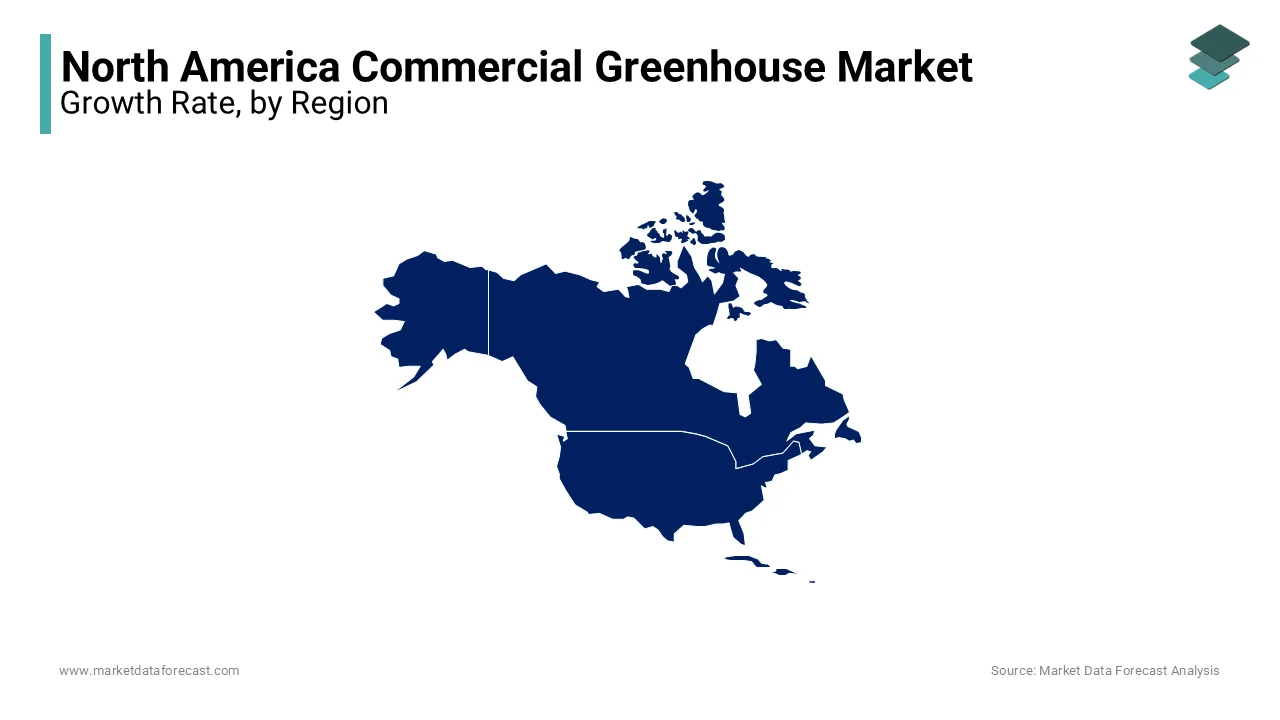
United was the top performer in the North America commercial greenhouse market by capturing 71.8% of the market share in 2024. The domination of the United States in the regional market is due to tax policy, urban migration, and supply chain localization cements. The growth is not merely demographic but infrastructural. Many states offer accelerated depreciation allowances for controlled environment agriculture under the tax code, incentivizing corporate investment. Walmart’s Dallas and Orlando fulfillment centers source a portion of their fresh produce within a 150-mile radius, which compresses logistics and favors local greenhouse clusters.
Canada
Canada grew steadily in the North American commercial greenhouse market, with Ontario and British Columbia in the lead, which together operate a portion of the nation’s commercial greenhouse acreage. Unlike the U.S., Canada’s growth is policy-engineered. The federal government allocated a significant amount to greenhouse operators adopting carbon capture and geothermal heating, which positions the sector as a climate mitigation tool. Leamington, Ontario, dubbed the Tomato Capital of Canada, exports notable millions annually in greenhouse vegetables, primarily to U.S. border states, leveraging NAFTA’s successor trade framework.
COMPETITION LANDSCAPE
The North America Commercial Greenhouse Market features a tripartite competitive landscape: legacy structural engineers, agri-tech integrators, and modular system disruptors. Competition centers not on price but on resilience engineering, regulatory alignment, and yield predictability. Incumbents leverage decades of structural certification to win public tenders, while tech-native entrants embed AI and IoT to lock in recurring SaaS revenue.
KEY MARKET PLAYERS
A few of the market players in the North American commercial greenhouse market include
- Nexus Corporation
- Heliospectra AB
- Argus Control Systems Limited
- Lumigrow Inc.
- Hort Americans
- LLC
- Agra Tech, Inc.
- Rough Brothers, Inc.
- Berry Global Group, Inc.
- Prospect
- Stuppy Greenhouse
- DeCloet Greenhouse Manufacturing Ltd.
Top Players In The Market
- Certhon North America engineers turnkey greenhouse systems integrating climate computers, energy curtains, and hydroponic layouts tailored for North American microclimates. The firm collaborates with universities to validate crop models under variable light conditions, strengthening technical credibility. It recently launched a modular greenhouse design compatible with rooftop urban farms, which is targeting municipal food resilience grants. Certhon avoids commoditized pricing, instead embedding AI-driven yield forecasting into every build by differentiating through agronomic intelligence rather than square footage.
- Rough Brothers, Inc. specializes in custom-engineered greenhouse structures for research institutions and commercial growers, emphasizing durability in extreme weather. The company retrofitted university botanical facilities with seismic-compliant framing ahead of Pacific Northwest fault line activity projections. Rough Brothers prioritizes structural longevity over rapid scalability, which aligns with public-sector infrastructure cycles.
- Nexus Corporation delivers scalable greenhouse kits optimized for cannabis, leafy greens, and vertical stacking systems. The open innovation lab to simulate desert-climate growing under photovoltaic canopies. Nexus targets regulatory-compliant, high-margin crops, avoiding commodity vegetable markets. Its modular automation stack allows third-party robotics integration and future-proofing installations against labor shortages.
Top Strategies Used by Key Market Participants
Leading players deploy asset-light expansion through leasing models to reduce client entry barriers. They embed regulatory compliance software directly into control systems to preempt audit failures. Strategic university partnerships validate agronomic performance under localized conditions, building scientific credibility. Energy resilience is engineered via hybrid geothermal-solar integrations, reducing operational volatility. Workforce development initiatives, including certified technician programs, secure long-term service revenue while mitigating labor scarcity
RECENT MARKET NEWS
- In April 2023, PepsiCo, Inc. started its greenhouse accelerator program named Juntos Crecemos Edition. Through its program, the company aims to offer support to Hispanic-owned businesses in the food and beverage sector using the latest innovations.
- In August 2022, Redwire, a leading space infrastructure company in the USA, planned to launch its commercial greenhouse on the International Space Station to promote crop yield and offer space exploration support.
MARKET SEGMENTATION
This research report on the North America commercial greenhouse market has been segmented and sub-segmented based on equipment, Type, Crop Type, and country.
By Type
- Glass
- Plastic
By Crop Type
- Fruits & Vegetables
- Flowers and Ornamentals
- Nursery Crops
- Varietal
By Equipment Type
- Heating Systems
- Cooling Systems
- Others
By Country
- The U.S.
- Canada
- Rest of North America
Frequently Asked Questions
What is the North America commercial greenhouse market?
The North America commercial greenhouse market includes the construction, equipment, and operation of large-scale greenhouse facilities used to produce vegetables, flowers, herbs, and other horticultural crops year-round under controlled conditions.
Why are commercial greenhouses important?
Commercial greenhouses enable year-round crop production, improved yield, efficient resource use, reduced dependency on seasonal weather, and enhanced food security.
What drives growth in the North America commercial greenhouse market?
Growth is driven by increasing demand for fresh produce, controlled-environment agriculture (CEA), labor efficiency, climate change challenges, and technological advancements in automation and environmental control.
What technologies are used in commercial greenhouses?
Key technologies include climate control systems, LED lighting, hydroponics/aeroponics, sensors, IoT connectivity, automated irrigation, and environmental monitoring.
What crops are commonly grown in commercial greenhouses?
Typical crops include tomatoes, cucumbers, peppers, leafy greens, herbs, ornamental flowers, and specialty produce for retail and foodservice markets.
How do commercial greenhouses support sustainability?
They improve sustainability by reducing water use, enabling precision nutrient delivery, cutting transportation emissions, lowering pesticide use, and optimizing land use.
Which regions in North America are key markets?
Major activity occurs in the United States (California, Florida, Arizona, Texas) and Canada, where greenhouse operations support local produce supply and export markets.
What trends are shaping the commercial greenhouse market?
Key trends include vertical integration, automation, robotics, digitization, renewable energy integration, and specialty/high-value crop production.
What challenges does the market face?
Challenges include high capital costs, energy consumption, labor shortages, regulatory compliance, and competition from traditional open-field farming.
How do controlled environmental systems benefit crop yields?
Controlled systems optimize temperature, humidity, CO₂, and light, reducing stress on crops and enabling higher yields, better quality, and more consistent production.
Related Reports
Access the study in MULTIPLE FORMATS
Purchase options starting from
$ 2000
Didn’t find what you’re looking for?
TALK TO OUR ANALYST TEAM
Need something within your budget?
NO WORRIES! WE GOT YOU COVERED!
Call us on: +1 888 702 9696 (U.S Toll Free)
Write to us: sales@marketdataforecast.com