- Product Description Description
- Table of Contents TOC
- List of Table & Figure LOT
- Get Free Sample PDF Sample PDF
Market Size, 2025
$69.03 BnMarket Estimate, 2026
$78.28 BnMarket Forecast, 2034
$214.06 BnCAGR, 2026–2034
13.4%Executive Summary: North America Data Center Server Market
- Market Scope: Comprehensive North American data center server industry analysis covering server tiers, form factors, vertical applications, deployment types, country leadership frameworks, strategic corporate developments, and competitive landscapes.
- Market Valuation: Valued at USD 69.03 billion (2025), estimated at USD 78.28 billion (2026), and projected to reach USD 214.06 billion by 2034, registering a robust CAGR of 13.40% (2026–2034).
- Primary Growth Drivers: Surge in AI and machine learning workloads, high-performance computing infrastructure demand, edge computing proliferation, liquid cooling adoption for high-density servers, modular data center shifts, and hyperscale cloud investments. Restraints include escalating energy costs and semiconductor supply chain disruptions.
Key Market Segment Metrics (2026–2034)
| Category | Leading Segment (2025 Position) | Fastest-Growing Segment |
|---|---|---|
| By Server Tier | Tier 1 servers (dominated market with a 65.1% share in 2025) | Tier 2 servers (expanding at a CAGR of 14.2%) |
| By Form Factor | Half-Height Blades (led form factor segment with 42.3% share) | Micro Servers (experiencing the highest growth rate at a CAGR of 16.8%) |
| By Vertical | BFSI (accounted for 28.4% of end-user demand) | Manufacturing (fastest-growing vertical at a CAGR of 15.4%) |
| By Application | Virtualization and Private Cloud (held largest share at 35.7%) | Storage-Centric servers (growing fastest at a CAGR of 17.6%) |
| By Region / Country | United States (commanded 85.7% of the regional market in 2025) | North American hyperscale expansion and digital transformation hubs |
Major Market Players & Market Structure
Market Structure: Highly competitive North American hardware and cloud infrastructure ecosystem driven by strategic cloud partnerships, heavy R&D investments in next-generation processors, intelligent management platforms, and circular economy sustainability initiatives.
Key Companies: Dell Technologies Inc., Hewlett Packard Enterprise (HPE), IBM Corporation, Cisco Systems, Inc., Lenovo Group Limited, Super Micro Computer, Inc., Oracle Corporation, Microsoft Corporation (Azure), Google LLC (Google Cloud), Amazon Web Services, Inc. (AWS), Fujitsu Ltd., Hitachi, Ltd., Huawei Technologies Co., Ltd., Inspur Systems Ltd., QCT (Quanta Cloud Technology), NetApp, Inc., VMware, Inc., Nutanix, Inc., Equinix, Inc., and Rackspace Technology, Inc.
North America Data Center Server Market Size
The North America Data Center Server Market is projected to grow from USD 69.03 billion in 2025 to USD 78.28 billion in 2026 and reach USD 214.06 billion by 2034, registering a CAGR of 13.40% from 2026 to 2034.
A data center server is a high-performance computer designed to process, store, and distribute data at a massive scale within a centralized facility called a data center. These servers form the backbone of data processing and storage within colocation facilities, enterprise data centers, and cloud service infrastructures. Data center operations account for a notable portion of North America's total electricity consumption, reflecting the sector's significant energy demands. A substantial concentration of the world's most expansive data centers is located within the region, indicating a leading role in global digital infrastructure. Specific areas within North America are establishing themselves as central locations for these facilities. A large number of operational data centers across the region support the increasing reliance on digital services. The server deployment landscape is increasingly influenced by hybrid cloud adoption, artificial intelligence (AI) workloads, and edge computing demands. Moreover, the energy use of data centers in North America has remained relatively stable despite increasing workloads, due to improvements in server efficiency and virtualization technologies.
MARKET DRIVERS
Surge in AI and Machine Learning Workloads
The proliferation of artificial intelligence and machine learning applications is contributing to the growth of the North America data center server market. Enterprises across sectors such as healthcare, finance, and automotive are increasingly deploying AI-driven analytics, necessitating high-performance computing (HPC) capabilities. Substantial revenue is observed in the global AI software market, indicating commercial interest. A specific region accounts for a majority of the global expenditure on AI software. The trend in AI software expenditure is driving infrastructure changes, leading operators to prioritize investment in specialized, high-computation servers. A key component provider for these servers has experienced a significant revenue increase, demonstrating the commercial impact of this infrastructure shift. The demand is further amplified by generative AI platforms, which require clusters of servers equipped with advanced processors and high-bandwidth memory. These developments signal a sustained demand for next-generation servers tailored for AI and HPC environments, which strengthens this as a dominant market driver.
Expansion of Edge Computing Infrastructure
The rapid proliferation of edge computing is another pivotal factor propelling the expansion of the North America data center server market. As latency-sensitive applications such as autonomous vehicles, augmented reality, and real-time analytics gain traction, data processing is increasingly decentralized to locations closer to end-users. The financial scale of technologies designed to process data closer to where it originates is expanding significantly, with a substantial portion of this market expansion concentrated in a specific geographic region. This growth pattern requires changes in the physical characteristics of computing hardware, with a shift towards smaller, self-contained servers deployed in numerous locations rather than solely in large, centralized facilities. Furthermore, the rise of smart cities and IoT ecosystems in the U.S. and Canada is accelerating the need for localized compute resources. These edge deployments often require ruggedized and low-latency servers, creating a new niche within the broader server market. Consequently, the expansion of edge infrastructure is becoming a key catalyst for server innovation and procurement in the region.
MARKET RESTRAINTS
Escalating Energy Costs and Sustainability Concerns
Mounting pressure from rising energy costs and sustainability mandates restricts the growth of the North America data center server market. As servers are among the most power-intensive components in data centers, their continuous operation contributes significantly to overall energy consumption. Commercial electricity costs have risen, increasing operational expenses for data center operators [1]. Inefficient server use and cooling systems contribute significantly to total data center energy consumption. Regulations and standards are tightening to encourage energy efficiency [1]. Some new construction rules require efficient server technology in new data centers, and many data center operators view energy management as a major operational hurdle. As sustainability becomes a corporate priority, organizations are prioritizing server consolidation, virtualization, and liquid cooling technologies over raw server procurement. Consequently, the financial and regulatory burden of energy-intensive server operations is constraining market growth, particularly for legacy and underutilized systems.
Supply Chain Disruptions and Component Shortages
Persistent supply chain disruptions and semiconductor shortages further impede the expansion of the North America data center server market. The global chip shortage, exacerbated by geopolitical tensions and pandemic-induced factory shutdowns, has severely impacted server manufacturing timelines. Supply chains for critical hardware components have shown gaps between inventory and demand. The availability of specialized parts has impacted the production of enterprise computing equipment. Technology manufacturers have observed extended periods for fulfilling customer orders due to these constraints. Distribution delays have been linked to the scarcity of foundational microelectronic elements. Additionally, the concentration of semiconductor fabrication in Asia introduces logistical vulnerabilities. Many North American server manufacturers experienced delays exceeding eight weeks for key components. These disruptions have led to increased server costs, with average server prices rising. Furthermore, the reliance on a limited number of suppliers for high-end processors and memory has intensified supply risks. The ripple effect of these constraints is evident in delayed data center expansions and reduced server refresh cycles, particularly among mid-sized enterprises. So, these barriers will remain a significant restraint on market scalability.
MARKET OPPORTUNITIES
Adoption of Liquid Cooling Technologies
Liquid cooling offers a potential opportunity for the North American data center server market. This is driven by the need for enhanced thermal management in high-density computing environments. Traditional air-cooling systems are increasingly inadequate for modern servers that operate at elevated power densities, particularly those supporting AI and HPC workloads. As per sources, liquid-cooled servers can reduce energy consumption compared to conventional systems. Major vendors such as IBM and Hewlett-Packard Enterprise have introduced immersion cooling solutions tailored for dense server deployments. Furthermore, the U.S. Department of Energy’s Better Building Challenge promotes liquid cooling adoption, offering incentives for energy-efficient server infrastructure. The push for sustainable, high-performance computing is making liquid cooling a cornerstone of future data centers, which opens lucrative opportunities for specialized server technologies and cooling solutions.
Growth in Modular and Micro Data Centers
The emergence of modular and micro data centers is opening new prospects for the North American data center server market. This is particularly true for remote and edge locations. These compact, scalable solutions offer rapid deployment capabilities without the need for extensive infrastructure investments. Many North American enterprises are increasingly adopting modular infrastructure to manage distributed computing requirements. These localized data centers are designed to support specific regional applications. Major telecommunications providers are utilizing these compact units to extend high-performance computing capabilities into less-populated or rural areas. Federal standards now recognize modular architectures as a viable method for achieving scalable and secure computing frameworks. The shift toward decentralized solutions reflects a growing emphasis on processing data closer to where it is generated and used. Modular data centers provide server vendors with versatile, tailored solutions for various deployment scenarios, allowing businesses to achieve agility and low-latency processing.
MARKET CHALLENGES
Cybersecurity Vulnerabilities in Server Infrastructure
Cybersecurity threats pose a major barrier to the North American data center server market. This is because servers remain prime targets for cyberattacks due to their critical role in data processing and storage. The increasing sophistication of ransomware, DDoS attacks, and firmware-level breaches has heightened security concerns. The rise of zero-day exploits targeting server firmware has further complicated defense strategies. A significant portion of these costisre specifically linked to incidents involving server infrastructure. The average expense incurred from a single breach affecting a server is considerable, driving the adoption of various protective measures such as software updates, data masking techniques, and systems designed to identify unauthorized access. A persistent vulnerability pattern exists concerning older server equipment that is not current with modern operational software. A considerable number of data center facilities still utilize these older, less secure systems. These security vulnerabilities not only increase operational risks but also drive demand for secure-by-design servers, pushing vendors to integrate advanced threat detection capabilities. However, balancing performance with security remains a persistent challenge, especially in cost-sensitive deployments.
Regulatory Compliance and Data Sovereignty Requirements
Data sovereignty and regulatory compliance are emerging as complex challenges for the North American data center server market. This is particularly true as governments tighten data governance frameworks. Regulations are introducing new requirements regarding the physical location where data processing occurs. Mandates are becoming more localized, restricting cross-border data flows and increasing the need for region-specific infrastructure deployments. Rules from one major economic region can influence operational requirements for North American data centers handling data from that region. Enterprises have noted an increase in compliance expenses due to evolving data residency laws, and a complex regulatory environment can present a barrier to efforts to increase server scalability. Furthermore, the lack of standardized compliance frameworks across states and provinces complicates server deployment strategies. For instance, California’s privacy laws differ significantly from those in Texas or Ontario, creating operational fragmentation. These regulatory hurdles not only increase administrative overhead but also limit the flexibility of server provisioning, especially for multinational enterprises seeking unified infrastructure strategies. Navigating evolving data governance and compliance landscapes remains a critical challenge for market participants.
REPORT COVERAGE
| REPORT METRIC | DETAILS |
| Market Size Available | 2025 to 2034 |
| Base Year | 2025 |
| Forecast Period | 2026 to 203 |
| Segments Covered | By Tier, Form Factor, End-User Verticals, Application, and Region. |
| Various Analyses Covered | Global, Regional, and Country-Level Analysis, Segment-Level Analysis, Drivers, Restraints, Opportunities, Challenges; PESTLE Analysis; Porter’s Five Forces Analysis, Competitive Landscape, Analyst Overview of Investment Opportunities |
| Countries Covered | United States |
| Market Leaders Profiled | Dell Technologies Inc., Hewlett Packard Enterprise (HPE), IBM Corporation, Cisco Systems, Inc., Lenovo Group Limited, Super Micro Computer, Inc., Oracle Corporation, Microsoft Corporation (Azure), Google LLC (Google Cloud), Amazon Web Services, Inc. (AWS), Fujitsu Ltd., Hitachi, Ltd., Huawei Technologies Co., Ltd., Inspur Systems Ltd., QCT (Quanta Cloud Technology), NetApp, Inc., VMware, Inc., Nutanix, Inc., Equinix, Inc., Rackspace Technology, Inc. |
SEGMENTAL ANALYSIS
By Tier Insights
The Tier 1 segment dominated the North America data center server market by accounting for a 65.1% share in 2025. The dominance of Tier 1 servers is primarily driven by their superior reliability, advanced processing capabilities, and comprehensive support ecosystems that large organizations require for mission-critical applications. This segment encompasses enterprise-grade servers from leading vendors,s including Dell EMC, HPE, and IBM, which are deployed in large-scale data centers operated by hyperscalers and major corporations. The expansion of hyperscale data centers across North America is the main factor propelling Tier 1 server dominance. Major technology companies, es including Amazon Web Services, Microsoft Azure, and Google Cloud Platform,orm have invesa ted substantial amount in North American data center infrastructure. These hyperscalers predominantly procure Tier 1 servers due to their scalability, performance consistency, and integration capabilities with existing enterprise ecosystems. The deployment of these servers supports massive cloud computing operations that require thousands of interconnected units operating with minimal downtime. Furthermore, the shift toward containerized applications and microservices architecture has increased demand for high-performance Tier 1 servers that can efficiently handle distributed computing workloads. Enterprise digital transformation programs across North America have significantly bolstered Tier 1 server adoption, as organizations prioritize robust infrastructure to support their evolving business needs. These enterprises predominantly select Tier 1 servers due to their advanced security features, comprehensive management tools, and extended lifecycle support that align with corporate governance requirements. Manufacturing companies have also increased Tier 1 server procurement year-over-year to support Industry 4.0 initiatives, including IoT integration and predictive analytics platforms. Additionally, the healthcare sector's migration to electronic health records and telemedicine platforms has created substantial demand for Tier 1 servers. These enterprise-wide deployments typically involve procurement contracts worth millions of dollars, making Tier 1 vendors the preferred choice for organizations requiring long-term reliability and vendor accountability.
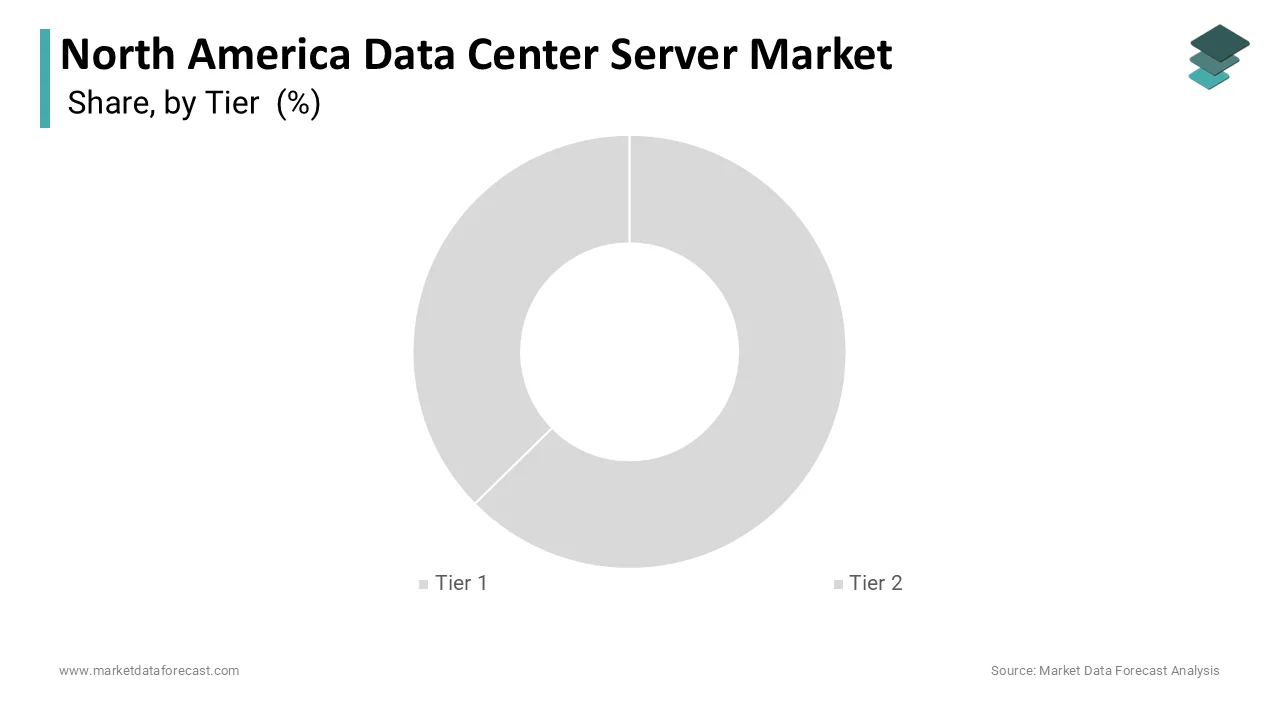
The Tier 2 server segment is expected to exhibit a noteworthy CAGR of 14.2% from 2025 to 2033 due to increasing adoption among mid-sized enterprises, edge computing deployments, and specialized applications that do not require the extensive features of premium server offerings. This segment represents emerging vendors and mid-tier server solutions that offer competitive performance at reduced costs compared to Tier 1 alternatives. The proliferation of cost-effective Tier 2 server solutions has caused rapid market expansion by addressing the infrastructure needs of mid-market enterprises that previously could not afford Tier 1 alternatives. These companies typically operate with IT budgets smaller thanthose of large enterprises, making Tier 2 servers an attractive option. The education sector has emerged as a significant adopter. Similarly, regional healthcare systems have adopted Tier 2 servers for departmental applications and localized data processing. The availability of modular configurations and simplified management interfaces has further enhanced Tier 2 server appeal, enabling organizations with limited IT resources to deploy and maintain server infrastructure effectively. The explosive growth of edge computing applications has emerged as the major driver for Tier 2 server market expansion, as these solutions offer an optimal balance between performance and deployment flexibility for distributed computing environments. Telecommunications companies have been particularly aggressive in adopting Tier 2 servers for 5G network edge nodes. The retail sector has also embraced Tier 2 servers for in-store computing applications. Additionally, smart city initiatives across North American municipalities have accelerated Tier 2 server adoption, with local governments procuring these solutions for traffic management systems, public safety applications, and environmental monitoring platforms.
By Form Factor Insights
The Half-Height Blades segment led the North America data center server market by capturing a 42.3% share in 2025. The leading position of this segment is attributed to its exceptional space efficiency, shared infrastructure capabilities, and streamlined management features that align with modern data center operational requirements. This segment represents blade server configurations that offer high-density computing capabilities within compact chassis designs, making them particularly attractive for data centers requiring maximum computational power within a minimal physical footprint. The critical need for space optimization in densely populated urban data center environments has positioned Half-Height Blades as the preferred form factor choice across North America's major metropolitan areas. Real estate costs in prime data center locations have escalated, compelling operators to prioritize vertical integration and rack efficiency over horizontal expansion strategies. Half-Height Blade servers deliver more computing density compared to traditional rack servers, enabling data centers to accommodate numerous servers within a single 19-inch rack unit while maintaining centralized power and cooling management through shared backplane infrastructure. Financial institutions have been particularly aggressive in blade server adoption. Furthermore, the convergence of networking, storage, and compute resources within blade chassis architectures has reduced cabling complexity, significantly lowering operational overhead and improving system reliability in high-density environments. The superior energy efficiency and thermal management capabilities of Half-Height Blade servers have established them as the dominant form factor choice for North American data centers prioritizing sustainability and operational cost reduction. Shared power supplies and cooling systems within blade chassis architectures eliminate redundant components, reducing overall power consumption while maintaining consistent performance levels. Major cloud service providers have leveraged these efficiency gains to achieve significant operational cost reductions. The integration of advanced thermal management features, including liquid cooling compatibility and an intelligent fan control system,s has enabled blade servers to operate effectively in high-density configurations without compromising reliability. Additionally, the modular nature of blade architectures facilitates progressive capacity expansion without requiring complete infrastructure overhauls, allowing data centers to scale efficiently while maintaining optimal energy efficiency ratios throughout their operational lifecycle.
The Micro Servers segment is predicted to witness the highest CAGR of 16.8% during the forecast period, od owing to increasing demand for specialized, low-power computing solutions that can be deployed in space-constrained environments and distributed computing architectures. This segment, valued at approximately $2.1 billion in 2023, encompasses ultra-compact server units designed for specific workloads, including web serving, caching, and edge computing applications. The exponential proliferation of edge computing applications is driving the Micro Server segment expansion across North America, as these compact form factors offer optimal deployment flexibility for distributed computing environments. Telecommunications infrastructure providers have been particularly aggressive in adopting Micro Servers for 5G network edge nodes. The retail sector has also embraced Micro Servers for in-store computing applications. Additionally, smart city initiatives across North American municipalities have accelerated Micro Server adoption, with local governments procuring these solutions for traffic management systems, public safety applications, and environmental monitoring platforms. The compact form factor enables deployment in non-traditional locations, including utility closets, kiosks, and outdoor enclosures, expanding computing capabilities beyond conventional data center boundaries. The escalating demand for efficient content delivery and web caching solutions has caused rapid Micro Server market growth, as these specialized form factors excel in handling high-volume, low-complexity computing tasks with exceptional energy efficiency. E-commerce platforms have also increased Micro Server adoption for product catalog hosting and shopping cart processing. The hospitality and tourism sector has leveraged Micro Servers for property management systems and guest services applications. The inherent scalability of Micro Server architectures enables content providers to rapidly expand caching capacity during peak traffic periods while maintaining consistent performance levels and minimizing operational costs.
By End-User Verticals Insights
The Banking, Financial Services, and Insurance (BFSI) segment was the largest segment in the North America data center server market by holding a share of 28.4% in 2025 because of the sector's massive data processing needs, stringent security mandates, and continuous digital transformation initiatives that necessitate advanced computing capabilities. This segment encompasses banks, insurance companies, investment firms, and payment processors that require robust, secure, and highly available server infrastructure to support mission-critical financial operations and regulatory compliance requirements. The relentless evolution of digital banking services and fintech integration is propelling the BFSI server segment’s dominance across North America, as financial institutions invest heavily in modern infrastructure to support innovative customer experiences and competitive service offerings. Major banks are allocating a portion of their IT budgets to modernize server infrastructure to support essential digital services. This spending is aimed at enhancing mobile banking platforms and real-time payment systems. Additionally, the implementation of real-time payment systems, including FedNow and RTP networks, has created substantial demand for high-performance servers capable of processing thousands of transactions per second with microsecond latency requirements. Stringent regulatory compliance requirements and escalating cybersecurity threats have positioned the BFSI sector as the largest server market segment in North America, as financial institutions must deploy advanced server infrastructure to meet evolving security standards and protect sensitive customer data. The implementation of comprehensive regulatory frameworks, frameworks including the SEC's cybersecurity disclosure rules, FDIC's technology risk management guidelines, and state-level privacy laws, has compelled BFSI organizations to invest in secure server environments featuring advanced encryption, multi-factor authentication, and continuous monitoring capabilities. Major insurance companies have allocated funds to server infrastructure upgrades to comply with Solvency II requirements and state insurance regulations, with many of these investments focused on secure data processing and storage systems. Investment management firms have also increased server security investments to meet SEC compliance requirements for customer data protection and transaction reporting. The adoption of zero-trust security architectures has further accelerated server demand, with financial institutions deploying isolated server environments for different business functions to minimize the impact of security breaches. Additionally, the requirement for audit-ready infrastructure has led to widespread adoption of tamper-proof server logging and blockchain-based transaction recording systems.
The Manufacturing segment is estimated to register the fastest CAGR of 15.4% over the forecast period, with the manufacturing sector's increasing reliance on data-driven decision making, predictive analytics, and automated production systems that require robust computing capabilities. This segment covers discrete manufacturing, process manufacturing, and industrial equipment companies that are rapidly adopting server infrastructure to support Industry 4.0 initiatives, IoT integration, and digital transformation programs. The comprehensive adoption of Industry 4.0 principles and smart manufacturing technologies is fuelling this segment’s growth within North America's manufacturing sector, as companies invest heavily in digital infrastructure to achieve operational excellence and competitive advantage. The aerospace and defense sector has also accelerated server adoption for digital twin applications and advanced materials research. Process manufacturing companies, including chemical producers and pharmaceutical manufacturers, have increased server procurement to support continuous process optimization and quality control systems. The integration of artificial intelligence and machine learning algorithms within manufacturing operations has created substantial demand for GPU-accelerated servers capable of processing massive datasets from sensor networks and production equipment. The widespread integration of Internet of Things (IoT) technologies and predictive maintenance systems has catalyzed unprecedented server market growth within North America's manufacturing sector, as companies deploy advanced computing infrastructure to harness real-time operational data and optimize equipment performance. The implementation of predictive maintenance systems has reduced unplanned equipment downtime, compelling manufacturers to deploy edge servers and cloud-connected computing resources to process real-time sensor data and execute maintenance algorithms. Small and medium-sized manufacturers have also embraced IoT integration. The convergence of operational technology and information technology networks has created demand for hybrid server architectures that can accommodate both traditional enterprise applications and industrial IoT workloads. Additionally, the emergence of digital thread concepts in manufacturing has necessitated server infrastructure capable of maintaining complete product lifecycle data from design through disposal by enabling manufacturers to optimize production processes and improve product quality through comprehensive data analytics.
By Application Insights
The Virtualization and Private Cloud application segment was the top performer in the North America data center server market, occupying a share of 35.7% in 2025. The expansion of virtualization and the private cloud segment is driven by its ability to consolidate multiple applications and services within a shared server infrastructure while maintaining security isolation and performance optimization. This segment encompasses server deployments optimized for virtual machine hosting, private cloud infrastructure, and software-defined computing environments that enable organizations to maximize resource utilization and operational flexibility. Enterprise data center consolidation programs have emerged as the primary factor driving virtualization and private cloud server segment dominance across North America, as organizations seek to optimize infrastructure efficiency while reducing operational complexity and costs. The federal government has also accelerated virtualization adoption through the Federal Data Center Consolidation Initiative. Healthcare organizations have increased virtualization server deployments to support electronic health record consolidation and telemedicine platform integration. The financial services sector has also embraced virtualization to optimize branch office computing and support remote work initiatives. Additionally, the adoption of hyperconverged infrastructure solutions has accelerated virtualization server demand, with organizations deploying integrated compute, storage, and networking resources within unified server platforms that simplify management and improve scalability. The widespread adoption of hybrid cloud strategies has placed virtualization and private cloud servers as the dominant application segment, as organizations deploy flexible infrastructure solutions that seamlessly integrate on-premises computing with public cloud services. Retail organizations have particularly embraced hybrid cloud strategies. The manufacturing sector has also accelerated hybrid cloud adoption. Government agencies have increased virtualization server investments to support secure hybrid cloud implementations that maintain sensitive data on-premises while leveraging public cloud resources for non-sensitive applications and disaster recovery services. The emergence of containerization technologies, including Kubernetes, has further accelerated virtualization server demand, as organizations require specialized server configurations optimized for container orchestration and microservices deployment. Additionally, the implementation of zero-trust security models within hybrid cloud environments has necessitated advanced virtualization servers featuring built-in security controls and workload isolation capabilities to protect data and applications across distributed computing infrastructures.
The Storage-Centric server application segment is anticipated to witness the fastest CAGR of 17.6% from 2025 to 2033 due to the exponential increase in data generation, regulatory compliance requirements, and digital content proliferation that necessitate specialized server infrastructure for efficient data management. This segment includes server deployments specifically optimized for high-capacity storage, data archiving, backup operations, and content delivery applications that prioritize data retention and accessibility over computational performance. The unprecedented explosion of data generation across North American enterprises is driving rapid expansion within this market, as organizations grapple with massive volumes of structured and unstructured data that require specialized infrastructure for efficient storage and retrieval. Healthcare organizations have also accelerated storage server adoption to accommodate electronic health records, medical imaging archives, and genomic research data. The financial services sector has increased storage-centric server deployments to accommodate transaction records, customer communications, and regulatory compliance documentation. Additionally, the proliferation of IoT devices and sensor networks has created substantial demand for storage servers capable of accommodating continuous data streams from industrial equipment, smart city infrastructure, and connected consumer devices. The financial services sector has been particularly aggressive in storage server adoption. Healthcare organizations have also increased storage server investments to accommodate HIPAA requirements for patient record retention and FDA mandates for pharmaceutical research data preservation. Government agencies have accelerated storage server procurement to support Freedom of Information Act compliance and public records retention requirements. The emergence of environmental, social, and governance (ESG) reporting requirements has further accelerated storage server demand, as corporations must maintain comprehensive records of sustainability initiatives, carbon footprint data, and stakeholder communications for regulatory disclosure and investor transparency purposes. Additionally, the implementation of blockchain-based audit trails and immutable record systems has created demand for storage servers capable of maintaining complete transaction histories and cryptographic proof chains.
COUNTRY LEVEL ANALYSIS
United States Data Center Server Market Analysis
The United States led the North America data center server market, by accounting for a 85.7% share in 2025. The dominance of the U.S. market is driven by the country's status as the global epicenter for technology innovation, hosting the world's largest concentration of hyperscale data centers and serving as the headquarters for major cloud service providers, enterprise software companies, and digital infrastructure vendors. The United States' market supremacy is further reinforced by its advanced telecommunications infrastructure, favorable business climate, and substantial investments in next-generation computing technologies, including artificial intelligence, quantum computing, and edge computing platforms. The country continues to experience robust growth driven by unprecedented demand from hyperscale cloud providers, enterprise digital transformation initiatives, and emerging technology applications that require sophisticated computing infrastructure. The proliferation of artificial intelligence and machine learning applications has created substantial demand for specialized servers featuring advanced processors, graphics processing units, and high-bandwidth memory systems. Enterprise digital transformation programs have also accelerated server demand. The financial services sector alone accounts for a portion of total U.S. server market revenue, as banks, insurance companies, and investment firms invest heavily in secure, high-performance computing infrastructure to support real-time transaction processing, risk management systems, and regulatory compliance requirements. Additionally, the implementation of 5G telecommunications networks has created demand for edge computing servers positioned at network access points to support low-latency applications, including autonomous vehicles, augmented reality, and industrial IoT systems. The convergence of operational technology and information technology networks within industrial sectors has further accelerated server demand, with manufacturers, utilities, and transportation companies investing annually in server infrastructure to support Industry 4.0 initiatives and digital transformation programs.
Canada Data Center Server Market Analysis
Canada followed closely in the North American data center server market, with strong government support for digital infrastructure development, strategic geographic positioning for transatlantic data connectivity, and growing adoption of cloud computing services among Canadian enterprises and public sector organizations. Canada's market growth is also supported by favorable energy costs, cool climate conditions that reduce data center cooling requirements, and progressive data privacy regulations that attract international companies seeking compliant data processing environments. It is further driven by government digital transformation initiatives, expanding cloud adoption among small and medium enterprises, and strategic investments in artificial intelligence research and development infrastructure. Provincial governments, including Ontario, British Columbia, and Quebec, have also increased server procurement to support healthcare digitization programs, educational technology platforms, and smart city initiatives. The telecommunications sector has accelerated server adoption to support 5G network deployment and edge computing services. Financial services organizations have also increased server investments to support digital banking platforms, fraud detection systems, and regulatory compliance requirements. Additionally, Canada's emergence as a global leader in artificial intelligence research has created demand for specialized servers supporting machine learning workloads and data analytics applications. The presence of major data center operators, including Equinix, Digital Realty, and CyrusOne, has further enhanced Canada's server market competitiveness by providing world-class infrastructure services that attract international businesses seeking North American market access while maintaining compliance with Canadian privacy regulations.
COMPETITIVE LANDSCAPE
The North America data center server market exhibits intense competitive dynamics characterized by technological innovation, strategic positioning, and customer-centric solution development among established players and emerging vendors. Market competition is primarily driven by performance differentiation, pricing strategies, and service capabilities as organizations increasingly demand flexible, scalable, and secure computing infrastructure solutions. The competitive landscape is marked by continuous product innovation cycles, with major vendors regularly introducing enhanced server platforms featuring improved processing power, memory capacity, and energy efficiency metrics. Strategic acquisitions and partnerships have become commonplace as companies seek to expand their technological capabilities and market reach while addressing evolving customer requirements for hybrid cloud integration and edge computing solutions. Price competition remains significant, particularly in segments where commoditization pressures exist, forcing vendors to differentiate through value-added services, extended warranties, and comprehensive support offerings. The market also experiences competition from alternative computing paradigms, including cloud-native solutions and serverless architectures that challenge traditional server deployment models. Customer loyalty patterns are increasingly influenced by vendor reputation, technical support quality, and long-term relationship management rather than单纯的 product specifications. Regional competition varies significantly based on local market conditions, regulatory requirements, and customer preferences, requiring vendors to adapt their strategies while maintaining global competitiveness and operational efficiency.
KEY MARKET PLAYERS
Some of the companies that are playing a dominating role in the global North America data center server market include
- Dell Technologies Inc.
- Hewlett Packard Enterprise (HPE)
- IBM Corporation
- Cisco Systems, Inc.
- Lenovo Group Limited
- Super Micro Computer, Inc.
- Oracle Corporation
- Microsoft Corporation (Azure)
- Google LLC (Google Cloud)
- Amazon Web Services, Inc. (AWS)
- Fujitsu Ltd.
- Hitachi, Ltd.
- Huawei Technologies Co., Ltd.
- Inspur Systems Ltd.
- QCT (Quanta Cloud Technology)
- NetApp, Inc.
- VMware, Inc.
- Nutanix, Inc.
- Equinix, Inc.
- Rackspace Technology, Inc.
TOP LEADING PLAYERS IN THE MARKET
- Dell Technologies stands as a dominant force in the North American data center server market through its comprehensive portfolio of PowerEdge servers and integrated infrastructure solutions. The company's significant contribution to the global market stems from its ability to deliver scalable, secure, and efficient server platforms that cater to diverse enterprise requirements ranging from small businesses to large-scale data centers. Dell's strategic focus on modular architecture, advanced management capabilities, and sustainability initiatives has positioned it as a preferred vendor for organizations seeking reliable computing infrastructure. The company's extensive global presence and robust partner ecosystem enable seamless deployment and support services across multiple regions. Dell's innovation in areas such as edge computing, artificial intelligence optimization, and hybrid cloud integration has consistently driven market advancement while maintaining competitive pricing structures that appeal to cost-conscious customers without compromising on performance or security standards.
- Hewlett Packard Enterprise maintains a prominent position in the global data center server landscape through its innovative HPE ProLiant server family and comprehensive hybrid infrastructure solutions. The company's significant market contribution originates from its strategic transformation into a software-defined infrastructure provider, focusing on delivering intelligent server platforms that seamlessly integrate with cloud environments and edge computing deployments. HPE's commitment to research and development has resulted in breakthrough technologies, including memory-driven computing architectures and advanced security frameworks that address evolving enterprise challenges. The company's global reach extends through strategic partnerships with major cloud providers and telecommunications companies, enabling widespread adoption of its server solutions across diverse industry verticals. HPE's emphasis on sustainable computing practices and energy-efficient designs has resonated well with environmentally conscious organizations seeking to reduce their carbon footprint while maintaining high-performance computing capabilities essential for modern business operations.
- IBM Corporation maintains a distinguished presence in the North America data center server market through its Power Systems and zSystems server platforms designed for enterprise-scale computing requirements. The company's global market contribution stems from its legacy of innovation in enterprise computing, particularly in areas of high availability, security, and mission-critical application support. IBM's strategic focus on hybrid cloud integration and artificial intelligence optimization has enabled its server solutions to remain relevant in rapidly evolving technology landscapes. The company's extensive consulting capabilities and deep industry expertise provide customers with comprehensive infrastructure planning and implementation services that ensure optimal performance and return on investment. IBM's commitment to open-source technologies and standards-based solutions has facilitated widespread adoption across diverse computing environments while maintaining compatibility with existing enterprise systems. The company's emphasis on security-by-design principles and advanced threat protection capabilities has made its server platforms particularly attractive to highly regulated industries,s including finance, healthcare, and government sectors requiring stringent data protection and compliance adherence.
TOP STRATEGIES USED BY KEY MARKET PARTICIPANTS
- Leading players in the North America data center server market actively pursue strategic partnerships with cloud service providers, software vendors, and technology integrators to create comprehensive solution ecosystems. These collaborations enable server manufacturers to offer end-to-end infrastructure solutions that seamlessly integrate hardware, software, and services while addressing specific customer requirements. By establishing strong partnerships with major cloud platforms, server vendors can ensure optimal compatibility and performance when customers deploy hybrid or multi-cloud architectures. Additionally, ecosystem development involves working closely with channel partners, system integrators, and managed service providers to expand market reach and provide localized support services. This strategy allows companies to leverage complementary capabilities while reducing time-to-market for innovative solutions and creating mutually beneficial revenue opportunities across the entire technology value chain.
- Key market participants consistently invest heavily in research and development initiatives focused on advancing server technology through innovative design approaches and emerging technology integration. This strategy involves developing next-generation processors, advanced cooling solutions, and intelligent management systems that enhance performance while reducing energy consumption and operational complexity. Companies focus on creating modular and scalable server architectures that can adapt to evolving workload requirements and emerging computing paradigms, gms including edge computing, artificial intelligence, and quantum computing. The emphasis on innovation extends to software-defined infrastructure capabilities, automated provisioning systems, and predictive maintenance technologies that improve operational efficiency and reduce downtime. By maintaining leadership in technological advancement, market leaders can command premium pricing while establishing barriers to entry for competitors and ensuring long-term customer loyalty through continuous value delivery and performance optimization.
- Major players in the data center server market have adopted comprehensive sustainability strategies that emphasize energy efficiency, reduced environmental impact, and circular economy principles throughout product lifecycles. This approach involves developing servers with advanced power management capabilities, utilizing recycled materials in manufacturing processes, and implementing end-of-life recycling programs that minimize electronic waste. Companies focus on creating energy-efficient designs that reduce operational costs for customers while meeting increasingly stringent environmental regulations and corporate sustainability goals. The strategy includes investing in renewable energy sources for manufacturing facilities, optimizing supply chain logistics to reduce carbon footprint, and developing liquid cooling technologies that significantly reduce water and energy consumption. Additionally, vendors emphasize lifecycle assessment methodologies and carbon footprint tracking to provide customers with transparent environmental impact metrics that support their own sustainability reporting requirements and corporate responsibility initiatives.
MARKET SEGMENTATION
This research report north america data center server market is segmented and sub-segmented into the following categories.
By Tier
- Tier 1
- Tier 2
By Form Factor
- Half-Height Blades
- Micro Servers
By End-User Verticals
- Banking, Financial Services, and Insurance (BFSI)
- Manufacturing
By Application
- Virtualization and Private Cloud
- Storage-Centric Servers
By Country
- United States
- Canada