- Product Description Description
- Table of Contents TOC
- List of Table & Figure LOT
- Get Free Sample PDF Sample PDF
Market Size, 2025
$97.90 BnMarket Estimate, 2026
$104.96 BnMarket Forecast, 2034
$183.19 BnCAGR, 2026–2034
7.21%North America Hydrogen Market Size
The size of the North America hydrogen market was worth USD 97.90 billion in 2025. The regional market is anticipated to grow at a CAGR of 7.21% from 2026 to 2034 and be worth USD 183.19 billion by 2034 from USD 104.96 billion in 2026.

The hydrogen is gaining traction due to its potential to decarbonize hard-to-abate sectors such as refining, steelmaking, and long-haul transport. The region’s robust industrial infrastructure, coupled with aggressive climate policy frameworks, has positioned it at the forefront of hydrogen adoption globally. According to the U.S. Department of Energy, the United States alone accounts for approximately 15% of global hydrogen production, primarily derived from natural gas through steam methane reforming.
MARKET DRIVERS
Industrial Demand and Decarbonization Initiatives
The rising demand from traditional industrial sectors seeking cleaner alternatives to fossil fuels is accelerating the growth of the North America hydrogen market. Industries such as refining, ammonia production, and methanol manufacturing have long relied on hydrogen, but the push for decarbonization is accelerating the transition from gray to blue and green hydrogen. According to the International Energy Agency (IEA), industrial sectors account for nearly 70% of hydrogen consumption in the U.S., with refineries being the largest end-users. For example, California’s Low Carbon Fuel Standard (LCFS) incentivizes refineries to reduce carbon intensity, encouraging the adoption of low-emission hydrogen. In addition, companies like Air Products and Linde are investing heavily in hydrogen supply chains tailored for industrial clients. In Texas, one of the largest hydrogen pipeline networks spans over 600 miles, supporting petrochemical clusters along the Gulf Coast. Furthermore, Canada's Suncor Energy plans to replace fossil-based hydrogen with blue hydrogen at its oil sands operations, aiming to cut emissions by 1 million tons annually by 2030.
Transportation Sector Electrification and Heavy-Duty Mobility
The rapid electrification of the transportation sector in heavy-duty mobility, where battery electric vehicles face limitations in range and payload capacity, is also to propel the growth of the North America hydrogen market. Hydrogen fuel cell electric vehicles (FCEVs) are emerging as a viable alternative for freight, public transit, and logistics. Major automakers, including Toyota and Hyundai, have launched commercial FCEV trucks in partnership with U.S.-based startups like Kenworth and Nikola. For instance, the Port of Los Angeles has deployed over 100 hydrogen fuel cell drayage trucks under the Zero-Emission Drayage Truck Deployment Program, which is aiming to achieve full zero-emission cargo movement by 2035. Additionally, Cummins and Ballard Power Systems are expanding their fuel cell manufacturing capacities in the U.S. and Canada, respectively by signaling strong growth potential. Moreover, the U.S. Department of Transportation’s National Blueprint for Transportation Decarbonization outlines hydrogen as a central pillar in achieving a net-zero transportation system by 2045.
MARKET RESTRAINTS
High Production and Distribution Costs
The high production and distribution costs is limiting the growth of the North America hydrogen market. Green hydrogen is produced using renewable energy, which is significantly more expensive than gray hydrogen derived from fossil fuels. Furthermore, the lack of a comprehensive hydrogen distribution network adds to the economic burden. Building hydrogen pipelines, storage facilities, and refueling stations requires substantial capital investment. Additionally, the intermittent availability of low-cost renewable energy further complicates the economics of green hydrogen. Regions such as Alberta and Texas, while rich in wind and solar resources, still face grid integration challenges that affect hydrogen production efficiency.
Regulatory Uncertainty and Policy Fragmentation
Regulatory uncertainty and policy fragmentation across North America are another major challenge to the hydrogen market’s growth. While federal governments in the U.S. and Canada have introduced supportive measures, implementation varies widely at the state and provincial levels, creating an inconsistent regulatory landscape. According to the Canadian Hydrogen and Fuel Cell Association, over 20 different hydrogen-related policies exist across Canadian provinces, often lacking alignment on definitions, incentives, and emission reduction targets. In the U.S., states like California and New York have pioneered aggressive hydrogen roadmaps, while others lag in formulating concrete strategies. For example, California’s Advanced Clean Trucks rule mandates that 75% of new trucks sold be zero-emission by 2035, which is directly influencing hydrogen demand. In contrast, states without similar mandates lack the necessary regulatory push, resulting in uneven market development. Additionally, the absence of standardized codes and safety regulations for hydrogen infrastructure delays project approvals. As per the American Petroleum Institute, the permitting process for hydrogen pipelines in the U.S. can take up to three years, longer than for conventional gas pipelines. This bureaucratic inertia discourages private investment and slows down large-scale deployment.
MARKET OPPORTUNITIES
Expansion of Green Ammonia and Synthetic Fuels
The growing demand for green ammonia and synthetic fuels in maritime shipping and aviation is driving the growth of the North America hydrogen market. These sectors are increasingly exploring carbon-free alternatives to diesel and jet fuel, where hydrogen plays a foundational role. According to the International Renewable Energy Agency (IRENA), green ammonia synthesized using green hydrogen and nitrogen could meet up to 30% of global shipping fuel demand by 2050. In North America, ports such as Houston and Vancouver are positioning themselves as early adopters of ammonia-fueled vessels. In the U.S., CF Industries, a major ammonia producer, has committed to producing 1.8 million tons of blue ammonia annually by 2025, with plans to transition to green ammonia thereafter. Similarly, in Canada, Hyaspira is developing a green ammonia plant in Newfoundland and Labrador, leveraging abundant hydroelectric power to produce carbon-neutral fertilizer and fuel. Additionally, synthetic kerosene (e-kerosene), made from hydrogen and captured CO₂, is gaining traction in the aviation industry. Airlines such as United Airlines have signed agreements with firms like SG Preston and Twelve to develop domestic e-fuel supply chains.
Integration with Renewable Energy Grids and Long-Term Storage
Hydrogen is increasingly viewed as a key enabler of renewable energy integration and long-duration energy storage, presenting a significant opportunity for the North America hydrogen market. Hydrogen offers a solution by converting excess renewable electricity into storable energy, which can be dispatched when needed or used in other sectors. According to the National Renewable Energy Laboratory (NREL), hydrogen could provide up to 10 terawatt-hours of seasonal storage capacity in the U.S. by 2030. Several utility-scale projects are already underway to demonstrate this synergy. In Texas, the ACES Delta Project by Apex Clean Energy and Mitsubishi Heavy Industries aims to build a 2-gigawatt green hydrogen facility powered entirely by renewables, capable of storing 100 gigawatt-hours of energy daily.
MARKET CHALLENGES
Limited Workforce and Supply Chain Readiness
The limited readiness of the workforce and supply chain to support rapid scaling is posing new challenges for the growth of the North America hydrogen market. The region lacks a sufficiently trained labor force and localized manufacturing capabilities for critical hydrogen technologies such as electrolysers, compressors, and fuel cells. Most components required for hydrogen infrastructure are imported, increasing costs and lead times. As reported by the U.S. Department of Commerce, over 70% of proton exchange membrane (PEM) electrolyser components used in North America are sourced from Europe and Asia. However, progress remains slow.
Public Perception and Safety Concerns
The public perception and safety concerns pose another significant challenge to the expansion of the North America hydrogen market. The general awareness and acceptance remain low among consumers and policymakers. Misconceptions about hydrogen’s flammability and storage risks persist, often fueled by historical incidents such as the Hindenburg disaster. These perceptions influence regulatory hesitancy and public opposition to hydrogen infrastructure projects. For instance, proposed hydrogen refueling stations in suburban areas have faced community pushback due to fire risk concerns. Additionally, media portrayal of hydrogen incidents, even minor ones, tends to amplify fears. A 2021 incident at an Air Liquide plant in Quebec led to temporary shutdowns and heightened scrutiny, despite no injuries or environmental damage.
REPORT COVERAGE
| REPORT METRIC | DETAILS |
| Market Size Available | 2025 to 2034 |
| Base Year | 2025 |
| Forecast Period | 2026 to 2034 |
| Segments Covered | By Type, Application, and Region. |
| Various Analyses Covered | Global, Regional and Country-Level Analysis, Segment-Level Analysis, Drivers, Restraints, Opportunities, Challenges; PESTLE Analysis; Porter’s Five Forces Analysis, Competitive Landscape, Analyst Overview of Investment Opportunities |
| Countries Covered | United States, Canada, Mexico, Rest of North America |
| Market Leaders Profiled | Linde plc (Ireland), Air products and Chemicals, Inc. (US), Air Liquide (France), Worthington Industries (US), Cryolor (France), Hexagon Purus (Norway), NPROXX (Netherlands), and others. |
SEGMENTAL ANALYSIS
By Sector Insights
The gray hydrogen segment held a dominant share of the North America hydrogen market in 2025. Due to its cost-effectiveness and long-standing integration into industrial applications such as oil refining, ammonia synthesis, and methanol production. The U.S. alone produces more than 10 million metric tons of gray hydrogen annually, which is driven largely by steam methane reforming (SMR) using abundant natural gas resources.
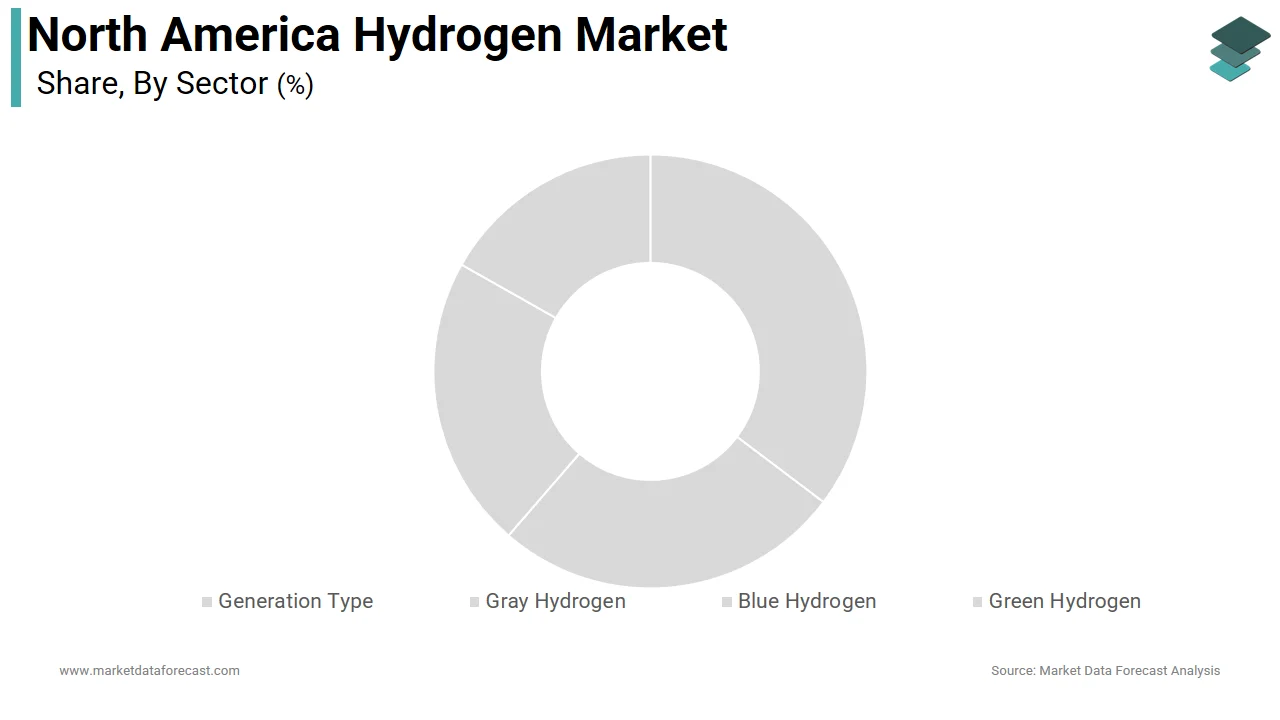
The continued reliance on gray hydrogen stems from its economic viability compared to cleaner alternatives. According to BloombergNEF, the levelized cost of gray hydrogen in the U.S. ranges between $1.50 and $2.50 per kilogram, significantly lower than green hydrogen, which costs between $4 and $6 per kilogram. Additionally, the existing infrastructure for natural gas extraction and processing supports large-scale hydrogen production without requiring substantial capital investment. As reported by the International Energy Agency (IEA), approximately 70% of hydrogen demand in North America comes from refineries, where it is used to desulfurize crude oil and improve fuel quality.
The green hydrogen segment is likely to grow with an expected CAGR of 30.3% throughout the forecast period. The Inflation Reduction Act (IRA) in the U.S., which introduced a production tax credit of up to $3 per kilogram for clean hydrogen, is making green hydrogen more financially viable. As per the National Renewable Energy Laboratory (NREL), this incentive could reduce green hydrogen costs by up to 40% by 2030, which is accelerating its adoption across sectors like mobility, chemicals, and power generation. Additionally, the expansion of wind and solar capacity provides a sustainable feedstock for electrolysis. Texas, for instance, has over 40 GW of installed wind power capacity, offering a strong foundation for green hydrogen projects. Companies like Plug Power and HyDeal USA are developing large-scale green hydrogen hubs that could supply over 6 million kilograms per day by 2030. Canada’s commitment to achieving net-zero emissions by 2050 further reinforces regional momentum.
By Storage Insights
The physical hydrogen storage segment dominated the North America hydrogen market with a significant share in 2025. The growth of the segment is attributed to be driven by its technological maturity and compatibility with the current hydrogen infrastructure. Compressed hydrogen tanks operating at 350–700 bar pressure are standard in fuel cell electric vehicles (FCEVs), while liquid hydrogen storage at -253°C is preferred for bulk transportation and aerospace applications. According to the National Renewable Energy Laboratory (NREL), over 90% of hydrogen refueling stations in North America use compressed gaseous storage, which supports growing deployment of hydrogen-powered buses, trucks, and trains. Moreover, industrial clusters along the Gulf Coast rely heavily on high-pressure tube trailers and underground salt caverns for large-scale hydrogen storage.
The material-based hydrogen storage segment is likely to grow with a CAGR of 25.3% throughout the forecast period, owing to the enhanced safety and efficiency these materials offer, particularly for mobile and distributed applications. For instance, Ammonia Casale and BASF are advancing ammonia-based hydrogen carriers that can store and transport hydrogen in a stable compound form, reducing infrastructure complexity. According to the International Energy Agency (IEA), ammonia can hold 17.6% hydrogen by weight, which is making it an attractive option for long-distance transport and decentralized refueling. Furthermore, research institutions like the Pacific Northwest National Laboratory (PNNL) are developing novel sorbent materials that can absorb and release hydrogen at ambient conditions, potentially eliminating the need for high-pressure tanks or cryogenic storage. Additionally, companies such as Hyborian and Hydrogenious Technologies are piloting organic liquid carriers for hydrogen distribution in North America.
By Application Insights
The refinery applications segment was accounted in holding 40.2% of the North America hydrogen market share in 2024. Hydrogen plays a crucial role in petroleum refining, particularly in hydrocracking and hydrotreating processes that remove sulfur and other impurities from crude oil to produce cleaner fuels. The sustained demand from refineries is driven by tightening environmental regulations and evolving fuel quality standards. For example, California's Low Carbon Fuel Standard (LCFS) mandates refineries to reduce carbon intensity, prompting increased adoption of low-emission hydrogen sources. As per the International Energy Agency (IEA), North American refineries consume over 5 million metric tons of hydrogen annually, with the Gulf Coast hosting some of the most hydrogen-intensive refining complexes globally. Moreover, the presence of extensive hydrogen pipeline networks, particularly in Texas and Louisiana, supports continuous hydrogen supply to refineries.
The ammonia production segment is expected to register a CAGR of 12.3% in the coming years. Traditionally reliant on fossil-based hydrogen, the sector is undergoing a transformation toward low-carbon ammonia made using blue and green hydrogen. The agricultural industry's need for sustainable fertilizers and the maritime sector's interest in ammonia as a zero-emission fuel is escalating the growth of the segment. According to the International Renewable Energy Agency (IRENA), green ammonia could meet up to 30% of global shipping fuel demand by 2050, which is creating new markets for hydrogen producers. In addition, government support is accelerating project development. The U.S. Department of Energy’s Earthshot Initiative aims to reduce the cost of green hydrogen to $1 per kilogram by 2030, directly benefiting ammonia synthesis economics. Furthermore, ports like Vancouver and Houston are positioning themselves as ammonia bunkering hubs for international shipping.
COUNTRY-LEVEL ANALYSIS
United States Hydrogen Market Insights
The United States led 75.6% of the North America hydrogen market share in 2024. The Inflation Reduction Act (IRA), which offers tax credits of up to $3 per kilogram for clean hydrogen production, is significantly boosting investment in green and blue hydrogen projects. According to BloombergNEF, the IRA has already spurred over USD 50 billion in hydrogen-related commitments across the country. Major players like Plug Power, Cummins, and Air Products are actively developing gigawatt-scale electrolyzer facilities and hydrogen hubs in states such as Texas, Louisiana, and California.
Canada Hydrogen Market Insights
Canada was accounted in holding 18.2% of the North America hydrogen market share in 2024. A major growth driver is the Canadian government’s CAD 1.5 billion national hydrogen strategy, launched in 2020, which aims to position the country as a top-three global hydrogen producer by 2030. According to the Canadian Hydrogen and Fuel Cell Association, Canada has over 40 active hydrogen projects with the potential to generate 10 GW of green hydrogen capacity by 2030. Provinces like Alberta, Quebec, and British Columbia are leading the charge. Suncor Energy and ATCO are developing blue hydrogen projects in Alberta, while Hyaspira is constructing a green ammonia plant in Newfoundland powered entirely by hydroelectricity. Additionally, the Port of Vancouver is piloting hydrogen-fueled port equipment and marine vessels.
COMPETITIVE LANDSCAPE
The competition in the North America hydrogen market is intensifying as traditional industrial gas leaders, emerging clean tech firms, and energy majors vie for dominance in a rapidly evolving sector. Established players like Air Products and Linde continue to leverage their deep technical expertise and infrastructure networks to maintain strong positions. At the same time, new entrants such as Plug Power and Hyzon Motors are pushing the boundaries with innovative hydrogen applications in mobility and power generation. The influx of federal and state-level funding is further fueling competitive dynamics, prompting companies to scale operations, forge strategic alliances, and invest heavily in research and development.
KEY MARKET PLAYERS
Noteworthy Companies dominating the North America hydrogen market profiled in the report are
- Linde plc
- Air Products and Chemicals, Inc.
- Air Liquide
- Worthington Industries
- Cryolor
- Hexagon Purus
- NPROXX
TOP LEADING PLAYERS IN THE MARKET
- Air Products is a global leader in industrial gases and one of the most influential players in the North America hydrogen market. The company has been instrumental in developing large-scale hydrogen production facilities, refueling infrastructure, and clean energy solutions. With decades of experience in hydrogen supply chain development, Air Products has pioneered innovative projects such as hydrogen-powered mobility hubs and blue ammonia initiatives. Its strategic partnerships with governments and industries across the U.S. and Canada have significantly shaped the regional hydrogen ecosystem.
- Plug Power is a key innovator driving the adoption of green hydrogen in North America. Specializing in hydrogen fuel cell systems for material handling and heavy-duty transportation, Plug Power has expanded its capabilities to include electrolyzer manufacturing, liquefaction, and on-site hydrogen generation. The company’s aggressive investment in end-to-end hydrogen solutions has positioned it as a major enabler of decarbonization in logistics, warehousing, and mobility sectors by making it a pivotal player in the evolving hydrogen landscape.
- Linde, through its North American operations, plays a central role in hydrogen production, storage, and distribution. Leveraging its technological expertise and extensive infrastructure, Linde supports diverse applications ranging from refining to fuel cell vehicle refueling.
TOP STRATEGIES USED BY KEY MARKET PARTICIPANTS
Strategic Partnerships and Collaborations Leading companies are forming alliances with technology providers, government agencies, and research institutions to accelerate hydrogen project deployment. These collaborations help in sharing R&D costs, enhancing innovation, and aligning with regulatory frameworks that support hydrogen adoption across various sectors.
Vertical Integration of Hydrogen Value Chain Major players are investing across multiple stages of the hydrogen value chain from production and storage to distribution and end-use applications. This approach allows them to control costs, ensure supply reliability, and offer integrated solutions that meet growing demand in industrial and mobility sectors.
Expansion into Green Hydrogen Production. As sustainability becomes a priority, companies are shifting focus toward green hydrogen. They are investing in electrolyzer manufacturing, renewable energy integration, and large-scale green hydrogen hubs to position themselves at the forefront of the clean hydrogen economy in North America.
RECENT MARKET DEVELOPMENTS
- In February 2024, Plug Power announced the expansion of its electrolyzer manufacturing facility in Rochester, New York, which is aiming to increase domestic production capacity and support the growing demand for green hydrogen solutions across North America.
- In May 2024, Air Products initiated construction on a new blue ammonia production facility in Louisiana by integrating carbon capture technology to supply low-carbon feedstock for agriculture and marine fuel applications.
- In July 2024, Linde launched a joint venture with a leading Canadian energy firm to develop a hydrogen refueling network targeting long-haul trucking corridors across Ontario and Quebec, which is strengthening its presence in the mobility sector.
- In September 2024, Cummins introduced a next-generation fuel cell system designed specifically for Class 8 trucks by partnering with major North American fleet operators to pilot hydrogen-powered freight transport solutions.
- In November 2024, General Electric partnered with Siemens Energy to integrate hydrogen-compatible turbines into existing power plants across Texas, which is supporting grid flexibility and the transition to cleaner energy sources.
MARKET SEGMENTATION
This North America hydrogen market research report is segmented and sub-segmented into the following categories.
By Sector
- Generation Type
- Gray Hydrogen
- Blue Hydrogen
- Green Hydrogen
By Storage
-
- Physical
- Material-based
By Transportation
-
- Long Distance
- Short Distance
By Application
- Energy
- Power Generation
- CHP
- Mobility
- Chemical & Refinery
- Petroleum Refinery
- Ammonia Production
- Methanol Production
By Country
- United States
- Canada
- Mexico
- Rest of North America