- Product Description Description
- Table of Contents TOC
- List of Table & Figure LOT
- Get Free Sample PDF Sample PDF
Market Size, 2025
$3,760.00 MnMarket Estimate, 2026
$3,910.00 MnMarket Forecast, 2034
$5,300.00 MnCAGR, 2026–2034
3.87%Executive Summary: North America Modified Starch Market
- Market Scope: Regional analysis of the North American modified starch sector, detailing raw material types, functional applications, industrial drivers, and country-level profiles.
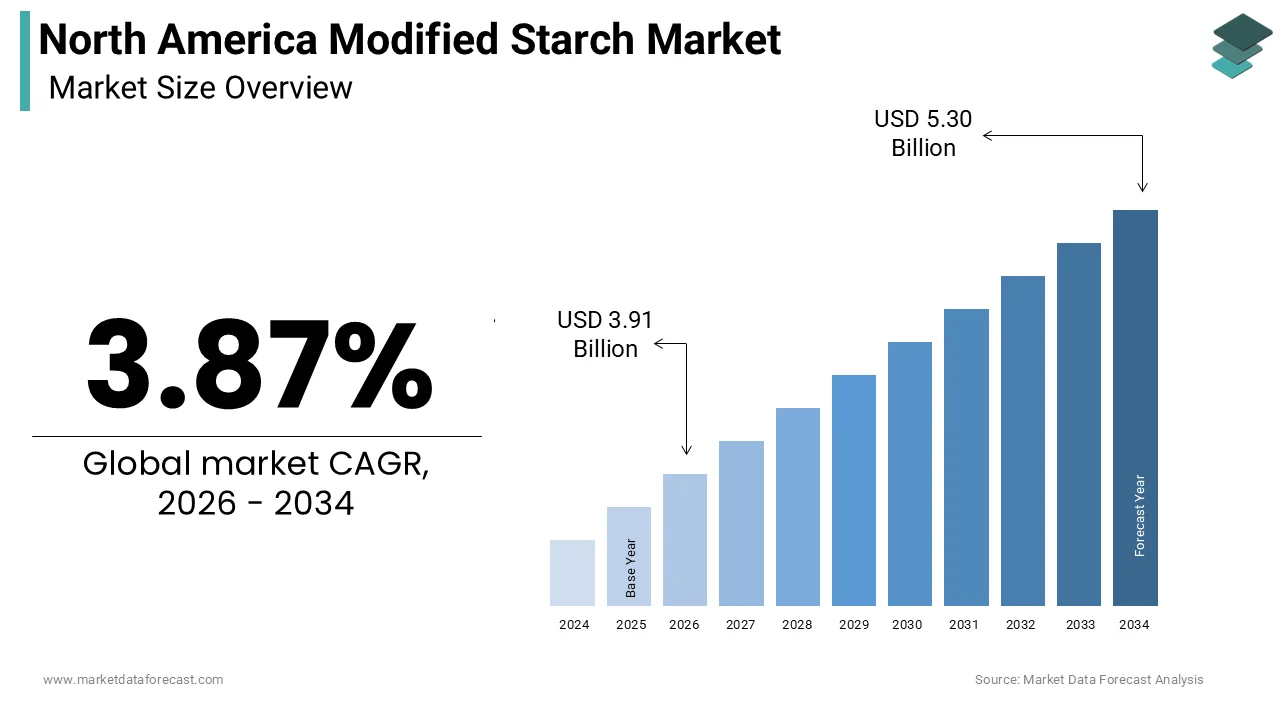
- Market Valuation: Valued at USD 3,760 million in 2025, reaching USD 3,910 million in 2026, and projected to expand to USD 5,300 million by 2034, growing at a CAGR of 3.87% from 2026 to 2034.
- Primary Growth Drivers: Growing awareness of functional foods, rising demand for natural ingredients in food and feed, and increasing applications of low-calorie sweeteners in beverages.
Key Market Segment Metrics
| Category | Leading Segment (Base Position) | Fastest-Growing / High-Growth Segment |
|---|---|---|
| By Raw Material | Corn (dominated the market share, driven by abundant regional availability and versatile food and beverage applications) | Cassava (anticipated at a higher growth rate, fueled by its position as a highly cost-effective global starch source) |
| By Function | Thickeners & Stabilizers (captured the major market share, essential for enhancing texture and heat/acid stability in processed foods) | Binders & Emulsifiers (fast-growing segments propelled by expanding pharmaceutical disintegrant and coated paper manufacturing demands) |
| By Region | USA (market leader holding the highest regional demand, supported by advanced industrial processing and major manufacturing operations) | Canada & Mexico (fast-growing hubs driven by rising investments in functional food sectors and expanding industrial applications) |
Major Market Players & Industry Landscape
Market Structure: A highly consolidated, technologically advanced market driven by major international and domestic chemical and agricultural ingredient processors supplying customized starch modifications.
Key Companies: Cargill, Ingredion Incorporated, Archer Daniels Midland Company, Tate & Lyle, and Grain Processing Corporation.
 Download Free Sample Report
North America Modified Starch Market Size
The size of the North American modified starch market was expected to be worth USD 3,760 million in 2025 and is anticipated to be worth USD 5,300 million by 2034 from USD 3,910 million in 2026, growing at a CAGR of 3.87% during the forecast period.
Modified starch is natural starch (derived from plants like corn, wheat, potato, or tapioca) that has been physically, enzymatically, or chemically altered to change its original properties. These functional ingredients enhance texture stability and shelf life in diverse industrial applications. According to the United States Department of Agriculture, corn production in the United States exceeded 15 billion bushels recently, providing abundant raw material for starch modification facilities. This agricultural surplus ensures consistent supply and competitive pricing for manufacturers operating within the region. As per studies, modified food starch is a widely utilized thickener and stabilizer across a diverse range of commercially available ultra-processed and packaged food products in North America. This widespread usage underscores the critical role of these ingredients in maintaining product quality and consumer acceptance. The market definition includes various derivatives such as pregelatinized, oxidized, and cross-linked starches used across the food, beverage, paper, and textile sectors. Regulatory bodies like the Food and Drug Administration strictly monitor safety standards for food-grade modifications. Manufacturers must comply with these guidelines to ensure market access and consumer trust. Innovation in clean label technologies drives the development of physically modified alternatives. Strategic collaborations between agritech firms and food processors further enhance supply chain efficiency. The market continues to evolve as demand for convenient and stable food products rises among urban populations.
MARKET DRIVERS
Expansion of the Processed Food and Beverage Industry
The rapid expansion of the processed food and beverage sector significantly propels the North America modified starch market. This growth is driven by an increasing demand for functional texturizers and stabilizers. Consumers increasingly rely on ready-to-eat meals and packaged snacks due to busy lifestyles. According to research, the packaged food market in North America experiences steady consumer-driven volume expansion, reflecting consistent demand for convenient prepackaged goods. This growth trajectory directly increases the volume of modified starch required for maintaining texture and consistency during processing and storage. As per reports, processed, prepared, and convenient meal selections account for a substantial portion of grocery and household food spending across the consumer landscape. This high expenditure level drives manufacturers to use cost-effective and efficient ingredients like modified starch to enhance product appeal. Modified starches prevent syneresis and improve freeze-thaw stability in frozen foods, which are popular in the region. Beverage companies utilize these ingredients to provide mouthfeel and suspend particles in drinks. The versatility of modified starch allows seamless integration into various formulations without altering flavor. Regulatory approval for specific modified starches facilitates easier market entry for new product launches. Consumer preference for consistent quality in branded products further reinforces demand. These factors collectively create a robust foundation for market growth in the food segment.
Growing Demand for Clean Label and Natural Ingredients
The rising consumer preference for clean label and natural ingredients substantially drives the North America modified starch market. This market growth is primarily achieved through innovation in physical modification techniques. Shoppers increasingly scrutinize ingredient lists and avoid chemically modified additives in their purchases. According to the International Food Information Council, simple, recognizable ingredients influence the purchasing decisions of 69% of consumers, while front-of-panel highlights such as Nutrition Facts are considered by 45%. This trend compels manufacturers to replace traditional chemical modifiers with physically modified starches such as heat-moisture-treated variants. As per studies, demand for products emphasizing non-GMO transparency, minimal handling, and clean labels continues to scale upward to meet health-conscious purchasing patterns. This shift encourages starch producers to invest in advanced physical processing technologies that maintain functional properties without synthetic chemicals. Physically modified starches offer similar performance to chemically altered ones while meeting clean label standards. Food brands leverage these ingredients to market their products as wholesome and transparent. Retailers prioritize stocking items with clean labels to attract health-conscious demographics. The availability of organic certified modified starches further expands market opportunities. Educational campaigns by nutritionists highlight the benefits of minimally processed ingredients. These dynamics foster a favorable environment for natural modified starch adoption.
MARKET RESTRAINTS
Volatility in Raw Material Prices
Fluctuations in the prices of key raw materials such as corn and potatoes hamper the expansion of the North America modified starch market. This creates uncertainty in production costs. Agricultural outputs are highly sensitive to weather conditions, trade policies, and global demand shifts. According to research, corn prices fluctuate based on seasonal shifts, supply projections, and weather disruptions in global production regions. This volatility forces manufacturers to face unpredictable input costs, which can erode profit margins if not passed to consumers. As per reports, the expanding demand for corn across livestock feed and alternative industrial sectors influences the broad availability of raw material for commercial processing. This competition intensifies during periods of low harvest, leading to scarcity and price spikes for starch manufacturers. Small and medium enterprises often lack the financial resilience to absorb sudden cost increases. Long-term contracts with suppliers may mitigate risks but limit flexibility in sourcing cheaper alternatives. Price instability discourages investment in new production capacities and innovation projects. Consumers may switch to cheaper substitutes if final product prices rise significantly. The lack of government subsidies for starch processing exacerbates the financial burden on producers. These economic pressures hinder steady market expansion and profitability.
Stringent Regulatory Compliance and Labeling Requirements
Strict regulatory frameworks and complex labeling requirements impede the North American modified starch market. This, in turn, increases compliance burdens for manufacturers. Each jurisdiction maintains distinct guidelines for defining modified starches and permitted modification methods. According to sources, new food ingredients and chemical modifications are subject to review frameworks to demonstrate safety before commercial deployment. Such rigorous demands delay product approvals and increase time to market for innovative starch variants. As per studies, ingredient disclosure rules guide how technical texturizers and stabilizers are declared on prepackaged retail labels. This transparency requirement creates marketing challenges for brands trying to position modified starches as natural or healthy. Inconsistent enforcement of regulations across states and provinces complicates supply chain management for national distributors. Manufacturers must invest heavily in legal and quality assurance teams to ensure compliance. The cost of regulatory adherence reduces funds available for research and development. Counterfeit or mislabeled products further erode consumer trust in legitimate brands. The absence of harmonized standards between the United States and Canada adds another layer of complexity. These hurdles discourage smaller players from entering the market and limit overall growth potential.
MARKET OPPORTUNITIES
Advancements in Biodegradable Packaging Solutions
The growing emphasis on sustainability offers a substantial opportunity for the North America modified starch market. This potential is specifically driven by its expanding application in biodegradable packaging materials. Consumers and regulators increasingly demand alternatives to single-use plastics to reduce environmental impact. According to the World Bank, global plastic waste generation accounts for 12% of all municipal solid waste worldwide. Modified starches serve as key components in bioplastics due to their renewable nature and biodegradability. As per the Biodegradable Products Institute, commercial certification updates expand independent testing requirements for individual constituents from a range of 1–10% up to 1–15% of dry mass. This trend encourages packaging manufacturers to incorporate starch-based films and foams for food containers and bags. Research institutions collaborate with industry players to enhance the water resistance and durability of starch-based plastics. Government incentives for green manufacturing further support adoption of bio-based materials. Brands leverage sustainable packaging to enhance their corporate image and appeal to environmentally conscious buyers. The versatility of modified starch allows customization for various packaging needs. Investment in scaling up production facilities for bioplastics creates new revenue streams. Early adopters of this technology gain competitive advantage in the evolving green economy.
Innovation in Pharmaceutical and Medical Applications
Emerging applications in the pharmaceutical and medical sectors pave the way for the expansion of the North American modified starch market. This expansion goes beyond traditional food uses. Modified starches function as excipients, binders, and disintegrants in drug formulations, ensuring effective delivery of active ingredients. According to research, the biopharmaceutical sector registers steady capital investments and technical progress aimed at manufacturing customized therapeutic delivery networks. This growth creates demand for high-purity modified starches that meet strict pharmacopeial standards. Scientific validation opens doors for specialized starch producers to partner with pharmaceutical companies. The aging population increases demand for medications requiring precise and reliable formulation aids. Regulatory approval for pharmaceutical-grade starches facilitates market entry for qualified manufacturers. Innovation in controlled-release technologies utilizes modified starch matrices to regulate drug absorption. Collaborations between starch suppliers and drug developers accelerate formulation optimization. The high-value nature of pharmaceutical applications allows for premium pricing strategies. These dynamics position modified starch as a critical component in healthcare innovation.
MARKET CHALLENGES
Competition from Alternative Hydrocolloids and Gums
Intense competition from alternative hydrocolloids and gums challenges the North American modified starch market. These offer alternative functionalities at competitive prices. Ingredients such as xanthan gum, guar gum, and cellulose derivatives provide similar thickening and stabilizing effects. According to studies, alternative hydrocolloids are increasingly utilized in formulated plant-based and gluten-free dietary segments due to their functional qualities. This availability provides formulators with multiple options, reducing dependency on starch-based ingredients. As per the American Chemical Society, cross-linked and chemically modified starches are engineered to provide structural resistance to extreme temperatures, high shear, and low pH conditions. Such performance advantages encourage manufacturers to switch to alternatives for specific high-end applications. Price fluctuations in gum markets sometimes make them more attractive than starch derivatives. Consumer perception of gums as natural also influences formulation choices in clean label products. Starch producers must continuously innovate to match the performance profiles of these alternatives. Marketing efforts struggle to differentiate modified starch benefits against well-established gum ingredients. The fragmentation of the hydrocolloid market increases competitive pressure on pricing. Overcoming this challenge requires targeted research into unique starch functionalities.
Consumer Misconceptions About Chemical Modification
Widespread consumer misconceptions regarding chemical modification processes are a significant obstacle to the North America modified starch market. These misconceptions foster negative perceptions. Many shoppers associate the term modified with artificial or unhealthy additives despite scientific evidence of safety. According to the International Food Information Council, survey data reveals that 37% of US adults rank food additives and ingredients among their top three food safety concerns. This hesitation limits market penetration for chemically modified starches even when they are safe and effective. As per reports, consumer understanding varies widely regarding the practical distinctions between various mechanical, physical, and chemical raw-material processing techniques. Lack of clear communication from brands exacerbates confusion and distrust among health-conscious buyers. Retailers may hesitate to promote products with modified starches to avoid consumer backlash. Formulators face pressure to remove modified starches from recipes even when no suitable natural alternative exists. Negative media coverage occasionally amplifies fears about food additives impacting brand reputation. Industry efforts to clarify safety standards often fail to reach mainstream audiences effectively. This perceptual barrier restricts growth potential for traditional modified starch variants. Addressing this challenge requires sustained educational campaigns and transparent labeling practices.
REPORT COVERAGE
| REPORT METRIC | DETAILS |
| Market Size Available | 2025 to 2034 |
| Base Year | 2025 |
| Forecast Period | 2026 to 2034 |
| CAGR | 3.87% |
| Segments Covered | By Raw Material, Application, Function, and Region |
| Various Analyses Covered | Global, Regional, & Country-Level Analysis; Segment-Level Analysis; DROC; PESTLE Analysis; Porter’s Five Forces Analysis; Competitive Landscape; Analyst Overview of Investment Opportunities |
| Regions Covered | US, Canada, Mexico, andthe Rest of North America |
| Market Leaders Profiled | Emsland-Starke GmbH, Grain Processing Corporation, Cargill, Ingredion Incorporated, Archer Daniels Midland Company, Tate & Lyle, Roquette Frères, Avebe U.A., Agrana Beteiligungs-AG, and North America Bio-Chem Technology Group Company Limited |
SEGMENTAL ANALYSIS
By Raw Material Insights
The corn segment dominated the North America modified starch market and accounted for a substantial share in 2025. This dominance was driven by the region’s vast agricultural infrastructure and high yield efficiency. The United States is the world’s largest producer of corn, providing a consistent and cost-effective supply chain for starch manufacturers. According to the United States Department of Agriculture, corn acreage in the United States exceeded 90 million acres recently, ensuring abundant raw material availability for industrial processing. This scale allows producers to achieve economies of scale that lower production costs significantly. As per the National Corn Growers Association, approximately 12% of the U.S. corn crop ends up in foods consumed by humans, while the wet milling industry processes around 10% to 11.4% of the harvest to produce starch, sweeteners, oil, and co-products. This substantial volume supports diverse downstream industries such as food, beverage, and paper manufacturing. Corn starch offers versatile functional properties that can be easily modified through chemical or physical methods. Its neutral flavor profile makes it ideal for a wide range of food applications without altering taste. Established extraction facilities in the Midwest provide logistical advantages for distribution across the continent. Regulatory frameworks favor corn-based ingredients due to their long history of safe use. Manufacturers benefit from stable pricing mechanisms supported by government agricultural policies. These factors collectively maintain corn as the primary raw material source in the regional market.
The cassava segment is the fastest-growing in the North American modified starch market due to the demand for gluten-free and allergen-free alternatives. Consumers increasingly seek non-grain-based starches to accommodate dietary restrictions and health preferences. According to the Food and Agriculture Organization, global cassava production has expanded significantly since 2000, driven by rising demand for dried cassava and starch in livestock feed, industrial use, and urban markets. This trend influences North American importers to source high-quality cassava starch for specialized food formulations. According to the Gluten Intolerance Group, 23% of U.S. shoppers report avoiding gluten in their homes, with 7% rigidly restricting it. Cassava starch provides excellent clarity and texture stability, making it suitable for premium food applications. Its hypoallergenic nature appeals to parents seeking safe ingredients for children’s foods. Manufacturers invest in supply chains connecting Southeast Asian producers with North American processors to meet this demand. Innovation in enzymatic modification enhances the functional properties of cassava starch, further expanding its utility. The clean label movement favors physically modified cassava starch over chemically altered grain variants. Retailers expand their offerings of cassava-based products to capture this niche but growing demographic. These dynamics position cassava as the most dynamic growth vector in the raw material segment.
By Application Insights
The food and beverages segment led the North America modified starch market and captured a significant share in 2025. This leading position was attributed to its extensive use in processed products. Modified starches serve as essential thickeners, stabilizers, and texturizers in sauces, soups, dairy products, and baked goods. According to the data, the packaged food industry in North America operates at a massive economic scale, driving robust domestic usage of functional texturizers and ingredient starches. This economic magnitude ensures steady demand for functional ingredients that enhance product quality and shelf life. As per research, modified starches represent one of the most widely utilized and sought-after classes of functional texturizers applied across new product formulations to enhance structural properties and quality attributes. The versatility of modified starch allows it to withstand harsh processing conditions such as high heat and acidity. Beverage manufacturers use these ingredients to suspend particles and provide consistent viscosity in drinks. Consumer preference for convenient and ready-to-eat meals drives the need for stable formulations. Regulatory approval for food-grade modified starches facilitates widespread adoption across various categories. Major food corporations prioritize suppliers who can deliver consistent quality and volume. The integration of modified starch in plant-based meat alternatives further expands its application scope. These factors solidify the dominance of the food and beverage segment.
The animal feed segment is expanding rapidly in the North America modified starch market, owing to advancements in livestock nutrition and pet food quality. Modified starches improve pellet durability and digestibility in animal feed formulations, enhancing overall animal health. According to the American Feed Industry Association, U.S. manufacturers utilize more than 600 plant- and animal-based ingredients to manufacture pet food products, with corn and corn gluten meal serving as dominant plant-based carbohydrate and protein inputs. This growth encourages manufacturers to incorporate high-quality modified starches to improve kibble texture and nutrient retention. As per research, physically modifying or cooking raw starches changes their structural gelatinization properties, altering dry matter and gross energy digestibility compared to native varieties. Such scientific evidence drives adoption in commercial livestock operations seeking efficiency gains. The rise in pet humanization leads to demand for human-grade ingredients in pet food products. Modified starches act as binders that reduce dust and improve palatability for animals. Aquaculture sectors also utilize modified starch to stabilize water quality and feed integrity. Regulatory standards for animal feed safety ensure consistent quality requirements for starch suppliers. Investment in research focuses on optimizing starch structures for specific animal digestive systems. These dynamics position animal feed as the most rapidly expanding application sector.
By Function Insights
In 2025, the thickener segment held the largest share in the North American modified starch market because of its critical role in achieving desired product consistency. Consumers associate viscosity with quality and richness in foods such as gravies, puddings, and soups. According to studies, thickening agents represent a foundational class of functional ingredients deployed to control rheological properties and moisture binding across modern food systems. The high utilization rate translates directly to strong demand in the North American market. As per reports, structural performance and structural stability under scaling conditions are crucial considerations when identifying texturizers for retail product lines. Modified starches offer superior thickening power compared to native starches, requiring lower usage levels. They provide smooth textures without grittiness, enhancing consumer sensory experience. The convenience food sector relies heavily on thickeners to maintain consistency during reheating. Beverage applications use thickeners to create mouthfeel in low-calorie drinks. Regulatory guidelines permit a wide range of thickening modifications, ensuring flexibility for formulators. Cost-effectiveness makes modified starch thickeners preferable over gum-based alternatives in many applications. These factors maintain thickeners as the dominant functional category in the market.
The stabilizer segment is quickly accelerating in the North America modified starch market. This growth is propelled by the need for extended shelf life and freeze-thaw stability. Modern distribution chains require products to remain stable under varying temperature conditions during transport and storage. According to the American Frozen Food Institute and FMI, structural demand for frozen items persists as consumers look for long-lasting solutions to stock up their home kitchens. The trend necessitates robust stabilizers to prevent ice crystal formation and phase separation in frozen products. As per reviews, cross-linking introduces intra- and intermolecular covalent bonds that restrict granule swelling, thereby providing superior freeze-thaw stability and retrogradation resistance compared to standard native starches. Such performance benefits drive adoption in ice cream, frozen dinners, and chilled desserts. Dairy alternatives such as almond and oat milk rely on stabilizers to prevent sedimentation and ensure uniformity. Clean label stabilizers derived from physical modification gain popularity among health-conscious brands. Innovation in dual-function starches that thicken and stabilize simultaneously reduces formulation complexity. Manufacturers seek solutions that maintain texture over longer periods to reduce waste. These dynamics position stabilizers as the most rapidly expanding functional segment.
REGIONAL ANALYSIS
United States Modified Starch Market Analysis
The United States was the top performer in the North America modified starch market in 2025. This prominence was supported by its massive industrial base and high consumption of processed foods. The country serves as both a primary producer of raw materials and a key consumption hub. In addition, the agricultural strength lowers input costs for local manufacturers and supports export competitiveness. According to the Consumer Brands Association, the consumer packaged goods industry stands as the largest domestic manufacturing segment by workforce in the United States, supporting millions of jobs and supplying staple household goods to families nationwide. Local regulations favor efficient production methods, encouraging innovation in modification technologies. Major global players establish production facilities in the Midwest to leverage these advantages. The government supports bioeconomy initiatives that promote sustainable starch processing. Urban populations drive demand for convenient and stable food products. Retail expansion in online channels further broadens market access. Strategic partnerships between agritech firms and food companies enhance supply chain efficiency. The US regulatory framework ensures high quality standards that build consumer trust. These factors cement the United States' leadership role in the regional market.
Canada Modified Starch Market Analysis
Canada is a mature sector within the North American modified starch market, owing to stringent quality standards and growing health consciousness among consumers. The country benefits from strong trade links with the United States, which influence consumer trends and regulatory alignment. According to agriculture and agri-food economic profiles tracked by Lloyds Bank Trade Portal, the combined Canadian agricultural system and the food processing industry account for over CAD 100 billion of the country's Gross Domestic Product (GDP). This economic scale drives demand for high-quality modified starches in local formulations. As per sources, the Canadian Food Inspection Agency enforces mandatory guidelines covering nutrition tables, ingredient names, and allergen breakdowns, while "Clean Label" claims themselves remain explicitly unregulated under existing federal frameworks. Manufacturing hubs in Ontario and Quebec attract investment in advanced starch processing technologies. The rising prevalence of dietary restrictions prompts consumers to seek gluten-free and allergen-free options. Retail chains expand their natural health sections to meet this demand. Cross-border e-commerce facilitates access to premium international brands. Government initiatives promote local agricultural value addition, including pulse and potato starch processing. Consumer education campaigns by health authorities boost awareness of functional ingredient benefits. These dynamics position Canada as a critical growth engine in the region.
COMPETITIVE OVERVIEW
The competitive landscape of the North America Modified Starch Market features a mix of global agribusiness giants and specialized ingredient manufacturers. Large corporations leverage their extensive distribution networks and vertical integration to maintain strong market presence. Regional players compete by offering niche solutions and personalized customer service to specific industry segments. The market remains consolidated, with a few key entities controlling significant production capacities for corn-based starches. Competition intensifies as companies differentiate through sustainability certifications and clean label innovations. Price sensitivity in industrial applications drives competition between large-scale producers. Strategic partnerships between starch manufacturers and food processors shape the competitive dynamics. Regulatory compliance serves as a key barrier to entry, favoring established players with robust quality systems. Innovation in physical modification technologies provides a competitive edge for early adopters. The focus shifts toward value-added services such as technical formulation support. Companies invest in brand building to capture trust in natural and safe ingredients. Mergers and acquisitions remain common strategies to consolidate market position and expand geographic reach.
KEY MARKET PLAYERS
Major Key Players in the North American modified starch market include
- Emsland-Starke GmbH
- Grain Processing Corporation
- Cargill
- Ingredion Incorporated
- Archer Daniels Midland Company
- Tate & Lyle
- Roquette Frères
- Avebe U.A
- Agrana Beteiligungs-AG
- North America Bio-Chem Technology Group Company Limited
Top Strategies Used by Key Market Participants
Key market participants employ several strategic approaches to strengthen their position in the North America Modified Starch Market. First, they prioritize vertical integration to control supply chains from crop cultivation to final extraction. This strategy ensures consistent quality and reduces dependency on external suppliers for raw materials. Second, companies invest heavily in research and development to create innovative clean label alternatives. These innovations address consumer concerns about chemical additives and expand application possibilities in health foods. Third, firms pursue sustainability certifications to appeal to environmentally conscious consumers and corporate buyers. Certifications like Non-GMO Project Verified enhance brand credibility and market access significantly. Fourth, players engage in strategic collaborations with food brands to co-develop customized texturizing solutions. These partnerships facilitate faster entry into emerging segments such as plant-based meats. Fifth, companies focus on educational marketing to highlight the functional benefits of modified starches. This approach builds customer loyalty and justifies premium pricing structures for specialized products.
Leading Players in the Market
- Ingredion Incorporated strengthens its position in the North America Modified Starch Market through extensive research and development capabilities focused on clean label solutions. The company operates multiple production facilities across the United States, ensuring reliable supply for food and industrial clients. Ingredion recently launched new texturizing systems that replace chemically modified starches with physically altered alternatives. This innovation addresses growing consumer demand for transparent ingredient lists in processed foods. The corporation collaborates closely with major food brands to customize starch functionalities for specific applications. Their technical service teams provide formulation support to optimize product performance and cost efficiency. Ingredion invests in sustainable sourcing practices to minimize environmental impact during corn processing. These efforts enhance their reputation as a partner for high-quality and responsible ingredient solutions. The company also expands its portfolio of specialty starches for plant-based meat alternatives. Such strategic initiatives differentiate Ingredion from competitors in the highly competitive regional market.
- Cargill Incorporated leverages its integrated agricultural supply chain to dominate the North American modified starch market with consistent raw material access. The company processes vast quantities of corn and other crops to produce diverse modified starch variants for various industries. Cargill recently introduced advanced enzymatic modification technologies that improve the functional properties of native starches without chemical additives. This approach aligns with regulatory trends favoring natural processing methods in food production. The corporation focuses on sustainability certifications to appeal to environmentally conscious buyers and retailers. Cargill partners with local farmers to implement regenerative agriculture practices, ensuring long-term resource availability. Their robust logistics network enables efficient distribution to customers across the continent. The company also provides educational resources to help formulators understand the benefits of modified starches. These actions solidify Cargill’s role as a key enabler of innovation in the region.
- ADM strengthens its influence in the North America Modified Starch Market by integrating vertical operations from farm to finished product. The company utilizes its global expertise to produce high-purity modified starches for the food, pharmaceutical, and industrial sectors. ADM recently expanded its production capacity in the Midwest to meet rising demand for specialty starches in convenience foods. This expansion allows the company to offer faster delivery times and greater product customization options. The corporation emphasizes innovation in texture modification to enhance mouthfeel in low-fat and reduced sugar products. ADM collaborates with health organizations to promote the nutritional benefits of fortified starch-based foods. Their commitment to quality assurance ensures compliance with strict regulatory standards in North America. The company also supports smallholder farmers through sustainability programs, securing stable raw material sources. These strategic initiatives enhance ADM’s competitive edge and foster long-term growth in the market.
MARKET SEGMENTATION
This research report on the North American modified starch market has been segmented and sub-segmented based on raw material, application, function, and region.
By Raw Material
- Potato
- Wheat
- Corn
- Cassava
By Application
- Food & Beverages
- Animal Feed
By Function
- Thickeners
- Stabilizers
- Binders
- Emulsifiers
By Region
- US
- Canada
- Mexico
- Rest of North America