- Product Description Description
- Table of Contents TOC
- List of Table & Figure LOT
- Get Free Sample PDF Sample PDF
Market Size, 2025
$2.30 BnMarket Estimate, 2026
$2.53 BnMarket Forecast, 2034
$5.42 BnCAGR, 2026–2034
10%North America Private LTE Market Size
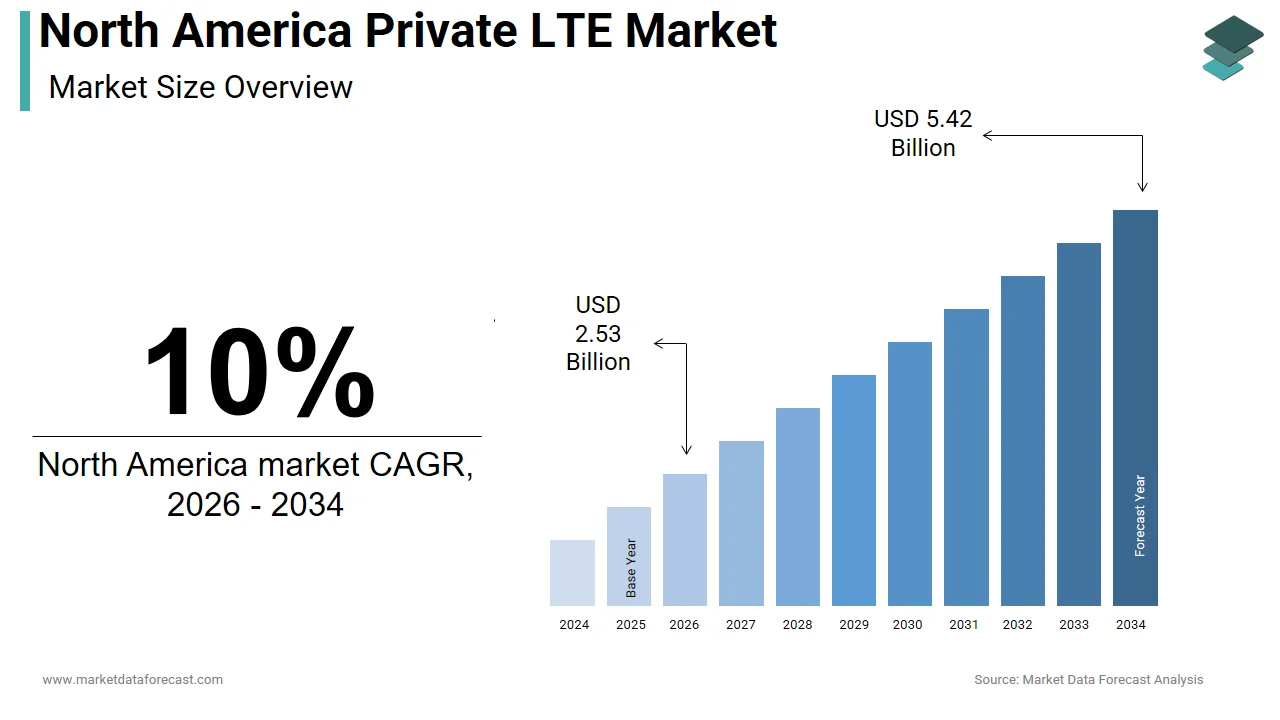
The size of the North America private LTE market was worth USD 2.30 billion in 2025. The market is anticipated to grow at a CAGR of 10% from 2026 to 2034 and be worth USD 5.42 billion by 2034 from USD 2.53 billion in 2026.
The private LTE is a Long-Term Evolution network deployed by enterprises, government agencies, and industrial operators to ensure secure, reliable, and high-performance wireless connectivity tailored to specific operational needs. Unlike public LTE offered by mobile network operators, private LTE allows organizations to maintain control over spectrum allocation, quality of service, latency, and security parameters, making it ideal for mission-critical applications. Advancements in cloud-native core architectures, edge computing integration, and interoperability with IoT and AI-driven automation systems further support the demand.
MARKET DRIVERS
Demand for Secure and Reliable Connectivity in Critical Infrastructure
The growing demand for secure and highly reliable wireless communication within critical infrastructure sectors such as utilities, transportation, and public safety is driving the growth of the North America private LTE market. Moreover, in power generation and distribution, companies like Duke Energy and Exelon have adopted private LTE to manage smart grid operations, remote monitoring, and field technician coordination. Transportation authorities are also leveraging private LTE for rail signaling, traffic management, and emergency responder coordination. In Canada, the Toronto Transit Commission integrated private LTE into its subway signaling system, improving train scheduling accuracy and passenger safety.
Expansion of Industrial IoT and Automation Across Manufacturing Sectors
The rapid expansion of Industrial Internet of Things (IIoT) and automation technologies in manufacturing, logistics, and supply chain operations is also to fuel the growth of the North America private LTE market. As per a 2024 study by the Association for Advancing Automation, North America saw a 22% increase in robotic installations in 2023, many of which depend on private LTE for seamless command-and-control communication and real-time data exchange. Automotive manufacturers such as Ford and General Motors have deployed private LTE networks in their production plants to coordinate autonomous guided vehicles (AGVs), monitor assembly line performance, and enable predictive maintenance through IIoT analytics. Furthermore, logistics and warehouse operators are integrating private LTE to support drone-based inventory tracking, real-time asset monitoring, and fleet management systems. Additionally, private LTE supports mobility and scalability better than Wi-Fi, allowing industrial equipment to move freely across large facilities without signal degradation.
MARKET RESTRAINTS
High Initial Deployment Costs and Complex Infrastructure Requirements
The high initial capital expenditure required for network deployment, including hardware procurement, spectrum licensing, and integration with existing IT and operational technology (OT) infrastructures, is restricting the growth of the North America private LTE market. Moreover, integrating private LTE with legacy industrial control systems, SCADA networks, and enterprise resource planning (ERP) platforms often requires extensive engineering efforts. While long-term benefits such as reduced downtime and improved automation justify the investment, the upfront financial barrier remains a deterrent, particularly for budget-conscious organizations seeking more cost-effective alternatives like hybrid cloud solutions or managed private LTE services offered by third-party providers.
Spectrum Licensing Complexity and Regulatory Hurdles
The complexity involved in spectrum licensing and regulatory compliance is ascribed to restricting the growth of the North America private LTE market. According to the Wireless Innovation Forum, only about 30% of eligible industrial firms successfully secured Priority Access Licenses (PALs) under the CBRS framework in 2023, largely due to confusion around eligibility criteria, auction procedures, and technical specifications. Many companies lacked the internal expertise to handle the registration process, forcing them to rely on consultants or managed service providers, adding time and cost to the deployment cycle. Additionally, state and local regulations regarding antenna placement, radio frequency emissions, and infrastructure zoning can vary widely, complicating nationwide rollouts. These regulatory hurdles, combined with concerns about potential future changes in spectrum policy, create uncertainty for enterprises considering private LTE investments.
MARKET OPPORTUNITIES
Integration with Edge Computing and Real-Time Data Processing
It integrates with edge computing and real-time data processing by enabling faster decision-making and enhanced operational efficiency across industries. According to a 2024 Gartner report, over 70% of industrial enterprises plan to adopt edge computing strategies by 2025, with private LTE serving as the backbone for connecting distributed devices, sensors, and machinery. For instance, in the oil and gas sector, Chevron and BP have deployed private LTE networks integrated with edge AI analytics to monitor pipeline integrity and detect anomalies in real time. Moreover, in healthcare, hospitals such as Johns Hopkins and Mayo Clinic are using private LTE to support mobile robotics, telemedicine carts, and wearable patient monitoring systems that rely on ultra-low latency connectivity.
Adoption in Smart City and Public Safety Initiatives
The adoption within smart city and public safety initiatives is also to fuel the growth of the North America private LTE market. Municipalities and law enforcement agencies are increasingly turning to private LTE networks to enhance emergency response, optimize traffic management, and improve surveillance capabilities with minimal reliance on public networks. According to the International Association of Chiefs of Police, over 60% of U.S. police departments now use private LTE for real-time video streaming, body-worn camera feeds, and situational awareness dashboards, significantly improving coordination during crisis events. The First Responder Network Authority (FirstNet), established post-9/11, has already deployed a nationwide LTE network dedicated exclusively to first responders, demonstrating the effectiveness of private LTE in mission-critical scenarios. Cities like New York, Los Angeles, and Chicago are expanding their smart infrastructure with private LTE-powered solutions for traffic light synchronization, gunshot detection, and environmental monitoring. Furthermore, private LTE is being used to support drone-based emergency response, flood monitoring, and wildfire detection programs. In California, the Department of Forestry and Fire Protection (CAL FIRE) utilizes private LTE-connected drones to assess fire spread patterns and coordinate firefighting efforts in real time.
MARKET CHALLENGES
Competition from Emerging 5G and Alternative Wireless Technologies
The increasing competition from emerging 5G and alternative wireless technologies that offer similar or superior capabilities in terms of speed, latency, and scalability is a challenging factor for the growth of the North America private LTE market. According to a 2024 ABI Research whitepaper, over 45% of surveyed enterprises expressed interest in private 5G as a viable alternative to private LTE, citing advantages such as higher bandwidth, massive machine-type communications (mMTC), and ultra-reliable low-latency communications (URLLC). Companies in manufacturing, logistics, and healthcare are particularly drawn to 5G’s ability to support dense IoT deployments and real-time automation workflows. Moreover, other wireless technologies such as Wi-Fi 6E, Bluetooth Mesh, and proprietary low-power wide-area networks (LPWANs) are gaining traction in specific verticals. This competitive pressure is forcing private LTE vendors to emphasize backward compatibility, cost-effectiveness, and proven reliability in industrial settings.
Technical Expertise Gap and Workforce Readiness
The shortage of skilled professionals capable of designing, deploying, and managing complex private LTE networks will also limit the growth of the North America private LTE market. According to a 2024 report by the Brookings Institution, only 12% of U.S. engineering graduates possess training relevant to private LTE and wireless infrastructure deployment, which is a growing skills gap in the telecommunications sector. Additionally, many industrial firms lack in-house expertise to configure private LTE networks optimized for their specific operational needs, leading to reliance on external vendors and consultants. This issue is further compounded by the rapid evolution of wireless standards and the emergence of Open RAN architectures, which introduce new layers of complexity in network design and integration.
REPORT COVERAGE
| REPORT METRIC | DETAILS |
| Market Size Available | 2025 to 2034 |
| Base Year | 2025 |
| Forecast Period | 2026 to 2034 |
| Segments Covered | By Component, Technology, Deployment Model, Frequency Band, End user, and Region. |
| Various Analyses Covered | Global, Regional and Country-Level Analysis, Segment-Level Analysis, Drivers, Restraints, Opportunities, Challenges; PESTLE Analysis; Porter’s Five Forces Analysis, Competitive Landscape, Analyst Overview of Investment Opportunities |
| Countries Covered | United States, Canada, Mexico, Rest of North America |
| Market Leaders Profiled | Nokia( Finland), Ericsson (Sweden), Huawei (China), ZTE(China), NEC(Japan), Aviat Networks, Samsung (South Korea) Affirmed Networks(US), Athonet (Italy), Airspan (US), ASOCS (US), Boingo Wireless (US), Casa Systems (US), Cisco (US) and others. |
SEGMENTAL ANALYSIS
By Component Insights
The infrastructure segment dominated the North America private LTE market share in 2025, with the increasing adoption of private LTE in industrial environments such as manufacturing, logistics, and utilities, where enterprises need to deploy dedicated hardware to ensure secure and reliable connectivity. According to a 2024 Deloitte report, over 70% of surveyed industrial firms reported deploying on-premises LTE infrastructure to support automation, IoT integration, and real-time monitoring systems. Additionally, the Federal Communications Commission’s (FCC) allocation of the 3.5 GHz Citizens Broadband Radio Service (CBRS) band has spurred demand for infrastructure components, including eNodeBs, antennas, and distributed units. Moreover, the expansion of Open RAN-based private LTE architectures is further boosting infrastructure spending. Companies are opting for modular, software-defined network components that allow greater flexibility and scalability.
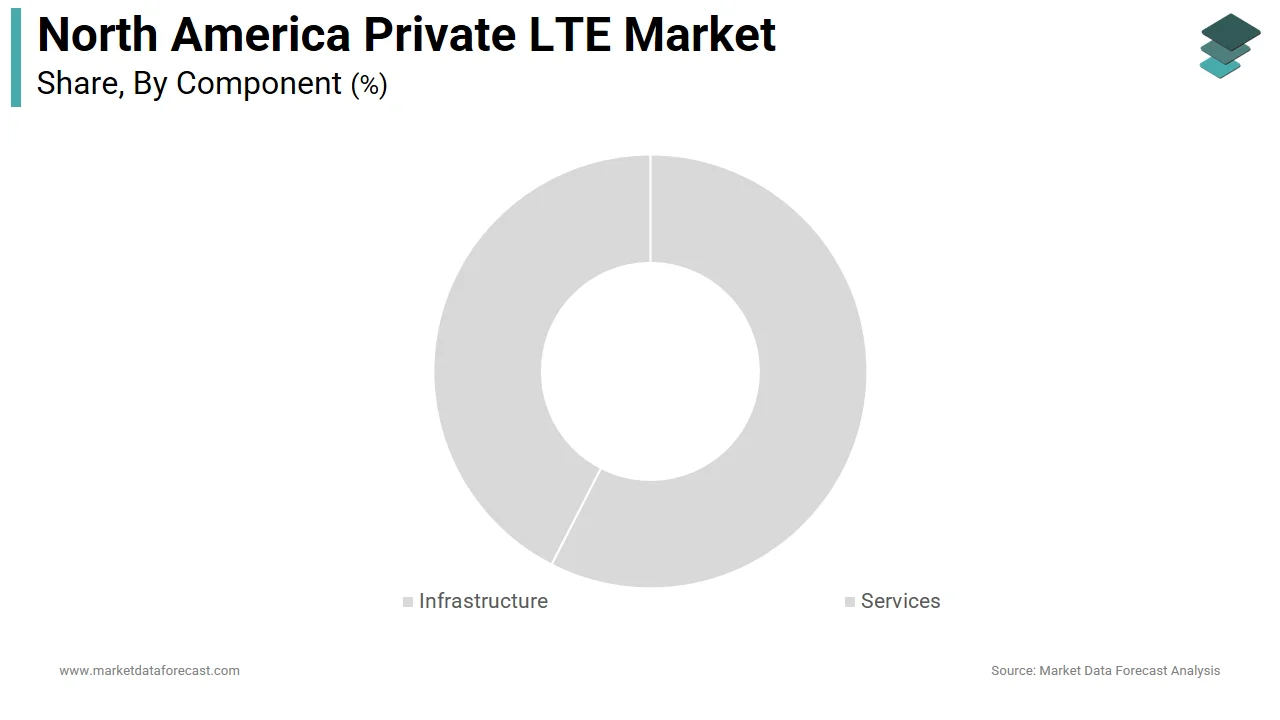
The services segment is swiftly emerging with a CAGR of 23.7% from 2026 to 2034. A major contributing factor to this segment’s expansion is the increased reliance on third-party vendors for end-to-end private LTE implementation among mid-sized businesses lacking in-house expertise. As per a McKinsey & Company analysis published in 2024, over 50% of surveyed companies opted for managed private LTE services to accelerate deployment timelines and minimize technical barriers. Furthermore, the adoption of cloud-native core platforms and virtualized network functions has increased the need for professional services related to orchestration, security, and performance optimization. Many organizations are partnering with service providers like AT&T, Ericsson, and Mavenir to manage private LTE operations remotely while ensuring compliance with evolving regulatory standards. Additionally, growing cybersecurity concerns and the need for regular firmware updates and network monitoring have heightened the demand for post-deployment support services.
By Technology Insights
The FDD (Frequency Division Duplexing) technology segment was the largest and held 59.2% of the North America private LTE market share in 2024 with the FDD’s widespread adoption is its extensive use in public safety, utility, and transportation sectors, where balanced bi-directional communication is essential. According to the First Responder Network Authority (FirstNet), over 80% of first responder communications in the U.S. rely on FDD-based LTE networks, which provide guaranteed bandwidth and minimal latency during emergency operations. Moreover, the energy and manufacturing industries favor FDD for its reliability in handling real-time telemetry, control signals, and SCADA communications. Duke Energy and Exelon have deployed FDD-based LTE networks to monitor grid performance and coordinate field technician activities, demonstrating the technology’s effectiveness in industrial settings.
The TDD (Time Division Duplexing) segment is anticipated to grow with a CAGR of 25.2% in the coming years with its adaptability to asymmetric data traffic patterns, which are common in modern industrial IoT and video streaming applications. Additionally, the Citizens Broadband Radio Service (CBRS) band at 3.5 GHz, which supports TDD mode, has seen significant uptake across logistics, healthcare, and smart city initiatives. Moreover, the integration of TDD with Open RAN and virtualized network cores is accelerating its adoption in edge computing environments. Companies like Google and Microsoft are exploring TDD-based private LTE networks for AI-driven factory automation and cloud-edge coordination, reinforcing their relevance in next-generation industrial ecosystems.
By Deployment Model Insights
The centralized deployment model segment was the largest by holding 57.4% of the North America private LTE market share in 2024, with the preference for centralized control in mission-critical applications such as power grid monitoring, rail signaling, and defense communications. Additionally, the expansion of cloud-native private LTE core architectures has enabled enterprises to deploy centralized models with enhanced scalability and remote orchestration capabilities. Moreover, the adoption of centralized LTE in municipal and federal government networks is further strengthening this segment. Cities like New York and Chicago have implemented centralized LTE frameworks to manage public safety communications, drone surveillance, and traffic management systems through a unified command center.
The distributed deployment model is expected to expand with a CAGR of 26.4% from 2026 to 2034. A major contributing factor to this segment’s rise is the increasing integration of private LTE with edge computing and AI-driven automation systems, where real-time decision-making is crucial. Additionally, the expansion of Open RAN (Radio Access Network) architecture is accelerating the adoption of distributed LTE deployments. Open RAN enables disaggregation of hardware and software components, allowing enterprises to deploy LTE base stations closer to the point of use while maintaining interoperability with central controllers. Moreover, the logistics and mining sectors are increasingly adopting distributed LTE clusters to maintain seamless connectivity in vast, geographically dispersed locations. Amazon and Rio Tinto have both tested distributed LTE configurations to support autonomous vehicles, drones, and mobile robotics in their respective supply chain and extraction operations.
By Frequency Band Insights
The shared spectrum segment was accounted for in holding 53.2% of the North America private LTE market share in 2024, with the widespread adoption of shared spectrum in commercial and industrial settings, particularly in manufacturing, logistics, and healthcare. As per the Wireless Innovation Forum, more than 15,000 commercial CBRS users were registered in the U.S. by early 2024, with companies like Google, Dell, and Microsoft investing heavily in shared spectrum-enabled LTE infrastructure. Additionally, shared spectrum offers a compelling balance between cost-efficiency and performance, allowing enterprises to deploy private LTE networks without the complexities and financial burden of acquiring exclusive frequency licenses. Moreover, the First Responder Network Authority (FirstNet) and military installations have also embraced shared spectrum models to supplement their dedicated LTE networks, enhancing capacity and redundancy without interference.
The licensed spectrum segment is likely to grow with an expected CAGR of 24.8% from 2026 to 2034. A major contributing factor to this segment’s acceleration is the Federal Communications Commission’s (FCC) auction of Priority Access Licenses (PALs) in the 3.5 GHz band, which grants enterprises exclusive rights to spectrum usage in specific geographic areas. Additionally, licensed spectrum is gaining traction in public safety and law enforcement applications, where guaranteed bandwidth and minimal latency are non-negotiable. The First Responder Network Authority (FirstNet) has expanded its reliance on licensed LTE channels to support real-time video transmission from body-worn cameras, drone reconnaissance, and emergency dispatch coordination.
COUNTRY-LEVEL ANALYSIS
United States Private LTE Market Insights
The United States was the top performer of the North America private LTE market with 76.3% of share in 2024 with the widespread deployment of private LTE in critical infrastructure sectors, including energy, transportation, and public safety. Utilities such as Duke Energy and Southern Company are utilizing private LTE to manage smart grid operations, reducing outage durations and improving fault detection capabilities. Additionally, the manufacturing and logistics sectors are rapidly integrating private LTE to support Industrial Internet of Things (IIoT), autonomous guided vehicles (AGVs), and real-time asset tracking. Companies like Ford, General Motors, and Amazon have invested heavily in private LTE to enhance automation, improve warehouse throughput, and enable seamless machine-to-machine communication. Moreover, the Department of Defense and homeland security agencies are expanding private LTE networks for secure, resilient communication in tactical environments, leveraging technologies such as Open RAN and edge computing.
Canada Private LTE Market Insights
Canada held 18.2% of the North America private LTE market share with the government-led digitization efforts, increasing adoption in natural resource extraction, and the expansion of smart city initiatives. Additionally, the Canadian government has been actively promoting private LTE adoption in public safety and emergency response systems, with municipalities such as Toronto and Calgary investing in LTE-powered emergency communication networks. The Toronto Transit Commission, for instance, integrated private LTE into subway signaling systems, which is improving train scheduling accuracy and passenger safety. Moreover, the expansion of smart city projects supported by Innovation, Science and Economic Development Canada is further boosting private LTE adoption. Municipalities are deploying LTE-connected sensors for air quality monitoring, intelligent transportation systems, and public Wi-Fi hotspots, as outlined in the Smart Cities Challenge program launched by Infrastructure Canada.
COMPETITIVE LANDSCAPE
The competition in the North America private LTE market is highly dynamic, characterized by a mix of global telecom equipment providers, software-defined networking specialists, and niche regional players striving to capture market share through differentiation and strategic positioning. While established vendors like Ericsson, Nokia, and Cisco dominate due to their extensive R&D capabilities, mature product portfolios, and strong channel partnerships, newer entrants are leveraging open standards and modular architectures to challenge traditional models.
Market participants face intense pressure to adapt to rapidly evolving wireless standards, changing regulatory landscapes, and increasing demand for flexible, cost-effective deployment options. Vendors must continuously refine their value propositions by offering tailored solutions, advanced orchestration tools, and robust cybersecurity frameworks.
Additionally, the convergence of private LTE with next-generation technologies such as Open RAN, multi-access edge computing (MEC), and AI-driven analytics is redefining competitive dynamics. Companies are not only competing on hardware performance but also on software integration, service delivery, and long-term scalability. This evolving landscape necessitates a balance between innovation, affordability, and customer-centric deployment models, which is making the North America private LTE market one of the most fiercely contested yet promising segments in the broader telecom industry.
KEY MARKET PLAYERS
Noteworthy Companies dominating the North America private LTE market profiled in the report are
- Nokia
- Ericsson
- Huawei
- ZTE
- NEC
- Aviat Networks
- Samsung
- Affirmed Networks
- Athonet
- Airspan
- ASOCS
- Boingo Wireless
- Casa Systems
- Cisco
TOP LEADING PLAYERS IN THE MARKET
Ericsson is a global leader in telecommunications infrastructure. The company provides end-to-end private LTE solutions tailored for industrial, enterprise, and public sector applications. Ericsson’s contribution to the global market includes pioneering advancements in Open RAN architecture, cloud-native core networks, and integration with AI-driven automation platforms by enabling enterprises to deploy scalable and secure wireless networks.
Another key player is Nokia, which offers a comprehensive portfolio of private LTE solutions under its Digital Automation Cloud platform. Nokia has been instrumental in deploying mission-critical communication systems for industries such as manufacturing, logistics, and smart cities.
Cisco Systems is also a major contributor to the North America private LTE market, focusing on converged wired-wireless architectures that integrate private LTE with enterprise networking infrastructures. Cisco emphasizes secure mobility, edge computing, and seamless integration with SD-WAN technologies, offering enterprises a unified digital experience. Its strong presence in enterprise IT markets enables it to drive adoption of private LTE in hybrid and campus environments across North America.
TOP STRATEGIES USED BY KEY MARKET PARTICIPANTS
Key players in the North America private LTE market employ several strategic approaches to maintain and strengthen their competitive edge. One of the most significant strategies is technology innovation and ecosystem development, where companies continuously invest in research and development to enhance network performance, security, and interoperability with emerging technologies such as edge computing, AI, and IoT.
Another strategy involves strategic partnerships and ecosystem alliances, allowing vendors to collaborate with telecom operators, system integrators, and vertical industry leaders. These alliances help align product roadmaps with evolving use cases and accelerate time-to-market for customized private LTE deployments in sectors like manufacturing, healthcare, and public safety.
The expansion through managed services and cloud-based offerings plays a vital role in sustaining growth. Leading firms are shifting toward subscription-based models, offering fully managed private LTE services that reduce deployment complexity for enterprises. By providing turnkey solutions and ongoing support, companies ensure broader accessibility and faster adoption of private LTE across diverse business environments.
RECENT MARKET DEVELOPMENTS
- In January 2024, Ericsson announced a strategic partnership with a leading U.S. energy provider to deploy a dedicated private LTE network for real-time grid monitoring and automated fault detection by enhancing reliability and response times across power distribution systems.
- In March 2024, Nokia launched a new suite of cloud-managed private LTE solutions designed specifically for mid-sized enterprises, which is aiming to lower deployment barriers and enable plug-and-play integration with existing IT and operational technology environments.
- In June 2024, Cisco introduced an enhanced version of its private LTE orchestration platform, integrating zero-trust security features and AI-powered network optimization tools to improve performance and simplify management for enterprise customers.
- In September 2024, Mavenir expanded its Open RAN-based private LTE offerings in North America by launching a modular solution tailored for manufacturing plants and logistics hubs by emphasizing scalability, reduced latency, and seamless integration with cloud services.
- In November 2024, AT&T unveiled a managed private LTE service package targeting federal agencies and critical infrastructure providers, which is combining dedicated spectrum access with AI-driven network analytics to ensure continuous uptime and secure communications.
MARKET SEGMENTATION
This North America private LTE market research report is segmented and sub-segmented into the following categories.
By Component
- Infrastructure
- RAN
- Mobile Core Network
- Backhaul
- Services
- Consulting
- Integration and Deployment
- Support and Maintenance
- Managed Services
By Technology
- FDD
- TDD
By Deployment Model
- Centralized
- Distributed
By Frequency Band
- Licensed
- Unlicensed
- Shared spectrum
By End user
- Utilities
- Mining
- Oil and Gas
- Manufacturing
- Transportation and Logistics
- Government and Public Safety
- Healthcare
- Others
By Country
- United States
- Canada
- Mexico
- Rest of North America