- Product Description Description
- Table of Contents TOC
- List of Table & Figure LOT
- Get Free Sample PDF Sample PDF
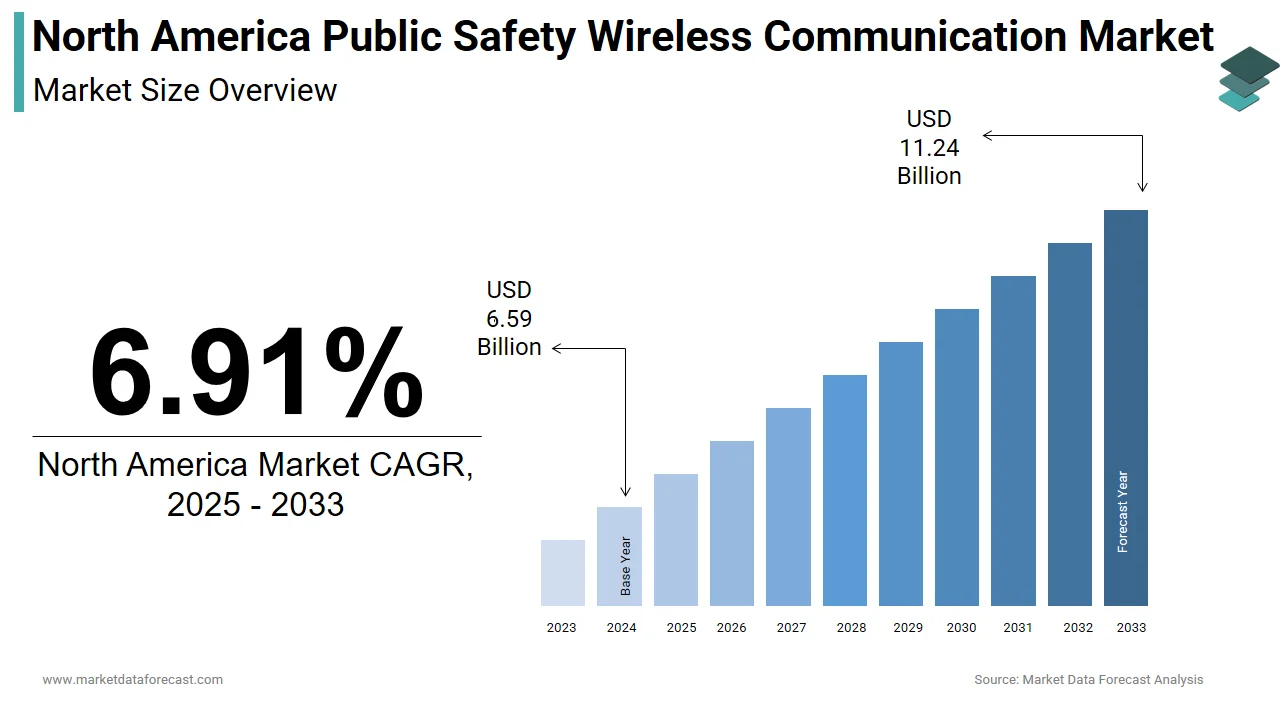
Market Size, 2025
$6.59 BnMarket Estimate, 2026
$7.05 BnMarket Forecast, 2034
$12.02 BnCAGR, 2026–2034
6.91%North America Public Safety Wireless Communication Market Size
The North America public safety wireless communication market was valued at USD 6.59 billion in 2025, is estimated to reach USD 7.05 billion in 2026, and is projected to reach USD 12.02 billion by 2034, growing at a CAGR of 6.91% from 2026 to 2034.
The public safety wireless communication is an ecosystem of networks designed to facilitate seamless, secure, and reliable communication among first responders, law enforcement agencies, fire departments, and emergency medical services. These systems operate across dedicated frequency bands, including the 700 MHz spectrum allocated by the Federal Communications Commission (FCC) for public safety broadband, and are increasingly anchored by the First Responder Network Authority (FirstNet), a nationwide broadband network established under the Middle Class Tax Relief and Job Creation Act of 2012. As of 2023, FirstNet has connected over 6 million users across all U.S. states and territories, including more than 18,000 public safety agencies, as confirmed by AT&T, the network’s builder and operator. The integration of Long-Term Evolution (LTE) and emerging 5G technologies into public safety infrastructure enables real-time data sharing, high-definition video streaming, and location-based services during emergency operations.
MARKET DRIVERS
Escalating Frequency and Complexity of Natural Disasters Requiring Real-Time Coordination
The increasing recurrence and severity of natural disasters is propelling the growth of the North America public safety wireless communication market. According to the National Oceanic and Atmospheric Administration, the United States experienced 28 distinct billion-dollar weather and climate disasters in 2023, cumulatively causing over $92.8 billion in damages, marking a sharp rise from the annual average of 8.1 such events between 2018 and 2022. During the 2023 Canadian wildfire season, over 15 million hectares burned, displacing more than 200,000 people and requiring cross-border coordination between U.S. and Canadian emergency units, as reported by Natural Resources Canada. Legacy radio systems often fail under such strain due to limited bandwidth and lack of data capability. In response, agencies are migrating to broadband-based solutions like FirstNet, which saw a 47% increase in active users during disaster activations in 2023 compared to the previous year, as disclosed by the First Responder Network Authority. The ability to transmit real-time video from drones, share GIS maps, and maintain voice communication under degraded infrastructure conditions has become indispensable.
Federal and State-Level Mandates for Interoperable Communication Networks
Mandated interoperability across public safety agencies is solely amplifying the growth of the North America public safety wireless communication market. According to the 9/11 Commission Report, communication failures among first responders were identified as a vulnerability, prompting long-term legislative and regulatory reforms. In the U.S., the Middle Class Tax Relief and Job Creation Act of 2012 established the First Responder Network Authority (FirstNet Authority) with the explicit mission of deploying a nationwide, interoperable broadband network for public safety. As of 2024, all 50 states, five U.S. territories, and the District of Columbia have opted into the FirstNet network, demonstrating full geographic adoption, as confirmed by the FirstNet Authority’s public deployment records. Furthermore, the FCC has enforced strict technical standards for narrowband and broadband systems to ensure cross-agency compatibility, particularly in multi-jurisdictional operations.
MARKET RESTRAINTS
High Capital and Operational Expenditures Limiting Adoption in Rural and Municipal Agencies
The financial burden of deploying and maintaining the advanced technologies for smaller and rural jurisdictions is hampering the growth of the North America public safety wireless communication market. The transition from legacy Land Mobile Radio (LMR) systems to broadband LTE or 5G-based platforms requires substantial investment in new user devices, in-vehicle routers, network infrastructure, and ongoing subscription fees. According to the International Association of Chiefs of Police, nearly 63% of municipal police departments in the U.S. with fewer than 100 officers reported budget constraints as the primary barrier to adopting broadband communication tools in their 2023 operational survey. Rural fire departments, which constitute over 70% of fire agencies in the U.S., often operate on volunteer-based models with limited tax bases by making large-scale procurement unfeasible. The cost of building dedicated towers or small cells in geographically dispersed areas escalates deployment expenses. For instance, the Alaska Division of Homeland Security and Emergency Management estimated that extending broadband coverage to remote indigenous communities costs upwards of $1.2 million per site due to logistical and environmental challenges.
Spectrum Congestion and Regulatory Delays in Frequency Allocation
Spectrum availability and regulatory inertia on the scalability and performance of public safety wireless networks are inhibiting the growth of the North America public safety wireless communication market. While the 700 MHz band was reallocated for public safety use after the digital television transition, increasing demand from commercial 5G networks has led to interference risks and spectrum encroachment concerns. The FCC’s 2023 Spectrum Frontiers report indicated that 68% of public safety agencies in metropolitan areas experienced at least one instance of signal degradation due to adjacent-band transmissions from commercial operators. In Canada, the deployment of the PSBN has been delayed in several provinces due to unresolved coordination between Innovation, Science, and Economic Development Canada and regional telecom providers over spectrum leasing terms. Furthermore, the lack of harmonized spectrum policies acrossthe U.S. and Canadian border regions complicates cross-border emergency operations. For example, the Pacific Northwest Emergency Response Commission reported in 2023 that 34% of joint U.S.-Canada drills experienced communication failures due to incompatible frequency usage.
MARKET OPPORTUNITIES
Integration of Artificial Intelligence and Predictive Analytics in Emergency Response Networks
The integration of artificial intelligence (AI) enhances situational awareness and decision-making. AI-powered platforms can analyze real-time data streams from body-worn cameras, drones, and IoT sensors to predict incident escalation, optimize responder dispatch, and detect anomalies in communication patterns. In 2023, the Los Angeles Fire Department implemented an AI-driven command system that reduced emergency response times by 18% by analyzing traffic patterns, weather data, and historical incident logs, as documented in a case study by the Urban Institute. Similarly, the New York City Police Department’s Domain Awareness System, which integrates wireless feeds with AI analytics, has improved suspect identification accuracy by 32% since its 2022 upgrade, according to internal NYPD performance metrics. The U.S. Department of Homeland Security has allocated $120 million under its Science and Technology Directorate’s 2023–2025 roadmap to fund AI-integrated communication pilots across 15 metropolitan areas. These systems enable automated transcription of radio traffic, sentiment analysis during crisis calls, and predictive hotspot mapping for crime or fire outbreaks.
Expansion of Private 5G Networks for Operations
The emergence of private 5G networks offers a strategic opportunity to overcome the limitations of public broadband infrastructure in high-risk and remote environments. Unlike consumer-grade networks, private 5G systems provide ultra-low latency (under 10 milliseconds), guaranteed bandwidth, and enhanced security, making them ideal for use in tactical operations, disaster zones, and infrastructure sites. These networks achieved 99.999% uptime during field exercises, supporting high-definition video transmission and augmented reality navigation for hazmat teams. Similarly, the Port of Vancouver implemented a private 5G network in 2023 to coordinate emergency response among border security, fire, and medical units, reducing inter-agency communication delays by 58%, according to a report by the Canadian Safety and Security Program. In rural areas, temporary 5G cells mounted on drones or vehicles can be rapidly deployed; the California Governor’s Office of Emergency Services utilized such systems during the 2023 wildfire season, achieving 100% connectivity in previously unreachable canyons. The Global System for Mobile Communications Association estimates that North America will host over 1,200 private 5G networks in public safety and infrastructure sectors by 2026, up from 320 in 2023.
MARKET CHALLENGES
Cybersecurity Vulnerabilities in IP-Based Communication Systems
The transition from analog radio to Internet Protocol (IP)-based broadband networks has introduced significant cybersecurity risks to public safety communications, which has limited the growth of the North America public safety wireless communication market. Unlike closed LMR systems, IP-based platforms such as FirstNet and PSBN are susceptible to distributed denial-of-service (DDoS) attacks, data interception, and ransomware infiltration. In 2023, the U.S. Cybersecurity and Infrastructure Security Agency recorded 1,427 cyber incidents targeting state and local government networks, a 37% increase from 2022, with emergency communication systems being among the most targeted sectors. Weak authentication protocols and outdated firmware in field devices further exacerbate vulnerabilities. In a 2023 audit, the Government Accountability Office found that 45% of public safety agencies using LTE devices had not implemented end-to-end encryption for data transmissions. Additionally, supply chain risks from foreign-manufactured equipment have prompted the FCC to ban devices from certain vendors in networks.
Workforce Readiness and Technological Skill Gaps in Field Operations
The disparity between advanced technology deployment and the operational readiness of frontline personnel. Many first responders, particularly in volunteer or part-time agencies, lack the technical proficiency to fully utilize data-rich broadband systems. According to a 2023 survey by the National Association of State Emergency Medical Services Officials, 58% of EMTs and paramedics in rural U.S. regions reported difficulty operating LTE-enabled devices during emergency calls, citing complex interfaces and inadequate training. This skills gap undermines the return on investment in advanced networks. For example, during a 2023 multi-agency drill in Arizona, 71% of participating units failed to transmit live video feeds despite being equipped with capable devices, as noted in a post-exercise evaluation by the Arizona Division of Emergency Management. The issue is compounded by high turnover rates and limited funding for continuous training programs.
REPORT COVERAGE
| REPORT METRIC | DETAILS |
| Market Size Available | 2025 to 2034 |
| Base Year | 2025 |
| Forecast Period | 2026 to 2034 |
| Segments Covered | By Technology Type, Application Area, End User, Deployment Mode, and Region. |
| Various Analyses Covered | Global, Regional and Country-Level Analysis, Segment-Level Analysis, Drivers, Restraints, Opportunities, Challenges; PESTLE Analysis; Porter’s Five Forces Analysis, Competitive Landscape, Analyst Overview of Investment Opportunities |
| Countries Covered | United States, Canada, Mexico, Rest of North America |
| Market Leaders Profiled | Motorola, JVCKENWOOD Corporation, Cisco, Harris, Nokia, EADS, Hytera, ICOM, Sepura, Ericsson, and Others. |
SEGMENTAL ANALYSIS
By Technology Type Insights
The Land Mobile Radio (LMR) segment accounted in holding 58.3% of the North America public safety wireless communication market share in 2024, with the extensive installed base across thousands of local and rural agencies. As per the Association of Public-Safety Communications Officials (APCO), over 73% of fire departments and 65% of sheriff’s offices in the U.S. still rely primarily on LMR systems for daily operations. These systems operate on dedicated VHF/UHF frequencies, ensuring uninterrupted voice transmission even in underground or dense urban environments where LTE signals falter. Additionally, LMR infrastructure has a lifecycle of 15 to 20 years, and many agencies have only recently completed major upgrades funded through federal grants such as the Department of Homeland Security’s Urban Areas Security Initiative.
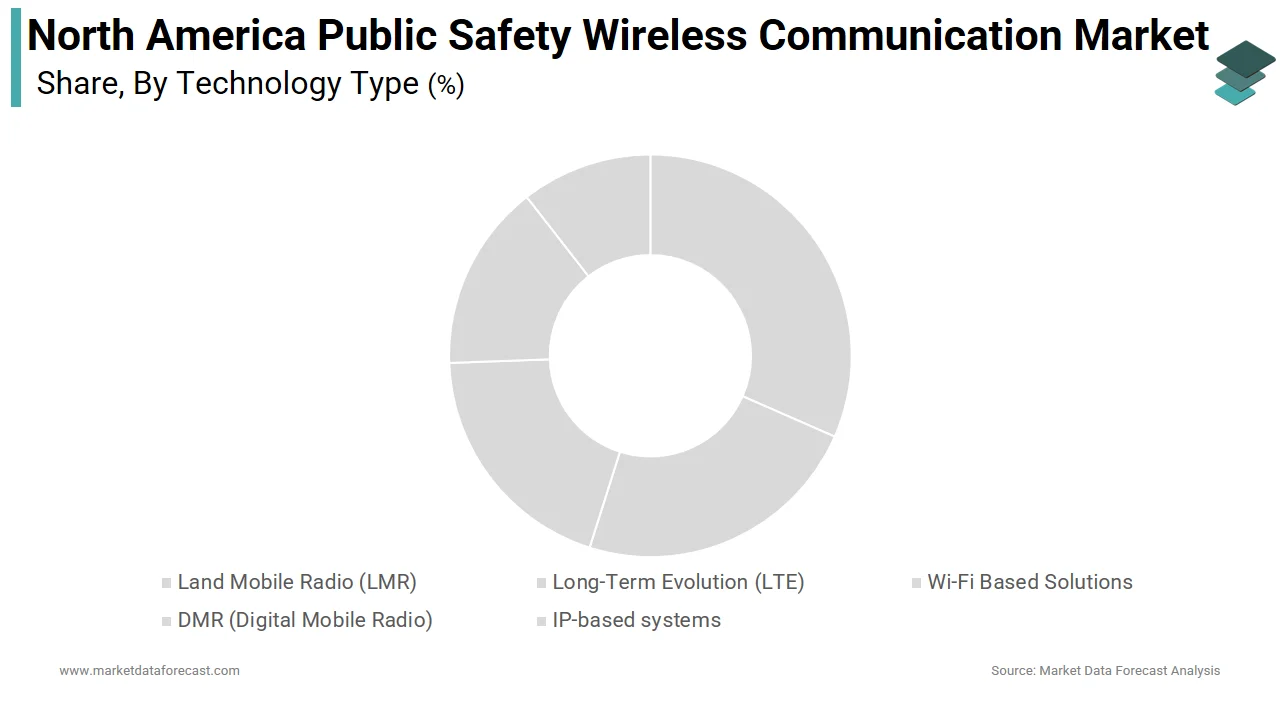
The Long-Term Evolution (LTE) segment is expected to grow with a CAGR of 14.6% during the forecast period owing to the urgent need for data-rich communication capabilities in emergency response. LTE enables high-definition video streaming from body cameras, real-time access to criminal databases, and drone-based situational awareness capabilities unattainable with legacy LMR. During the 2023 Hawaii wildfires, FirstNet’s LTE network supported over 1.2 million data sessions, including live video feeds from incident command centers, as documented by the Hawaii Emergency Management Agency.
By Application Area Insights
The emergency services segment was the largest and held a prominent share of the North America public safety wireless communication market share in 2025 with the sheer volume and operational intensity of frontline emergency response units, including police, fire, and emergency medical services (EMS). According to the National Registry of Emergency Medical Technicians, over 37 million emergency medical calls were handled in the U.S. in 2023, requiring seamless coordination between dispatch centers and mobile units. Additionally, the Federal Emergency Management Agency (FEMA) mandates interoperable communication for all federally funded emergency units, accelerating investment in integrated networks. Canada’s Emergency Health Services in British Columbia upgraded its radio and data systems in 2023, linking over 1,200 ambulances to a centralized LTE backbone by enhancing dispatch accuracy and reducing response intervals by 17%, according to BC Emergency Health Services’ annual performance review.
The Public Safety Agencies segment is growing lucratively with a CAGR of 13.9% in the coming years, with the rising complexity of security threats and the need for inter-agency intelligence sharing. The Department of Homeland Security operates 81 such centers across the U.S., all of which now require secure, high-bandwidth wireless connectivity to process real-time feeds from CCTV, license plate readers, and mobile command units. In 2023, the New York Police Department’s Real Time Crime Center processed over 450,000 data queries using LTE-connected devices, improving suspect identification speed by 35%, according to NYPD internal metrics. These capabilities demand robust wireless infrastructure, pushing agencies to adopt broadband solutions. In Canada, the Royal Canadian Mounted Police initiated a nationwide LTE migration in 2023 by aiming to equip 25,000 officers with data-capable devices by 2026, as disclosed by Public Safety Canada.
By End User Insights
The government segment was accounted in holding the North America public safety wireless communication market share in 2025, with a centralized role of federal, state, and local governments in funding, regulating, and operating communication networks. The U.S. Federal Communications Commission has designated over 20 MHz of the 700 MHz band exclusively for public safety use by enabling the development of FirstNet, a government-led initiative that has seen $40 billion in federal and state investment since its inception, according to the National Telecommunications and Information Administration. At the state level, California allocated $210 million in its 2023 budget for upgrading wireless systems across 58 counties, emphasizing interoperability between law enforcement and fire agencies, as documented in the California State Legislature’s Budget Act. Government agencies also operate the largest fleets of communication devices over 4.1 million LMR and LTE units in active service across U.S. public safety departments in 2023, per the Bureau of Justice Assistance.
The healthcare institutions segment is expected to register a CAGR of 15.2% from 2026 to 2034, with the increasing integration of pre-hospital care into the broader healthcare continuum. According to the American Hospital Association, 68% of U.S. hospitals with emergency departments now require ambulances to use secure wireless networks to send electronic patient care reports before arrival, improving triage efficiency by up to 30%, as cited in a 2023 Joint Commission report. Another factor is the rise of telemedicine in emergency response during the 2023 Midwest floods. Mercy Health deployed LTE-connected mobile clinics that conducted over 1,200 virtual consultations with trauma specialists by reducing evacuation needs by 41%, according to internal operational data.
By Deployment Mode Insights
The on-premises segment held a prominent share of the North America public safety wireless communication market in 2025, with the importance of control, security, and uptime in operations. Public safety agencies prioritize physical ownership of communication infrastructure to ensure uninterrupted access during disasters when commercial networks may fail. For example, the New York City Office of Emergency Management operates a fully redundant on-premise network with underground data centers capable of withstanding Category 5 hurricane conditions, as detailed in its 2023 Resilience Report. Additionally, federal standards such as the National Institute of Standards and Technology (NIST) Special Publication 800-171 mandate strict data sovereignty for sensitive law enforcement communications, discouraging reliance on third-party cloud providers.
The cloud-based deployment segment is deemed to witness a CAGR of 16.3% in the coming years with the increasing demand for scalable, interoperable, and rapidly deployable communication solutions. The First Responder Network Authority reported in 2023 that over 1.8 million users had accessed FirstNet’s cloud-based Mission Critical Services, including group calling, video sharing, and location tracking, during large-scale emergencies. Furthermore, cloud platforms facilitate rapid disaster recovery; during Hurricane Idalia in 2023, Florida’s Division of Emergency Management restored full communication functionality within two hours using cloud backups, compared to 18 hours in previous storms, according to state emergency logs.
COUNTRY-LEVEL ANALYSIS
The United States Public Safety Wireless Communication Market Insights
The United States was the top performer in the North America public safety wireless communication market by capturing 78.3% of share in 2024 with the comprehensive federal initiatives, substantial funding, and advanced technological integration. The cornerstone of this dominance is the First Responder Network Authority (FirstNet), which, as of 2023, had enrolled over 6 million users and deployed more than 17,000 cell sites across all 50 states and territories, according to AT&T, the network’s builder and operator. Additionally, the Department of Homeland Security distributed over $1.8 billion in 2023 through the State and Local Cybersecurity Grant Program to modernize communication systems, as reported by the Federal Emergency Management Agency. The U.S. also leads in innovation, with agencies like the Los Angeles Police Department implementing AI-enhanced LTE platforms that process real-time video analytics.
Canada Public Safety Wireless Communication Market Insights
Canada was positioned second with 16.4% of the North America public safety wireless communication market share in 2024. The country is undergoing a strategic transformation in public safety communications through the rollout of the Public Safety Broadband Network (PSBN), a nationwide LTE system managed in partnership with Rogers Communications. As of 2023, the PSBN had achieved 65% population coverage, with full deployment expected by 2025, according to Public Safety Canada. A key driver is federal coordination across provincial and municipal agencies, particularly in emergency response and border security. The Royal Canadian Mounted Police equipped over 12,000 officers with LTE-enabled devices in 2023, enabling real-time access to criminal databases and encrypted communications, as reported by the RCMP’s Operational Technology Division. Additionally, Canada’s vast geography necessitates resilient wireless networks; the Northwest Territories implemented a satellite-backed LTE system in 2023 to serve remote indigenous communities, covering 1.3 million square kilometers with 98% reliability, according to Indigenous Services Canada. The federal government has committed CAD 1.1 billion to the PSBN through 2027, ensuring sustained investment.
COMPETITIVE LANDSCAPE
The competitive landscape of the North America public safety wireless communication market is defined by a convergence of legacy expertise and technological innovation. Established players with deep roots in land mobile radio systems are navigating a strategic shift toward broadband and data-centric platforms, while telecommunications providers are leveraging their network infrastructure to secure pivotal roles in public safety ecosystems. The market is characterized by high barriers to entry due to stringent regulatory requirements, the need for system reliability, and long procurement cycles involving government agencies. As a result, competition is concentrated among a select group of firms that combine technical credibility with proven deployment experience. Differentiation is achieved not through price, but through system resilience, security certifications, and seamless interoperability across jurisdictions. Partnerships with federal bodies and participation in nationwide networks like FirstNet have become key competitive levers. Companies are also vying to integrate emerging technologies such as artificial intelligence, edge computing, and encrypted cloud services to enhance operational capabilities. The emphasis on performance means that trust, reliability, and compliance outweigh novelty, by fostering a landscape where reputation and proven track record determine market standing. This environment encourages collaboration as much as competition, with firms often serving as subcontractors or technology integrators within larger government-led initiatives.
KEY MARKET PLAYERS
Noteworthy Companies dominating the North America Public safety wireless communication market profiled in the report are Motorola, JVCKENWOOD Corporation, Cisco, Harris, Nokia, EADS, Hytera, ICOM, Sepura, Ericsson, and Others.
TOP LEADING PLAYERS IN THE MARKET
Motorola Solutions
Motorola Solutions has long been a cornerstone in the North America public safety wireless communication market, renowned for its deep expertise in technologies. The company has pioneered advancements in Land Mobile Radio (LMR) systems and has seamlessly transitioned into broadband solutions with its ASTRO 25 and WAVE platforms. Motorola’s integration of artificial intelligence, biometrics, and real-time data analytics into its communication ecosystem has set new benchmarks for situational awareness. Its close collaboration with federal and local agencies ensures that its solutions align precisely with operational needs, reinforcing its reputation as a trusted partner in public safety.
AT&T
AT&T holds a strategic position as the builder and operator of FirstNet, the nationwide public safety broadband network in the United States. This exclusive role has positioned AT&T as a central enabler of next-generation wireless communication for first responders. The company’s investment in dedicated network infrastructure, including priority and preemption features, ensures that emergency personnel maintain connectivity during crises. AT&T’s integration of 5G, IoT, and cloud-based services into the public safety domain has redefined how agencies operate in the field. Its influence extends globally by serving as a model for other nations exploring nationwide emergency broadband networks, demonstrating how telecom operators can become integral to national security infrastructure.
L3Harris Technologies
L3Harris Technologies combines advanced radio engineering with cutting-edge cybersecurity to deliver secure, scalable communication solutions for public safety agencies. The company is a major supplier of encrypted LMR systems and has expanded into broadband with its ATCAD and P25 networks, known for their reliability in extreme conditions. L3Harris actively supports federal and military-grade communication requirements, contributing to cross-border interoperability and disaster resilience. Its focus on innovation in portable, rapidly deployable systems enables emergency units to establish connectivity in remote or damaged environments. Through robust R&D and strategic government partnerships, L3Harris continues to influence both North American and international public safety communication standards with a strong emphasis on security and operational continuity.
TOP STRATEGIES USED BY KEY MARKET PARTICIPANTS
One major strategy employed by leading players is deepening public-private partnerships to co-develop and operate networks. Companies ensure their technologies meet exacting public safety standards while gaining long-term operational roles, such as AT&T’s stewardship of FirstNet. This fosters trust and institutional integration, making displacement by competitors highly unlikely.
Another key approach is vertical integration of hardware, software, and network services to offer end-to-end communication ecosystems. Companies like Motorola Solutions and L3Harris bundle radios, command center software, analytics, and encryption into unified platforms, enhancing interoperability and reducing reliance on third-party vendors. This holistic model increases customer lock-in and streamlines deployment.
A third strategy involves investing in rapid deployment and portable communication solutions for disaster response. Firms are developing mobile command units, drone-integrated networks, and temporary 5G cells that can be activated in crisis zones. These systems strengthen their value proposition by ensuring connectivity in infrastructure-compromised environments, positioning them as indispensable during large-scale emergencies.
RECENT MARKET DEVELOPMENTS
- In March 2024, Motorola Solutions launched a new AI-powered command software suite integrated with its LMR and LTE networks, enabling real-time incident analysis and automated resource dispatch for public safety agencies across the United States and Canada.
- In June 2023, AT&T expanded FirstNet’s coverage by deploying additional Band 14 spectrum cells in rural and underserved regions, enhancing connectivity for first responders in remote areas and reinforcing its commitment to nationwide emergency network resilience.
- In January 2024, L3Harris Technologies introduced a next-generation portable 5G node capable of establishing secure, high-bandwidth communication in disaster zones within minutes, significantly improving rapid deployment capabilities for federal and state emergency units.
- In September 2023, Motorola Solutions partnered with a leading cybersecurity firm to embed zero-trust architecture into its public safety communication platforms, strengthening data protection and ensuring compliance with evolving federal security mandates.
- In May 2024, AT&T collaborated with the U.S. Department of Homeland Security to conduct a nationwide interoperability drill using FirstNet’s priority access features, demonstrating seamless coordination across multiple agencies and validating the network’s readiness for large-scale emergencies.
MARKET SEGMENTATION
This North America Public safety wireless communication market research report is segmented and sub-segmented into the following categories.
By Technology Type
- Land Mobile Radio (LMR)
- Long-Term Evolution (LTE)
- Wi-Fi-Based Solutions
- DMR (Digital Mobile Radio)
- IP-based systems
By Application Area
- Emergency Services
- Public Safety Agencies
- Transportation and Logistics
- Utility Companies
- Military and Defense
By End User
- Govement
- Healthcare Institutions
- Educational Institutions
- Private Enterprises
- Non-Govemental Organizations (NGOs)
By Deployment Mode
- On-Premise Deployment
- Cloud-Based Deployment
- Hybrid Deployment
By Communication Type
- Voice Communication
- Data Communication
- Video Communication
- Text Messaging
By Country
- United States
- Canada
- Mexico
- Rest of North America