- Product Description Description
- Table of Contents TOC
- List of Table & Figure LOT
- Get Free Sample PDF Sample PDF
Market Size, 2025
$77.40 BnMarket Estimate, 2026
$79.75 BnMarket Forecast, 2034
$101.25 BnCAGR, 2026–2034
3.03%North America Solid Waste Management Market Summary
The North America solid waste management market was valued at USD 77.40 billion in 2025, is estimated to reach USD 79.75 billion in 2026, and is projected to reach USD 101.25 billion by 2034, growing at a CAGR of 3.03% from 2026 to 2034. Growing urbanization, regulatory mandates, and circular economy developments are fueling market growth across the region.
Key Market Trends & Insights
- United States led the North America solid waste management market in 2025.
- Canada is expected to grow steadily due to advanced EPR policies.
- Based on waste type, the plastic segment held the largest share in 2025.
- Based on disposal methods, the landfill segment remained dominant in 2025.
Market Size & Forecast
- 2025 Market Size: USD 77.40 Billion
- 2026 Market Size: USD 79.75 Billion
- 2034 Projected Market Size: USD 101.25 Billion
- CAGR (2026 to 2034): 3.03%
- United States: Largest market in 2025
- Canada: Growing with strong regulatory backing
North America Solid Waste Management Market Size
The North America solid waste management market was valued at USD 77.40 billion in 2025, is estimated to reach USD 79.75 billion in 2026, and is projected to reach USD 101.25 billion by 2034, growing at a CAGR of 3.03% from 2026 to 2034.
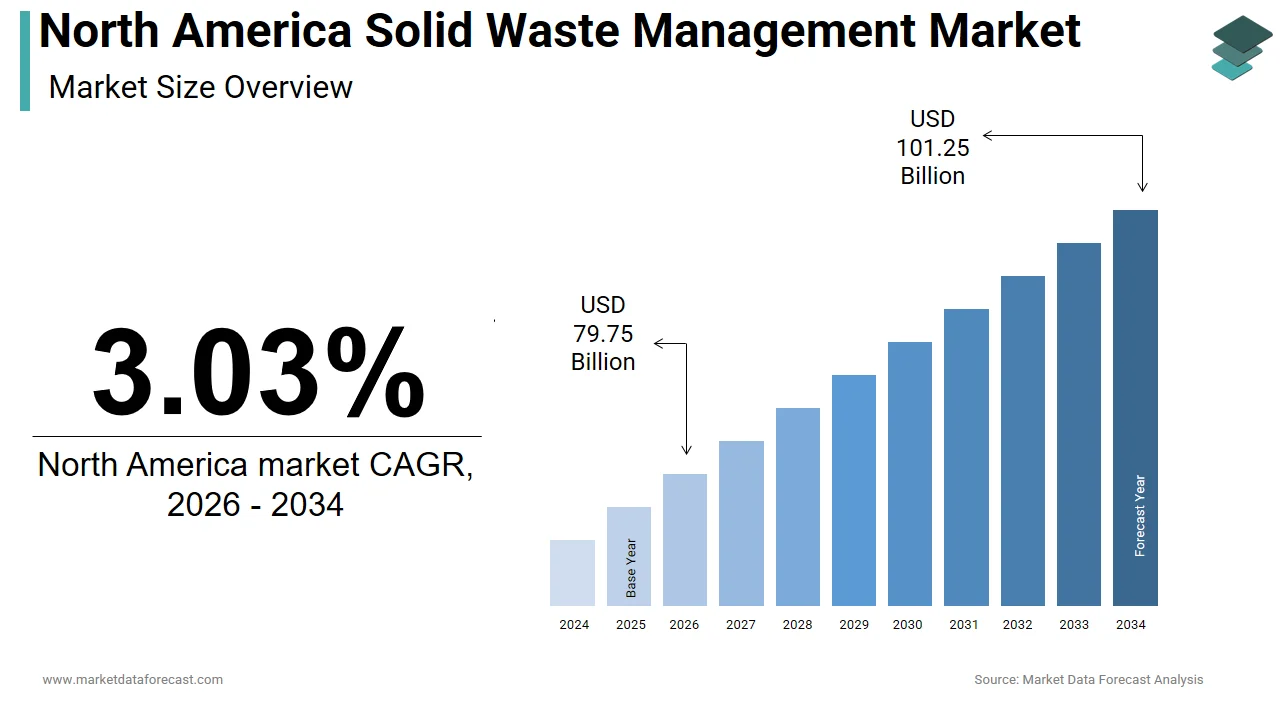
Modern waste management operations utilize advanced technologies, including automated collection systems, waste-to-energy conversion plants, material recovery facilities, and smart monitoring systems that optimize route planning and container filling rates. According to the Environmental Protection Agency, North America generates approximately 292 million tons of municipal solid waste annually, with varying diversion rates across different jurisdictions. The integration of Internet of Things sensors, artificial intelligence, and data analytics has revolutionized operational efficiency, enabling real-time monitoring of waste generation patterns and collection optimization.
MARKET DRIVERS
Population Growth and Urbanization Pressures
The expanding urban population across North America creates unprecedented demand for sophisticated waste management infrastructure and services, which is driving the growth of the North American solid waste management market. The United States Census Bureau projects that the urban population will reach 292 million by 2030, representing 85% of the total population, which directly correlates with increased waste generation volumes requiring efficient collection and processing systems. Urban density amplifies waste management complexity as municipalities must optimize collection routes, reduce traffic congestion, and minimize environmental impacts while serving growing populations within constrained geographical boundaries. Municipal governments are increasingly adopting smart city initiatives that integrate waste management systems with broader urban planning strategies, which are creating opportunities for technology-driven solutions that enhance operational efficiency. Furthermore, changing consumption patterns associated with urban lifestyles contribute to evolving waste streams that require specialized handling capabilities. E-commerce growth has increased packaging waste by 15% annually, according to the National Retail Federation, while single-use item proliferation creates challenges for traditional recycling systems.
Environmental Regulations and Sustainability Mandates
The stringent environmental regulations across North American jurisdictions drive continuous investment in advanced waste management technologies and sustainable processing methods. The Environmental Protection Agency's Resource Conservation and Recovery Act establishes comprehensive frameworks for hazardous waste management, requiring specialized handling, transportation, and disposal procedures that create substantial market opportunities for compliant service providers. Additionally, state-level renewable energy standards mandate waste-to-energy conversion targets that stimulate infrastructure development and technology adoption throughout the region. Canadian provinces have implemented extended producer responsibility programs that shift waste management costs from municipalities to manufacturers, creating financial incentives for source reduction and recyclable material design. British Columbia's Recycling Regulation requires producers to manage 85% of designated materials, which is generating significant demand for collection, sorting, and processing services. Moreover, corporate sustainability commitments from major retailers and manufacturers create secondary demand for waste management services that exceed regulatory minimums. Walmart's zero waste initiative and Amazon's packaging reduction goals require sophisticated waste auditing, diversion tracking, and reporting capabilities that specialized service providers must develop to remain competitive.
MARKET RESTRAINTS
Infrastructure Aging and Capital Investment Requirements
North America's waste management market growth is hindered by the lack of proper infrastructure and operational efficiency across multiple service categories. The American Society of Civil Engineers grades the nation's solid waste infrastructure as needing substantial investment, with over 40% of landfills operating beyond their originally designed capacity, according to the Environmental Research & Education Foundation. Capital investment requirements for modernizing waste management systems create financial barriers that limit market expansion and technological adoption, particularly for smaller operators lacking access to substantial funding sources. Transportation infrastructure limitations further constrain waste management operations, as aging road networks and bridge restrictions limit collection vehicle routing options and increase operational costs. The Federal Highway Administration reports that 43% of major urban roads are in poor condition, directly impacting waste collection efficiency and vehicle maintenance costs.
Skilled Labor Shortages and Workforce Development Challenges
The workforce shortages constrain operational capacity and service quality across all market segments. The Bureau of Labor Statistics projects a 5% decline in waste collection jobs through 2030, despite increasing demand for services, creating significant operational challenges for market participants. Training and certification requirements for hazardous waste handling create additional workforce constraints that limit service provider capacity and increase labor costs throughout the industry. The Occupational Safety and Health Administration mandates extensive certification programs for workers handling dangerous materials, requiring significant investment in training programs and ongoing compliance monitoring. Furthermore, demographic shifts within the existing workforce create succession planning challenges that threaten long-term operational continuity and knowledge transfer.
MARKET OPPORTUNITIES
Circular Economy Development and Resource Recovery Innovation
The transition toward circular economy principles creates substantial opportunities for waste management companies to develop value-added services that transform waste streams into marketable resources. Advanced sorting technologies, chemical recycling processes, and material recovery innovations enable operators to extract higher value from traditional waste streams while supporting corporate sustainability objectives. Organic waste processing represents a particularly promising opportunity segment, as anaerobic digestion and composting technologies convert food waste into renewable energy and soil amendments. The USDA reports that food waste comprises 22% of municipal solid waste streams, creating substantial feedstock opportunities for operators investing in organic waste processing capabilities. Additionally, industrial symbiosis programs create opportunities for waste management companies to facilitate material exchange between manufacturing facilities, reducing disposal costs while generating revenue from material brokerage services.
Smart Technology Integration and Digital Transformation
The digital transformation initiatives enhance operational efficiency, improve customer service, and develop new revenue streams through technology integration, which is amplifying the growth of the North American solid waste management market. Internet of Things sensors, artificial intelligence algorithms, and predictive analytics enable operators to optimize collection routes, monitor container fill levels, and predict maintenance requirements with unprecedented accuracy. Mobile applications and customer portals create opportunities for enhanced customer engagement and service customization that differentiate providers in competitive markets. Real-time tracking systems, automated scheduling capabilities, and digital payment processing improve customer satisfaction while reducing administrative costs and operational inefficiencies. Furthermore, data analytics capabilities create opportunities for waste management companies to develop consulting services and strategic insights that support municipal planning and corporate sustainability initiatives. Waste generation pattern analysis, diversion rate optimization, and environmental impact assessment services provide valuable information to government agencies and private enterprises seeking to improve their waste management performance. Companies investing in advanced data collection and analysis capabilities can leverage their operational insights to develop high-margin consulting services that complement traditional waste management operations.
MARKET CHALLENGES
Regulatory Complexity and Compliance Management
The North American solid waste management market operates within a complex web of federal, state, provincial, and local regulations that create significant compliance challenges and operational constraints for market participants. The Environmental Protection Agency maintains over 200 separate regulatory programs affecting waste management operations, while individual states and provinces implement additional requirements that vary significantly across jurisdictions. This regulatory fragmentation creates substantial administrative burdens and compliance costs that particularly impact smaller operators lacking dedicated regulatory affairs capabilities.
Hazardous waste classification and handling requirements create additional complexity that constrains operational flexibility and increases service delivery costs throughout the industry. The Resource Conservation and Recovery Act establishes detailed requirements for over 200,000 different hazardous waste streams, requiring specialized training, equipment, and documentation procedures that increase operational complexity and liability exposure. Furthermore, evolving environmental standards and emerging contaminant regulations create ongoing compliance challenges that require continuous adaptation and investment in new technologies and procedures. Per- and polyfluoroalkyl substances regulations have created new disposal requirements for affected materials, requiring specialized treatment processes and disposal facilities that are not yet widely available.
Climate Change Adaptation and Resilience Requirements
Climate change impacts create significant operational challenges for North American waste management systems that must adapt to changing weather patterns, sea level rise, and extreme weather events while maintaining service reliability and environmental compliance. The National Oceanic and Atmospheric Administration reports that weather-related disasters have increased by 50% over the past decade, creating operational disruptions and infrastructure damage that increase costs and reduce service reliability. Waste management facilities located in flood-prone areas or coastal regions face particular vulnerability to climate impacts that require substantial investment in resilience measures and alternative operational strategies.
Temperature variations and changing precipitation patterns affect waste composition and processing efficiency, requiring adaptive operational procedures and equipment modifications that increase operational complexity and costs. Organic waste decomposition rates vary significantly with temperature changes, affecting landfill gas generation patterns and requiring adjustments to collection and flaring systems. Additionally, climate change creates new regulatory requirements and stakeholder expectations that challenge traditional waste management approaches and require innovative solutions. Carbon reduction mandates, renewable energy requirements, and environmental justice considerations create additional operational constraints that require significant investment in new technologies and procedures.
REPORT COVERAGE
| REPORT METRIC | DETAILS |
| Market Size Available | 2025 to 2034 |
| Base Year | 2025 |
| Forecast Period | 2026 to 2034 |
| Segments Covered | By Waste Type, Disposal Method, Product Type, Collection Type, End User, and Country. |
| Various Analyses Covered | Global, Regional and Country-Level Analysis, Segment-Level Analysis, Drivers, Restraints, Opportunities, Challenges; PESTLE Analysis; Porter’s Five Forces Analysis, Competitive Landscape, Analyst Overview of Investment Opportunities |
| Countries Covered | United States, Canada, Mexico, Rest of North America |
| Market Leaders Profiled | Waste Management Inc., Republic Services, Clean Harbors, Stericycle, Advanced Disposal Services, and Others. |
SEGMENTAL ANALYSIS
By Waste Type Insights
The plastic segment was the largest and held 35.4% of the North America solid waste management market share in 2024, with the exponential growth in single-use plastic consumption across North American markets. The American Chemistry Council reports that North America consumed over 35 million tons of plastic resins in packaging applications alone during 2023, generating massive waste streams that require sophisticated management solutions. The food service industry's reliance on plastic containers, bags, and wraps has intensified, with restaurant and delivery services contributing significantly to overall plastic waste generation. The evolving regulatory landscape mandating plastic waste reduction and recycling targets across multiple jurisdictions is another factor fuelling the growth of the North American solid waste management market. Similar regulations in Canada mandate that provinces achieve 50% plastic packaging recycling rates by 2030, according to Environment and Climate Change Canada. These regulatory frameworks establish minimum performance standards that drive investment in advanced sorting technologies, chemical recycling facilities, and extended producer responsibility programs that enhance market value and service complexity. Additionally, corporate sustainability commitments from major retailers and manufacturers have created secondary demand for sophisticated plastic waste management services that exceed regulatory minimums. Walmart's Project Gigaton initiative requires suppliers to reduce plastic packaging by 10% by 2025, which is generating demand for waste auditing, material recovery, and circular economy consulting services.
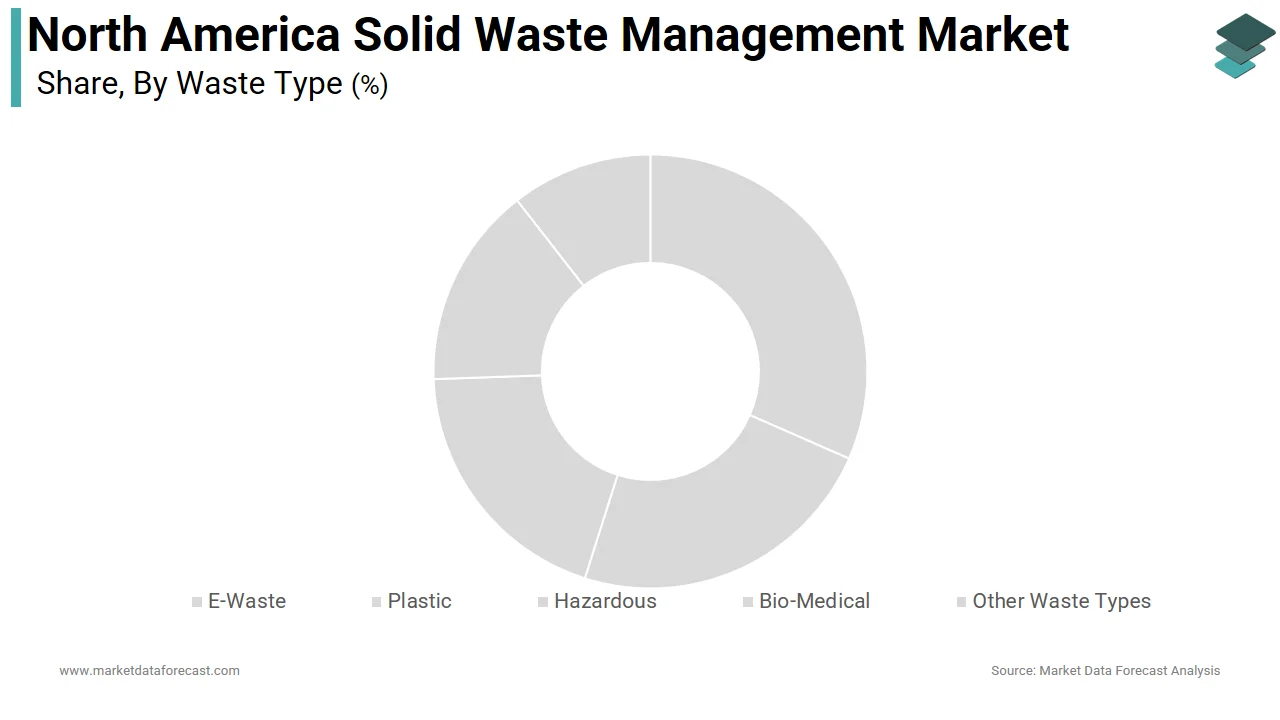
The electronic segment is likely to grow with a CAGR of 6.8% from 2026 to 2034, with the accelerating pace of technological advancement, shortened product life cycles, and increasing consumer electronics adoption across residential and commercial sectors. The Consumer Technology Association reports that average U.S. households now own 11 connected devices, representing a 40% increase from 2018 levels, generating substantial volumes of obsolete electronics requiring proper disposal and recycling. Commercial sectors are experiencing similar growth, with smart building technologies, industrial sensors, and digital infrastructure upgrades creating continuous streams of electronic waste that require specialized handling due to valuable material content and environmental hazards. The implementation of extended producer responsibility programs specifically targeting electronic waste across multiple North American jurisdictions is also to fuel the growth of the North American solid waste management market. The Basel Action Network indicates that eight U.S. states have enacted comprehensive e-waste recycling laws requiring manufacturers to fund collection and recycling programs, creating structured market opportunities for specialized service providers.
By Disposal Methods Insights
The landfill disposal segment in the North American solid waste management market held 52.35% of the share in 2024 due to the extensive existing landfill infrastructure and sunk capital investments throughout North America that create economic incentives for continued utilization. The Environmental Research & Education Foundation reports that over 1,200 active municipal solid waste landfills operate across the United States, representing billions of dollars in infrastructure investments that operators seek to maximize through extended operational lifespans. The limited availability of alternative disposal capacity for certain waste streams that cannot be effectively processed through recycling or energy recovery methods is also to fuel the growth of the segment. The National Association of Clean Water Agencies indicates that hazardous waste streams comprising 15% of total waste volumes often require specialized landfill disposal due to treatment limitations and regulatory requirements. Additionally, economic considerations and cost competitiveness continue to favor landfill disposal for many waste generators despite environmental concerns and regulatory pressures.
The recycling services segment is gearing up with an expected CAGR of 5.4% from 2026 to 2034, with the implementation of ambitious recycling targets and mandatory diversion requirements across multiple North American jurisdictions that create structured demand for recycling services. The Ellen MacArthur Foundation reports that California's SB 1383 mandates 75% organic waste diversion by 2025, while similar legislation in Canadian provinces requires 50% overall waste diversion rates by 2030, according to Environment and Climate Change Canada. The growing corporate demand for recycled content and circular economy solutions that create premium pricing opportunities for high-quality recycled materials is also escalating the growth of the segment. The Recycling Partnership indicates that over 300 major corporations have committed to using 50% recycled content in packaging by 2030, generating substantial demand for sophisticated sorting and processing services that can deliver consistent quality recycled materials. Consumer goods manufacturers are increasingly willing to pay premium prices for certified recycled content that supports their sustainability objectives and meets regulatory requirements for post-consumer recycled content.
COUNTRY-WISE ANALYSIS
United States Solid Waste Management Market Insights
The United States was the top performer of the North American solid waste management market with 82.3% of the share in 2024, with the extraordinary volume of municipal solid waste generated annually across diverse geographic and demographic markets. The Environmental Protection Agency reports that U.S. residents generate 4.9 pounds of waste per person daily, significantly exceeding global averages and creating substantial demand for collection, transportation, and processing services. The complex and fragmented regulatory landscape that varies substantially across federal, state, and local jurisdictions is creating demand for specialized compliance services and regulatory expertise. Additionally, corporate sustainability commitments and extended producer responsibility programs have created substantial secondary demand for sophisticated waste management services that exceed regulatory minimums. The Sustainability Consortium reports that over 400 Fortune 500 companies have established zero-waste goals, which require comprehensive waste auditing, diversion tracking, and reporting services that command premium pricing.
Canada Solid Waste Management Market Insights
Canada was positioned second by capturing 15.3% of the North American solid waste management market share in 2024, with the comprehensive extended producer responsibility programs implemented across multiple provinces that create structured demand for specialized waste management services. Environment and Climate Change Canada reports that British Columbia's recycling regulation covers 17 material categories and requires producers to achieve 85% collection rates, generating substantial demand for collection networks, sorting facilities, and processing services. The stringent environmental regulations and carbon reduction commitments that require sophisticated waste management approaches and compliance monitoring services are also expected to fuel the growth of the market in this country.
Furthermore, indigenous community waste management initiatives have created new market opportunities for culturally sensitive and geographically appropriate waste management services. Indigenous Services Canada reports that over 600 First Nations communities require specialized waste management solutions that account for remote locations, seasonal accessibility challenges, and cultural considerations. These unique requirements create demand for mobile processing units, seasonal collection services, and community-based waste management programs that command premium pricing while supporting broader social and environmental objectives.
COMPETITIVE LANDSCAPE
The North American solid waste management market exhibits a highly concentrated competitive landscape dominated by several large national operators alongside numerous regional and local service providers. Major players compete primarily on service quality, geographic coverage, and technological capabilities rather than price alone, as customers increasingly prioritize reliability, compliance, and environmental performance. The market dynamics are influenced by factors such as regulatory compliance requirements, infrastructure investments, and evolving customer preferences for sustainable waste management solutions. Competition intensifies in metropolitan areas where customer acquisition costs are high, and companies must differentiate themselves through superior service quality, innovative technology solutions, and comprehensive service portfolios.
The industry also witnesses increasing consolidation as larger firms acquire smaller competitors to expand geographic reach and enhance service capabilities. Market participants continuously adapt their business models to address changing regulatory requirements, environmental standards, and digital transformation demands while maintaining profitability in a challenging economic environment. Smaller regional operators often compete by offering specialized services, local market knowledge, and personalized customer relationships that larger national providers may struggle to replicate. The competitive landscape is further complicated by the entry of technology companies and consulting firms that offer innovative waste management solutions and digital platforms that challenge traditional service delivery models.
KEY MARKET PLAYERS
Noteworthy Companies dominating the North America Solid waste management market profiled in the report are
- Waste Management Inc
- Royal Barksdale Company
- Republic Services
- Clean Harbors
- Golnar Tragacanth Company
- Persian Tragacanth Industries
- Stericycle
- Advanced Disposal Services
TOP LEADING PLAYERS IN THE MARKET
- Royal Barksdale Company has established itself as a leading supplier in the Middle East and Africa tragacanth market through decades of specialized trading experience and extensive regional distribution networks. The company's commitment to quality assurance and sustainable sourcing practices has enabled them to serve diverse industries, including pharmaceuticals, food processing, and cosmetics across multiple countries. Their strategic partnerships with Iranian suppliers ensure consistent supply chain reliability while maintaining competitive pricing structures. The company's investment in processing facilities and quality control systems has enhanced product purity and customization capabilities, allowing them to meet specific customer requirements across different industrial applications and geographic markets.
- Golnar Tragacanth Company has gained significant market presence in the African tragacanth sector through innovative processing techniques and comprehensive regional coverage. The company specializes in producing pharmaceutical-grade tragacanth with enhanced solubility properties that cater to the growing healthcare manufacturing demand across the continent. Their integrated approach from raw material procurement to final product development ensures consistent quality control throughout the supply chain. Golnar's research and development initiatives have led to the creation of specialized formulations for specific industrial applications, which is positioning them as a preferred supplier among cosmetic and food processing companies seeking reliable and high-quality tragacanth solutions.
- Persian Tragacanth Industries represents a significant force in the regional market through their comprehensive product portfolio and strategic market expansion initiatives. The company has successfully penetrated both traditional and emerging markets by offering customized tragacanth solutions tailored to specific customer requirements and regional preferences. Their vertically integrated operations from raw material harvesting to finished product manufacturing, ensure quality standards while maintaining competitive pricing. The company's focus on sustainable harvesting practices and community engagement programs has strengthened its reputation among environmentally conscious buyers by enabling it to capture substantial market share across diverse geographical territories and industrial sectors.
TOP STRATEGIES USED BY KEY MARKET PARTICIPANTS
Strategic Acquisitions and Consolidation
Leading companies in the North American solid waste management market are pursuing aggressive acquisition strategies to expand their geographic reach, enhance service capabilities, and achieve operational synergies. These consolidation efforts enable larger operators to capture market share from smaller regional providers while developing comprehensive service portfolios that span multiple waste streams and disposal methods. Companies are particularly focused on acquiring specialized service providers that offer unique capabilities in hazardous waste handling, electronic waste processing, or advanced recycling technologies. This approach allows them to rapidly expand into new market segments without the substantial capital investment and development time required for organic growth initiatives.
Technology Integration and Digital Transformation
Market participants are investing heavily in advanced technologies, including Internet of Things sensors, artificial intelligence algorithms, and data analytics platforms to optimize operational efficiency and enhance customer service delivery. These technology initiatives enable companies to develop predictive maintenance capabilities, optimize collection routes, and provide real-time visibility into service delivery performance. Companies are also implementing mobile applications and customer portals that facilitate automated scheduling, real-time tracking, and digital payment processing. The integration of smart city technologies with waste management systems creates opportunities for municipalities to improve operational efficiency while reducing environmental impacts through data-driven decision making and resource optimization.
Sustainability and Circular Economy Development
Major players are developing comprehensive sustainability initiatives that focus on waste reduction, material recovery, and circular economy solutions to meet evolving customer expectations and regulatory requirements. These programs include investment in advanced recycling technologies, organic waste processing facilities, and waste-to-energy conversion systems that transform traditional disposal operations into resource recovery centers. Companies are also developing consulting services and technology platforms that help customers achieve their sustainability objectives through waste auditing, diversion tracking, and carbon footprint reduction programs. These initiatives enable service providers to differentiate their offerings while creating new revenue streams and strengthening customer relationships through value-added services.
RECENT MARKET DEVELOPMENTS
- In February 2024, Waste Management Inc. acquired Advanced Disposal Services' commercial and residential collection assets to expand its geographic footprint in the southeastern United States and enhance route density optimization capabilities.
- In May 2024, Republic Services partnered with Google Cloud to implement advanced data analytics and artificial intelligence solutions for optimizing collection routes and improving operational efficiency across their service network.
- In August 2024, Clean Harbors expanded its hazardous waste processing capabilities through the acquisition of Safety-Kleen's industrial services division, strengthening its position in the industrial waste management sector.
- In November 2024, Waste Connections acquired Progressive Waste Solutions' Canadian operations to enhance its presence in the Alberta and British Columbia markets and expand its municipal solid waste service capabilities.
- In March 2024, Casella Waste Systems launched a comprehensive organic waste processing facility in Vermont to serve the growing demand for food waste management and renewable energy generation services.
MARKET SEGMENTATION
This North America Solid waste management market research report is segmented and sub-segmented into the following categories.
By Waste Type
- E-Waste
- Plastic
- Hazardous
- Bio-Medical
- Other Waste Types
By Disposal Method
- Landfills
- Incineration
- Recycling
By Product Type
- Waste Disposal Equipment
- Waste Recycling and Sorting Equipment
By Collection Type
- Curbside Pickup
- Door-to-Door Collection
- Community Recycling Programs
By End User
- Municipal Waste Management
- Healthcare
- Chemical
- Mining
By Country
- United States
- Canada
- Mexico
- Rest of North America