- Product Description Description
- Table of Contents TOC
- List of Table & Figure LOT
- Get Free Sample PDF Sample PDF
Market Size, 2025
$3.33 BnMarket Estimate, 2026
$3.81 BnMarket Forecast, 2034
$11.09 BnCAGR, 2026–2034
14.30%Executive Summary: Global Organic Seeds Market
- Market Scope: Comprehensive analysis of the global organic seeds sector, detailing alternative agricultural systems, chemical-free farming inputs, crop categories, regulatory frameworks, and regional profiles spanning 2026 to 2034.
- Market Valuation: Valued at USD 3.33 billion in 2025, reaching USD 3.81 billion in 2026, and projected to expand to USD 11.09 billion by 2034, growing at a robust CAGR of 14.3% from 2026 to 2034.
- Primary Growth Drivers: Growing awareness regarding negative health impacts from agricultural chemicals, environmental concerns over conventional farming, rising non-synthetic food demand, and favorable regulatory frameworks.
Key Market Segment Metrics
| Category | Leading Segment (Base Position) | Fastest-Growing / High-Growth Segment |
|---|---|---|
| By Crop Type | Vegetable Seeds (held a leading market share in 2026, driven by rising global food production needs and growing population demands) | Field-Crop Seeds (anticipated at high growth rates, fueled by expanding organic farming land acreage and grain demand) |
| By Application | Agriculture (dominated in 2026, supported by large-scale commercial organic crop production and shifting farming systems) | Horticulture (projected at peak CAGR, propelled by urban farming, greenhouse cultivation, and organic gardening trends) |
| By Distribution Channel | Retailers & Wholesalers (captured major market share in 2026, anchored by established agricultural supply chains and seed outlets) | Cooperatives & Direct Online Channels (expected to register maximum growth, driven by farmer networks and digital distribution) |
| By Region | North America (market leader in 2026, backed by high consumer adoption rates and favorable government organic regulations) | Asia-Pacific (fastest-growing regional hub with robust potential, driven by expanding organic acreage and sustainable farming initiatives) |
Major Market Players & Industry Landscape
Market Structure: Fragmented yet specialized competitive ecosystem featuring dedicated organic seed producers and agricultural breeders focusing on non-GMO, chemical-free, and high-purity crop varieties.
Key Companies: Seeds of Change, Johnny’s Selected Seeds, Fedco Seeds, High Mowing Organic Seeds, Seed Savers Exchange, Wild Garden Seeds, HILD Samen, Fleuren, Vitalis Organic Seeds, Navdanya, De Bolster, Maas Plant, Southern Exposure Seed Exchange, and Arnica Kwekerij.
 Download Free Sample Report
Global Organic Seeds Market Size
The global organic seeds market size was valued at USD 3.33 billion in 2025 and is anticipated to reach a valuation of USD 3.81 billion in 2026 and USD 11.09 billion by 2034, growing at a CAGR of 14.3% during the forecast period from 2026 to 2034.
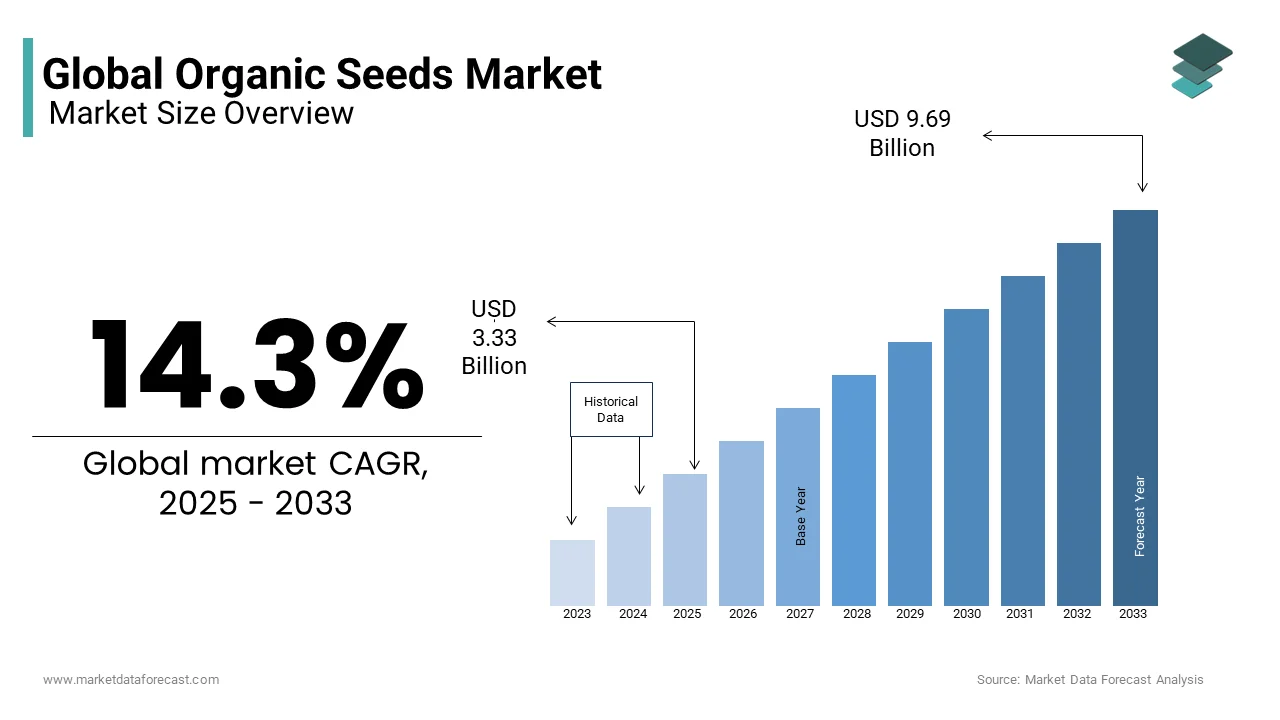
With the increasing popularity of organic food and organic farming and increasing environmental awareness regarding the use of chemical fertilizers and pesticides, the need for organic seeds is increasing, which enhances the growth of this market in the aforementioned forecast period.
Organic farming is an alternative agricultural system that relies on fertilizers of organic origin like compost, manure, green manure, and bone meal and emphasizes techniques like crop rotation. Organic farming does not use harmful chemical fertilizers like pesticides, herbicides, and insecticides. Seed crops are sown for a longer duration than food crops. In order to collect seeds, plants must complete their entire life cycle, with additional time required for drying and curing seeds. Non-synthetic food products have better taste, higher antioxidant characteristics, and more nutritional value.
MARKET DRIVERS
The growth of the organic seeds market is driven by the growing awareness regarding the negative health impact caused by utilizing chemicals in agriculture, growing environmental concerns over conventional agricultural practices, increasing demand for non-synthetic products in the Food and Beverage industry, and favorable regulatory frameworks pertaining to organic farming in developed regions. However, the high costs of organic seeds and supply-demand woes are likely to hamper the growth of the market. Also, initiatives taken by the government and agencies related to agriculture hold great future potential for the market.
REPORT COVERAGE
| REPORT METRIC | DETAILS |
| Market Size Available | 2024 to 2033 |
| Base Year | 2024 |
| Forecast Period | 2025 to 2033 |
| CAGR | 14.3% |
| Segments Covered | By Crop Type, By Application, By Distribution Channel |
| Various Analyses Covered | Global, Regional & Country Level Analysis, Segment-Level Analysis, DROC, PESTLE Analysis, Porter’s Five Forces Analysis, Competitive Landscape, Analyst Overview on Investment Opportunities |
| Regions Covered | North America, Europe, APAC, Latin America, Middle East & Africa |
| Market Leaders Profiled | Johnny’s Selected Seeds, Fedco Seeds, High Mowing Organic Seeds, Seed Savers Exchange, Wild Garden Seeds, HILD Samen, Fleuren, Vitalis Organic Seeds, Navdanya, De Bolster, Maas Plant, Southern Exposure Seed Exchange, and Arnica Kwekerij. |
REGIONAL ANALYSIS
North America is leading the market, while Asia-Pacific is in second place. Higher adoption rates and favorable government regulations favored the dominance of North America. Crop-wise, Vegetable Seeds are leading the market by a small margin over Fruit and Nut Seeds due to the ever-increasing need for increased food production and growing population.
KEY MARKET PLAYERS
Some of the key players dominating this market include Seeds of Change, Johnny’s Selected Seeds, Fedco Seeds, High Mowing Organic Seeds, Seed Savers Exchange, Wild Garden Seeds, HILD Samen, Fleuren, Vitalis Organic Seeds, Navdanya, De Bolster, Maas Plant, Southern Exposure Seed Exchange, and Arnica Kwekerij.
MARKET SEGMENTATION
This research report on the global organic seeds market has been segmented and sub-segmented into the following categories.
By Crop Type
- Field-crop Seeds
- Vegetable Seeds
- Fruit and Nut Seeds
- Other
By Application
- Agriculture
- Horticulture
- Other Practices
By Distribution Channel
- Wholesalers
- Retailers
- Cooperatives
BY Region
- North America
- Asia-Pacific
- Europe
- Latin America
- Middle East and Africa