- Product Description Description
- Table of Contents TOC
- List of Table & Figure LOT
- Get Free Sample PDF Sample PDF
Market Size, 2025
$15.59 BnMarket Estimate, 2026
$16.59 BnMarket Forecast, 2034
$27.25 BnCAGR, 2026–2034
6.40%Global Patient Blood Management (PBM) Market Size
The global patient blood management (PBM) market was valued at USD 15.59 billion in 2025, is estimated to reach USD 16.59 billion in 2026, and is projected to reach USD 27.25 billion by 2034, growing at a CAGR of 6.40% from 2026 to 2034.

The Patient Blood Management (PBM) is the systematic, evidence-based medical approach that optimizes the care of patients who might need a blood transfusion by ensuring improved clinical outcomes and efficient resource utilization. PBM emphasizes minimizing unnecessary transfusions, reducing reliance on donor blood, and enhancing patient safety. Its importance is amplified by the global rise in surgical procedures and chronic diseases that often involve blood loss or anemia. According to the World Health Organization, nearly 118.5 million blood donations are collected annually worldwide, yet demand continues to outpace supply in many low- and middle-income countries.
MARKET DRIVERS
Increasing surgical procedures and blood demand
The demand for PBM solutions is increasing with the global rise in surgical interventions, especially in cardiovascular, orthopedic, and oncology specialties, where blood management is accelerating the growth of the Patient Blood Management (PBM) market. As per the World Health Organization, over 234 million major surgical procedures are performed worldwide each year, many of which involve substantial blood loss. Growing adoption of minimally invasive procedures has reduced transfusion rates but has simultaneously elevated demand for effective blood conservation technologies.
Rising prevalence of anemia and chronic conditions
Chronic anemia and related blood disorders significantly increase the need for PBM protocols. This is escalating the growth of the Patient Blood Management (PBM) market. According to the World Health Organization, 42% of children under five and 40% of pregnant women worldwide suffer from anemia, with a massive disease burden. In addition, non-communicable diseases like cancer and kidney disorders often require transfusion support. According to the International Agency for Research on Cancer, nearly 20 million new cancer cases occurred globally in 2022, with a large proportion needing blood support during chemotherapy or surgical care.
MARKET RESTRAINTS
High implementation costs and limited infrastructure
The integration of PBM systems requires advanced infrastructure, skilled staff, and continuous training by making it a costly proposition for many healthcare institutions, which is restraining the growth of the Patient Blood Management (PBM) market. Such disparities restrict the adoption of PBM programs in resource-constrained settings. Additionally, upfront investment in technologies such as cell salvage machines, point-of-care testing devices, and digital transfusion management platforms is prohibitive for smaller hospitals.
Limited awareness and compliance challenges
Adoption of PBM is restrained by low awareness among healthcare professionals in emerging regions and inconsistent compliance even in advanced healthcare systems. The European Commission has variability in transfusion practices across member states, with inappropriate transfusions still prevalent in certain countries. Moreover, inadequate training in PBM protocols leads to inconsistent application of best practices. Hospitals without standardized policies often default to traditional transfusion methods with the broader adoption of evidence-based PBM frameworks.
MARKET OPPORTUNITIES
Technological innovations in blood conservation
Rapid advancements in digital health and medical devices are opening new opportunities in PBM. Point-of-care testing, artificial intelligence-based predictive analytics, and minimally invasive surgical devices are majorly contributors to the growth of the Patient Blood Management (PBM) market. For example, the U.S. Food and Drug Administration approved advanced blood management software solutions in 2023 that allow clinicians to track hemoglobin levels in real time by reducing unnecessary transfusions. These technologies enhance efficiency, improve clinical decision-making, and reduce costs, which is creating fertile ground for PBM expansion.
Expanding adoption in emerging economies
Healthcare modernization in Asia-Pacific, Latin America, and parts of Africa is creating significant opportunities for the Patient Blood Management (PBM) market. According to India’s Ministry of Health and Family Welfare, the country performs more than 30 million surgeries annually, where blood shortages persist in over 20% of its districts.
MARKET CHALLENGES
Shortage of skilled healthcare professionals
Implementing PBM effectively requires multidisciplinary teams, including anesthesiologists, hematologists, and transfusion specialists is impeding the growth of the Patient Blood Management (PBM) market. However, the World Health Organization has identified a global shortfall of 15 million healthcare workers by 2030, with shortages most severe in Asia and Africa. This scarcity limits the ability of hospitals to implement complex PBM protocols at scale. Without adequate training and staffing, even advanced technologies cannot be fully leveraged.
Ethical and regulatory complexities
Blood management involves ethical concerns regarding the allocation and prioritization of blood resources is a challenge for the Patient Blood Management (PBM) market. Variations in regulatory policies across countries further complicate the adoption of PBM systems. For example, the European Blood Alliance notes that while some countries have strict transfusion thresholds, others operate with more lenient guidelines, leading to inconsistency in care delivery. Moreover, ethical debates around patient consent and restrictive transfusion strategies can delay acceptance of PBM practices in certain regions.
REPORT COVERAGE
| REPORT METRIC | DETAILS |
| Market Size Available | 2025 to 2034 |
| Base Year | 2025 |
| Forecast Period | 2026 to 2034 |
| Segments Covered | By Component, End-user, Product, and Region. |
| Various Analyses Covered | Global, Regional and Country-Level Analysis, Segment-Level Analysis, Drivers, Restraints, Opportunities, Challenges; PESTLE Analysis; Porter’s Five Forces Analysis, Competitive Landscape, Analyst Overview of Investment Opportunities |
| Countries Covered | North America, Europe, APAC, Latin America, Middle East & Africa |
| Market Leaders Profiled | Biomerieux SA, Asahi Kasei Corporation, Haier Biomedical, Macopharma, Immucor, Inc, B. Braun SE, Terumo Corporation, Grifols, S.A., Haemonetics Corporation, LivaNova PLC, and Others. |
SEGMENTAL ANALYSIS
By Component Insights
The Whole blood and RBCs segment was the largest and held 60.2% of the share in 2024, with its central role in trauma care, surgeries, and chronic disease management. The growth of the segment is rising prevalence of anemia, which affects 1.6 billion people worldwide according to the WHO, and by their indispensable role in managing hemorrhage and perioperative care. The reliance on RBCs in oncology and cardiovascular surgeries reinforces their market strength.

The plasma segment is expected to expand at a CAGR of 9.3% from 2025 to 2033, with its growing use in emergency care and therapeutic applications. In addition, the COVID-19 pandemic accelerated plasma demand through convalescent plasma therapies, spotlighting its therapeutic potential. Increased investment in plasma fractionation facilities, especially in the Asia-Pacific, is further boosting availability. Its rising adoption in regenerative medicine and rare disease treatment ensures its position as the fastest-growing segment in PBM.
By End User Insights
The hospitals segment was the largest and held 50.2% of the representative Patient Blood Management (PBM) market share in 2024, with the primary centers for surgical care and transfusion management. Rising rates of elective and emergency surgeries, combined with protocols to minimize transfusions, have made hospitals the key implementers of PBM practices. Integration of multidisciplinary teams like surgeons, anesthesiologists, and transfusion specialists within hospitals also strengthens their dominance.
The diagnostic clinics and pathology labs segment is anticipated to grow at a CAGR of 8.2% during the forecast period, with the increasing reliance on laboratory-based screening and monitoring for blood conservation. According to the U.S. Centers for Disease Control and Prevention, over 14 billion laboratory tests are performed annually worldwide, many related to blood profiling and hemoglobin monitoring. The rising demand for personalized diagnostics in chronic diseases, such as oncology and hematology, is accelerating PBM adoption in outpatient settings. Their ability to provide precise preoperative and postoperative testing enhances efficiency and supports transfusion decision-making, which is driving rapid growth.
By Product Insights
The instruments segment held 40.2% of the patient blood management market share in 2024, with its role in transfusion monitoring, cell salvage, and blood conservation techniques. Their dominance is driven by the rising number of complex surgeries, where many require intraoperative blood management. Furthermore, the high prevalence of trauma cases like road accidents alone cause 1.3 million deaths annually, as per the WHO has spurredthe adoption of advanced devices like autotransfusion systems and hemostatic analyzers. Hospitals are increasingly integrating point-of-care testing instruments to optimize transfusion thresholds by ensuring both patient safety and efficient use of blood resources.
The software segment is projected to grow with a CAGR of 10.3% during the forecast period, with the rising adoption of artificial intelligence, predictive analytics, and digital transfusion management platforms. For example, the U.S. Food and Drug Administration approved advanced PBM software solutions in 2023 that enable real-time monitoring of hemoglobin and coagulation levels, minimizing unnecessary transfusions. Additionally, electronic health record (EHR) integration is enabling hospitals to implement standardized PBM protocols more efficiently. The importance of digital monitoring systems for improving compliance with transfusion guidelines is accelerating the uptake of software-based solutions globally.
REGIONAL ANALYSIS
North America Patient Blood Management (PBM) Market Analysis
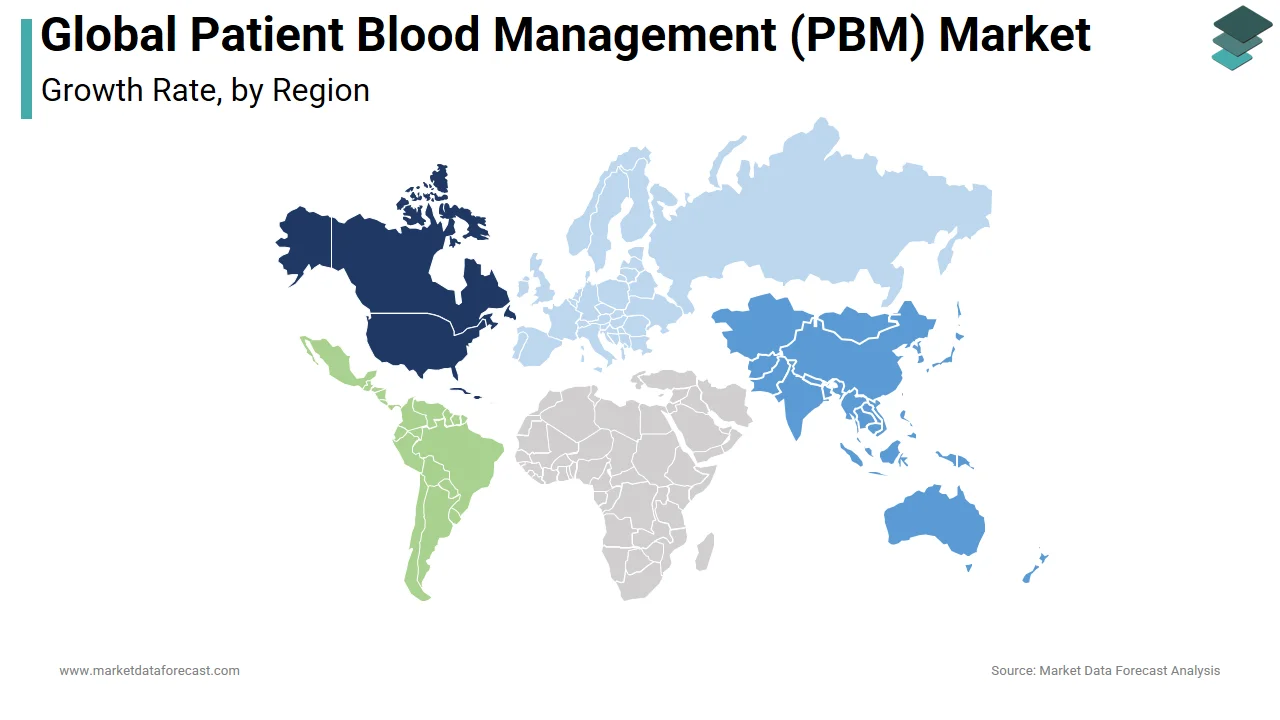
North America was the top performer of the Patient Blood Management (PBM) market by capturing 35.4% of share in 2024 with its advanced healthcare infrastructure and stringent transfusion guidelines. The American Association of Blood Banks has established strict standards, reducing unnecessary transfusions across hospitals. Additionally, the U.S. performs over 17 million surgical procedures annually (CDC), reinforcing the need for PBM.
Europe Patient Blood Management (PBM) Market Analysis
Europe Patient Blood Management (PBM) market growth is more likely to have significant growth opportunities throughout the forecast period with the well-structured blood donation systems and regulatory support. The European Blood Alliance emphasizes harmonized transfusion protocols across member countries, which has improved patient safety. Investments in digital transfusion platforms and cross-border plasma programs are strengthening Europe’s position in the market.
Asia Pacific Patient Blood Management (PBM) Market Analysis
Asia Pacific Patient Blood Management (PBM) market is expected to have a significant CAGR with the high surgical volumes and unmet blood supply needs. India alone conducts 30 million surgeries annually (Ministry of Health and Family Welfare), yet the National AIDS Control Organization estimates persistent blood shortages in 20% of its districts. Rapid hospital modernization in China, coupled with government-led initiatives for blood donation, is advancing PBM. Rising prevalence of thalassemia and other hemoglobinopathies further drives reliance on structured PBM practices across the region.
Latin America Patient Blood Management (PBM) Market Analysis
Latin America Patient Blood Management (PBM) market growth is driven by Brazil as a key contributor. The Pan American Health Organization reports that blood donation rates remain below WHO recommendations in several countries, heightening the need for efficient PBM. Increasing surgical procedures in Brazil and Mexico, combined with government campaigns promoting voluntary blood donations, are supporting growth.
Middle East & Africa Patient Blood Management (PBM) Market Analysis
The Middle East & Africa Patient Blood Management (PBM) market growth is likely to grow with the rising healthcare investments. According to the World Bank, healthcare spending in the Gulf region has been growing at 6% annually, facilitating the adoption of advanced transfusion technologies.
COMPETITIVE LANDSCAPE
The Patient Blood Management Market is characterized by intense competition among multinational corporations and regional firms, with innovation and accessibility emerging as key differentiators. Global leaders such as Haemonetics, Fresenius, and Terumo compete alongside smaller local players that cater to niche clinical demands. The competition is further heightened by the rapid adoption of digital transfusion management tools, which allow hospitals to reduce unnecessary blood use. As per the International Society of Blood Transfusion, the emphasis on optimizing blood resources has accelerated procurement of PBM technologies across both developed and emerging economies. Players are also competing on service quality, offering clinician training programs and post-installation support, which are highly valued in resource-constrained healthcare systems.
KEY MARKET PLAYERS
Some of the companies that are playing a dominating role in the global patient blood management (PBM) market include
- Biomerieux SA
- Asahi Kasei Corporation
- Haier Biomedical
- Macopharma
- Immucor, Inc.
- Braun SE
- Terumo Corporation
- Grifols, S.A.
- Haemonetics Corporation
- LivaNova PLC
Top Strategies Used by Key Market Participants
Key players in the Patient Blood Management Market are increasingly adopting strategic collaborations, digital transformation, and localized manufacturing to expand their footprint in Asia Pacific. Collaborations with hospitals and research institutes are enabling the introduction of advanced PBM programs tailored to regional needs. For instance, partnerships with Asian medical universities have accelerated clinical adoption of autotransfusion systems. Digital transformation remains a core strategy, with companies investing heavily in AI-based transfusion monitoring and EHR-integrated PBM software to enhance efficiency and safety. Furthermore, localized manufacturing and supply chain strengthening are being prioritized to address persistent blood shortages in emerging markets such as India and Southeast Asia.
Top Players in the Patient Blood Management Market
- Haemonetics Corporation is a leading innovator in patient blood management solutions, particularly recognized for its advanced apheresis and cell salvage technologies. In Asia Pacific, the company has been expanding its presence by supplying cutting-edge blood component collection systems to major hospital networks. Its focus on reducing transfusion dependency has aligned with government-led initiatives across countries such as China and India, where surgical volumes are rapidly rising.
- Fresenius SE & Co. KGaA has established itself as a key contributor to the Asia Pacific PBM landscape through its blood transfusion, plasma therapy, and emergency care solutions. The company has leveraged its global expertise to meet rising demands in markets such as India, where blood shortages remain a pressing challenge. In 2024, Fresenius expanded its regional manufacturing capabilities, ensuring faster delivery of transfusion-related instruments and consumables. Its ongoing investment in R&D for plasma-based therapies is particularly relevant in Southeast Asia, where demand for plasma fractionation is rising.
- Terumo Corporation, headquartered in Japan, plays a crucial role in shaping the PBM market in the Asia Pacific, leveraging its strong local base and extensive regional distribution network. The company’s autotransfusion systems, blood management devices, and transfusion safety solutions have been widely adopted in hospitals across China, Japan, and India. In 2023, Terumo launched next-generation blood collection technologies tailored for high-volume surgical centers in Asia. The firm has also been investing in AI-driven monitoring tools to optimize transfusion thresholds, a prominent need in rapidly modernizing healthcare systems. Terumo’s long-standing reputation in Asia Pacific continues to strengthen its leadership in PBM innovation.
MARKET SEGMENTATION
This research report on the global patient blood management (PBM) market has been segmented and sub-segmented into the following categories.
By Component
- Whole Blood and Red Blood Cells
- Plasma
By End User
- Blood Banks
- Hospitals
- Diagnostic Clinics and Pathology Labs
By Product
- Instruments
- Blood Processing Devices
- Blood Transfusion Devices
- Blood Culture Screening Devices
- Diagnostic and Testing Instruments
- Blood Storage Devices
- Accessories
- Syringes and Needles
- Vials and Tubes
- Blood Bags
- Others
- Reagents and Kits
- Blood Culture Media
- Blood Typing Reagents
- Slide Staining Reagents
- Assay Kits
- Software
By Region
- North America
- Europe
- Asia Pacific
- Latin America
- The Middle East and Africa