- Product Description Description
- Table of Contents TOC
- List of Table & Figure LOT
- Get Free Sample PDF Sample PDF
Market Size, 2025
$45,165.30 MnMarket Estimate, 2026
$49,004 MnMarket Forecast, 2034
$94,118 MnCAGR, 2026–2034
8.50%Global Polyols Market Summary
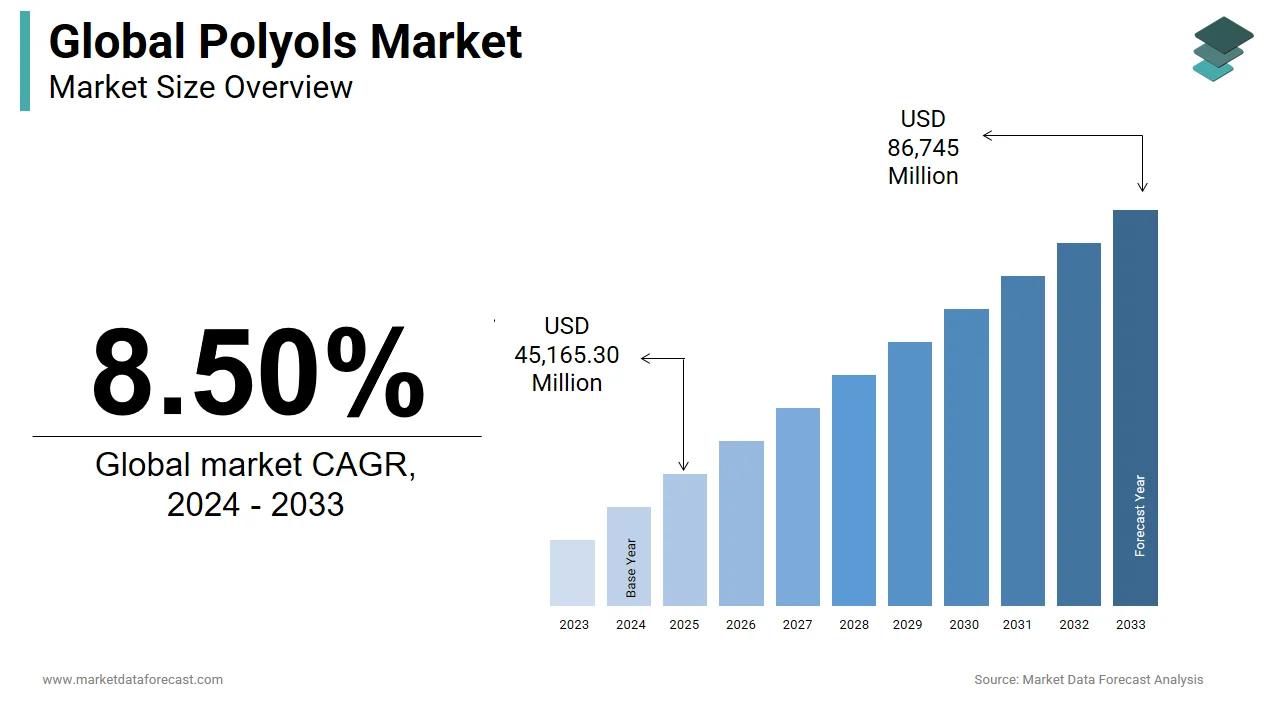
The global polyols market was valued at USD 45,165.30 million in 2025 and is projected to reach USD 49,004 million in 2026 and USD 94,118 million by 2034, growing at a CAGR of 8.50% from 2026 to 2034. The growth of the polyols market is driven by rising demand for polyurethane foams, increasing usage in construction and automotive industries, growing need for energy-efficient insulation materials, and expanding applications in coatings, adhesives, and sealants.
Key Market Trends
- Rising adoption of rigid and flexible polyurethane foams for insulation, furniture, and automotive applications.
- Growing demand for polyether polyols due to their superior mechanical and chemical properties.
- Increasing emphasis on energy-efficient and lightweight materials in the construction and transportation sectors.
- Expansion of coatings, adhesives, sealants, and elastomers applications using polyols.
- Innovations in bio-based polyols to support sustainability and reduce carbon footprint.
Segmental Insights
- Based on product, the polyether segment dominated the global polyols market in 2024, owing to its wide application in flexible and rigid foams, adhesives, and coatings.
- Based on application, the rigid foam segment held the largest share of 54.3% in 2024, driven by extensive use in construction, refrigeration, and insulation industries.
Regional Insights
- Asia-Pacific led the global polyols market with 45.3% share in 2024, supported by rapid industrialization, expanding construction sector, and strong demand from automotive and furniture industries in China, India, and Southeast Asia.
- North America witnessed steady growth due to high adoption in insulation materials, automotive, and industrial applications.
- Europe experienced consistent demand driven by sustainable construction practices and energy-efficient building standards.
- Latin America saw moderate growth owing to increasing construction and industrial activities.
- Middle East & Africa is emerging as a growing market due to infrastructural development and an expanding industrial base.
Competitive Landscape
The global polyols market is moderately consolidated with key players focusing on product innovation, capacity expansion, and sustainable solutions. Leading companies include Covestro AG, BASF SE, Dow, Shell Plc, Huntsman International LLC, Coim USA Inc, Stephan Company, and Palmer Holland, Inc.
Global Polyols Market Size
The global polyols market was valued at USD 45,165.30 million in 2025, is estimated to reach USD 49,004 million in 2026, and is projected to reach USD 94,118 million by 2034, growing at a CAGR of 8.50% from 2026 to 2034.
The polyols are a class of organic compounds containing multiple hydroxyl groups, which are primarily used as key building blocks in the production of polyurethanes, coatings, adhesives, sealants, and elastomers. These materials are broadly categorized into petrochemical-based polyether and polyester polyols, as well as emerging bio-based variants derived from renewable feedstocks. According to the U.S. Environmental Protection Agency, polyurethanes account for over 70% of global polyol consumption, finding application in insulation, furniture, automotive interiors, and footwear.
MARKET DRIVERS
Expansion of the Construction and Insulation Industry
The global construction sector’s emphasis on energy-efficient buildings is driving the growth of the polyols market. As per the International Energy Agency, buildings are responsible for nearly 30% of global final energy consumption, with space conditioning representing over half of that usage. Polyol-based polyurethane foams offer superior thermal resistance, with R-values exceeding 6.0 per inch, compared to 3.2 for fiberglass, according to the U.S. Department of Energy. China’s Ministry of Housing and Urban-Rural Development mandates that all new public buildings meet Level A energy efficiency standards, which is driving the adoption of polyurethane insulation in commercial high-rises.
Growth in Automotive Lightweighting and Interior Components
The automotive industry’s shift toward lightweight materials to improve fuel efficiency and extend electric vehicle (EV) range has significantly increased polyol utilization in seating, dashboards, and acoustic insulation. According to the International Council on Clean Transportation, reducing vehicle weight by 10% improves fuel economy by 6–8%, making polyurethane foams derived from polyols, which is a strategic material. The Society of Automotive Engineers reports that the average passenger vehicle contains 18–25 kg of flexible polyurethane foam, primarily in seats and headliners. Additionally, the European Automobile Manufacturers Association notes that over 90% of new cars in the EU feature polyurethane-sealed sunroofs and structural adhesives, enhancing durability and crash performance.
MARKET RESTRAINTS
Volatility in Propylene Oxide and Crude Oil Feedstock Prices
Polyol production is heavily dependent on propylene oxide (PO), which is a derivative of propylene is linked to crude oil and natural gas pricing, which is set to restrain the growth of the polyols market. According to the U.S. Energy Information Administration, propylene prices fluctuated by over 35% between 2021 and 2023 due to supply chain disruptions and refinery output volatility. According to the American Chemistry Council, feedstock expenses account for up to 60% of total polyol production costs, leaving producers vulnerable to margin compression during price spikes.
Regulatory Pressure on Flame Retardants and Emissions in Polyurethane Foams
Polyurethane foams are a primary end-use of polyols, facing increasing regulatory scrutiny due to the hazardous flame retardants and volatile organic compounds (VOCs) used in their formulation, which is hampering the growth of the polyols market. As per the European Chemicals Agency, several brominated flame retardants commonly used in flexible foams have been classified as substances of very high concern (SVHC) under REACH, leading to restrictions in consumer products. According to the California Air Resources Board, VOC emissions from foam production must be reduced by 75% by 2025 under the South Coast Air Quality Management District rules. These compliance burdens increase production costs and limit the use of conventional polyol formulations in environmentally sensitive markets.
MARKET OPPORTUNITIES
Development of Bio-Based and Renewable Polyols
The shift toward sustainable chemistry is accelerating the commercialization of bio-based polyols derived from vegetable oils, lignin, and waste biomass, which showcases new opportunities for the growth of the polyols market. According to the U.S. Department of Agriculture, bio-polyols now account for over 12% of total polyol production in North America, with soybean and castor oil being the primary feedstocks. Researchers at the University of Delaware have developed a catalytic process to convert lignin into polyether polyols with performance parity to petroleum-based equivalents, achieving a 92% conversion efficiency in pilot trials. The European Commission’s Horizon Europe program has funded over €40 million in bio-polyol research, aiming to replace 30% of fossil-based polyols by 2030. Companies like Arkema and Covestro have launched commercial lines of castor-oil-derived polyols for use in eco-friendly foams and coatings.
Rising Demand for High-Performance Coatings and Adhesives
Polyols are increasingly used in high-performance polyurethane coatings and structural adhesives for industrial, marine, and aerospace applications due to their durability, chemical resistance, and adhesion properties. As per the American Coatings Association, polyurethane coatings represent over 25% of the industrial protective coatings market, valued at $18 billion globally in 2023. The aerospace industry uses polyurethane adhesives in over 60% of commercial aircraft assemblies, reducing weight and improving fatigue resistance compared to mechanical fasteners, according to the International Air Transport Association. Additionally, the construction sector is adopting polyurethane sealants for high-rise glazing systems, with the Building and Construction Authority of Singapore reporting a 40% increase in usage since 2020.
MARKET CHALLENGES
Complexity in Supply Chain Integration and Feedstock Security
The structural challenges due to the limited number of integrated producers capable of securing both propylene oxide and co-product management are likely to hinder the growth of the polyols market. According to the International Council of Chemical Associations, only 15 global facilities operate fully integrated PO/SM (propylene oxide/styrene monomer) or PO/MTBE (methyl tertiary butyl ether) units, creating supply bottlenecks. In 2023, weak polystyrene markets in Europe caused producers to curtail PO output, reducing polyol feedstock supply by 18%, as reported by ICIS.
Technological Barriers in Recyclability and Circular Economy Integration
The polyurethanes derived from polyols remain largely non-recyclable through conventional mechanical methods, which limits the growth of the polyols market. As per the Ellen MacArthur Foundation, less than 6% of polyurethane waste is recycled globally, with the majority ending up in landfills or incinerators. Chemical recycling methods such as glycolysis and hydrolysis are still in early commercialization, with only three industrial-scale plants operating worldwide, according to the Plastics Europe 2023 Recycling Report. Covestro’s pilot plant in Dormagen, Germany, can recover up to 80% of polyol content from flexible foam waste, but scalability remains limited. The European Commission’s Circular Economy Action Plan mandates that all plastic packaging be reusable or recyclable by 2030, pressuring polyol producers to innovate.
REPORT COVERAGE
| REPORT METRIC | DETAILS |
| Market Size Available | 2025 to 2034 |
| Base Year | 2025 |
| Forecast Period | 2026 to 2034 |
| Segments Covered | By Product, Application, and Region. |
| Various Analyses Covered | Global, Regional and Country-Level Analysis, Segment-Level Analysis, Drivers, Restraints, Opportunities, Challenges; PESTLE Analysis; Porter’s Five Forces Analysis, Competitive Landscape, Analyst Overview of Investment Opportunities |
| Regions Covered | North America, Europe, Asia-Pacific, Latin America, Middle East and Africa |
| Market Leaders Profiled | Covestro AG, BASF SE, Dow, Shell Plc, Huntsman International LLC, Coim USA Inc, Stephan Company, Palmer Holland, Inc. |
SEGMENTAL ANALYSIS
By Product Insights
The polyether segment accounted for a dominant share of the global polyols market in 2025, with its widespread compatibility with isocyanates and superior performance in producing flexible and rigid foams. Their low viscosity and excellent solubility enable easier processing in industrial applications, especially in polyurethane foam manufacturing. The construction and automotive sectors heavily rely on polyether-based foams for insulation and seating, amplifying demand.
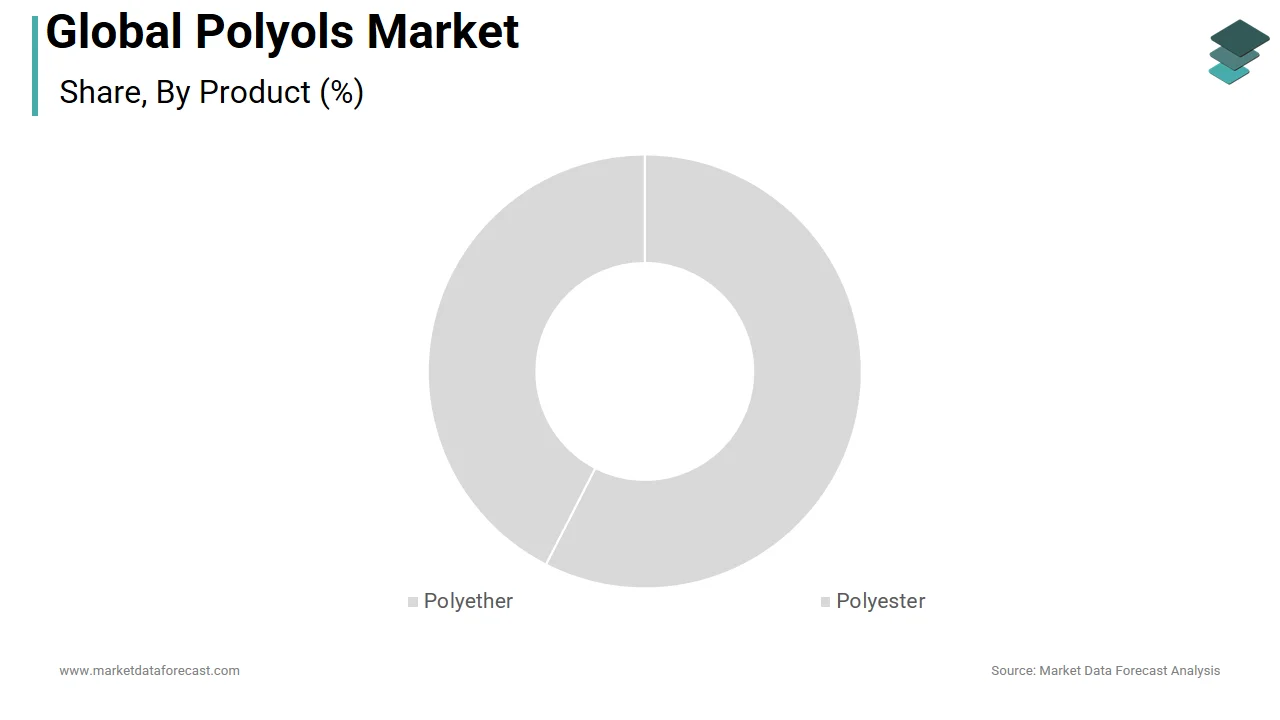
The polyester segment is lucratively growing with an expected CAGR of 6.2% during the forecast period with the rising demand in high-performance, durable applications such as coatings, adhesives, sealants, and elastomers (CASE). Furthermore, polyester polyols are increasingly favored in eco-friendly formulations due to their partial derivation from bio-based feedstocks. As per the European Coatings Journal, bio-based polyester polyols usage grew by 9% annually between 2020 and 2023.
By Application Insights
The rigid foam segment was the largest and held 54.3% of the polyols market share in 2024, with its indispensable role in thermal insulation across construction and cold chain logistics. Rigid polyurethane foams, derived from polyols, exhibit exceptional thermal resistance, with a typical R-value (thermal resistance) of R-6 to R-7 per inch. This efficiency helps in achieving energy code compliance in buildings. According to the International Energy Agency, improving building insulation could reduce global CO₂ emissions by 5.8 gigatons annually by 2050.
The flexible foam segment is likely to grow with an expected CAGR of 5.8% throughout the forecast period, with the escalating demand in furniture, bedding, and automotive seating, particularly in emerging economies. In the automotive sector, lightweighting initiatives are increasing the use of flexible polyurethane foams to enhance passenger comfort without adding mass. As perthe International Organization of Motor Vehicle Manufacturers, global vehicle production reached 89 million units in 2023, up from 79 million in 2022. Additionally, innovations like low-VOC (volatile organic compound) and plant-based flexible foams are gaining traction.
REGIONAL ANALYSIS
Asia Pacific Polyols Market Analysis
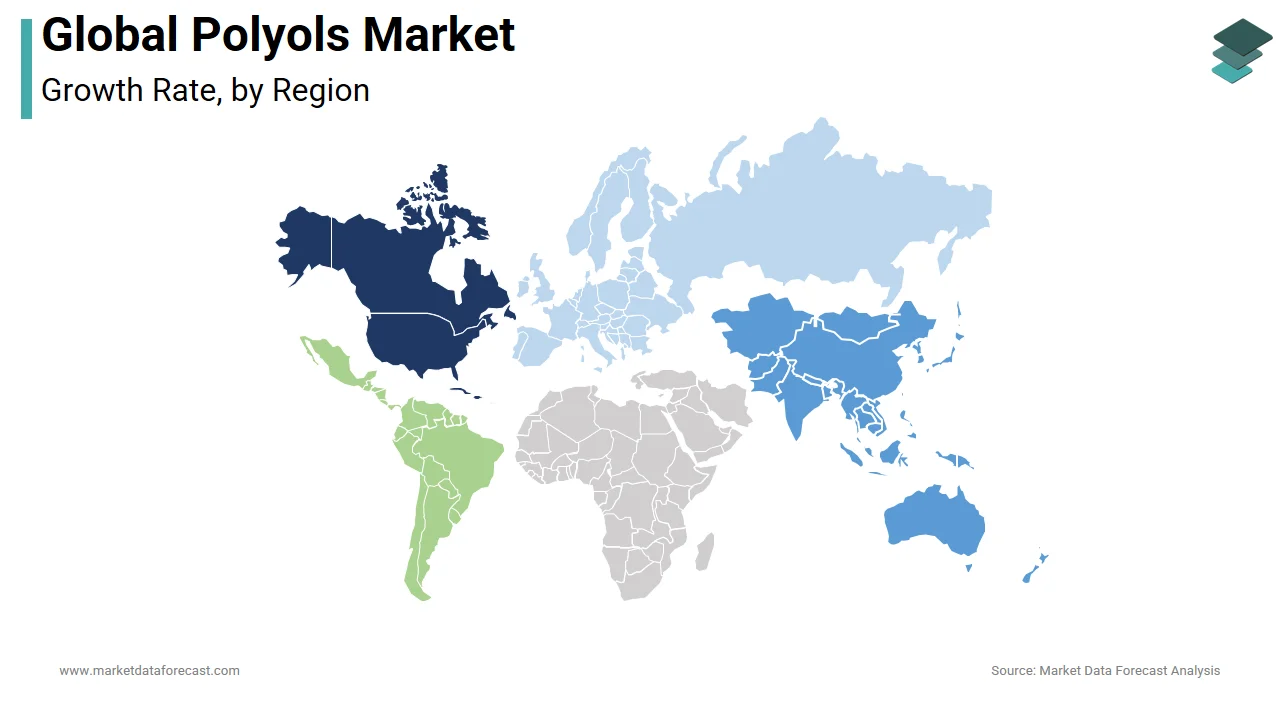
Asia Pacific was the largest contributor of the global polyols market with 45.3% of the share in 2024, owing to the rapid urbanization, booming construction, and robust manufacturing in countries like China, India, and South Korea. China alone accounts for more than 60% of Asia’s polyol consumption, driven by its status as the world’s largest producer of refrigeration appliances and automobiles. Additionally, India’s housing sector is expanding rapidly, with the Ministry of Housing and Urban Affairs estimating a need for 30 million new urban housing units by 2030. This construction surge, coupled with government-backed energy efficiency programs like the Energy Conservation Building Code (ECBC), is accelerating the adoption of high-performance insulation materials derived from polyols.
North America Polyols Market Analysis
North America held 22.3% of the global polyols market share in 2024. The U.S. Department of Energy mandates that all new federal buildings must be zero-energy by 2030, pushing widespread use of high-efficiency insulation, primarily rigid polyurethane foams made from polyols. Additionally, automakers like Ford and General Motors are incorporating bio-based polyols into vehicle interiors to reduce carbon footprints. According to the American Chemistry Council, bio-polyol usage in automotive foams grew by 15% between 2021 and 2023.
Europe Polyols Market Analysis
Europe's polyols market growth is likely to grow with a strong emphasis on sustainability and regulatory compliance. As per the European Construction Industry Federation (FIEC), over 75% of new buildings in the EU now meet nearly zero-energy building (nZEB) standards, necessitating high-performance insulation materials like polyol-based rigid foams. Germany, the largest consumer in Europe, accounts for nearly 30% of regional polyol demand, driven by its Energiewende (energy transition) policy. Regulatory pressure under REACH and the EU Taxonomy for Sustainable Activities is accelerating the phase-out of fossil-based chemicals.
Latin America Polyols Market Analysis
Latin America polyols market is likely to grow steadily in the coming years. The region’s polyol demand is closely linked to urban development and consumer goods production, particularly in Brazil and Mexico. Additionally, the appliance sector is expanding—Brazil produced 12 million refrigerators in 2023, according to the National Association of Electrical and Digital Industries (ABINEE), each requiring rigid foam insulation. However, economic instability and import dependency on raw materials constrain faster growth. Local production remains limited, with most polyols imported from the U.S. and Europe. Nevertheless, companies like Braskem are exploring bio-based polyol development using sugarcane ethanol, aligning with Brazil’s bioeconomy strategy.
Middle East & Africa Polyols Market Analysis
The Middle East and Africa polyols market growth is driven by growth concentrated in the Gulf Cooperation Council (GCC) countries and South Africa. In Saudi Arabia, cooling accounts for over 70% of residential electricity use during summer, according to the King Abdullah City for Atomic and Renewable Energy (K.A.CARE), making thermal insulation a national priority. The Saudi Vision 2030 initiative includes plans for 5 million new housing units, many of which will incorporate energy-efficient materials. However, limited local polyol production and reliance on imports from Asia and Europe hinder scalability. SABIC has initiated R&D into recyclable polyurethanes, but commercial deployment remains in early stages.
COMPETITIVE LANDSCAPE
The competition in the polyols market is intense, driven by technological innovation, sustainability demands, and regional economic shifts. Major players compete on product performance, environmental credentials, and application-specific solutions. The Asia Pacific region has become a focal point due to rapid industrialization, urbanization, and rising demand in the construction and automotive sectors. Companies differentiate through R&D investments, especially in bio-based and CO2-utilizing polyols. Localized production and technical support enhance customer retention. New entrants from China and India are increasing pressure on pricing and innovation. Established firms respond with strategic collaborations, capacity expansions, and digital integration. Sustainability certifications and circular economy initiatives further shape competitive dynamics.
KEY MARKET PLAYERS
Some of the companies that are playing a dominating role in the global polyols market include
- Covestro AG
- BASF SE
- Dow
- Shell Plc
- Huntsman International LLC
- Coim USA Inc
- Stephan Company
- Palmer Holland, Inc.
Top Strategies Used by the Key Market Participants
Key players in the polyols market employ strategies such as product innovation, vertical integration, and sustainability-driven development. Companies invest heavily in R&D to create bio-based, low-emission polyols catering to green building and automotive efficiency standards. Strategic partnerships with downstream manufacturers enable customized solutions and faster market entry. Geographic expansion into high-growth Asia Pacific regions strengthens supply chain resilience. Capacity expansions and technology upgrades improve production efficiency. Digital tools for formulation and customer support enhance service delivery.
Top Players in the Polyols Market
- BASF SE is a leading global chemical company with a strong footprint in the Asia Pacific polyols market, particularly in China, India, and Southeast Asia. The company offers a wide range of polyether and polyester polyols used in flexible and rigid foams for automotive, construction, and furniture industries. BASF emphasizes innovation and sustainability, launching bio-based polyols to meet eco-friendly demands. In recent years, it expanded its production capacity in South Korea and strengthened R&D collaborations with regional partners. BASF also invested in digital formulation tools to support customers in product development by enhancing service efficiency.
- Dow Chemical is a major player in the Asia Pacific polyols market, delivering high-performance polyols for insulation, transportation, and consumer goods. The company has deep integration in the region’s supply chains, with manufacturing facilities in China and technical centers in Japan and India. Dow focuses on sustainable innovation, introducing low-GHG polyols and recyclable foam technologies. In 2023, it launched a new line of bio-based polyols tailored for Asian construction needs, improving energy efficiency in buildings. Dow also partnered with regional foam manufacturers to co-develop lightweight automotive seating solutions.
- Covestro AG is a prominent contributor to the Asia Pacific polyols market, known for its advanced polyurethane solutions and sustainable technologies. The company prioritizes circular economy principles, introducing CO2-based polyols and increasing use of renewable feedstocks. In 2023, Covestro opened a new application development center in Shanghai to accelerate local innovation and customer collaboration. It also launched a recyclable flexible foam for furniture and bedding in India.
MARKET SEGMENTATION
This research report on the global polyols market has been segmented and sub-segmented into the following categories.
By Product
- Polyether
- Polyester
By Application
- Rigid Foam
- Flexible Foam
- Coatings
- Adhesives & Sealants
- Elastomers
- Other Applications
By Region
- North America
- Europe
- Asia Pacific
- Latin America
- The Middle East and Africa