Global Recycled Glass Market Size Share, Trends, and Growth Analysis Report, Segmented By Product (Cullet, Glass Powder, Crushed Glass, Others), Application & Region (North America, Europe, Latin America, Asia Pacific, Middle East & Africa), Industry Forecast From 2025 to 2033
Global Recycled Glass Market Size
The global recycled glass market size was valued at USD 3.40 billion in 2024 and is anticipated to reach USD 3.63 billion in 2025 and USD 6.13 billion by 2033, growing at a CAGR of 6.76% during the forecast period from 2025 to 2033.
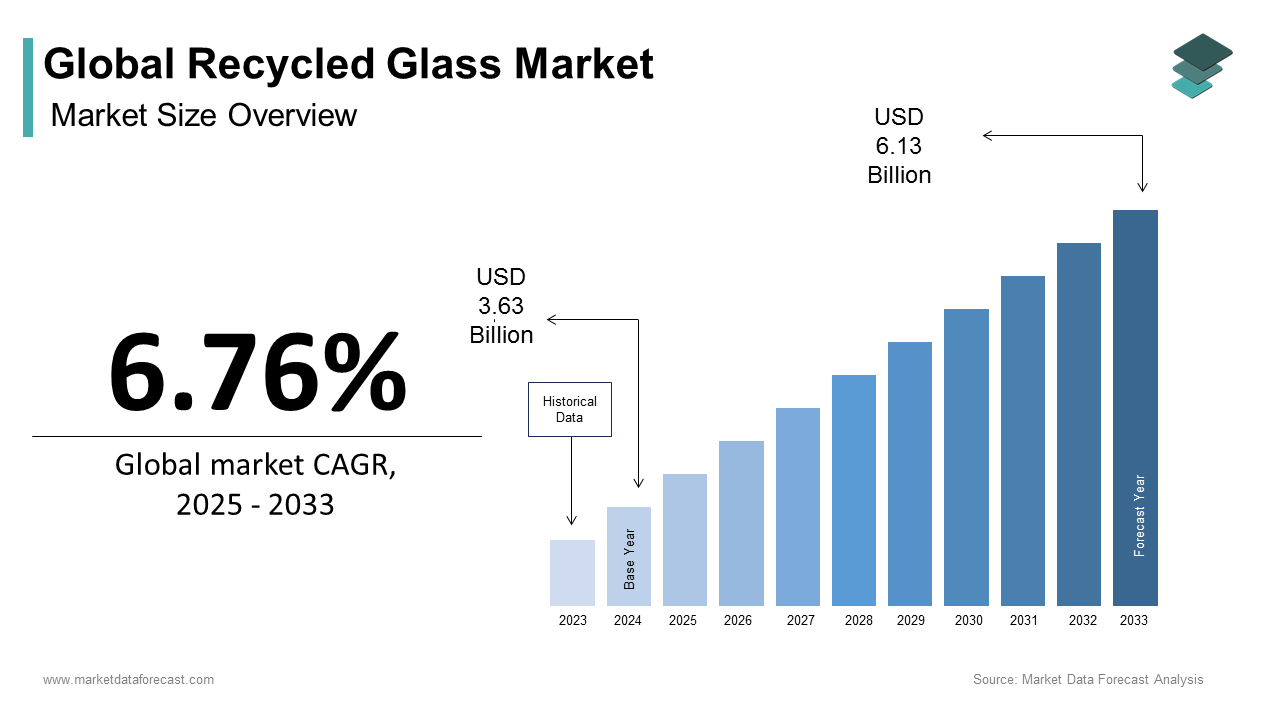
Recycled glass is produced through the collection, sorting, and reprocessing of post-consumer and post-industrial glass waste, serving as a sustainable alternative to virgin silica in manufacturing.
MARKET DRIVERS
Expansion of Mandatory Packaging EPR Schemes and Circular Economy Legislation
The proliferation of extended producer responsibility (EPR) frameworks across developed and emerging economies is driving the growth of the recycled glass market. As per the United Nations Environment Programme, 72 countries had implemented or were in the process of rolling out EPR regulations for packaging materials by 2023. In the European Union, the Packaging and Packaging Waste Directive mandates that 70% of all packaging waste, including glass, be prepared for reuse or recycling by 2030. These legally binding targets compel bottlers and packagers to secure stable supplies of cullet, thereby institutionalizing demand for recycled glass.
Growing Adoption in Construction and Infrastructure Applications
The increasing demand for construction materials such as concrete, asphalt, and insulation, driven by performance benefits and sustainability mandates, is solely to level up the growth of the recycled glass market. According to the U.S. Green Building Council, over 40% of new commercial buildings certified under LEED in 2023 incorporated recycled glass in flooring, countertops, or insulation systems. As per the Australian Road Research Board, more than 800,000 tons of recycled glass were used in road projects across Victoria and New South Wales between 2020 and 2023. Similarly, the UK’s Highways Agency has approved the use of glass cullet in sub-base layers, citing its angular particle structure and resistance to compaction.
MARKET RESTRAINTS
Contamination and Color Separation Challenges in Collection Systems
The contamination from non-glass materials and the mixing of glass by color, which diminishes the value and usability of cullet, is restricting the growth of the recycled glass market. According to the Waste and Resources Action Programme (WRAP) in the UK, up to 20% of glass collected in mixed recycling bins is contaminated with ceramics, stones, or plastics. Color purity is essential for high-end applications; even a small proportion of green glass in a clear cullet batch can disqualify it for use in clear container production. In the United States, the Institute of Scrap Recycling Industries notes that single-stream recycling systems have increased cross-contamination rates, with post-sorting breakage and residue levels averaging 12–15%.
Declining Demand from the Traditional Container Glass Industry
The global container glass sector is historically the largest consumer of recycled glass, which has experienced a structural decline due to shifting beverage consumption patterns, leading to a decline in the growth of the recycled glass market. In North America, the Aluminum Association reports that aluminum can shipments reached 52 billion units in 2023, capturing a growing share of the ready-to-drink market. This shift reduces the volume of returnable glass and diminishes demand for cullet in furnace feedstock. Moreover, the closure of glass manufacturing plants such as Ardagh Group’s furnace shutdown in Pennsylvania in 2022 has eliminated regional end markets for recycled glass.
MARKET OPPORTUNITIES
Development of High-Value Engineered Glass Products
Innovations in material science are enabling the transformation of recycled glass into premium engineered products such as glassphalt, glass-based ceramics, and filtration media, unlocking higher-margin applications. In water treatment, the U.S. Geological Survey notes that granulated recycled glass is being used as a filtration medium in municipal wastewater plants due to its non-leaching properties and superior hydraulic conductivity compared to sand. Companies like Strategic Materials in the U.S. and Cycled Glass in Australia have commercialized decorative glass aggregates for architectural use, which are selling at premiums up to 300% over raw cullet.
Integration into Decarbonization Strategies of Major Beverage Brands
Global beverage corporations are increasingly integrating recycled glass into their net-zero roadmaps, driven by science-based targets and consumer pressure, which is fuelling the growth of the recycled glass market. According to the Carbon Trust, producing glass from 100% recycled cullet reduces CO₂ emissions by up to 580 kg per ton compared to virgin material, a critical advantage in decarbonizing supply chains. In 2023, Coca-Cola European Partners announced that 84% of its glass bottles in Western Europe contained at least 70% recycled content, with a commitment to reach 90% by 2025. These corporate mandates are creating long-term offtake contracts and incentivizing investment in cullet sorting and purification infrastructure.
MARKET CHALLENGES
Geographic Mismatch Between Recycling Facilities and End Markets
The spatial disconnect between collection centers and glass manufacturing or processing plants. According to the U.S. Department of Transportation, transporting glass cullet beyond 150 miles becomes economically unviable due to its high weight-to-value ratio, leading to stockpiling or disposal even when recycling infrastructure exists. In rural areas of India and South Africa, the lack of rail connectivity forces reliance on road transport, increasing logistics costs by up to 40%, as reported by the International Solid Waste Association. In Australia, despite high urban recycling rates, remote communities often landfill glass due to insufficient local demand. This fragmentation limits economies of scale and discourages private investment in reprocessing facilities. As per the World Bank’s 2023 report, in circular economy infrastructure, over 60% of collected glass in low-density regions is ultimately downcycled or discarded due to logistical inefficiencies.
Fragility of the Cullet Supply Chain During Economic Downturns
The recycled glass supply chain exhibits high sensitivity to macroeconomic fluctuations in the construction and hospitality sectors, which is also hindering the growth of the recycled glass market. According to the OECD, the closure of restaurants and hotels during the 2020–2021 pandemic led to a 35% drop in commercial glass collection in major cities like London, New York, and Sydney. This disrupted the flow of high-quality, source-separated cullet, forcing recyclers to rely more on curbside streams with higher contamination rates. Similarly, during economic slowdowns, construction activity declines, reducing demand for glass-based aggregates. These cyclical vulnerabilities expose the sector to volatility, undermining long-term planning and investment in advanced sorting and processing technologies.
REPORT COVERAGE
| REPORT METRIC | DETAILS |
| Market Size Available | 2024 to 2033 |
| Base Year | 2024 |
| Forecast Period | 2025 to 2033 |
| CAGR | 6.76% |
| Segments Covered | By Product, Application, and Region |
| Various Analyses Covered | Global, Regional, and Country Level Analysis; Segment-Level Analysis; DROC; PESTLE Analysis; Porter’s Five Forces Analysis; Competitive Landscape; Analyst Overview of Investment Opportunities |
| Regions Covered | North America, Europe, APAC, Latin America, Middle East & Africa |
| Market Leaders Profiled | Strategic Materials Inc., Ardagh Group S.A., Owens-Illinois Inc., Vetropack Holding Ltd., Momentum Recycling, Harsco Environmental, NGV Glass Recycling Pty Ltd., Heritage Glass, Glasrecycling NV, Reiling Glas Recycling GmbH & Co. KG, Coloured Aggregates Inc., eCullet Inc., Glass Recycled Surfaces |
SEGMENTAL ANALYSIS
By Product Insights
The cullet segment dominated the global recycled glass market by capturing a dominant share in 2024. Cullet is recycled glass that has been cleaned, sorted, and crushed for remelting, which remains the most economically and industrially viable form of post-consumer glass reuse in container manufacturing. According to the European Container Glass Federation, using one ton of cullet in production lowers CO₂ emissions by up to 580 kilograms compared to virgin feedstock, a critical advantage under tightening climate regulations. The high thermal efficiency of cullet, which melts at a lower temperature than raw materials, further enhances its appeal. As per the European Commission’s Circular Economy Action Plan, all glass packaging placed on the EU market must contain a minimum of 70% recycled content by 2030, with interim targets already in effect.
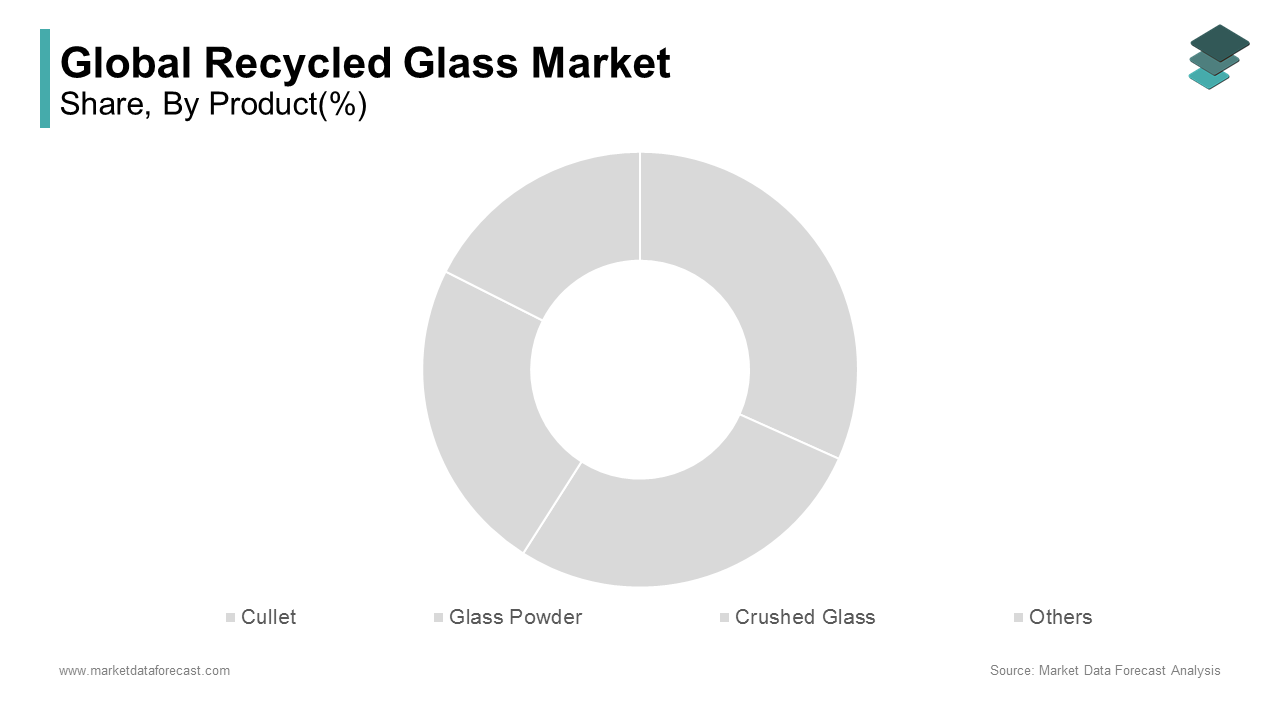
The glass powder segment is projected to grow with a CAGR of 11.4% from 2025 to 2033, with its increasing use in high-performance construction materials and 3D printing applications. Glass powder is typically ground to a particle size below 100 microns and acts as a pozzolanic additive in concrete, improving strength, durability, and resistance to alkali-silica reaction (ASR). As per the U.S. Green Building Council, over 35% of LEED-certified projects in 2023 incorporated glass powder in concrete or terrazzo flooring, which is leveraging its contribution to material reuse credits. In road construction, the Australian Road Research Board found that glass powder used as a filler in asphalt binders improved rutting resistance by 18% under high-temperature conditions.
By Application Insights
The glass containers application segment accounted in holding 54.3% of the recycled glass market share in 2024, with the closed-loop recyclability of glass bottles and jars used in food and beverage packaging, where safety, inertness, and consumer preference sustain demand. According to the European Container Glass Federation, over 25 million tons of glass containers were produced in Europe in 2023, with an average recycled content of 65%.
The highway beads (glass beads used in road marking) segment is anticipated to register a CAGR of 12.6% during the forecast period, with the increasing use of recycled glass in retroreflective pavement markings, which enhance nighttime visibility and road safety. Crushed and spherical glass beads derived from recycled container glass are embedded in road paint to reflect vehicle headlights. In India, the Ministry of Road Transport and Highways mandated the use of reflective glass beads in all national highway projects in 2022, driving demand for over 150,000 metric tons annually.
REGIONAL ANALYSIS
Europe Market Insights
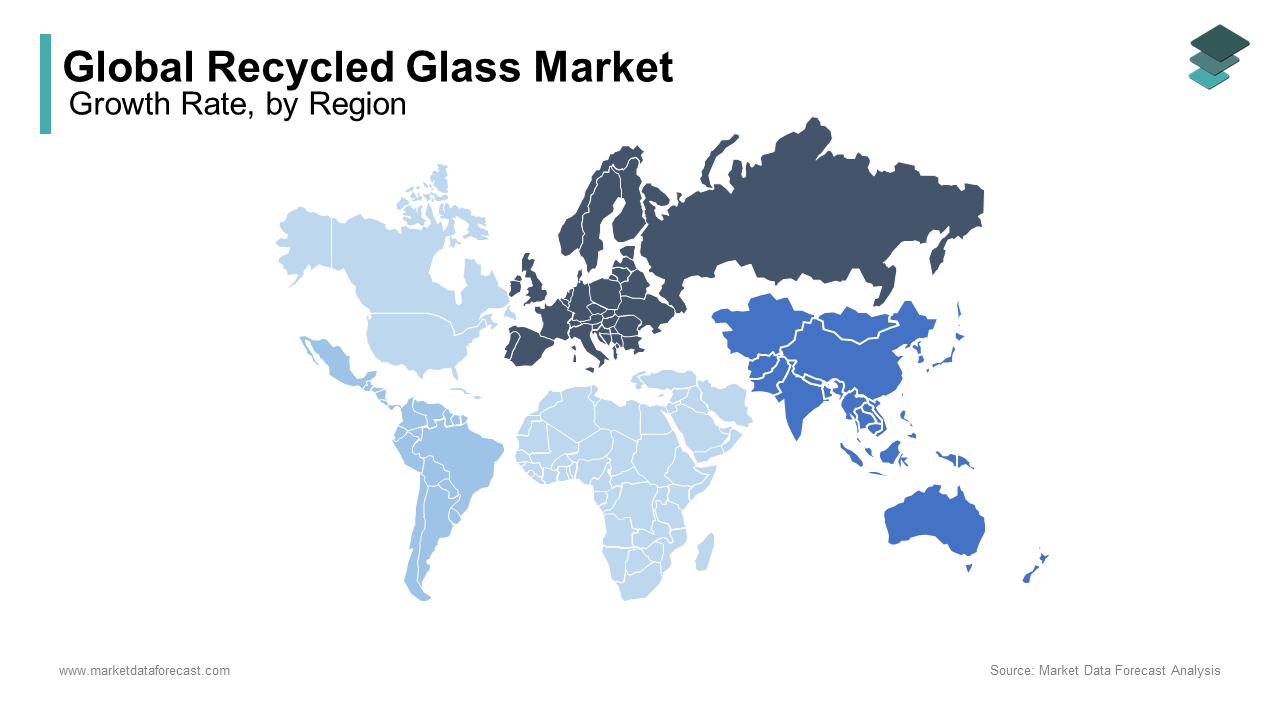
Europe was the top performer of the global recycled glass market by holding 41.3% the share in 2024, with the most efficient deposit return systems, with countries like Germany, Finland, and Sweden achieving glass container return rates above 90%. The European Union’s Circular Economy Action Plan mandates that all packaging placed on the market be reusable or recyclable by 2030, with specific targets for glass. According to the European Environment Agency, the EU recycled 24.7 million tons of glass in 2023, of which 76% was used in new container production.
Asia Pacific Market Insights
Asia Pacific was positioned second by capturing 29.3% of the share in 2024, with China, India, and Japan driving regional dynamics. However, the Chinese Ministry of Ecology and Environment has introduced stricter waste classification rules in 267 cities, which is improving source separation. In India, the Swachh Bharat Mission has expanded urban waste collection, but infrastructure for glass reprocessing remains limited.
North America Market Insights
North America's recycled glass market growth is likely to grow with prominent growth opportunities during the forecast period. As per the U.S. Environmental Protection Agency, approximately 31% of glass waste was recycled in 2023. California’s bottle bill system achieved a 76% return rate, while states without DRS programs averaged below 20%.
Latin America Market Insights
Latin America's recycled glass market is growing steadily, with Brazil, Mexico, and Chile emerging as key players in glass recycling. As per the Pan American Health Organization, Brazil recycled 1.8 million tons of glass in 2023, primarily through informal waste picker networks that supply 70% of collected material to formal processors.
Middle East & Africa Market Insights
Middle East & Africa recycled glass market growth is driven by South Africa, Saudi Arabia, and the UAE, leading regional efforts. As per the African Union’s 2023 Waste Management Outlook, less than 10% of glass waste is formally recycled across the continent, largely due to underdeveloped collection systems and a lack of processing infrastructure.
COMPETITION OVERVIEW
The competition in the recycled glass market is evolving from a commodity-driven landscape to one shaped by technological capability, regulatory alignment, and end-market integration. While large waste management firms and glass manufacturers dominate through scale and infrastructure, regional players are gaining ground by focusing on niche applications such as glassphalt and filtration media. Differentiation increasingly hinges on the ability to deliver high-purity, color-sorted cullet and to innovate in value-added products.
KEY MARKET PLAYERS
A few of the dominating players in the global recycled glass market include
- Strategic Materials Inc.
- Ardagh Group S.A.
- Owens-Illinois Inc.
- Vetropack Holding Ltd.
- Momentum Recycling
- Harsco Environmental
- NGV Glass Recycling Pty Ltd.
- Heritage Glass
- Glasrecycling NV
- Reiling Glas Recycling GmbH & Co. KG
- Coloured Aggregates Inc.
- eCullet Inc.
- Glass Recycled Surfaces
Top Strategies Used by Key Market Participants
Key players in the recycled glass market are deploying vertical integration, technological modernization, and strategic partnerships. Companies are investing in advanced sorting technologies such as near-infrared (NIR) spectroscopy and AI-driven robotics to improve cullet purity and color separation. Expansion into downstream applications like construction aggregates and glass-based composites allows firms to diversify revenue and absorb mixed-color glass streams. Geographic diversification through regional processing hubs reduces logistical inefficiencies and strengthens local supply chains. Additionally, participation in circular economy coalitions and sustainability certifications enhances brand credibility and access to environmentally driven procurement contracts in both public and private sectors.
LEADING PLAYERS IN THE RECYCLED GLASS MARKET
Veolia
Veolia operates as a global leader in environmental services, with an extensive footprint in recycled glass processing across the Asia Pacific region. The company manages integrated waste-to-resource facilities in Australia, India, and Singapore, where it processes post-consumer glass into high-purity cullet for use in container manufacturing and construction. It has also partnered with major beverage companies in Thailand and Indonesia to establish closed-loop recycling programs by ensuring consistent off-take.
Cleanaway Waste Management Limited
Cleanaway is Australia’s largest waste and recycling company, playing a pivotal role in advancing recycled glass utilization across the Asia Pacific region. The company operates multiple glass processing hubs, including a flagship facility in Laverton, Victoria, capable of processing 300,000 tons of glass annually into cullet and engineered aggregates. In 2023, Cleanaway introduced its “Glass to Road” program in partnership with the New South Wales government, diverting over 100,000 tons of mixed-color glass from landfills into road base construction. It has also invested in mobile crushing units to reduce transport costs and improve regional accessibility.
Nippon Sheet Glass Co., Ltd. (NSG Group)
Nippon Sheet Glass, a leading global glass manufacturer, is deeply integrated into the recycled glass ecosystem, particularly in Japan and Southeast Asia. The company operates advanced container glass plants in Yokohama and Kyoto, where recycled cullet constitutes over 70% of furnace feedstock, in compliance with Japan’s stringent environmental standards. NSG has pioneered closed-loop recycling models in collaboration with local municipalities and beverage producers by ensuring a consistent supply of sorted glass.
MARKET SEGMENTATION
This research report on the global recycled Glass market is segmented and sub-segmented into the following categories.
By Product
- Cullet
- Glass Powder
- Crushed Glass
- Others
By Application
- Flat Glass
- Glass Containers
- Glass Bottle
- Fiber Glass
- Highway Beads
- Abrasives
- Fillers
- Others
By Region
- North America
- Europe
- Latin America
- Asia Pacific
- Middle East & Africa
Frequently Asked Questions
1. What are the key drivers of the recycled glass market?
Key drivers include increasing environmental awareness, government regulations on waste management, demand for sustainable packaging, and cost savings in glass manufacturing.
2. What are the main benefits of recycling glass?
It reduces energy consumption, conserves natural resources, minimizes landfill waste, and lowers carbon emissions.
3. What are the challenges in the recycled glass market?
Challenges include contamination of glass waste, high processing costs, lack of proper collection infrastructure, and limited awareness in developing regions.
4. What is cullet, and why is it important in recycled glass?
Cullet is crushed, recycled glass that is melted to produce new glass products. It reduces energy use and extends the lifespan of furnaces in glass manufacturing.
5. Which regions dominate the recycled glass market?
Europe and North America are leading due to strong recycling regulations, while Asia-Pacific is growing rapidly with rising urbanization and sustainability initiatives.
6. How does recycled glass impact the packaging industry?
Recycled glass is widely used in producing bottles and containers, helping brands meet sustainability goals and regulatory recycling targets.
7. What is the market outlook for recycled glass?
The market is expected to grow steadily due to rising demand for sustainable materials, circular economy policies, and increased recycling infrastructure investments.
8. What types of recycled glass are commonly produced?
The main types include container glass, flat glass, fiber glass, and specialty glass.
9. Who are the major players in the recycled glass market?
Key players include Strategic Materials Inc., Ardagh Group, O-I Glass, Vetropack, and others.
10. What opportunities exist in the recycled glass market?
Opportunities include innovations in collection technology, the use of recycled glass in construction materials, and the growing demand for eco-friendly packaging solutions.
Related Reports
Access the study in MULTIPLE FORMATS
Purchase options starting from
$ 2500
Didn’t find what you’re looking for?
TALK TO OUR ANALYST TEAM
Need something within your budget?
NO WORRIES! WE GOT YOU COVERED!
Call us on: +1 888 702 9696 (U.S Toll Free)
Write to us: sales@marketdataforecast.com