- Product Description Description
- Table of Contents TOC
- List of Table & Figure LOT
- Get Free Sample PDF Sample PDF
Market Size, 2025
$11.21 BnMarket Estimate, 2026
$12.15 BnMarket Forecast, 2034
$23.21 BnCAGR, 2026–2034
8.42%Global Soil Conditioners Market Size, Growth Drivers, and Forecast (2025–2034)
- Market Scope: Comprehensive global industry analysis of the soil conditioners market covering application verticals, natural and synthetic types, crop classifications, solubility formulations, and regional adoption frameworks.
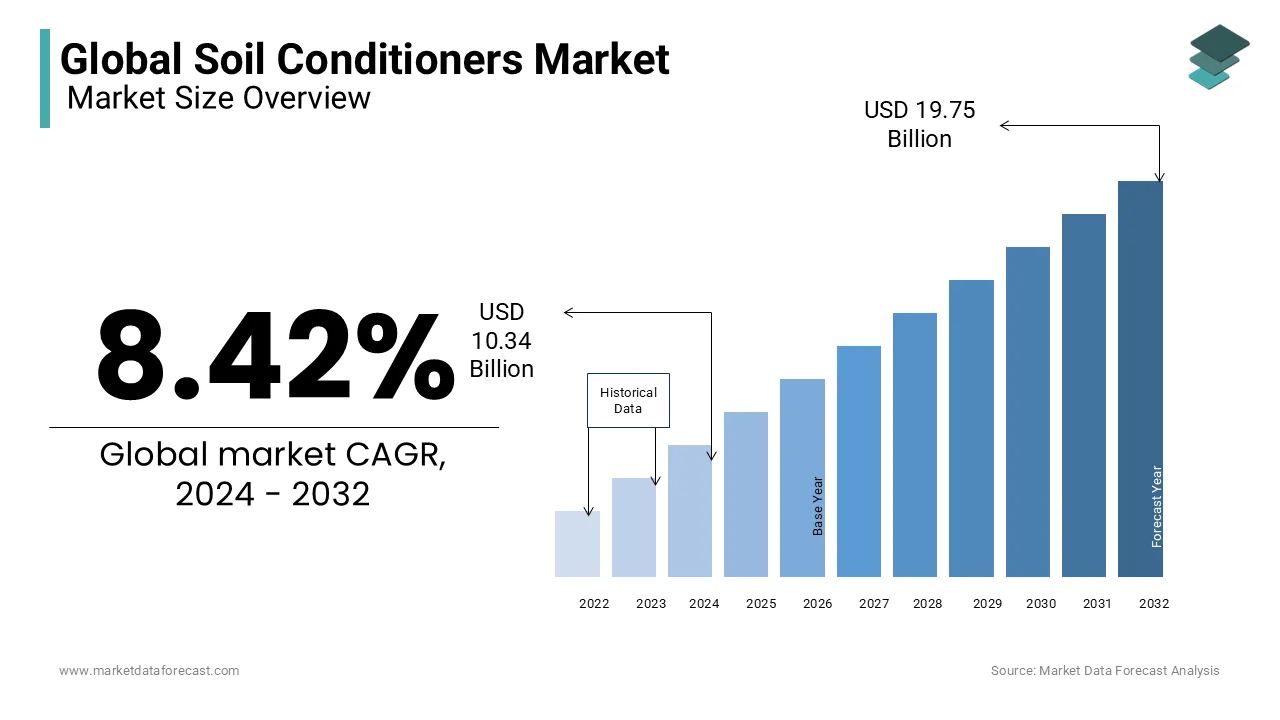
- Market Valuation: Valued at USD 11.21 billion in 2025, estimated at USD 12.15 billion in 2026, and projected to reach USD 23.21 billion by 2034, registering a steady CAGR of 8.42% from 2026 to 2034.
- Primary Growth Drivers: Rising awareness regarding soil health enhancement and structure optimization, growing integration of precision agriculture technologies, increasing population pressures, and expanded R&D investments into sustainable agricultural inputs.
Global Soil Conditioners Market Segment Metrics (2026–2034)
| Category | Leading Segment (2025 Position) | Fastest-Growing Segment |
|---|---|---|
| By Application | Agricultural Application (dominant consumer of soil amendments and conditioners) | Specialized Agricultural & Precision Farming Applications |
| By Type | Natural Soil Conditioners (holding a major share due to organic farming shifts) | Synthetic & Enzyme-Enhanced Variants (driven by high-performance requirements) |
| By Crop | Cereals & Grains (primary staple crops capturing the largest volume share) | Fruits & Vegetables (expanding rapidly under high-value horticulture demands) |
| By Solubility | Water-Soluble Formulations (preferred for broad application and uniform distribution) | Hydrogels & Advanced Liquid Solutions (accelerating due to high water-retention efficacy) |
| By Region | North America & Asia-Pacific (leading regional markets with extensive agricultural bases) | Latin America & MEA (witnessing high adoption to counter soil degradation and water stress) |
Global Soil Conditioners Market Players & Industry Structure
Market Structure: Highly competitive global agrochemical and specialty chemical marketplace dominated by leading multinational corporations focusing on sustainable soil amendments, advanced formulations, and geographic expansion.
Key Companies: BASF SE (Germany), The Dow Chemical Company (U.S.), Evonik Industries AG (Germany), Akzo Nobel N.V. (Netherlands), Solvay S.A. (Belgium), Croda International Plc (U.K.), Clariant International AG (Switzerland), Lambent Corp. (U.S.), Adeka Corporation (Japan), and Eastman Chemical Company (U.S.).
Global Soil Conditioners Market Size
The global soil conditioners market size was valued at USD 11.21 billion in 2025 and is anticipated to reach USD 12.15 billion in 2026 to reach USD 23.21 billion by 2034, growing at a CAGR of 8.42% from 2026 to 2034.
Soil conditioners are materials that are added to soil in order to enhance its physical qualities, like fertility, and alsoitsr mechanics. It comes under the category of soil amendments, which include many fertilizers and non-organic materials.
Soil conditioners have a wide range of applications. It is primarily usedtoo compact the soil and improve its structure. Compacting the soil decreases the growth of roots, preventing their absorption of nutrients and water from the soil. Soil conditioners are also used to enhance the quality of poor soils by adding substances into them, like compost, clay, beneficial bacteria, and minerals like calcium and magnesium, among others. A few additives greatly enhance the capability of soils to exchange cations. They can also be used to enhance the water-retaining capacity, especially in dry and coarse soil,s by adding additives like organic materials, ls for example.
Market Drivers and Restraints
The soil conditioners market is driven by factors such as rising awareness about the need for soil enhancement, technological advancements in agriculture like the use of precision agriculture techniques in soil and crop management, rising need for enhancement in the quality of soil, rising population,ons and growing investment in research and development,ment among others. However, the market is mainly constrained by a lack of awareness about soil conditioners in developing nations.
REPORT COVERAGE
| REPORT METRIC | DETAILS |
| Market Size Available | 2025 to 2034 |
| Base Year | 2025 |
| Forecast Period | 2026 to 2034 |
| CAGR | 8.42% |
| Segments Covered | By Application, Type, CSolubility, and Region |
| Various Analyses Covered | Global, Regional & Country Level Analysis, Segment-Level Analysis, DROC, PESTLE Analysis, Porter’s Five Forces Analysis, Competitive Landscape, Analyst Overview of Investment Opportunities |
| Regions Covered | North America, Europe, APAC, Latin America, Middle East & Africa |
| Market Leaders Profiled | BASF SE (Germany), The Dow Chemical Company (U.S.), Evonik Industries AG (Germany), Akzo Nobel N.V. (Netherlands), Solvay S.A. (Belgium), Croda International Plc (U.K.), Clariant International AG (Switzerland), Lambent Corp. (U.S.), Adeka Corporation (Japan), Eastman Chemical Company (U.S.). |
SEGMENT ANALYSIS
By Application Insights

REGIONAL ANALYSIS
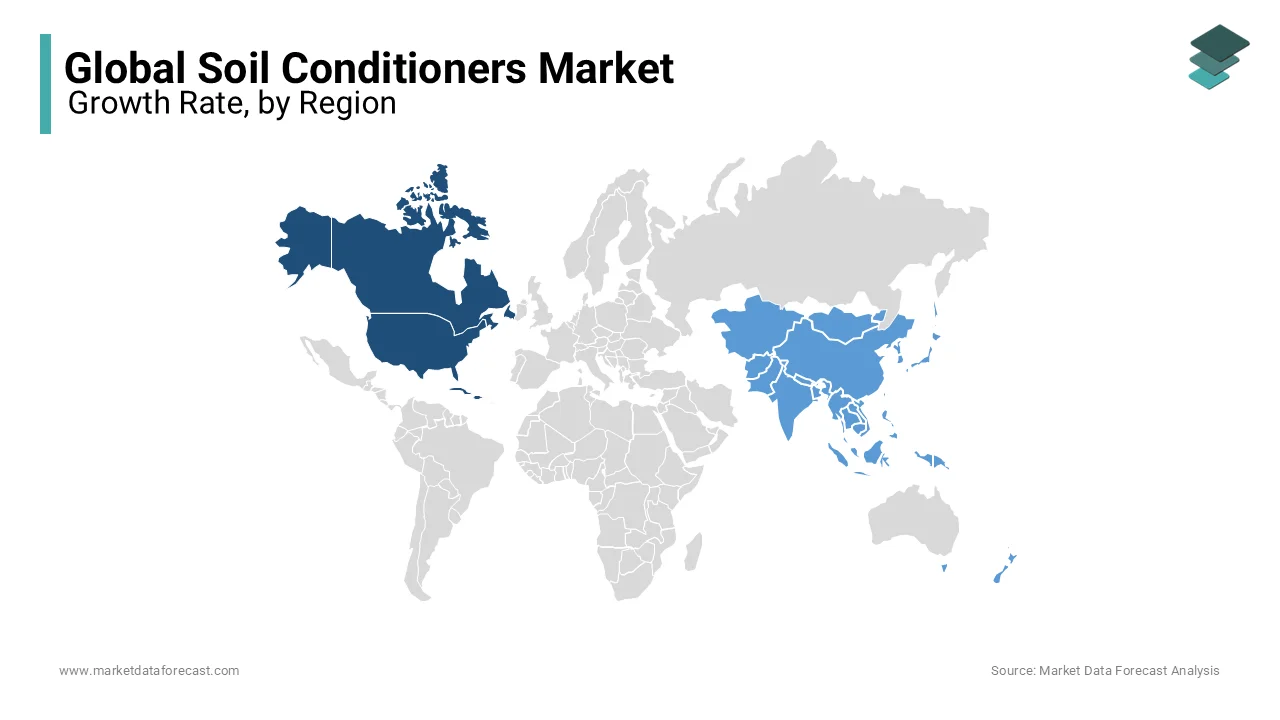
North America has the second-largest market, followed by the Asia Pacific region,n in terms of share.
KEY MARKET PLAYER
Some of the market players dominate the global soil conditioners market.
- BASF SE (Germany)
- The Dow Chemical Company (U.S.)
- Evonik Industries AG (Germany)
- Akzo Nobel N.V. (Netherlands)
- Solvay S.A. (Belgium)
- Croda International Plc (U.K.)
- Clariant International AG (Switzerland)
- Lambent Corp. (U.S.)
- Adeka Corporation (Japan)
- Eastman Chemical Company (U.S.).
MARKET SEGMENTATION
This research report on the global soil conditioners market is segmented and sub-segmented based on Application, Type, Crop, Solubility, and Region.
By Application
- Agricultural
- Industrial
By Type
- Natural
- Synthetic
By Crop
- Oilseeds
- Pulses
- Cereals
- Grains
- Fruits
- Vegetables
By Solubility
- Water-soluble
- Hydrogels
By Region
- North America
- Europe
- Asia Pacific
- Latin America
- The Middle East and Africa
- Rest of the World