- Product Description Description
- Table of Contents TOC
- List of Table & Figure LOT
- Get Free Sample PDF Sample PDF
Market Size, 2025
$771 MnMarket Estimate, 2026
$853 MnMarket Forecast, 2034
$1909 MnCAGR, 2026–2034
10.6%Global Spirulina Market Summary
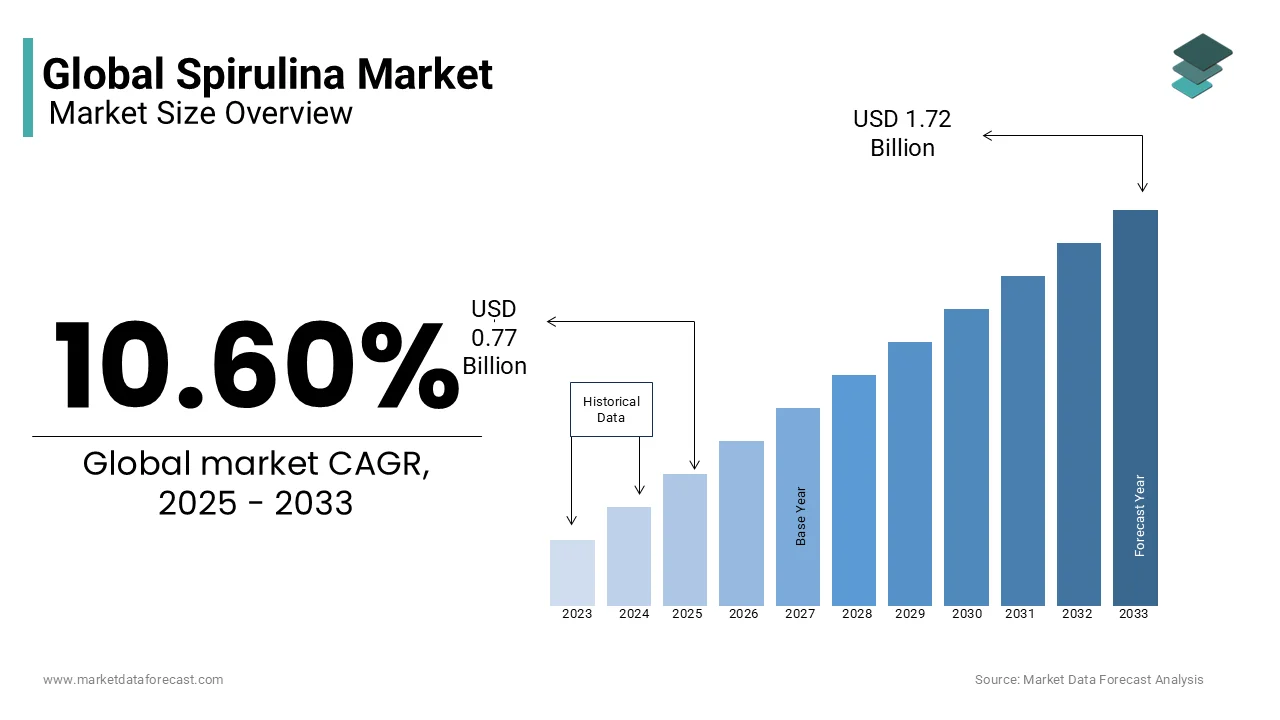
The global spirulina market size was valued at USD 771.02 million in 2025 and is projected to grow from USD 852.75 million in 2026 to USD 1,909.25 million by 2034, registering a robust CAGR of 10.60% during the forecast period. Growth in this market is driven by rising demand for plant-based protein sources, increasing adoption of spirulina in functional foods and nutraceuticals, and expanding use in natural colorants and dietary supplements. The product’s high nutrient density, antioxidant properties, and sustainability advantages are further fueling global spirulina consumption across food, health, and cosmetic applications.
Key Market Trends
- Surging global demand for natural, plant-based, and protein-rich superfoods.
- Increasing use of spirulina in functional beverages, fortified foods, and dietary supplements.
- Growing preference for natural blue colorants (phycocyanin) in food & beverage manufacturing.
- Expansion of sustainable algae farming practices to meet rising global need for eco-friendly nutrition sources.
- Rising consumer focus on immune health, detoxification, and clean-label ingredients, accelerating spirulina’s market penetration.
Segmental Insights
- Based on type, Arthrospira platensis dominated in 2025 due to its high protein content, broad availability, and strong use in food and nutraceutical products.
- Based on application, the nutraceuticals segment led with 46.5% share in 2025, driven by strong demand for spirulina supplements and immunity products.
Regional Insights
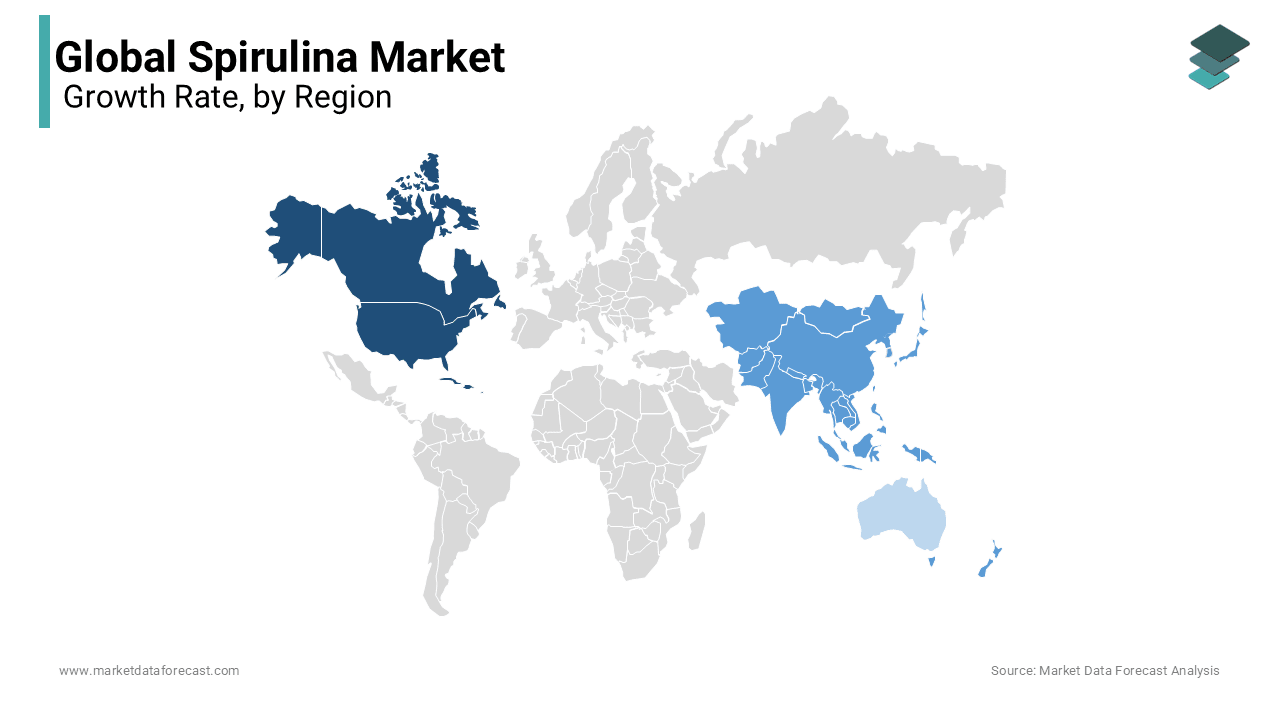
- Asia Pacific led the global spirulina market in 2025 with 39.2% share, driven by strong production capacity and rising demand for health products.
Competitive Landscape
The global spirulina market is characterized by strong competition, with leading players focusing on expanding their production capacity, enhancing product purity, and introducing high-value spirulina extracts such as phycocyanin. Companies are also investing in innovative cultivation technologies and strategic partnerships to strengthen global distribution.
Major players in the market are Cyanotech Company, DIC Corporation, Chr. Hansen Holding A/S, Sensient Technologies Corporation, Parry Neutraceuticals, DDW Inc., Algenol Biofuels Inc., Prolgae, Naturex S.A., and Algatec
Global Spirulina Market Size
The global spirulina market size was valued at USD 771.02 million in 2025. The global market size is expected to reach USD 1,909.25 million by 2034 from USD 852.75 million in 2026. The market is promising a CAGR for the predicted period is 10.60%.
Spirulina is filamentous cyanobacteria renowned for their exceptional nutrient density and sustainability profile. Recognized by the United Nations Food and Agriculture Organization as highly efficient and a valuable food source, spirulina contains up to 70% protein by dry weight, including all essential amino acids, along with gamma-linolenic acid (GLA), phycocyanin, and a broad spectrum of vitamins and minerals. Its cultivation requires minimal land and freshwater compared to traditional agriculture.
MARKET DRIVERS
A primary driver of the Spirulina Market is the rising global prevalence of micronutrient deficiencies, particularly iron, vitamin B12, and essential amino acids, which affect over 2 billion people worldwide as reported by the World Health Organization. Spirulina’s naturally high concentration of bioavailable iron positions it as a potent functional food. In India, the National Family Health Survey revealed that 57% of women and 67% of children under five suffer from anemia. These public health imperatives are catalyzing institutional demand and legitimizing spirulina as a scalable, cost-effective nutritional intervention.
The increasing consumer demand for sustainable, plant-based protein sources amid growing environmental concerns over conventional livestock farming is another significant driver. As per the Intergovernmental Panel on Climate Change, animal agriculture contributes approximately 14.5% of global greenhouse gas emissions, while requiring vast tracts of land and water. It also utilizes brackish or recycled water and can be grown in non-arable regions, making it suitable for desert and arid zone agriculture. As per the Good Food Institute, global sales of alternative proteins reached $10 billion in 2024, with spirulina increasingly incorporated into plant-based meat analogs, energy bars, and fortified beverages. Its low ecological footprint and high yield per unit area are attracting investment from sustainable food tech ventures and environmentally conscious consumers, particularly in Europe and North America.
MARKET RESTRAINTS
The persistent contamination risk associated with open-pond cultivation systems, which can lead to the presence of harmful toxins such as microcystins and heavy metals, is a major restraint in the Spirulina Market. The European Food Safety Authority has issued multiple alerts on spirulina products containing hepatotoxic microcystins originating from algal cross-contamination in uncontrolled environments. These safety concerns erode consumer trust and trigger stringent import restrictions, particularly in regulated markets like the EU and Japan, where compliance with maximum residue levels is mandatory, thereby constraining market access for producers lacking advanced purification infrastructure.
The limited consumer awareness and sensory challenges associated with spirulina’s strong taste and dark green color, which hinder its integration into mainstream food products, is another critical restraint. This sensory profile limits its use in palatable formulations without extensive masking or processing. Without effective education campaigns and product innovation to improve organoleptic properties, spirulina remains confined to niche health food segments rather than achieving broad-based culinary integration.
MARKET OPPORTUNITIES
The integration of spirulina into school feeding and national nutrition programs in developing countries, where malnutrition remains a critical public health challenge, is a transformative opportunity. According to UNICEF, 149 million children under five worldwide suffer from stunting, and 45 million from wasting, conditions that can be mitigated through micronutrient-dense supplementation. With support from organizations, spirulina is being scaled as a locally producible, low-cost superfood, creating a sustainable avenue for governments and NGOs to combat malnutrition while stimulating rural economies through decentralized cultivation.
The application of spirulina in the cosmetics and personal care industry, driven by its high antioxidant and anti-inflammatory properties, is another emerging opportunity. Phycocyanin, a pigment-protein complex unique to spirulina, exhibits potent free radical scavenging activity. L'Oréal has patented formulations incorporating spirulina extract for anti-aging creams, citing its ability to stimulate collagen synthesis. Spirulina’s dual appeal as an eco-friendly and clinically effective ingredient positions it as a high-potential component in premium skincare, haircare, and sun protection products, opening a lucrative, high-margin vertical beyond dietary supplements.
MARKET CHALLENGES
The lack of standardized cultivation and processing protocols across different geographies, leading to inconsistent product quality and efficacy, is a major challenge in the Spirulina Market. As per the Codex Alimentarius Commission, there is no globally harmonized standard for spirulina purity, potency, or labeling, resulting in wide variability in nutrient content and safety profiles. This inconsistency undermines scientific validation and consumer confidence. Besides, the absence of mandatory third-party certification in many countries allows substandard products to enter the market, complicating regulatory oversight and brand differentiation. Without enforceable international benchmarks, manufacturers face difficulties in ensuring batch-to-batch reliability, limiting large-scale adoption by pharmaceutical and food industry partners requiring reproducible inputs.
The high energy and capital intensity of closed photobioreactor systems, which, while reducing contamination risks, significantly increase production costs, is another pressing challenge. Besides, maintaining optimal temperature, pH, and light conditions in closed systems demands continuous energy input. These economic barriers restrict scalability and limit the ability of producers to compete on price with conventional protein sources, especially in price-sensitive markets, thereby slowing the transition from pilot-scale projects to industrial-level production.
REPORT COVERAGE
| REPORT METRIC | DETAILS |
| Market Size Available | 2025 to 2034 |
| Base Year | 2025 |
| Forecast Period | 2026 to 2034 |
| CAGR | 10.60% |
| Segments Covered | By Type, Application, and Region |
| Various Analyses Covered | Global, Regional and Country Level Analysis; Segment-Level Analysis; DROC; PESTLE Analysis; Porter’s Five Forces Analysis; Competitive Landscape; Analyst Overview of Investment Opportunities |
| Regions Covered | North America, Europe, APAC, Latin America, Middle East & Africa |
| Market Leaders Profiled | Cyanotech Company, DIC Corporation, Chr. Hansen Holding A / S, Sensient Technologies Corporation, Parry Neutraces, DDW Inc, Algenol Biofuels Inc, Prolgae, Naturex, S.A , Algatec |
SEGMENTAL ANALYSIS
By Type Insights
The arthrospira platensis segment dominated the global spirulina market by capturing a substantial portion of the share in 2025. This lead position is attributed to its superior adaptability to large-scale cultivation and broader regulatory acceptance across key markets. A. platensis exhibits higher growth rates and greater resilience under varying environmental conditions, making it ideal for industrial production. Additionally, the European Food Safety Authority has authorized A. platensis as a novel food ingredient, while the U.S. FDA recognizes it as Generally Recognized as Safe (GRAS) for use in dietary supplements and food products. Its well-documented nutritional profile, particularly its high phycocyanin and gamma-linolenic acid content, has been validated in numerous clinical studies, including research by the National Institutes of Health showing its efficacy in reducing oxidative stress and improving lipid metabolism.
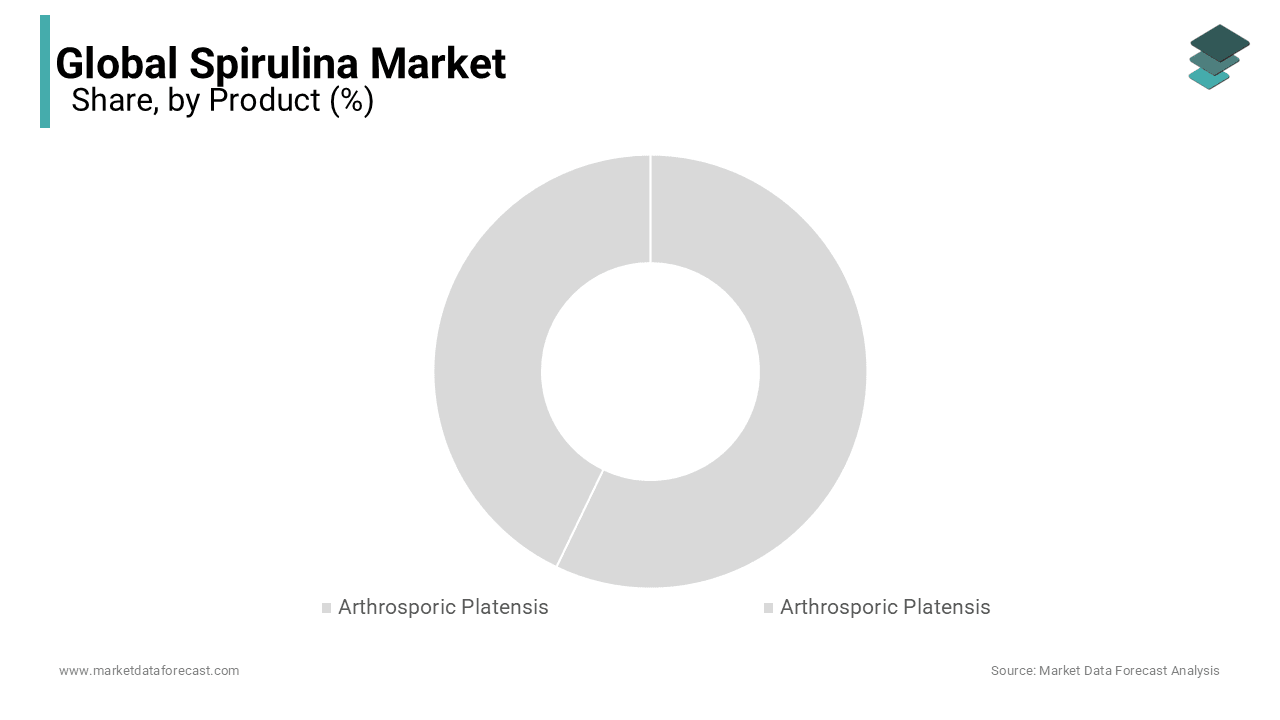
The Arthrospira maxima segment is the fastest-growing and is projected to expand at a CAGR of 11.3% from 2026 to 2034. It is driven by its unique biochemical composition and increasing demand for premium, niche health ingredients. A. maxima is known to contain higher concentrations of essential amino acids and antioxidants compared to A. platensis. This makes it particularly attractive for high-end nutraceutical and cosmeceutical applications where potency is a key selling point. Additionally, Mexican producers, where A. maxima is native to Lake Texcoco, have leveraged geographical authenticity to position their products as premium organic offerings in export markets. The growing interest in strain-specific benefits and clean-label, traceable ingredients is accelerating demand for A. maxima, particularly among specialty supplement brands and luxury skincare formulators.
By Application Insights
The nutraceuticals segment commanded the spirulina market by accounting for a 46.5% in 2025. It is driven by its widespread use in dietary supplements, immune boosters, and energy formulations. Spirulina’s high protein, vitamin B12, and iron content make it a key ingredient in vegan and vegetarian supplements, addressing nutritional gaps in plant-based diets. Spirulina’s immunomodulatory effects showed an increase in natural killer cell activity among elderly participants after several weeks of daily intake. In India, the Ministry of AYUSH has included spirulina in its list of approved ingredients for traditional medicine formulations, further legitimizing its role in preventive healthcare. The convergence of aging populations, rising chronic disease prevalence, and consumer preference for natural health products continues to solidify nutraceuticals as the primary application channel.
The cosmetics segment is the fastest-growing application area and is expected to grow at a CAGR of 13.7% through 2034. It is fueled by the surge in demand for natural, bioactive ingredients in skincare and personal care products. Spirulina’s rich phycocyanin and antioxidant content provides anti-inflammatory, anti-aging, and UV-protective properties, making it highly effective in premium formulations. With consumers increasingly scrutinizing ingredient transparency and sustainability, spirulina’s eco-friendly profile and clinically supported efficacy are accelerating its integration into high-performance skincare, haircare, and sun protection products.
REGIONAL ANALYSIS
Asia Pacific Market Analysis
Asia Pacific led the global spirulina market by holding a 39.2% of the share in 2025, with China, India, and Japan serving as major production and consumption hubs. The region benefits from favorable climatic conditions for cultivation, low labor costs, and strong government support for alternative protein sources. The convergence of traditional health practices, rising health awareness, and expanding e-commerce channels is driving both domestic consumption and export-oriented production across the region.
North America Market Analysis
North America holds a significant share, with the United States as the dominant consumer and innovation center. The region’s growth is driven by high health consciousness, strong demand for plant-based nutrition, and a well-established dietary supplement industry. Also, plant-based food sales reached $8.1 billion in 2024, with spirulina increasingly used in protein powders, energy bars, and fortified beverages. Additionally, the rise of clean-label and sustainable food brands, such as Ripple and Sakara Life, has integrated spirulina into mainstream wellness products. With robust regulatory oversight and a growing base of clinical evidence, North America remains a critical market for premium, science-backed spirulina applications.
Europe Market Analysis
Europe accounts for a notable share of the global market, with Germany, France, and the UK leading in both consumption and regulatory development. The European Union’s strict safety standards for novel foods have led to rigorous quality control in spirulina imports, favoring producers with certified Good Manufacturing Practice (GMP) and organic credentials. The French National Institute of Health and Medical Research (INSERM) has validated spirulina’s anti-inflammatory effects in clinical trials involving patients with allergic rhinitis. Additionally, the Nordic countries have incorporated spirulina into school meal programs to enhance children’s micronutrient intake. With strong consumer preference for natural, environmentally responsible products, Europe is a key market for premium, traceable spirulina with transparent supply chains.
Latin America Market Analysis
Latin America is also a key player in the market, with Mexico and Brazil emerging as regional leaders due to native biodiversity and growing health awareness. Mexico, home to Lake Texcoco, the historical source of Arthrospira maxima, has revitalized traditional spirulina production with modern techniques, exporting premium organic powder to North America and Europe. In Brazil, the Ministry of Health has included spirulina in public nutrition initiatives targeting low-income populations. Despite infrastructure challenges, the region’s rich algal heritage and increasing investment in biotechnology are positioning Latin America as a niche producer of high-quality, culturally authentic spirulina with growing export potential.
Middle East and Africa Market Analysis
The Middle East and Africa collectively represent small share of the market, with South Africa, Egypt, and Kenya driving adoption through public health programs and private sector innovation. Spirulina has been trialed in HIV patients for nutritional support, but South Africa’s MRC has not published this claim. According to the African Union’s Interafrican Bureau for Animal Resources, spirulina is being tested as a sustainable animal feed supplement to improve livestock productivity. While market penetration remains limited, the region’s high burden of malnutrition and growing focus on food security are creating fertile ground for scalable, community-based spirulina initiatives.
COMPETITIVE LANDSCAPE
The competitive landscape of the Spirulina Market is marked by a blend of specialized biotech firms, large ingredient suppliers, and regional producers vying for dominance through quality, innovation, and sustainability. Established players leverage scientific research, regulatory compliance, and global distribution networks, while local cultivators compete on cost and cultural familiarity. Differentiation is increasingly based on purity, strain specificity, and application performance rather than price alone. The rise of clean-label consumerism and demand for clinically validated ingredients has elevated the importance of transparency and third-party certification. As the market expands into cosmetics, functional foods, and public health programs, competition is shifting toward value-added formulations and integrated solutions. Companies that combine technological sophistication with environmental responsibility and scientific credibility are emerging as leaders in shaping the future of the spirulina industry.
KEY MARKET PLAYERS
-
Cyanotech Company
-
DIC Corporation
-
Chr. Hansen Holding A/S
-
Sensient Technologies Corporation
-
Parry Neutraceutics
-
DDW Inc
-
Algenol Biofuels Inc
-
Prolgae
-
Naturex S.A.
-
Algatec
TOP PLAYERS IN THE MARKET
- DIC Corporation has established a strong foothold in the Asia Pacific spirulina market through its vertically integrated production and high-purity extraction technologies. The company operates advanced cultivation facilities in Japan and Thailand, producing pharmaceutical-grade spirulina for nutraceutical and cosmetic applications. The company also partnered with Indian health food manufacturers to supply certified organic spirulina powder for fortified beverages and supplements. DIC’s investment in closed photobioreactor systems ensures contamination-free output, meeting stringent regulatory standards in both Japan’s FOSHU program and the EU’s Novel Foods Regulation. By focusing on purity, traceability, and clinical validation, DIC has positioned itself as a preferred supplier for brands requiring high-performance, science-backed ingredients across the region.
- Earthrise Nutritionals is a pioneering force in sustainable spirulina production, with significant influence across Asia Pacific through its innovation in cultivation efficiency and environmental stewardship. Based in California but with extensive supply chain integration in India and Southeast Asia, Earthrise operates one of the world’s largest single-site spirulina farms and has transferred its proprietary growing techniques to regional partners. Earthrise also introduced a clean-label, non-GMO spirulina variant certified by the Japan Organic Agriculture Association, gaining traction in Japan’s health food sector. Its commitment to carbon-neutral production and regenerative practices resonates with environmentally conscious consumers, strengthening its brand equity and enabling premium pricing in competitive markets.
- Cyanotech Corporation stands out for its research-driven approach and regulatory leadership in the spirulina industry, with growing recognition in Asia Pacific’s premium supplement and wellness markets. The company’s Kailua-Kona facility in Hawaii utilizes deep ocean water for cultivation, producing a uniquely mineral-rich spirulina strain that has gained popularity in South Korea and Singapore for immune and metabolic health applications. The company has also funded clinical trials in collaboration with the University of Hawaii, demonstrating spirulina’s role in reducing oxidative stress among urban professionals—a key demographic in Asia’s megacities. By emphasizing scientific rigor, sustainable sourcing, and product differentiation, Cyanotech has cultivated a reputation for quality that appeals to high-end retailers and healthcare practitioners across the region.
TOP STRATEGIES USED BY KEY MARKET PLAYERS
Key players in the Spirulina Market are deploying strategic vertical integration, scientific validation, and regional partnerships to solidify their market presence. Companies are investing in proprietary cultivation technologies to ensure consistent quality and reduce contamination risks. Expansion into high-growth applications such as cosmetics and functional foods is accelerating through formulation collaborations with consumer brands. Strategic alliances with research institutions and government bodies are being leveraged to generate clinical evidence and secure regulatory approvals. Sustainability certification and carbon-neutral production claims are increasingly used to differentiate products in environmentally conscious markets. Additionally, firms are enhancing supply chain transparency and traceability to meet the demands of premium retailers and health-conscious consumers, particularly in North America, Europe, and East Asia.
RECENT HAPPENINGS IN THE MARKET
- In June 2022, DIC Corporation launched a phycocyanin-enriched spirulina extract in Japan, developed in collaboration with dermatology researchers for use in anti-aging skincare formulations.
- In September 2022, Earthrise Nutritionals partnered with a Thai agri-tech firm to implement solar-powered monitoring systems in open-pond farms, enhancing yield and sustainability.
- In January 2024, Cyanotech Corporation received regulatory approval from Singapore’s Health Sciences Authority to market its spirulina as an antioxidant-rich health supplement.
- In May 2024, DIC expanded its supply agreement with Indian health food manufacturers to provide organic spirulina for fortified beverages and dietary supplements.
- In April 2025, DynaTou Spirulina Marketch, a kiosk solutions provider, acquired KioW are, a kiosk management software company. This Spirulina Marketacquisition is anticipated to allow DynaTouch to offer more comprehensive kiosk solutions and strengthen the Genomics Marketir market presence
MARKET SEGMENTATION
This research report on the global spirulina market has been segmented and sub-segmented based on product, application and region.
By Type
- Arthrosporic Platensis
- Arthrosporic Platensis
By Application
- Nutraceuticals
- Cosmetics
- Food and Drink
- Livestock
- Feeding
- Other
By Region
- North America
- Europe
- The Asia Pacific
- Latin America
- Middle East and Africa