- Product Description Description
- Table of Contents TOC
- List of Table & Figure LOT
- Get Free Sample PDF Sample PDF
Market Size, 2025
$326.92 MnMarket Estimate, 2026
$345.91 MnMarket Forecast, 2034
$543.48 MnCAGR, 2026–2034
5.81%Executive Summary: Global Termite Bait Systems Market
- Market Scope: Comprehensive global termite bait systems market analysis covering termite species, station types, application domains, regional leadership frameworks, and eco-friendly pest management transitions.
- Market Valuation: Valued at USD 326.92 million (2025), estimated at USD 345.91 million (2026), and projected to reach USD 543.48 million by 2034, registering a CAGR of 5.81% (2026–2034).
- Primary Growth Drivers: Growing housing and urban infrastructure markets, rising chemical resistance from conventional liquid termiticides, increasing consumer demand for non-toxic and environmentally sustainable pest management, and proactive residential structural protection measures.
Key Market Segment Metrics (2026–2034)
| Category | Leading Segment (2025 Position) | Fastest-Growing Segment |
|---|---|---|
| By Termite Type | Subterranean (accounted for the majority of handling and structural damage costs globally) | Drywood & Dampwood Termite management applications |
| By Station Type | In-Ground stations (dominated by monitoring underground foraging activity around residential and commercial perimeters) | Above-ground monitoring systems combined with smart tech integration |
| By Application | Commercial & Industrial (led market share to avoid major infrastructure and asset losses) | Residential housing and urban real estate developments |
| By Region | North America (dominated due to widespread subterranean termite prevalence and sophisticated pest control networks) | Asia-Pacific (fastest-growing region driven by rapid economic expansion, urbanization, and high structural damage risks in China and India) |
Major Market Players & Market Structure
Market Structure: Competitive and consolidated chemical and pest control landscape featuring major global agrochemical corporations and specialized extermination enterprises competing on active ingredient efficacy, insect growth regulators (IGRs), patent protection, and sustainable bait station designs.
Key Companies: DowDuPont (Corteva), BASF, Bayer, Sumitomo Chemical, Syngenta, Rentokil Initial, Spectrum Brands, Ensystex, PCT International, Rollins, Terminix International, and Arrow Exterminators.
Global Termite Bait Systems Market Size
The global termite bait systems market size was valued at USD 326.92 million in 2025 and is anticipated to reach 345.91 million in 2026 to reach USD 543.48 million by 2034, growing at a CAGR of 5.81% from 2026 to 2034.
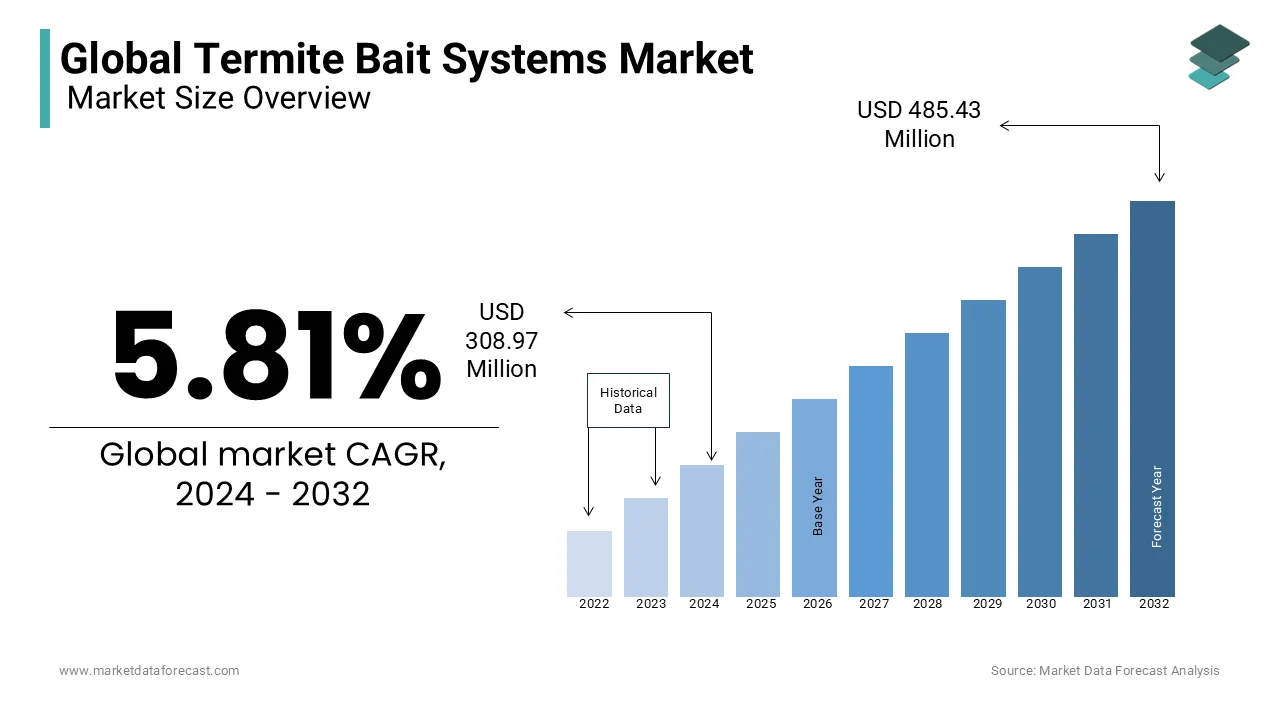
CURRENT SCENARIO OF THE GLOBAL TERMITE BAIT SYSTEMS MARKET
The environmental benefits associated with termite bait systems are an important factor contributing to the expansion of this market on a worldwide scale. Due to the growing housing market and the escalating prevalence of the termite population due to poor construction practices, the market for termite bait systems is predicted to grow in the coming years.
Termite baits contain a small amount of wood and pesticides, which help slow the expansion of termites. Termite baits also consist of cardboard, paper, or other acceptable termite foods, combined with a slow-acting substance that is lethal to termites. It also acts as a regulator of insect expansion. Termite treatment in residential areas is done with a liquid termiticide applied to the topsoil.
MARKET TRENDS
New trends in termite bait systems include bait and ground monitoring systems. These systems can be employed alone or in combination with treatment for greater flexibility. Companies in the termite bait system product ecosystem are capitalizing on this trend and are recommending that end-users use liquid termiticide bait systems when setting up stations. This treatment serves as an alternative in cases where liquid termiticides are not a practical solution to control termites. The market for termite bait systems is a relatively small sector in the termite control industry; however, the market has grown at a significant rate due to the growing need for effective termite management with less toxic methods in different industries, such as commercial and residential, in developed countries.
MARKET DRIVERS
The world's urban population grew rapidly from 746 million in 1950 to more than 4 billion in 2016, according to United Nations data.
As a result, there has been a rebound in the housing, infrastructure, and hospitality sectors. Termites were able to adapt to growing urban settlements due to the use of termiticide products in higher doses without the intervention of a certified pest control service provider. This led to escalated resistance to chemicals. Customers in residential areas have also been proactive enough to take such preventative measures for the structural protection of their homes. To maintain public health and hygiene, pest control has been sought as an important tool in urban cities in developed countries. The greater spending capacity of this demographic group has also been a factor in the provision of these services.
MARKET RESTRAINTS
The main factors hampering market expansion are high initial investment, contract maintenance renewal costs, and lack of awareness. In the case of bait systems, the cost of installation and bait components is included in the cost of the active ingredient. Therefore, bait systems are more expensive than conventional chemical treatments. Additionally, bait systems require multiple visits to the structure to monitor for termites and assess whether additional baits are needed.
The market has strong prospects in the coming years, such as a high consumer preference for innovative and sustainable products and growing market opportunities in urban residential areas. Each bait system is composed of an active ingredient, which is an insect expansion regulator or a chitin expansion inhibitor. It is a non-toxic and ecologically sustainable type of insecticide since it maintains the expansion of the larvae until the adult stage, thus reducing their possibilities of reproduction. Therefore, there is an opportunity to develop bait systems using compounds that are completely durable and, in addition, to use natural components that would function as attractants for termites.
MARKET CHALLENGES
The downside to bait systems is the time it takes to remove termite mounds. The effect of the baits is slow compared to the knockdown effects of liquid barriers. After installing the bait stations, it can take several months for termites to find the bait and share it with their nestmates. Also, there may be some degree of termite infestation elsewhere before the slow-acting baits take effect. Therefore, this process can take from several months to a year for the complete elimination of a termite colony. Also, homeowners with a severe termite infestation around their home would not prefer this method, as it takes longer.
REPORT COVERAGE
| REPORT METRIC | DETAILS |
| Market Size Available | 2025 to 2034 |
| Base Year | 2025 |
| Forecast Period | 2026 to 2034 |
| CAGR | 5.81% |
| Segments Covered | By Termite type, Station Type, Application, and Region |
| Various Analyses Covered | Global, Regional & Country Level Analysis, Segment-Level Analysis, DROC, PESTLE Analysis, Porter’s Five Forces Analysis, Competitive Landscape, Analyst Overview on Investment Opportunities |
| Regions Covered | North America, Europe, APAC, Latin America, Middle East & Africa |
| Market Leaders Profiled | DowDuPont (US), BASF (Germany), Bayer (Germany), Sumitomo Chemical (Japan), Syngenta (Switzerland), and Rentokil Initial (UK). Some emerging players in the termite bait systems market include Spectrum Brands (US) |
SEGMENTAL ANALYSIS
By Termite Insights

By Station Insights
The market for termite bait systems, in terms of station type, is predicted to be dominated by ground bait stations in 2021. The main function of the ground station type is to monitor the activities of floor bait stations. Termites are below ground level and around houses and apartments.
By Application Insights
It is predicted that the commercial and industrial segments will have the largest share in 2021. This dominance can be attributed to the need to avoid major infrastructure losses due to termite damage in the commercial and industrial sectors.
REGIONAL ANALYSIS
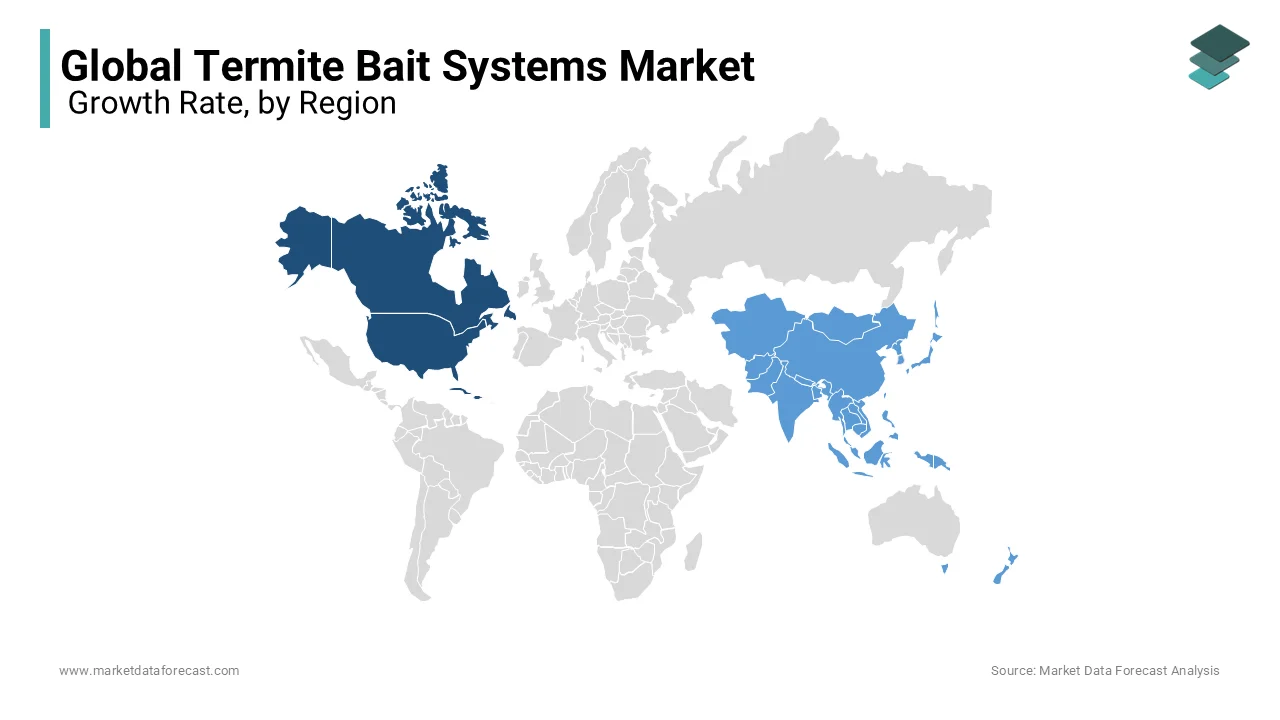
North America accounted for the largest share in 2021, followed by Asia-Pacific, due to the escalating adoption of termite bait systems in countries such as the United States, Canada, Australia, and China. Subterranean termites are widespread in North America and are responsible for 90% of handling and damage costs in the United States. Therefore, the North American region dominated the termite bait systems market in 2021. Asia-Pacific is probably the fastest-growing region in the worldwide termite bait systems market during the outlook period. Termitesaren believed to cause around RMB 80 billion in structural damage each year in China. In recent years, economic expansion in this region has led companies to invest in developing countries, including China and India. North America is the largest regional market in the world for termite bait systems.
KEY MARKET PLAYERS
The global market for termite bait systems was dominated by large players such as
- DowDuPont (US)
- BASF (Germany)
- Bayer (Germany)
- Sumitomo Chemical (Japan)
- Syngenta (Switzerland)
- Rentokil Initial (UK)
- Spectrum Brands (US)
- Ensystex (US)
- PCT International (Australia)
- Rollins (US)
- Terminix International (US)
- Arrow Exterminators (US).
RECENT MARKET NEWS
- Whitemire Micro-Gen declares the introduction of Advance Compress Termite Bait II, a bigger bait load product for the developed termite bait systems.
- BASF protects the patent for its bait station against termites in Australia. BASF prevents the manufacturer from infringing on its patents for termite bait stations in Australia. BASF continues to invest in R&D as part of its commitment to sustainable agriculture and healthy environments.
MARKET SEGMENTATION
This research report on the global termite bait systems market is segmented and sub-segmented based on the Termite Type, Station Type, Application, and Region.
By Termite Type
- Subterranean
- Dampwood
- Drywood
By Station Type
- In-Ground
- Above-Ground
By Application
- Commercial & Industrial
- Residential
- Agriculture & Livestock Farms
By Region
- North America
- Europe
- Asia Pacific
- Latin America
- Middle East & Africa