- Product Description Description
- Table of Contents TOC
- List of Table & Figure LOT
- Get Free Sample PDF Sample PDF
Market Size, 2025
$684.15 BnMarket Estimate, 2026
$732.38 BnMarket Forecast, 2034
$1,263.07 BnCAGR, 2026–2034
7.05%Global Textile Fabrics Market Size
The global textile fabrics market was valued at USD 684.15 billion in 2025, is estimated to reach USD 732.38 billion in 2026, and is projected to reach USD 1263.07 billion by 2034, growing at a CAGR of 7.05% from 2026 to 2034.
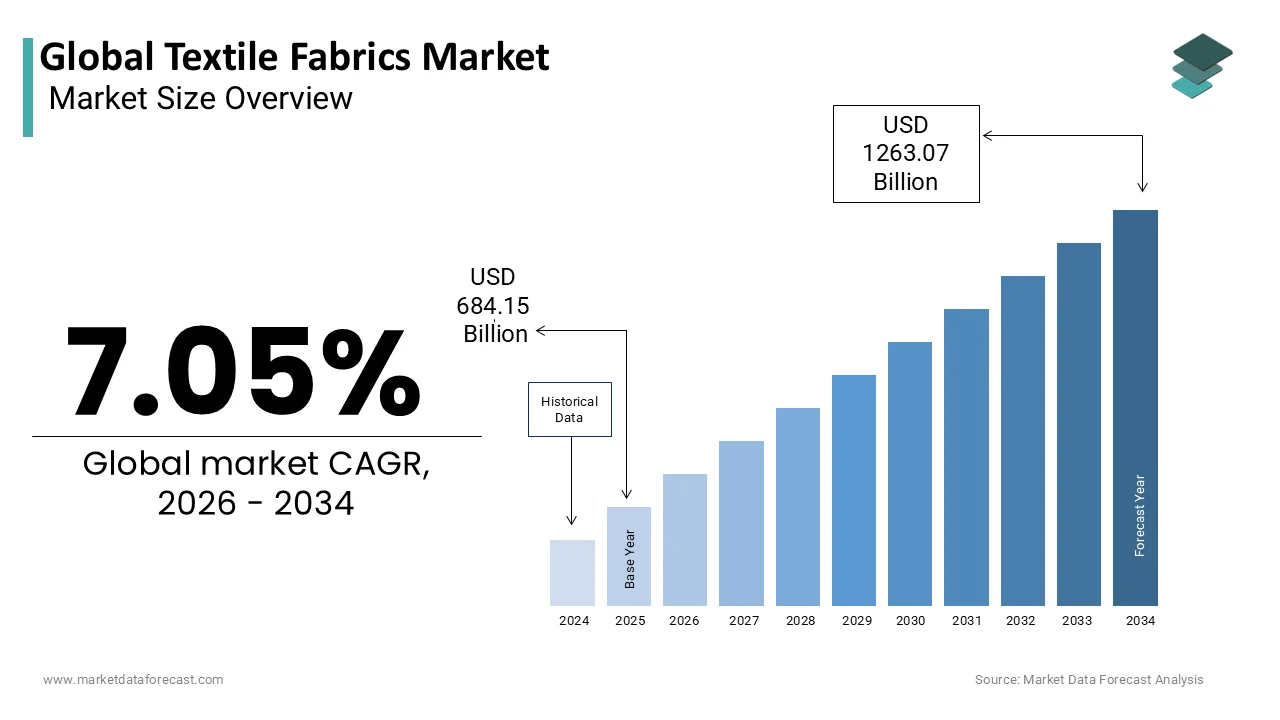
The textile fabrics market encompasses the production and distribution of flexible, engineered materials derived from natural, synthetic, or blended fibers used in apparel, home textiles, industrial applications, and technical textiles. Moreover, many millions of metric tons of fiber were produced globally in 2023, with cotton, polyester, and viscose making up the largest shares. Also, the global apparel and textile sector employs hundreds of millions of people across its value chain, making it one of the most labor-intensive industries. According to the United Nations Environment Programme, the average consumer now purchases 60% more clothing than in 2000, yet keeps each garment for half as long, intensifying demand for fabrics and amplifying environmental concerns. Furthermore, in countries such as Bangladesh and Vietnam, textile manufacturing represents a major share of industrial exports, underscoring its economic importance.
MARKET DRIVERS
Rising Global Apparel Production and Fast Fashion Expansion
The proliferation of fast fashion brands has dramatically accelerated garment turnover, fueling sustained demand for textile fabrics. Like, Global apparel production has reached very high volumes, with fast fashion representing a substantial portion of output. Zara, H&M, and Shein release up to 24 collections per year, compared to the traditional two, necessitating rapid fabric procurement and just-in-time manufacturing. Also, Bangladesh, as a leading garment exporter, continues to import large volumes of fabric annually to meet the requirements of international buyers. Additionally, synthetic fabrics, particularly polyester, account for a large share of global fiber production due to their affordability and durability. This hyper-speed production model ensures continuous pressure on textile suppliers to deliver high volumes at competitive prices and short lead times.
Increasing Demand for Technical and Performance Textiles
The expansion of technical textiles, engineered for functional properties such as moisture-wicking, flame resistance, and antimicrobial protection, is reshaping fabric demand across healthcare, automotive, and protective gear sectors. Also, technical textiles represent a rapidly growing segment, with global consumption rising steadily each year. Moreover, hundreds of millions of surgical gowns and vast quantities of face masks were used globally in 2022, many made from nonwoven polypropylene. The European Automobile Manufacturers Association highlights that the average car now contains over 40 kilograms of technical textiles, used in airbags, seatbelts, and insulation. Additionally, NASA and private space firms are adopting high-strength aramid and carbon fiber fabrics for space suits and habitat structures. These specialized applications command premium pricing and drive innovation in fiber engineering and fabric finishing technologies.
MARKET RESTRAINTS
Environmental Degradation from Synthetic Fiber Production and Dyeing Processes
The textile industry is a major contributor to water pollution and greenhouse gas emissions, particularly through synthetic fiber manufacturing and wet processing. Textile dyeing and finishing are recognized as major contributors to industrial water pollution, accounting for a significant share of wastewater discharge worldwide. In addition, polyester production contributes substantially to global greenhouse gas emissions, making it one of the most carbon-intensive fibers in the textile industry. Also, major textile clusters in India, such as Tiruppur and Ludhiana, have faced challenges with untreated effluent discharge, putting pressure on local water resources. Additionally, microfiber shedding from synthetic fabrics contributes to 35% of oceanic microplastic pollution, as per the International Union for Conservation of Nature. These environmental costs are triggering regulatory scrutiny and consumer backlash, constraining unsustainable production models.
Volatility in Raw Material Prices, Particularly Cotton and Petrochemicals
Textile fabric manufacturers face significant cost instability due to fluctuations in the prices of key inputs such as cotton and crude oil-derived synthetics. Cotton prices have shown sharp increases during periods of supply disruption, particularly when weather conditions and logistics issues constrain production in major producing countries. Also, Cotton remains one of the most widely used natural fibers, representing a sizable share of global fiber production. Simultaneously, Prices of polyester feedstocks like PTA are closely linked to crude oil trends, creating volatility for synthetic fiber manufacturers. These input cost swings compress manufacturer margins, particularly for mid-tier producers without hedging capabilities, and complicate long-term pricing strategies for downstream brands and retailers.
MARKET OPPORTUNITIES
Adoption of Recycled and Bio-Based Fibers in Sustainable Textiles
The shift toward circularity is driving innovation in recycled and renewable fiber technologies. According to the Ellen MacArthur Foundation, only 1% of clothing is recycled into new garments, but this is changing with advancements in mechanical and chemical recycling. Also, Recycled polyester output has been growing strongly in Europe, supported by brand commitments and consumer demand for sustainable apparel. In India, the Council of Scientific and Industrial Research has developed man-made cellulose fiber from agricultural residues, reducing reliance on wood pulp. Bio-based nylon, derived from renewable sources like castor oil, represents a niche but growing share of the specialty fiber market. As the EU prepares to enforce mandatory recycled content rules by 2030, the integration of sustainable fibers is becoming a strategic imperative and a market differentiator.
Integration of Smart Textiles and Wearable Technology
The convergence of textiles with electronics and IoT is unlocking new applications in health monitoring, defense, and adaptive clothing. Moreover, the smart clothing and wearable textiles business is expanding quickly, fueled by advancements in conductive fabrics, embedded sensors, and IoT integration. In healthcare, the Mayo Clinic has tested smart garments with textile-based ECG sensors that monitor cardiac activity in real time, improving remote patient care. Defense organizations are exploring adaptive fabrics that regulate body temperature and improve endurance in challenging environments. Additionally, companies like Google and Levi Strauss have collaborated on Project Jacquard to weave touch-sensitive threads into denim jackets for device control. As miniaturization and washable electronics advance, smart textiles are transitioning from niche prototypes to scalable commercial products, creating high-growth opportunities in performance and medical fabrics.
MARKET CHALLENGES
Labor Rights and Ethical Sourcing Concerns in Global Supply Chains
The textile industry continues to face scrutiny over exploitative labor practices, particularly in low-cost manufacturing hubs. According to the International Labour Organization, over 170 million children are engaged in child labor globally, with textile and garment production identified as a high-risk sector in countries like Pakistan and Uzbekistan. Also, in major sourcing countries, wages for garment workers often remain well below living wage benchmarks, despite rising global demand. The Uyghur Forced Labor Prevention Act in the United States has blocked billions of dollars in textile imports from Xinjiang, citing forced labor risks, as documented by the U.S. Customs and Border Protection. These ethical concerns are prompting brands to invest in blockchain traceability and third-party audits, but supply chain opacity and subcontracting networks remain significant obstacles to full transparency.
Rapid Technological Obsolescence and Innovation Pressure
Textile manufacturers are under increasing pressure to adopt digital and automation technologies to remain competitive, yet many lack the capital or expertise for transformation. Moreover, the adoption of advanced digital manufacturing technologies in textiles remains limited in many emerging markets. Also, technologies such as digital textile printing can greatly reduce resource use and speed up production, but uptake has been slow due to cost barriers. Additionally, the pace of material innovation, such as self-cleaning, UV-protective, or phase-change fabrics, requires continuous R&D investment. The commercial life of new textile technologies is shortening, forcing firms to innovate faster to avoid obsolescence.
REPORT COVERAGE
| REPORT METRIC | DETAILS |
| Market Size Available | 2025 to 2034 |
| Base Year | 2025 |
| Forecast Period | 2026 to 2034 |
| Segments Covered | ByFabrics Type, Application, and Region. |
| Various Analyses Covered | Global, Regional, and Country-Level Analysis, Segment-Level Analysis, Drivers, Restraints, Opportunities, Challenges; PESTLE Analysis; Porter’s Five Forces Analysis, Competitive Landscape, Analyst Overview of Investment Opportunities |
| Region Covered | North America, Europe, Asia-Pacific, Latin America, the Middle East and Africa |
| Market Leaders Profiled | Wolfin Textiles Ltd, Bombay Rayon Fashions Limited, Premier Textiles Limited, Toray Textiles Europe Limited, Arvind Limited (India), Klopman International, Whaleys (Bradford) LTD, Weiqiao Textile Company Limited, Reliance Industries Limited, Shahlon Group, and Others. |
SEGMENTAL ANALYSIS
By Fabrics Type Insights
The polyester segment dominated the global textile fabrics market with a 54.1% share by volume in 2025. This lead position is anchored in its cost-effectiveness, durability, and versatility across apparel and industrial applications. Also, Global polyester production runs into tens of millions of metric tons annually, reflecting its central role in both fast fashion and technical textiles. Further, polyester is heavily used in sportswear and outerwear due to its moisture-wicking and shape-retention properties, making it a dominant choice in performance fabrics. Like, in India, polyester blends account for a significant portion of synthetic textile use, valued for wrinkle resistance and ease of maintenance. Additionally, the scalability of petrochemical-based production ensures a consistent supply, reinforcing polyester’s dominance despite environmental concerns.
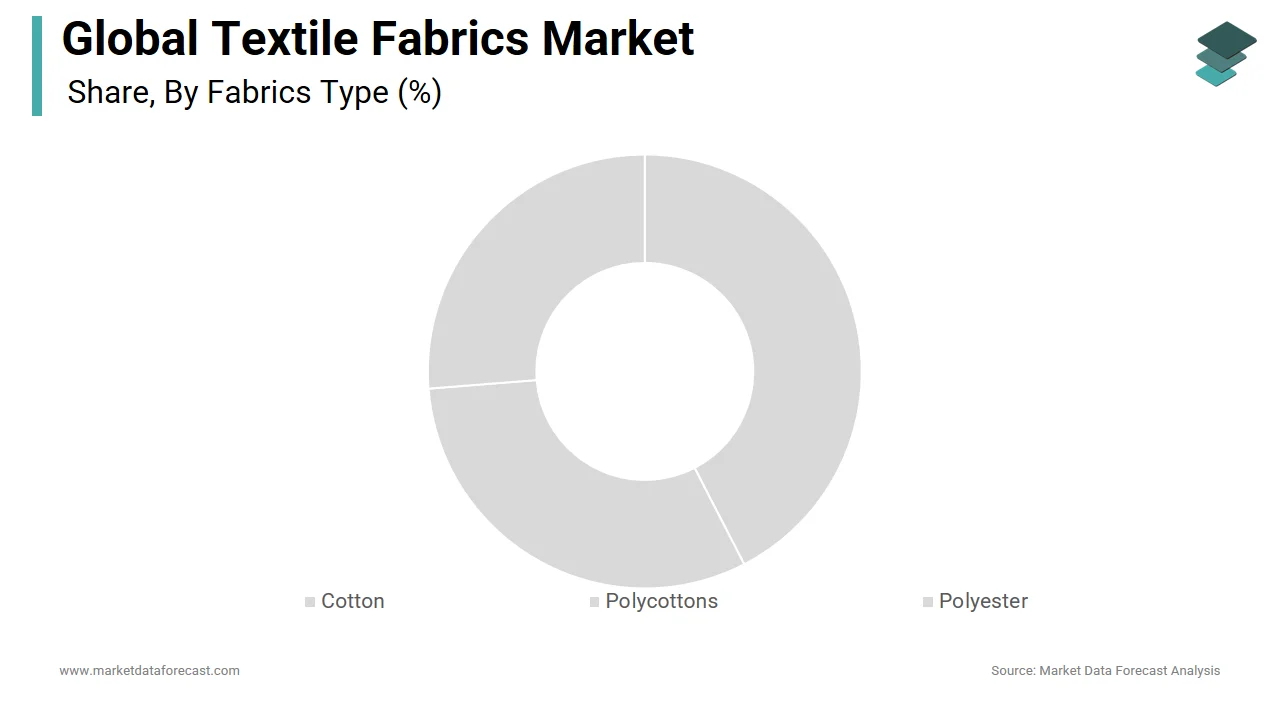
The cotton segment is expanding at a CAGR of 7.1% from 2025 to 2033. This is due to rising consumer preference for natural, breathable, and biodegradable materials. In addition, Global cotton demand has been rising steadily, with sustainability concerns pushing many consumers and brands to favor natural over synthetic options. Moreover, in advanced markets, a growing share of consumers expresses a preference for natural fibers over synthetics due to environmental and microplastic concerns. Also, markets like Japan are showing increased demand for organic cotton, supported by incentives for sustainable textile adoption. Besides, advancements in water-efficient farming and BCI (Better Cotton Initiative) certification have improved cotton’s environmental profile, making it a preferred choice for eco-conscious brands and retailers seeking to align with circular economy principles.
By Application Insights
The T-shirt segment commanded the market with a 35.1% share of the global woven and knitted apparel fabric demand in 2025. This dominance is due to the garment’s universal appeal, affordability, and role as a staple in casual wardrobes across age groups and geographies. In developed markets, per capita T-shirt purchases remain high, reflecting their role as staple casualwear. Also, t-shirts account for a large portion of garment exports from leading manufacturing hubs such as Bangladesh. Moreover, Billions of T-shirts are sold worldwide each year, making it one of the most frequently purchased and replaced clothing items. Their use in branding, activism, and promotional campaigns further amplifies demand, sustaining fabric procurement at scale.
The performance wear segment is growing at a CAGR of 9.6% from 2025 to 2033. It is driven by increasing demand for functional apparel in fitness, medical, and occupational settings. Also, performance textiles represent a large and fast-expanding global market, spanning athletic, medical, and protective uses. Increasing participation in fitness and active lifestyles is fueling higher demand for performance-focused fabrics. Governments and industry players are investing heavily in smart and functional textile R&D, especially in technologically advanced markets. Additionally, the European Agency for Safety and Health at Work mandates flame-resistant and high-visibility fabrics for industrial workers, expanding use beyond sport. As health consciousness and workplace safety standards rise, performance wear is becoming a high-value, innovation-driven segment.
REGIONAL ANALYSIS
Asia Pacific Textile Fabrics Market Insights
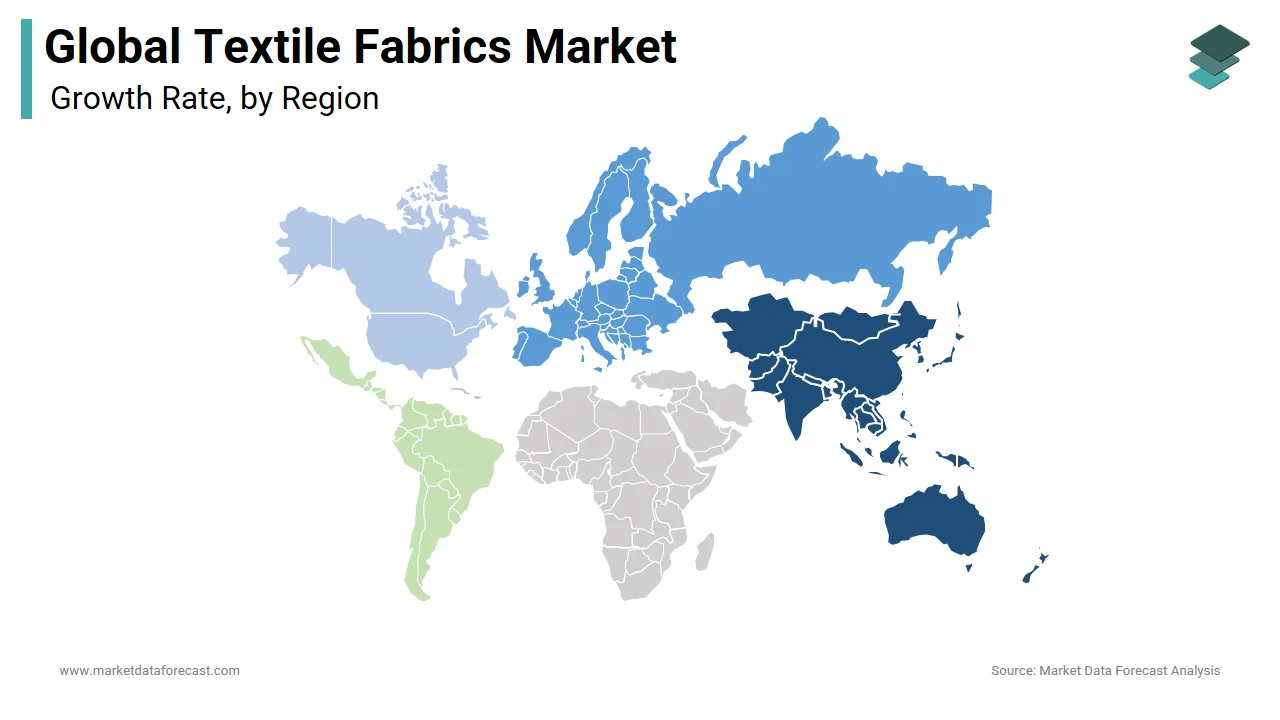
Asia Pacific held a dominant share of the global textile fabrics market, functioning as the epicenter of production, innovation, and rising domestic demand. China and India are the largest producers, collectively accounting for a significant portion of global fiber output. The region hosts integrated supply chains, from spinning and weaving to dyeing and garment assembly, enabling rapid turnaround for global brands. Textile exports from Southeast Asia have been growing, led by countries such as Vietnam and Indonesia. Domestic consumption is also accelerating; per capita fabric consumption in India has been rising steadily in recent years. With government initiatives like India’s Production Linked Incentive (PLI) scheme, the region is modernizing infrastructure and attracting foreign investment, reinforcing its leadership in both volume and value.
Europe Textile Fabrics Market Insights
Europe is a mature textile fabrics market, distinguished by high regulatory standards, premium branding, and leadership in sustainable textiles. Also, many textile companies in Europe have adopted eco-certified dyes and chemicals to comply with sustainability standards. Germany, Italy, and France are key innovation centers, with Italian mills recognized as major producers of luxury fabrics worldwide. The European Commission’s Circular Economy Action Plan mandates that all textiles placed on the EU market by 2030 must be recyclable and contain recycled content. Also, second-hand clothing sales in Europe grew, reshaping fabric demand. With strong consumer awareness and investment in digital printing and biodegradable fibers, Europe remains a trendsetter in ethical and high-performance textile development.
North America Textile Fabrics Market Insights
North America is a smaller share but a significantly high-value market and is characterized by premium pricing, brand-driven demand, and a resurgence in domestic manufacturing. The U.S. continues to import large volumes of textiles and apparel each year, but domestic production of technical and performance fabricshas grownw due to reshoring initiatives. Also, the U.S. is a leading producer of high-performance fibers used in specialized applications. Additionally, the rise of on-demand manufacturing and digital printing has reduced waste and lead times, with companies like Unifi investing in closed-loop recycling systems. Canada notes an increase in sustainable fabric adoption in 2023. While volume is modest, North America leads in innovation, regulatory influence, and integration of smart textiles into mainstream applications.
Latin America Textile Fabrics Market Insights
Latin America is a smaller share of global production, with Brazil, Mexico, and Colombia serving as primary production and export hubs. Brazil is among the largest textile producers in the region, with a strong base in cotton and denim fabrics. As per the Inter-American Development Bank, nearshoring by U.S. brands has increased textile investment in Central America, particularly in Honduras and Guatemala, due to proximity and trade agreements. Technical textile production has been growing in Chile, particularly for industrial applications such as mining and agriculture. However, limited downstream processing and reliance on imported synthetic fibers constrain full vertical integration. Despite challenges, rising regional trade under the Pacific Alliance and Mercosur frameworks is fostering cross-border collaboration and modernization of dyeing and finishing infrastructure.
Middle East & Africa Textile Fabrics Market Insights
Middle East & Africa exhibit growing strategic importance due to import dependency, urbanization, and government-led industrialization. The Gulf region relies heavily on imports to meet its textile fabric demand. Saudi Arabia is investing heavily in building local textile manufacturing capacity under national development programs. South Africa remains one of the largest textile producers in the region, though capacity utilization is limited. The United Nations Economic Commission for Africa highlights that fast-growing urban populations in Nigeria and Kenya are increasing demand for affordable apparel, creating opportunities for localized production. With rising investments in fiber recycling and vocational training, the region is laying the foundation for future self-sufficiency.
KEY MARKET PLAYERS
Noteworthy Companies dominating the Global textile fabrics market profiled in the report are Wolfin Textiles Ltd, Bombay Rayon Fashions Limited, Premier Textiles Limited, Toray Textiles Europe Limited, Arvind Limited (India), Klopman International, Whaleys (Bradford) LTD, Weiqiao Textile Company Limited, Reliance Industries Limited, Shahlon Group, and Others.
TOP LEADING PLAYERS IN THE MARKET
Toray Industries, Inc.
Toray Industries has established itself as a global leader in synthetic and performance textile innovation, with a significant footprint across the Asia Pacific region. The company has deepened its presence in Japan, China, and Southeast Asia through advanced R&D centers focused on high-strength, lightweight fabrics for sportswear, automotive, and medical applications. The company also expanded its carbon fiber-reinforced textile production in Thailand to support regional aerospace and EV manufacturing. Additionally, Toray introduced a bio-based polyester using plant-derived ethanol in India, aligning with sustainability mandates. By integrating material science with circular design principles, Toray is shaping the future of functional textiles in one of the world’s most dynamic manufacturing regions.
Indorama Ventures (Thailand)
Indorama Ventures, a global polyester and fiber producer headquartered in Thailand, plays a pivotal role in supplying sustainable synthetic fabrics acrossthe Asia Pacific. The company operates integrated production facilities in Indonesia, Vietnam, and India, enabling cost-efficient delivery to garment manufacturers in fast-fashion supply chains. The company also invested in chemical recycling technology at its PET facility in Rayong, Thailand, aiming to achieve 100% recyclability by 2030. In 2025, it collaborated with the Vietnam Textile and Apparel Association to promote circular economy practices among SMEs. By advancing closed-loop manufacturing and reducing carbon intensity, Indorama is reinforcing its leadership in eco-responsible synthetic fiber production and supporting regional decarbonization goals.
Luthra Group (India)
Luthra Group has emerged as a key enabler of high-performance and technical textiles in India, with growing influence across South and Southeast Asia. Specializing in specialty finishing and functional coatings, the company supplies antimicrobial, flame-retardant, and UV-protective fabrics to healthcare, defense, and outdoor apparel sectors. The company also partnered with the Indian Institute of Technology Delhi to create smart textiles embedded with temperature-sensing nanofibers for medical monitoring. In 2025, Luthra inaugurated a new technical textile park in Gujarat, supported by India’s Production Linked Incentive (PLI) scheme, to boost domestic manufacturing capacity. By aligning with national industrial policies and advancing R&D in performance fabrics, Luthra is positioning India as a competitive hub for high-value textile innovation.
TOP STRATEGIES USED BY KEY MARKET PARTICIPANTS
Key players in the textile fabrics market are leveraging vertical integration, sustainable innovation, and digital transformation to strengthen their competitive positioning. Companies are investing in closed-loop recycling systems and bio-based fibers to meet tightening environmental regulations and consumer demand for eco-friendly materials. Strategic partnerships with fashion brands and technology firms are enabling the development of smart textiles with embedded sensors and conductive threads. Firms are expanding production in the Asia Pacific through localized manufacturing hubs to reduce lead times and comply with regional trade policies. Digitalization of design and production via 3D knitting, AI-driven quality control, and blockchain traceability is improving efficiency and transparency. Additionally, participants are focusing on technical and performance fabrics to capture high-margin segments in healthcare, defense, and sportswear, shifting away from commoditized apparel textiles.
COMPETITION OVERVIEW
The competitive landscape of the textile fabrics market is characterized by a growing divide between commodity-driven producers and innovation-focused enterprises. While price and scale remain critical in mass apparel segments, differentiation is increasingly achieved through sustainability, functionality, and technological integration. In the Asia Pacific, competition is intensifying as local manufacturers upgrade facilities to meet global ESG standards and reduce reliance on imported synthetics. Japanese and European firms lead in high-performance and luxury fabrics, while Chinese and Indian players are rapidly advancing in technical textiles and circular production. The absence of uniform global regulations allows for varied strategic approaches, but long-term leadership will depend on the ability to balance cost efficiency with environmental responsibility, digital agility, and responsiveness to evolving consumer and industrial demands across diverse end-use sectors.
RECENT MARKET DEVELOPMENTS
- In January 2023, Indorama Ventures commissioned a chemical recycling plant in Indonesia capable of processing 50,000 metric tons of post-consumer PET waste annually into food-grade rPET, strengthening its circular economy footprint in the ASEAN region.
MARKET SEGMENTATION
This Global textile fabrics market research report is segmented and sub-segmented into the following categories.
By Fabrics Type
- Cotton
- Polycottons
- Polyester
By Application
-
- T-shirts
- Sportswear
- Outdoor Clothing
- Performance Wear
By Country
- North America
- Europe
- Asia-Pacific
- Middle East Africa
- Latin America