- Product Description Description
- Table of Contents TOC
- List of Table & Figure LOT
- Get Free Sample PDF Sample PDF
Market Size, 2025
$2.99 BnMarket Estimate, 2026
$3.11 BnMarket Forecast, 2034
$4.32 BnCAGR, 2026–2034
4.18%UK Printer Market Size, Growth, Trends & Forecast (2026–2034)
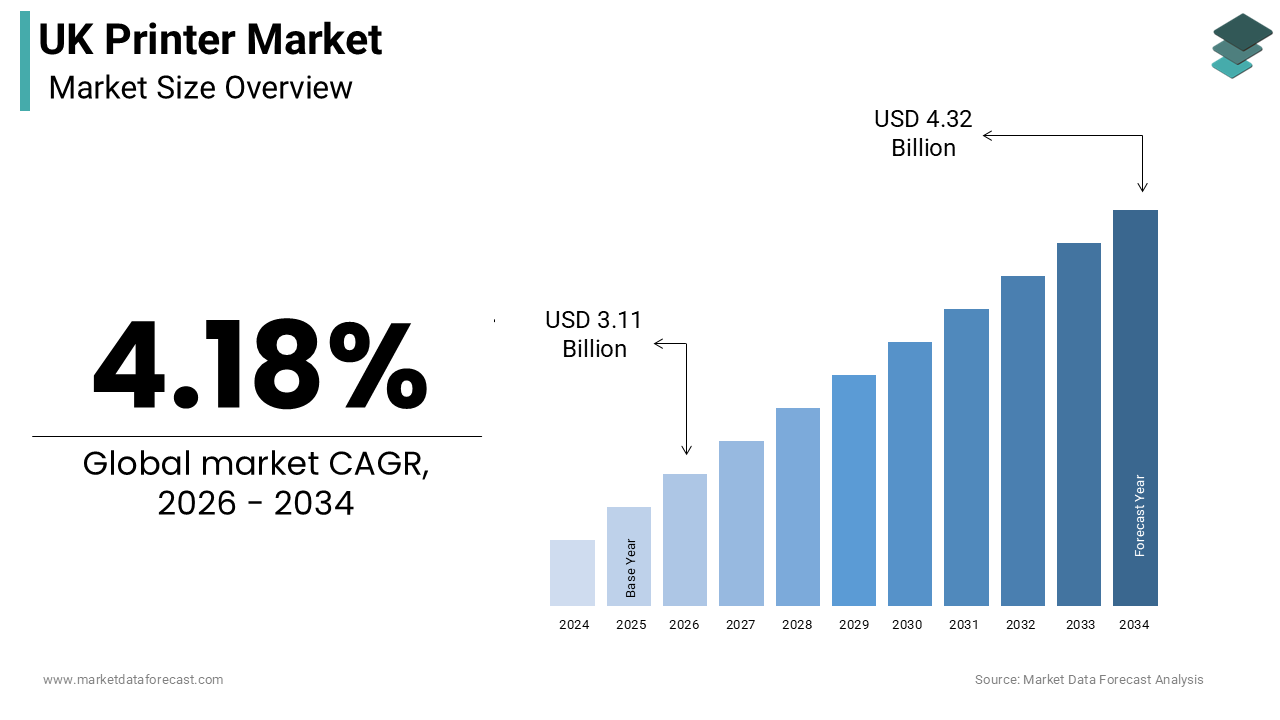
The UK printer market size was valued at USD 2.99 billion in 2025, reached USD 3.11 billion in 2026, and is projected to reach USD 4.32 billion by 2034, growing at a compound annual growth rate (CAGR) of 4.18% from 2026 to 2034. Propelled by the entrenchment of hybrid work models, e-commerce logistics documentation needs, and the expansion of managed print services, the market demonstrates steady demand across commercial and residential sectors.
Key Executive Metrics (At-a-Glance)
- 2025 Base Valuation: USD 2.99 Billion
- 2026 Current Valuation: USD 3.11 Billion
- 2034 Forecast Valuation: USD 4.32 Billion
- Compound Annual Growth Rate (CAGR): 4.18% (2026–2034)
- Largest Type Segment: Laser Printers (Dominant share in 2025 due to speed, reliability, and cost-per-page efficiency in business environments)
- Fastest-Growing Type Segment: Inkjet Printers (Projected at a CAGR of 6.4% driven by refillable ink tank systems and photo/creative printing)
- Largest Technology Segment: Server-Based Printing Infrastructure (Held largest share in 2025 for enterprise security and centralized management)
- Fastest-Growing Technology Segment: Cloud and Serverless Printing Solutions (Projected at a leading CAGR of 9.1% driven by hybrid work flexibility)
- Largest Application Segment: Commercial and Enterprise (Held leading share in 2025 via legal, administrative, and e-commerce logistics workflows)
- Fastest-Growing Application Segment: Residential and Home Office (Projected at a CAGR of 7.4% fueled by ongoing remote work and domestic printing needs)
- Regional Standing: United Kingdom (Held the highest share of the European printer market in 2025)
Core Market Drivers & Growth Triggers
- Hybrid Work & Home Offices: Permanent remote and hybrid work arrangements requiring reliable, secure multi-function printing equipment in residential spaces.
- E-Commerce & Logistics: Exponential growth in online retail and parcel delivery generating massive demand for thermal and laser labels, shipping manifests, and return documents.
Primary Market Restraints & Challenges
- Digital Transformation: Accelerated paperless initiatives, cloud storage adoption, and government digital-first strategies reducing overall print volumes.
- Environmental Regulations: Strict waste regulations, Extended Producer Responsibility (EPR) mandates, and electronic waste concerns imposing higher operational hurdles.
UK Printer Market Segmentation Breakdown
| Segment Category | Largest Segment Focus | Fastest-Growing Segment Focus |
|---|---|---|
| By Type | Laser Printers (Dominant share in 2025 via high-speed, high-volume office performance) | Inkjet Printers (CAGR of 6.4% driven by tank-based affordability and creative media printing) |
| By Technology | Server-Based Printing (Dominant share in 2025 for secure, centralized enterprise management) | Cloud and Serverless Printing (CAGR of 9.1% driven by mobile flexibility and remote access needs) |
| By Application | Commercial and Enterprise (Leading share in 2025 supported by SME and logistics documentation) | Residential and Home Office (CAGR of 7.4% fueled by home schooling, remote work, and creative projects) |
Major Industry Players Profiled
Key corporations shaping the UK printer market include HP Inc., Canon Inc., Epson Europe B.V., Brother Industries, Ltd., Xerox Holdings Corporation, Lexmark International, Inc., Ricoh Company, Ltd., Konica Minolta, Inc., Kyocera Document Solutions Inc., Sharp Corporation, Toshiba Tec Corporation, OKI Electric Industry Co., Ltd., Dell Technologies Inc., Samsung Electronics Co., Ltd., and Zebra Technologies Corporation.
UK Printer Market Size
The UK printer market size was valued at USD 2.99 billion in 2025, and is projected to reach USD 4.32 billion by 2034 from USD 3.11 billion in 2026, growing at a CAGR of 4.18%.
According to the House of Commons Library, there are approximately 5.7 million small and medium-sized enterprises in the UK, many of which rely on physical documentation for legal compliance, invoicing, and logistical operations despite digital transformation efforts. As per data from the Department for Business and Trade, the creative industries contribute over 124 billion pounds annually to the economy, driving demand for high-quality, large-format, and specialty printing solutions for marketing materials and design prototypes. The cultural persistence of paper-based workflows in sectors such as healthcare, law, and education ensures steady consumption of printing resources. Regulatory frameworks governed by the Environment Agency enforce strict standards on electronic waste and toner cartridge recycling, influencing product design and end-of-life management strategies. Consumer behavior is increasingly guided by total cost of ownership considerations rather than upfront device prices, prompting manufacturers to innovate in connectivity, security, and energy efficiency. The market operates at the intersection of legacy infrastructure requirements and modern cloud-integrated workflows, reflecting a hybrid approach to information management in a digitally advanced nation.
MARKET DRIVERS
Resilience of Hybrid Work Models and Home Office Infrastructure
The entrenchment of hybrid work arrangements in the UK is primarily fuelling the expansion of the UK printer market, as professionals require reliable home office equipment to manage physical documents securely and efficiently. While remote work reduced overall office printing volumes, it shifted demand toward compact, high-performance multifunction devices capable of handling scanning, copying, and printing tasks within residential spaces. According to the Office for National Statistics, approximately 16% of workers in the UK continue to work from home some or all of the time, creating a sustained need for personal printing solutions that offer enterprise-grade security and connectivity. According to the data from YouGov, 40% of remote workers prefer having a dedicated printer at home to handle sensitive contracts, tax documents, and educational materials without relying on public or shared facilities. The rise of homeschooling and online education further amplifies this demand, with families requiring regular printing of worksheets, assignments, and study guides. Manufacturers have responded by developing user-friendly devices with mobile printing capabilities and automated ink delivery systems that reduce maintenance burdens for non-technical users. The necessity for tangible records in legal, financial, and administrative processes ensures that printing remains an essential function, even in highly digitized workflows. This structural change in work dynamics has created a stable secondary market for home office printers that complements, rather than replaces, corporate infrastructure.
Growth of E-Commerce and Logistics Documentation Needs
The exponential growth of the e-commerce sector in the UK is further boosting the printer market expansion in the UK, particularly for labeling, shipping manifests, and return documentation. As online retail expands, businesses require robust, high-volume printing systems to generate barcodes, address labels, and packing slips efficiently to meet consumer expectations for rapid delivery. According to the Office for National Statistics, online sales accounted for 27% of total retail trade in early 2024, necessitating sophisticated logistics operations supported by thermal and laser printing technologies. Data from the British Retail Consortium highlights that the average number of parcels delivered daily in the UK exceeds 5 million, each requiring accurate and durable printed labels for tracking and identification. Small and medium-sized enterprises selling through platforms like Amazon and eBay invest in specialized label printers to streamline their fulfillment processes and reduce errors. The complexity of international trade post-Brexit has also increased the volume of customs declarations and commercial invoices that must be physically attached to shipments. This operational requirement ensures consistent demand for reliable printing hardware and consumables in the logistics and warehousing sectors. Furthermore, the rise of reverse logistics due to high return rates in fashion retail generates additional printing needs for return labels and documentation, reinforcing the critical role of printers in the supply chain ecosystem.
MARKET RESTRAINTS
Accelerated Digital Transformation and Paperless Initiatives
The Widespread adoption of digital documentation and paperless workflows is impeding the UK printer market growth, as organizations actively seek to reduce reliance on physical media to improve efficiency and sustainability. Cloud-based storage, electronic signature platforms, and collaborative software tools have replaced many traditional printing tasks, such as contract signing, report distribution, and internal memos. According to the Department for Science, Innovation and Technology, the UK government’s digital strategy aims to make public services fully digital by default, reducing the need for printed forms and correspondence in the public sector. Data from Deloitte indicates that 65% of UK businesses have implemented paperless policies to lower operational costs and minimize their environmental footprint, leading to a decline in overall print volumes. Educational institutions are increasingly adopting digital textbooks and online assessment tools, further reducing the demand for classroom printing. The convenience of accessing information on mobile devices and tablets has changed consumer behavior, making physical copies less necessary for everyday reading and reference. This cultural and operational shift toward digital-first practices erodes the fundamental use case for printers, particularly in knowledge-intensive industries. As software solutions become more sophisticated and secure, the economic and functional arguments for maintaining extensive printing infrastructure weaken, constraining market growth and forcing manufacturers to pivot toward niche applications.
Environmental Regulations and Sustainability Concerns
Stringent environmental regulations and growing consumer awareness regarding the ecological impact of printing practices impose significant constraints on the UK printer market. The production, disposal, and recycling of printers, ink cartridges, and toner involve hazardous materials and substantial energy consumption, attracting scrutiny from regulators and environmentally conscious buyers. According to the Environment Agency, the UK generates hundreds of thousands of tonnes of electrical waste annually, with printing equipment contributing significantly to this burden due to short product lifecycles and complex components. Data from the Waste and Resources Action Programme reveals that only a fraction of ink cartridges are properly recycled, with many ending up in landfills where they release toxic substances into the soil and water. The Extended Producer Responsibility regulations require manufacturers to cover the costs of collecting and recycling their products, increasing operational expenses and complicating supply chain management. Consumers are increasingly opting for digital alternatives to avoid the guilt associated with paper waste and plastic pollution from cartridge packaging. Corporate sustainability goals often include targets for reducing paper usage and carbon emissions, directly limiting procurement budgets for new printing hardware. These regulatory and social pressures force companies to invest heavily in eco-friendly designs and take-back schemes, which may not fully offset the negative perception of printing as an unsustainable practice, thereby restraining market expansion.
MARKET OPPORTUNITIES
Expansion of Managed Print Services and Subscription Models
The transition from traditional hardware sales to Managed Print Services (MPS) and subscription-based consumption models offers a substantial opportunity for market participants to generate recurring revenue and deepen customer relationships. Businesses are increasingly seeking predictable costs and outsourced management of their printing infrastructure to reduce IT burdens and optimize resource usage. According to the Federation of Small Businesses, over 50% of UK SMEs outsource non-core functions, including IT and facility management, creating a fertile ground for MPS providers who offer comprehensive solutions, including maintenance, supplies, and monitoring. Data from industry analysts suggests that the MPS market in the UK is growing at a faster rate than hardware sales, as companies prioritize operational efficiency over asset ownership. Subscription models, such as HP Instant Ink and Epson EcoTank, allow consumers and businesses to pay for page volume rather than expensive cartridges, enhancing affordability and convenience. These services leverage Internet of Things (IoT) sensors to predict supply needs and automate replenishment, reducing downtime and waste. Providers can upsell value-added services, such as document security, workflow automation, and analytics, helping clients transform their print environments into strategic assets. By focusing on service delivery and customer experience, manufacturers can differentiate themselves in a saturated hardware market and build long-term loyalty through continuous engagement and support.
Integration of Advanced Security Features In Connected Devices
The integration of advanced cybersecurity features into networked printers offers a significant opportunity for manufacturers to address growing concerns about data privacy and intellectual property protection in the workplace. As printers become intelligent IoT devices connected to corporate networks, they represent potential entry points for cyberattacks, making security a critical purchasing criterion for enterprises. According to the National Cyber Security Centre, peripheral devices, including printers, are frequently targeted by hackers due to often overlooked vulnerabilities and default passwords. Data from the Ponemon Institute indicates that 60% of UK organizations have experienced a security breach involving a printer or multifunction device, highlighting the urgent need for hardened firmware and encryption protocols. Manufacturers can capitalize on this fear by developing devices with built-in threat detection, secure boot mechanisms, and automatic patching capabilities that comply with strict data protection regulations such as GDPR. Offering certified secure printing solutions allows vendors to command premium prices and win contracts in sensitive sectors such as finance, healthcare, and government. Partnerships with cybersecurity firms to provide holistic endpoint protection further enhance value propositions. By positioning printers as secure nodes in the digital infrastructure rather than just output devices, manufacturers can tap into the expanding cybersecurity budget allocations of UK businesses and differentiate their offerings in a competitive landscape.
MARKET CHALLENGES
Supply Chain Volatility and Component Shortages
The UK printer market faces persistent challenges related to global supply chain instability and shortages of critical electronic components, such as semiconductors and display panels. These disruptions affect the manufacturing timelines and availability of printers, leading to stockouts and delayed deliveries that frustrate customers and damage brand reputation. According to the Semiconductor Industry Association, lead times for certain chips used in printer controllers and connectivity modules have remained extended, causing production bottlenecks for major manufacturers. Data from the British Chambers of Commerce highlights that 40% of UK technology firms reported supply chain issues as a major barrier to growth in the past year, impacting their ability to fulfill orders. The reliance on Asian manufacturing hubs makes the market vulnerable to geopolitical tensions, trade restrictions, and logistical congestion. Rising freight costs and raw material prices further squeeze profit margins, forcing companies to increase retail prices, which may dampen demand in a price-sensitive environment. Manufacturers struggle to forecast demand accurately amidst these uncertainties, leading to inefficient inventory management and increased working capital requirements. Diversifying supply sources is a long-term strategy that requires significant investment and time, leaving companies exposed in the interim. This volatility complicates strategic planning and threatens the reliability of service level agreements, particularly for managed print service providers who depend on consistent hardware availability.
Intense Competition from Alternative Communication Channels
The printer market in the UK contends with intense competition from alternative communication and documentation channels that offer faster, cheaper, and more sustainable ways to share information. Digital signage, email marketing, social media, and cloud collaboration tools have largely replaced the need for printed newsletters, brochures, and internal reports in many organizational contexts. According to Ofcom, the average UK adult spends over 4 hours daily on digital media, indicating a profound shift in attention and information consumption habits away from physical formats. Data from the Royal Mail shows that letter volumes have declined significantly over the past decade, as businesses and individuals switch to electronic billing and communication methods. The immediacy and interactivity of digital content make it more attractive for marketing campaigns, where real-time analytics and audience engagement are prioritized over static print materials. In the education sector, learning management systems and interactive whiteboards reduce the need for handouts and textbooks. This structural displacement of print by digital alternatives erodes the total addressable market for printers, forcing manufacturers to compete for a shrinking pool of essential use cases. Adapting to this reality requires innovation in niche areas, such as photo printing, packaging, and secure document handling, but the overall trend poses a formidable challenge to long-term volume growth.
REPORT COVERAGE
| REPORT METRIC | DETAILS |
| Market Size Available | 2025 to 2034 |
| Base Year | 2025 |
| Forecast Period | 2026 to 2034 |
| CAGR | 4.18% |
| Segments Covered | By Type, Technology, Application, and Region. |
| Various Analyses Covered | Global, Regional and Country-Level Analysis, Segment-Level Analysis, Drivers, Restraints, Opportunities, Challenges; PESTLE Analysis; Porter’s Five Forces Analysis, Competitive Landscape, Analyst Overview of Investment Opportunities |
| Market Leaders Profiled | HP Inc., Canon Inc., Epson Europe B.V., Brother Industries, Ltd., Xerox Holdings Corporation, Lexmark International, Inc., Ricoh Company, Ltd., Konica Minolta, Inc., Kyocera Document Solutions Inc., Sharp Corporation, Toshiba Tec Corporation, OKI Electric Industry Co., Ltd., Dell Technologies Inc., Samsung Electronics Co., Ltd., Zebra Technologies Corporation |
SEGMENTAL ANALYSIS
By Type Insights
The laser printers segment dominated the market by holding the highest share of the UK market in 2025 due to their superior speed, reliability, and lower cost per page, which are critical for high-volume business and office environments. These devices utilize toner powder and heat to fuse images onto paper, resulting in sharp text quality and resistance to smudging, which is essential for professional documents and legal contracts. According to the British Chambers of Commerce, small and medium-sized enterprises account for 99% of all UK businesses, many of which prioritize operational efficiency and minimal downtime in their document workflows. Data from industry procurement studies indicates that laser printers can produce up to 30 pages per minute, significantly faster than most consumer inkjet models, making them ideal for busy office settings. The longevity of laser toner cartridges means less frequent replacements, reducing maintenance interruptions and total cost of ownership over the device's lifespan. Furthermore, laser printers are better suited for handling large print jobs without the risk of ink drying out, a common issue with infrequently used inkjet devices. The robustness of laser technology ensures consistent performance in demanding commercial applications, such as invoicing, shipping labels, and internal reporting. This reliability, combined with economic efficiency, cements the dominance of laser printers in the corporate and institutional sectors, where volume and consistency are paramount.
On the other hand, the inkjet printers segment is estimated to register a CAGR of 6.4% during the forecast period in the UK market, owing to the advancements in tank-based systems and the rising demand for high-quality photo and creative printing. Modern inkjet technologies have overcome historical drawbacks of high running costs and slow speeds by introducing refillable ink tank models that offer significantly lower cost per page compared to traditional cartridge-based systems. According to Mintel, over 40% of UK households with children prefer inkjet printers for their ability to produce vibrant color prints for school projects, photos, and creative hobbies. The rise of remote work and home schooling has increased the need for versatile home office devices that can handle both document and image printing with high fidelity. As per the data from Canon and Epson sales, a surge in demand is noticed for eco-tank and mega-tank printers, which appeal to environmentally conscious consumers seeking to reduce plastic waste from disposable cartridges. Additionally, inkjet technology allows for printing on a wider variety of media, including glossy photo paper, cardstock, and fabric, enabling creative professionals and hobbyists to explore diverse artistic projects. This versatility, combined with improved economic efficiency, drives rapid adoption in the residential and small business segments.
By Technology Insights
The server-based printing infrastructure segment had the largest share of the UK market in 2025, particularly among large enterprises and government institutions that require strict control, security, and centralized management of print resources. This traditional model relies on dedicated print servers to manage job queues, user authentication, and driver distribution, ensuring that sensitive documents are handled securely within the local network. According to the National Cyber Security Centre, many UK organizations in regulated sectors, such as finance and healthcare, maintain on-premise servers to comply with data sovereignty and privacy regulations that mandate local storage and processing of information. Data from Gartner indicates that despite the rise of cloud solutions, over 60% of large UK enterprises still rely on hybrid or fully on-premise print infrastructure to maintain granular control over access policies and audit trails. Server-based systems allow IT departments to implement complex rules for color usage, departmental charging, and secure-release printing, which are difficult to enforce in purely cloud environments. The integration with existing Active Directory structures simplifies user management and ensures seamless compatibility with legacy applications. This need for robust security and administrative control ensures that server-based printing remains the backbone of corporate document management in the UK.
On the other hand, the cloud and serverless printing solutions segment is estimated to exhibit the fastest growth trajectory and register a CAGR of 9.1% during the forecast period, owing to the rising need for flexibility, mobility, and reduced IT overhead in modern hybrid work environments. These technologies enable users to print from any location and device without being connected to a specific local network, eliminating the need for complex driver installations and server maintenance. According to the Office for National Statistics, the number of remote workers in the UK has stabilized at high levels, creating demand for printing solutions that bridge the gap between home and office environments seamlessly. Data from IDC reveals that adoption of cloud print management services has increased by 25% annually, as organizations seek to simplify their IT infrastructure and support a distributed workforce. Services like Google Cloud Print alternatives and manufacturer-specific cloud portals allow employees to send jobs to office printers while working remotely, enhancing productivity and collaboration. The scalability of cloud solutions enables businesses to easily add or remove users and devices without significant hardware investments. Furthermore, cloud analytics provide insights into usage patterns, helping organizations optimize their print fleets and reduce waste. This agility and ease of use make cloud printing the preferred choice for forward-looking enterprises adapting to new ways of working.
By Application Insights
The commercial and enterprise segment dominated the market by holding the leading share of the UK market in 2025. The dominance of the commercial and enterprise segment in the UK market can be credited to the increasing need for physical documentation in legal, financial, logistical, and administrative processes. Despite digital transformation initiatives, many business-critical workflows, such as contract signing, invoice processing, and shipping label generation, still require reliable, high-volume printing capabilities. According to the Federation of Small Businesses, there are over 5.7 million SMEs in the UK, each requiring regular printing services for daily operations, compliance, and customer communication. Data from the British Retail Consortium highlights that the logistics sector alone generates millions of printed labels and manifests daily to support the e-commerce supply chain, which relies on physical tracking and identification. Large corporations maintain extensive print fleets managed through contracted services to ensure continuity and cost control. The regulatory requirement for retaining physical records in certain industries, such as law and healthcare, further sustains demand for enterprise-grade printers. Additionally, the need for professional presentation materials, brochures, and reports for client meetings ensures that high-quality color printing remains relevant. This structural reliance on physical documents for operational integrity and legal compliance secures the dominant position of the commercial and enterprise segment.
However, the residential and home office segment is estimated to progress at a prominent CAGR of 7.4% during the forecast period in the UK market due to the lasting impact of remote work trends and the increasing integration of printing into domestic life. The shift toward hybrid work models has transformed homes into functional offices, requiring dependable printing solutions for tasks such as printing tax returns, school assignments, and work-related documents. According to YouGov, approximately 30% of UK households purchased a new printer during the pandemic and continue to upgrade their devices to support ongoing remote work and education needs. Data from the Department for Education indicates that schools frequently assign tasks that require physical submission or printed materials, encouraging families to maintain home printing capabilities. The rise of creative hobbies, such as scrapbooking, photo albums, and DIY crafts, also drives demand for versatile inkjet printers capable of high-quality image reproduction. Manufacturers are responding with compact, stylish designs and mobile-friendly features that appeal to home users seeking convenience and aesthetic appeal. As the boundary between work and home life blurs, the residential segment continues to expand, offering significant opportunities for manufacturers targeting the consumer market.
REGIONAL ANALYSIS
The UK held the highest share of the European market in 2025 and is likely to maintain a mature and sophisticated position in the European printer market for the next few years by emphasizing managed print services, sustainability, and digital integration. The nation serves as a key market for global manufacturers due to its advanced IT infrastructure, high broadband penetration, and stringent regulatory environment regarding data security and electronic waste. According to the Office for National Statistics, the UK service sector dominates the economy, driving demand for efficient document management solutions in professional environments. Data from the Environment Agency highlights that the UK has some of the strictest recycling regulations for electrical equipment in Europe, forcing manufacturers to innovate in product design and take-back schemes. The presence of major multinational corporations and a vibrant SME sector creates a balanced demand for both high-end enterprise solutions and cost-effective home office devices. The UK government’s digital strategy encourages paperless operations but acknowledges the continued necessity of printing in specific sectors, creating a nuanced market dynamic. Consumer awareness of environmental issues drives a clear preference for eco-friendly products, such as tank-based inkjets and energy-efficient lasers. This combination of regulatory pressure, technological readiness, and diverse economic activity positions the UK as a leader in sustainable and efficient printing practices within the region.
COMPETITION OVERVIEW
The UK printer market features intense competition characterized by the presence of global technology giants and agile niche players vying for dominance in a mature yet evolving sector. Established corporations leverage extensive distribution networks, strong brand recognition, and comprehensive service portfolios to maintain leadership, while smaller innovators disrupt the status quo with specialized eco-friendly or high-performance industrial solutions. Competitive dynamics are shaped by the urgent need to address sustainability concerns, prompting rapid adoption of tank-based systems and circular economy practices across the industry. Price sensitivity remains a factor, although value-added services such as managed print contracts allow differentiated products to command higher margins. Retail channel conflicts arise as direct-to-consumer online sales gain share from traditional office supply stores, forcing manufacturers to optimize omnichannel strategies. Brand loyalty is increasingly fragile as consumers prioritize total cost of ownership and ease of use over hardware specifications alone. Regulatory pressures regarding electronic waste and data security further intensify competitive pressures requiring continuous adaptation. Success depends on balancing innovation, sustainability, and cost efficiency while maintaining strong retailer relationships.
KEY MARKET PLAYERS
A few major players of the UK printer market include
- HP Inc
- Canon Inc
- Epson Europe B.V
- Brother Industries, Ltd
- Xerox Holdings Corporation
- Lexmark International, Inc
- Ricoh Company, Ltd
- Konica Minolta, Inc
- Kyocera Document Solutions Inc
- Sharp Corporation
- Toshiba Tec Corporation
- OKI Electric Industry Co., Ltd
- Dell Technologies Inc
- Samsung Electronics Co., Ltd
- Zebra Technologies Corporation
Top Strategies Used By Key Market Participants
Key players in the UK printer market employ several strategic approaches to maintain competitiveness and drive growth. Product innovation remains central as companies develop energy-efficient and connected devices to meet evolving consumer needs. Sustainability initiatives are critical, with manufacturers investing in recyclable materials and cartridge-free systems to comply with environmental regulations. Subscription models such as ink-on-demand services provide recurring revenue streams and enhance customer retention through convenience. Strategic partnerships with software providers enable seamless cloud integration and improved workflow management for enterprise clients. Digital marketing strategies leverage online platforms to reach remote workers and small business owners directly. After-sales support improvements, including extended warranties and proactive maintenance services, build trust and loyalty. These combined strategies allow market participants to navigate challenges and capitalize on opportunities in the dynamic UK landscape.
Leading Players In The UK Printer Market
- HP Inc maintains a formidable presence in the UK through its extensive portfolio of laser and inkjet printers, catering to both home and enterprise users. The company actively drives innovation in sustainable printing by introducing devices made from ocean-bound plastics and offering cartridge recycling programs. Recent actions include expanding its HP Plus subscription service, which provides automated ink delivery and advanced security features to UK consumers. HP collaborates with major UK retailers to ensure widespread availability and promotes remote work solutions tailored for hybrid offices. The brand leverages strong customer support networks to enhance user experience and loyalty. By focusing on connectivity andeco-friendlyy designs, HP strengthens its reputation as a leader in modern printing solutions. Their commitment to reducing environmental impact ensures sustained relevance in the competitive UK market.
- Canon UK contributes significantly to the market with its high-quality imaging technology and robust multifunction printers widely used in creative industries and corporate sectors. The company emphasizes precision and reliability, offering specialized large-format printers for professional photographers and graphic designers. Recent efforts involve launching new imageCLASS series devices equipped with enhanced security protocols and cloud integration capabilities for business users. Canon supports local businesses through comprehensive managed print services that optimize workflow efficiency and reduce operational costs. The company invests in training programs for IT professionals to ensure seamless implementation of their technologies. By prioritizing image quality and operational sustainability, Canon differentiates itself in the premium segment. Their strategic focus on innovation and customer-centric solutions reinforces their position as a trusted partner in the UK printing landscape.
- Epson UK plays a pivotal role by pioneering heat-free inkjet technology and tank-based systems that offer low cost per page and reduced environmental impact. The company targets environmentally conscious consumers and small businesses with its EcoTank range, which eliminates the need for disposable cartridges. Recent actions include partnering with UK educational institutions to provide affordable printing solutions for schools and universities facing budget constraints. Epson enhances its product lineup with mobile printing apps and smart home integration features appealing to tech-savvy users. The brand actively promotes its carbon-neutral initiatives and sustainable manufacturing practices to align with national green goals. By focusing on cost efficiency and ecological responsibility, Epson captures a growing segment of value-driven customers. Their dedication to innovation and sustainability solidifies their status as a key innovator in the UK printer market.
MARKET SEGMENTATION
This research report on the UK printer market is segmented and sub-segmented into the following categories.
By Type
- Laser
- Inkjet
- LED Printer
- Others
By Technology
- Serverless/Cloud
- Server
By Application
- Residential
- Commercial
- Educational Institutions
- Enterprises
- Government
- Others