U.S. Lime Market Research Report By Type (Quicklime and Hydrated Lime), Application (Building Materials and Water Treatment), and Country (California, Texas, Florida & Rest of the United States) – Industry Analysis on Size, Share, Trends, and Growth Forecast (2026 to 2034)
Market Size, 2025
$2.21 BnMarket Estimate, 2026
$2.30 BnMarket Forecast, 2034
$3.13 BnCAGR, 2026–2034
3.94%U.S. Lime Market Report Summary
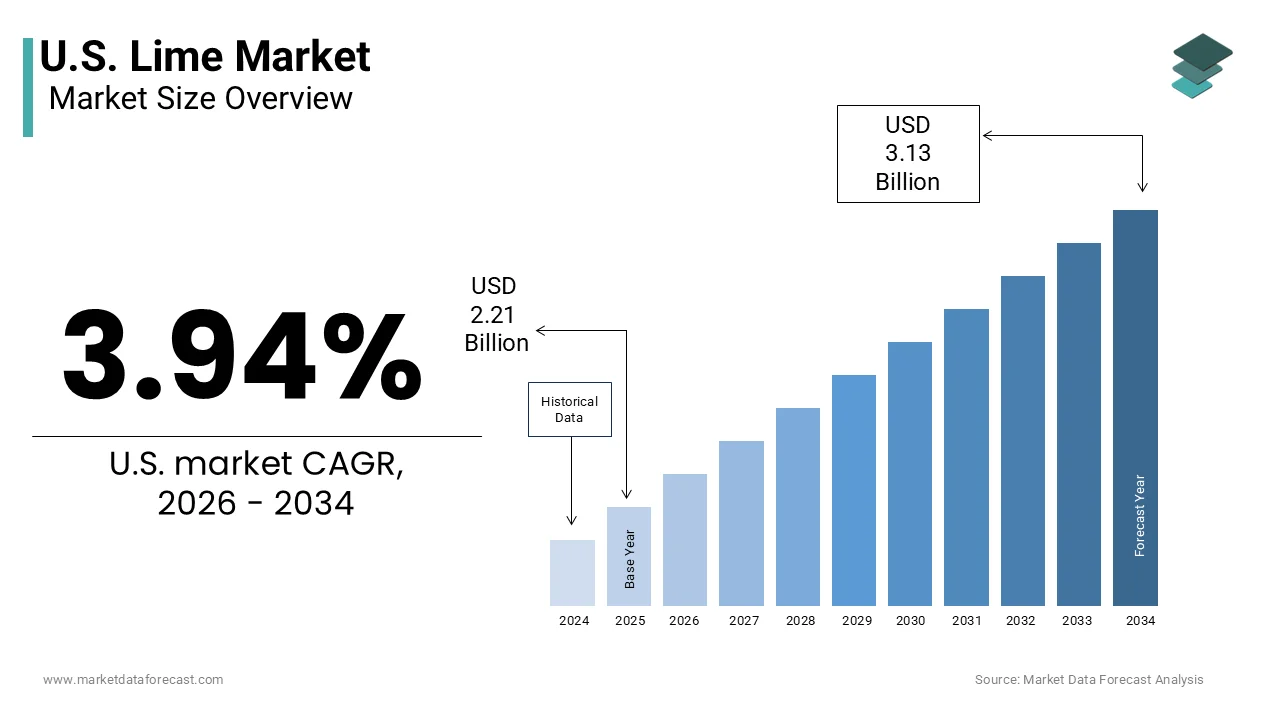
The U.S. Lime Market was valued at USD 2.21 billion in 2025 and is projected to reach USD 3.13 billion by 2034, growing from USD 2.30 billion in 2026 at a CAGR of 3.94% during the forecast period. Growth is driven by increasing demand from the construction, steel, and water treatment industries, expanding environmental applications, and rising adoption of lime in industrial manufacturing processes. Climate-related production risks, citrus supply chain pressures, and stringent environmental regulations are shaping market dynamics.
Key Market Trends
- Rising adoption of hydrated lime in water treatment and flue gas desulfurization applications.
- Growing investments in energy-efficient kiln technologies and sustainable lime production.
- Increasing use of precision manufacturing and digital monitoring to improve operational efficiency.
- Expansion of lime applications in green building materials and infrastructure development.
- Rising focus on sustainability through carbon emission reduction and environmentally compliant production processes.
Segmental Insights
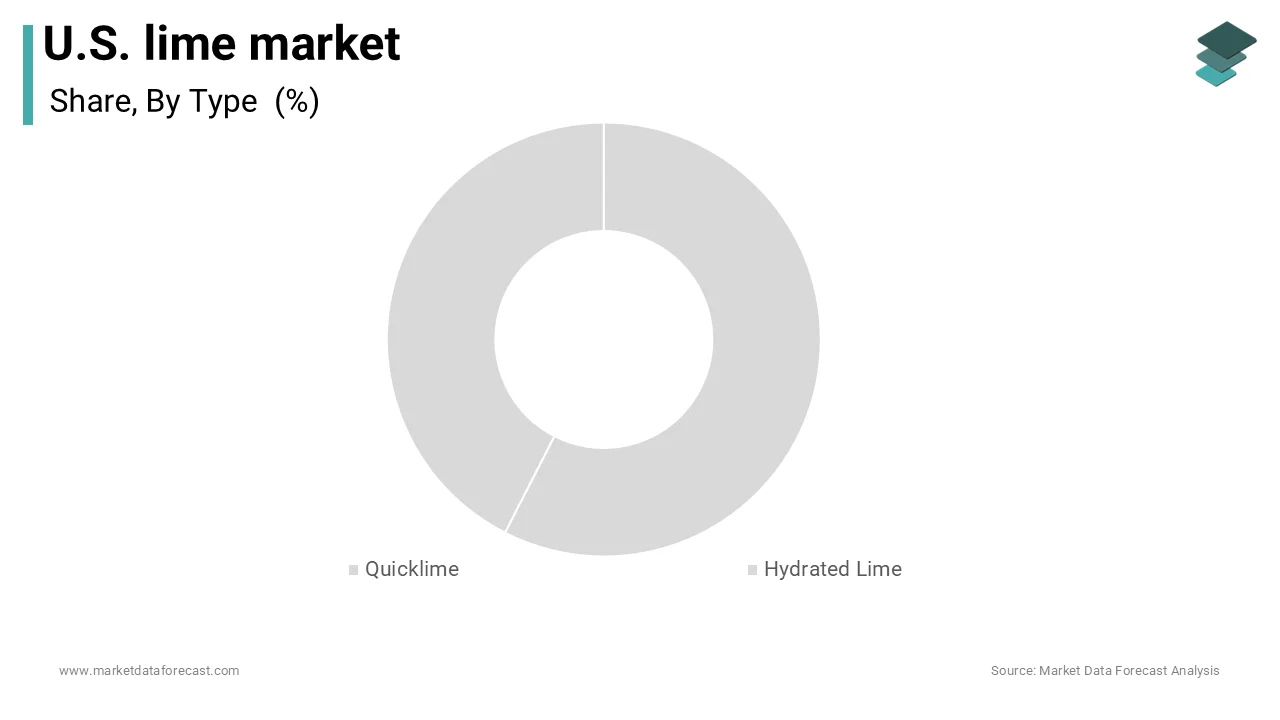
- Based on product type, quicklime held the majority share in 2025, driven by its extensive use in steel manufacturing, chemical processing, and industrial applications due to its high reactivity and cost-effectiveness.
- Based on application, building materials held the largest share in 2025, supported by strong demand from construction, soil stabilization, mortar production, and road infrastructure projects.
- Hydrated lime is the fastest-growing product type segment, projected to register a CAGR of 5.6%, driven by increasing adoption in environmental protection, water treatment, and emission control applications.
Regional Insights
- Texas led the market in 2025, supported by its large-scale construction activities, industrial manufacturing base, and abundant limestone resources.
- California holds a significant share, driven by extensive infrastructure projects, stringent environmental regulations, and strong water treatment demand.
- Florida is a prominent market due to its growing construction sector, water treatment investments, and agricultural applications.
- Georgia contributes notably through expanding industrial operations and increasing infrastructure development.
- Water treatment is the fastest-growing application segment, projected to grow at a CAGR of 10.2%, driven by increasing investments in drinking water infrastructure, wastewater treatment, and stricter environmental regulations.
Competitive Landscape
The market is highly competitive, with multinational manufacturers and regional producers competing on production efficiency, product quality, technological innovation, and environmental compliance. Companies are investing in capacity expansion, advanced kiln technologies, digital manufacturing solutions, and sustainable production practices to strengthen their market position while meeting evolving regulatory standards and industrial demand.Prominent players in the market include Carmeuse, Lhoist Group, Graymont Limited, Mississippi Lime Company, United States Lime & Minerals, Inc., Linwood Mining & Minerals Corporation, Minerals Technologies Inc., Cheney Lime & Cement Company, Pete Lien & Sons, Inc., Valley Mineral LLC, and Brookville Manufacturing.
U.S. Lime Market Size
The U.S. lime market was valued at USD 2.21 billion in 2025, is estimated to reach USD 2.30 billion in 2026, and is projected to reach USD 3.13 billion by 2034, growing at a CAGR of 3.94% from 2026 to 2034.
The limes are distinct from lemons due to their higher acidity and unique aromatic profile, which drives their specific demand in food service and manufacturing sectors. The agricultural sector for limes is heavily concentrated in states such as Florida, California, and Texas, where climatic conditions support year-round or seasonal production. The total citrus production in the United States has faced volatility due to environmental pressures, yet limes remain a critical component of the fresh fruit sector. Consumer preferences have shifted towards natural and organic produce, which influences farming practices and supply chain dynamics. Domestic consumption rates are bolstered by the popularity of Mexican and Asian cuisines, which extensively utilize lime for flavor enhancement. The market definition also extends to processed lime products, including juice concentrates and essential oils, which cater to the cosmetic and pharmaceutical industries.
MARKET DRIVERS
Surging Demand for Ethnic Cuisine and Beverage Innovation Drives Market Expansion
The proliferation of ethnic cuisines, particularly Mexican, Thai, and Vietnamese, is driving the growth of the United States lime market. These culinary traditions rely heavily on lime for its acidic balance and aromatic qualities, which are indispensable in dishes such as tacos, curries, and pho. The ethnic cuisine continues to dominate dining trends w, with Mexican food remaining the most popular ethnic category among American consumers. This sustained preference ensures a steady baseline demand for fresh limes in both commercial food service and household kitchens. Furthermore, the beverage industry has witnessed a robust expansion in craft cocktails and non alcoholic refreshments that feature lime as a core ingredient. The Mixology trend has elevated the status of fresh citrus juices, leading bars and restaurants to prioritize high-quality fresh limes over processed alternatives. The rise of health-conscious beverages such as infused waters and detox drinks also contributes to this demand. Consumers are increasingly aware of the vitamin C content and antioxidant properties of limes, which aligns with the broader wellness movement.
Industrial Applications in Cleaning and Personal Care Products Boost Consumption
Beyond the food and beverage sector, the industrial application of lime derivatives in cleaning agents and personal care products is significantly propelling the growth of the United States lime market. Lime oil and citric acid extracted from limes are valued for their natural degreasing properties and fresh scent, which make them ideal ingredients in eco-friendly cleaning solutions. As per the Environmental Protection Agency, the shift towards green chemistry and sustainable household products has accelerated the adoption of plant-based ingredients in commercial cleaning formulations. Manufacturers are increasingly replacing synthetic chemicals with natural extracts to meet regulatory standards and consumer expectations for safer home environments. The global trend towards natural cosmetics has prompted major brands to incorporate citrus extracts into facial cleansers, toners,s and body washes. The demand for natural and organic personal care items has grown substantially, ly with consumers scrutinizing ingredient lists for recognizable natural components. This industrial demand provides a stable revenue stream for lime processors who can utilize lower-grade fruits or byproducts for extraction purposes. The versatility of lime in non-food applications diversifies the market risk and ensures that production volumes are supported by multiple end-use sectors.
MARKET RESTRAINTS
Vulnerability to Citrus Greening Disease Threatens Domestic Production Stability
The prevalence of citrus greening disease, also known as Huanglongbing, in the domestic lime supply chain is hindering the growth of the United States lime market. This bacterial infection affects the vascular system of citrus trees , leading to fruit drop, reduced yield, and eventual tree death. As per the United States Department of Agriculture, citrus greening has devastated orange groves in Florida and has increasingly impacted lime production in key growing regions. The lack of a definitive cure for this disease forces growers to invest heavily in preventive measures such as insecticide applications and the removal of infected trees. These mitigation strategies increase operational costs and reduce the overall profitability of lime farming. The psychological impact on farmers has also led to a reduction in planted acreage as some producers exit the citrus industry altogether. The total citrus-bearing acreage has declined significantly over the past decade due to the persistent threat of greening. This reduction in domestic supply increases reliance on imports, which can be subject to trade policy fluctuations and logistical disruptions. The long-term sustainability of domestic lime production is therefore contingent upon the development of resistant rootstocks and effective disease management protocols.
Climate Change and Extreme Weather Events Disrupt Agricultural Output
The climate change-induced weather anomalies, by disrupting the consistent agricultural output, are additionally limiting the growth of the United States lime market. Limes are sensitive to temperature fluctuations, frost, and excessive rainfall, which can damage blossoms and fruit. The frequency of extreme weather events, such as hurricanes and droughts, has increased in major citrus-growing states like Florida and California. Hurricanes can cause immediate physical damage to orchards, while prolonged droughts stress trees and reduce fruit size and quality. These environmental stresses lead to unpredictable harvest volumes, which complicate supply chain planning for distributors and retailers. The variability in yield forces buyers to seek alternative sources, es often leading to increased import dependence during poor domestic harvest seasons. The water scarcity issues in California have necessitated stricter irrigation regulations, which impact crop productivity. The financial burden of adapting to climate change through improved irrigation systems and protective infrastructure further strains farmers' resources. Additionally, shifting climate zones may alter the suitability of traditional growing regions, requiring long-term strategic adjustments in land use. The inherent uncertainty associated with weather patterns makes it difficult for stakeholders to forecast production accurately.
MARKET OPPORTUNITIES
Expansion of Organic Lime Cultivation Meets Health-Conscious Consumer Preferences
The growing consumer preference for organic produce is prompting participants to differentiate their offerings and capture higher value segments, which is setting up new opportunities for the growth of the United States lime market. Health-conscious consumers are increasingly willing to pay a premium for fruits that are free from synthetic pesticides and fertilizers. This trend is particularly pronounced among millennial and Gen Z shoppers, who prioritize sustainability and personal health in their purchasing decisions. Lime growers who transition to organic certification can access niche markets and secure contracts with high-end grocery chains and specialty food stores. The limited supply of organic limes compared to conventional varieties allows for better margin retention for producers. Furthermore, the federal government provides support programs for farmers transitioning to organic practices, which can offset initial conversion costs. According to the United States Department of Agriculture National Organic Program, the number of certified organic operations has risen, indicating a supportive ecosystem for organic agriculture. This shift not only enhances profitability but also aligns with broader environmental sustainability goals.
Technological Advancements in Precision Agriculture Enhance Yield Efficiency
The integration of precision agriculture technologies to improve yield efficiency and reduce resource wastage in cultivation will additionally fuel the growth of the United States lime market. Technologies, such as drone monitoring, soil sensors,s and automated irrigationsystems,s enable farmers to optimize input usage and detect early signs of stress or disease. The adoption of precision agriculture tools has been shown to increase crop yields while reducing water and fertilizer consumption. For lime growers, these technologies provide real-time data that facilitates informed decision-making regarding harvesting timing and pest management. The use of artificial intelligence in analyzing crop health can lead to more targeted interventions, which minimize chemical usage and environmental impact. This technological leap is particularly relevant in the context of labor shortages and rising operational costs. By adopting these advanced methods, domestic lime producers can enhance their competitiveness against imported fruits, which may have lower labor costs but higher transportation emissions. The ability to produce high-quality limes consistently through technological assistance strengthens the domestic supply chain. Moreover, these innovations appeal to environmentally conscious consumers and retailers who value sustainability credentials.
MARKET CHALLENGES
Labor Shortages Impact Harvesting and Post-Harvest Operations
The agricultural sector in the United States faces chronic labor shortages, which directly impact the harvesting and post-harvest handling of limes, and is one of the challenges for the growth of the United States lime market. Lime harvesting is labor-intensive as it requires careful manual picking to prevent damage to the fruit and the tree. As per the American Farm Bureau Federation, the availability of farm labor has declined due to stricter immigration policies and an aging domestic workforce. This shortage leads to delays in harvesting, which can result in fruit over-ripening and spoilage in the field. The inability to secure sufficient labor during peak seasons forces growers to leave fruit unharvested or incur higher costs to attract temporary workers. These increased labor costs erode profit margins and make domestic limes less price-competitive compared to imports from countries with lower labor costs. The challenge is compounded by the perishable nature of limes, which require prompt processing and cooling after harvest. Delays in the supply chain due to labor bottlenecks can compromise fruit quality and shelf life.
Regulatory Compliance and Environmental Standards Increase Operational Costs
The strict environmental regulations and compliance requirements are additional financial burdens on lime producers,s affecting their operational efficiency, which also slows the growth of the United States lime market. Growers must adhere to guidelines regarding water usage, pesticide application, and waste management, which often require costly upgrades to infrastructure and practices. The regulations aimed at protecting water quality and biodiversity have become more stringent, necessitating detailed record-keeping and monitoring. The cost of complying with these regulations includes investing in advanced irrigation systems to conserve water and adopting integrated pest management strategies to reduce chemical runoff. The financial impact of regulatory compliance on small and medium-sized farms can be substantial, limiting their ability to invest in other areas of growth. Furthermore, trade policies and import regulations can fluctuate, creating uncertainty for producers who rely on export markets or compete with imports. Changes in tariffs or safety standards can disrupt market access and increase administrative costs. The challenge lies in balancing environmental stewardship with economic sustainability. Producers must navigate a complex regulatory environment while maintaining profitability. This dynamic requires continuous adaptation and investment in compliant technologies and practices.
REPORT COVERAGE
| REPORT METRIC | DETAILS |
| Market Size Available | 2025 to 2034 |
| Base Year | 2025 |
| Forecast Period | 2026 to 2034 |
| Segments Covered | By Type, Application, and Region. |
| Various Analyses Covered | Global, Regional and Country-Level Analysis, Segment-Level Analysis, Drivers, Restraints, Opportunities, Challenges; PESTLE Analysis; Porter’s Five Forces Analysis, Competitive Landscape, Analyst Overview of Investment Opportunities |
| Countries Covered | New York, Massachusetts, Pennsylvania, Illinois, Ohio, Michigan, Texas, Florida, Georgia, California, Washington, Colorado. |
| Market Leaders Profiled | Carmeuse, Lhoist Group, Graymont Limited, Mississippi Lime Company, United States Lime & Minerals, Inc., Linwood Mining & Minerals Corporation, Minerals Technologies Inc., Cheney Lime & Cement Company, Pete Lien & Sons, Inc., Valley Mineral LLC, Brookville Manufacturing |
SEGMENTAL ANALYSIS
By Product Type Insights
The quick lime segment was the largest by holding 46.3% of the United States lime market share in 2025 due to its extensive utility as a primary raw material in steel manufacturing and chemical processing. The robust demand from the steel industry, where quick lime serves as a fluxing agent to remove impurities, such as silica and phosphorus, during the steelmaking process. According to the American Iron and Steel Institute, te the United States produced approximately 72 million metric tons of raw steel in recent years, ars requiring substantial volumes of quick lime for efficient production. The high reactivity and cost-effectiveness of quick lime make it indispensable for large-scale industrial applications. Furthermore, the chemical industry relies heavily on quick lime for the production of calcium carbide and other derivatives. The established supply chains and existing industrial infrastructure favor quick lime over hydrated forms for bulk applications.
The hydrated lime segment is likely to witness the fastest CAGR of 5.6% during the forecast period, with the increasing adoption in environmental applications, particularly in flue gas desulfurization and water treatment processes. Regulatory pressures to reduce sulfur dioxide emissions from power plants have mandated the use of hydrated lime as an effective scrubbing agent. The stringent air quality standards have compelled energy providers to upgrade emission control systems, thereby boosting demand for hydrated lime. Additionally, the water treatment sector utilizes hydrated lime for pH adjustment and softening, which aligns with the growing emphasis on clean drinking water infrastructure. The United States Environmental Protection Agency estimates that billions of dollars are invested annually in water infrastructure upgrades, meeting sustained demand for treatment chemicals. Hydrated lime is also gaining traction in construction for its ease of handling and safety profile compared to quick lime. The rising trend of green building practices encourages the use of hydrated lime in mortars and plasters due to its breathability and mold resistance properties.
By Application Insights
The building material application segment was the largest by capturing 34.8% of the United States lime market share in 20,25 with the extensive use of lime in construction activities, including mortar product, ion soil stabilization, and asphalt modification. The construction industry's reliance on lime stems from its ability to enhance the durability and workability of building materials. Lime is essential in producing masonry mortar, which provides superior bond strength and flexibility compared to cement-only mixes. The renovation and restoration of historic buildings also contribute significantly to this dominance, as lime-based mortars are required to maintain structural integrity and aesthetic authenticity. Furthermore, the use of lime in soil stabilization for road construction offers a cost-effective solution for improving load-bearing capacity. The Federal Highway Administration promotes the use of lime-stabilized subgrades to extend pavement life and reduce maintenance costs. The widespread availability of limestone resources across the United States ensures a steady supply for the building material sector.
The water treatment application segment is expected to register the fastest CAGR of 10.2% from 2026 to 2034, with the increasing regulatory mandates and infrastructure investments aimed at ensuring safe drinking water and wastewater management. Lime is crucial for adjusting pH level, removing hardness,and precipitating contaminantss in both municipal and industrial water treatment facilities. Municipalities are upgrading their treatment plants to meet stricter safety standards, which drives the demand for lime as a cost-effective and efficient treatment agent. The aging water infrastructure in the United States requires significant rehabilitation efforts. According to the American Water Works Association, an estimated 1 trillion dollars is needed over the next twenty-five years to replace and upgrade water infrastructure. This massive investment pipeline creates a sustained demand for treatment chemicals, including lime. Industrial sectors, such as power generation and mining, also contribute to this growth by utilizing lime for wastewater neutralization and sludge conditioning. The growing awareness of water scarcity and quality issues further incentivizes the adoption of advanced treatment technologies.
TOP LEADING PLAYERS IN THE MARKET
- Carmeuse is a leading global producer of lime and limestone products with a significant presence in the United States market. The company focuses on providing high-quality solutions for steel construction and environmental applications. Carmeuse has recently invested in modernizing its production facilities to enhance efficiency and reduce carbon emissions. These initiatives align with global sustainability goals and strengthen its competitive position. The company actively engages in research and development to create innovative lime-based products that meet evolving customer needs. Its strategic partnerships with industrial clients ensure a stable demand pipeline. Carmeuse continues to expand its distribution network to improve service delivery and customer satisfaction across various regions.
- Lhoist is a major international manufacturer of lime, dolomite, and mineral products serving diverse industries worldwide. In the United States, the company provides essential materials for steelmaking, water treatment,t and soil stabilization. Lhoist has recently focused on digital transformation to optimize its supply chain and production processes. The implementation of advanced monitoring systems allows for real-time data analysis and improved decision-making. The company also prioritizes sustainability by investing in energy-efficient technologies and reducing its environmental footprint. Lhoist collaborates with customers to develop customized solutions that address specific industrial challenges. Its strong emphasis on safety and quality assurance enhances its reputation among clients.
- Graymont is a prominent producer of high-quality lime and limestone products with extensive operations in North America. The company serves key sectors including construction, agriculture,e and environmental management. Graymont has recently undertaken capacity expansion projects to meet increasing demand for lime products in the United States. These expansions include upgrades to kiln technology,gy which improve product consistency and reduce energy consumption. The company also focuses on sustainable practices by implementing waste reduction programs and utilizing renewable energy sources. Graymont strengthens its market position through strategic acquisitions of local quarries and distribution centers. This approach enhances its logistical capabilities and ensures a reliable supply to customers. The company’s dedication to customer service and technical support fosters long-term relationships with clients.
TOP STRATEGIES USED BY KEY MARKET PARTICIPANTS
Key players in the United States lime market primarily employ strategies such as strategic acquisitions, capacity expansion, and technological innovation to strengthen their market position. Companies frequently acquire smaller regional producers to consolidate their supply chains and expand their geographic reach. This approach allows them to serve a broader customer base more efficiently. Investment in advanced kiln technologies is another common strategy aimed at improving production efficiency and reducing environmental impact. Product diversification is also crucial as companies develop specialized lime formulations for niche applications in water treatment and agriculture. Strategic partnerships with industrial clients help secure long-term contracts and ensure steady revenue streams. Additionally, firms focus on sustainability initiatives to enhance their brand reputation and meet corporate social responsibility goals.
COMPETITIVE LANDSCAPE
The competition in the United States lime market is characterized by a mix of large multinational corporations and regional producers who compete on price, quality, and service reliability. The market structure is moderately consolidated,d with a few key players holding significant influence over supply dynamics. Competitive intensity is driven by the commoditized nature of standard lime production,w hich forces companies to differentiate through value-added services and specialized applications. Innovation in production technology plays a vital role as firms seek to reduce energy costs and minimize environmental footprints. Regulatory compliance serves as a barrier to entry for new competitors due to the high capital requirements for meeting environmental standards. Established players leverage their extensive distribution networks to ensure timely delivery and consistent supply to industrial clients. Customer loyalty is maintained through technical support and customized solutions that address specific industry needs. Price volatility in raw materials and energy costs further influences competitive strategies as companies manage margins carefully.
KEY MARKET PLAYERS
Some of the companies that are playing a dominating role in the U.S. lime market include
- Carmeuse
- Lhoist Group
- Graymont Limited
- Mississippi Lime Company
- United States Lime & Minerals, Inc.
- Linwood Mining & Minerals Corporation
- Minerals Technologies Inc.
- Cheney Lime & Cement Company
- Pete Lien & Sons, Inc.
- Valley Mineral LLC
- Brookville Manufacturing
MARKET SEGMENTATION
This research report on the U.S. lime market has been segmented and sub-segmented into the following categories.
By Type
- Quicklime
- Hydrated Lime
By Application
- Building Materials
- Water Treatment
By Country
- California
- Texas
- Florida
- Rest of the United States
Frequently Asked Questions
1. Which factors are driving the growth of the U.S. Lime Market?
Key drivers for the U.S. Lime Market include growing construction demand, industrial expansion, sustainable agriculture, and water treatment usage.
2. Which U.S. states lead in lime production within the U.S. Lime Market?
Major states producing lime are California, Texas, Florida, and Arizona, supported by favorable climate conditions and strong industrial infrastructure.
3. Who are the leading companies in the U.S. Lime Market?
Prominent players include United States Lime & Minerals, Mississippi Lime Company, and Cheney Lime & Cement Company, known for their sustainable production.
4. What are the major applications of lime in the U.S. Lime Market?
The U.S. Lime Market’s key applications are in construction materials, agriculture, metallurgy, and environmental services like wastewater treatment.
5. How is sustainability influencing the U.S. Lime Market?
The U.S. Lime Market is adopting green technologies to reduce carbon emissions and promote eco-friendly lime production practices.
6. What trends are shaping the future of the U.S. Lime Market?
Trending factors include digital manufacturing integration, rising infrastructure investments, and organic agricultural lime products.
7. How has industrialization impacted the U.S. Lime Market?
Industrial growth across construction, chemical, and mining sectors has significantly boosted lime consumption throughout the U.S. Lime Market.
8. What role does agriculture play in the U.S. Lime Market?
Agriculture uses lime to improve soil quality, regulate acidity, and enhance crop yield, contributing to stable demand within the market.
9. What type of lime products dominate the U.S. Lime Market?
Quicklime and hydrated lime are the dominant product segments, owing to wide use in construction, manufacturing, and processing.
10. How do import trends affect the U.S. Lime Market supply?
While the U.S. produces lime domestically, it also imports significant quantities, mainly from Mexico and Colombia, to meet demand.
Related Reports
Access the study in MULTIPLE FORMATS
Purchase options starting from
$ 1200
Didn’t find what you’re looking for?
TALK TO OUR ANALYST TEAM
Need something within your budget?
NO WORRIES! WE GOT YOU COVERED!
Call us on: +1 888 702 9696 (U.S Toll Free)
Write to us: sales@marketdataforecast.com