- Product Description Description
- Table of Contents TOC
- List of Table & Figure LOT
- Get Free Sample PDF Sample PDF
Market Size, 2025
$485.00 BnMarket Estimate, 2026
$516.53 BnMarket Forecast, 2034
$854.85 BnCAGR, 2026–2034
6.5%U.S. Logistics Market Summary
The U.S. logistics market was valued at USD 485 billion in 2025 and is projected to reach USD 854.85 billion by 2034, growing at a CAGR of 6.5% from 2026 to 2034, driven by e-commerce expansion, infrastructure modernization, and AI-enabled supply chain optimization.
Market Snapshot
- 2025 Market Size: USD 485 billion
- 2026 Estimate: USD 516.53 billion
- 2034 Forecast: USD 854.85 billion
- CAGR (2026–2034): 6.5%
- Base Year: 2025
- Forecast Period: 2026–2034
The U.S. logistics market represents one of the most complex and capital-intensive supply chain ecosystems globally, integrating freight transportation, warehousing, inventory management, and last-mile delivery across a continental economy. It underpins domestic manufacturing, retail distribution, energy supply chains, and healthcare delivery, while serving as a critical enabler of U.S. economic competitiveness.
Quick Growth Drivers
- Explosive e-commerce growth accelerating demand for last-mile and same-day delivery
- Proliferation of micro-fulfillment centers and hyper-local distribution hubs
- Federal investment in highways, ports, rail corridors, and intermodal terminals
- Rising demand for time-critical and temperature-controlled logistics
- Adoption of AI-driven routing, forecasting, and inventory optimization tools
Principal Restraints
- Chronic shortage of commercial truck drivers, inflating freight rates
- Rising labor and fuel costs impacting operating margins
- Fragmented state-level regulations on emissions, vehicle standards, and permits
- Limited near-term scalability of automation in long-haul trucking
High-Value Opportunities
- AI-powered dynamic routing and demand sensing to reduce empty miles
- Expansion of inland ports and near-shore fulfillment hubs
- Growth of cold-chain logistics for biologics, vaccines, and specialty foods
- Increased use of rail–truck intermodal transport to lower costs and emissions
- Automation and robotics in warehousing and sortation centers
Key Market Challenges
- Persistent congestion at major ports, rail hubs, and urban freight gateways
- Limited interoperability between legacy logistics software platforms
- Data fragmentation across transportation and warehouse systems
- Rising compliance and reporting burden under sustainability mandates
Fastest-Growing Segments
- Fourth-Party Logistics (4PL): End-to-end supply chain orchestration
- Air Freight: High-value e-commerce and healthcare shipments
- Healthcare Logistics: Biologics, home healthcare, and specialty pharmaceuticals
- Technology-enabled Asset-Light Logistics Models
Regional Leadership & Dynamics
- Texas (18.7% share): Central logistics hub with strong energy, manufacturing, and intermodal connectivity
- California: Port-centric logistics and e-commerce fulfillment dominance
- Illinois: Rail and inland intermodal leadership
- New York & Florida: High-velocity retail, healthcare, and import distribution
What Wins Commercially
- Dense distribution networks enabling same-day and next-day delivery
- Advanced warehouse automation and robotics
- AI-driven visibility and predictive delay management
- Flexible asset-light logistics models
- Sustainability-aligned fleet strategies and emissions transparency
Top Strategic Ask for Executives
Invest aggressively in AI-enabled orchestration, inland fulfillment expansion, and workforce productivity solutions while balancing automation with labor realities to maintain service reliability and margin resilience.
Leading Players
Some of the companies that are playing a dominating role in the U.S. logistics market include
United Parcel Service, FedEx Corporation, XPO Logistics, C.H. Robinson Worldwide, Amazon Logistics, DHL Supply Chain, Lineage Logistics, Ryder System Inc., Expeditors International of Washington Inc., and GXO Logistics.
U.S. Logistics Market Size
The U.S. logistics market was valued at USD 485 billion in 2025, is expected to reach USD 516.53 billion in 2026, and is projected to be worth USD 854.85 billion by 2034, growing at a CAGR of 6.5% from 2026 to 2034.
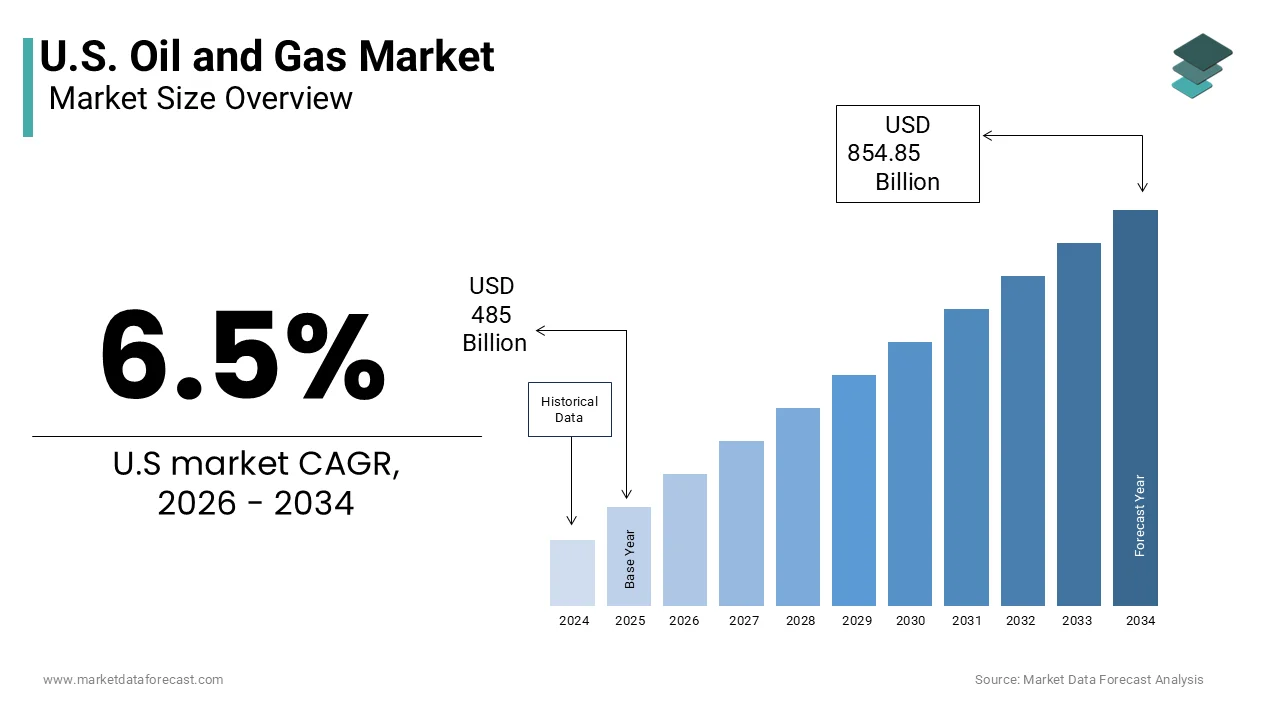
The logistics are the orchestrated movement, storage, and integration of goods, information, and resources across an intricate national supply chain spanning manufacturing hubs, distribution centers, ports, rail corridors, and last-mile delivery networks.
MARKET DRIVERS
Explosive Growth of E-Commerce Is Forcing Structural Reconfiguration of Distribution Networks
The relentless expansion of online retail is dismantling legacy logistics models and compelling investment in hyper-localized fulfillment, dynamic routing, and automated sortation, which is driving the growth of the US logistics market. Major retailers, including Walmart and Target, have deployed over eight hundred micro fulfillment centers inside or adjacent to stores to meet these expectations, reducing the average delivery radius to under 10 miles.
Federal Infrastructure Investment Is Unlocking Modal Shift and Network Resilience
The infusion of capital into transportation arteries is enabling long-deferred upgrades that enhance freight fluidity and promote intermodal efficiency. This factor is expected to fuel the growth of the US logistics market. The Government Accountability Office found that targeted highway improvements on the National Highway Freight Network reduced average freight delay by twenty-two minutes per truck per day in pilot corridors.
MARKET RESTRAINTS
Chronic Shortage of Commercial Truck Drivers Is Constraining Capacity and Elevating Costs
The logistics sector faces a structural labor deficit that undermines service reliability and inflates operational expenditure, despite technological advancements that are inhibiting the growth of the US logistics market. The U.S. Department of Transportation’s recent pilot allowing drivers aged eighteen to twenty-one to operate interstate commerce has yielded fewer than two thousand qualified participants in its first year. This labor vacuum cannot be solved by automation alone in the near term and is forcing shippers to absorb higher rates, accept longer lead times, or redesign supply chains around rail and parcel networks.
Fragmented Regulatory Environment Across States Is Increasing Compliance Complexity and Operational Friction
Logistics providers must navigate a labyrinth of inconsistent regulations governing vehicle dimensions, weight limits, emissions standards, and driver certification, which erode efficiency and increase administrative overhead, and are additionally hampering the growth of the US logistics market. According to the American Transportation Research Institute, carriers operating in more than ten states spend an average of eighteen hours per vehicle annually on compliance documentation and permitting, costing the industry over one point two billion dollars each year. This regulatory dissonance prevents economies of scale, complicates fleet standardization, and delays adoption of cross-border efficiency initiatives, which is undermining national supply chain cohesion despite federal oversight.
MARKET OPPORTUNITIES
Deployment of Artificial Intelligence in Dynamic Route and Inventory Optimization Is Unlocking Unprecedented Efficiency
Machine learning algorithms are transforming logistics from static planning to real-time adaptive orchestration, reducing waste, improving asset utilization, and enhancing delivery precision, which is likely to create new opportunities for the growth of the US logistics market. Startups such as ClearMetal and project44 have partnered with major retailers to embed transit time prediction engines that adjust inventory allocation based on weather, traffic, and port congestion forecasts, reducing expedited freight costs by up to 40%.
Expansion of Inland Port and Near-Shore Fulfillment Hubs Is Reducing Dependency on Coastal Gateways
The strategic relocation of inventory and transloading functions away from congested coastal ports toward inland intermodal nodes is enhancing supply chain resilience and reducing transit time to population centers, which is also gearing up the growth of the US logistics market. The Council of Supply Chain Management Professionals estimates that this geographic rebalancing reduces total landed logistics cost by up to 18% while insulating retailers from port labor disputes and ocean freight volatility.
MARKET CHALLENGES
Persistent Congestion at Major Freight Gateways Is Creating Systemic Bottlenecks and Schedule Volatility
The key nodes in the national logistics network remain prone to chronic delays that cascade across supply chains and inflate inventory carrying costs, which is a great challenge for the growth of the US logistics market. This congestion is not episodic but structural, forcing retailers to hold excess buffer stock, pay premium rates for air freight substitution, or redesign sourcing strategies entirely.
Inadequate Interoperability Between Legacy and Digital Freight Platforms Is Impeding real-time visibility.
Many logistics providers operate with fragmented data ecosystems where transportation management systems, warehouse execution platforms, and carrier portals cannot exchange information seamlessly. This attribute is also likely to hinder the growth of the US logistics market. The Department of Transportation’s Freight Data Dictionary initiative found that over eight hundred distinct data fields are used across major transportation management systems, with less than thirty % standardized. Startups attempting to bridge these gaps face resistance from legacy software vendors reluctant to adopt their open architectures. The Government Accountability Office estimates that manual data re-entry across multimodal shipments adds over seven hundred million dollars annually in administrative waste.
REPORT COVERAGE
| REPORT METRIC | DETAILS |
| Market Size Available | 2025 to 2034 |
| Base Year | 2025 |
| Forecast Period | 2026 to 2034 |
| Segments Covered | By Model, Transportation, End-use Industry, and Region. |
| Various Analyses Covered | Global, Regional, and Country-Level Analysis, Segment-Level Analysis, Drivers, Restraints, Opportunities, Challenges; PESTLE Analysis; Porter’s Five Forces Analysis, Competitive Landscape, Analyst Overview of Investment Opportunities |
| Countries Covered | New York, Massachusetts, Pennsylvania, Illinois, Ohio, Michigan, Texas, Florida, Georgia, California, Washington, Colorado. |
| Market Leaders Profiled | United Parcel Service (UPS), FedEx Corporation, XPO Logistics Inc., C.H. Robinson Worldwide Inc., Amazon Logistics, DHL Supply Chain, Lineage Logistics, Ryder System Inc., Expeditors International of Washington Inc., GXO Logistics |
SEGMENTAL ANALYSIS
By Model Insights
The third-party logistics segment was the largest by capturing 61.2% of the United States logistics market share in 2025, with the structural complexity of modern supply chains, the need for scalable capacity, and the imperative to convert fixed costs into variable operational expenses. The Food and Drug Administration mandates chain of custody documentation and temperature-controlled handling for pharmaceuticals, a compliance burden most efficiently managed by specialized 3PLs with validated systems.
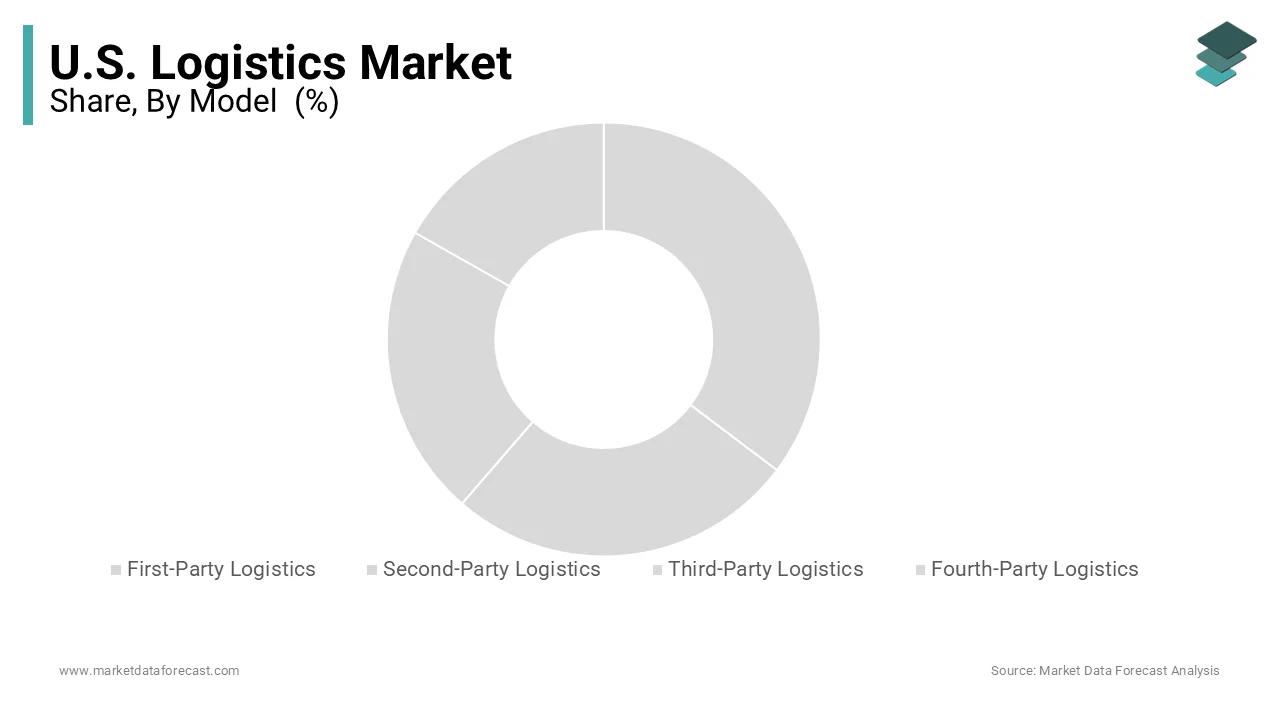
The fourth-party logistics segment is projected to expand at a CAGR of 12.8% throughout the forecast period, with the need for end-to-end orchestration across fragmented global supply chains, digital transformation mandates, and result-based logistics contracting. The electronics manufacturers reduced excess inventory by 29% after adopting 4PL-managed control towers that synchronize production forecasts with retail point of sale data. The Federal Aviation Administration now mandates 4PL oversight for drone delivery pilots to ensure airspace deconfliction and regulatory compliance across municipal jurisdictions.
By Transportation Insights
The road transportation segment accounted for the largest share of the US logistics market in 2025, with the nation’s last-mile dispersion, last-mile delivery imperatives, and the absence of time-sensitive services for time-sensitive or low-density shipments. Many commercial trucks operate daily across the National Highway System, supported by three point five million professional drivers. Road freight’s irreplaceability stems not from efficiency alone but from ubiquity, flexibility, and door-to-door service unmatched by rail or waterborne alternatives.
The Air transportation segment is likely to grow with an expected CAGR of 9.6% throughout the forecast, st period, owing to high-weight e-commerce, urgent healthcare, and just-in-time just in time manufacturing replenishment. The increasing prominence of air transport for ceremonial-use technologies to ensure sachain of custody and reduce diversion risk is also enhancing the growth of the segment to some extent. The rise of regional air cargo hubs in cities such as Indianapolis, Louisville, and Ontario has reduced average domestic air transit times to under six hours, making transport economically viable for premium consumer goods.
By End Use Industry Insights
The fast-moving consumer goods segment held a prominent share of the US logistics market in 2025, with high inventory turnover, low margin tolerance for waste, and the imperative for nationwide shelf replenishment within tightly compressed time windows. The Environmental Protection Agency estimates that food waste in the supply chain costs the industry over forty-four billion dollars annually, which is driving adoption of predictive spoilage analytics and dynamic routing to reduce dwell time.
The healthcare logistics segment is anticipated to grow with an expected CAGR of 13.4% from 202,5 to 2033 with the prolifertemperature-sensitivesensitive biologics, regulatory traceability mandates, and the decentralization of care delivery to home and outpatient settings.
COUNTRY LEVEL ANALYSIS
Texas Logistics Market Analysis
Texas was the largest contributor in the US logistics market by capturing 18.7% o,f shares in 2025 with its structured multimodal connectivity, energy-driven industrial base, and central geographic position bridging coastal and inland markets. The logistics continuity planning for energy-intensive industries is driving investment in redundant transport and inventory buffers.
COMPETITIVE LANDSCAPE
The United States logistics market is defined by fierce rivalry among integrated carriers, regional specialists, and digital freight brokers competing across speed, cost, sustainability, and technological sophistication. Incumbents leverage vast asset networks and decades of regulatory compliance to defend positions while aggressively acquiring automation and visibility startups to embed artificial intelligence and real-time tracking. New entrants disrupt through asset-light models, dynamic pricing algorithms, and carbon-transparentarent routing that appeal to e-commerce sustainability-driven shippers. Price competition is tempered by service level agreements in healthcare and technology sectors that reward reliability over cost.
KEY MARKET PLAYERS
Some of the companies that are playing a dominating role in the U.S. logistics market include
- United Parcel Service (UPS)
- FedEx Corporation
- XPO Logistics Inc.
- C.H. Robinson Worldwide Inc.
- Amazon Logistics
- DHL Supply Chain
- Lineage Logistics
- Ryder System Inc.
- Expeditors International of Washington Inc.
- GXO Logistics
TOP LEADING PLAYERS IN THE MARKET
- United Parcel Service has significantly enhanced its technological and operational capabilities to meet rising e-commerce and same-day delivery expectations.
- FedEx Corporation has strategically evolved its logistics architecture to prioritize dynamic efficiency and digital integration. In March 2025, it partnered with the Department of Energy to pilot hydrogen fuel cell delivery vans in California and Texas by aligning with sustainability mandates while preserving payload and range for urban operations.
- XPO Logistics has positioned itself as a technology-forward, asset-light orchestrator of freight movement.
TOP STRATEGIES USED BY KEY MARKET PARTICIPANTS
Leading logistics providers prioritize network densification through micro fulfillment centers and cross-dock hubs to last-mile transit times and enhance urban delivery precision. They embed artificial intelligence into route planning and warehouse operations to minimize fuel waste and labor inefficiency. Strategic acquisitions of regional carriers and technology startups accelerate geographic coverage and platform interoperability. Partnerships with retailers and manufacturers enable vendor-managed inventory and demand sensing that reduce stockouts and overstock. Fleet electrification and alternative fuel adoption are scaled to state-level emissions mandates and corporate commitments. Real-time shipment visibility and predictive delay alerts are now standard for high-value clients.
MARKET SEGMENTATION
This research report on the U.S. logistics market is segmented and sub-segmented into the following categories.
By Model
- First-Party Logistics
- Second-Party Logistics
- Third-Party Logistics
- Fourth-Party Logistics
By Transportation
- Road
- Rail
- Air
- Water
- Others
By End-Use Industry
- Fast-Moving Consumer Goods (FMCG)
- Healthcare
- Manufacturing
- Retail & E-commerce
- Automotive
- Others
By Country
- Texas
- California
- New York
- Illinois
- Florida
- Rest of the United States