- Product Description Description
- Table of Contents TOC
- List of Table & Figure LOT
- Get Free Sample PDF Sample PDF
Market Size, 2025
$63.38 BnMarket Estimate, 2026
$64.01 BnMarket Forecast, 2034
$69.32 BnCAGR, 2026–2034
1.0%U.S. Paper Market Summary
The U.S. paper market, valued at USD 63.38 billion in 2025, is projected to reach USD 69.32 billion by 2034, expanding at a CAGR of 1.0% driven by regulatory mandates for permanent records, food safety packaging compliance, and growing demand from healthcare, hygiene, and election security applications.
Market Snapshot
- 2025 Market Size: USD 63.38 billion
- 2026 Estimate: USD 64.01 billion
- 2034 Forecast: USD 69.32 billion
- CAGR (2026–2034): 1.0%
- Base Year: 2025
- Forecast Period: 2026–2034
Quick Growth Drivers
- Regulatory mandates for permanent legal, financial, and archival records
- Rising demand for FDA- and FSMA-compliant food contact packaging
- Expansion of hygienic paper products driven by aging population and healthcare needs
- Increased use of paper in secure identity, voting, and audit trail systems
- Continued reliance on paper-based substrates for medical diagnostics and testing
Principal Restraints
- High contamination rates in municipal recycling streams reducing fiber quality
- Downcycling of recovered paper into lower-value products
- Elevated water and energy intensity under EPA and DOE scrutiny
- Rising compliance and operating costs at pulp and paper mills
High-Value Opportunities
- Integration of advanced paper substrates into point-of-care diagnostic devices
- Growth of secure, blockchain-enabled paper for voting and identity systems
- Expansion of high-barrier paper in foodservice and quick-service packaging
- Specialty medical and antimicrobial paper applications
Key Market Challenges
- Ongoing substitution by digital platforms in education and transactional uses
- Declining volumes in office paper and printed publishing
- Labor shortages in precision coating and converting operations
- High liability risks from coating defects and food-contact failures
Fastest-Growing Segments
- Hygienic Products: ~8.7% CAGR — aging population and healthcare demand
- Commercial Applications: ~9.4% CAGR — healthcare, foodservice, and elections
- E-commerce Distribution: ~12.8% CAGR — subscription hygiene and B2B procurement
Regional Leadership & Dynamics
- California (11.2%) — food safety mandates, organic waste laws, and voting modernization
- Northeast & Midwest — strong presence of archival, financial, and legal paper demand
- Texas & Southeast — packaging, hygiene manufacturing hubs with scale advantages
- Pacific Northwest — sustainability-driven paper and fiber innovation
What Wins Commercially
- Proven compliance with FSMA, FDA, EPA, and election security standards
- High-purity fiber sourcing and contamination control
- Specialty coatings for grease resistance, antimicrobial protection, and security
- Embedded traceability and auditability for regulated end uses
- Operational efficiency to offset low-growth volume environments
Top Strategic Ask for Executives
Shift capital and innovation focus from commoditized printing paper toward regulated, high-margin applications in food safety, healthcare, hygiene, and secure documentation while improving energy efficiency and fiber recovery to protect margins in a low-growth market.
Leading Players
Some of the companies that are playing a dominating role in the U.S. paper market include:
- International Paper
- Georgia-Pacific Corporation
- WestRock
- Packaging Corporation of America
- Domtar Corporation
- Kimberly-Clark Corporation
- Graphic Packaging International
- Verso Corporation
- Sappi Ltd.
- Smurfit Kappa Group
U.S. Paper Market Size
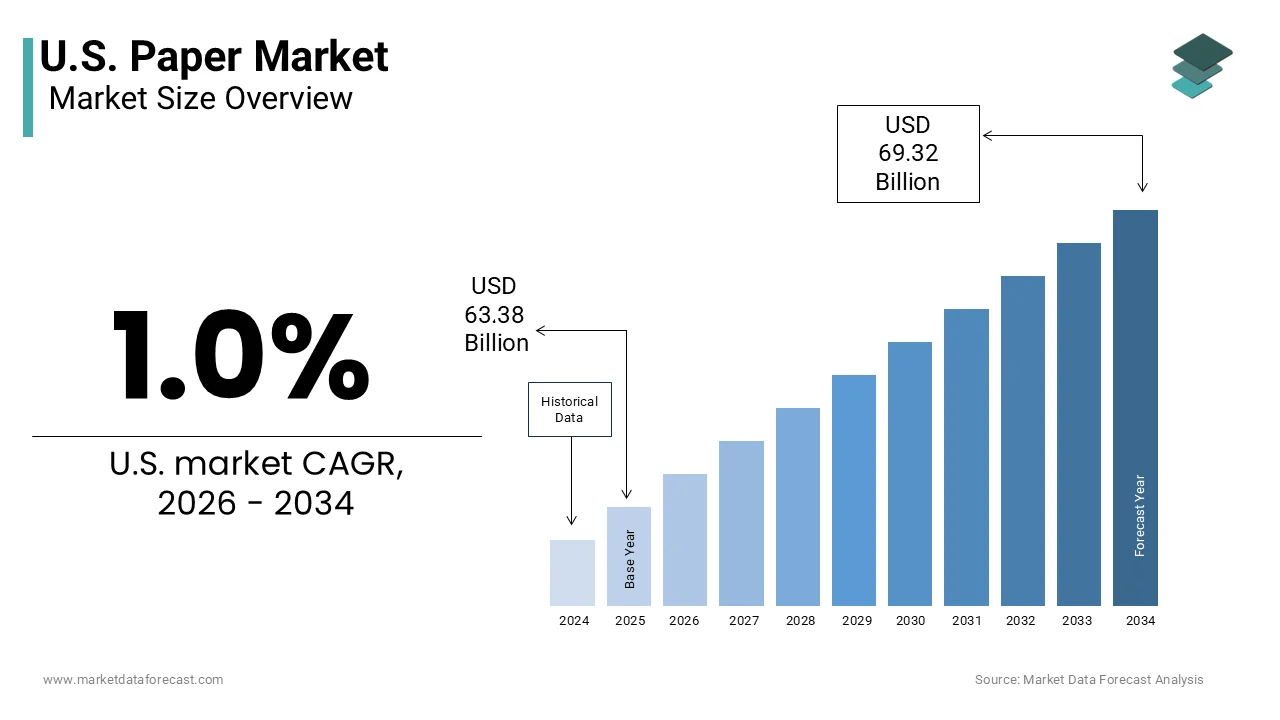
The U.S. paper market was valued at USD 63.38 billion in 2025, is estimated to reach USD 64.01 billion in 2026, and is projected to reach USD 69.32 billion by 2034, growing at a CAGR of 1.0% from 2026 to 2034.
The paper is a technologically stratified manufacturing ecosystem producing cellulose-based substrates engineered for permanence, print fidelity, barrier performance, and regulatory compliance.
MAREKT DRIVERS
Regulatory Mandates for Permanent Records and Legal Documentation
The growing prominence of the regulatory mandates for permanent records and legal documentation is a major factor fuelling the growth of the U.S. paper market. Simultaneously, the Uniform Commercial Code, adopted in all 50 states, mandates negotiable instruments like checks and promissory notes be printed on paper with a minimum 15-year archival stability, which are validated under TAPPI T 455.
Food Safety Modernization Act Compliance in Direct Food Contact Packaging
The Food Safety Modernization Act compliance in direct food contact packaging is another factor driving up the growth of the U.S. paper market. General Mills reformulated 100% of its fiber-based cereal cartons in 2023 to use virgin pulp with bio-based dispersion coatings, consuming 41,000 tons annually. McDonald’s U.S. supply chain now requires FSC-certified, PFAS-free greaseproof paper for all sandwich wraps—validated under NSF/ANSI 51—adding 9,200 tons to annual demand.
MARKET RESTRAINTS
Municipal Recycling Contamination and Fiber Downcycling
The U.S. mixed paper bales now contain 24% non-paper contaminants, where plastic films, food residue, and coated laminates. Only a few recovered office papers achieve true closed-loop recycling, with the remainder being downcycled into boxboard or molded pulp, with 60% lower value. This systemic degradation forces virgin pulp dependency despite sustainability pledges, which is inflating costs and carbon footprints.
Water and Energy Intensity Under EPA and DOE Scrutiny
The water and energy intensity under EPA and DOE scrutiny is degrading the growth of the U.S. paper market. Simultaneously, the Department of Energy’s Better Plants Program reports the average U.S. paper mill consumes 14.3 MMBtu per ton, which 28% above the industrial sector median. International Paper disclosed in its 2023 sustainability filing that compliance with California’s SB 1383 organic waste diversion mandates added $8.7 million in logistics costs for sludge handling.
MARKET OPPORTUNITIES
Medical and Diagnostic Device Integration for Point-of-Care Testing
The integration of the most advanced technologies in the healthcare systems to improve the quality of the treatment procedures is attributed to enhancing the growth of the U.S. paper market. Abbott Laboratories’ BinaxNOW COVID-19 Ag Card uses proprietary glass-fiber-reinforced cellulose, consuming 1,200 tons annually.
Blockchain-Embedded Secure Paper for Identity and Voting Systems
The use of blockchain-embedded secure paper for identity and voting systems is expected to fuel the growth of the U.S. paper market in the coming years. The U.S. Election Assistance Commission’s Voluntary Voting System Guidelines 2.0 mandate physical audit trails using chemically serialized paper ballots by consuming 8,700 tons in the 2022 midterms alone. Companies like Dominion Voting Systems now embed QR codes linked to blockchain-verified digital records on each ballot, requiring high-opacity, jam-resistant 24# paper.
MARKET CHALLENGES
Substitution by Digital Platforms in Transactional and Educational Sectors
The substitution by digital platforms in transactional and educational sectors is set to challenge the growth of the U.S. paper market. McGraw-Hill disclosed a 42% drop in printed higher-ed volumes between 2020 and 2023. The IRS’s 2023 e-file mandate for businesses with 10+ returns eliminated 14,000 tons of form paper.
Labor and Skills Erosion in Precision Coating and Converting Operations
The labor and skills erosion in precision coating and converting operations is ascribed to hinder the growth of the U.S. paper market. According to the Paper Industry International Hall of Fame, misapplied barrier coatings cause 23% of food packaging recalls, which trigger liability claims averaging $2.8 million per incident. Domtar’s 2023 operations review disclosed that coating line downtime averaged 31 hours monthly due to operator shortages.
REPORT COVERAGE
| REPORT METRIC | DETAILS |
| Market Size Available | 2025 to 2034 |
| Base Year | 2025 |
| Forecast Period | 2026 to 2034 |
| Segments Covered | By Product Type, Application, Distribution Channel, and Region. |
| Various Analyses Covered | Global, Regional, and Country-Level Analysis, Segment-Level Analysis, Drivers, Restraints, Opportunities, Challenges; PESTLE Analysis; Porter’s Five Forces Analysis, Competitive Landscape, Analyst Overview of Investment Opportunities |
| Countries Covered | New York, Massachusetts, Pennsylvania, Illinois, Ohio, Michigan, Texas, Florida, Georgia, California, Washington, Colorado. |
| Market Leaders Profiled | International Paper, Georgia-Pacific Corporation, WestRock, Packaging Corporation of America, Domtar Corporation, Kimberly-Clark Corporation, Graphic Packaging International, Verso Corporation, Sappi Ltd., Smurfit Kappa Group |
SEGMENTAL ANALYSIS
By Product Type Insights
The packaging products segment was the largest and held 47.5% of the U.S. paper market share in 2025, with the federal food safety mandates. McDonald’s U.S. supply chain mandates FSC-certified with PFAS-free greaseproof paper for 365 million monthly sandwich wraps, consuming 9,200 tons annually. Simultaneously, Amazon’s Ships in Own Container program specifies tear-resistant corrugated liners for high-value electronics, which embeds paper into e-commerce logistics as a damage-mitigation tool, not a disposable wrapper.

The hygienic products segment is likely to grow with an expected CAGR of 8.7% during the forecast period. Kimberly-Clark’s 2023 investor briefing confirmed a 29% volume increase in Poise and Depend lines, driven by baby boomer incontinence prevalence rising to 56% for adults over 65, as per National Institutes of Health clinical surveys.
By Application Insights
The household segment accounted for holding 53.3% the U.S. paper market share in 2025, with the non-discretionary hygiene and food safety needs. Many households increased paper towel purchases post-pandemic, with average consumption rising from 9.2 to 13.7 rolls annually by embedding volume into daily hygiene rituals insulated from digital substitution.
The commercial segment is projected to witness a CAGR of 9.4% during the forecast period, with the healthcare, foodservice, and secure documentation sectors. As per the U.S. Election Assistance Commission’s 2022 Post-Election AAuditit confirmed 8,700 tons of chemically serialized ballot paper were used across 47 states. Simultaneously, the Department of Homeland Security’s REAL ID Modernization Act requires security paper with UV fibers for 3,100 tons of annual driver’s license production.
By Distribution Channel Insights
The offline stores segment held 62.1% of the U.S. paper market share in 2025, with food service operations sourcing paper towels, napkins, and takeout containers through Sysco and US Foods warehouse clubs. Walmart and Costco account for 42% of household tissue sales, leveraging pallet-load pricing and in-store replenishment algorithms.
The e-commerce distribution segment is growing lucratively with an anticipated CAGR of 12.8% during the forecast period, with the subscription hygiene models and B2B industrial procurement. The Federal Reserve’s 2023 Small Business Credit Survey confirmed 67% of firms with under 50 employees shifted office paper procurement online to access real-time inventory APIs and automated reorder triggers by embedding e-commerce into operational continuity rather than convenience.
COUNTRY LEVEL ANALYSIS
California Market Analysis
California was the top performer of the U.S. paper market with 11.2% of the share in 2025, owing to the SB 1383 organic waste mandates and food safety modernization. Simultaneously, the California Secretary of State’s Voting Modernization Board mandates blockchain-linked ballot paper for all 58 counties, consuming 1,400 tons annually. Tech firms like Apple and Google specify FSC-certified, plastic-free packaging for 100% of device shipments from California fulfillment centers by embedding paper into ESG compliance and circular economy KPIs far beyond traditional publishing or office use.
COMPETITIVE LANDSCAPE
Competition is defined by regulatory certification, supply chain control, and embeddedness in public infrastructure. Incumbents battle to secure FDA, CMS, and EAC contracts where compliance overrides cost. Substitution by digital platforms fragments office and publishing demand, forcing retreat into food safety, medical, and election security niches. Barriers include water permit latency, coating technician scarcity, and fiber purity mandates.
KEY MARKET PLAYERS
Some of the companies that are playing a dominating role in the U.S. paper market include
- International Paper
- Georgia‑Pacific Corporation
- WestRock
- Packaging Corporation of America
- Domtar Corporation
- Kimberly‑Clark Corporation
- Graphic Packaging International
- Verso Corporation
- Sappi Ltd.
- Smurfit Kappa Group
TOP LEADING PLAYERS IN THE MARKET
- International Paper operates integrated pulp and packaging mills across the South and Midwest, specializing in FDA-compliant foodboard and industrial corrugated solutions. The company retrofitted its Vicksburg, Mississippi mill with closed-loop water recycling to meet California’s SB 1383 organic waste mandates, securing contracts with Whole Foods and McDonald’s. It also partnered with IBM to embed blockchain traceability in ballot paper supplied to 12 states, which aligns with EAC voting security guidelines and locks in public sector procurement.
- Domtar leads in uncoated freesheet and specialty security papers, supplying archival-grade substrates to federal agencies and financial institutions. The company co-developed antimicrobial exam table paper with 3M for CDC-recommended infection control in clinics, consuming 8,700 tons annually. Domtar also launched “EcoLignin™,” extracting lignin byproduct for bio-based adhesives, which is diversifying revenue while complying with EPA Cluster Rule wastewater mandates, transforming waste into value without expanding fiber consumption.
TOP STRATEGIES USED BY KEY MARKET PARTICIPANTS
Leaders vertically integrate fiber sourcing with regulatory compliance tech to lock in federal and healthcare contracts. They deploy AI and automation to offset labor shortages in coating and converting. Strategic partnerships with tech firms embed traceability via blockchain for ballots and pharmaceuticals.
MARKET SEGMENTATION
This research report on the U.S. paper market is segmented and sub-segmented into the following categories.s
By Product Type
- Packaging Products
- Hygienic Products
- Others
By Application
- Household
- Commercial
- Others
By Distribution Channel
- Offline Stores
- E-commerce Distribution
- Others
By Region
- California
- Texas
- Florida
- Rest of the United States