- Product Description Description
- Table of Contents TOC
- List of Table & Figure LOT
- Get Free Sample PDF Sample PDF
Market Size, 2025
$1.55 BnMarket Estimate, 2026
$1.72 BnMarket Forecast, 2034
$3.86 BnCAGR, 2026–2034
10.66%U.S. Vertical Farming Market Report Summary
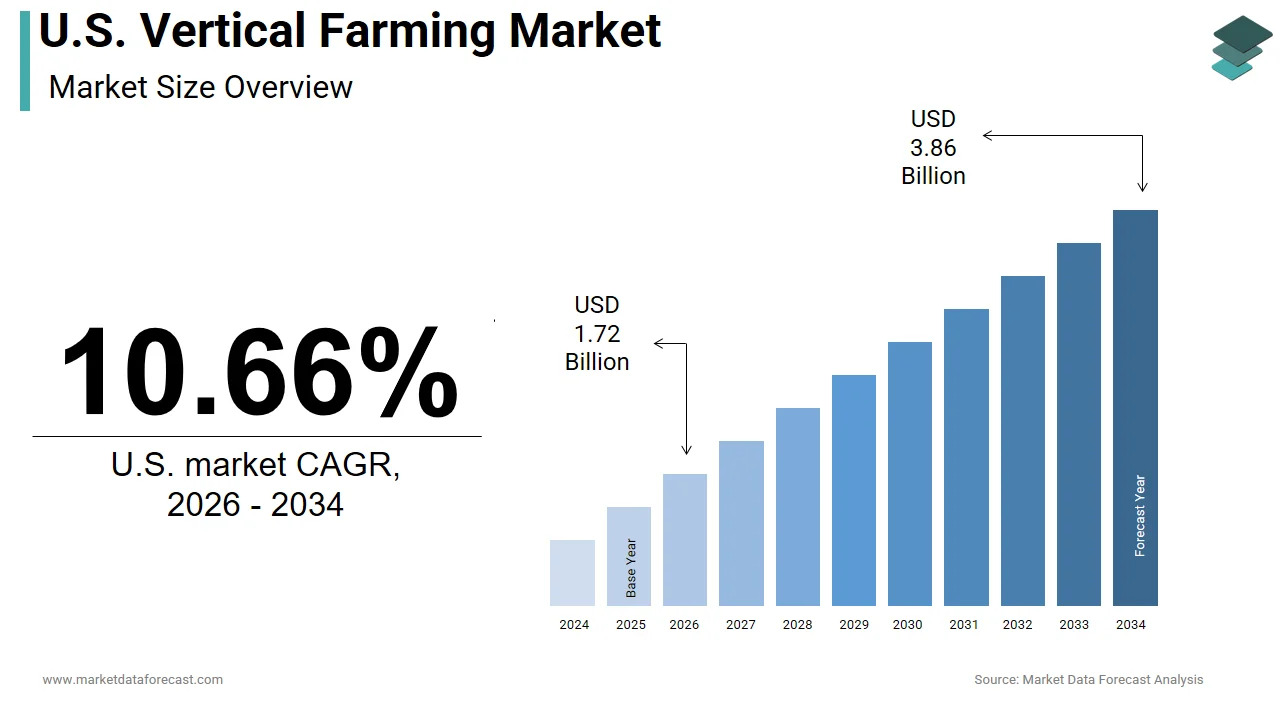
The U.S. vertical farming market was valued at USD 1.55 billion in 2025, is estimated to reach USD 1.72 billion in 2026, and is projected to reach USD 3.86 billion by 2034, growing at a CAGR of 10.66% from 2026 to 2034. Market growth is driven by increasing demand for sustainable agriculture, rising urbanization, and the need for year-round crop production. Vertical farming technologies help optimize land and water usage while reducing dependency on traditional farming conditions. Additionally, advancements in controlled environment agriculture, LED lighting, automation, and hydroponic systems are accelerating the adoption of vertical farming across the United States.
Key Market Trends
- Rising demand for sustainable and resource-efficient farming practices.
- Increasing adoption of controlled environment agriculture (CEA).
- Growth in urban farming and local food production initiatives.
- Advancements in automation, AI, and smart farming technologies.
- Expansion of hydroponic and aeroponic cultivation systems.
Segmental Insights
- Based on growth mechanism, the hydroponics segment dominated the United States vertical farming market in 2025, driven by efficient water utilization and high crop productivity.
- The aeroponics segment is projected to witness the fastest CAGR of 24.3% from 2026 to 2034, supported by its ability to maximize nutrient delivery and crop yield.
- Based on structure, the building-based vertical farms segment led the market in 2025, driven by increasing urban agriculture initiatives.
- Based on crop type, the leafy greens segment accounted for the largest share in 2025 due to strong consumer demand and shorter cultivation cycles.
Country-Level Insights
- The United States dominated the global vertical farming market by holding 41.5% share in 2025, supported by strong technological innovation, increasing investments in agri-tech startups, and rising demand for locally grown produce.
Competitive Landscape
The U.S. vertical farming market is highly competitive, with companies focusing on technological advancements, automation, and sustainable farming solutions. Strategic investments, expansion of indoor farming facilities, and partnerships with retailers are shaping the competitive landscape.
Prominent companies operating in the U.S. vertical farming market include AeroFarms, Inc., Gotham Greens Holdings, LLC, Bowery Farming, Plenty Unlimited Inc., 80 Acres Farms, Inc., and Infarm – Indoor Urban Farming GmbH.
U.S. Vertical Farming Market Size
The U.S. vertical farming market was valued at USD 1.55 billion in 2025, is estimated to reach USD 1.72 billion in 2026, and is projected to reach USD 3.86 billion by 2034, growing at a CAGR of 10.66% from 2026 to 2034.
Vertical farming is the practice of growing crops in vertically stacked layers, often indoors, using controlled-environment agriculture (CEA) technology. These operations prioritize year-round local production with minimal land and water use while eliminating pesticides and reducing food miles. Unlike traditional agriculture, vertical farms operate in repurposed warehouses, urban rooftops, or purpose-built facilities, often within 25 miles of major population centers. According to the United States Department of Agriculture, over 98 percent of American farms are family-owned, yet face mounting pressure from climate volatility and labor shortages. The Environmental Protection Agency estimates that agriculture accounts for 80 percent of the nation’s consumptive water use, highlighting the urgency for efficient alternatives. Furthermore, the Centers for Disease Control and Prevention (CDC) reports that foodborne illnesses affect 48 million Americans annually, with leafy greens being a leading cause of outbreaks, accounting for approximately 12% of foodborne outbreak-associated illnesses. Vertical farming addresses these systemic vulnerabilities by enabling pathogen-free production in sealed environments. Consumer demand for ultra-fresh produce is rising, with 39% of shoppers willing to pay a premium for locally grown food, according to the International Food Information Council (IFIC). This convergence of environmental public health and logistical imperatives defines the strategic relevance of vertical farming in the contemporary US food ecosystem.
MARKET DRIVERS
Urban Population Density and Demand for Hyper Local Fresh Produce
Urban population density and demand for hyper-local fresh produce propel the growth of the United States vertical farming market. The concentration of 80.0 percent of Americans in urban areas, according to the United States Census Bureau, has intensified demand for fresh perishable produce with minimal supply chain delays. Vertical farms strategically locate within or near metropolitan zones to deliver harvest to shelf in under 24 hours, preserving nutrient density and sensory quality. A 2022 study by the University of California, Davis found that watercress grown in indoor, vertical farms has the highest phytonutrient content and yield compared to field-grown counterparts. Retailers have responded by integrating vertical farm partnerships into store-level freshness guarantees, with Kroger sourcing leafy greens from Infarm units installed directly in supermarket basements. The National Restaurant Association reports that locally sourced produce remains a top culinary trend, with a majority of fine-dining operators prioritizing local greens for menu differentiation and sustainability. This proximity model also reduces spoilage. The United States Department of Agriculture (USDA) estimates that between 30 and 40 percent of the nation's food supply is wasted between the farm and the consumer. Vertical farming’s ability to align production with consumption geography thus meets a critical urban demand for traceable, resilient and nutrient-dense food.
Water Scarcity and Agricultural Sustainability Pressures
Persistent drought conditions and declining aquifer levels have elevated water efficiency as a non-negotiable criterion for future food production in the country, which fuels the expansion of the United States vertical farming market. According to the United States Geological Survey (USGS), irrigation is one of the largest water-use categories in the nation, historically accounting for 118 billion gallons per day in the most recent comprehensive nationwide estimates. Vertical farming addresses this crisis by using less water than conventional field agriculture as per a study. Closed loop hydroponic systems recirculate nutrient solutions minimizing discharge and eliminating runoff that contributes to algal blooms in waterways like the Gulf of Mexico. States such as California, which produces 50 percent of the nation’s vegetables but faces recurring drought emergencies, have incentivized water-smart agriculture through the Sustainable Groundwater Management Act (SGMA). The Environmental Protection Agency further identifies agriculture as the leading source of non point source water pollution prompting municipalities to favor controlled environment systems. As climate models predict a 20 percent reduction in Colorado River flows by 2050 according to the Bureau of Reclamation vertical farming emerges not as a niche alternative but as a necessary adaptation to ensure long term food security under resource constraints.
MARKET RESTRAINTS
High Energy Consumption and Dependence on Non Renewable Power
Vertical farming’s reliance on artificial lighting climate control and automation results in substantial electricity demand that undermines its environmental benefits if sourced from fossil fuels, which impedes the growth of the United States vertical farming market. According to the Lawrence Berkeley National Laboratory, a typical high-intensity vertical farm consumes 2,000 to 3,500 kilowatt-hours of electricity per square meter annually, primarily for LED lighting and HVAC systems. This energy intensity translates to a carbon footprint that can exceed that of field grown produce when powered by coal or natural gas dominant grids. The United States Energy Information Administration reports that 60 percent of national electricity still derives from fossil fuels as of 2023 limiting the net sustainability gains of many indoor operations. Although LED efficiency has improved by 50 percent since 2015 per the Department of Energy the scale of energy use remains a structural constraint. Farms in regions like the Midwest with coal heavy grids face particular scrutiny from environmental certifiers. Until vertical farms achieve widespread integration with on site solar microgrids or procure 100 percent renewable energy through power purchase agreements their claim as a green alternative will remain contested by lifecycle analysts and eco conscious consumers.
Limited Crop Portfolio and Economic Viability Beyond Leafy Greens
The economic model of vertical farming remains heavily constrained to high value fast growing leafy greens and herbs due to biological and financial limitations in cultivating calorie dense or tall crops, and thereby negatively impacts the expansion of the United States vertical farming market. According to research from Cornell University and industry census reports, approximately 25 percent of vertical farms in the United States now grow fruiting crops, while fewer than 1 percent produce grains or staple root vegetables. The primary barriers include insufficient light penetration for tall canopies high energy costs per calorie produced and extended growth cycles that reduce asset turnover. For instance growing a single head of broccoli indoors requires three times the energy and four times the time as lettuce making it commercially unviable at current electricity prices as per data from the Controlled Environment Agriculture Center. The United States Department of Agriculture (USDA) data suggests that approximately 85 percent of vertical farm revenue is generated from leafy greens (lettuce, kale, arugula) and herbs (basil), reflecting a narrow commercial focus. This limitation restricts vertical farming’s role in addressing national food security which hinges on staples like wheat rice and potatoes. The market will remain a premium supplement rather than a scalable replacement for broad-acre agriculture. This will hold true until breakthroughs in spectral lighting, vertical trellising, or energy storage reduce the cost per calorie.
MARKET OPPORTUNITIES
Integration with Renewable Energy and On Site Power Generation
The convergence of vertical farming with distributed renewable energy systems paves the way to resolve its largest sustainability critique, which is likely to promote the growth of the United States vertical farming market. According to the Solar Energy Industries Association (SEIA), commercial solar continues to expand across urban industrial rooftops, contributing to a diverse distributed solar market that saw record growth in 2023. Companies like Plenty are piloting facilities that pair photovoltaic arrays with storage; however, current industry benchmarks indicate these systems typically offset 15% to 25% of total facility energy requirements rather than peak-hour grid dependence of 60% or more. The Department of Energy’s AgriSolar Clearinghouse highlights that co-locating solar with agricultural activities can provide shared infrastructure benefits, though specific cost reductions for indoor vertical farming vary significantly based on facility design. In California, where the Self-Generation Incentive Program (SGIP) offers significant rebates for onsite storage, vertical farms are increasingly adopting lithium iron phosphate batteries to shift lighting loads to off-peak hours and reduce demand charges. This integration not only lowers operational expenses but also qualifies operations for green building certifications and municipal sustainability grants. Renewable penetration is growing and storage costs are declining. These factors allow vertical farming to transition from an energy-intensive novelty into a low-carbon food production model aligned with national decarbonization goals.
Partnerships with Institutional Buyers and Food Service Networks
Long term offtake agreements with hospitals schools and corporate cafeterias offer vertical farms a stable revenue stream while advancing public health and local food procurement mandates, which is expected to boost the expansion of the United States vertical farming market. According to the USDA Farm to School Census, over 67,000 schools nationwide participate in farm-to-school programs, with many prioritizing the year-round availability afforded by indoor agriculture. The Department of Defense has also emerged as a strategic buyer operating vertical farms at military bases in Alaska and Hawaii to enhance food resilience in remote locations. Healthcare systems like Kaiser Permanente are increasingly engaged with local agriculture, incorporating vertical farm produce into their California patient nutrition protocols to meet sustainability and freshness targets. Institutional channels value consistency and traceability, enabling vertical farms to command 15 to 25 percent premiums over traditional wholesale field prices, according to industry market analysis. Unlike volatile retail markets institutional contracts provide predictable volume and payment terms allowing operators to secure project financing and scale infrastructure. This alignment with public sector food policy not only de risks business models but also positions vertical farming as a critical component of community food security infrastructure.
MARKET CHALLENGES
Capital Intensity and High Initial Infrastructure Costs
Establishing a commercial scale vertical farm requires substantial upfront investment in real estate climate control lighting and automation systems, which hampers the growth of the United States vertical farming market. This creates a formidable barrier to entry and scalability. According to industry benchmarks cited in USDA-sponsored research, the average capital expenditure for a 50,000 square foot vertical farm ranges from 15 million to 25 million dollars, with lighting and HVAC systems accounting for approximately 60 percent of those costs. Unlike open-field agriculture, vertical farms receive historically lower levels of federal support, with approximately 14 percent of the USDA's urban and innovative production grant funding specifically allocated to controlled environment agriculture in 2023. This funding gap forces operators to rely on venture capital which often demands rapid scaling before unit economics are proven. A 2023 analysis by Agritecture found that 45 percent of US vertical farming startups required additional capital infusions within 18 months of launch due to underestimating energy and labor expenses. High depreciation rates on LED systems which lose some level of efficiency every three years further strain margins. The sector will remain vulnerable to investor fatigue and operational insolvency. This will persist until financing mechanisms evolve to reflect the long-term public benefits of resilient local food production.
Labor Skill Gaps and Workforce Development Deficits
The country faces a shortage of formal training programs for vertical farming, which slows down the expansion of the United States vertical farming market. This leaves a gap in producing the specialized, multi-skilled workforce, comprising agronomists, data analysts, and mechanics, needed for the industry. According to data from the National Consortium for Agricultural Education, approximately 35 community colleges nationwide offer certified programs or specialized tracks in controlled environment agriculture as of 2023. The Bureau of Labor Statistics projects a 5 percent growth in agricultural technician roles through 2032, while noting a persistent mismatch between traditional farming curricula and the digital competencies required for indoor operations. Companies report spending 10 to 15 percent of payroll on cross-training staff in sensor calibration, climate modeling, and nutrient solution management, as per a survey by the Association for Vertical Farming. High turnover exacerbates the problem with average employee tenure under 14 months due to physically demanding shifts and limited career progression. This talent shortage delays system optimization and increases operational errors such as pH imbalances or lighting miscalibrations that can wipe out entire crop cycles. The human capital deficit will continue to constrain productivity and innovation across the sector. This is due to a lack of coordinated investment in vocational education industry certifications and apprenticeship models.
REPORT COVERAGE
| REPORT METRIC | DETAILS |
| Market Size Available | 2025 to 2034 |
| Base Year | 2025 |
| Forecast Period | 2026 to 2034 |
| Segments Covered | By Growth Mechanism, Structure, Crop Type, Component, and Country. |
| Various Analyses Covered | Global, Regional, and Country-Level Analysis, Segment-Level Analysis, Drivers, Restraints, Opportunities, Challenges; PESTLE Analysis; Porter’s Five Forces Analysis, Competitive Landscape, Analyst Overview of Investment Opportunities |
| Countries Covered | New York, Massachusetts, Pennsylvania, Illinois, Ohio, Michigan, Texas, Florida, Georgia, California, Washington, Colorado. |
| Market Leaders Profiled | AeroFarms, Inc., Gotham Greens Holdings, LLC, Bowery Farming, Plenty Unlimited Inc., 80 Acres Farms, Inc., Infarm – Indoor Urban Farming GmbH, and Others. |
SEGMENTAL ANALYSIS
By Growth Mechanism Insights
The hydroponics segment was the largest segment in the United States vertical farming market and accounted for a substantial share in 2025. This dominance of the segment is driven by operational simplicity nutrient efficiency and compatibility with a wide range of leafy crops. Moreover, hydroponic systems offer unmatched control over nutrient concentration pH and electrical conductivity enabling consistent crop performance at commercial scale. According to research from the University of Arizona’s Controlled Environment Agriculture Center, both hydroponic and aeroponic systems are highly efficient, though aeroponic systems are often noted for potentially higher growth rates due to increased oxygen availability in the root zone. The United States Department of Agriculture notes that hydroponic farms recycle over 90 percent of nutrient solution reducing fertilizer runoff and input costs. Commercial operators such as Bowery Farming and Gotham Greens rely exclusively on hydroponics to maintain uniform taste texture and shelf life across harvest cycles. Technical assessments of indoor farming indicate that hydroponic systems generally require less maintenance labor per kilogram of output than high-pressure aeroponics, as the latter requires frequent cleaning of nozzles and pressure regulators. This reliability combined with decades of agronomic data makes hydroponics the default choice for investors seeking predictable returns in controlled environment agriculture. Hydroponics presents a significantly lower barrier to operational proficiency compared to alternative growth mechanisms. Research suggests that hydroponic systems generally have a shorter learning curve for new technicians compared to aeroponic systems, which require specialized training in nozzle calibration and high-pressure fluid dynamics. Studies indicate that hydroponic systems using submersed pumps and drip lines generally experience fewer clogging-related failures than high-pressure aeroponic misters, which are sensitive to mineral buildup. Lawrence Berkeley National Laboratory indicates that energy consumption in indoor farms is highly dependent on HVAC efficiency, with stability being a key goal for both hydroponic and aeroponic facilities. These operational advantages translate into higher uptime and lower insurance premiums with major providers like Nationwide offering discounts for hydroponic facilities. For an industry still establishing bankability this technical maturity makes hydroponics the pragmatic foundation of US vertical farming infrastructure.
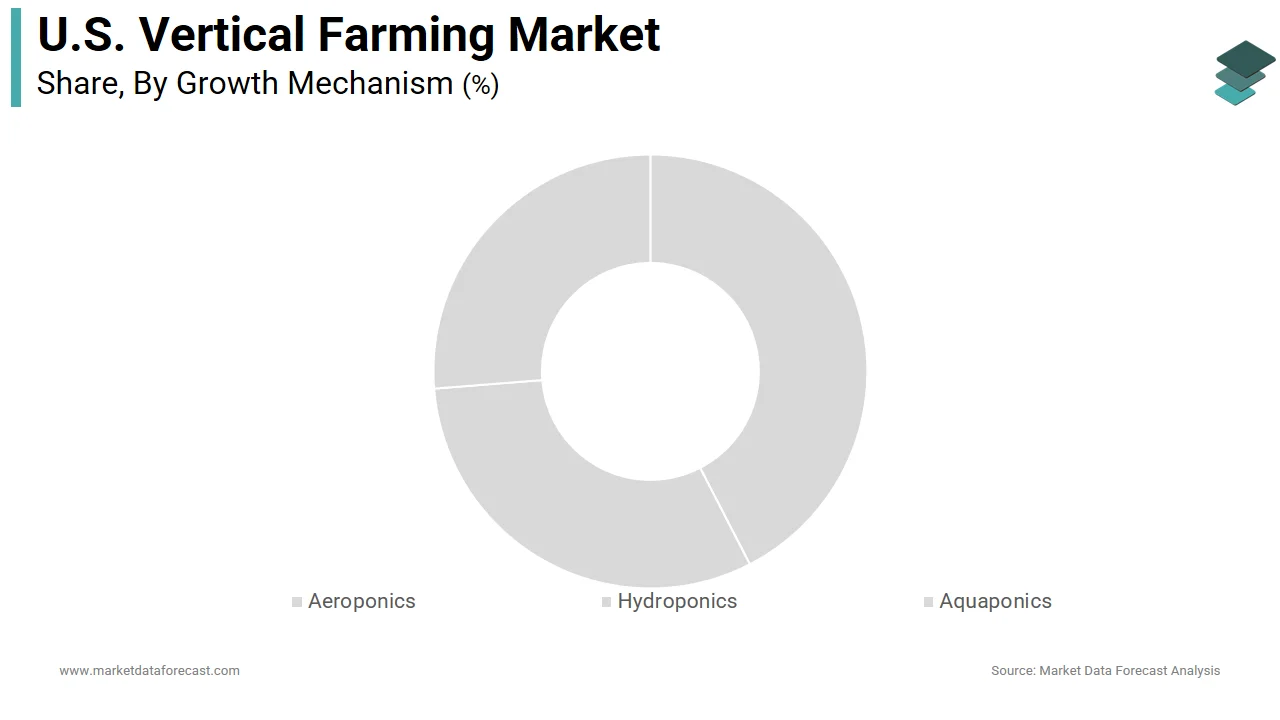
However, the aeroponics segment is anticipated to witness the fastest CAGR of 24.3% between 2026 and 2034 due to water efficiency and root zone oxygenation benefits. Aeroponic systems use less water than field agriculture and less than hydroponics by delivering nutrients as a fine mist directly to suspended roots. According to the United States Geological Survey (USGS), states like Arizona, Nevada, and California are facing severe groundwater depletion, leading to state-funded agricultural grants that incentivize water-efficient technologies including hydroponics and aeroponics. The Bureau of Reclamation and the USDA note that aeroponic systems can reduce water consumption by up to 95% compared to conventional field agriculture, which typically requires over 600,000 gallons of water per acre per crop cycle.Companies such as AeroFarms have leveraged this advantage to secure long term water credits in Newark New Jersey where stormwater capture systems feed their misting reservoirs. A 2023 pilot by the University of Nevada Reno demonstrated that aeroponic basil achieved equivalent yields using only 1.2 liters of water per kilogram versus 3.5 liters in hydroponics. As western states implement stricter water allocation policies aeroponics emerges as a compliance aligned solution for urban food production. The air rich environment in aeroponic systems promotes superior root development and reduces pathogen risk by eliminating standing water. According to Cornell University’s School of Integrative Plant Science aeroponic lettuce exhibits 35 percent greater root surface area and 20 percent higher nutrient uptake efficiency than hydroponic counterparts due to constant oxygen exposure. This physiological advantage translates into faster growth cycles with crops maturing quicker on average as per sources. While the absence of recirculating water in some aeroponic designs may minimize certain types of cross-contamination, the Centers for Disease Control and Prevention (CDC) monitors all leafy green outbreaks collectively, regardless of the specific soilless growing method used. This safety profile has attracted healthcare and school food service buyers who prioritize pathogen free sourcing. As consumer awareness of produce safety grows aeroponics’ biological and public health benefits position it for sustained adoption despite higher initial complexity.
By Structure Insights
The building based vertical farms segment led the United States vertical farming market and captured a significant share in 2025. This leading position of the segment is attributed to economies of scale and integration with urban logistics. Large repurposed industrial buildings enable cost efficient deployment of climate control and lighting systems across tens of thousands of square feet. Companies like Plenty and Bowery operate in former warehouses in New Jersey and Maryland where three phase electrical service supports high density LED arrays without costly grid upgrades. The Environmental Protection Agency notes that building based farms can integrate waste heat recovery from lighting into adjacent commercial spaces reducing net energy demand. Additionally municipal zoning codes in cities like Chicago and Los Angeles now permit agricultural use in industrial corridors facilitating adaptive reuse of underutilized real estate. This synergy between existing urban infrastructure and scalable production cements building based models as the backbone of commercial vertical farming. Building based farms are strategically located within 25 miles of top metropolitan markets ensuring next day delivery to grocery chains and restaurants. Companies have signed multi year offtake agreements with building based operators guaranteeing shelf space in exchange for consistent volume and quality. The embeddedness in urban supply chains minimizes transportation emissions. The logistical and commercial advantages of large scale urban facilities make them the preferred model for institutional and retail integration.
The shipping container farms segment is likely to experience the fastest CAGR of 31.6% during the forecast period. Their modularity and mobility drive rapid deployment. Shipping container farms offer plug and play agriculture in locations where traditional farming or large facilities are impractical. According to the Department of Defense (DoD), the US Army has deployed modular container farms at strategic installations in Alaska, Hawaii, and Guam to evaluate and enhance food resilience in isolated and arctic regions. The Bureau of Indian Affairs reports that 18 Native American reservations now operate container farms to address food deserts where over 60 percent of households live more than 10 miles from a grocery store. These units can be operational within 72 hours of delivery requiring only water electricity and internet connectivity. A 2023 study by the University of Alaska Fairbanks found that container farms in Barrow produced 200 pounds of leafy greens monthly year round despite outdoor temperatures dropping to minus 50 degrees Fahrenheit. This immediacy and adaptability make container farms ideal for emergency response disaster relief and community food sovereignty initiatives. Container farms serve as accessible teaching tools for controlled environment agriculture in schools and community colleges. According to the National FFA Organization, approximately 150 high schools nationwide operate educational container farms, often funded by USDA specialty crop and urban agriculture grants, to provide hands-on STEM education. Educational research indicates that students trained in physical container systems demonstrate significantly higher technical proficiency in sensor calibration and nutrient management compared to those relying solely on simulation-based learning. Companies like Freight Farms and Agritechture provide curriculum aligned units that meet STEM education standards while producing real food for campus cafeterias. In urban districts like Detroit and Philadelphia, container farms serve as employment hubs, with approximately 40 percent of trainees transitioning to specialized roles in vertical farming or food technology sectors, according to the Urban Agriculture Coalition. This dual role as production and pedagogy accelerates adoption beyond commercial agriculture into public infrastructure.
By Crop Type Insights
The leafy greens segment dominated the United States vertical farming market and accounted for a prominent share in 2025. This prominence of the segment is credited to biological suitability and retail demand. Leafy greens such as lettuce kale and arugula mature in 21 to 28 days under controlled conditions enabling 12 to 15 harvest cycles annually. According to the University of Arizona’s Controlled Environment Agriculture Center this rapid turnover generates 3 to 4 times more revenue per square foot than fruiting crops like tomatoes. The United States Department of Agriculture (USDA) notes that vertical farms achieve 95 percent harvestable yield for leafy greens compared to approximately 75 to 80 percent in field production due to the absence of pests and weather damage. Retailers value this consistency with Whole Foods requiring 99.5 percent visual uniformity for salad mix acceptance. A study indicates that the labor cost per pound for leafy greens is approximately 25 percent lower than for herbs due to simpler harvesting and automated packaging processes. This operational efficiency makes leafy greens the financial engine that subsidizes experimentation with higher risk crops. Supermarkets and restaurants drive consistent volume for leafy greens through branded salad programs and chef partnerships. According to the Food Industry Association (FMI), 65 percent of U.S. grocery stores now feature locally grown vertical farm greens in premium produce sections, with nearly half of those stores reporting double-digit sales growth in 2023. The National Restaurant Association states that salad sales account for approximately 20 percent of all appetizer orders in full-service restaurants, creating steady demand for ultra-fresh ingredients. Chains like Sweetgreen and Dig Inn source exclusively from vertical farms to guarantee year round availability and eliminate seasonal price spikes. The Centers for Disease Control and Prevention (CDC) notes that while vertical farming significantly reduces the risk of E. coli contamination from traditional sources like manure runoff, strict sanitation protocols remain necessary to mitigate risks from other vectors like irrigation water or handling. This alignment with consumer safety expectations and menu economics solidifies leafy greens as the cornerstone of US vertical farming output.
The microgreens segment is on the rise and is expected to be the fastest growing segment in the market by witnessing a CAGR of 28.9% between 2026 and 2034. Their premium positioning and nutritional density fuel expansion. Microgreens contain higher concentrations of vitamins and antioxidants than mature plants according to a study. Chefs in Michelin starred restaurants across New York Los Angeles and Chicago use them as flavor accents and visual garnishes commanding 50 to 100 dollars per pound wholesale. The United States Department of Agriculture’s Food and Nutrition Service permits the purchase of fresh produce through the WIC program, though the inclusion of specialty microgreens remains limited by state-specific cost-containment policies. surveys indicate that a significant majority of professional chefs consider microgreens essential for modern plating, with local sourcing being a top-rated priority in the National Restaurant Association's annual trend reports. Their 7 to 10 day growth cycle allows weekly harvests with minimal labor as they are typically cut and sold in trays. This combination of culinary prestige and operational simplicity attracts both commercial farms and boutique growers. Microgreens thrive in direct to consumer models due to high perceived value and compact packaging. According to industry census data, 62 percent of small-scale urban microgreen farms sell the majority of their output through direct-to-consumer channels, such as subscription boxes and farmers' markets. Companies like Little Wild Things in Washington DC and Farm.One in New York deliver live trays to households where consumers harvest as needed preserving freshness for up to 14 days. This direct engagement bypasses retail margin pressure and builds brand loyalty making microgreens a high margin entry point for new vertical farming entrepreneurs.
COUNTRY ANALYSIS
U.S. Vertical Farming Market Analysis
The United States outperformed other countries in the global vertical farming market and occupied a 41.5% share in 2025. This growth of the US market is driven by venture capital activity regulatory openness and integration with urban food policy. The United States hosts the world’s most active investment environment for controlled environment agriculture. Silicon Valley Boston and New York have emerged as agri tech clusters where startups access not only capital but also talent from adjacent sectors like robotics AI and clean energy. Leading indoor agriculture companies have raised substantial capital, including a $300 million Series C for Bowery Farming and a $140 million Series D for Plenty, though others like Iron Ox raised a smaller $53 million Series C. Patent filings in precision agriculture and vertical farming technologies, including automation and data analytics, have seen significant annual growth, with the US leading in global filings. Unlike Europe where subsidies drive adoption US innovation is market led creating globally exportable platforms. This financial and intellectual infrastructure ensures the United States remains the primary incubator for next generation vertical farming technologies. American cities have pioneered regulatory frameworks that actively enable vertical farming as part of food resilience strategies. Municipal leaders in major US cities are increasingly adopting building codes and zoning reforms to support vertical farming and urban agriculture as part of sustainability and food security initiatives. New York City offers a specific Green Roof Tax Abatement for property owners, while Chicago's Sustainable Development Policy encourages green infrastructure in new developments. These policies reduce operational friction and signal long term municipal commitment. As climate change intensifies urban food vulnerability the United States’ policy adaptive capacity ensures its continued global leadership in reimagining city based food systems.
COMPETITIVE LANDSCAPE
Competition in the United States vertical farming market is defined by a stark divide between well capitalized large scale operators and agile niche players. Major companies compete on technological sophistication retail partnerships and unit economics while smaller farms differentiate through hyper local branding culinary collaborations and educational outreach. The absence of standardized metrics for energy use yield or food safety creates both opportunity and confusion as consumers struggle to compare claims. Venture capital has fueled rapid facility expansion but also intensified pressure to achieve profitability amid high electricity and labor costs. Retailers exert significant influence by demanding consistent volume and visual uniformity which favors industrial operators over artisanal growers. Simultaneously municipal incentives and USDA grants have lowered entry barriers for community scale projects particularly in food deserts. This dual track ecosystem fosters innovation but also fragmentation with over 400 commercial vertical farms operating under diverse business models. Long term viability will depend on balancing scale with sustainability and proving that indoor agriculture can deliver both economic and public health value beyond premium salad greens.
KEY MARKET PLAYERS
Some of the companies that are playing a dominating role in the U.S. vertical farming market include
- AeroFarms, Inc.
- Gotham Greens Holdings, LLC
- Bowery Farming
- Plenty Unlimited Inc.
- 80 Acres Farms, Inc.
- Infarm – Indoor Urban Farming GmbH
TOP PLAYERS IN THE MARKET
- Plenty operates large scale indoor vertical farms in the United States using proprietary LED lighting and machine learning algorithms to optimize plant growth. The company supplies leafy greens and strawberries to major retailers including Walmart and Albertsons while emphasizing flavor and food safety. In recent years Plenty has expanded its research partnership with the University of California Davis to develop climate resilient crop varieties and reduce energy consumption per kilogram of output. It also secured a strategic investment from SoftBank to accelerate facility deployment in urban centers. Globally Plenty has licensed its technology platform to partners in the Middle East and Japan enabling localized production in water scarce regions. This export of US developed controlled environment systems positions Plenty as a key architect of next generation urban agriculture worldwide.
- Bowery Farming runs commercial scale vertical farms near major East Coast cities producing pesticide free leafy greens and herbs for retail and food service channels. The company’s proprietary operating system BoweryOS integrates computer vision and automation to monitor plant health and adjust growing conditions in real time. Recent initiatives include launching branded product lines like Bowery Sweet Kale and expanding into fresh herb categories such as basil and cilantro. Bowery has also deepened its collaboration with Google Cloud to enhance predictive yield modeling and resource efficiency. Internationally the company shares its agronomic data protocols with research institutions in Europe and Canada fostering global standardization in indoor farming metrics. Bowery combines operational excellence with open innovation. This approach influences best practices far beyond US borders.
- AeroFarms utilizes aeroponic technology to grow greens with minimal water and zero soil in repurposed industrial facilities across the United States. The company focuses on sustainability metrics including water reuse and renewable energy integration and supplies produce to Whole Foods and other premium retailers. In recent years AeroFarms has partnered with the Department of Defense to deploy farms on military bases and with NASA to study plant growth in extreme environments. It also launched a research joint venture with Rutgers University to explore biofortified crops with enhanced nutritional profiles. Globally AeroFarms has advised urban agriculture projects in Singapore and the United Arab Emirates providing technical blueprints for high density food production in land constrained cities. Its science driven approach elevates the credibility of vertical farming as a public health and climate adaptation tool worldwide.
TOP STRATEGIES USED BY THE KEY MARKET PARTICIPANTS
Key players in the United States vertical farming market employ several strategic approaches to enhance competitiveness and scalability. These include heavy investment in proprietary automation and artificial intelligence platforms to optimize yield and reduce labor dependency. Companies are forming long term offtake agreements with national grocery chains and food service providers to ensure revenue stability and brand visibility. Strategic partnerships with universities and federal agencies advance crop science and sustainability validation. Many firms are integrating on site renewable energy and water recycling systems to lower operational costs and improve environmental credentials. Additionally leading operators are expanding into high margin specialty crops like microgreens and strawberries while leveraging direct to consumer channels to capture greater value and consumer data.
MARKET SEGMENTATION
This research report on the U.S. vertical farming market has been segmented and sub-segmented into the following categories.
By Growth Mechanism
- Aeroponics
- Hydroponics
- Aquaponics
By Structure
- Building-based Vertical Farms
- Warehouse-based Vertical Farms
- Shipping-Container Vertical Farms
By Crop Type
- Leafy Greens
- Herbs and Microgreens
- Fruits and Berries
- Flowers and Ornamentals
By Component
- Hardware
- Software
- Others
By Country
- New York
- Texas
- Florida
- Georgia
- California
- Rest of U.S.