- Product Description Description
- Table of Contents TOC
- List of Table & Figure LOT
- Get Free Sample PDF Sample PDF
Market Size, 2025
$90.70 BnMarket Estimate, 2026
$98.19 BnMarket Forecast, 2034
$185.27 BnCAGR, 2026–2034
8.26%U.S. Frozen Food Market Report Summary
The U.S. frozen food market was valued at USD 90.70 billion in 2025, is anticipated to reach USD 98.19 billion in 2026, and is projected to reach USD 185.27 billion by 2034, growing at a CAGR of 8.26% during the forecast period. The growth of the U.S. frozen food market is driven by shifting consumer preferences toward convenient meal options, rising demand for longer shelf-life food products, and increasing adoption of frozen food in both households and foodservice sectors. Technological advancements in cold chain logistics and packaging solutions have further improved the quality, taste, and accessibility of frozen products, enhancing overall market performance.
Key Market Trends
- The increasing popularity of frozen ready meals and healthy frozen food alternatives among working professionals and urban households.
- Rising demand for plant-based and vegan frozen products as part of the growing health and sustainability trends.
- Expansion of e-commerce grocery platforms that provide home delivery of frozen food products.
- Growing investments in advanced freezing technologies such as cryogenic freezing to preserve nutritional value and flavor.
- Heightened preference for premium and gourmet frozen meals due to evolving consumer tastes.
Segmental Insights
- Based on type, the frozen ready meals segment accounted for 42.3% of the U.S. frozen food market share in 2025, driven by the rising popularity of convenient, quick-preparation meal options that cater to fast-paced lifestyles. The segment includes frozen pizzas, pasta, and ethnic dishes that offer restaurant-quality experiences at home.
- Based on distribution channel, the supermarkets and hypermarkets segment held 68.2% of the market share in 2025, as these retail outlets continue to dominate frozen food sales through wide product availability, frequent promotions, and the presence of large freezer sections catering to diverse consumer needs.
Competitive Landscape
The U.S. frozen food market is highly competitive, with both multinational corporations and regional producers focusing on innovation, flavor diversification, and brand expansion. Companies are investing in sustainable packaging, clean-label ingredients, and digital sales channels to strengthen their market presence. Major players in the U.S. frozen food market include Nestlé USA, Conagra Brands Inc., General Mills Inc., Tyson Foods Inc., The Kraft Heinz Company, McCain Foods, Unilever PLC, Nomad Foods Ltd., Bellisio Foods, and Wawona Frozen Foods.
U.S. Frozen Food Market Size
The U.S. frozen food market size was valued at USD 90.70 billion in 2025, and it is expected to reach USD 185.27 billion by 2034, growing from USD 98.19 billion by 2026. The market is growing at a CAGR of 8.26% during the forecast period.
The frozen food in this context refers to any edible product preserved through subzero temperature control to extend shelf life while maintaining nutritional integrity, flavor profile, and convenience of preparation.
MARKET DRIVERS
The Accelerating Demand for Meal Solutions Among Dual-Income Households
The structural transformation of American family economics has propelled frozen food into a strategic necessity for millions of households where both adults are engaged in full-time employment is accelerating the growth of the US frozen food market.
The Surge in Plant-Based and Health-Conscious Frozen Offerings
The frozen food market growth is propelled by plant-based and nutrient-dense options capturing unprecedented shelf space and consumer loyalty. The Hartman Group’s 2023 Eating Occasions Compass reveals that 52% of consumers who purchase frozen meals do so with the explicit intention of obtaining higher fiber, lower sodium, or fortified nutritional profiles.
MARKET RESTRAINTS
Logistical and Cold Chain Infrastructure Limitations in Rural Markets
The logistical and cold chain infrastructure limitations in rural areas are restraining the growth of the US frozen food market. This infrastructure gap is compounded by lower population density, which discourages investment in refrigerated transport and storage facilities. Furthermore, the Federal Highway Administration notes that nearly 19% of rural roads remain unpaved or in poor condition, increasing transit time and the risk of cold chain failure.
Expansion Through Direct-to-Consumer and Subscription-Based Frozen Platforms
The emergence of digitally native frozen food brands leveraging subscription models and direct-to-consumer fulfillment to bypass traditional retail constraints and cultivate deeper consumer relationships is significantly fostering the growth of the US frozen food market. Moreover, direct-to-consumer models generate first-party data that allows manufacturers to iterate on formulations based on real-time feedback, reducing the risk of new product failure.
MARKET OPPORTUNITIES
Strategic Alignment With Food Service and Institutional Channels
The frozen food manufacturers are increasingly capitalizing on synergies with institutional and food service buyers, including school hospitals, corporate cafeterias, and restaurant chains, to unlock volume. These channels offer predictable demand cycles, bulk purchasing agreements, and reduced marketing overhead compared to consumer retail. Manufacturers who invest in HACCP certified production allergen free facilities and customized portioning stand to capture long-term contracts that buffer against economic downturns and shifting consumer preferences in the retail space.
MARKET CHALLENGES
Labor Shortages and Automation Gaps in Production Facilities
The persistent labor shortages, particularly in skilled roles such as equipment technicians, quality assurance specialists, and cold environment logistics personnel, are hampering the growth of the US frozen food market. This gap leaves manufacturers reliant on manual labor for tasks such as portioning, inspection, and palletizing, which are increasingly difficult to staff. Wage inflation compounds the challenge, with average hourly earnings in frozen food manufacturing rising by nine point seven % over the past two yyearstill failing to attract sufficient applicants.
REPORT COVERAGE
| REPORT METRIC | DETAILS |
| Market Size Available | 2025 to 2034 |
| Base Year | 2025 |
| Forecast Period | 2026 to 2034 |
| CAGR | 8.26% |
| Segments Covered | By Type, Distribution Channel, and Region |
| Various Analyses Covered | Global, Regional, and Country Level Analysis; Segment-Level Analysis; DROC; PESTLE Analysis; Porter’s Five Forces Analysis; Competitive Landscape; Analyst Overview of Investment Opportunities |
| Regions Covered | New York, Massachusetts, Pennsylvania, Illinois, Ohio, Michigan, Texas, Florida, Georgia, California, Washington, Colorado |
| Market Leaders Profiled | Nestlé USA, Conagra Brands Inc., General Mills Inc., Tyson Foods Inc., The Kraft Heinz Company, McCain Foods, Unilever PLC, Nomad Foods Ltd., Bellisio Foods, and Wawona Frozen Foods |
SEGMENTAL ANALYSIS
By Type Insights
The Frozen Ready Meals segment accounted in holding 42.3% of the US frozen food market share in 2025. The psychological shift is equally critical, as per a study in Appetite Journal, 64% of consumers now perceive frozen meals as equivalent or superior to home-cooked dishes in terms of flavor complexity and ingredient quality.
The frozen snacks and bakery products segment is expected to grow with an anticipated CAGR of 9.8% from 2026 to 2034, with a fundamental redefinition of snacking behavior among American consumers who increasingly treat snacks as meal replacement,,s micro indulgences, and functional nutrition sources rather than peripheral treats. Manufacturers are capitalizing on this with innovation in texture, flavor layering, and portion control. Retailers note that frozen bakery items now generate higher per square foot sales than ambient snacks in many urban stores, reflecting their premium positioning and repeat purchase behavior.
By Distribution Channel Insights
The supermarkets and hypermarkets segment held 68.2% of the US frozen food market share in 2025, with the structural advantages including scale of assortment, the cold chain infrastructure, and consumer trust built over decades of consistent service. Cold storage investment is another key differentiator as Kroger and Albertsons have collectively allocated over one point five billion dollars since 2020 to upgrade freezer capacity and energy efficiency, ensuring optimal product integrity.
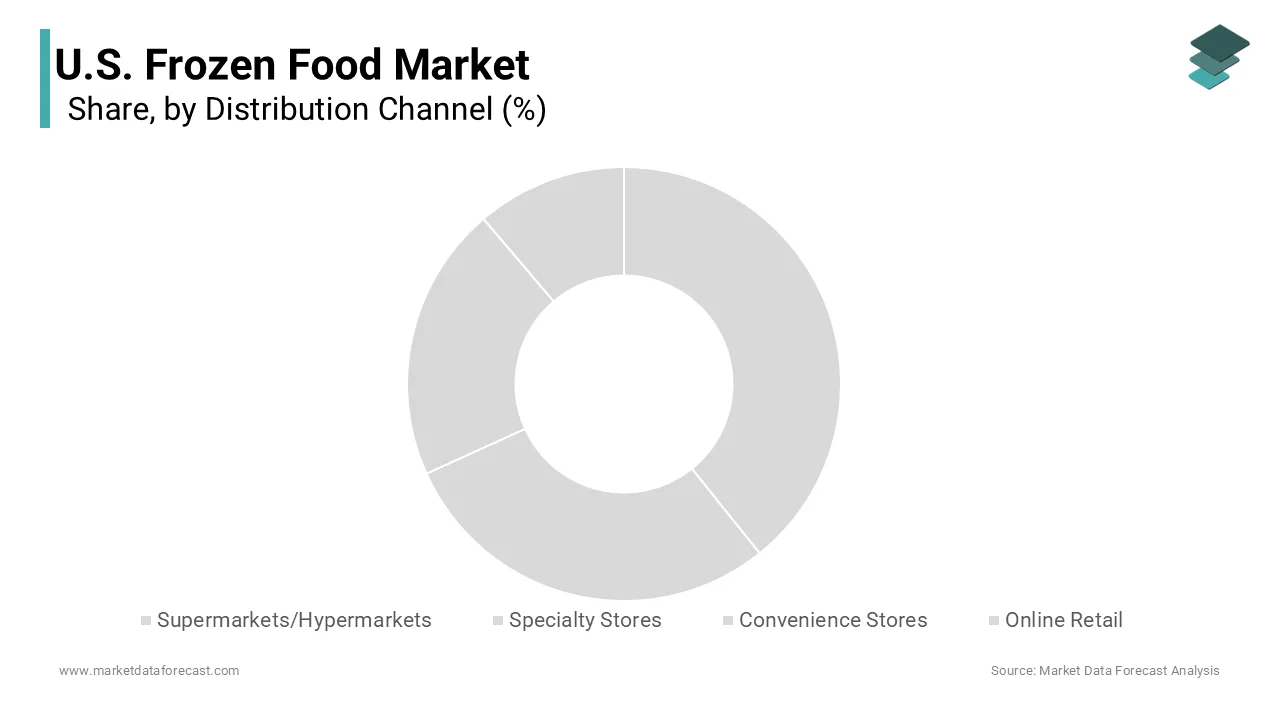
The online retail channel segment is lucratively growing with an expected CAGR of 8.3% in next coming years, with a function of pandemic-induced habit formation, but a structural realignment of consumer expectation around convenience and discovery
COMPETITIVE LANDSCAPE
KEY MARKET PLAYERS
A few of the dominating players in the U.S. frozen food market include
-
Nestlé USA
-
Conagra Brands Inc.
-
General Mills Inc.
-
Tyson Foods Inc.
-
The Kraft Heinz Company
-
McCain Foods
-
Unilever PLC
-
Nomad Foods Ltd.
-
Bellisio Foods
-
Wawona Frozen Foods
MARKET SEGMENTATION
This research report on the U.S. frozen food market is segmented and sub-segmented into the following categories.
By Type
-
Frozen Ready Meals
-
Frozen Seafood & Meat Products
-
Frozen Snacks & Bakery Products
-
Others (e.g., frozen fruits and vegetables)
By Distribution Channel
-
Supermarkets/Hypermarkets
-
Specialty Stores
-
Convenience Stores
-
Online Retail
By Region
-
New York
-
Massachusetts
-
Pennsylvania
-
Illinois
-
Ohio
-
Michigan
-
Texas
-
Florida
-
Georgia
-
California
-
Washington
-
Colorado