- Product Description Description
- Table of Contents TOC
- List of Table & Figure LOT
- Get Free Sample PDF Sample PDF
Market Size, 2025
$549.27 BnMarket Estimate, 2026
$564.37 BnMarket Forecast, 2034
$701.16 BnCAGR, 2026–2034
2.75%Executive Summary: U.S. Home Improvement Market
- Market Scope: Comprehensive market tracking goods and services deployed by homeowners and contractors to renovate, repair, upgrade, and personalize residential structures, including structural modifications and smart technology integrations.
- Market Valuation: Valued at USD 549.27 billion in 2025, reaching USD 564.37 billion in 2026, and projected to expand to USD 701.16 billion by 2034, growing at a steady CAGR of 2.75% during the forecast period (2026–2034).
- Primary Growth Drivers: Aging housing stock necessitating systemic upgrades, and prolonged homeownership tenure (median duration at 13.5 years) amplifying personalization demand for life stages. Key restraints include skilled labor shortages disrupting project timelines and cost structures, and persistent material price volatility.
Key Market Segment Metrics (2026–2034)
| Category | Leading Segment (2025 Position) | Fastest-Growing Segment |
|---|---|---|
| By Type | Do-it-for-me (held 62.3% of the U.S. market share in 2025, driven by technical complexity and safety concerns) | Do-it-yourself (DIY) (expected to grow with an anticipated CAGR of 6.8% driven by maker literacy and digital tutorials) |
| By End-Use | Kitchen Upgrades (accounted for 31.2% of market share in 2025 as the functional/emotional nucleus of the home) | System Upgrades (projected to showcase an esteemed CAGR of 9.2% driven by climate volatility and surge/pump needs) |
| By Region | California (top performer holding 19.2% share in 2025 due to regulatory intensity and efficiency mandates) | Texas (ranked second with 11.4% share, driven by demographic momentum and high-velocity volume) |
Major Market Players & Market Structure
Market Structure: Defined by a tripartite rivalry among vertically integrated giants competing through digital enablement, contractor loyalty, and design-phase influence, alongside regional and online disruptors.
Key Companies: The Home Depot, Lowe’s Companies, Menards, Ace Hardware, True Value, Sherwin-Williams, Floor & Decor, Builders FirstSource, ABC Supply, Ferguson Enterprises, Amazon, and Wayfair.
U.S. Home Improvement Market Size
The U.S. home improvement market size was valued at USD 549.27 billion in 2025 and is anticipated to reach USD 564.37 billion in 2026 and USD 701.16 billion by 2034, growing at a CAGR of 2.75% during the forecast period from 2026 to 2034
Home improvement is goods and services deployed by homeowners and contractors to renovate, repair, upgrade, or personalize residential structures. It spans structural modifications, aesthetic enhancements, system modernizations, and smart technology integrations.
MARKET DRIVERS
Aging Housing Stock Necessitating Systemic Upgrades
The structural obsolescence of America’s residential inventory is primarily prompting the growth of the U.S. home improvement market. The homes constructed before 1990 exhibit 30% to 50% higher energy leakage than modern builds, which are compelling owners to retrofit windows, seal ductwork, and upgrade HVAC units. In 2023, the National Association of Home Builders documented that 61% of remodelers cited “system replacement” as their primary motivator, not aesthetics.
Prolonged Homeownership Tenure Amplifying Personalization Demand
The Americans are staying in their homes longer than at any point since the 1980s, with the median duration of homeownership now at 13.5 years is driving the growth of the U.S. home improvement market. A 2023 study by the National Kitchen & Bath Association, 74% of major kitchen renovations included accessibility features such as step-free entries or adjustable countertops, even among households without current mobility limitations. This anticipatory customization reflects a cultural shift: homes are evolving with life stages, demanding continuous adaptation. The emotional and utilitarian attachment to space drives sustained, value-added investment beyond cyclical market trends.
MARKET RESTRAINTS
Skilled Labor Shortages Disrupting Project Timelines and Cost Structures
The shortage of skilled labor is solely a restraining factor for the growth of the U.S. home improvement market. Contractors now average 21 days to schedule initial consultations, up from 9 days in 201 by causing cascading delays. Labor scarcity inflates wages. Construction pay rose 5.3% year-over-year through Q1 2025, per Bureau of Labor Statistics data, a to transferring cost burdens to homeowners. Projects stall or shrink in scope, suppressing market velocity despite high demand intent.
Material Price Volatility Eroding Budget Certainty
Persistent inflation in core building materials undermines consumer confidence in committing to large-scale renovations is additionally limiting the growth of the U.S. home improvement market. Many clients are postponing or downsizing projects in early 2025 due to unpredictable material quotes. Unlike new construction, home improvement lacks bulk purchasing leverage; homeowners absorb spot-market fluctuations. This volatility forces mid-project scope changes, breeds consumer frustration, and deters discretionary spending, even among financially capable households are creating a barrier to market expansion.
MARKET OPPORTUNITIES
Electrification and Energy Retrofit Convergence
The federal push toward residential electrification opens a structural growth corridor for energy-focused home upgrades are lucratively posing new opportunities for the growth of the U.S. home improvement market. This triggers demand for electrical panel upgrades, insulation enhancements, and smart thermostats. Contractors who bundle efficiency audits with retrofit execution capture higher-margin, policy-subsidized workstreams.
Aging-in-Place Infrastructure as a Demographic Imperative
Home modification is becoming a public health priority, with its sole purpose to escalate the growth of the U.S. home improvement market. Many elderly people face issues due to environmental hazards like slippery floors or poor lighting. This drives demand for zero-step entries, lever-style door hardware, grab bars, and widened hallways. Forward-looking contractors are certifying in Certified Aging-in-Place Specialist (CAPS) programs, positioning themselves for municipal and insurer-referred work.
MARKET CHALLENGES
Regulatory Fragmentation Across Municipal Jurisdictions
Home improvement projects face inconsistent permitting, zoning, and code enforcement across the 19,000+ local jurisdictions in the United States. U.S. counties fully adopt the latest residential building codes by creating compliance ambiguity. Contractors must navigate disparate fee structures, inspection timelines, and material approvals by increasing overhead and risk. This regulatory patchwork stifles scalability for national service providers and deters DIYers from undertaking permitted work, suppressing legitimate market activity.
Consumer Decision Paralysis Amid Information Overload
The digital platforms have democratized access to product reviews, contractor ratings, and design inspiration, but at the cost of cognitive overload, which is hindering the growth of the U.S. home improvement market. Pinterest hosts over 2.1 billion home improvement pins, while YouTube renovation tutorials exceed 15 million, yet algorithmic content often prioritizes aesthetics over code compliance or durability.
REPORT COVERAGE
| REPORT METRIC | DETAILS |
| Market Size Available | 2025 to 2034 |
| Base Year | 2025 |
| Forecast Period | 2026 to 2034 |
| CAGR | 2.75% |
| Segments Covered | By Type, End Use, and Region |
| Various Analyses Covered | Global, Regional, and Country Level Analysis; Segment-Level Analysis; DROC; PESTLE Analysis; Porter’s Five Forces Analysis; Competitive Landscape; Analyst Overview of Investment Opportunities |
| Regions Covered | New York, Massachusetts, Pennsylvania, Illinois, Ohio, Michigan, Texas, Florida, Georgia, California, Washington, Colorado |
| Market Leaders Profiled | The Home Depot, Lowe’s Companies, Menards, Ace Hardware, True Value, Sherwin-Williams, Floor & Decor, Builders FirstSource, ABC Supply, Ferguson Enterprises, Amazon, Wayfair |
SEGMENTAL ANALYSIS
By Type Insights
The “Do-it-for-me” segment was the largest and held 62.3% of the U.S. home improvement market share in 2025, with the structurally reinforced by the increasing technical complexity of modern renovations and the irreversible decline in household repair literacy. As per the U.S. Consumer Product Safety Commission, over 310,000 home improvement-related emergency room visits occurred in 2023, with 63% stemming from DIY attempts involving power tools or structural modifications, further deterring self-execution. Contractors have capitalized on this through bundled service packages, transparent digital quoting, and project management apps by transforming home improvement from a chore into a concierge experience.
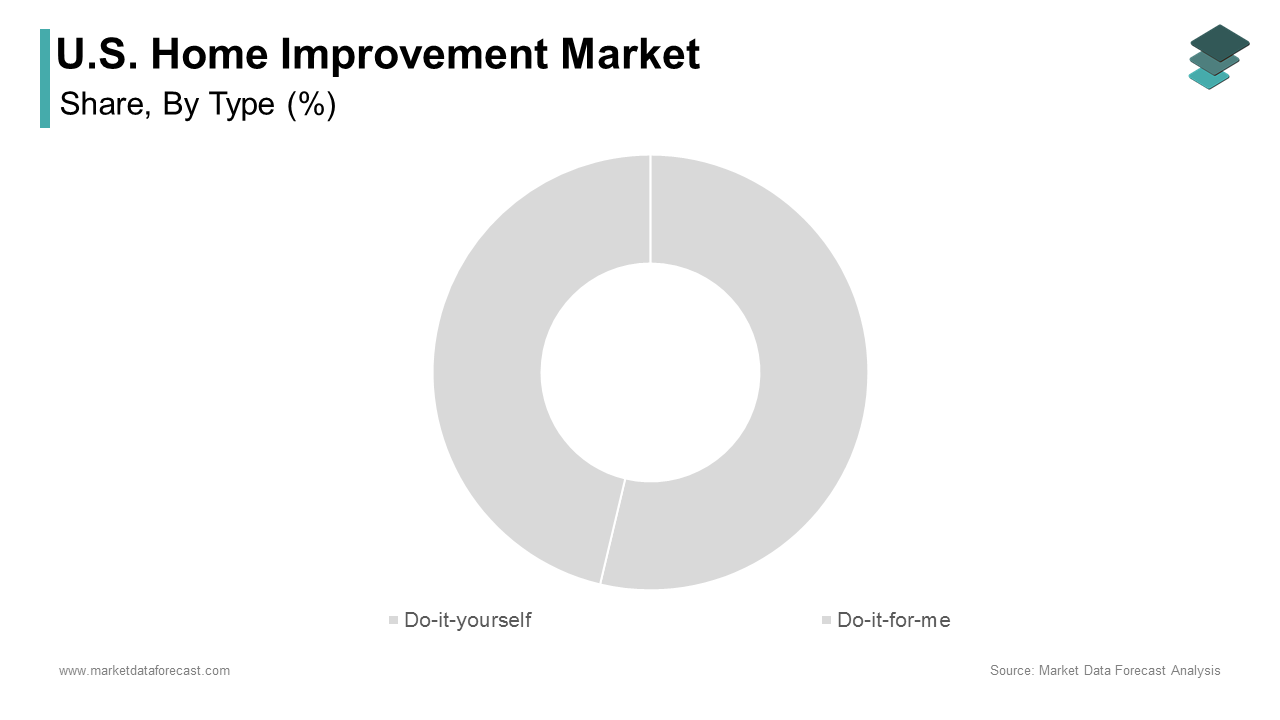
The DIY segment is expected to grow with an anticipated CAGR of 6.8% throughout the forecast period, with economic constraints alone but by a cultural renaissance in maker literacy and platform-enabled empowerment. YouTube’s home improvement tutorial category grew 21% in viewership in 2023 alone, with channels like Home RenoVision DIY amassing over 4.2 million subscribers who follow step-by-step tile installations and drywall repairs.
By End-Use Insights
The Kitchen segment accounted in holding 31.2% of the U.S. home improvement market share in 2025, owing to the kitchen’s transformation into the functional and emotional nucleus of the American home. Manufacturers have responded with hyper-customizable systems. Labor dynamics also play a role, where kitchen remodels are among the most contractor-reliant, with 89% involving licensed professionals per HomeAdvisor data, by ensuring consistent quality and justifying premium pricing.
The system segment is projected to showcase e esteemed CAGR of 9.2% throughout the forecast period. Climate volatility intensifies urgency, whereas NOAA recorded 28 billion-dollar weather events in 2023, driving demand for whole-home surge protectors and sump pump systems, sales of which grew 53% year-over-year according to NPD Group’s retail tracking.
REGIONAL ANALYSIS
California Home Improvement Market Analysis
California was the top performer of the U.S. home improvement market by holding 19.2% of share in 2025, with the regulatory intensity, environmental stress, and housing market dynamics unique to the state. California’s Title 24 Building Energy Efficiency Standards, updated in 2022, mandate solar readiness, advanced insulation, and electrification readiness in all renovations by compelling system upgrades even in cosmetic remodels.
Texas Home Improvement Market Analysis
Texas was ranked second with 11.4% of the U.S. home improvement market share in 2025. The state’s unique regulatory environment with minimal permitting in unincorporated areas enables rapid project initiation; Harris County recorded a 33% year-over-year increase in non-permitted renovation valuations in 2023, per county assessor filings. This combination of demographic momentum, builder-led customization, and reactive climate adaptation creates a uniquely high-velocity, volume-driven market unmatched in scalability.
COMPETITION OVERVIEW
The U.S. home improvement market is defined by a tripartite rivalry among vertically integrated giants competing through digital enablement, contractor loyalty, and design-phase influence. Regional players survive via hyper-local service, while online disruptors chip away at commodity categories. Differentiation hinges on reducing project friction through labor access, real-time inventory, financing, or compliance automation. Regulatory tailwinds around electrification and resilience are reshaping product assortments, favoring players with policy-aligned ecosystems.
KEY MARKET PLAYERS
A few of the dominating players in the U.S. home improvement market include
- The Home Depot
- Lowe’s Companies
- Menards
- Ace Hardware
- True Value
- Sherwin-Williams
- Floor & Decor
- Builders FirstSource
- ABC Supply
- Ferguson Enterprises
- Amazon
- Wayfair
Top Strategies Used by the Key Market Participants
Leaders deploy digital ecosystem integration, localized inventory intelligence, contractor enablement platforms, immersive visualization tools, and upstream specification capture to dominate the U.S. home improvement market. They embed AI for demand forecasting, acquire niche tech for labor matching and merchandising, and expand consultative showrooms to influence design early. Partnerships with energy and automation firms create proprietary installation ecosystems. Workforce training and financing bundles reduce friction for homeowners and pros alike.
LEADING Players in the U.S. Home Improvement Market
The Home Depot
Home Depot anchors its dominance through deep integration with professional contractors and systematized supply chain efficiency. The retailer expanded its Pro Desk consultants by 30%, embedding field expertise directly in stores. AI-driven regional demand forecasting now informs stocking, minimizing fulfillment gaps.
Lowe’s Companies, Inc.
Lowe’s sharpens its edge by fusing localized retail intelligence with immersive digital tools for DIY consumers. The company also acquired Majority, a contractor-matching platform for urban markets, reducing project abandonment through vetted local labor.
Ferguson Enterprises
Ferguson transcends traditional wholesale by embedding itself in the design specification phase of high-value renovations. This upstream positioning in kitchen, bath, and institutional projects secures premium margins and locks in project pipelines long before competitors engage.
MARKET SEGMENTATION
This research report on the U.S. Home Improvement Market has been segmented and sub-segmented based on the following categories.
By Type
- Do-it-yourself
- Do-it-for-me
By End-Use
- Kitchen Upgrades
- Bath Upgrades
- System Upgrades
- Exterior Replacements
By Region
- New York
- Massachusetts
- Pennsylvania
- Illinois
- Ohio
- Michigan
- Texas
- Florida
- Georgia
- California
- Washington
- Colorado