- Product Description Description
- Table of Contents TOC
- List of Table & Figure LOT
- Get Free Sample PDF Sample PDF
Market Size, 2025
$18.04 BnMarket Estimate, 2026
$20.19 BnMarket Forecast, 2034
$49.63 BnCAGR, 2026–2034
11.90%Global Vehicle Security System Market Size, Growth, Trends & Forecast (2026–2034)
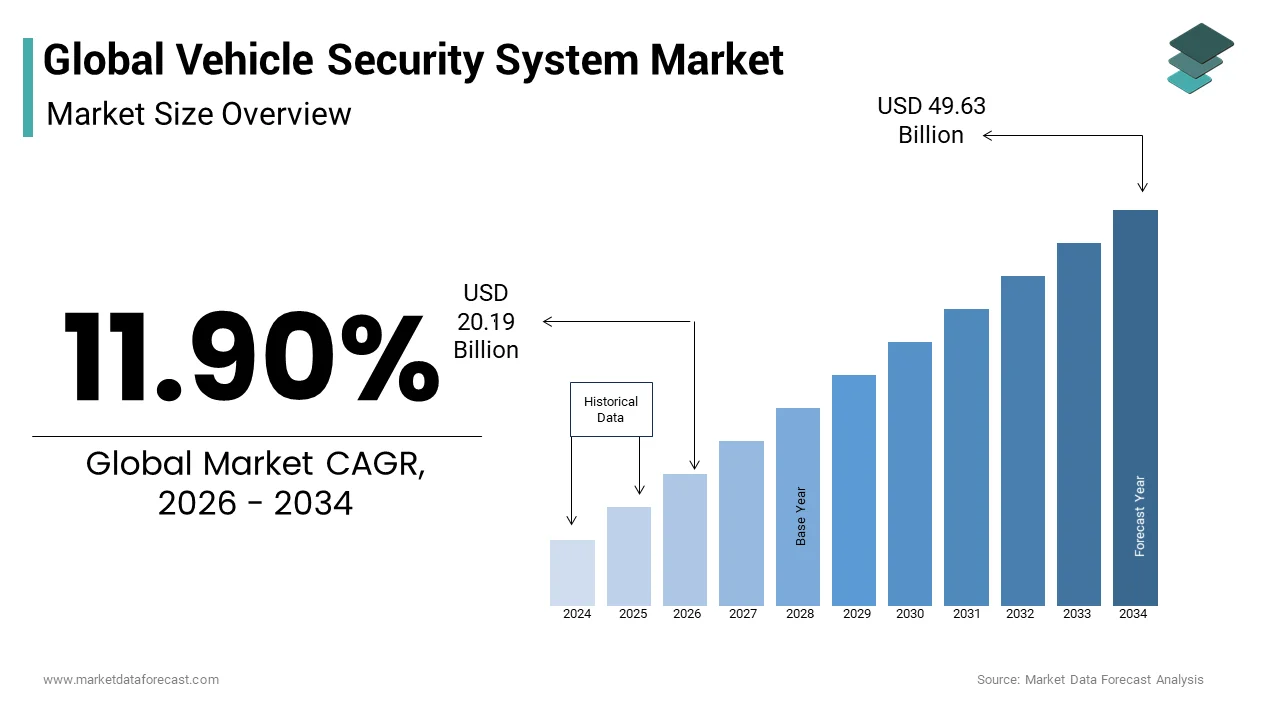
The global vehicle security system market size was valued at USD 18.04 billion in 2025, stands at USD 20.19 billion in 2026, and is anticipated to reach a valuation of USD 49.63 billion by 2034, registering a robust compound annual growth rate (CAGR) of 11.9% during the forecast period from 2026 to 2034. Growth is primarily driven by rising rates of vehicle theft, the global shift toward software-defined connected vehicles, and strict legislative mandates requiring factory-fit electronic engine immobilization devices.
Key Executive Metrics (At-a-Glance)
- 2025 Base Valuation: USD 18.04 Billion
- 2026 Current Valuation: USD 20.19 Billion
- 2034 Forecast Valuation: USD 49.63 Billion
- Compound Annual Growth Rate (CAGR): 11.9% (2026–2034)
- Dominant Product Type Segment: Immobilizers captured 30.3% of the global market share in 2025 due to widespread statutory mandates across international transport authorities.
- Fastest Growing Product Type Segment: Passive keyless entry is estimated to register a CAGR of 11.4% driven by surging consumer demand for hands-free proximity access.
- Dominant Technology Segment: Positioning systems (GPS) led with 21.5% of the market share in 2025 for real-time tracking and recovery.
- Fastest Growing Technology Segment: Face detection systems are projected to grow at a CAGR of 12.4% due to biometric cabin authentication neutralizing relay attacks.
- Dominant Vehicle Segment: Passenger cars lead the market with over 60% revenue share, while commercial vehicles are expanding rapidly at a 9.5% CAGR.
- Regional Market Leadership: Asia-Pacific stands as the largest and fastest-growing market, followed closely by North America and Europe.
Core Market Drivers
- Organized Criminal Sophistication: Escalating rates of tech-enabled vehicle theft utilizing electronic signal relays and key programming toolkits, forcing heavy investments in tracking beacons and cellular immobilizers.
- Connected & Software-Defined Architectures: Proliferation of cloud-connected telematics and smart vehicle platforms requiring advanced cybersecurity, intrusion detection systems, and encrypted over-the-air updates.
Primary Market Restraints & Challenges
- Implementation Costs & Retrofitting Barriers: High component pricing, complex dashboard integration, and steep labor rates restricting advanced anti-theft upgrades in older legacy fleets.
- Technical Workforce Shortages: Acute global shortages of specialized automotive cybersecurity and mechatronics technicians limiting workshop installation throughput.
Global Vehicle Security System Market Segmentation Breakdown
| Segment Category | Key Offerings / Categories | Largest / Leading Sub-Segment | Fastest Growing Sub-Segment |
|---|---|---|---|
| By Product Type | Alarm, Immobilizer, Remote Keyless Entry, Passive Keyless Entry, Central Locking System | Immobilizer (30.3% share) | Passive Keyless Entry (11.4% CAGR) |
| By Vehicle Type | Passenger Car, Commercial Vehicle, Off-Highway Vehicle | Passenger Car (>60% share) | Commercial Vehicle (9.5% CAGR) |
| By Technology | Global Positioning System, Global System for Mobile Communication, Face Detection System, Real-Time Location System | Global Positioning System (21.5% share) | Face Detection System (12.4% CAGR) |
| By Region | North America, Europe, Asia-Pacific, Latin America, Middle East and Africa | Asia-Pacific | Asia-Pacific |
Major Industry Players Profiled
Key market participants operating across the global vehicle security system ecosystem include Continental AG, Robert Bosch GmbH, Valeo SA, Lear Corporation, and specialized industry associations and suppliers.
Global Vehicle Security System Market Size
The global vehicle security system market size was valued at USD 18.04 billion in 2025 and is anticipated to reach a valuation of USD 20.19 billion in 2026, and USD 49.63 billion by 2034, growing at a CAGR of 11.9%, from 2026 to 2034.
Vehicle security system includes integrated electronic devices, mechanical immobilizers, alarm networks, biometric access controls, and cybersecurity software solutions designed to protect automobiles from unauthorized access, physical theft, and digital intrusion. As a foundational sector within automotive electronics, this market ensures asset protection for commercial and passenger fleets alike. According to the European Automobile Manufacturers Association, regional motor vehicle production exceeded 16.3 million units, establishing an expansive manufacturing base that systematically incorporates advanced factory-fit security architectures across European assembly lines. This dense production landscape directly drives market expansion because modern vehicle platforms require multi-layered electronic defenses to counter sophisticated criminal tactics. Furthermore, according to Eurostat, municipal population densities across European urban centers reached record thresholds, heightening localized vehicle security risks and stimulating continuous consumer demand for robust anti-theft tracking and alarm installations.
MARKET DRIVERS
Rising Vehicle Theft and Criminal Sophistication
The growth of the vehicle security system market is majorly driven by the organized criminal syndicates utilizing sophisticated electronic signal relays and key programming toolkits to bypass traditional factory locks, leaving older vehicle fleets vulnerable to opportunistic theft. Escalating rates of vehicle theft and criminal sophistication generate an urgent demand wave for advanced vehicle security systems, as reported by Federal Bureau of Investigation crime reporting data on rising automobile theft volumes across major metropolitan networks. Vehicle owners and commercial fleet managers are forced to invest heavily in secondary aftermarket security installations, including GPS tracking beacons, cellular immobilizers, and loud perimeter alarms, to protect their mobile assets. According to the National Insurance Crime Bureau, vehicle recovery rates for equipped units exceed 85%, highlighting the direct operational utility of real-time tracking technology in combating organized auto theft rings. This security imperative relates directly to the vehicle security system market by driving continuous consumer acquisition of active monitoring subscriptions and hardware retrofits. Additionally, according to international insurance council evaluations, policy underwriters offer significant premium discounts for vehicles protected by certified multi-layered electronic security systems, accelerating private market adoption.
Connected Vehicles and Software-Defined Architectures
The transition toward software-defined vehicles, where remote keyless entry, smartphone-as-a-key protocols, and cloud-connected telematics open potential digital attack vectors for cybercriminals, which is further aiding the global market expansion. Proliferation of connected vehicles and software-defined architectures introduces complex software vulnerabilities that heavily boost demand for digital vehicle security systems, according to International Telecommunication Union digital mobility insights. Protecting modern vehicles requires sophisticated in-vehicle intrusion detection systems, encrypted communication channels, and over-the-air security update protocols to shield electronic control units from remote hacking. According to International Energy Agency global connectivity tracking data, active connected vehicle fleets surpassed 250 million units worldwide, establishing a massive addressable ecosystem requiring continuous digital surveillance. This technological evolution relates directly to the vehicle security system market by shifting industry revenues away from pure mechanical hardware toward software-driven cybersecurity solutions and real-time threat monitoring services. Furthermore, according to automotive software association benchmarks, enterprise investments in automotive cybersecurity operations centers grew by 22% annually, cementing the critical role of digital defense integration.
MARKET RESTRAINTS
Implementation Costs and Retrofitting Barriers
The expensive nature of advanced biometric access controls, encrypted ultra-wideband transponders, and professional dashboard integration required for modern security suites is a major restraint for the global vehicle security system market. High implementation costs and complex hardware retrofitting barriers create a severe financial restraint that discourages budget-conscious vehicle owners from upgrading older security infrastructure, as indicated by Bureau of Labor Statistics consumer price indexes. When attempting to retrofit older automobiles with contemporary security configurations, consumers face steep parts pricing and high hourly shop labor rates that frequently outweigh the perceived resale value of legacy vehicles. According to the Motor and Equipment Manufacturers Association, specialized electronic component manufacturing expenses rose across global fabrication hubs, driving up wholesale retail prices for premium alarm and immobilizer kits. This financial friction relates directly to the vehicle security system market by restricting advanced anti-theft adoption primarily to new luxury vehicle purchases while leaving older segments underserved. Additionally, according to automotive consumer research panels, high upfront accessory costs remain a primary deterrent for independent car owners seeking aftermarket security upgrades.
Technical Workforce Shortages
Acute shortage of specialized automotive cybersecurity and electronics technicians creates a major operational constraint that limits security system installation throughput, which is further hampering the global vehicle security system market growth. As automobiles transform into rolling computers, traditional mechanics frequently lack the specialized diagnostic training needed to program encrypted key fobs and calibrate delicate interior ultrasonic intrusion sensors. According to International Labour Organization technical education metrics, vocational training enrollment rates for advanced automotive mechatronics lag behind commercial service demands, creating a wide talent gap. This workforce deficit relates directly to the vehicle security system market by extending customer wait times, elevating workshop installation fees, and restricting the operational capacity of regional security retrofitters. Furthermore, according to industry human resource benchmarks, security product manufacturers must spend heavily on proprietary dealer training programs, adding substantial operational friction to supply chains.
MARKET OPPORTUNITIES
Biometric Authentication and Smartphone Access
Integration of biometric authentication and smartphone-as-a-key protocols unlocks lucrative commercial expansion opportunities for vehicle security system manufacturers, as highlighted in Deloitte digital automotive studies. Advanced biometric authentication prevents relay attacks completely, because physical vehicle ignition remains locked until the specific biological signature of the authorized driver is verified by onboard sensors. According to Car Connectivity Consortium technology adoption surveys, 82% of surveyed mobility organizations identified smartphone vehicle access as a top strategic priority for next-generation transport ecosystems. This technological trend relates directly to the vehicle security system market by creating high-margin product categories that command premium pricing among original equipment manufacturers. Additionally, according to mobile technology trade association reports, consumer willingness to pay for digital subscription security features expanded by 18%, opening recurring revenue streams for automotive technology providers.
Fleet Telematics and Commercial Asset Monitoring
Expansion of fleet telematics and commercial asset monitoring networks generates powerful commercial opportunities for the global vehicle security system market. Fleet security systems now integrate geo-fencing alerts, remote engine kill switches, and driver behavior analytics directly into centralized dispatch dashboards to minimize commercial liability and asset loss. According to International Road Transport Union operational reports, commercial transport fleet utilization metrics increased by 8% annually, escalating the financial stakes of vehicle theft or cargo hijacking. This commercial expansion relates directly to the vehicle security system market by driving bulk B2B procurement contracts for ruggedized, enterprise-grade telematics and security hardware. Furthermore, according to international supply chain benchmarks, fleet managers utilizing integrated security tracking systems report a 30% reduction in unauthorized vehicle downtime, accelerating commercial adoption rates.
MARKET CHALLENGES
Relay Attacks and Signal Spoofing Vulnerabilities
Vulnerability to relay attacks and advanced signal spoofing techniques is a notable challenge to the global vehicle security system market expansion. Traditional passive keyless entry systems are inherently vulnerable to this vector, forcing manufacturers to rapidly redesign communication protocols using motion-sensing key fobs and ultra-wideband radio localization. According to National Insurance Crime Bureau tactical briefings, electronic relay thefts account for an increasing share of luxury vehicle losses in dense urban neighbourhoods. This security vulnerability relates directly to the vehicle security system market by forcing rapid product obsolescence, costly firmware recalls, and emergency software patches to neutralize active exploit methods. Additionally, according to consumer protection surveys, public awareness of relay theft vulnerabilities has damaged consumer trust in standard wireless key fobs, which is compelling manufacturers to invest heavily in tamper-proof hardware redesigns.
Regulatory Fragmentation and Compliance Mandates
Regulatory fragmentation and stringent international cybersecurity compliance mandates create severe administrative and financial friction for vehicle security system manufacturers. Manufacturers must allocate massive capital reserves to pass exhaustive penetration testing and homologation audits for every separate export market they intend to service. According to International Organization for Standardization operational updates, compliance verification costs for automotive electronic subassemblies increased by double digits across global testing laboratories. This regulatory burden relates directly to the vehicle security system market by delaying product launch timelines and disproportionately squeezing smaller aftermarket security developers who lack large compliance budgets. Furthermore, according to automotive trade association disclosures, navigating multi-jurisdictional cybersecurity mandates adds significant overhead expenses that are ultimately passed down to automotive component buyers.
REPORT COVERAGE
| REPORT METRIC | DETAILS |
| Market Size Available | 2025 to 2034 |
| Base Year | 2025 |
| Forecast Period | 2026 to 2034 |
| CAGR | 11.9% |
| Segments Covered | By Product Type, Vehicle Type, Technology, and Region. |
| Various Analyses Covered | Global, Regional, & Country Level Analysis; Segment-Level Analysis; DROC, PESTLE Analysis; Porter’s Five Forces Analysis; Competitive Landscape; Analyst Overview of Investment Opportunities |
| Regions Covered | North America, Europe, APAC, Latin America, Middle East & Africa |
| Market Leaders Profiled | Robert Bosch GmbH (Germany), Continental AG (Germany), and Lear Corporation (U.S.), research institutes such as the Automotive Research Association of India (ARAI), European Automotive Research Partners Association (EARPA), and the United States Council for Automotive Research (USCAR), and regional automobile associations such as China Association of Automobile Manufacturers (CAAM), Japan Automobile Manufacturers Association (JAMA), and the European Automobile Manufacturers Association (ACEA), and Others. |
SEGMENT ANALYSIS
By Product Insights
The immobilizer segment dominated the market by capturing 30.3% of the global market share in 2025 and is estimated to maintain the leading position in the product type category throughout the forecast period due to the widespread legislative mandate implemented by international transport authorities requiring factory-fitted electronic engine immobilization devices on all newly produced motor vehicles to thwart hot-wiring attempts. According to National Highway Traffic Safety Administration vehicle safety compliance summaries, mandatory immobilizer legislation contributed to a 20% reduction in unauthorized vehicle thefts across major metropolitan test zones over a multi-year evaluation window. This regulatory enforcement relates directly to the vehicle security system market by establishing a non-negotiable baseline of hardware integration that every original equipment manufacturer must incorporate into standard production lines. Furthermore, according to international insurance rating bureau assessments, automobiles equipped with certified engine immobilizers qualify for a 15% reduction in comprehensive insurance premiums, heavily incentivizing private vehicle buyers to choose protected models.
However, the passive keyless entry segment emerges as the fastest growing category within product types and is estimated to register a CAGR of 11.4% over the forecast period in the global market owing to the rising consumer preference for seamless, hands-free automotive access where doors unlock automatically as the owner approaches the vehicle carrying an encrypted transponder fob. According to Car Connectivity Consortium technology adoption surveys, 82% of surveyed vehicle buyers prioritize advanced proximity sensing and keyless convenience when selecting next-generation passenger cars. This rapid growth connects directly to the vehicle security system market by encouraging luxury and mid-range original equipment manufacturers to transition away from traditional mechanical keys toward high-margin digital entry suites. Additionally, according to global automotive electronics distributor reports, aftermarket installations of passive entry upgrade modules grew by 16% annually as motorists sought to modernize older legacy vehicles with contemporary convenience features.
By Technology Insights
The positioning system segment led the market by commanding for the 21.5% of the global market share in 2025. The dominance of positioning system segment in the global market is attributed to the critical requirement for real-time asset tracking and instantaneous stolen vehicle recovery capabilities demanded by commercial fleet operators and private insurance companies alike. According to Federal Bureau of Investigation crime reporting division data, connected GPS tracking beacons enable law enforcement agencies to achieve an 85% vehicle recovery rate within the first 24 hours of a reported theft. This high recovery efficiency relates directly to the vehicle security system market by driving massive bulk procurement contracts from commercial logistics enterprises seeking to protect high-value cargo shipments. Furthermore, according to International Road Transport Union telemetry reports, commercial fleet operators utilizing active positioning security grids experienced a 25% decrease in unauthorized vehicle usage incidents, reinforcing widespread commercial adoption.
On the other end, the face detection system segment is predicted to witness a CAGR of 12.4% over the forecast period in the global market owing to the integration of cabin-facing biometric cameras and artificial intelligence algorithms that verify driver identity before allowing engine ignition, effectively neutralizing relay theft threats. According to Society of Automotive Engineers technology metrics, biometric cabin monitoring system installations in luxury and commercial vehicles increased by 28% year-on-year. This technological surge connects directly to the vehicle security system market by opening lucrative revenue streams for advanced software-driven security features that command premium retail pricing. Additionally, according to cybersecurity research council findings, corporate fleets adopting facial recognition driver authentication report a 40% reduction in unauthorized vehicle operation, cementing high-growth market demand.
By Vehicle Insights
The passenger car segment led the market with the highest share of the global market in 2025. The dominance of the passenger car segment in the global market can be credited to the massive global consumer ownership volumes and high daily commuting requirements. For instance, passenger cars account for over 60% of total vehicle security system market revenue, establishing an unmatched baseline consumption volume for alarms and central locking systems. This dominant position relates directly to the sheer numerical superiority of passenger automobiles within the global vehicle parc, where millions of consumer vehicles continually require active perimeter protection in dense urban environments. Additionally, according to the Federal Highway Administration, annual passenger vehicle miles traveled increased by 3.5%, escalating exposure to opportunistic parking lot thefts and driving routine security maintenance. This high exposure connects directly to the vehicle security system market by ensuring continuous original equipment manufacturer and aftermarket demand for replacement lock actuators, alarm sirens, and glass break sensors. Furthermore, according to global automotive consumer research panels, 75% of private vehicle buyers rate anti-theft security features as a decisive factor when purchasing a new passenger automobile.
On the other side, the commercial vehicles segment is projected to grow at a CAGR of 9.5% over the forecast period owing to the rapid expansion of last-mile delivery fleets, heavy freight transport operations, and ride-sharing networks that require rigorous asset monitoring to prevent commercial cargo theft. According to International Transport Forum logistics benchmarks, global commercial freight transport volumes expanded by 7%, placing millions of high-value transport trucks and delivery vans at risk of transit interception. This rapid expansion relates directly to the vehicle security system market by compelling fleet managers to invest heavily in multi-layered security architectures, remote engine immobilizers, and live tracking telemetry. Additionally, according to international logistics association reports, commercial operators allocate nearly 12% of their annual vehicle maintenance budgets specifically toward upgrading security and telematics hardware to satisfy strict corporate insurance mandates.
REGIONAL ANALYSIS
North America Market Analysis
North America held the leading share of the global market in 2025 and is expected to maintain steady growth over the next few years, maintaining a dominant and mature position as a major regional revenue contributor within the global vehicle security system market, supported by advanced connected vehicle infrastructure and high consumer awareness regarding automotive asset protection. According to the United States Department of Transportation, national vehicle operating hours reached peak levels, creating continuous demand for robust anti-theft tracking and alarm installations across major metropolitan centers. This regional market status relates directly to advanced consumer preference for integrated smartphone-as-a-key platforms and premium digital cybersecurity solutions that safeguard modern software-defined vehicles. Additionally, according to the Specialty Equipment Market Association, regional automotive aftermarket security upgrade expenditures expanded by 6%, reflecting strong consumer spending on localized vehicle hardening and GPS recovery modules.
Europe Market Analysis
Europe is likely to experience stable expansion over the coming years, commanding a prominent regional market position driven by stringent automotive safety legislation, high vehicle population densities, and sophisticated manufacturing standards enforced across continental production hubs. According to the European Automobile Manufacturers Association, regional vehicle production exceeded 16.3 million units, ensuring that advanced factory-fit security architectures are systematically integrated into all assembly lines. This regional standing relates directly to rigorous European Union type-approval regulations that mandate electronic immobilizers and perimeter alarm systems on every new passenger and commercial vehicle. Furthermore, according to Eurostat urban mobility reports, expanding municipal population densities heightened localized vehicle security risks, stimulating continuous consumer adoption of cellular tracking beacons and encrypted keyless entry suites.
Latin America Market Analysis
Latin America is projected to show moderate growth over the next few years, acting as an expanding regional growth zone characterized by rising vehicle registration volumes and a heavy reliance on independent aftermarket security retrofitters. According to the Economic Commission for Latin America and the Caribbean, regional automotive sales rose by 5%, steadily increasing the long-term addressable base for vehicle security system manufacturers. This market status relates directly to urban security concerns that motivate vehicle owners to purchase secondary mechanical steering locks, loud perimeter alarms, and manual immobilizers. Additionally, according to the Latin American Automotive Association, investments in regional independent accessory installation networks grew by 7%, improving local technical capabilities for integrating advanced alarm and central locking systems into older legacy fleets.
Asia Pacific Market Analysis
Asia Pacific is anticipated to record rapid development over the next few years, standing as the largest and fastest growing regional market within the global vehicle security system industry, propelled by massive automotive manufacturing output across China, Japan, and other regional economies. According to the China Association of Automobile Manufacturers, domestic vehicle production figures surpassed tens of millions of units annually, establishing an enormous foundational vehicle parc that requires mandatory security integration. This dominant regional position relates directly to the exponential surge in urban passenger car sales paired with government-backed anti-theft regulations that require standard immobilizer fitment across all mass-market models. Moreover, according to automotive trade association benchmarks, regional commercial vehicle sales registered consistent growth spikes, driving heavy regional demand for commercial-grade GPS tracking and fleet security management systems.
Middle East and Africa Market Analysis
Middle East and Africa is poised for progressive advancement over the coming years, operating as a specialized regional market influenced by luxury vehicle concentrations, vast cross-border trade corridors, and extreme environmental operating conditions. According to regional transport authorities, heavy commercial freight traffic expanded by 7%, creating intense security demands for long-haul transport trucks operating across remote desert highways. This regional market status relates directly to high concentrations of premium and luxury passenger automobiles that require advanced biometric access controls, face detection systems, and encrypted satellite tracking to deter organized theft rings. Furthermore, according to the African Development Bank, transnational trade corridor investments stimulated commercial fleet expansions, locking in steady regional demand for enterprise-grade vehicle security systems and professional installation services.
COMPETITIVE LANDSCAPE
The global vehicle security system market exhibits a moderately consolidated and fiercely competitive landscape governed by established multinational automotive suppliers and specialized electronic component manufacturers. Industry participants continuously compete for high-value original equipment manufacturer contracts by offering engineered security solutions that comply with strict international cyber resilience, crash safety, and anti-theft standards. Competition centers on technological innovation, integration speed with software-defined vehicle architectures, and the capacity to supply tamper-proof digital key and biometric access suites. Major market players heavily invest in localized R&D hubs, advanced radar and camera sensor fusion, and comprehensive cloud-monitoring networks to counteract sophisticated relay theft tactics and reduce vulnerability windows. Stringent regulatory compliance requirements and the rapid evolution of connected mobility further intensify rivalry, compelling firms to prioritize superior software reliability and robust encryption protocols to secure long-term operational growth.
KEY MARKET PLAYERS
The ecosystem of the vehicle security system industry consists of manufacturers such as
- Robert Bosch GmbH (Germany)
- Continental AG (Germany)
- Lear Corporation (U.S.)
- Valeo SA
- Automotive Research Association of India (ARAI)
- European Automotive Research Partners Association (EARPA)
- United States Council for Automotive Research (USCAR)
- China Association of Automobile Manufacturers (CAAM)
- Japan Automobile Manufacturers Association (JAMA)
- European Automobile Manufacturers Association (ACEA).
Top Players In The Market
- Continental AG functions as a major global automotive technology pioneer specializing in the design and delivery of advanced electronic control units, immobilizer modules, and cybersecurity frameworks for modern vehicle security systems. Its active involvement encompasses the integration of secure access architectures, ultra-wideband transponders, and cloud-connected intrusion detection tools that protect passenger automobiles from complex cyber threats. To strengthen its commercial position, the corporation heavily invests in software-defined vehicle platforms and high-performance computing zones designed to execute real-time threat analysis. Furthermore, the company expands its cooperative partnerships with leading software developers to ensure seamless over-the-air security updates across international vehicle fleets.
- Robert Bosch GmbH operates as a premier global supplier of mobility services and industrial technology, providing state-of-the-art vehicle security components including encrypted keyless entry systems, sensor networks, and electronic immobilizers. Its core market involvement centers on developing robust hardware enablers and smart sensor technologies that secure vehicle perimeters against unauthorized physical entry and relay attacks. To reinforce its competitive stance, the enterprise continuously upgrades its microchip processing units and deploys advanced artificial intelligence platforms to enhance cabin authentication protocols. Additionally, the corporation focuses on expanding its localized manufacturing and engineering footprints to support original equipment manufacturers in rapidly deploying secure vehicle networks.
- Valeo SA acts as a vital international automotive technology company dedicated to creating innovative driving assistance solutions, passive entry systems, and secure biometric access controls for global transport manufacturers. Its primary market involvement focuses on engineering scalable security packages that combine camera vision technology, radar fusion, and encrypted digital key platforms to prevent vehicle theft. For strengthening its competitive advantage, the firm prioritizes the development of cost-optimized, flexible architectures capable of operating across diverse voltage standards in commercial and passenger vehicles. Moreover, the enterprise enhances its technical support infrastructure and expands regional production hubs to meet surging international demand for connected vehicle security solutions.
Top Strategies Used By Key Market Participants
Key market participants deploy advanced strategic initiatives including long-term supply agreements with multinational automotive manufacturers, targeted acquisitions of specialized cybersecurity firms, joint ventures for biometric software development, and portfolio diversification into cloud-connected telematics platforms. Furthermore, leading firms emphasize continuous investments in automated manufacturing facilities, rigorous penetration testing laboratories, and scalable over-the-air software update frameworks to maintain competitive advantages within the global industry.
Major Strategic Actions Taken By Key Companies
- April 2024: DynaTouch acquired KioWare, a kiosk management software company, to offer comprehensive kiosk solutions and strengthen the vehicle security system market presence.
- January 2025: Continental AG unveiled its software-defined vehicle digital architecture framework at the Consumer Electronics Show to enhance cloud-connected vehicle security management.
- March 2025: Robert Bosch GmbH deployed advanced sensor-on-chip series technologies equipped with enhanced data encryption to secure next-generation automated vehicle platforms.
- May 2026: Valeo SA secured a major commercial vehicle deployment contract with a leading original equipment manufacturer in India to integrate advanced safety and security driver monitoring systems.
- June 2026: Continental AG expanded its European automotive software development hub to accelerate the deployment of encrypted over-the-air intrusion defense patches.
MARKET SEGMENTATION
This research report on the global vehicle security market has been segmented and sub-segmented based on product type, vehicle type, technology, and region.
By Product Type
- Alarm
- Immobilizer
- Remote Keyless Entry
- Passive Keyless Entry
- Central Locking System
By Vehicle Type
- Passenger Car
- Commercial Vehicle
- Off-Highway Vehicle
By Technology
- Global Positioning System
- Global System for Mobile Communication
- Face Detection System
- Real-Time Location System
By Region
- North America
- Europe
- Asia-Pacific
- Latin America
- Middle East and Africa