- Product Description Description
- Table of Contents TOC
- List of Table & Figure LOT
- Get Free Sample PDF Sample PDF
Market Size, 2025
$1885 MnMarket Estimate, 2026
$2224 MnMarket Forecast, 2034
$8361 MnCAGR, 2026–2034
18%Global Healthcare 3D Printing Market Report Summary
The global healthcare 3D printing market was valued at USD 1,885 million in 2025, is estimated to reach USD 2,224.30 million in 2026, and is projected to reach USD 8,361 million by 2034, growing at a CAGR of 18% from 2026 to 2034. Market growth is driven by the increasing adoption of personalized medicine, rising demand for patient-specific implants and prosthetics, and advancements in additive manufacturing technologies. Healthcare 3D printing enables precise anatomical modeling, improved surgical planning, and customized treatment solutions. The growing use of 3D printing in orthopedics, dental applications, and tissue engineering, along with increasing investments in healthcare innovation, is further accelerating market expansion globally.
Key Market Trends
- Increasing adoption of patient-specific implants and prosthetics.
- Growing use of 3D printing for surgical planning and anatomical models.
- Rising demand for personalized and precision medicine.
- Advancements in bioprinting and tissue engineering technologies.
- Expansion of digital workflows integrating imaging and 3D printing.
Segmental Insights
- Based on modality, the standalone segment dominated the global healthcare 3D printing market by capturing 61.6% share in 2025, driven by widespread deployment in hospitals and research centers.
- Based on component, the software segment is projected to register the fastest CAGR of 26.2%, supported by increasing demand for automated design workflows and imaging integration.
- Based on technology, the photopolymerization segment led the market with 40.4% share in 2025, due to its high precision, resolution, and superior surface finish.
- Based on application, the medical segment held the largest share of 45.5% in 2025, driven by growing use in surgical planning, implants, and patient-specific solutions.
Regional Insights
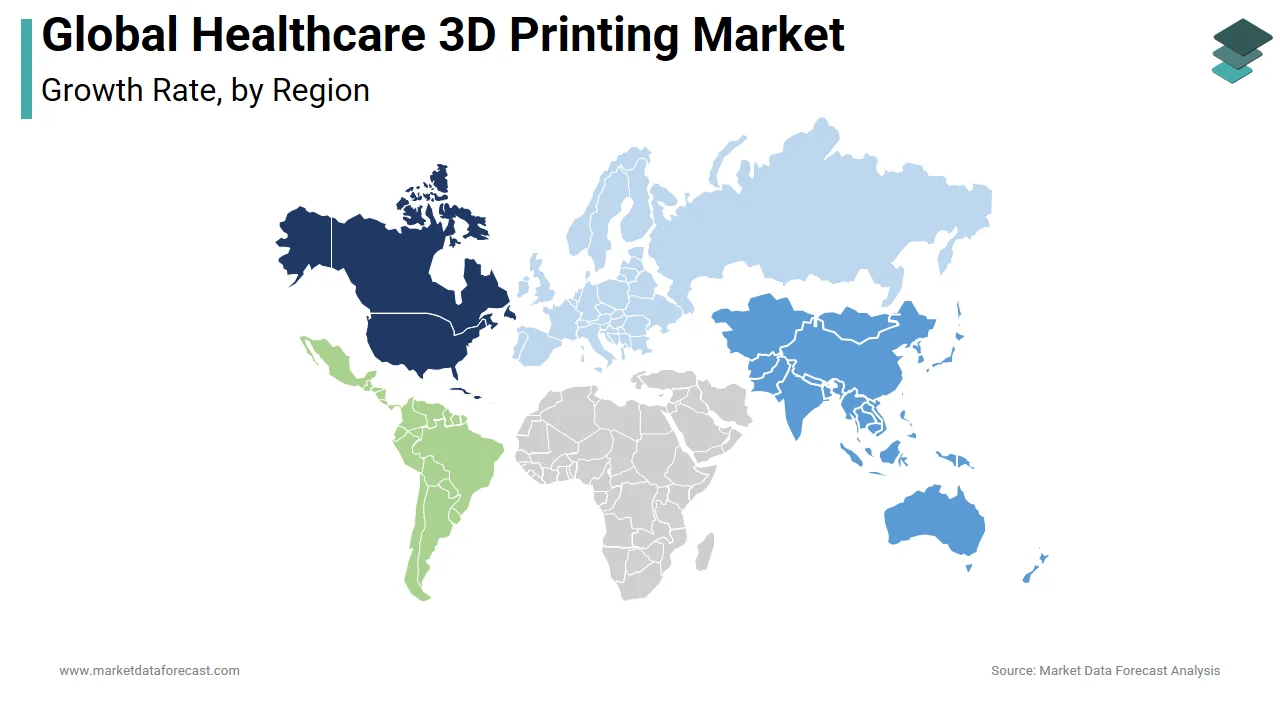
The global healthcare 3D printing market is witnessing strong growth across regions due to technological advancements and increasing healthcare investments.
- North America led the market in 2025 with 41.4% share, supported by strong R&D capabilities and early adoption of advanced technologies.
- Europe followed with 22.9% share in 2025, driven by increasing adoption of digital healthcare solutions and strong regulatory support.
- Asia-Pacific is the fastest-growing region due to expanding healthcare infrastructure, large population base, and rising investments in medical innovation.
Competitive Landscape
The global healthcare 3D printing market is highly competitive, with the presence of technology providers, medical device companies, and specialized additive manufacturing firms. Market players are focusing on innovation, expanding application areas, and integrating advanced software and materials into their offerings. Strategic collaborations, product development, and investments in bioprinting are shaping competitive dynamics across the market.
Prominent companies operating in the global healthcare 3D printing market include 3D Systems Corporation, ExOne, Formlabs, GE, Materialise NV, Oxford Performance Materials, Inc., Organovo Holdings, Inc., Proto Labs, SLM Solutions Group AG, Stratasys Ltd., Aspect Biosystems, EOS GmbH, Cellink, Renishaw, Prodways, and EnvisionTEC.
Global Healthcare 3D Printing Market Size
The size of the global healthcare 3D printing market was worth USD 1,885 million in 2025. The global market is anticipated to grow at a CAGR of 18% from 2026 to 2034 and be worth USD 8,361 million by 2034 from USD 2,224.30 million in 2026.

Healthcare 3D printing represents a transformative paradigm in modern medicine where additive manufacturing technologies fabricate patient-specific anatomical models, surgical guides, implants, and bioprinted tissues layer by layer. This technology shifts medical device production from mass manufacturing to personalized solutions tailored to individual physiological requirements. The integration of computed tomography and magnetic resonance imaging data allows clinicians to create precise digital replicas of patient anatomy before physical fabrication occurs. According to the European Society of Radiology, many hospitals in Europe have integrated some form of 3D printing capability into their clinical workflows. As per the United States Food and Drug Administration, numerous 3D printed medical devices have been cleared since 2017, which signals robust regulatory acceptance. According to the American Academy of Orthopaedic Surgeons, orthopedic surgeons in developed nations widely utilize 3D printed models for preoperative planning. As per the National Institutes of Health, bioprinting research has advanced to the stage where scientists can print living human skin cells with high viability rates. According to the British Association of Dermatologists, stress-induced telogen effluvium has become increasingly common, affecting a notable portion of adults following major life events. As per the Association of American Medical Colleges, educational institutions now incorporate 3D printed anatomical models in a majority of medical training programs. This technological evolution fundamentally alters how healthcare providers approach diagnosis, treatment planning, and therapeutic intervention across multiple specialties.
MARKET DRIVERS
Rising Demand for Personalized Implants and Prosthetics
The escalating requirement for customized medical solutions is primarily driving the global healthcare 3D printing market growth, as traditional mass-produced implants often fail to match unique patient anatomies perfectly. As per the Journal of Orthopaedic Research, patient-specific implants are shown to reduce surgical time and decrease complication rates. As per the European Hip Society, a significant number of hip and knee replacement surgeries in Europe now utilize 3D printed custom implants. Craniofacial reconstruction procedures benefit immensely from this technology since standard implants cannot address complex geometries effectively. As per the International Diabetes Federation, diabetic foot ulcers require customized offloading devices that 3D printing can produce quickly. Pediatric patients particularly benefit since their growing skeletons require frequently adjusted prosthetics that conventional manufacturing cannot economically provide. Approximately 1.7 million people in the United States live with limb loss, and 3D printed prosthetics cost 90% less than traditional options, according to the Amputee Coalition. As per the American Dental Association, dental applications drive significant volume with millions of crowns and bridges fabricated using 3D printing technology annually. This personalization capability directly improves patient outcomes while reducing overall healthcare expenditure through shorter hospital stays and fewer revision surgeries.
Advancements in Bioprinting and Regenerative Medicine
Breakthroughs in bioprinting technology create unprecedented opportunities for tissue engineering and organ regeneration that address critical global healthcare shortages, which is further boosting the expansion of the healthcare 3D printing market. As per Harvard University research, scientists have successfully printed functional human heart tissue patches that demonstrate contractile capabilities. As per the United Network for Organ Sharing, many patients remain on the global organ transplant waiting list, and daily deaths occur while waiting for organs. As per the International Society for Burn Injuries, bioprinted skin grafts have shown high success rates in treating severe burn victims across clinical trials. As per the National Centre for the Replacement, Refinement and Reduction of Animals in Research, pharmaceutical companies utilize 3D printed tissue models for drug testing, reducing reliance on animal testing while improving the prediction accuracy of human responses. As per Global Data, numerous bioprinting startups have received substantial venture capital funding. As per the Wake Forest Institute, researchers have printed ear cartilage that integrates with native tissue successfully. As per the Wound Healing Society, bioprinted skin substitutes accelerate healing compared to conventional dressings. These advancements position bioprinting as a cornerstone of future regenerative therapies with the potential to eliminate organ rejection.
MARKET RESTRAINTS
Stringent Regulatory Approval Processes
Complex and varying regulatory frameworks across different jurisdictions create substantial barriers that slow the commercialization of 3D printed medical devices significantly, which is majorly impeding the healthcare 3D printing market growth. As per the United States Food and Drug Administration, patient-specific implant designs require extensive clinical validation, extending approval timelines compared to standard devices. As per the European Commission, the implementation of the Medical Device Regulation increased documentation requirements, causing delays for small manufacturers. As per the National Institutes of Health, each material used in bioprinting must undergo separate biocompatibility testing that adds high costs. The lack of standardized post market surveillance protocols for customized devices creates uncertainty among investors and manufacturers alike. As per the Additive Manufacturing Users Group, many 3D printing startups cite regulatory compliance as their biggest operational challenge. As per Japan's Pharmaceuticals and Medical Devices Agency, duplicate testing requirements add delays to market entry timelines. As per the European Medicines Agency, application processing capacity has not kept pace with rising submissions. These regulatory hurdles increase development costs, limiting accessibility for smaller healthcare providers and stifling innovation in resource-constrained environments.
High Initial Capital Investment and Operational Costs
Substantial financial requirements for acquiring industrial-grade 3D printing systems and maintaining specialized facilities restrict widespread adoption, particularly among smaller healthcare institutions, which is further hampering the expansion of the healthcare 3D printing market. For instance, industrial metal 3D printers that are suitable for implant fabrication are highly expensive. The annual maintenance contracts for these systems represent a significant portion of the initial purchase price. As per the International Organization for Standardization, specialized facilities require clean room environments meeting ISO Class 7 standards that are costly to construct and operate. As per the Bureau of Labor Statistics, trained personnel command premium salaries compared to traditional laboratory staff. As per commodity market data, medical-grade titanium powder is significantly more expensive than conventional forms. Small hospitals with limited budgets cannot justify these expenditures when utilization rates remain low during initial implementation phases. As per the European Health Insurance database, insurance reimbursement policies cover only a portion of 3D printed procedure costs in most European countries. These financial barriers prevent many community hospitals from adopting the technology despite demonstrated clinical benefits, creating a disparity in access between large academic medical centers and smaller regional facilities.
MARKET OPPORTUNITIES
Expansion of Point of Care Manufacturing
The decentralization of medical device production through onsite hospital-based 3D printing laboratories is a significant opportunity for the healthcare 3D printing market. As per the Radiological Society of North America, many hospitals worldwide have established dedicated 3D printing facilities that produce surgical guides quickly after imaging acquisition. As per the World Health Organization, this point-of-care model reduces supply chain dependencies that previously caused surgical delays during global disruptions. Emergency departments benefit from rapid fabrication of custom splints and immobilization devices that fit effectively on the first attempt, as documented by the American College of Emergency Physicians. As per the Children's Hospital Association, pediatric hospitals achieve significant cost savings by printing respiratory masks and feeding tubes sized precisely for infants rather than maintaining extensive inventory. The Veterans Health Administration operates numerous point-of-care printing sites that produced a large number of custom devices in 2024. As per the World Bank, rural healthcare facilities gain access to specialized devices previously unavailable due to logistical constraints, serving underserved patients globally. As per the Society of Manufacturing Engineers, training programs now certify hospital staff in 3D printing operations, with thousands of technicians qualified in 2024. As per the Environmental Protection Agency, this distributed manufacturing approach reduces carbon emissions through the elimination of transportation and packaging. The scalability of this model allows hospitals to respond dynamically to emerging health crises without relying on external suppliers.
Integration of Artificial Intelligence with Workflows
The convergence of artificial intelligence algorithms with 3D printing systems unlocks unprecedented capabilities in design optimization, quality control, and predictive maintenance that enhance clinical outcomes substantially, which is another promising opportunity for the global market. As per research from the Massachusetts Institute of Technology, AI-driven generative design software reduces implant weight while maintaining structural integrity. As per Johns Hopkins University, machine learning models analyze historical surgical cases to recommend optimal implant geometries with high accuracy. As per the National Institute of Standards and Technology, automated defect detection systems identify printing anomalies in real time, preventing faulty device production. As per Siemens Healthineers, predictive maintenance algorithms reduce printer downtime through early identification of component wear patterns. As per Mayo Clinic proceedings, natural language processing enables surgeons to describe desired implant characteristics verbally, reducing design time significantly. As per CB Insights, hundreds of healthcare AI startups focus specifically on 3D printing applications, attracting substantial investment during 2024. Cloud-based AI platforms allow small clinics to access sophisticated design capabilities without local computational infrastructure, democratizing advanced manufacturing. As per Autodesk, the integration reduces material waste through optimized support structure generation. This synergy between artificial intelligence and additive manufacturing creates intelligent ecosystems that continuously improve through accumulated data insights.
MARKET CHALLENGES
Intellectual Property Rights and Data Security
The digital nature of 3D printing files creates complex intellectual property vulnerabilities and patient data privacy risks that threaten widespread commercial adoption significantly, which is significantly challenging the expansion of the healthcare 3D printing market. As per the World Intellectual Property Organization, digital design files for medical devices face piracy risks. As per the Department of Health and Human Services, patient imaging data used to create custom implants must comply with regulations, yet many 3D printing software solutions lack adequate encryption standards. As per the Federal Bureau of Investigation, cyberattacks targeting medical device design files have increased in recent years. As per the American Bar Association, the legal framework for ownership of patient-specific designs remains ambiguous, with lawsuits involving disputed rights between hospitals, designers, and patients. As per the Healthcare Information and Management Systems Society, blockchain implementation for file authentication remains in pilot stages with limited adoption globally. As per the European Data Protection Board, cross-border data transfers face restrictions under the General Data Protection Regulation, complicating international collaborations. As per Interpol, counterfeit 3D-printed medical devices have entered emerging markets. The lack of universal digital watermarking standards allows unauthorized replication that undermines innovation incentives. These security challenges erode stakeholder confidence and necessitate substantial investment in cybersecurity infrastructure that many organizations cannot afford.
Shortage of Skilled Professionals and Training
The critical scarcity of personnel trained in both medical sciences and additive manufacturing technologies creates a significant bottleneck that impedes market expansion and quality assurance. As per the World Economic Forum, there is a global deficit of qualified healthcare 3D printing specialists. As per the United Nations Educational, Scientific, and Cultural Organization, only a limited number of universities worldwide offer dedicated programs combining biomedical engineering with additive manufacturing. As per the Society of Manufacturing Engineers, the average training period for competent operators spans many months, yet employers report vacancies remaining unfilled for extended periods. As per the International Organization for Standardization, certification programs lack uniformity with numerous credentials available globally, creating confusion among hiring managers. As per Bureau of Labor Statistics data, experienced professionals command salaries significantly above traditional biomedical roles, pricing out smaller institutions. As per the American Society of Mechanical Engineers, continuing education requirements evolve rapidly with new materials and techniques emerging quarterly, yet only a portion of practitioners participate in annual updates. As per the Radiological Society of North America, the knowledge gap between radiologists who acquire images and engineers who print devices causes projects to require redesign cycles. As per the World Health Organization, rural and developing regions face acute shortages with very few certified specialists per million people. This workforce deficiency limits scalability and compromises quality consistency across different healthcare settings globally.
REPORT COVERAGE
| REPORT METRIC | DETAILS |
| Market Size Available | 2025 to 2034 |
| Base Year | 2025 |
| Forecast Period | 2026 to 2034 |
| Segments Covered | By Modality, Components, Technology, Application, Medical Specialty, End user, and Region. |
| Various Analyses Covered | Global, Regional, and Country-Level Analysis, Segment-Level Analysis, Drivers, Restraints, Opportunities, Challenges; PESTLE Analysis; Porter’s Five Forces Analysis, Competitive Landscape, Analyst Overview of Investment Opportunities |
| Regions Covered | North America, Europe, APAC, Latin America, Middle East & Africa |
| Market Leaders Profiled | 3D Systems Corporation, Exone, Formlabs, GE, Materialise NV, Oxferd Performance Materials, Inc., Organovo Holdings, Inc., Proto Labs, SLM Solutions Group AG, Stratasys Ltd., Aspect Biosystems, Cellink, Renishaw, Prodways, EnvisionTEC, and Others. |
SEGMENTAL ANALYSIS
SEGMENTAL ANALYSIS
By Modality Insights
The standalone modality segment dominated the market by holding 61.6% of the global market share in 2025. The leading position of the standalone modality segment is attributed to the preference of large academic medical centers and research institutions for flexible systems that allow the independent selection of hardware, software, and materials. Unlike integrated closed-loop systems, standalone units enable facilities to upgrade specific components without replacing the entire infrastructure, significantly reducing long-term capital expenditure. The open architecture of these systems fosters innovation by allowing engineers to customize printing parameters for patient-specific applications across diverse specialties such as orthopedics, dentistry, and maxillofacial surgery. Furthermore, the ability to source third-party biocompatible materials at competitive prices appeals to budget-conscious healthcare providers. As per the Association of Medical Illustrators, hospital-based additive manufacturing labs widely utilize standalone configurations to maintain operational autonomy and adaptability. This flexibility is crucial in a rapidly evolving technological landscape where new materials and software updates emerge frequently. The decoupling of hardware and software also facilitates collaboration between different departments, enabling radiologists, surgeons, and engineers to work on a unified platform without proprietary restrictions. These factors collectively ensure that standalone modalities remain the preferred choice for the majority of healthcare institutions globally.
By Component Insights
The software component segment is projected to register the highest CAGR of 26.2% over the forecast period, owing to the increasing complexity of medical imaging data and the critical need for automated design workflows that efficiently convert DICOM files into printable 3D models. As the volume of patient-specific cases rises globally, manual segmentation and design processes become significant bottlenecks that only advanced software solutions can resolve effectively. The integration of artificial intelligence and machine learning algorithms into design platforms allows for the automatic generation of optimized lattice structures and implant geometries, reducing design time substantially. Healthcare providers are increasingly investing in cloud-based software solutions that enable secure remote collaboration between surgeons and engineers, facilitating decentralized point-of-care manufacturing models. The shift towards value-based care models necessitates precise preoperative planning tools that minimize surgical errors and reduce hospital stays, further driving software adoption. As per the Radiological Society of North America, the deployment of specialized medical imaging and design software has increased significantly in hospitals in recent years. The scalability of software licenses allows institutions to expand their printing capabilities without significant additional hardware investments, which is making it an attractive option for budget-constrained facilities seeking to modernize their workflows.

By Technology Insights
The photopolymerization segment held the dominant position in the healthcare 3D printing market in 2025 with a share of 40.4% of the global market in 2025 due to the superior surface finish and high resolution that photopolymerization offers, which are critical for creating detailed anatomical models and precise surgical guides. The ability to produce smooth surfaces reduces post-processing time and ensures that surgical guides fit accurately on patient anatomy without causing tissue irritation or infection. The speed of photopolymerization systems allows for the rapid fabrication of multiple parts in a single build cycle, making it ideal for high-volume applications such as dental aligners and hearing aid shells. As per Align Technology corporate reports, the global production of clear aligners is largely manufactured using photopolymerization techniques. The versatility of photopolymer resins, which range from rigid opaque materials for bone models to flexible transparent resins for soft tissue simulation, caters to a wide array of clinical needs. As per the European Dental Association, digital dentistry labs rely heavily on photopolymerization for crown and bridge fabrication due to its exceptional dimensional accuracy. The mature ecosystem of material suppliers and printer manufacturers further solidifies its market position, providing users with a broad selection of certified biocompatible resins.
On the other hand, the bioprinting segment is poised to be the fastest-growing segment in the healthcare 3D printing market and expand at a CAGR of 30.3% over the forecast period, owing to the breakthroughs in bioink formulation and the urgent global need for functional tissue substitutes to address critical organ shortages. Unlike other technologies that focus on inert materials, bioprinting deposits living cells alongside biomaterials to create constructs that mimic native tissue physiology. The potential to print skin grafts for burn victims, cartilage for joint repair, and eventually complex organs like kidneys represents a paradigm shift in regenerative medicine. As per CB Insights, venture capital investment in bioprinting startups has been substantial, reflecting strong confidence in the commercial viability of this technology. Pharmaceutical companies are increasingly adopting bioprinted tissue models for drug toxicity testing, which offer more accurate human responses than traditional animal models. As per the National Institutes of Health, numerous bioprinting research projects have been funded to translate laboratory successes into clinical therapies. As regulatory frameworks evolve to accommodate living products, the pathway to market approval is becoming clearer, encouraging further innovation. The convergence of stem cell biology and additive manufacturing creates a unique value proposition that promises to revolutionize treatment for chronic diseases and trauma.
By Application Insights
The medical segment had 45.5% of the global market share in 2025 due to the widespread adoption of patient-specific models for preoperative planning and the increasing use of custom implants in orthopedics and craniomaxillofacial surgery. Anatomical models allow surgeons to visualize complex pathologies in three dimensions, practice procedures, and select optimal surgical approaches before entering the operating room. The reduction in surgical time and anesthesia exposure associated with using these models makes them a cost-effective solution for healthcare systems globally. Orthopedic implants produced via 3D printing feature porous structures that promote bone ingrowth, improving long-term fixation and reducing revision rates significantly. As per the American Academy of Orthopaedic Surgeons, complex joint reconstruction cases increasingly utilize 3D printed guides or implants to enhance precision. The versatility of medical applications spans from pediatric cardiology, where models of congenital heart defects are routine, to oncology, where cutting guides ensure precise tumor resection. The established reimbursement codes for certain 3D printed medical devices in Europe and North America further stabilize this segment's leadership. The tangible benefits in patient outcomes and operational efficiency ensure that medical applications remain the cornerstone of the industry.
On the other side, the pharmaceutical segment is emerging as the fastest-growing area in the healthcare 3D printing market and is expected to expand at a CAGR of 25.9% over the forecast period, owing to the revolutionary potential of 3D printing to create personalized dosage forms and complex drug release profiles that are impossible to achieve with conventional tableting methods. The technology enables the fabrication of polypills that combine multiple medications with different release kinetics into a single tablet, improving patient compliance, especially for elderly populations with polypharmacy needs. The first 3D printed drug, Spritam, received FDA approval in 2015, opening the regulatory door for subsequent innovations in the field. The ability to adjust dosages precisely based on patient weight, age, or metabolic rate supports the global shift towards precision medicine. Pharmaceutical companies are investing heavily in continuous manufacturing technologies where 3D printing plays a central role, reducing production costs and inventory waste significantly. As per the Global Pharmaceutical Packaging Association, interest in on-demand printing of medications has surged among major drug manufacturers. As regulatory guidelines for 3D printed drugs become more defined, the pathway for commercialization shortens, attracting further investment and accelerating market expansion.
REGIONAL ANALYSIS
North America Healthcare 3D Printing Market Analysis
North America stood as the undisputed leader in the global healthcare 3D printing market by accounting for 41.4% of the global market share in 2025. The dominating position of North America in the global market is attributed to its exceptional integration of research, clinical practice, and regulatory support. The region hosts numerous dedicated 3D printing laboratories within university hospitals, facilitating close collaboration between clinicians and engineers to accelerate product development. As per the American Dental Association, a large majority of dental laboratories in the United States have adopted digital workflows, including 3D printing, driving significant volume in the dental sector. The presence of major hardware manufacturers like Stratasys and 3D Systems provides local healthcare providers with cutting-edge technology and immediate technical support. The Medicare and Medicaid systems in the United States have begun covering costs for certain 3D printed prosthetics and surgical guides, removing financial barriers for patients and encouraging widespread adoption. As per the Association for Manufacturing Technology, the medical sector accounts for a notable portion of additive manufacturing revenue in the region. Strong intellectual property protection laws encourage innovation and attract international investment from global players. Furthermore, the region's leadership in bioprinting research, supported by substantial grants from the National Institutes of Health, ensures a steady pipeline of breakthrough technologies. The high disposable income and comprehensive insurance coverage allow patients to access premium 3D printed treatments, reinforcing the region's market leadership.
Europe Healthcare 3D Printing Market Analysis
Europe held the second-largest position in the global healthcare 3D printing market with a share of 22.9% in 2025. The region benefits from a centralized approach to healthcare regulation through the European Medicines Agency and the implementation of the Medical Device Regulation, which provides a unified framework for market entry. Countries like Germany, the United Kingdom, and France are at the forefront of adopting 3D printing for orthopedics, dentistry, and surgical planning. The region has a strong tradition of engineering excellence and precision manufacturing that translates well into medical device production. Government initiatives such as Industrie 4.0 in Germany and the NHS innovation programs in the UK have accelerated the digitalization of healthcare workflows. The presence of world-renowned research institutions and a dense network of universities fosters innovation in bioprinting and regenerative medicine. As per Horizon Europe program data, significant funding has been allocated for health-related research projects involving additive manufacturing. Despite varying reimbursement landscapes across member states, the overall trend is towards greater acceptance of 3D printed solutions. The region's strong focus on sustainability and circular economy principles also aligns well with the waste-reduction benefits of additive manufacturing. These factors collectively position Europe as a key growth engine in the global market.
Asia Pacific Healthcare 3D Printing Market Analysis
Asia Pacific is the fastest-growing region in the global healthcare 3D printing market, owing to the massive populations and rising healthcare expenditures in countries like China, Japan, and India. Governments in these nations are actively investing in healthcare infrastructure and digital technologies to address the needs of aging populations and the increasing prevalence of chronic diseases. China has emerged as a major manufacturing hub for 3D printers and materials, offering cost-effective solutions that drive adoption in developing markets. Japan is a leader in robotics and precision engineering, applying these strengths to advanced surgical applications and bioprinting. The region benefits from a growing number of skilled engineers and researchers who are pushing the boundaries of additive manufacturing. Initiatives like "Made in China 2025" and "Industry 4.0" in India include specific provisions for medical device manufacturing using 3D printing. The increasing medical tourism industry in countries like Thailand and Singapore also boosts demand for high-quality personalized medical devices. The region's young demographic and tech-savvy population are quick to adopt new medical technologies. These dynamics position the Asia Pacific as a critical frontier for market expansion and innovation.
Latin America Healthcare 3D Printing Market Analysis
Latin America holds a modest but growing share of the global healthcare 3D printing market. The region is characterized by a mix of emerging economies with varying levels of healthcare infrastructure and adoption rates. Brazil and Mexico are the leading markets in the region, driven by growing medical tourism industries and increasing investments in healthcare modernization. The region faces challenges such as limited reimbursement policies and high import duties on medical devices, which can hinder adoption. However, there is a growing recognition of the potential of 3D printing to reduce costs and improve access to care in remote areas. Local universities and research centers are beginning to explore applications in maxillofacial surgery and orthopedics. As per the Pan American Health Organization, additive manufacturing has the potential to address supply chain issues in rural clinics. The region benefits from a young population of engineers and doctors who are eager to adopt new technologies. Government initiatives in Brazil to localize medical device production are creating opportunities for domestic 3D printing companies. While the market is still in its nascent stages, the growth potential is significant as economic conditions improve and awareness increases.
Middle East and Africa Healthcare 3D Printing Market Analysis
The Middle East and Africa region holds the smallest share of the global healthcare 3D printing market but presents significant long-term potential. The market is concentrated in Gulf Cooperation Council countries like the United Arab Emirates and Saudi Arabia, which are investing heavily in healthcare infrastructure and diversification away from oil. These nations are adopting smart city initiatives that include advanced healthcare technologies like 3D printing. South Africa is the leading market in the African continent, driven by a relatively developed private healthcare sector and research institutions. The region faces challenges such as a limited skilled workforce and inadequate regulatory frameworks in many countries. However, there is a strong push from governments to localize medical device production and reduce reliance on imports. The Vision 2030 plans in Saudi Arabia and the UAE include specific goals for adopting digital health technologies. The region's young population and increasing prevalence of lifestyle diseases create a growing demand for innovative medical solutions. International collaborations and aid programs are helping to build capacity and transfer knowledge. While currently small, the market is poised for growth as investments materialize and infrastructure improves.
COMPETITIVE LANDSCAPE
The competition in the healthcare 3D printing market is intense and characterized by rapid technological advancements and frequent strategic maneuvers among key participants. Established players leverage their extensive patent portfolios and broad product ranges to maintain dominance while emerging startups disrupt niches with innovative bioprinting and software solutions. Companies constantly strive to differentiate themselves through superior material properties, faster printing speeds, and enhanced user interfaces that simplify clinical workflows. Regulatory compliance serves as a significant barrier to entry, which favors large corporations with resources to navigate complex approval processes across different regions. Collaborative ecosystems involving manufacturers, healthcare providers, and academic institutions are becoming crucial for driving innovation and validating new applications. Price competition remains moderate due to the high value placed on precision and reliability in medical applications, but cost reduction pressures exist as the market matures. The landscape is dynamic with continuous mergers, acquisitions, and partnerships reshaping the hierarchy of influence and capability within the global sector.
KEY MARKET PLAYERS
Companies playing a prominent role in the global healthcare 3D printing market include
- 3D Systems Corporation
- Exone
- Formlabs
- GE
- Materialise NV
- Oxferd Performance Materials, Inc.
- Organovo Holdings, Inc.
- Proto Labs
- SLM Solutions Group AG
- Stratasys Ltd.
- Aspect Biosystems
- EOS GmbH
- Cellink
- Renishaw
- Prodways
- EnvisionTEC
TOP PLAYERS IN THE MARKET
- Stratasys Ltd stands as a global pioneer in additive manufacturing solutions with a profound impact on the healthcare sector. The company provides advanced polymer 3D printing systems widely used for creating anatomical models, surgical guides, and patient-specific instruments. Stratasys recently launched new biocompatible materials specifically designed for medical applications to expand its portfolio. The firm actively collaborates with leading hospitals and research institutions to develop customized workflows that enhance surgical precision. Their strategic focus includes integrating artificial intelligence into printing software to automate design processes and improve efficiency. Stratasys also invests heavily in educational programs to train medical professionals on utilizing 3D printing technologies effectively. These initiatives demonstrate their commitment to advancing personalized medicine and solidifying their role as a critical enabler of modern healthcare innovation globally.
- 3D Systems Corporation is a foundational entity in the healthcare 3D printing landscape, offering comprehensive solutions from scanners to printers and materials. The company specializes in metal and polymer printing technologies essential for producing implants, dental restorations, and surgical tools. 3D Systems recently expanded its digital dentistry platform by introducing high-speed printers that significantly reduce production times for dental labs. They maintain strong partnerships with regulatory bodies to ensure their materials meet stringent biocompatibility standards required for clinical use. The firm continues to innovate in bioprinting by developing advanced bioinks and tissue engineering platforms for regenerative medicine research. Their acquisition of specialized software firms enhances their ability to offer end-to-end digital workflows for healthcare providers. These efforts underscore their dedication to transforming patient care through precise and scalable additive manufacturing technologies.
- EOS GmbH is a leading manufacturer of industrial 3D printing systems with a significant footprint in the medical device industry. The company excels in metal laser melting technology, which is crucial for fabricating complex orthopedic implants and craniofacial structures. EOS recently introduced new machine models featuring enhanced automation and monitoring capabilities to ensure consistent quality in medical production. They work closely with medical device manufacturers to optimize printing parameters for titanium and cobalt chrome alloys used in implants. The firm emphasizes sustainability by promoting energy-efficient printing processes and recyclable material usage in healthcare applications. EOS also supports research initiatives focused on developing porous implant structures that promote better bone integration. Their continuous investment in process validation and certification helps clients navigate regulatory requirements efficiently. These actions reinforce their position as a trusted partner for high-precision medical manufacturing worldwide.
TOP STRATEGIES USED BY KEY MARKET PARTICIPANTS
Key players in the healthcare 3D printing market primarily employ strategic acquisitions to expand their technological portfolios and geographic reach rapidly. Companies frequently invest in research and development to create novel biocompatible materials and advanced printing hardware that meet evolving clinical needs. Forming strategic partnerships with hospitals and universities allows firms to validate technologies in real-world settings and accelerate regulatory approvals. Many participants focus on vertical integration by offering complete digital workflows, including software scanning and printing services, to lock in customers. Expanding manufacturing facilities and establishing regional distribution centers help organizations reduce lead times and serve local markets more effectively. Licensing agreements with biomedical startups enable established corporations to access cutting-edge innovations without internal development risks. These collective strategies aim to strengthen market presence and drive widespread adoption of additive manufacturing in global healthcare systems.
MARKET SEGMENTATION
This research report on the global healthcare 3D printing market has been segmented and sub-segmented based on component, technology, application, end-user, and region.
By Modality
- Standalone
- Integrated
By Components
- Material
- Hardware
- Software
- Services
By Technology
- Bioprinting
- Droplet Deposition/Extrusion-Based Technologies
- Photopolymerization
- Laser Beam Melting
- Electron Beam Melting (EBM)
- 3DP/Adhesion Bonding/Binder Jetting
- Others
By Application
- Medical
- Surgical
- Pharmaceutical
- Others
By Medical Specialty
- Orthopedics
- Dental
- Cardiovascular
- Craniomaxillofacial (CMF)
- Neurosurgery
- Oncology
- Others
By End user
- Medical and Surgical Centers
- Research Centers and Academic Institutions
- Pharmaceutical and Biotechnology Companies
- Others
By Region
- North America
- Europe
- Asia Pacific
- Latin America
- Middle East & Africa