- Product Description Description
- Table of Contents TOC
- List of Table & Figure LOT
- Get Free Sample PDF Sample PDF
Market Size, 2025
$1.64 BnMarket Estimate, 2026
$1.92 BnMarket Forecast, 2034
$6.74 BnCAGR, 2026–2034
17.01%Africa E-Commerce Market Size
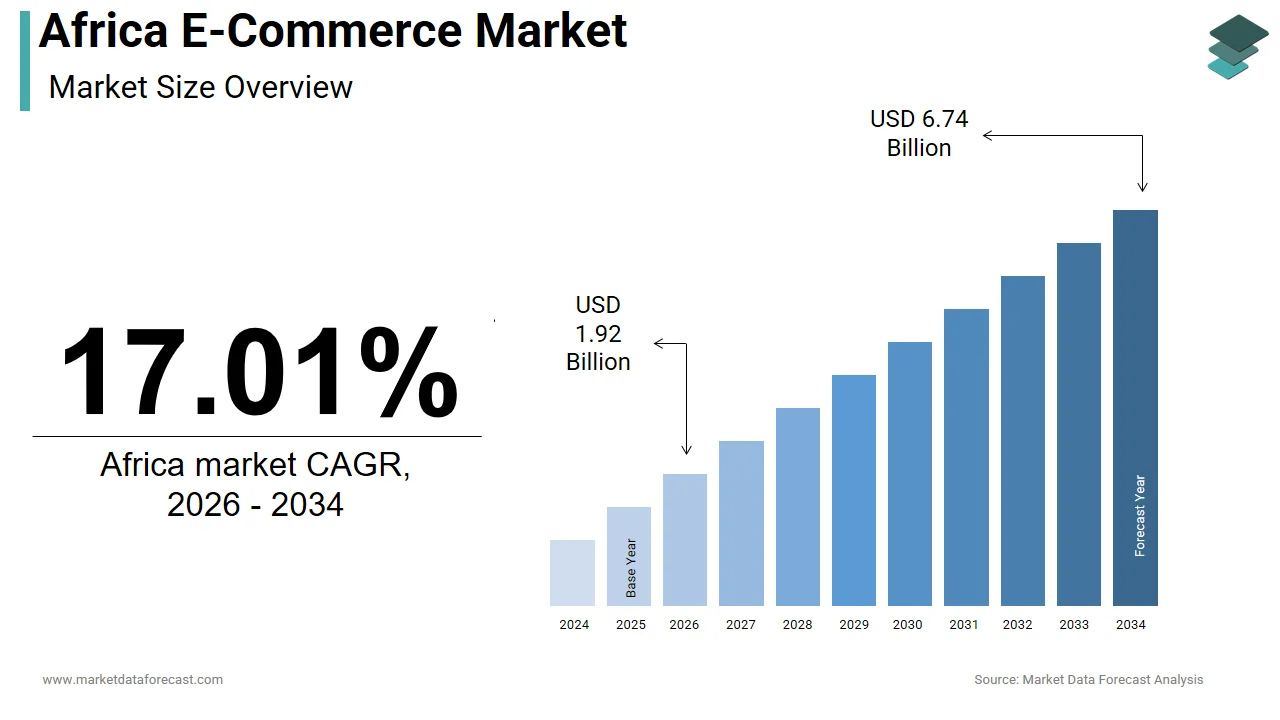
The size of the Africa e-commerce market was valued at USD 1.64 billion in 2025. This market is expected to grow at a CAGR of 17.01% from 2026 to 2034 and be worth USD 6.74 billion by 2034 from USD 1.92 billion in 2026.
E-commerce is a digital marketplace where consumers and businesses engage in online buying and selling of goods and services. It encompasses a wide range of platforms, including B2C retail websites, mobile-based marketplaces, peer-to-peer trading apps, and digital payment gateways tailored for African consumers.
According to the World Bank, as of 2023, internet penetration across Africa surpassed 40%, with mobile broadband subscriptions exceeding 500 million, laying a strong foundation for digital commerce growth. As per the International Telecommunication Union, mobile money accounts outnumbered traditional bank accounts in many sub-Saharan African countries, facilitating seamless digital transactions even in remote areas.
Governments in countries like Nigeria, Kenya, and South Africa are also investing in digital infrastructure and enacting policies to support safe and efficient e-commerce operations.
Moreover, the proliferation of smartphones, increasing urbanization, and rising disposable incomes are reinforcing the momentum of digital trade. Also, young, tech-savvy populations are driving demand for convenience-driven shopping experiences, making e-commerce one of the most dynamic sectors in the continent’s digital economy.
MARKET DRIVERS
Rising Mobile and Internet Penetration Across the Continent
The rapid expansion of mobile and internet connectivity, which has significantly lowered barriers to digital commerce, is one of the primary drivers of the Africa e-commerce market. This widespread connectivity has enabled millions of previously unbanked individuals to participate in online transactions through mobile money platforms.
In countries like Kenya and Tanzania, mobile wallets such as M-Pesa and Tigo Pesa have become integral to daily financial activities, allowing users to make payments for goods and services without the need for traditional banking infrastructure.
E-commerce platforms have capitalized on this trend by integrating mobile payment solutions directly into their systems. Startups like Jumo and MFS Africa have expanded digital wallet functionalities to support online purchases, credit scoring, and microloans, further embedding e-commerce into everyday life.
The continued investment in fiber optic networks and 4G/5G rollouts is expected to grow internet accessibility even faster which is enabling broader participation in the digital economy and accelerating e-commerce adoption across the continent.
Youth Demographics and Changing Consumer Behavior
The continent’s youthful population and shifting consumer preferences toward digital engagement are other significant drivers of the Africa e-commerce market. According to the United Nations, in 2023, approximately 60% of Africa’s population was under the age of 25, making it one of the youngest and most digitally connected demographics globally. This generation is increasingly comfortable using smartphones, social media, and mobile applications for shopping, entertainment, and financial management.
As per a study by Afrobarometer, in 2023, over 70% of urban youth in Nigeria and Ghana regularly used digital platforms for product research and purchase decisions. Influencer marketing, peer reviews, and mobile-first shopping experiences have played a crucial role in shaping these habits.
Apart from these, the rise of gig economies and remote work has increased disposable income among young professionals, who now seek convenience and variety in their purchasing options.
Local entrepreneurs and international players alike are responding to this shift by launching hyper-localized e-commerce apps that cater to regional tastes and payment preferences.
MARKET RESTRAINTS
Underdeveloped Logistics and Last-Mile Delivery Infrastructure
The underdeveloped logistics and last-mile delivery infrastructure, which significantly hampers the efficiency and scalability of online retail operations, is one of the major restraints facing the Africa e-commerce market. Unlike mature markets with well-established supply chains, many African countries struggle with poor road networks, limited warehousing facilities, and inconsistent delivery timelines.
According to the World Bank, in 2023, only 35% of rural populations in sub-Saharan Africa lived within two kilometers of an all-season road, severely limiting access to timely deliveries. In cities like Lagos and Nairobi, traffic congestion and inadequate postal systems contribute to delays and higher operational costs for e-commerce businesses.
To address these challenges, some companies have resorted to building in-house logistics networks. For instance, Jumia invested heavily in its own fleet and distribution centers across multiple African markets. However, these investments often result in elevated operating expenses, reducing profit margins and discouraging smaller players from entering the market.
So, without broader investments in transportation infrastructure and regulatory reforms to support third-party logistics providers, the limitations of existing delivery systems will continue to constrain the growth of e-commerce across the continent.
Low Trust in Online Transactions and Payment Security Concerns
The low level of consumer trust in online transactions and concerns about payment security is another critical constraint in the Africa e-commerce market. Despite rising digital adoption, many consumers remain wary of sharing personal and financial information on online platforms due to fears of fraud, data breaches, and unreliable service delivery.
Besides, past incidents of fake websites and failed deliveries have contributed to persistent skepticism, particularly among first-time users.
Mobile money has helped bridge the trust gap to some extent, but issues such as transaction reversals, high fees, and limited dispute resolution mechanisms still pose challenges. As per the Central Bank of Kenya, in 2023, complaints related to digital payment fraud rose compared to the previous year.
Financial literacy gaps further exacerbate the problem. Many potential customers lack awareness of secure online shopping practices or how to verify the legitimacy of e-commerce sites.
MARKET OPPORTUNITIES
Expansion of Social Commerce and Influencer-Led Sales Models
The rapid growth of social commerce, where online sales are driven through social media platforms and influencer marketing, is a major opportunity emerging in the Africa e-commerce market. With high social media engagement rates and a growing preference for peer-endorsed products, African consumers are increasingly turning to platforms like Instagram, Facebook, and TikTok to discover and purchase goods.
These interactions often bypass traditional e-commerce websites, relying instead on direct messaging and cash-on-delivery mechanisms.
Startups and small businesses are leveraging this trend by integrating shop features into their social profiles and collaborating with influencers to reach younger audiences.
This evolution is reshaping how brands interact with consumers, offering a decentralized and culturally relevant alternative to conventional e-commerce.
Growth of Cross-Border E-Commerce and Pan-African Trade Platforms
The rise of cross-border e-commerce and pan-African trade platforms, facilitated by regional economic integration and digital marketplaces that connect buyers and sellers across national borders, is another significant opportunity in the Africa e-commerce market.
According to the African Union, in 2023, intra-African trade accounted for less than 20% of total continental trade, indicating vast untapped potential for regional commerce. The implementation of the African Continental Free Trade Area (AfCFTA) is expected to reduce tariffs and streamline logistics, making it easier for African businesses to sell across borders.
Digital platforms such as Zando, Jumia Global, and Twiga Foods are capitalizing on this shift by enabling merchants to list products for sale beyond domestic markets. Moreover, fintech innovations such as multi-currency wallets and localized payment gateways are easing cross-border transaction complexities.
MARKET CHALLENGES
Fragmented Regulatory Frameworks and Taxation Policies
The fragmented nature of regulatory frameworks and taxation policies across different countries is a pressing challenge confronting the Africa e-commerce market. While some nations have made progress in developing digital commerce laws, others lag behind, creating inconsistencies that hinder business scalability and investor confidence.
According to the United Nations Conference on Trade and Development (UNCTAD), in 2023, less than half of African countries had comprehensive e-commerce regulations in place, leaving many online businesses in legal gray areas regarding data privacy, consumer rights, and digital taxation. The absence of standardized procedures for handling disputes and enforcing contracts further complicates cross-border transactions.
Taxation policies also present hurdles. Some governments have introduced levies on digital transactions, such as Uganda’s social media tax and Nigeria’s proposed e-commerce VAT, which have been criticized for stifling digital entrepreneurship rather than encouraging formalization. These measures risk pushing small traders into informal channels rather than bringing them into regulated e-commerce ecosystems.
Limited Access to Formal Financial Services and Digital Payment Solutions
The limited access to formal financial services and reliable digital payment solutions, which restricts the ability of consumers to engage in online transactions, is a persistent challenge in the Africa e-commerce market. Although mobile money has partially filled this gap, many users still rely on cash-on-delivery models, which increase logistical complexity and transaction risks for sellers.
According to the World Bank’s Global Findex Report, in 2023, approximately 57% of adults in sub-Saharan Africa remained unbanked, limiting their capacity to use credit cards or digital wallets for online purchases. Even among those with mobile money accounts, interoperability issues between different payment systems often prevent seamless transactions across platforms.
This hesitancy constrains the growth of formal e-commerce ecosystems and encourages informal digital trade through social media and chat-based commerce.
REPORT COVERAGE
| REPORT METRIC | DETAILS |
| Market Size Available | 2025 to 2034 |
| Base Year | 2025 |
| Forecast Period | 2026 to 2033 |
| Segments Covered | By Model Type, Product, and Region. |
| Various Analyses Covered | Global, Regional and Country-Level Analysis, Segment-Level Analysis, Drivers, Restraints, Opportunities, Challenges; PESTLE Analysis; Porter’s Five Forces Analysis, Competitive Landscape, Analyst Overview of Investment Opportunities |
| Countries Covered | Sudan, Egypt, Kenya, Ethiopia, Ghana, South Africa, Rest of Africa |
| Market Leaders Profiled | Amazon.com, Inc., Alibaba.com, ASOS, Zando, Costco Wholesale Corporation, Takealot Group, Dangdang, eBay Inc., Jumia Technologies AG, Flipkart.com, JD.com, Lazada, MercadoLibre S.R.L., Shopify, Shopee, Walmart, Wayfair LLC, Zalando, and Others. |
SEGMENTAL ANALYSIS
By Model Type Insights
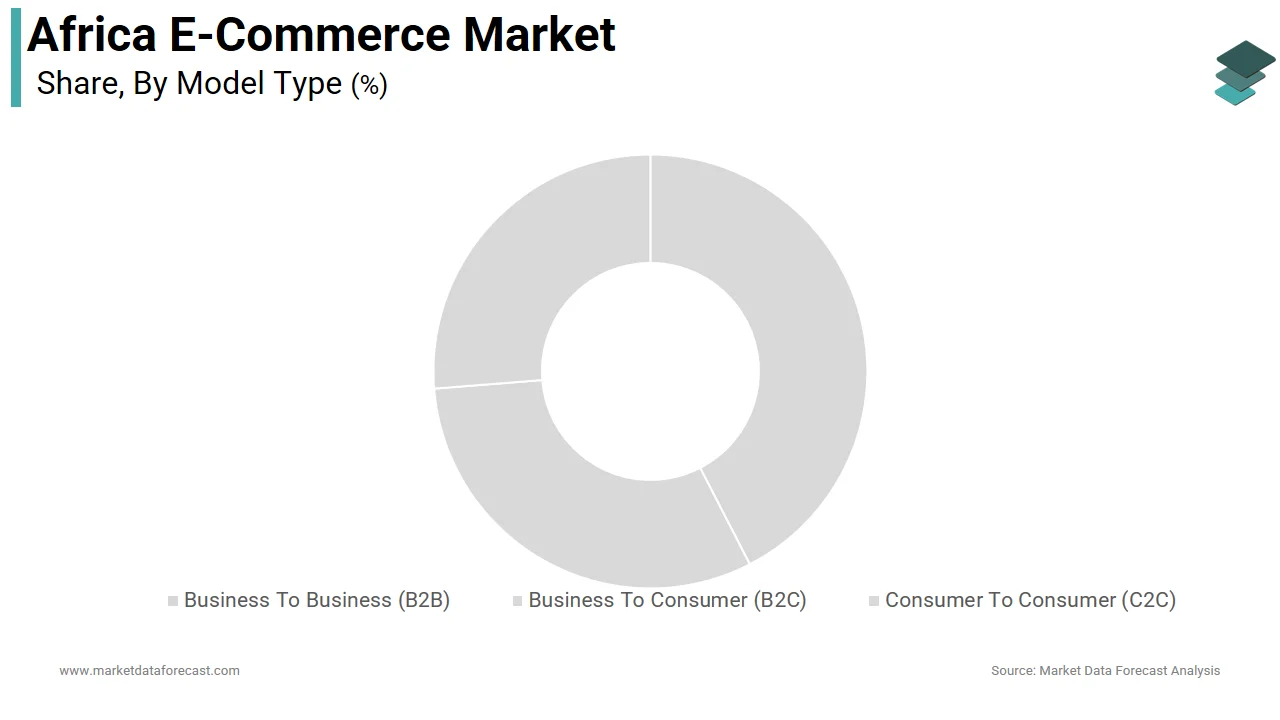
The Business-to-Consumer (B2C) model segment secured the largest share of the Africa e-commerce market and accounted for 56.4% of total revenue in 2024. The widespread adoption of online retail platforms that connect businesses directly with end consumers, offering convenience, variety, and competitive pricing, is propelling the growth of Business-to-Consumer (B2C) model segment.
Like Jumia, Takealot, and Zando are significant players in Sub-Saharan Africa's online retail market. These platforms provide seamless shopping experiences through mobile apps and localized payment gateways, catering to an increasingly tech-savvy and digitally connected population.
Urbanization and rising disposable incomes are key drivers behind the growth of B2C e-commerce.
Apart from these, government-backed digital identity systems and improved logistics networks are enabling smoother transactions and faster deliveries. These developments have enhanced consumer trust in online shopping, reinforcing the stronghold of the B2C model in the regional e-commerce ecosystem.
The Consumer-to-Consumer (C2C) model segment is the fastest-growing segment in the Africa e-commerce market and is expanding at a CAGR of 19.8% during the forecast period. The growth of this segment is fueled by the increasing popularity of peer-to-peer selling platforms, which allow individuals to list and sell used or handmade goods directly to other consumers.
In Nigeria and Kenya, a significant portion of informal traders now rely on social media to reach customers, bypassing traditional e-commerce sites.
In addition, limited access to formal credit and business licenses has encouraged many small-scale entrepreneurs to start online stores using free listing platforms such as OLX and Jiji. Furthermore, the ease of transaction via mobile money and cash-on-delivery models makes C2C commerce accessible even to those without bank accounts.
By Product Insights
The clothing and footwear segment dominated the Africa e-commerce market by capturing 24.4% of total revenue in 2024. A growing preference for online shopping among fashion-conscious youth, particularly in urban centers where disposable incomes are rising and access to digital platforms is expanding, is driving the dominance of clothing and footwear segment.
The proliferation of local designers and the availability of both international and indigenous brands have contributed to sustained demand.
Moreover, social media-driven marketing has played a crucial role in shaping consumer behavior. Platforms like Instagram and TikTok are increasingly being used by African entrepreneurs to showcase products directly to consumers, bypassing traditional retail channels.
Further, mobile-first shopping apps tailored for African markets are integrating cash-on-delivery and mobile money payment options, making it easier for first-time buyers to engage in online fashion commerce without financial risk.
These patterns strengthen the dominance of the clothing and footwear segment in the Africa e-commerce landscape.
The healthcare segment is the fastest-growing product category in the Africa e-commerce market and is projected to expand at a compound annual growth rate (CAGR) of approximately 22.4% from 2025 to 2033. Increasing reliance on digital health solutions, the rise of telemedicine, and greater consumer confidence in purchasing medical products online is fuelling the rapid ascent healthcare segment.
These platforms offer prescription medications, vitamins, and personal protective equipment with doorstep delivery, enhancing accessibility especially in underserved regions.
The expansion of online health consultations has also spurred demand for home-based medical supplies and wellness products.
Moreover, post-pandemic awareness of hygiene and preventive care has led to increased sales of sanitizers, masks, and fitness equipment online.
COUNTRY-LEVEL ANALYSIS
Nigeria E-Commerce Market Insights
Nigeria held the leading position in the Africa e-commerce market by commanding 26% of total revenue in 2024. It serves as a hub for digital commerce in West Africa, supported by a large and youthful population, high internet penetration, and a vibrant startup ecosystem.
Mobile money and fintech innovations, led by firms like Flutterwave and Paystack, have further enabled secure online transactions, reducing barriers to entry for e-commerce platforms.
Jumia, headquartered in Nigeria, remains one of the continent's largest e-commerce operators, reporting an increase in monthly active users in 2023 compared to the previous year. Besides, the Central Bank of Nigeria has been proactive in promoting digital payments, enhancing trust in online transactions.
South Africa E-Commerce Market Insights
South Africa maintains a significant share of the Africa e-commerce market and is recognized as the most mature and structured digital commerce environment on the continent. It benefits from advanced digital infrastructure, high smartphone adoption, and a well-developed financial services sector that supports seamless online transactions.
Local retailers such as Takealot and Mr Price Online have successfully leveraged omnichannel strategies to capture consumer interest.
The country also hosts numerous cross-border e-commerce operations serving the Southern African region, facilitated by efficient logistics providers and relatively stable supply chains.
Kenya E-Commerce Market Insights
Kenya maintains a notable share of the Africa e-commerce market and is emerging as a key player due to its progressive digital policies, high mobile money adoption, and a thriving fintech ecosystem. The country has become a testing ground for innovative e-commerce models that integrate digital payments and last-mile delivery solutions.
The widespread use of mobile wallets such as M-Pesa has enabled even unbanked individuals to participate in online transactions, reducing friction in digital payments.
Kenya’s government has actively supported digital entrepreneurship through initiatives like the National ICT Masterplan, which promotes e-commerce integration in SMEs.
Nairobi has also emerged as a regional e-commerce incubation center, hosting startups like Copia Global and Sendy, which are redefining rural access and logistics delivery. These factors ensure Kenya’s continued influence in shaping the evolution of the Africa e-commerce market.
Egypt E-Commerce Market Insights
Egypt is positioning itself as a strategic gateway to North Africa through a combination of digital policy reforms, growing internet penetration, and rising consumer demand for online shopping.
According to the National Telecom Regulatory Authority (NTRA), in 2023, over 60% of Egyptians were internet users, with e-commerce adoption accelerating rapidly in sectors such as fashion, electronics, and food delivery. The Egyptian government has been actively supporting digital transformation through initiatives like the “Digital Egypt” strategy, which includes investments in broadband expansion and digital skills development.
Local platforms like Jumia Egypt and MaxAB have gained traction by leveraging mobile-first interfaces and cash-on-delivery options that align with consumer preferences.
With Cairo emerging as a regional tech and logistics hub, Egypt is strengthening its e-commerce infrastructure through partnerships with global e-marketplaces and payment service providers. These developments reinforce Egypt’s role as a key contributor to the evolution of the Africa e-commerce market.
Ghana E-Commerce Market Insights
Ghana is emerging as a rising digital commerce hub in West Africa due to improving digital infrastructure, increasing smartphone adoption, and supportive regulatory reforms.
The Ghanaian government has been actively promoting digital financial inclusion, with mobile money transactions surpassing 1.2 billion in value during the same period, as per the Bank of Ghana.
E-commerce platforms such as Tonaton, YooKoonect, and Jumia Ghana have capitalized on this trend by offering localized product listings and flexible payment methods.
With Accra becoming a regional center for digital innovation and venture capital funding, Ghana is likely to maintain a strong presence in the evolving Africa e-commerce market, reinforcing its strategic position in West Africa.
COMPETITIVE LANDSCAPE
The competition in the Africa e-commerce market is highly dynamic, shaped by a mix of global giants, regional champions, and nimble startups vying for dominance in a rapidly evolving digital landscape. While international players bring scale and technological expertise, regional operators often have a deeper understanding of local consumer behavior, payment ecosystems, and logistical constraints. This creates a competitive yet complementary environment where innovation thrives and hybrid business models emerge.
E-commerce platforms are increasingly differentiating themselves through hyper-localized experiences, superior customer service, and tailored financial inclusion strategies that cater to underbanked populations. At the same time, social commerce and mobile-first platforms are disrupting traditional e-commerce structures, allowing micro-entrepreneurs to enter the digital economy without significant upfront investment.
Public-private collaborations are also shaping the competitive terrain, with governments partnering with e-commerce firms to improve digital infrastructure, cybersecurity, and regulatory clarity. Venture capital interest in African tech startups continues to rise, fueling entrepreneurship and cross-border expansion. As digital adoption accelerates, the Africa e-commerce market is transforming into a vibrant hub of innovation and strategic collaboration.
KEY MARKET PLAYERS
Some of the noteworthy companies in the Africa E-Commerce market profiled in this report are
- Amazon.com, Inc.
- Alibaba.com
- ASOS
- Zando
- Costco Wholesale Corporation
- Takealot Group
- Dangdang
- eBay Inc.
- Jumia Technologies AG
- Flipkart.com
- JD.com
- Lazada
- MercadoLibre S.R.L.
- Shopify
- Shopee
- Walmart
- Wayfair LLC
- Zalando
TOP LEADING PLAYERS IN THE MARKET
- Jumia is the leading e-commerce platform operating across multiple African countries, offering a wide range of products and services including retail, food delivery, and logistics. Founded to address the unique challenges of African markets, Jumia has become a model for digital commerce in emerging economies. Its contribution to the global market lies in its ability to adapt international e-commerce frameworks to local conditions, inspiring similar ventures in other developing regions.
- Takealot is South Africa’s largest online retailer and a dominant force in the Southern African e-commerce space. It offers a comprehensive shopping experience with a focus on consumer electronics, fashion, and home goods. The company contributes to the global market by demonstrating how localized supply chains, customer service models, and digital payment integrations can enhance e-commerce scalability in high-penetration internet environments outside traditional Western markets.
- Zando operates as a key e-commerce player in Southern Africa, leveraging strategic partnerships and global investment to expand its product offerings and logistical capabilities. As part of the Flipkart-Walmart ecosystem, Zando brings global best practices in inventory management, customer engagement, and digital payments to the African context. Its operations serve as a blueprint for integrating multinational e-commerce strategies with regional market dynamics.
TOP STRATEGIES USED BY KEY MARKET PARTICIPANTS
One major strategy employed by key players in the Africa e-commerce market is localized platform development, where companies tailor their websites and mobile apps to suit regional languages, payment preferences, and cultural trends. This approach enhances user experience and increases adoption among diverse consumer groups who may otherwise be hesitant to shop online.
Another widely adopted approach is investment in last-mile delivery infrastructure, including in-house logistics networks and partnerships with third-party couriers. Given the continent's infrastructural limitations, having reliable and cost-effective delivery solutions is crucial for ensuring customer satisfaction and repeat business.
A third critical strategy involves integrating mobile money and alternative payment systems into e-commerce platforms. Since many African consumers remain unbanked, supporting mobile wallets, cash-on-delivery, and USSD-based payment options allows businesses to reach broader audiences and facilitate seamless transactions even in low-trust environments.
RECENT MARKET DEVELOPMENTS
- In January 2023, Jumia launched an expanded fulfillment network in Nigeria, enhancing delivery speed and reliability in Lagos, Abuja, and Port Harcourt to better serve urban customers and small merchants.
- In May 2023, Takealot partnered with local fintech providers in South Africa to integrate flexible payment options, enabling users to pay in installments and increasing purchasing power for mid-range electronics and appliances.
- In September 2023, Zando introduced a new AI-driven recommendation engine aimed at personalizing the shopping experience for users in Kenya and Ghana, improving conversion rates and average order values.
- In February 2024, Jumia launched a dedicated SME marketplace in Egypt, helping thousands of local businesses digitize their operations and access a broader consumer base across North Africa.
- In June 2024, a consortium of African e-commerce startups formed a strategic alliance to share logistics infrastructure and digital marketing resources, aiming to reduce operational costs and increase regional competitiveness.
MARKET SEGMENTATION
This Africa E-Commerce market research report is segmented and sub-segmented into the following categories.
By Model Type
- Business To Business (B2B)
- Business To Consumer (B2C)
- Consumer To Consumer (C2C)
By Product
- Automotive
- Beauty & Personal Care
- Books & Stationery
- Consumer Electronics
- Home Appliances
- Clothing & Footwear
- Healthcare
- Others
By Country
- Sudan
- Egypt
- Kenya
- Ethiopia
- Ghana
- South Africa
- Rest of Africa