- Product Description Description
- Table of Contents TOC
- List of Table & Figure LOT
- Get Free Sample PDF Sample PDF
Market Size, 2025
$2,298 BnMarket Estimate, 2026
$2,794 BnMarket Forecast, 2034
$13,319CAGR, 2026–2034
21.56%Middle East E-Commerce Market Size
The size of the Middle East e-commerce market was valued at USD 2,298 billion in 2025. This market is expected to grow at a CAGR of 21.56% from 2026 to 2034 and be worth USD 13,319 billion by 2034 from USD 2,794 billion in 2026.
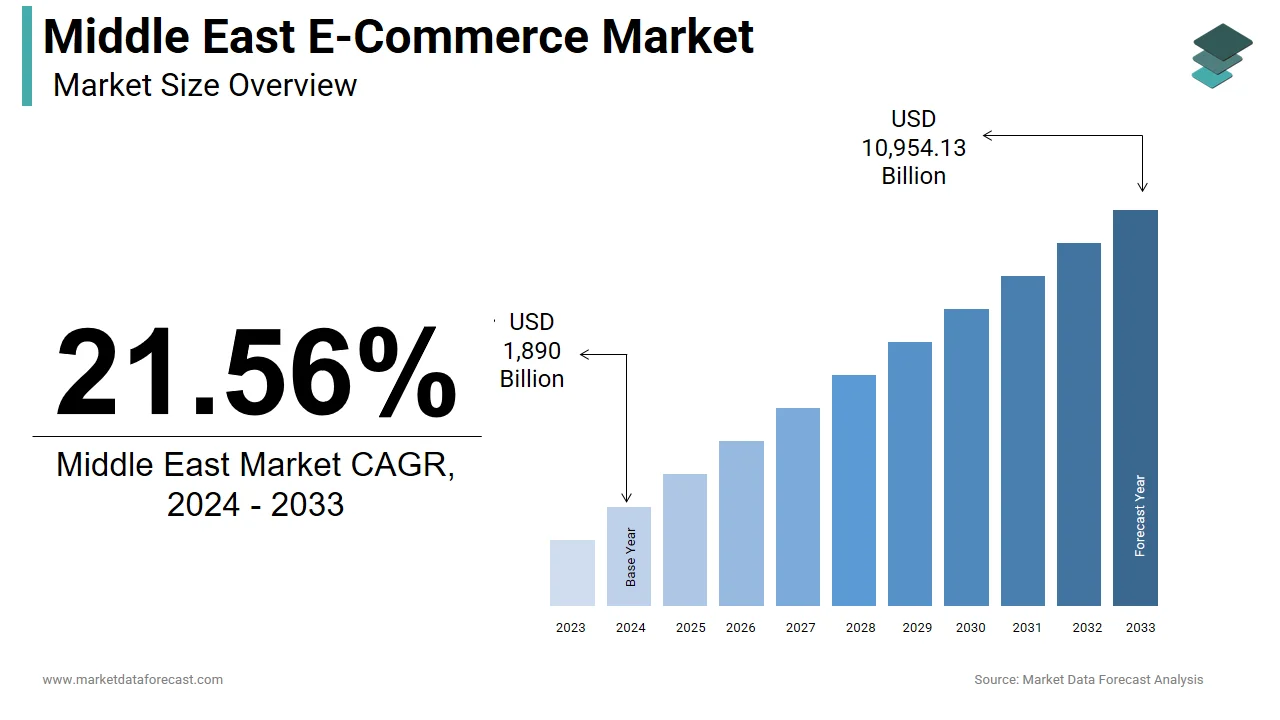
The e-commerce is digital buying and selling of goods and services across countries such as the United Arab Emirates, Saudi Arabia, Egypt, Israel, and others in the region. According to the International Telecommunication Union (ITU), internet usage in the Middle East surpassed 70% of the population in 2023, with mobile internet subscriptions exceeding 1.2 billion connections across the region. Additionally, government initiatives aimed at promoting digital economies, such as Saudi Arabia’s Vision 2030 and UAE’s Digital Economy Strategy, have accelerated the development of supportive infrastructure including fintech ecosystems, cross-border trade facilitation, and regulatory reforms for digital commerce. Moreover, the rise of local and global e-commerce platforms like Noon, Souq (now Amazon.ae), Jumia, and Namshi has further catalyzed the shift from traditional retail to online shopping.
MARKET DRIVERS
Rising Smartphone Penetration and Mobile Internet Usage
The rapid proliferation of smartphones and high-speed mobile internet is amplifying the growth of the Middle East e-commerce market. As per the International Telecommunication Union (ITU), mobile cellular subscriptions in the region exceeded 1.2 billion in 2023, with smartphone ownership surpassing 60% in urban centers like Dubai, Riyadh, and Cairo. According to GSMA Intelligence, mobile internet usage in the Middle East grew by 44% between 2020 and 2023, enabling greater access to e-commerce platforms and digital payment solutions. In countries like Egypt and Jordan, where desktop-based shopping remains limited, mobile apps have become the primary gateway to online retail. Additionally, the deployment of 5G networks across the Gulf Cooperation Council (GCC) has further enhanced browsing speeds and reduced latency, improving user engagement on e-commerce platforms. According to Ericsson Mobility Report 2024, GCC countries accounted for some of the highest average mobile data consumption rates globally, which is facilitating real-time product discovery, live streaming, and interactive shopping features.
Increasing Adoption of Digital Payments and Fintech Innovations
The growing acceptance of digital payment methods and the emergence of fintech solutions tailored to regional needs is to propel the growth of the Middle East e-commerce market. Historically, cash-on-delivery (COD) dominated online transactions due to low trust in card payments and limited banking access. However, recent years have seen a significant shift, with digital wallets, buy-now-pay-later (BNPL) services, and contactless payment options gaining traction. As per the Central Bank of the UAE, digital payment transaction volumes in the country increased by 38% in 2023, driven by platforms such as PayPal, Apple Pay, and locally developed solutions like UAE’s Now Money and Saudi Arabia’s STC Pay. Furthermore, governments are actively supporting financial inclusion through national digital identity systems and open banking frameworks.
MARKET RESTRAINTS
Underdeveloped Logistics and Last-Mile Delivery Infrastructure
A significant restraint impeding the growth of the Middle East e-commerce market is the inconsistent development of logistics and last-mile delivery infrastructure, particularly in non-GCC countries. While major urban centers such as Dubai, Riyadh, and Doha benefit from well-established supply chain networks, rural and semi-urban areas face challenges related to inefficient distribution systems, inadequate warehousing, and unreliable delivery timelines.
According to the World Bank's Logistics Performance Index 2023, only a handful of Middle Eastern countries scored above the global average in terms of customs efficiency, infrastructure quality, and shipment tracking capabilities. In countries like Yemen, Sudan, and parts of Iraq, e-commerce businesses struggle with poor road connectivity, political instability, and limited cold-chain storage facilities, which hinder the timely and safe delivery of perishable and temperature-sensitive products. Moreover, as per McKinsey & Company, approximately 30% of online orders in the Middle East experience delays or require multiple rescheduling attempts before successful delivery. This inconsistency affects customer satisfaction and discourages repeat purchases, especially among first-time online shoppers.
Persistent Preference for Cash-on-Delivery and Low Trust in Online Transactions
Despite advancements in digital payment infrastructure, a lingering preference for cash-on-delivery (COD) continues to constrain the Middle East e-commerce market. According to Mastercard’s Global Consumer Survey 2023, nearly 45% of online shoppers in the region still opt for COD due to concerns about fraud, lack of return policies, and unfamiliarity with digital transaction mechanisms. This trend is particularly pronounced in Egypt, Jordan, and Lebanon, where a large portion of the population remains unbanked or underbanked. As per the World Bank’s Global Findex Database 2023, only 48% of adults in the Middle East hold a formal bank account, limiting their ability to engage in card-based or wallet-driven transactions.
MARKET OPPORTUNITIES
Growth of Social Commerce and Influencer-Driven Retail
The rapid rise of social commerce and influencer-driven retail is creating new growth opportunities for the Middle East e-commerce market. The region is witnessing a surge in online shopping behavior influenced by content creators, influencers, and digital communities. These platforms are increasingly being leveraged for direct-to-consumer sales through shoppable posts, live-streamed product demonstrations, and affiliate marketing strategies. As per Meta’s E-Commerce Trends Report 2023, more than 60% of Facebook and Instagram users in the Middle East have made a purchase directly from a social media post within the past year. Additionally, TikTok Shop has gained significant traction in the UAE and Saudi Arabia, with localized versions offering same-day delivery and influencer collaborations to drive impulse buying. Brands are capitalizing on this trend by partnering with regional influencers to promote products and build authentic consumer engagement. As per YouGov, 54% of young consumers in the Middle East trust recommendations from social media personalities more than traditional advertising. This shift presents a major opportunity for e-commerce players to integrate social commerce into their digital strategies, which is leveraging viral trends and peer endorsements to boost conversion rates and brand loyalty.
Expansion of Cross-Border E-Commerce and Free Trade Zones
The expansion of cross-border e-commerce is emerging as a transformative opportunity for the Middle East retail landscape, supported by favorable trade policies and the establishment of free zones dedicated to international digital commerce. Governments across the region are actively promoting import-export liberalization, streamlining customs procedures, and investing in logistics infrastructure to facilitate seamless cross-border transactions.
According to the World Trade Organization (WTO), the Middle East has seen a 27% increase in cross-border digital trade since 2021, with the UAE leading the way through initiatives like the Dubai Multi Commodities Centre (DMCC) and Jebel Ali Free Zone (JAFZA). These hubs offer tax-free business environments, advanced fulfillment centers, and streamlined documentation processes, which is attracting global e-commerce brands looking to serve Middle Eastern consumers without establishing full-scale local operations.
MARKET CHALLENGES
Regulatory Fragmentation Across Countries
One of the most pressing challenges confronting the Middle East e-commerce market is the lack of harmonized regulatory frameworks across different countries. Unlike more mature markets with unified digital commerce laws, the Middle East comprises diverse jurisdictions with varying rules governing taxation, data privacy, consumer protection, and digital payments. This fragmentation complicates compliance for both domestic and international e-commerce operators seeking to scale across the region. According to the United Nations Conference on Trade and Development (UNCTAD), only a few Middle Eastern countries have comprehensive e-commerce legislation in place, while others rely on outdated commercial codes that do not adequately address modern digital transactions. For instance, while the UAE and Saudi Arabia have implemented robust consumer rights regulations and digital contract enforcement mechanisms, countries like Iraq and Yemen still lack clear legal structures for online dispute resolution and digital signatures. Additionally, as per the World Bank’s Doing Business Report 2023, inconsistencies in customs duties, VAT implementation, and import restrictions create barriers for cross-border sellers operating in multiple Middle Eastern markets. The absence of standardized e-invoicing requirements and digital tax reporting formats further adds to operational complexity.
Limited Returns and After-Sales Support Infrastructure
Another critical challenge facing the Middle East e-commerce market is the underdeveloped infrastructure for product returns and after-sales service. Unlike in Western markets where hassle-free return policies and centralized customer service centers are standard, many online shoppers in the Middle East encounter difficulties when attempting to return defective items, exchange products, or seek warranty assistance. Moreover, as per PwC Middle East, only 25% of online retailers in the region offer centralized customer support channels with multilingual capabilities, leading to dissatisfaction among non-Arabic-speaking expatriate populations. The lack of uniform warranty coverage for imported electronics and cosmetics further deters high-value purchases.
REPORT COVERAGE
| REPORT METRIC | DETAILS |
| Market Size Available | 2025 to 2034 |
| Base Year | 2025 |
| Forecast Period | 2026 to 2034 |
| Segments Covered | By B2C E-Commerce, and Region. |
| Various Analyses Covered | Global, Regional, and Country-Level Analysis, Segment-Level Analysis, Drivers, Restraints, Opportunities, Challenges; PESTLE Analysis; Porter’s Five Forces Analysis, Competitive Landscape, Analyst Overview of Investment Opportunities |
| Countries Covered | KSA, UAE, Israel, the Rest of GCC, Rest of Middle East |
| Market Leaders Profiled | Amazon.com Inc. Alibaba Group Holding Limited Shopify Inc., Jumia, Noon, Costco Wholesale Corporation Best Buy Co. Inc. and others. |
SEGMENTAL ANALYSIS
By B2C E-Commerce Insights
The fashion and apparel segment accounted in holding 28.1% of the Middle East B2C e-commerce market share in 2024. According to Euromonitor International, fashion remains the top-performing category across major online platforms such as Noon, Amazon.ae, and Namshi with over 35% of all online orders falling under this segment. The region’s cultural emphasis on personal appearance and frequent participation in global fashion trends has fueled demand for international and local brands alike. Moreover, the rise of social commerce, particularly via Instagram and TikTok, has significantly boosted impulse buying behavior in fashion.
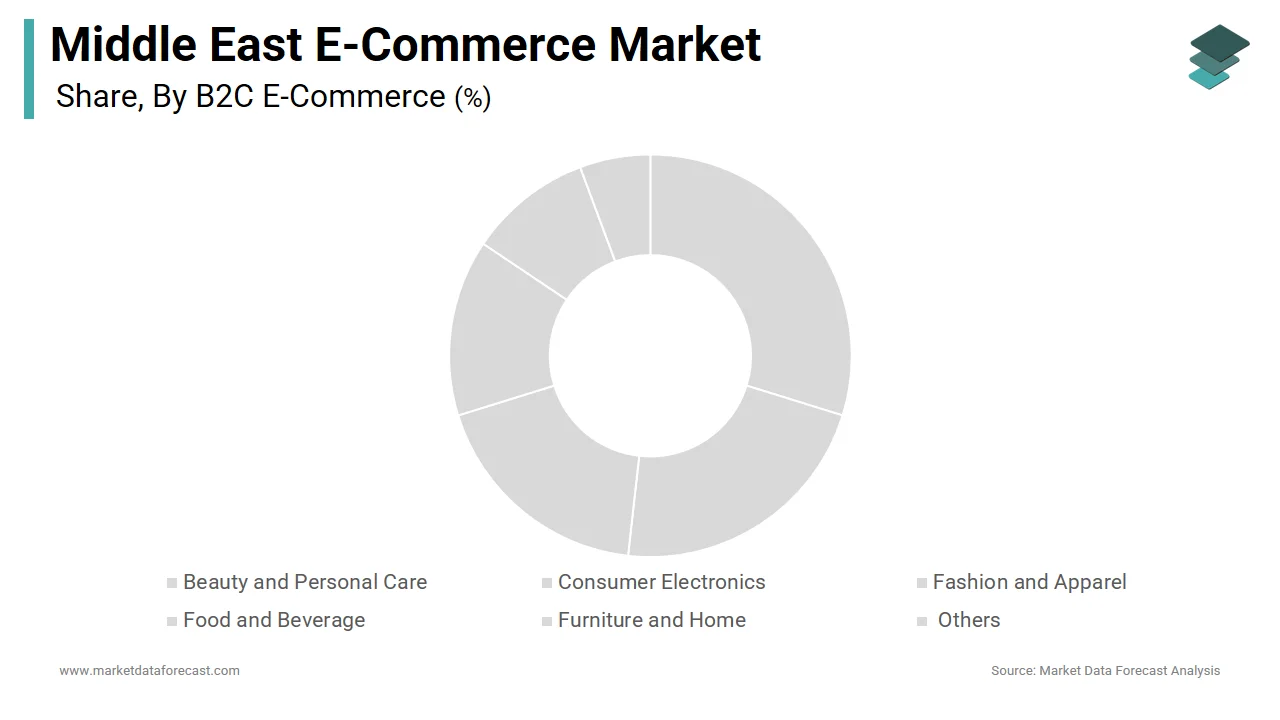
The food and beverage segment is likely to grow with an expected emerging CAGR of 18.9% during the forecast period with the rising adoption of online grocery delivery services, increased urbanization, and growing demand for convenience-driven shopping experiences. Platforms such as InstaShop (now part of Delivery Hero), Noon Fresh, and Carrefour Online have played a pivotal role in transforming traditional grocery shopping into a digital-first experience. Additionally, the increasing popularity of meal kits, organic products, and specialty foods has expanded product offerings and attracted a broader customer base. As reported by PwC Middle East, 62% of surveyed consumers now prefer ordering groceries online due to time constraints and the availability of home delivery.
COUNTRY-LEVEL ANALYSIS
United Arab Emirates E-Commerce Market Insights
The United Arab Emirates was the largest contributor with 31.2% of the Middle East and Africa (MEA) e-commerce market share in 2024 with its advanced digital infrastructure, high internet penetration, and strong government backing for digital transformation. Government initiatives such as the National Strategy for Artificial Intelligence 2031, Smart Dubai, and Digital Dubai have created a conducive environment for e-commerce innovation. Additionally, the presence of major players like Noon, Amazon.ae, and Careem Now has intensified competition and improved last-mile delivery efficiency.
Saudi Arabia E-Commerce Market Insights
Saudi Arabia held 25.3% of the MEA e-commerce market share in 2024 with the rapid modernization in recent years, with significant investments in digital payment systems, logistics, and consumer protection frameworks. According to the Saudi Data and Artificial Intelligence Authority (SDAIA) , over 80% of citizens are now active Internet users with online shopping becoming increasingly mainstream across urban and rural areas. The rise of domestic e-commerce platforms like Tasjeel and Jarir Bookstore, alongside global giants like Amazon and Noon has expanded consumer choice. Moreover, the Central Bank of Saudi Arabia has introduced regulations to boost trust in digital payments, which include mandatory fraud detection mechanisms and secure transaction protocols.
Egypt E-Commerce Market Insights
Egypt e-commerce market is gaining huge traction over CAGR with its large and youthful population, increasing smartphone adoption, and expanding digital financial services. Platforms such as Jumia, Salla, and MaxAB have leveraged this digital momentum to expand their reach, particularly in Cairo, Alexandria, and Giza.
Israel E-Commerce Market Insights
Israel e-commerce market growth is driven by a highly developed digital ecosystem, robust cybersecurity infrastructure, and high disposable incomes. Major platforms such as Allegro, Fiverr, and Zara’s localized operations have capitalized on this digital readiness. Additionally, Israel’s regulatory framework ensures consumer protection, data privacy, and efficient dispute resolution, fostering trust in online transactions.
South Africa E-Commerce Market Insights
South Africa e-commerce market is likely to grow from a relatively advanced financial system, growing internet access, and a diverse retail ecosystem that supports both domestic and cross-border trade. According to World Bank data, internet usage in South Africa reached 72% in 2023, with mobile broadband coverage expanding rapidly across urban and peri-urban areas. Despite logistical challenges and uneven digital access in rural regions, the rise of fintech startups like Yoco and Ozow has improved payment accessibility. The South African Reserve Bank has also introduced measures to enhance digital transaction security. With ongoing efforts to improve infrastructure and expand financial inclusion, South Africa remains a key growth driver in the MEA e-commerce market.
COMPETITIVE LANDSCAPE
The competition in the Middle East e-commerce market is intensifying as both global giants and regional players strive to capture a larger share of the growing digital economy. International platforms like Amazon, through its integrated presence in the Gulf via Amazon. ae, continue to dominate due to their extensive product catalogs, advanced logistics networks, and trusted brand reputation. However, they face increasing pressure from local champions such as Noon, which leverages deep market knowledge, strategic investments, and agile operations to compete effectively.
In parallel, startups and niche players are entering the market with innovative business models, focusing on areas such as social commerce, hyperlocal delivery, and digital payments. These emerging players are reshaping consumer engagement by tapping into influencer-driven sales, mobile-first shopping experiences, and personalized recommendations. Meanwhile, cross-border platforms like Shein and AliExpress are also gaining traction by offering affordable fashion and electronics at competitive price points.
The evolving regulatory environment, improving digital infrastructure, and rising consumer confidence are further fueling this competitive landscape. The Middle East e-commerce market remains one of the most dynamic and rapidly transforming sectors in the global retail industry as businesses race to enhance user experience, optimize supply chains, and build brand loyalty.
KEY MARKET PLAYERS
Some of the noteworthy companies in the Middle East E-Commerce market profiled in this report are
- Amazon.com Inc.
- Alibaba Group Holding Limited
- Shopify Inc.
- Jumia
- Noon
- Costco Wholesale Corporation
- Best Buy Co. Inc.
TOP LEADING PLAYERS IN THE MARKET
- Amazon plays a dominant role in the Middle East e-commerce market through its acquisition and integration of Souq.com, which gave it a strong foothold in the region. Operating under Amazon.ae, the company offers a vast array of products, from electronics to home goods, leveraging its global logistics expertise and customer-centric approach. Amazon has localized its services by adapting to regional preferences, including Arabic language support, flexible payment options, and tailored marketing campaigns. Its presence has significantly raised the bar for digital retail standards in the Middle East, influencing consumer expectations around delivery speed, product variety, and customer service.
- Noon is a leading homegrown e-commerce platform that has emerged as a major competitor to international players in the Middle East. Founded with substantial backing from Saudi and UAE investors, Noon offers a comprehensive marketplace covering multiple GCC countries. The platform emphasizes fast delivery, local language interfaces, and culturally relevant product offerings. With investments in logistics infrastructure and digital payments, Noon has strengthened its position as a key enabler of regional e-commerce growth. Its focus on localization and innovation continues to challenge global giants while supporting the digital transformation of retail across the Gulf.
- Jumia operates as a pan-African e-commerce leader with a strong presence in Egypt and other North African markets within the broader MEA region. It serves as a full-stack online retail platform, offering a wide range of products, logistics solutions, and digital payment systems tailored to emerging market needs. Jumia’s contribution lies in pioneering e-commerce ecosystems in regions where digital infrastructure and trust in online transactions are still developing. Through localized delivery networks and mobile-first strategies, Jumia plays a crucial role in expanding access to online shopping and fostering digital commerce adoption across the Middle East and Africa.
TOP STRATEGIES USED BY KEY MARKET PARTICIPANTS
One of the primary strategies adopted by key players in the Middle East e-commerce market is deep localization, where companies tailor their platforms, content, and services to align with regional languages, cultural norms, and consumer behaviors. This includes Arabic-language interfaces, Ramadan-specific promotions, and curated product selections based on local demand.
Another widely implemented strategy is investment in logistics and fulfillment infrastructure in warehousing, last-mile delivery, and cold chain capabilities. Companies are building or partnering with regional logistics providers to ensure faster, more reliable deliveries, which enhances customer satisfaction and repeat purchases.
A third critical approach is enhancing digital payment ecosystems through partnerships with fintech firms and banks to expand secure and convenient transaction methods. E-commerce leaders aim to reduce dependency on cash-on-delivery and increase overall conversion rates across the region by promoting cashless payments, digital wallets, and buy-now-pay-later options.
RECENT MARKET DEVELOPMENTS
- In January 2024, Noon launched a new fulfillment center in Riyadh to enhance its logistics capabilities and improve delivery times across Saudi Arabia. This move was aimed at strengthening its position against global competitors and meeting the rising demand for fast and reliable e-commerce services.
- In March 2024, Amazon.ae expanded its grocery delivery service, introducing same-day delivery for select items in Dubai and Abu Dhabi. This initiative was designed to boost convenience for urban consumers and increase daily engagement with the platform.
- In July 2024, Jumia partnered with a leading Egyptian fintech firm to integrate a digital wallet solution into its checkout process by aiming to reduce reliance on cash-on-delivery and encourage more secure and seamless transactions.
- In September 2024, TikTok Shop entered the UAE market through a collaboration with local influencers and merchants, which is marking its first formal expansion into the Gulf region and signaling a shift toward social commerce as a key growth driver.
- In November 2024, Shein announced plans to open a regional headquarters in Dubai, reinforcing its commitment to the Middle East and positioning itself for long-term growth by leveraging the city's status as a global trade and logistics hub.
MARKET SEGMENTATION
This Middle East E-Commerce market research report is segmented and sub-segmented into the following categories.
By B2C E-Commerce
- Beauty and Personal Care
- Consumer Electronics
- Fashion and Apparel
- Food and Beverage
- Furniture and Home
- Others
By Country
- KSA
- UAE
- Israel
- Rest of GCC countries
- Rest of Middle East