- Product Description Description
- Table of Contents TOC
- List of Table & Figure LOT
- Get Free Sample PDF Sample PDF
Market Size, 2025
$8.15 BnMarket Estimate, 2026
$9.73 BnMarket Forecast, 2034
$40.29 BnCAGR, 2026–2034
19.43%Global Agriculture Robots Market Size, Growth, Trends & Forecast (2026–2034)
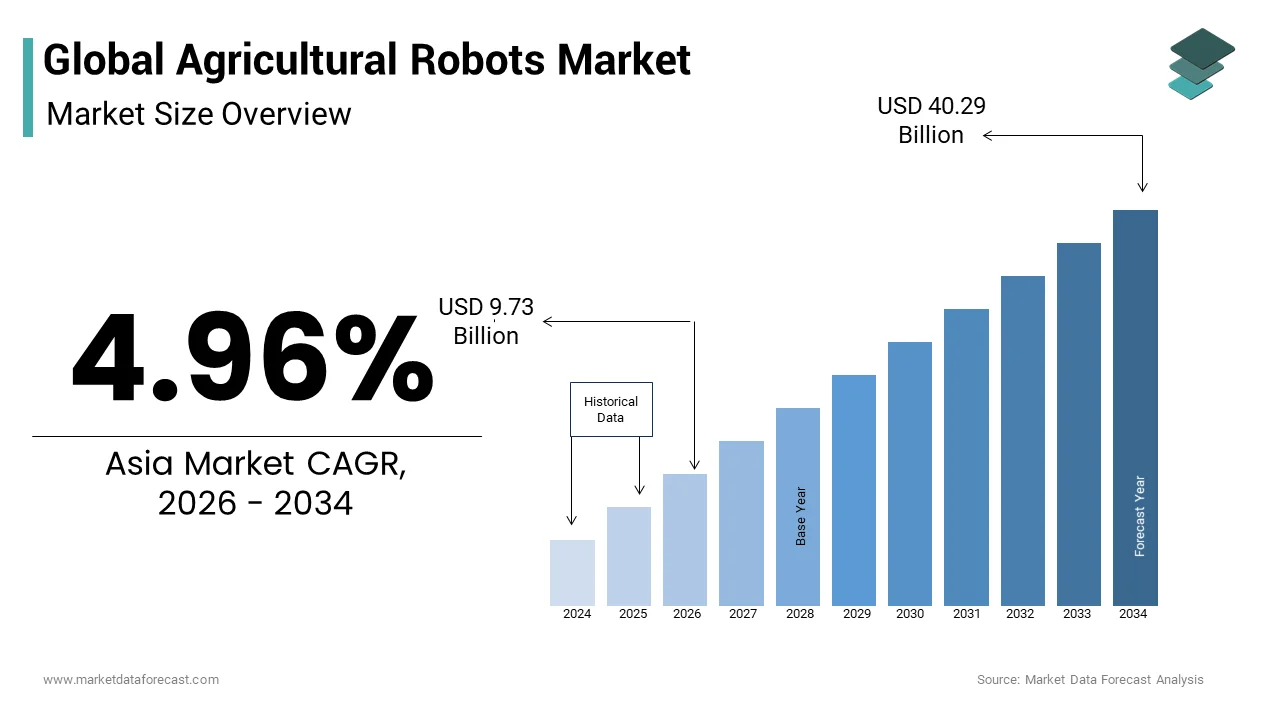
The global agriculture robots market size was valued at USD 8.15 billion in 2025, is anticipated to reach USD 9.73 billion in 2026, and is projected to scale to USD 40.29 billion by 2034, growing at a compound annual growth rate (CAGR) of 19.43% during the forecast period from 2026 to 2034. Growth is primarily propelled by severe agricultural labor shortages, stringent environmental regulations requiring precision agriculture, and the continuous integration of artificial intelligence for autonomous farming operations.
Key Executive Metrics (At-a-Glance)
- 2025 Base Valuation: USD 8.15 Billion
- 2026 Current Valuation: USD 9.73 Billion
- 2034 Forecast Valuation: USD 40.29 Billion
- Compound Annual Growth Rate (CAGR): 19.43% (2026–2034)
- Leading Regional Market: North America (supported by large-scale farming and high agritech adoption)
- Key Geographic Regions: North America, Europe, Asia-Pacific, Latin America, and Middle East & Africa
Core Market Drivers & Opportunities
- Labor Shortages: Aging farmer populations and rural-urban migration creating a critical deficit in manual labor availability worldwide.
- Precision Agriculture Mandates: Green Deal and Farm to Fork goals compelling reduced chemical pesticide and fertilizer usage via robotic spot treatments.
- AI & Vertical Farming: Edge-computed predictive analytics and rapid expansion into controlled environment indoor farming facilities.
Primary Market Restraints & Challenges
- High Capital Expenditure: Prohibitive upfront costs and specialized maintenance requirements limiting accessibility for smallholders.
- Interoperability & Regulation: Lack of universal data communication protocols across vendors and evolving safety compliance standards for autonomous field machinery.
Market Segmentation: Largest and Fastest-Growing Sectors
| Segment Category | Largest Segment | Fastest-Growing Segment |
|---|---|---|
| By Product | Milking Robots | Automated Harvest Robots (23.6% CAGR) |
| By Application | Dairy Management | Harvest Management (22.5% CAGR) |
| By Region | North America | Asia-Pacific |
Major Industry Players Profiled
Key market participants shaping the global agriculture robots landscape include AGCO, Autonomous Solutions Inc., Autonomous Tractor Corporation, Clearpath Robotics, Deepfield Robotics, DeLaval, GEA Group, Harvest Automation, John Deere, and Lely.
Global Agriculture Robots Market Size
The global agriculture robots market size was valued at USD 8.15 billion in 2025 and is anticipated to reach a valuation of USD 9.73 billion in 2026 and reach USD 40.29 billion by 2034, growing at a CAGR of 19.43% during the forecast period from 2026 to 2034.
MARKET OVERVIEW AND DEFINITION
Agriculture robots are autonomous and semi-autonomous mechanical systems designed to perform various farming tasks with minimal human intervention. These technologies include robotic harvesters, automated weeders, drone-based monitoring systems, and milking robots that enhance operational efficiency and precision. The integration of artificial intelligence, computer vision, and advanced sensors allows these machines to navigate complex agricultural environments and execute delicate operations such as fruit picking or soil analysis. In Europe, the adoption of agricultural robotics is driven by the urgent need to address labor shortages and comply with stringent environmental regulations. As per Eurostat, the agricultural workforce in the European Union has declined by approximately 25% over the past decade, creating a critical gap in manual labor availability. Furthermore, the Food and Agriculture Organization of the United Nations states that global food production must increase by 60% by 2050 to feed a growing population, necessitating higher productivity from existing arable land. The European Commission’s Farm to Fork Strategy aims to reduce chemical pesticide use by 50% by 2030, which accelerates the shift towards mechanical weeding and precise application methods enabled by robotics. According to the Joint Research Centre of the European Commission, digital technologies, including robotics, can improve crop yields by up to 15% while reducing input costs. This technological transition is not merely an operational upgrade but a structural necessity for sustainable food security and economic viability in modern agriculture across the continent.
MARKET DRIVERS
Severe Agricultural Labor Shortages Drive Automation Adoption
The persistent and worsening shortage of skilled and unskilled labor in the agricultural sector is primarily boosting the expansion of the global agriculture robots market. Demographic shifts, including an aging farmer population and rural-urban migration, have left farms with insufficient manpower to handle labor-intensive tasks such as harvesting, pruning, and planting. As per the European Commission, the average age of farm managers in the European Union is 57 years, indicating a looming succession crisis and a shrinking workforce. This demographic trend is exacerbated by the seasonal nature of agricultural work, which makes it difficult to attract and retain temporary workers. The International Labour Organization reports that the agricultural sector faces a global deficit of millions of workers, particularly during peak harvest seasons, leading to significant crop losses. In countries like Germany and Italy, farmers report leaving up to 20% of fruits and vegetables unharvested due to lack of personnel. Agricultural robots offer a reliable and consistent alternative to human labor, capable of operating continuously without fatigue or breaks. Autonomous harvesters and pickers can work around the clock, ensuring that crops are collected at optimal ripeness, thereby maximizing yield and quality. The ability of robots to perform repetitive and physically demanding tasks reduces the dependency on volatile labor markets. Consequently, farmers are increasingly investing in robotic solutions to secure their operations against labor uncertainties. This structural shift ensures that the demand for agricultural robots remains robust as the industry seeks to maintain productivity levels despite the dwindling human workforce.
Precision Agriculture Requirements Enhance Resource Efficiency
The growing imperative for precision agriculture due to environmental regulations and cost optimization goals significantly fuels the demand for agricultural robots. Modern farming requires precise application of inputs such as water, fertilizers, and pesticides to minimize waste and environmental impact while maximizing crop health. Agricultural robots equipped with advanced sensors and artificial intelligence can identify individual plants and apply treatments with millimeter accuracy. As per the Joint Research Centre of the European Commission, precision farming technologies can reduce fertilizer usage by up to 20% and pesticide application by 30% compared to traditional methods. This level of precision is difficult to achieve with conventional machinery, which often applies inputs uniformly across entire fields. The European Union’s Green Deal and Farm to Fork Strategy mandate significant reductions in chemical inputs, pushing farmers to adopt technologies that enable targeted interventions. Robotic weeders, for instance, use computer vision to distinguish between crops and weeds, allowing for mechanical removal or spot spraying of herbicides. This approach not only complies with regulatory standards but also lowers input costs for farmers. The International Fertilizer Association highlights that efficient nutrient management through precision technologies can improve nitrogen use efficiency by 25%. Furthermore, water scarcity issues in regions like Southern Europe necessitate smart irrigation systems managed by autonomous robots that monitor soil moisture levels in real time. The combination of regulatory pressure, economic incentives, and environmental consciousness makes precision agriculture a key driver for the integration of robotic systems in modern farming practices.
MARKET RESTRAINTS
High Initial Investment Costs Limit Accessibility for Smallholders
The substantial capital expenditure required to purchase and deploys agricultural robots is a major restraint to the global market growth. Advanced robotic systems involving sophisticated sensors, actuators, and artificial intelligence software command high upfront prices that are often prohibitive for farmers with limited financial resources. As per the European Investment Bank, the average cost of a single autonomous harvesting robot can exceed 100,000 euros, representing a major financial burden for family-owned farms. Unlike traditional tractors, which have established resale values and financing options, agricultural robots are considered niche investments with uncertain return on investment timelines. The European Network for Rural Development states that nearly 60% of farms in the European Union are smaller than 5 hectares, making it difficult to achieve economies of scale with expensive robotic equipment. Maintenance and repair costs further add to the total cost of ownership, as specialized technicians are required to service complex electronic and mechanical components. The lack of standardized financing products tailored to agricultural robotics excelsiorates the accessibility issue. Farmers are hesitant to invest in technology that may become obsolete quickly due to rapid technological advancements. Additionally, the integration of robots into existing farm infrastructure may require additional investments in connectivity and power supply. The European Agricultural Machinery Industry Association notes that while large agribusinesses can absorb these costs, smallholders struggle to justify the expense. This financial barrier creates a digital divide where only well-capitalized entities can leverage the benefits of automation, limiting the broader market penetration of agricultural robots.
Technical Complexity and Lack of Digital Literacy Hinder Implementation
The technical sophistication of agricultural robots and the associated data management systems is further hampering the expansion of the global market. Operating and maintaining these advanced machines requires skills in software management, data interpretation, and basic robotics engineering, which many traditional farmers do not possess. As per Eurostat, only 33% of farm managers in the European Union have basic or above-basic digital skills, indicating a significant skills gap in the agricultural workforce. The complexity of configuring robots for specific crop types and field conditions often leads to user frustration and underutilization of the technology. The European Innovation Partnership for Agricultural Productivity and Sustainability emphasizes that training and extension services are insufficient to support the widespread adoption of digital tools. Many farmers find it difficult to troubleshoot technical issues or interpret the data generated by robotic systems without specialized assistance. The lack of user-friendly interfaces and standardized operating protocols further complicates the learning curve. The Joint Research Centre reports that interoperability issues between different robotic platforms and farm management software create additional barriers for seamless integration. Consequently, even when robots are purchased, they may not be used to their full potential, resulting in poor perceived value. The agricultural sector faces a shortage of advisors who are proficient in both agronomy and robotics. This human capital deficit slows down the learning curve and discourages broader adoption. Until educational programs and technical support structures are strengthened, the technical complexity of agricultural robots will continue to restrain market expansion among less tech-savvy users.
MARKET OPPORTUNITIES
Integration of Artificial Intelligence Enables Predictive Analytics
The convergence of agricultural robots with artificial intelligence and machine learning algorithms offers a promising opportunity for the agriculture robots market. Advanced AI enables robots to analyze vast amounts of data from cameras, sensors, and historical records to optimize farming practices in real time. As per the European Partnership on Artificial Intelligence, the application of AI in agriculture is expected to grow significantly, enhancing productivity and sustainability through data-driven predictions. Machine learning models can identify patterns in crop growth, disease onset, and pest infestations, allowing robots to take proactive measures. The Joint Research Centre states that AI-enabled robotics can increase crop yields by up to 15% while reducing resource inputs. Robots equipped with edge computing capabilities can process data locally, providing immediate responses to changing field conditions. This real-time responsiveness allows for precise interventions such as targeted spraying or selective harvesting. Furthermore, AI algorithms can optimize routing and energy consumption for autonomous vehicles, extending their operational life and efficiency. The European Institute of Innovation and Technology supports projects that integrate AI with robotics to develop smart farming solutions. These innovations create new revenue streams for manufacturers through subscription-based analytics services. The ability to offer actionable intelligence rather than just mechanical labor enhances the value proposition of agricultural robots. As AI technology matures and becomes more accessible, it will drive the adoption of sophisticated robotic solutions across diverse agricultural sectors, enabling farmers to achieve unprecedented levels of efficiency and sustainability.
Expansion into Vertical Farming and Controlled Environment Agriculture
The rapid growth of vertical farming and controlled environment agriculture offers a lucrative opportunity for agricultural robots to play a central role in indoor farming operations. These high-tech farming methods rely heavily on automation to manage dense planting arrangements and precise environmental controls. As per the European Vertical Farming Alliance, the number of vertical farms in Europe has increased by 25% annually, driven by the demand for local and sustainable produce. Agricultural robots are essential for tasks such as seeding, transplanting, monitoring, and harvesting in these confined spaces where human labor is less efficient. The uniformity of indoor environments allows robots to operate with higher precision and speed compared to open fields. The European Commission’s Urban Food Action Plan encourages the development of urban agriculture initiatives, which often utilize robotic systems to maximize space utilization. Robots can navigate narrow aisles and vertical stacks, performing tasks around the clock without disrupting the controlled climate. This consistency is crucial for maintaining the quality and safety of produce in commercial settings. Furthermore, the integration of robots with Internet of Things sensors enables fully automated farming cycles from seed to harvest. The European Institute of Innovation and Technology highlights that robotics can reduce labor costs in vertical farms by up to 40%, making them more economically viable. As urbanization increases and the demand for fresh, local food grows, the synergy between robotics and controlled environment agriculture will expand. This segment offers a high growth potential for robot manufacturers specializing in compact and precise automated solutions.
MARKET CHALLENGES
Data Interoperability and Standardization Issues Fragment the Ecosystem
The lack of standardized data formats and interoperability protocols among different agricultural robot manufacturers creates significant challenges for the expansion of the agriculture robots market. Farmers often use equipment from multiple vendors, leading to incompatible data streams that cannot be easily consolidated into a single management platform. As per the European Committee for Standardization, the absence of universal communication standards for agricultural IoT devices hinders the development of cohesive digital farming ecosystems. This fragmentation forces users to manage multiple disjointed software applications, reducing efficiency and increasing the risk of data errors. The Joint Research Centre emphasizes that interoperability is crucial for unlocking the full potential of precision agriculture, but current market offerings remain siloed. Without standardized interfaces, integrating robotic data with machinery control systems and enterprise resource planning tools becomes technically challenging and costly. The European Innovation Partnership for Agricultural Productivity and Sustainability notes that data ownership and sharing concerns further complicate interoperability efforts. Farmers are hesitant to share data if they cannot ensure its portability and security across different platforms. This uncertainty limits the willingness to invest in interconnected robotic systems. The industry lacks a unified framework for data exchange, which stifles innovation and collaboration among technology providers. Efforts to establish common standards are ongoing, but progress is slow due to competitive interests and proprietary technologies. Until robust interoperability standards are widely adopted, the fragmented nature of the market will continue to impede the widespread and effective use of agricultural robots.
Regulatory Uncertainty and Safety Compliance Hurdles Delay Deployment
The evolving regulatory landscape regarding the safety and operation of autonomous agricultural robots poses a significant challenge to market growth and deployment. Current laws in many jurisdictions were not designed for unmanned mobile machinery operating in shared spaces with humans and animals. As per the European Agency for Safety and Health at Work, there is a lack of clear guidelines for the safe interaction between agricultural robots and farm workers, leading to liability concerns. Manufacturers must navigate complex certification processes to ensure their robots meet safety standards, which can be time-consuming and expensive. The European Commission is working on updating machinery directives to address autonomous systems, but implementation varies across member states. This regulatory uncertainty creates hesitation among farmers who fear legal repercussions in case of accidents. The International Organization for Standardization is developing specific standards for agricultural robotics, but adoption is not yet universal. Additionally, insurance providers are cautious about covering autonomous operations due to the lack of historical data on risk profiles. The European Insurance and Reinsurance Federation notes that premium costs for robotic equipment remain high due to perceived risks. Furthermore, restrictions on drone operations in certain areas limit the utility of aerial robots for monitoring and spraying. The need for continuous compliance updates as regulations evolve adds to the operational burden for manufacturers and users. Until a harmonized and clear regulatory framework is established, the deployment of agricultural robots will face delays and additional costs.
REPORT COVERAGE
| REPORT METRIC | DETAILS |
| Market Size Available | 2025 to 2034 |
| Base Year | 2025 |
| Forecast Period | 2026 to 2034 |
| CAGR | 19.43% |
| Segments Covered | By Product, Application, Region |
| Various Analyses Covered | Global, Regional & Country Level Analysis, Segment-Level Analysis, DROC, PESTLE Analysis, Porter’s Five Forces Analysis, Competitive Landscape, Analyst Overview on Investment Opportunities |
| Regions Covered | North America, Europe, APAC, Latin America, Middle East & Africa |
| Market Leaders Profiled | AGCO, Autonomous Solutions Inc., Autonomous Tractor Corporation, Clearpath Robotics, Deepfield Robotics, DeLaval, GEA Group, Harvest Automation, John Deere, Lely, and Others |
SEGMENTAL ANALYSIS
By Product Insights
The milking robots segment dominated the market by holding the highest share of the global market in 2025 due to their high adoption rate in the dairy industry and proven return on investment through labor savings and increased milk yield. The technology has matured significantly over the past two decades, offering reliable automated solutions for milking cows multiple times a day without human intervention. As per the International Dairy Federation, the global dairy sector faces a chronic shortage of skilled labor, with many farms struggling to find workers willing to perform the demanding twice-daily milking routine. Milking robots address this challenge by allowing cows to be milked voluntarily at any time, which reduces stress on the animals and improves overall herd health. The European Commission states that countries like the Netherlands and Germany have seen over 30% of their dairy farms adopt automatic milking systems, reflecting strong market penetration in regions with high labor costs. These systems also collect detailed data on each cow’s health and production, enabling farmers to make informed management decisions. The ability to monitor milk quality and detect early signs of mastitis further enhances the value proposition of milking robots. According to the Food and Agriculture Organization of the United Nations, the demand for dairy products is expected to grow by 25% by 2030, driving the need for efficient and scalable production methods. The consistent performance and tangible benefits of milking robots ensure their position as the dominant product segment in the agricultural robotics landscape.
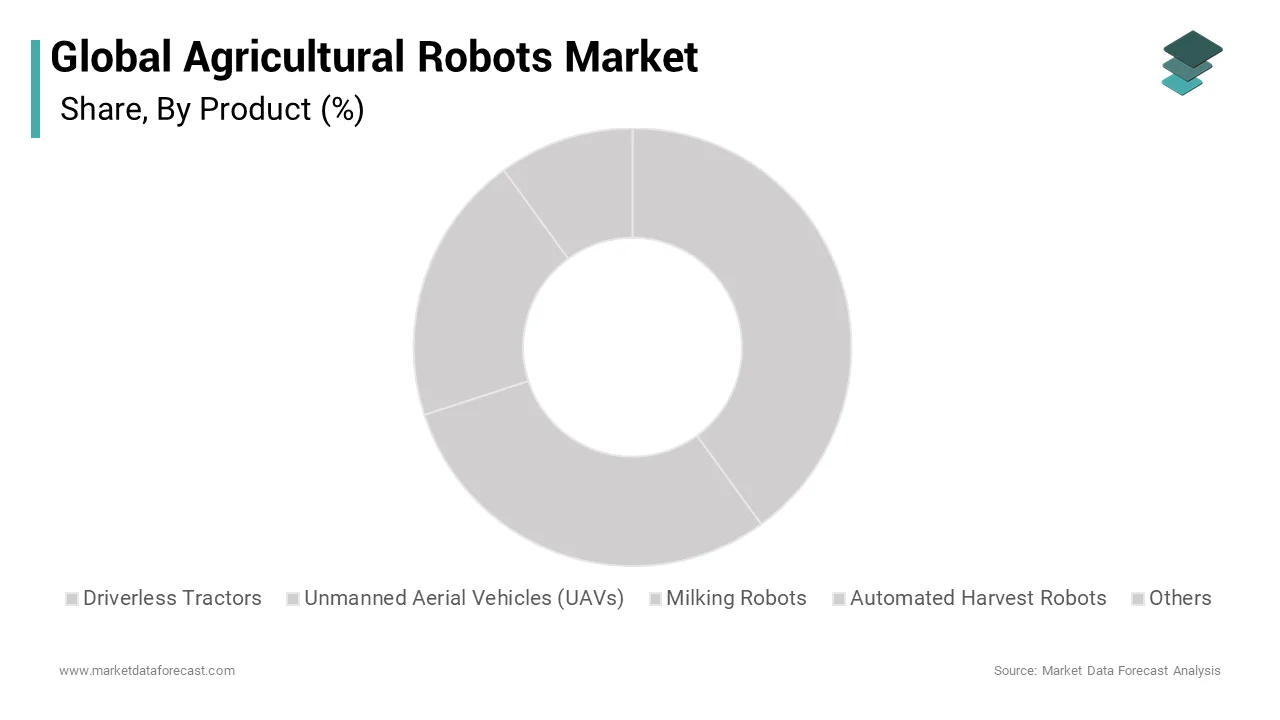
However, the automated harvest robots segment is estimated to register a promising CAGR of 23.6% during the forecast period in the global market owing to the urgent need to automate labor-intensive harvesting tasks for high-value crops such as fruits and vegetables, where labor shortages are most acute. As per the World Bank, the agricultural workforce in many developed countries has shrunk by more than 50% in the last three decades, creating a critical gap in seasonal labor availability. Traditional mechanical harvesters are often unsuitable for delicate produce, leading to significant damage and waste. Automated harvest robots equipped with advanced computer vision and soft robotic grippers can identify ripe fruits and pick them gently, mimicking human dexterity. The European Agricultural Machinery Industry Association reports that the development of these technologies has accelerated with several commercial models now available for crops like strawberries, apples, and tomatoes. The ability to operate continuously during short harvest windows ensures that crops are collected at peak ripeness, maximizing market value. Furthermore, the rising cost of manual labor makes the investment in harvesting robots increasingly economically viable. The Joint Research Centre of the European Commission highlights that automation in harvesting can reduce labor dependency by up to 70% for specific crops. As technology improves and costs decrease, the adoption of automated harvest robots is expected to surge across various agricultural sectors, which is driving exceptional market growth.
By Application Insights
The dairy management segment captured the leading share of the global market in 2025. The dominance of dairy management segment in the global market is majorly driven by the widespread adoption of robotic milking systems and automated feeding solutions in the dairy industry. The dairy sector was an early adopter of robotics due to the repetitive and labor-intensive nature of milking operations, which occur twice daily, every day of the year. As per the International Dairy Federation, the implementation of robotic milking systems has been shown to increase milk yield per cow by up to 5% due to more frequent and less stressful milking intervals. This improvement in productivity, combined with significant labor savings, makes dairy management robotics highly attractive to farm operators. The European Commission notes that in countries with high labor costs such as Denmark and Sweden, over 40% of new dairy installations include robotic milking units. These systems also provide valuable data on cow health and behavior, enabling proactive management of herd welfare. The ability to detect diseases like mastitis early through milk analysis sensors reduces veterinary costs and improves animal longevity. According to the Food and Agriculture Organization of the United Nations, the global demand for dairy products continues to rise, necessitating efficient and scalable production methods. The maturity of the technology and the clear economic benefits ensure that dairy management remains the largest application area for agricultural robots. The integration of robotics into other aspects of dairy farming, such as barn cleaning and feed pushing, further solidifies this segment's dominance.
On the other side, the harvest management segment is the fastest growing application segment and is estimated to witness a CAGR of 22.5% during the forecast period owing to the critical need to address labor shortages in the harvesting of high-value perishable crops such as berries, fruits, and vegetables. As per the United States Department of Agriculture, labor costs account for up to 50% of total production expenses for fresh produce, making automation a financial imperative for growers. The scarcity of seasonal workers has led to significant crop losses in recent years, with some estimates suggesting that up to 20% of produce is left unharvested due to lack of manpower. Robotic harvesting systems offer a reliable solution by operating continuously and efficiently regardless of labor availability. The European Agricultural Machinery Industry Association highlights that advancements in artificial intelligence and machine vision have enabled robots to accurately identify and pick ripe produce with minimal damage. These technologies are becoming increasingly affordable and accessible to medium-sized farms, expanding the potential market base. The ability to harvest at optimal ripeness improves product quality and shelf life, enhancing profitability for growers. Furthermore, regulatory pressures to reduce the use of chemical defoliants and other labor-saving chemicals are driving the adoption of mechanical harvesting alternatives. The combination of economic necessity, technological maturity, and regulatory support drives the rapid expansion of harvest management applications in the agricultural robotics sector.
REGIONAL ANALYSIS
North America Market Analysis
North America led the market in 2025 and holds a prominent position in the global agriculture robots market and is primarily characterized by large-scale farming operations and high adoption of advanced technologies. The United States dominates the regional market due to its vast agricultural land and strong investment in agritech innovation. As per the United States Department of Agriculture, the average farm size in the US is over 440 acres, providing the scale necessary to justify the investment in expensive robotic systems. The region benefits from a robust ecosystem of technology providers, research institutions, and venture capital funding that supports the development and deployment of agricultural robots. Canada also contributes significantly with its focus on precision agriculture and sustainable farming practices. The Canadian Government’s Agricultural Climate Solutions program provides funding for technologies that reduce greenhouse gas emissions, including autonomous equipment. The North American market is driven by the need to optimize labor usage and improve productivity in the face of rising operational costs. The presence of major agricultural machinery manufacturers in the region facilitates the integration of robotics into existing farming equipment. The Society of Automotive Engineers in the US plays a key role in setting standards for autonomous agricultural vehicles, ensuring safety and reliability. The high level of digital literacy among farmers and the availability of high-speed internet in rural areas further support market growth. The region’s focus on data-driven decision-making and efficiency ensures that North America remains a leader in the adoption of agricultural robotics.
Europe Market Analysis
Europe maintains a strong foothold in the Agriculture Robots Market, influenced by stringent environmental regulations and a strong commitment to sustainable agriculture. The European Union’s Green Deal and Farm to Fork Strategy are pivotal drivers mandating the reduction of chemical pesticide and fertilizer use. As per the European Environment Agency, these regulations encourage the adoption of robotic solutions for mechanical weeding and precise application of inputs. Germany, France, and the Netherlands are key markets within the region due to their advanced agricultural sectors and technological expertise. The European Commission’s Horizon Europe program provides substantial funding for research and development in agricultural robotics, fostering innovation and collaboration among member states. The region is characterized by a high density of small and medium-sized farms, which are increasingly adopting shared robotic solutions and cooperative models. The European Innovation Partnership for Agricultural Productivity and Sustainability facilitates knowledge exchange and technology transfer among farmers. The Joint Research Centre of the European Commission provides scientific support and data infrastructure for the deployment of smart farming technologies. European consumers’ demand for sustainably produced food also incentivizes farmers to demonstrate responsible land management through the use of advanced technologies. The Common Agricultural Policy provides financial incentives for farmers who implement precision agriculture practices. The presence of renowned research institutions and universities drives innovation in sensor technology and robotics. These factors collectively ensure that Europe remains a key driver of growth and innovation in the global agricultural robots market.
Asia Pacific Market Analysis
The Asia Pacific region is poised for substantial growth in the Agriculture Robots Market, driven by rapid population growth and the need to enhance agricultural productivity. China, Japan, and India are the primary contributors to the regional market, with China being the largest producer of agricultural goods globally. As per the Ministry of Agriculture and Rural Affairs of China, the government has launched initiatives to promote smart agriculture and reduce labor dependency in rural areas. The region faces challenges related to an aging farmer population and rural-urban migration, which necessitate the adoption of automated solutions. Japan is a leader in the development of compact and specialized robots for small-scale farms and high-value crops. The Japanese Ministry of Agriculture, Forestry and Fisheries supports the development of next-generation agricultural technologies through subsidies and research grants. India’s Digital Agriculture Mission aims to create a unified platform for agricultural data, encouraging the use of drones and robotic sensors. The Asian Development Bank reports that investment in agricultural technology in the region has increased by 15% annually. The presence of low-cost manufacturing hubs in China and Southeast Asia makes agricultural robots more affordable for local farmers. However, the fragmentation of land holdings and limited digital infrastructure in rural areas pose challenges to widespread adoption. Governments are investing in rural connectivity and training programs to overcome these barriers. The growing middle class and changing dietary habits increase demand for high-quality produce, further motivating farmers to adopt precision techniques. These dynamics position Asia Pacific as a high-potential market for agricultural robots.
Latin America Market Analysis
Latin America represents an emerging market for Agriculture Robots with growth driven by the expansion of commercial agriculture and export-oriented farming. Brazil and Argentina are the largest markets in the region due to their significant production of soybeans, corn, and other cash crops. As per the Brazilian Agricultural Research Corporation (Embrapa), the adoption of precision agriculture technologies in Brazil has grown by 20% in recent years to optimize input use and increase yields. The region’s vast arable land and favorable climate conditions attract investment in modern farming practices. Agricultural robots are essential for managing large-scale operations and reducing dependency on manual labor, which is becoming increasingly scarce and expensive. The Inter-American Institute for Cooperation on Agriculture supports initiatives to improve productivity and sustainability in Latin American agriculture. Economic volatility and currency fluctuations can impact purchasing power, but the long-term benefits of resource efficiency drive adoption among large agribusinesses. The Argentine Ministry of Agriculture promotes the use of technology to enhance competitiveness in global markets. The region faces challenges related to infrastructure limitations and access to finance for smallholders. International organizations such as the Food and Agriculture Organization provide technical assistance and funding for sustainable agriculture projects. The increasing awareness of environmental standards among international buyers encourages exporters to adopt monitoring and automation technologies. Local startups and technology providers are developing solutions tailored to the specific needs of Latin American farmers. These factors contribute to the steady growth of the agricultural robots market in the region.
Middle East and Africa Market Analysis
The Middle East and Africa region shows emerging potential in the Agriculture Robots Market, driven by the need to address water scarcity and improve food security in arid environments. Countries in the Gulf Cooperation Council, such as the United Arab Emirates and Saudi Arabia, are investing heavily in smart agriculture and controlled-environment farming. As per the Saudi Vision 2030 plan, the kingdom is allocating significant resources to develop sustainable agricultural practices, including the use of advanced robotics and automation. The harsh climate and limited arable land make efficient water and nutrient management critical for agricultural success. Agricultural robots help optimize irrigation and reduce labor requirements in desert farming and greenhouse operations. The African Union’s Comprehensive Africa Agriculture Development Programme emphasizes the importance of technology for agricultural transformation in Africa.
South Africa Market Analysis
South Africa dominates the African sub-market, supported by its well-developed commercial agricultural infrastructure and high rate of tech adoption. The nation faces notable labor pressures; according to World Bank data, agricultural labor in South Africa dropped from 21% in 2021 to 19% in 2022. This structural labor shortage, combined with a severe push for water conservation, has amplified the reliance on autonomous tractors and precision crop-monitoring drones. However, broader regional expansion across sub-Saharan Africa remains challenged by limited rural digital connectivity, low digital literacy among smallholder farming collectives, and capital constraints. International organizations and local agritech public-private partnerships continue to step in with technical assistance and specialized funding programs to promote sustainable robotics deployment.
COMPETITIVE LANDSCAPE
The competition in the Agriculture Robots Market is characterized by a mix of established agricultural machinery manufacturers and innovative startups specializing in niche robotic applications. Large incumbents leverage their extensive distribution networks and brand recognition to integrate robotics into traditional equipment lines while startups disrupt with specialized solutions for specific crops or tasks. The market sees intense rivalry in technological capabilities where companies compete to offer superior autonomy precision and ease of use. Strategic alliances between hardware providers and software developers are common as firms aim to create comprehensive digital farming ecosystems. Price sensitivity varies across regions with developed markets prioritizing advanced features while emerging economies focus on affordability and return on investment. Intellectual property protection is crucial as companies patent unique algorithms and mechanical designs to safeguard their innovations. Customer support and training play a vital role in building trust and ensuring effective utilization of complex robotic systems. The race to achieve greater reliability and adaptability in diverse field conditions drives continuous improvement in product offerings. As sustainability becomes a central theme competitors emphasize the environmental benefits of their technologies to appeal to eco conscious consumers and regulators. This dynamic landscape fosters rapid technological advancement and diverse solution options for global agriculture.
KEY MARKET PLAYERS
Some of the market players dominate the global agricultural robots market.
- AGCO
- Autonomous Solutions Inc.
- Deere and Company
- Tetra Laval International S.A.
- Autonomous Tractor Corporation
- Clearpath Robotics
- Deepfield Robotics
- DeLaval
- GEA Group
- Harvest Automation
- John Deere
- Lely
Top Players In The Market
- Deere and Company is a global leader in agricultural machinery that has aggressively expanded its robotics portfolio through strategic acquisitions and internal development. The company integrates autonomous technologies into its existing tractor and equipment lines enabling precise field operations with minimal human intervention. Deere recently acquired Bear Flag Robotics to enhance its autonomous driving capabilities for row crop farming. This move allows the company to offer fully autonomous tractors that can operate continuously improving farm efficiency. Deere also invests heavily in artificial intelligence and computer vision to develop see and spray technology that reduces herbicide use. By leveraging its extensive dealer network and customer base Deere ensures widespread adoption of its robotic solutions. The company’s focus on sustainability and precision agriculture strengthens its position as a key innovator in the global market.
- Tetra Laval International S.A. operates through its subsidiary DeLaval which is a pioneer in automated dairy farming solutions including milking robots and herd management systems. The company provides comprehensive robotic systems that improve animal welfare and farm productivity by allowing cows to be milked voluntarily. Tetra Laval recently launched new generations of milking robots with enhanced sensors for real time health monitoring and milk quality analysis. These advancements enable farmers to detect diseases early and optimize feeding strategies. The company also focuses on integrating its robotic systems with cloud based data platforms for better decision making. Tetra Laval’s strong presence in Europe and expanding footprint in Asia Pacific drive its global influence. Its commitment to innovation and customer support ensures it remains a dominant force in the dairy robotics segment.
- AGCO Corporation is a major manufacturer of agricultural equipment that has developed robust robotic solutions for harvesting and crop care. The company offers autonomous tractors and specialized robots for tasks such as fruit picking and weed control. AGCO recently partnered with technology firms to integrate advanced navigation systems into its Fendt brand tractors enabling high precision autonomous operations. The company also invests in drone technology for crop monitoring and spraying applications. AGCO’s focus on open architecture allows its robotic systems to integrate with third party software enhancing flexibility for farmers. The company’s global distribution network and strong brand reputation facilitate the adoption of its robotic products. AGCO continues to innovate in sustainable farming practices driving the development of efficient and environmentally friendly robotic solutions for diverse agricultural needs.
Top Strategies Used By Key Market Participants
Key players in the Agriculture Robots Market primarily focus on strategic acquisitions and partnerships to accelerate technological innovation and expand product portfolios. Companies invest heavily in research and development to enhance artificial intelligence and computer vision capabilities for improved autonomy and precision. Integrating robotic systems with cloud based data platforms enables real time monitoring and predictive analytics which adds value for farmers. Expanding into emerging markets through local collaborations helps companies navigate regulatory landscapes and cultural preferences. Offering robotics as a service models reduces upfront costs for farmers and creates recurring revenue streams. Developing interoperable systems that work with existing farm equipment ensures seamless integration and user adoption. Emphasizing sustainability and resource efficiency aligns products with global environmental regulations and consumer demands. Training and support services are crucial to overcome technical barriers and build trust among users. These strategies collectively drive growth and establish long term competitive advantages in the evolving agricultural robotics landscape.
MARKET SEGMENTATION
This research report on the global agriculture robots market is segmented and sub-segmented into the following categories.
By Product
- Driverless Tractors
- Unmanned Aerial Vehicles (UAVs)
- Milking Robots
- Automated Harvest Robots
- Others
By Application
- Dairy Management
- Irrigation Management
- Harvest Management
- Soil Management
- Inventory Management
By Region
- Asia Pacific
- North America
- Europe
- Middle East & Africa
- Latin America