- Product Description Description
- Table of Contents TOC
- List of Table & Figure LOT
- Get Free Sample PDF Sample PDF
Market Size, 2025
$49.06 BnMarket Estimate, 2026
$50.35 BnMarket Forecast, 2034
$61.97 BnCAGR, 2026–2034
2.63%Executive Summary: Asia Pacific Automotive Collision Repair Market
- Market Scope: Comprehensive regional Asia Pacific automotive collision repair market analysis covering product categories, vehicle types, service channels, geographic leadership frameworks, key growth drivers, and strategic industry trends.
- Market Valuation: Valued at USD 49.06 billion (2025), estimated at USD 50.35 billion (2026), and projected to reach USD 61.97 billion by 2034, registering a robust CAGR of 2.63% (2026–2034).
- Primary Growth Drivers: Rising road accident frequencies, increasing vehicle ownership rates, and expanding motor insurance coverage across the region. Notable trends include the rapid adoption of advanced diagnostic technologies for ADAS recalibration, direct repair program (DRP) integrations, and a shift toward certified networks for electric and hybrid vehicles.
Key Market Segment Metrics (2026–2034)
| Category | Leading Segment (2025 Position) | Fastest-Growing Segment |
|---|---|---|
| By Product / Material | Paints and coatings (dominated the product segment with a 58.6% revenue share in 2025) | Consumables (projected to grow at a CAGR of 9.4%) |
| By Vehicle Type | Light-duty vehicles (accounted for the largest share of repair volume in 2025) | Heavy-duty vehicles (advancing at a CAGR of 8.6%) |
| By Service Channel | Do-It-For-Me (DIFM) service channel (captured 64% of total revenue in 2025) | Original Equipment (OE) services (expected to expand at a CAGR of 9.1%) |
| By Region / Country | China (led the regional market with a 37.9% share in 2025, driven by high vehicle counts and insurance regulations) | Emerging regional markets like India and Southeast Asia (supported by professionalization of service channels) |
Major Market Players & Market Structure
Market Structure: Highly competitive collision repair and automotive aftermarket landscape featuring major service providers competing through digital diagnostic platforms, insurer partnerships for direct repair programs, technician training facilities, and mobile repair unit rollouts.
Key Companies: Midas, Caliber Collision, Car-Lux Body & Paint, Repco Auto Care, and Pit+Pat.
Asia Pacific Automotive Collision Repair Market Size
The size of the Asia Pacific automotive collision repair market was worth USD 49.06 billion in 2025. The Asia Pacific market is anticipated to grow at a CAGR of 2.63% from 2026 to 2034 and be worth USD 61.97 billion by 2034, up from USD 50.35 billion in 2026.
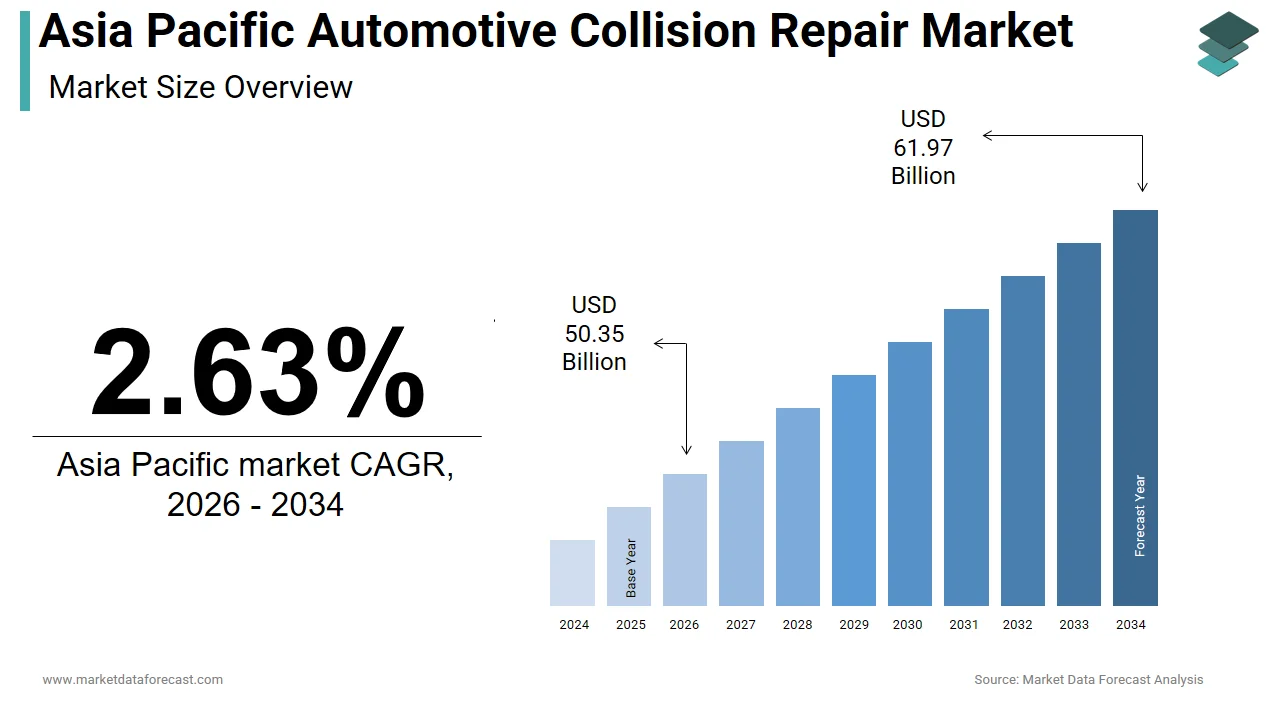
The Asia Pacific automotive collision repair market covers a broad range of services and products involved in restoring vehicles that have sustained damage from accidents or collisions. This includes body repairs, paint refinishing, glass replacement, mechanical diagnostics, and parts sourcing. Also, the rising vehicle ownership rates, increasing road traffic density, and growing insurance penetration have surged the demand for efficient and high-quality collision repair services across the region.
Moreover, urbanization and the expansion of the middle class in countries like India, Indonesia, and the Philippines have led to higher automobile usage, contributing to an uptick in accident-related repair needs. According to the World Health Organization (WHO), road traffic injuries remain a leading cause of death in several Asia and Pacific nations, with millions of non-fatal accidents reported annually, each requiring some level of vehicle restoration.
In addition, governments in the region are also strengthening vehicle safety norms and mandating insurance coverage, which is increasing the number of claims processed through authorized repair centers. For example, in Japan, the Ministry of Land, Infrastructure, Transport and Tourism mandates certified repair procedures for post-collision inspections and restorations.
Furthermore, the proliferation of organized multi-brand service chains and the integration of digital diagnostic tools are transforming traditional repair shops into technologically advanced service hubs.
MARKET DRIVERS
Rising Number of Road Accidents and Vehicle Damage Incidents
One of the primary drivers of the Asia Pacific automotive collision repair market is the increasing frequency of road accidents and vehicular damage incidents. Like, over 500,000 road traffic deaths occur annually in the Asia Pacific region, making it one of the most accident-prone areas globally. While these figures reflect severe cases, they underscore a much larger volume of minor and moderate collisions that require extensive repair work.
Also, in India alone, the Ministry of Road Transport and Highways recorded more than 400,000 road accidents in 2023 involving passenger cars, motorcycles, and commercial vehicles, many of which required bodywork and paint refinishing. Similarly, in China, it was reported a year-on-year increase in urban traffic density was reported, directly influencing the likelihood of low-speed collisions and bumper damages that necessitate professional repair interventions.
Besides, rapid motorization in Southeast Asian countries such as Thailand, Vietnam, and the Philippines has contributed to higher accident rates due to infrastructural limitations and evolving driver behavior patterns.
Expansion of Insurance Coverage and Claims Processing Networks
A significant factor fueling the Asia Pacific automotive collision repair market is the expanding reach of motor insurance policies and streamlined claims processing systems. Governments in several countries have mandated third-party liability insurance for all registered vehicles, while private insurers are offering comprehensive packages that cover collision-related damages. This increased insurance adoption translates into higher volumes of insured repair jobs, encouraging investment in certified repair shops and standardized service networks. Japanese and South Korean automakers have also strengthened their partnerships with authorized service centers to ensure quality-controlled repair outcomes for policyholders.
As per McKinsey, the integration of digital claims assessment, AI-based diagnostics, and direct repair programs (DRPs) is further accelerating claim approvals and boosting consumer confidence in formal repair channels.
MARKET RESTRAINTS
Shortage of Skilled Technicians and Training Gaps
One of the major restraints affecting the Asia Pacific automotive collision repair market is the shortage of skilled technicians and inadequate training infrastructure, particularly in developing economies. The complexity of modern vehicle construction featuring aluminum bodies, hybrid structures, and integrated electronics requires specialized knowledge that many traditional repair workshops lack. Similarly, in Indonesia, the Indonesian Automotive Aftermarket Association reported that a smaller share of repair centers employed fully certified technicians, with most relying on informal apprenticeship models that do not align with international standards. This skills gap results in inconsistent service quality, longer turnaround times, and higher error rates, discouraging consumers from opting for formal repair channels.
Availability of Informal and Unregulated Repair Shops
Another critical constraint impacting the Asia Pacific automotive collision repair market is the widespread presence of unregulated, informal repair shops that operate outside official certification frameworks. These establishments often offer lower-cost services but compromise on quality, safety, and environmental compliance, posing long-term risks to vehicle performance and customer satisfaction. According to the Federation of Automobile Dealers Associations (FADA) in India, a large share of collision-related repairs were conducted in unorganized workshops, primarily due to cost considerations and limited awareness about certified service providers. In the Philippines, the Motor Vehicle Parts and Accessories Exporters’ Association highlighted that unregistered garages frequently sourced second-hand or counterfeit spare parts, undermining the integrity of repair outcomes and increasing the risk of repeat damage. This informal market segment also presents challenges in terms of regulatory enforcement and consumer protection.
MARKET OPPORTUNITIES
Adoption of Advanced Diagnostic and Repair Technologies
A major opportunity emerging in the Asia Pacific automotive collision repair market is the increasing adoption of advanced diagnostic and repair technologies. As vehicles become more complex with features such as ADAS (Advanced Driver Assistance Systems), carbon fiber components, and electric drivetrains, the need for precision diagnostics and calibrated repair processes has intensified.
According to the Japan Automobile Research Institute, a large share of new vehicles sold in Japan in 2023 were equipped with ADAS functions such as lane-keeping assist and automatic emergency braking, which must be recalibrated after even minor collisions.
To meet this demand, collision repair centers in South Korea and Australia are investing in laser alignment systems, computerized paint matching, and real-time data analytics for fault detection. The Korea Transportation Safety Authority reported that certified repair facilities using these technologies saw an improvement in customer retention and repair accuracy.
Growth of Fleet-Based and Commercial Vehicle Repair Demand
The increasing demand for fleet-based and commercial vehicle collision repair services represents another promising avenue for the Asia Pacific market. With the rise of logistics, ride-hailing, and delivery-based businesses, commercial fleets are experiencing higher utilization rates and, consequently, greater exposure to collision risks. In response, fleet operators are prioritizing fast, reliable, and standardized repair services to minimize downtime and maintain service continuity. Major logistics companies in China and India have begun partnering with organized repair chains to establish dedicated maintenance and collision recovery networks.
MARKET CHALLENGES
Integration of Electric and Hybrid Vehicle Repair Requirements
One of the foremost challenges facing the Asia Pacific automotive collision repair market is the integration of electric and hybrid vehicle repair requirements into existing workshop capabilities. Unlike conventional internal combustion engine (ICE) vehicles, EVs and HEVs contain high-voltage battery packs, complex electrical architectures, and lightweight composite materials that require specialized handling during repair. According to the International Energy Agency (IEA), the number of electric vehicles on the road in the Asia Pacific region surpassed 20 million in 2023, necessitating a transformation in repair shop readiness. However, only a fraction of regional repair centers are currently equipped to handle high-voltage system diagnostics and safe disassembly procedures. In China, the China Association of Automobile Manufacturers emphasized the need for mandatory technician certifications for EV repair, citing potential risks related to electrical shock, fire hazards, and improper battery handling.
Regulatory Compliance and Standardization Across Countries
The Asia Pacific automotive collision repair market faces the challenge of varying regulatory compliance and standardization levels across countries, complicating cross-border service consistency and quality control. Each nation has its own set of guidelines governing repair methodologies, part authenticity verification, and environmental practices, making it difficult for multinational service providers to maintain uniformity. According to the ASEAN Automotive Federation, inconsistencies in technical standards between member states have slowed the development of regional service networks and hindered cross-border franchising opportunities. In Australia, the Australian Automotive Aftermarket Association reported that national repair accreditation programs were not easily transferable to neighboring countries, limiting the scalability of premium service providers. Furthermore, differing insurance protocols and inspection requirements create additional friction in service delivery and reimbursement mechanisms.
REPORT COVERAGE
| REPORT METRIC | DETAILS |
| Market Size Available | 2025 to 2034 |
| Base Year | 2025 |
| Forecast Period | 2026 to 2034 |
| Segments Covered | By Product, Vehicle Type, Service channel, and Region. |
| Various Analyses Covered | Global, Regional and Country-Level Analysis, Segment-Level Analysis, Drivers, Restraints, Opportunities, Challenges; PESTLE Analysis; Porter’s Five Forces Analysis, Competitive Landscape, Analyst Overview of Investment Opportunities |
| Countries Covered | India, China, Japan, South Korea, Australia, New Zealand, Thailand, Malaysia, Vietnam, Philippines, Indonesia, Singapore, Rest of APAC |
| Market Leaders Profiled | 3M, Automotive Technology Products LLC, Continental AG, Denso Corporation, Faurecia, Federal-Mogul LLC, Honeywell International, International Automotive Components Group, Johnson Controls, Magna International Inc., Mann+Hummel Group, Martinrea International Inc., Mitsuba Corporation, Robert Bosch GmbH, Takata Corporation, ODU GmbH & Co. KG, QPC Fiber Optic LLC, Smiths Interconnect, Souriau, Stäubli International AG, Stran Technologies, TE Connectivity, Teledyne Defense Electronics, Toshiba Electronic Devices & Storage Corporation, and X-Beam Tech Co., Ltd. |
SEGMENTAL ANALYSIS
By Product Insights
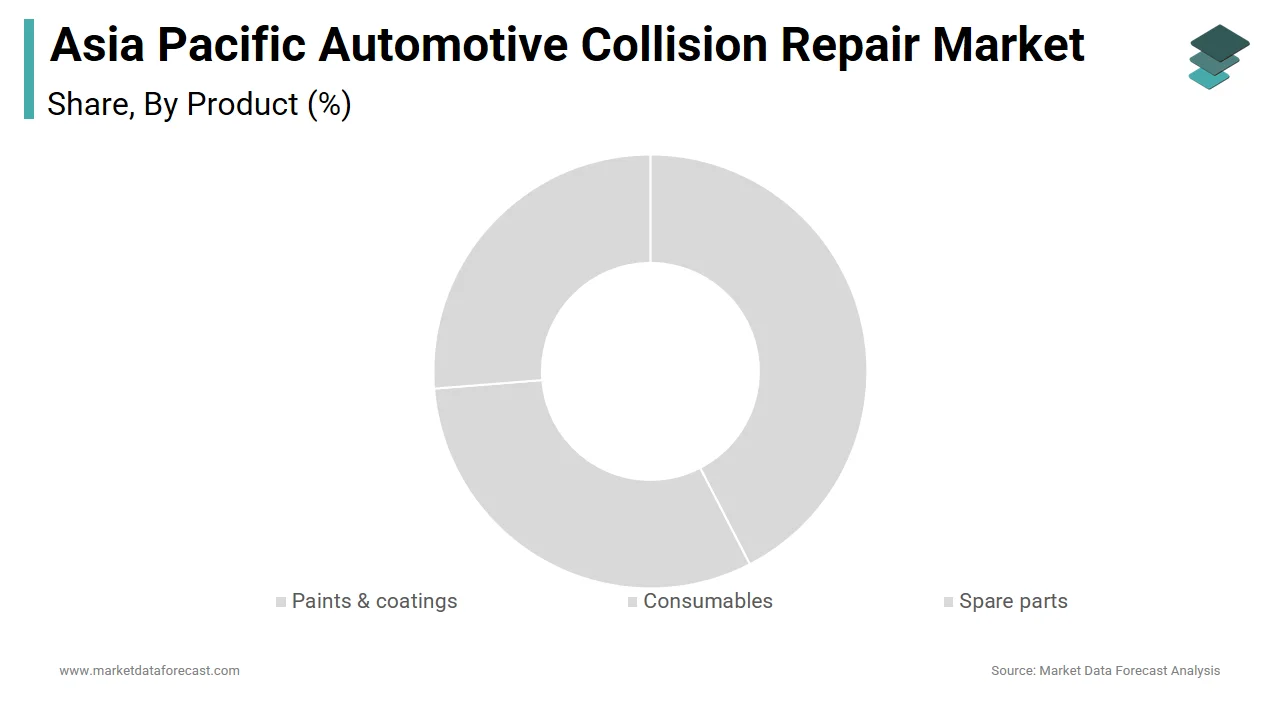
The paint and coatings segment represented the largest category in the Asia Pacific automotive collision repair market by accounting for a 58.6% of total revenue share in 2025. This dominance is primarily due to the extensive need for refinishing services following body repairs, which often involve repainting panels, bumpers, and structural components. Also, increasing insurance penetration has led to higher utilization of authorized repair centers that use factory-matched color formulations, reinforcing demand for premium paint solutions. Japanese automakers such as Toyota and Honda mandate certified paint systems for their authorized service networks, ensuring consistent finish quality and brand compliance.
The consumables segment is the fastest-growing in the Asia Pacific automotive collision repair market, projected to expand at a CAGR of 9.4% between 2025 and 2033. This growth is primarily attributed to the rising complexity of modern vehicle structures, necessitating advanced consumable materials such as adhesives, abrasives, sealants, and fasteners during repairs. According to the Japan Automobile Research Institute, nearly 70% of new vehicles sold in Japan in 2023 featured aluminum or composite body structures, requiring specialized bonding agents and filler materials that differ from traditional welding-based repair methods. Moreover, regulatory mandates on safety and durability have prompted repair workshops to adopt premium-grade consumables that meet international standards.
By Vehicle Type Insights
The Light-duty vehicles segment dominated the Asia Pacific automotive collision repair market in 2025. This overwhelming share stems from the sheer volume of passenger cars, SUVs, and small commercial vans on the road, which account for the majority of registered vehicles and accident incidents in the region. According to the Ministry of Road Transport and Highways of India, over 85% of road accidents in the country in 2023 involved light-duty vehicles, highlighting the segment's disproportionate exposure to collision events. Rising vehicle ownership rates in emerging economies such as Indonesia and the Philippines have also contributed to this trend.
The segment of heavy-duty vehicle segment is the fastest advancing in the Asia Pacific automotive collision repair market, expanding at a CAGR of 8.6%. This is mainly driven by the intensifying use of freight transport, logistics fleets, and construction equipment across the region, leading to higher wear and tear and incident-related damage. These vehicles, operating under heavy workloads and long-distance routes, are more prone to collisions and require frequent maintenance and body repairs. In Australia, the National Transport Commission reported a 9% rise in heavy vehicle accident claims in 2023, prompting fleet operators to invest in structured repair contracts with certified service providers. Also, government infrastructure projects in countries like Vietnam and Thailand are increasing the deployment of construction and utility vehicles, further boosting demand for professional collision repair services.
By Service Channel Insights
The Do-It-For-Me (DIFM) service channel held the largest share of the Asia Pacific automotive collision repair market by capturing a 64% of total revenue in 2025. This segment includes consumers who opt for professional assistance but retain control over selecting service providers, often through independent garages or multi-brand service centers. In China, the China Automobile Dealers Association reported that independent repair shops accounted for nearly 60% of all collision-related jobs in 2023, supported by a strong network of local parts suppliers and digital booking platforms. Moreover, rising awareness about insurance-backed repair options has encouraged vehicle owners to seek cost-effective yet reliable third-party services.
The Original Equipment (OE) service channel is the rapidly expanding segment in the Asia Pacific automotive collision repair market, expected to grow at a CAGR of 9.1%. This surge is largely fueled by increasing consumer preference for manufacturer-certified repairs, especially among luxury car owners and those seeking warranty protection. Japanese automakers such as Toyota, Honda, and Lexus have implemented stringent guidelines for post-collision restoration, mandating the use of genuine parts and factory-trained technicians. Similarly, in South Korea, Hyundai and Kia have expanded their collision repair networks, offering integrated diagnostics, recalibration, and paint matching through company-approved workshops. The Korea Transportation Safety Authority observed a 15% increase in OE-certified repair orders in 2023 compared to the previous year.
COUNTRY LEVEL ANALYSIS
China was at the forefront of the Asia Pacific automotive collision repair market by contributing 37.9% of regional demand in 2025. With the highest number of registered vehicles in the world and one of the most developed automotive ecosystems, China experiences a substantial volume of collision-related repair needs each year. According to the Ministry of Public Security, over 200,000 traffic accidents were officially recorded in major Chinese cities in 2023, many of which required body and paint restoration. This figure does not include unreported minor incidents, suggesting even higher latent demand. Furthermore, the Chinese government has been strengthening motor insurance regulations, mandating formalized repair procedures for claim settlements. The China Insurance Regulatory Commission reported that insurance-linked repair jobs rose by 18% in 2023, encouraging investment in certified service centers.
India is another key player in the market. The country’s demand is driven by a rapidly expanding vehicle parc, increasing road congestion, and rising insurance penetration, all of which contribute to higher accident-related repair volumes. Simultaneously, organized multi-brand service chains are gaining traction, replacing informal roadside mechanics in Tier 1 and Tier 2 cities. The National Skill Development Corporation highlighted that certified repair technician training programs had expanded in 2023, improving service quality and customer confidence. As per McKinsey, India’s automotive collision repair sector is poised for sustained growth, driven by both rising incident rates and increasing consumer preference for standardized, technology-enabled repair solutions.
Japan is a technologically advanced market with premium demand and is distinguished by its emphasis on precision, safety compliance, and OEM-certified repair procedures. With one of the highest vehicle ownership rates globally and a mature automotive ecosystem, Japan presents a stable demand base for high-quality collision repair services. The Ministry of Land, Infrastructure, Transport, and Tourism mandates strict inspection and repair protocols for post-collision vehicles, reinforcing the role of certified workshops. Also, the proliferation of ADAS-equipped vehicles has heightened the need for recalibration services, further elevating repair complexity and value.
South Korea represents an emerging hub for structured repair services, which is characterized by its growing preference for structured and certified repair solutions. With rising disposable incomes and a well-developed insurance framework, Korean consumers increasingly favor authorized and digitally enabled service providers over informal repair shops. Major insurers have introduced direct repair programs (DRPs), enabling policyholders to access pre-vetted repair centers that adhere to standardized quality benchmarks. Moreover, the increasing prevalence of electric and autonomous-ready vehicles has necessitated investments in calibrated repair facilities. Hyundai and Kia have launched dedicated EV collision repair centers equipped with specialized tools and trained technicians, enhancing service capabilities.
Australia accounts for a smaller share of the Asia Pacific automotive collision repair market, distinguished by its highly regulated environment and emphasis on safety compliance. The country’s collision repair sector is dominated by certified workshops that adhere to national standards for paint matching, structural repair, and electronic system recalibration. This shift reflects stronger insurer partnerships and consumer awareness regarding the risks associated with substandard repair practices. Also, the introduction of the National Collision Repairer Accreditation Scheme (NCRAS) has elevated industry benchmarks, ensuring that repair shops meet rigorous performance and technical capability requirements.
KEY MARKET PLAYERS
Some of the noteworthy companies in the APAC automotive collision repair market profiled in this report are 3M, Automotive Technology Products LLC, Continental AG, Denso Corporation, Faurecia, Federal-Mogul LLC, Honeywell International, International Automotive Components Group, Johnson Controls, Magna International Inc., Mann+Hummel Group, Martinrea International Inc., Mitsuba Corporation, Robert Bosch GmbH, Takata Corporation, ODU GmbH & Co. KG, QPC Fiber Optic LLC, Smiths Interconnect, Souriau, Stäubli International AG, Stran Technologies, TE Connectivity, Teledyne Defense Electronics, Toshiba Electronic Devices & Storage Corporation, and X-Beam Tech Co., Ltd.
TOP LEADING PLAYERS IN THE MARKET
Midas (USA, with strong presence in China, South Korea, and India)
Midas is a leading global brand in automotive repair services and holds a significant position in the Asia Pacific automotive collision repair market. With an extensive network of franchised service centers, Midas provides standardized body and paint restoration solutions that align with international quality benchmarks. The company's strength lies in its structured service delivery model, which ensures a consistent customer experience across multiple markets.
Caliber Collision (USA, expanding footprint in Australia and Southeast Asia)
Caliber Collision is a major player known for its comprehensive collision repair services, including structural repairs, refinishing, and mechanical diagnostics. In the Asia Pacific region, Caliber has been strengthening its presence through strategic partnerships and localized expansion initiatives. The company brings expertise in insurance-linked repair networks and digital diagnostics, enhancing service efficiency and claim processing transparency in key regional markets.
Car-Lux Body & Paint (Japan, with influence across ASEAN countries)
Car-Lux Body & Paint is a prominent Japanese collision repair chain with a reputation for high-quality refinishing and precision bodywork. The company serves both domestic and export markets, supporting Japanese automakers in maintaining OEM-level finishes post-collision. Car-Lux also plays a critical role in training technicians and setting industry standards in neighboring ASEAN countries, reinforcing its influence beyond Japan’s domestic market.
TOP STRATEGIES USED BY KEY MARKET PARTICIPANTS
Expansion into High-Growth Markets through Franchising and Joint Ventures
Leading players are aggressively expanding their regional footprint by leveraging franchising models and forming joint ventures with local operators. These strategies allow companies to tap into growing consumer demand while benefiting from localized knowledge and distribution networks without heavy capital investment.
Integration of Digital Diagnostic Tools and Smart Repair Systems
To enhance service accuracy and efficiency, key participants are adopting AI-driven diagnostics, real-time damage assessment apps, and automated paint matching technologies. This technological integration improves turnaround times, reduces human error, and enhances customer trust in repair outcomes, particularly in urban and insurance-backed service segments.
Strengthening Ties with Insurance Providers through Direct Repair Programs (DRPs)
Major collision repair firms are deepening their relationships with motor insurance companies by participating in DRP networks. These programs ensure a steady flow of insured repair jobs and provide consumers with trusted, cost-effective solutions, reinforcing long-term business stability and market visibility.
COMPETITION OVERVIEW
The competition in the Asia Pacific automotive collision repair market is marked by a mix of global chains, regional multi-brand service providers, and a vast network of independent workshops. Established brands such as Midas, Caliber Collision, and local leaders like Repco in Australia and Pit+Pat in India are leveraging technology, standardization, and insurance partnerships to differentiate themselves in a fragmented landscape.
At the same time, independent repair shops continue to dominate in terms of sheer numbers, particularly in emerging economies where price sensitivity remains a key factor. However, these informal players often lack certified training, modern equipment, and regulatory compliance, creating opportunities for organized service providers to capture market share.
Consumer awareness regarding repair quality, safety protocols, and warranty implications is rising, prompting a shift toward certified service centers. Additionally, government regulations and environmental guidelines are reshaping operational standards, pushing traditional repair businesses to either upgrade or consolidate.
RECENT MARKET DEVELOPMENTS
- In March 2024, Midas announced the launch of a new digital diagnostic platform tailored for Asian vehicle models, aimed at improving damage assessment speed and repair accuracy across its franchise network in China and India.
- In June 2024, Caliber Collision formed a strategic partnership with a leading Australian insurance provider to expand its direct repair program, ensuring preferential referral of collision-related claims to its certified service centers nationwide.
- In September 2024, Car-Lux Body & Paint opened a state-of-the-art training facility in Bangkok, designed to certify ASEAN-based technicians in advanced paint matching and aluminum repair techniques, supporting regional growth and service standardization.
- In November 2024, Repco Auto Care expanded its collision repair offerings in Sydney by acquiring a local premium body shop, signaling its intent to strengthen its presence in the high-end repair segment and enhance customer retention.
- In January 2025, Pit+Pat launched a mobile collision repair unit in Mumbai, offering on-site dent and scratch restoration services to urban customers, reflecting a broader trend toward convenience-driven, flexible repair models in the Asia Pacific region.
MARKET SEGMENTATION
This Asia Pacific automotive collision repair market research report is segmented and sub-segmented into the following categories.
By Product
- Paints & coatings
- Consumables
- Spare parts
By Vehicle Type
- Light-duty vehicle
- Heavy-duty vehicle
By Service channel
- DIY
- DIFM
- OE
By Country
- India
- China
- Japan
- South Korea
- Australia
- New Zealand
- Thailand
- Malaysia
- Vietnam
- Philippines
- Indonesia
- Singapore
- Rest Of APAC