- Product Description Description
- Table of Contents TOC
- List of Table & Figure LOT
- Get Free Sample PDF Sample PDF
Market Size, 2025
$7.57 BnMarket Estimate, 2026
$8.05 BnMarket Forecast, 2034
$13.23 BnCAGR, 2026–2034
6.4%Executive Summary: Asia Pacific Feminine Hygiene Market
- Market Scope: Regional assessment of feminine hygiene products encompassing diverse categories like sanitary pads, tampons, panty liners, internal cleaners, and disposable razors across key Asia-Pacific countries.
- Market Valuation: Valued at USD 7.57 billion in 2025, estimated at USD 8.05 billion in 2026, and projected to reach USD 13.23 billion by 2034, growing at a CAGR of 6.4% from 2026 to 2034.
- Primary Growth Drivers: Heightened awareness campaigns regarding menstrual health, rising literacy rates, eco-friendly innovations (such as biodegradable and reusable alternatives), and growing e-commerce retail accessibility.
Key Market Segment Metrics (2026–2034)
| Category | Segments / Core Focus | Key Highlights |
|---|---|---|
| By Product Type | Sanitary pads, Tampons, Internal cleaners & sprays, Panty liners & shields, Disposable razors & blades | Sanitary pads maintain the largest product share, supported by continuous innovations in comfort and eco-friendly materials. |
| By Distribution Channel | Supermarkets & hypermarkets, Drug stores, Convenience stores, Pharmacies & Beauty stores, Online stores | Online stores and hypermarkets are expanding rapidly, offering convenience and consumer discretion. |
| By Country | India, China, Japan, South Korea, Australia, New Zealand, Thailand, Malaysia, Vietnam, Philippines, Indonesia, Singapore, Rest of APAC | China and India account for the major regional share due to large populations, government health schemes, and shifting lifestyles. |
Major Market Players & Industry Landscape
Competitive Structure: Driven by multinational consumer goods leaders focusing on sustainable product portfolios, technological upgrades in manufacturing, and widespread educational campaigns.
Key Companies Profiled: The Procter & Gamble Company, Kimberly-Clark Corporation, Unicharm Corporation, Johnson & Johnson, Brait SE (Lil-Lets), Edgewell Personal Care, Kao Corporation, and Ontex International.
 Download Free Sample Report
Asia Pacific Feminine Hygiene Market Size
The Asia Pacific feminine hygiene market was valued at USD 7.57 billion in 2025. The market is estimated at USD 8.05 billion in 2026 and is projected to reach USD 13.23 billion by 2034, growing at a CAGR of 6.4% from 2026 to 2034.

The Asia-Pacific feminine hygiene market encompasses a diverse array of products designed to manage menstrual health and maintain personal cleanliness among women across the region. This sector includes sanitary pads, tampons, menstrual cups, and intimate washes that cater to varying cultural preferences and economic capabilities. Demographic shifts and evolving social attitudes toward menstrual hygiene management heavily influence the market dynamics. According to the World Bank, more than 500 million women and girls globally lack access to adequate menstrual supplies and facilities for menstrual hygiene management, and this indicates the scale of unmet need for affordable and accessible products. According to the World Bank, rural populations in developing countries had substantially lower access to improved sanitation facilities than urban populations, with access in 2008 standing at 40% in rural areas compared with 70% in urban areas, underscoring the infrastructure challenges affecting menstrual hygiene management. These infrastructural deficits highlight the critical intersection between public health infrastructure and consumer product adoption. The growing urbanization rates coupled with increasing female labor force participation are reshaping consumption patterns. Manufacturers are increasingly focusing on biodegradable materials and discreet packaging to align with environmental concerns and privacy needs. The market is not merely a commercial entity but a vital component of public health initiatives aiming to reduce stigma and improve quality of life for millions of women across diverse socioeconomic backgrounds in countries ranging from Japan to Indonesia.
MARKET DRIVERS
Rising Female Literacy and Health Awareness Driving Product Adoption
The escalating levels of female literacy and heightened health awareness are significantly propelling the expansion of the Asia Pacific feminine hygiene market by empowering women to make informed choices about their personal care. According to the World Health Organization, around 39% of schools globally provide menstrual health education, demonstrating that menstrual health education remains an important area for improvement. Educated women are more likely to seek out reliable and safe hygiene products rather than relying on traditional methods that may pose health risks. The World Health Organization emphasizes that menstrual health requires access to accurate information, affordable menstrual materials, and appropriate water, sanitation, hygiene, and waste management facilities. This educational push dismantles longstanding taboos and encourages open discussions about menstrual health. When women understand the health implications of poor hygiene, they prioritize purchasing dedicated feminine care products. This shift is particularly evident in countries like Vietnam and the Philippines, where government-led health campaigns have integrated menstrual hygiene into broader public health strategies. The correlation between education and product usage creates a sustainable demand base, as educated consumers tend to remain loyal to brands that offer safety and reliability. Furthermore, literate women often influence household purchasing decisions, thereby amplifying market reach beyond individual users to entire families. This demographic transformation ensures a steady growth trajectory for manufacturers who align their messaging with health empowerment narratives.
Increasing Urbanization and Female Workforce Participation Boosting Demand
The rapid urbanization and rising female workforce participation across the Asia Pacific region is further contributing to the Asia Pacific feminine hygiene market expansion by creating a consistent and growing consumer base with disposable income. According to the International Labour Organization, female labor force participation stood at 61.3% in East Asia, while South Asia recorded a much lower rate of 28.6%, highlighting substantial differences in women's economic participation across the region. Working women require products that offer comfort, discretion, and longevity during long hours at workplaces or while commuting. According to the Asian Development Bank, the urbanization rate in Asia and the Pacific is currently about 54% and is projected to rise to 64% by 2050. Urban environments typically provide better access to a variety of hygiene products compared to rural areas, thus facilitating trial and adoption of premium segments such as organic pads or menstrual cups. The shift from agrarian economies to service and industrial sectors means more women are entering formal employment where hygiene standards are strictly maintained. This professional environment necessitates the use of standardized hygiene products rather than improvised alternatives. Additionally, urban women are more exposed to global trends and marketing campaigns, which accelerate the acceptance of innovative products. The convergence of economic independence and urban living creates a robust foundation for market expansion as women prioritize personal care as part of their professional identity and daily routine.
MARKET RESTRAINTS
Persistent Cultural Stigma and Taboos Restricting Open Discussion
The enduring presence of cultural stigma and deep-rooted taboos surrounding menstruation is significantly hindering the growth of the Asia Pacific feminine hygiene market by suppressing open dialogue and limiting product accessibility. According to Plan International, at least 500 million girls and women globally lack what they need to manage their periods, while stigma, myths, and restrictions surrounding menstruation continue to affect girls' dignity and participation in everyday activities. This silence perpetuates misinformation and leads to the continued use of unhygienic alternatives, such as old cloth or ash, which pose serious health risks. The United Nations Children's Fund highlights that inadequate menstrual materials, facilities, restrictions on girls' movements, and feelings of shame can contribute to girls missing school during menstruation. Such exclusion from education reinforces the cycle of ignorance and limits future economic opportunities for women. When menstruation is viewed as impure or shameful, women are reluctant to buy branded products openly, which restricts market visibility and sales potential. Retailers in conservative areas may hesitate to stock feminine hygiene items prominently, further reducing access. The psychological burden of stigma also discourages innovation adoption, as women fear judgment for using modern products like menstrual cups or tampons. This cultural barrier requires extensive and sensitive marketing efforts that respect local traditions while gently challenging harmful norms. Until these deep-seated beliefs are addressed through community engagement and education, the market will struggle to reach its full potential in many parts of the region.
Inadequate Waste Management Infrastructure Hindering Sustainable Product Adoption
The insufficient waste management infrastructure in many Asia Pacific countries is substantially hampering the Asia Pacific feminine hygiene market by creating environmental concerns that deter the adoption of disposable hygiene products. According to the Asian Development Bank, only about 10% of solid waste in Asian cities ends up in properly engineered and managed landfill sites, demonstrating the scale of waste management challenges across the region. Most conventional pads contain plastic components that take hundreds of years to decompose, leading to landfill overflow and pollution. According to the Asian Development Bank, wastewater treatment remains limited in several Asian countries, with treatment rates of 10% in the Philippines, 14% in Indonesia, and 4% in Vietnam in the cited regional assessment. Consumers who are increasingly environmentally conscious may hesitate to purchase standard pads due to guilt over contributing to waste problems. This hesitation slows down market growth, especially among younger demographics who prioritize sustainability. Municipalities often lack designated bins for sanitary waste in public restrooms, which forces women to dispose of products improperly, causing hygiene hazards. The absence of incineration facilities or specialized recycling programs for feminine hygiene waste further complicates the issue. Brands face pressure to develop eco-friendly alternatives, but high costs limit their accessibility. Without improved infrastructure, the market cannot fully capitalize on the shift toward sustainable consumption, as consumers remain conflicted between convenience and environmental responsibility. This structural deficit acts as a brake on widespread adoption of modern hygiene solutions.
MARKET OPPORTUNITIES
Expansion of E-Commerce Platforms Enabling Discreet Purchasing
The rapid expansion of e-commerce platforms across the Asia-Pacific region presents a substantial opportunity for the Asia-Pacific feminine hygiene market by enabling discreet and convenient purchasing options for consumers. According to the Asian Development Bank, more than half of the region's approximately four billion residents already live in urban areas, while about one billion additional people are expected to move to cities over the next 30 years, supporting the expansion of digitally connected consumer markets. Digital platforms allow women to explore a wide range of products, including premium and niche items, without facing social judgment or embarrassment in physical stores. The Nielsen Company reports that 68% of urban women in the region prefer online shopping for feminine hygiene products due to privacy and home delivery benefits. This trend is particularly significant in conservative societies where buying such products openly may be stigmatized. E-commerce also facilitates access to detailed product information and reviews, which help consumers make informed choices about materials and features. Brands can leverage data analytics to understand consumer preferences and tailor their offerings accordingly. The rise of mobile payment systems further simplifies transactions, making it easier for women in remote areas to access products that are not available locally. Online subscription models ensure regular delivery, which builds customer loyalty and ensures consistent usage. This digital shift opens new revenue streams for manufacturers and allows smaller brands to compete with established players by reaching niche audiences directly. The convenience and anonymity offered by online channels are transforming how women engage with feminine hygiene products.
Growing Demand for Organic and Biodegradable Products Creating Niche Segments
The increasing consumer preference for organic and biodegradable feminine hygiene products is creating a lucrative opportunity for the Asia Pacific feminine hygiene market by catering to health-conscious and environmentally aware segments. According to the Global Organic Textile Standard, certified organic textile production and certification provide a framework for products made from organic fibers, supporting greater transparency and traceability in sustainable textile supply chains. Women are becoming more aware of the potential chemical exposures from conventional pads and are seeking alternatives made from bamboo, organic cotton, or plant-based fibers. The Global Organic Textile Standard reports that sales of certified organic feminine care products in Japan and Australia have grown by 30% annually, driven by stringent health regulations and consumer advocacy. This trend allows manufacturers to differentiate their offerings and command premium prices. Brands that invest in sustainable sourcing and transparent labeling can build strong trust with consumers who prioritize safety and ecological impact. The development of compostable pads and reusable menstrual cups aligns with global sustainability goals and appeals to younger demographics. Government incentives for green manufacturing in countries like South Korea and Singapore further support this shift. By focusing on innovation in materials, companies can tap into a growing segment that values both personal health and planetary well-being. This opportunity encourages research and development investments that can lead to breakthrough products addressing both hygiene and environmental concerns simultaneously.
MARKET CHALLENGES
Supply Chain Volatility Affecting Raw Material Availability
The inherent volatility in global supply chains is a notable challenge for the Asia Pacific feminine hygiene market by disrupting the availability and cost stability of essential raw materials. According to the International Monetary Fund, supply shocks accounted for about half of the increase in manufactured goods price inflation during the first three quarters of 2021, demonstrating the material effect of supply disruptions on manufacturing costs. Many countries in the region depend on imports for super-absorbent polymers and non-woven fabrics, which are subject to geopolitical tensions and logistics bottlenecks. The World Trade Organization indicates that shipping delays in major Asian ports have extended lead times by up to 20 days, affecting inventory management for hygiene product manufacturers. These disruptions force companies to maintain higher safety stocks, which ties up capital and increases operational costs. Fluctuating prices of crude oil directly impact the cost of plastic components, making pricing strategies unpredictable. Small and medium enterprises are particularly vulnerable, as they lack the bargaining power to secure long-term contracts with suppliers. Any interruption in the supply of key materials can lead to product shortages, which erode consumer trust and brand loyalty. Manufacturers must constantly navigate these uncertainties by diversifying suppliers or investing in local production capabilities. However, such transitions require significant time and investment. The inability to guarantee consistent product availability poses a persistent threat to market stability and growth prospects in an increasingly competitive landscape.
Regulatory Fragmentation Across Countries Complicating Compliance
The fragmented regulatory landscape across different countries in the Asia Pacific region is significantly challenging the Asia Pacific feminine hygiene market by imposing complex and varying compliance requirements on manufacturers. According to the Therapeutic Goods Administration, tampons and menstrual cups in Australia must comply with specific safety, quality, performance, packaging, and labeling standards, even though they are exempt from inclusion in the Australian Register of Therapeutic Goods. This lack of harmonization forces companies to adapt their products and documentation for each market, which increases time to market and operational costs. According to the Asian Regulatory Affairs Society, obtaining approval for a new feminine hygiene product can take anywhere from 6 to 18 months depending on the country due to differing evaluation processes. Inconsistent definitions of what constitutes a medical device versus a consumer good create confusion and legal risks. Some countries require clinical trials for products that are considered over-the-counter items in neighboring nations. This regulatory disparity hinders economies of scale and discourages smaller players from entering multiple markets. Companies must invest heavily in legal and regulatory expertise to navigate these complexities, which diverts resources from innovation and marketing. The absence of a unified regional standard also complicates cross-border trade and e-commerce operations. Until greater regulatory alignment is achieved, manufacturers will continue to face inefficiencies that limit their ability to respond quickly to market demands and consumer trends across the diverse Asia Pacific landscape.
REPORT COVERAGE
| REPORT METRIC | DETAILS |
| Market Size Available | 2025 to 2034 |
| Base Year | 2025 |
| Forecast Period | 2026 to 2034 |
| Segments Covered | By Product Type, Distribution Channel, and Region. |
| Various Analyses Covered | Global, Regional and Country-Level Analysis, Segment-Level Analysis, Drivers, Restraints, Opportunities, Challenges; PESTLE Analysis; Porter’s Five Forces Analysis, Competitive Landscape, Analyst Overview of Investment Opportunities |
| Countries Covered | India, China, Japan, South Korea, Australia, New Zealand, Thailand, Malaysia, Vietnam, Philippines, Indonesia, Singapore, Rest of APAC |
| Market Leaders Profiled | The Procter & Gamble Company, Kimberly-Clark Corporation, Unicharm Corporation, Johnson & Johnson, Brait SE (Lil-Lets), Edge well Personal Care, Kao Corporation, and Ontex International. |
SEGMENTAL ANALYSIS
By Product Type Insights
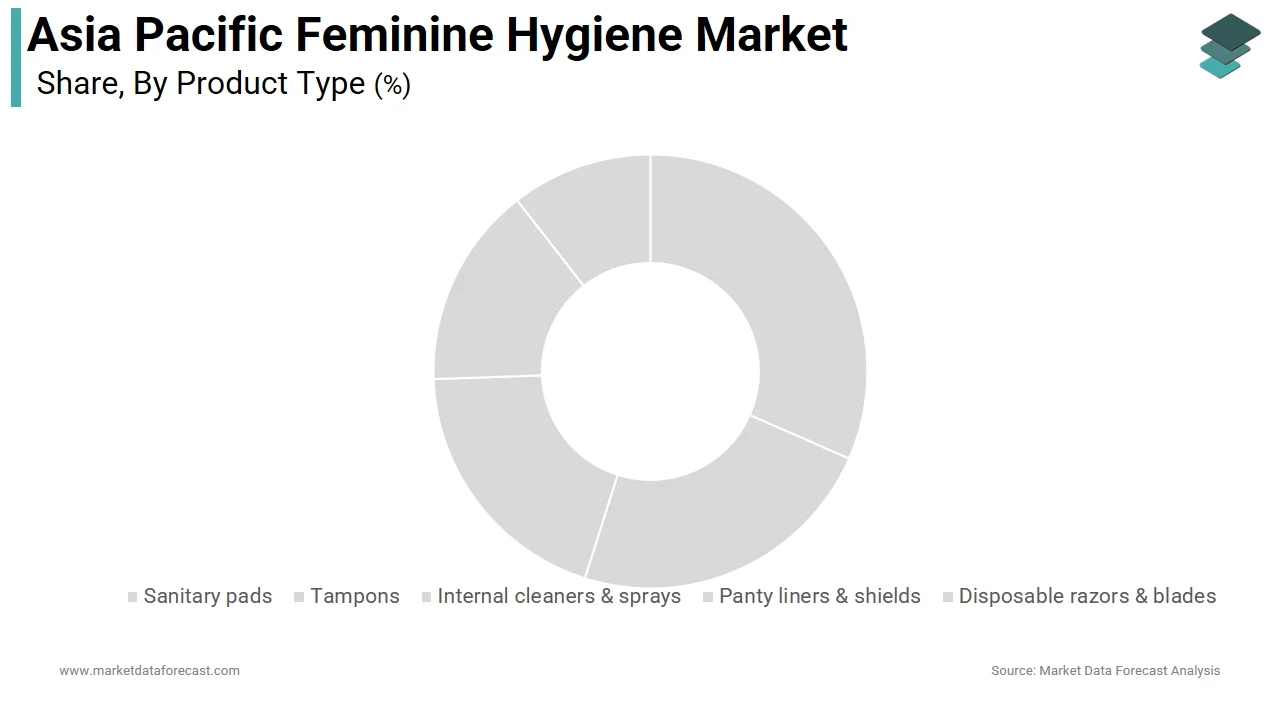
The sanitary pads segment dominated the market with the largest share of the Asia-Pacific feminine hygiene market in 2025. The dominance of the sanitary pads segment in the Asia Pacific feminine hygiene market is primarily driven by their high affordability and universal accessibility, which makes them the default choice for millions of women across diverse economic strata. According to the World Bank, access to affordable menstrual materials remains an important component of menstrual health, particularly where women and girls lack adequate facilities and supplies. The United Nations Development Programme states that government subsidy programs in countries like Indonesia and Malaysia have reduced the retail price of basic sanitary pads by 30%, further enhancing their accessibility to rural populations. Such initiatives directly correlate with increased market penetration, as price-sensitive consumers are more likely to adopt branded products when they are financially viable. The widespread availability of pads in local kirana stores, pharmacies, and supermarkets ensures that women do not need to travel long distances to purchase them. This convenience factor, combined with low cost, creates a barrier-free entry point for first-time users who may be transitioning from traditional methods. Manufacturers benefit from economies of scale due to high-volume sales, which allows them to maintain competitive pricing while ensuring quality. The cultural familiarity with pads also reduces the learning curve associated with other products like tampons or menstrual cups.
By Distribution Channel Insights
The supermarkets and hypermarkets segment held the largest share of the Asia-Pacific feminine hygiene market in 2025. The growth of the supermarkets and hypermarkets segment in this regional market is mainly attributed to their extensive retail network and the convenience of one-stop shopping, which attracts a broad consumer base. This shopping behavior favors supermarkets, as they offer a wide assortment of feminine hygiene brands and types under one roof, allowing for easy comparison and selection. The visibility of products in well-lit aisles with promotional displays encourages impulse buying and trial of new variants. Supermarkets also leverage their bargaining power to offer discounts and bundle deals, which attract price-sensitive consumers. The presence of trained staff who can assist with product queries adds value to the shopping experience, especially for first-time users. The trust associated with established retail chains assures consumers of product authenticity and quality, which is crucial for personal care items. Furthermore, the strategic location of supermarkets in high-traffic areas ensures maximum footfall and brand exposure. This combination of convenience, variety, and trust solidifies the position of supermarkets and hypermarkets as the leading distribution channel for feminine hygiene products in the region. According to an industry assessment of feminine hygiene products, online retail is expected to be the fastest-growing distribution channel during the forecast period, reflecting the increasing importance of discreet digital purchasing and home delivery.
However, the online stores segment is predicted to record a promising CAGR in the regional market over the forecast period owing to the increasing digital penetration and the explosive expansion of mobile commerce, which transforms how consumers access personal care products. According to the International Telecommunication Union, internet use has continued to expand across Asia and the Pacific, supporting greater access to digital services and online commerce. This widespread connectivity enables women to browse and purchase hygiene products from the comfort of their homes, overcoming geographical and social barriers. Mobile apps offered by major e-commerce platforms provide personalized recommendations and subscription services, which enhance customer engagement and retention. The ability to read reviews and compare prices empowers consumers to make informed decisions, which builds trust in online purchasing. Digital payment systems have become more secure and user-friendly, further facilitating seamless transactions. The anonymity offered by online shopping is particularly appealing in conservative societies where buying feminine hygiene products may be stigmatized. Social media marketing and influencer endorsements drive traffic to online stores, creating a virtuous cycle of awareness and sales. The continuous improvement in logistics and last-mile delivery ensures that products reach even remote areas quickly. This digital transformation is reshaping the distribution landscape and making online stores the fastest-growing channel in the market.
COUNTRY-LEVEL ANALYSIS
India Feminine Hygiene Market Analysis
India dominated the market by capturing the largest share of the regional market in 2025 and is likely to remain one of the key growth markets in the Asia Pacific feminine hygiene market over the next few years owing to the government programs, improving product access, and increasing menstrual health awareness. According to the Ministry of Health and Family Welfare, India's Menstrual Hygiene Scheme provides subsidized sanitary napkins to rural adolescent girls, with packs of six napkins supplied at a subsidized price of Rs 6 under the National Health Mission. This government intervention has significantly boosted market penetration in previously underserved segments. According to a peer-reviewed study using NFHS-5 data, only 42% of adolescent women in rural India reported exclusive use of hygienic menstrual methods, highlighting substantial room for further product adoption. The growing middle class and urbanization are further driving demand for premium and organic products as consumers become more health-conscious. Local manufacturers are leveraging cost-effective production methods to compete with international brands while catering to price-sensitive markets. The rise of social enterprises focusing on menstrual health education is also contributing to market growth by dismantling stigmas and encouraging product adoption. India's large youth demographic ensures a steady influx of new consumers who are more open to trying innovative hygiene solutions. The combination of government support, rising awareness, and economic growth positions India as a key growth engine for the regional market.
China Feminine Hygiene Market Analysis
China is likely to maintain a leading position in the Asia Pacific feminine hygiene market over the next few years, supported by its large consumer base, established retail infrastructure, and increasing household consumption. According to the National Bureau of Statistics of China, nationwide per capita consumption expenditure increased by 5.3% in 2024, while urban residents recorded per capita consumption expenditure growth of 4.7%. The Chinese Center for Disease Control and Prevention highlights that urban women increasingly prefer organic and antibacterial pads, which has led to a surge in premium segment sales. The rapid expansion of e-commerce platforms like Alibaba and JD.com has transformed distribution channels, making a wide variety of products accessible to consumers across the country. Chinese consumers are highly influenced by social media trends and celebrity endorsements, which drive brand loyalty and product trials. The government's focus on women's health and wellness has also contributed to a more open discourse around menstrual hygiene. Manufacturers are investing heavily in research and development to create innovative products that cater to specific needs such as sensitivity and odor control. The competitive landscape is dominated by both international and local brands that continuously innovate to capture market share. China's advanced retail infrastructure and tech-savvy consumers ensure that it remains a leader in market trends and product innovation within the region.
Japan Feminine Hygiene Market Analysis
Japan is likely to retain its position as a mature, innovation-driven market in the Asia Pacific feminine hygiene market over the next few years, supported by strong consumer expectations for product quality and safety. Japanese consumers prioritize product safety and efficacy, which has led to strict regulatory standards and high-quality manufacturing practices. The well-developed retail network, including convenience stores and drugstores, ensures widespread availability of diverse product options. Japanese brands are known for their technological advancements, such as ultra-thin designs and advanced absorbency cores, which set global benchmarks. The cultural emphasis on cleanliness and personal care drives consistent demand for high-end products. Additionally, the growing interest in sustainable and eco-friendly options is prompting manufacturers to introduce biodegradable and reusable products. Japan's mature market focuses on value addition and innovation rather than just volume growth, making it a key influencer of regional trends and product development.
South Korea Feminine Hygiene Market Analysis
South Korea is likely to experience continued growth in the Asia Pacific feminine hygiene market over the next few years, supported by strong consumer interest in personal care, advanced retail infrastructure, and product innovation. Korean consumers are highly influenced by K-beauty trends, which extend to personal care items, leading to a preference for visually appealing and well-packaged products. The strong e-commerce infrastructure and social media influence play a crucial role in shaping consumer preferences and driving brand loyalty. Local brands compete aggressively with international players by offering unique features and collaborative designs with popular celebrities. The focus on holistic wellness has also increased interest in intimate washes and herbal-based hygiene products. South Korea's advanced manufacturing capabilities allow for rapid product innovation and customization. The market is driven by young consumers who are willing to pay a premium for quality and brand image. This dynamic environment ensures that South Korea remains at the forefront of product trends and marketing strategies in the region.
Australia Feminine Hygiene Market Analysis
Australia is likely to maintain a mature and sustainability-focused position in the Asia Pacific feminine hygiene market over the next few years, supported by strong product standards and consumer interest in environmentally responsible options. According to the Therapeutic Goods Administration, tampons and menstrual cups supplied in Australia must meet applicable safety and quality standards, including requirements covering packaging, labeling, performance, and materials. The Therapeutic Goods Administration enforces strict standards for product safety, which ensures high quality and builds consumer trust. Australian consumers are well-informed and prefer brands that demonstrate transparency in sourcing and manufacturing practices. The well-established retail network, including pharmacies and supermarkets, provides easy access to a wide range of products. The influence of health advocates and environmental organizations has pushed manufacturers to adopt sustainable practices and offer eco-friendly alternatives. The high disposable income of consumers allows for the adoption of premium and reusable products such as menstrual cups and period panties. Australia's progressive stance on health and sustainability sets a benchmark for other markets in the region. The focus on quality and ethical consumption ensures steady growth in the premium and organic segments.
COMPETITIVE LANDSCAPE
The competitive landscape of the Asia Pacific Feminine Hygiene Market is characterized by intense rivalry between established multinational corporations and emerging local brands who vie for consumer loyalty through innovation and affordability. Multinational players leverage their global expertise, extensive distribution networks, and strong brand recognition to maintain dominance in urban centers and premium segments. They invest heavily in marketing campaigns that emphasize product safety, comfort, and technological advancements to differentiate themselves from competitors. Local brands compete aggressively by offering cost-effective solutions that cater to price-sensitive consumers in rural and semi-urban areas. These domestic players often have a deeper understanding of regional cultural nuances and preferences, allowing them to tailor products more effectively. The market is witnessing a surge in niche players who focus on organic, sustainable, and reusable products, appealing to environmentally conscious and health-aware consumers. E-commerce platforms have lowered entry barriers, enabling smaller brands to reach wider audiences without significant infrastructure investments. Competition is further intensified by continuous product launches and promotional activities that drive consumer trial and switching. Companies are increasingly collaborating with healthcare providers and educators to build trust and credibility. The dynamic nature of the market requires constant adaptation to changing consumer preferences, regulatory requirements, and technological advancements. This competitive environment fosters innovation and improves product quality, benefiting consumers across the region.
KEY MARKET PLAYERS
The leading companies operating in the Asia Pacific feminine hygiene market include:
- The Procter & Gamble Company
- Kimberly-Clark Corporation
- Unicharm Corporation
- Johnson & Johnson
- Unilever
- Brait SE (Lil-Lets)
- Edgewell Personal Care
- Kao Corporation
- Ontex International
TOP PLAYERS IN THE MARKET
- Procter and Gamble maintains a dominant presence through its extensive portfolio of trusted brands such as Whisper and Always, which are deeply embedded in consumer routines across the region. The company focuses heavily on innovation by introducing ultra-thin and breathable products that cater to the specific climatic conditions of tropical Asia. Recent initiatives include launching biodegradable pad variants in Japan and Australia to address growing environmental concerns among eco-conscious consumers. Procter and Gamble also invests significantly in digital marketing campaigns that educate young women about menstrual health, thereby building long-term brand loyalty. Their robust distribution network ensures product availability in both urban supermarkets and rural local stores. The company collaborates with non-governmental organizations to promote hygiene education in schools, which enhances its corporate social responsibility image. By leveraging advanced research and development capabilities, Procter and Gamble continuously improves product comfort and absorbency. This commitment to quality and accessibility strengthens its position as a market leader. The company also adapts its packaging sizes to suit different economic segments, ensuring affordability for low-income households. These strategic efforts consolidate its influence and drive sustained growth in the diverse Asia Pacific landscape.
- Kimberly-Clark Corporation contributes significantly to the market through its well-known Kotex brand, which is synonymous with reliability and comfort for millions of women. The company emphasizes product differentiation by offering specialized solutions such as overnight pads and period panties that address specific user needs. Kimberly-Clark has recently expanded its organic cotton product line in South Korea and China to meet the rising demand for natural and chemical-free hygiene options. The company actively engages in sustainability initiatives by reducing plastic usage in packaging and promoting recycling programs. Its strong partnerships with local retailers ensure wide visibility and easy access for consumers across various channels. Kimberly-Clark also leverages data analytics to understand changing consumer preferences and tailor its product offerings accordingly. The company supports menstrual health awareness campaigns in Southeast Asia, which helps dismantle stigmas and encourages product adoption. By focusing on innovation and sustainability, Kimberly-Clark builds trust and loyalty among health-conscious consumers. Its ability to adapt to regional trends while maintaining global quality standards ensures its competitive edge. The corporation continues to invest in manufacturing facilities to improve supply chain efficiency and reduce costs.
- Unilever plays a crucial role in the market through its intimate care brands such as Carefree and certain regional offerings that emphasize freshness and daily hygiene. The company focuses on expanding its product range to include intimate washes and wipes, which complement traditional sanitary products and address holistic personal care needs. Unilever has recently launched innovative panty liner variants with probiotic technology in Thailand and Indonesia to promote vaginal health and balance. The company utilizes its vast distribution network to reach remote areas where access to hygiene products is limited. Unilever also engages in aggressive digital marketing strategies targeting younger demographics through social media influencers and educational content. Its commitment to sustainability is evident in the introduction of recyclable packaging and reduced water usage in manufacturing processes. The company collaborates with local governments and health organizations to promote menstrual hygiene management in schools. By integrating intimate care into broader wellness narratives, Unilever captures a wider consumer base. Its focus on affordability and accessibility ensures that its products remain relevant to diverse socioeconomic groups. Unilever continues to innovate by incorporating natural ingredients and enhancing product comfort to meet evolving consumer expectations.
TOP STRATEGIES USED BY KEY MARKET PARTICIPANTS
Key players in the Asia Pacific Feminine Hygiene Market employ several strategic approaches to maintain competitiveness and drive growth. Product innovation remains a primary strategy, with companies investing heavily in research and development to create ultra-thin, breathable and organic options that cater to health conscious consumers. Brands are increasingly focusing on sustainability by introducing biodegradable materials and eco-friendly packaging to appeal to environmentally aware shoppers. Digital transformation is another critical strategy as companies leverage e-commerce platforms and social media marketing to reach younger demographics and provide discreet purchasing options. Partnerships with non-governmental organizations and government bodies help brands conduct educational campaigns that dismantle menstrual stigmas and expand market penetration in rural areas. Localization of products is essential as manufacturers adapt formulations, scents, and sizes to suit regional cultural preferences and climatic conditions. Companies also pursue expansion into adjacent categories such as intimate washes and period panties to offer holistic hygiene solutions. Strategic acquisitions of local brands allow multinational corporations to gain immediate market access and consumer trust. Pricing strategies are tailored to different economic segments, ensuring affordability for mass markets while offering premium options for affluent consumers. These multifaceted strategies enable key players to navigate the diverse and dynamic Asia-Pacific landscape effectively.
MARKET SEGMENTATION
This research report on the Asia Pacific feminine hygiene market has been segmented and sub-segmented into the following categories:
By Product Type
- Sanitary pads
- Tampons
- Internal cleaners & sprays
- Panty liners & shields
- Disposable razors & blades
By Distribution Channel
- Supermarkets & hypermarkets
- Drug stores
- Convenience stores
- Pharmacies & Beauty stores
- Online stores
By Country
- India
- China
- Japan
- South Korea
- Australia
- New Zealand
- Thailand
- Malaysia
- Vietnam
- Philippines
- Indonesia
- Singapore
- Rest of Asia Pacific