- Product Description Description
- Table of Contents TOC
- List of Table & Figure LOT
- Get Free Sample PDF Sample PDF
Market Size, 2025
$5.87 BnMarket Estimate, 2026
$7.35 BnMarket Forecast, 2034
$44.15 BnCAGR, 2026–2034
25.13%Executive Summary: Asia-Pacific Medical Cannabis Market
- Market Scope: Comprehensive regional evaluation of the Asia-Pacific medical cannabis market covering species, derivatives, applications, end users, routes of administration, and country-level distribution frameworks.
- Market Valuation: Valued at USD 5.87 billion in 2025, estimated at USD 7.35 billion in 2026, and projected to reach USD 44.15 billion by 2034, registering a strong CAGR of 25.13% (2026–2034).
- Primary Growth Drivers: Increasing prevalence of chronic pain, epilepsy, multiple sclerosis, and other chronic diseases; rising emphasis on traditional health practices and cannabis integration; and growing legalization generating tax revenues.
Key Market Segment Metrics (2026–2034)
| Category | Leading Segment (2025 Position) | Fastest-Growing Segment |
|---|---|---|
| By Species | Indica (holding the maximum market share driven by growing interest in CBD-based products and therapeutic applications) | Hybrid & Sativa Strains |
| By Derivative | Cannabidiol (CBD) (holding a significantly higher overall market share) | Tetrahydrocannabinol (THC) (projected to propel further driven by stress and anxiety relief applications) |
| By End User | Research & Development Centers (dominating the region due to a rise in research, collaborations, and epilepsy/cancer discoveries) | Pharmaceutical Industry & Hospitals |
| By Route of Administration | Oral Solutions & Capsules (leading with the largest share of the market, reinforced by innovations like Epidiolex) | |
Major Market Players & Market Structure
Market Structure: Highly evolving regulatory and commercial landscape across APAC featuring international medical cannabis producers and regional research centers navigating complex cross-border prohibitions, licensing updates, and clinical standardization.
Key Companies: BOL Pharma, Tilray, Medreleaf Corporation, Aurora Cannabis, Inc., Canopy Growth Corporation, Insys Therapeutics, Inc., Aphria, Inc., MGC Pharmaceuticals Limited, and GW Pharmaceuticals, plc.
Asia-Pacific Medical Cannabis Market Size
The size of the Asia Pacific medical cannabis market was worth USD 5.87 billion in 2025. The market is anticipated to grow at a CAGR of 25.13% from 2026 to 2034 and be worth USD 44.15 billion by 2034 from USD 7.35 billion in 2026.
MARKET DRIVERS
Increasing prevalence of chronic diseases
The increasing prevalence of chronic pain, epilepsy, multiple Sclerosis, and other chronic diseases in the Asia Pacific is one of the prime factors elevating the market share of the APAC cannabis market. Also, rising emphasis on the study of the incorporation and usage of cannabis for medical purposes is gaining traction in the region. As ASEAN countries are popular for their traditional health practices and medicines for treating and healing diseases or medical conditions, the demand for medical cannabis is showing an upward trend. The demand for cannabis-derived from hemp is rising as more people become aware of its benefits. Legalisation has increased tax revenues. This is one of the reasons that is ultimately shooting up the market share of the APAC medical cannabis market.
MARKET OPPORTUNITIES
Collaboration with established cannabis markets and research institutions
Collaborating with well-established cannabis markets and research institutions globally can promote the exchange of knowledge and technology, expediting the development of the APAC medical cannabis market during the forecast period. Investing in research and development to create standardized cannabis-based products ensures adherence to regulatory requirements while also guaranteeing quality, accurate dosage, and safety. This approach enhances acceptance within the medical community.
MARKET CHALLENGES
Stringent cannabis regulations and outright prohibitions
The stringent cannabis regulations in the Asia Pacific region, including outright prohibitions, present substantial hurdles to establishing a robust APAC medical cannabis market. Businesses in the cannabis industry might encounter difficulties arising from regulations that overlap, lack clarity, and occasionally contradict each other across different government levels. In a recent survey among cannabis cultivators, 37% of participants highlighted discrepancies between county, regional, and state regulations as a major challenge to conducting legal operations.
Regulatory costs surpass potential profits, affecting market growth.
The legalized cannabis industry's economic potential may be fully realized if new regulations don't exceed the costs operators would incur in the illegal market. Furthermore, the cannabis business often faces short-term, high-interest loans from private equity firms and small investor groups, high lease premiums, and high taxes, making profitability difficult for growers.
REPORT COVERAGE
| REPORT METRIC | DETAILS |
| Market Size Available | 2025 to 2034 |
| Base Year | 2025 |
| Forecast Period | 2026 to 2034 |
| Segments Covered | By Product Type, Derivative, Species, Source, Application, Route of Administration, End User, Distribution Channel, and Country. |
| Various Analyses Covered | Global, Regional & Country Level Analysis, Segment-Level Analysis; DROC, PESTLE Analysis, Porter's Five Forces Analysis, Competitive Landscape, Analyst Overview of Investment Opportunities |
| Countries Covered | India, China, Japan, South Korea, Australia, New Zealand, Thailand, Malaysia, Vietnam, Philippines, Indonesia, Singapore, Rest Of APAC. |
| Market Leader Profiled | Report are BOL Pharma, Tilray, Medreleaf Corporation, Aurora Cannabis, Inc., Canopy Growth Corporation, Insys Therapeutics, Inc., Aphria, Inc., MGC Pharmaceuticals Limited, GW Pharmaceuticals, plc., and Others. |
SEGMENTAL ANALYSIS
By Species Insights
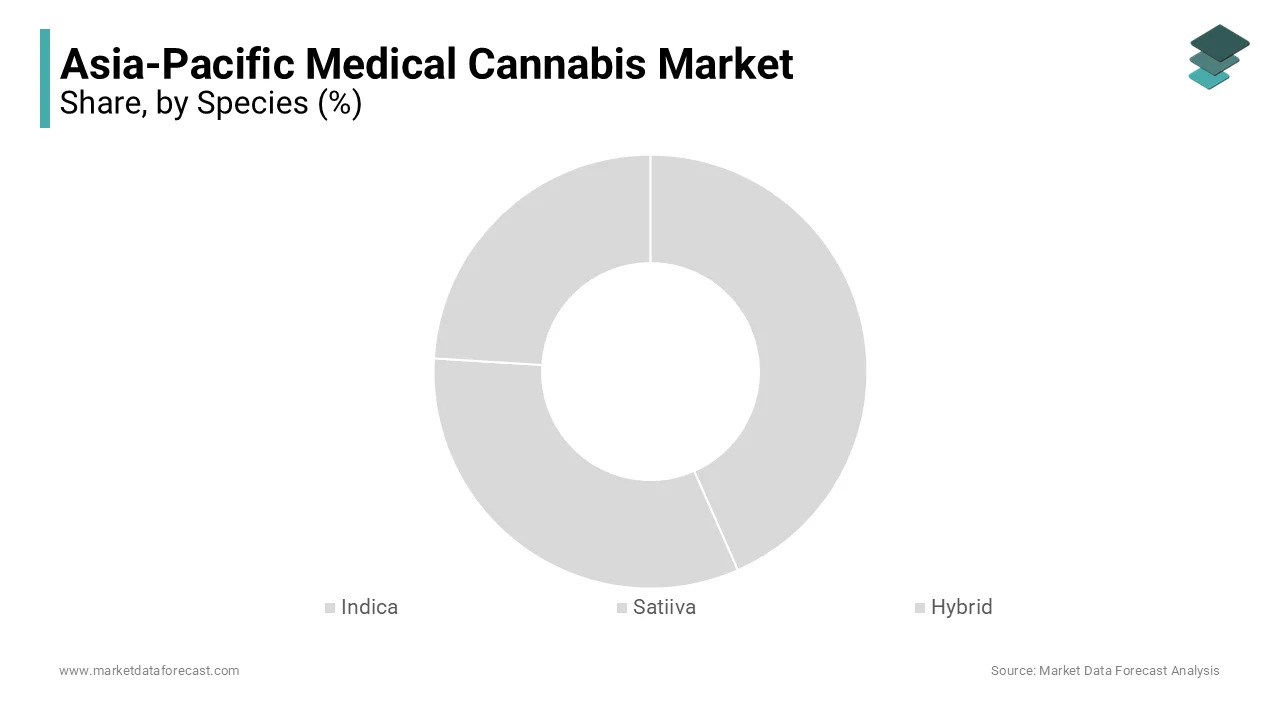
The Indica segment is holding the maximum market share under this segment of the APAC medical cannabis market. The demand for Cannabis Indica strains has expanded dramatically due to the growing interest in CBD-based products and their therapeutic applications.
By Derivatives Insights
The cannabidiol segment has a significantly higher market share. However, the growth rate of tetrahydrocannabinol will propel further during the forecast period due to its characteristic of being a reliever of mental health like stress, anxiety, etc.
By Application Insights
The epilepsy segment is gaining traction over the market share. According to a poll conducted on 5k people, more than sixty percent of cannabis consumers use it to relieve anxiety symptoms.
By End User Insights
The research and development centers segment is currently dominating the region due to a rise in research, collaboration, and new discoveries regarding epilepsy and cancer diseases.
By Route of Administration Insights
The oral solutions and capsules segment is leading with the largest share of the market. PureTech Health created Epidiolex, an oral CBD capsule formulation released in December 2023, enabling users to dispense up to 5 mL of CBD solution from a bottle.
REGIONAL ANALYSIS
Japan's medical cannabis market is likely to evolve and is in the process of making cannabis legal. A shift in perception towards the medical use of cannabis is taking place.
As a result, in October 2023, the Japanese government revised the old cannabis control act and renamed it Law Concerning Regulation of the Cultivation of Cannabis Plants. Furthermore, it plans to make it applicable within one year. Hence, the demand for cannabis in the APAC medical cannabis market will increase.
China's medical cannabis market is anticipated to witness a rise in market share in the coming years. Currently, China produces about half of the legal hemp grown worldwide. Cannabis is present in Chinese culture and produces hemp for industrial usage, but it is not legalized. It also exports it to Germany, the UK, the United States, Japan, and the Netherlands.
India's medical cannabis market is anticipated to grow at a steady pace during the forecast period. Cannabis is banned under the Narcotic Drugs and Psychotropic Substances Act, but State governments have the authority to grant licenses for medical and scientific purposes. Cannabis was first legalized in the state of Uttarakhand, and then in a few other states like Gujarat, Madhya Pradesh, Rajasthan, Orissa, and Uttar Pradesh have legalized cannabis and practice restricted farming. The market share is anticipated to grow in the future. Also, the demand for cannabidiol-based products has increased in recent times in the country.
South Korea's medical cannabis market is expected to register an upward trend in growth rate during the forecast period. Gyeongbuk, a hemp regulation-free zone in southeast South Korea, is the hub of the cannabis industry. And has recently accepted its use for medical and pharmaceutical purposes. However, just 19 percent of people are happy with the introduction of over-the-counter medical marijuana, which is now only available with a doctor's prescription.
Singapore's medical cannabis market is estimated to grow at a slower rate during the forecast period. The laws against cannabis have been eased for medical and recreational purposes. However, it has some of the most stringent cannabis usage laws and rules. One of the major issues in Singapore is the surge in cannabis addiction, which delays the large-scale use of medical cannabis.
KEY MARKET PLAYERS
Some of the notable companies playing a significant role in the Asia Pacific medical cannabis market Profiled in the Report are BOL Pharma, Tilray, Medreleaf Corporation, Aurora Cannabis, Inc., Canopy Growth Corporation, Insys Therapeutics, Inc., Aphria, Inc., MGC Pharmaceuticals Limited, GW Pharmaceuticals, plc., and Others.
MARKET SEGMENTATION
This research report on the Asia Pacific medical cannabis market has been segmented and sub-segmented based on species, derivatives, application, end user, route of administration, and country.
By Product Type
- Flowers/Buds
- Oils & Tinctures
- Concentrates (e.g., waxes, resins)
- Edibles
- Topicals (e.g., creams, ointments)
- Capsules & Tablets
- Vape Pens
- Patches
- Dissolvables/Powders
- Others (e.g., creams, moisturizers, serums)
By Derivative
- Cannabidiol (CBD)
- Tetrahydrocannabinol (THC)
- Balanced THC & CBD
- Cannabigerol (CBG)
- Cannabinol (CBN)
- Others
By Species
- Sativa
- Indica
- Hybrid
By Source
- Natural
- Synthetic
By Application
- Pain Management
- Cancer
- Epilepsy
- Arthritis
- Migraine
- Mental Health Disorders (e.g., anxiety, depression, PTSD)
- Neurological Disorders (e.g., Parkinson’s, Alzheimer’s, Multiple Sclerosis)
- AIDS
- Diabetes
- Glaucoma
- Amyotrophic Lateral Sclerosis (ALS)
- Autism
- Sleep Disorders
- Appetite Loss
- Others
By Route of Administration
- Oral Solutions & Capsules
- Smoking
- Vaporizers
- Topicals
- Intravenous
- Others
By End User
- Pharmaceutical Industry
- Research & Development Centers
- Hospitals
- Rehabilitation Centers
- Homecare Settings
- Others
By Distribution Channel
- Dispensaries
- Pharmacies (Hospital & Retail)
- Online Retailers
- Business-to-Business (B2B)
- Business-to-Consumer (B2C)
By Country
- India
- China
- Japan
- South Korea
- Australia
- New Zealand
- Thailand
- Malaysia
- Vietnam
- Philippines
- Indonesia
- Singapore
- Rest Of APAC