- Product Description Description
- Table of Contents TOC
- List of Table & Figure LOT
- Get Free Sample PDF Sample PDF
Market Size, 2025
$4.14 BnMarket Estimate, 2026
$5.29 BnMarket Forecast, 2034
$37.36 BnCAGR, 2026–2034
27.69%Executive Summary: Asia Pacific Mobile Wallet Market
- Market Scope: Comprehensive regional Asia Pacific mobile wallet market analysis covering payment types, application segments, geographic leadership frameworks, key growth drivers, market trends, and strategic industry developments.
- Market Valuation: Valued at USD 4.14 billion (2025), estimated at USD 5.29 billion (2026), and projected to reach USD 37.36 billion by 2034, registering an exceptional CAGR of 27.69% (2026–2034).
- Primary Growth Drivers: Unprecedented smartphone adoption, expanding high-speed internet connectivity, and proactive government initiatives promoting cashless transactions and financial inclusion. Notable trends include super app ecosystem integration, agent banking models, and AI-driven personalization.
Key Market Segment Metrics (2026–2034)
| Category | Leading Segment (2025 Position) | Fastest-Growing Segment |
|---|---|---|
| By Payment Type & Application | Remote payments (68.6% share in 2025) and Mobile commerce (largest application at 36.6% share) | Proximity payments (19.4% CAGR) and Public transport application (23.8% CAGR) |
| By Region & Country | India (largest country position commanding 24.7% of regional demand in 2025) | Asia-Pacific region overall (expanding at a massive CAGR of 27.69%) |
Major Market Players & Market Structure
Market Structure: Highly competitive fintech and digital payments landscape featuring major technology enterprises competing through vernacular language features, embedded insurance options, cross-border QR networks, and strategic regional acquisitions.
Key Companies: Apple Inc., Google LLC, Tencent, PayPal, Samsung Electronics, Ant Group (Alipay), Paytm (One97 Communications Ltd.), Kakao Corp (KakaoPay), Grab Financial, Sea Group (ShopeePay), and Ping An Insurance.
Asia Pacific Mobile Wallet Market Size
The size of the Asia Pacific mobile wallet market was worth USD 4.14 billion in 2025. The Asia Pacific market is anticipated to grow at a CAGR of 27.69% from 2026 to 2034 and be worth USD 37.36 billion by 2034 from USD 5.29 billion in 2026.
The Asia Pacific mobile wallet market refers to digital payment solutions that enable users to store, manage, and transact money using a smartphone or other mobile devices. These wallets facilitate seamless peer-to-peer transfers, bill payments, retail purchases, and financial services through secure, cloud-based platforms. The market has evolved rapidly in response to increasing smartphone adoption, expanding internet penetration, and growing consumer preference for cashless transactions.
MARKET DRIVERS
Rapid Expansion of Smartphone Penetration and Internet Connectivity
A key driver fueling the growth of the mobile wallet market in the Asia Pacific is the unprecedented rise in smartphone ownership and high-speed internet accessibility. According to GSMA, smartphone adoption in the region surged in 2023, with countries like India, Indonesia, and Vietnam witnessing particularly sharp increases due to falling device prices and improved mobile network coverage. This expansion has enabled even first-time digital users in semi-urban and rural areas to engage with mobile financial services seamlessly.
In India, smartphone users crossed the 800 million mark in 2023, facilitating widespread use of Unified Payments Interface (UPI)-based mobile wallets. Similarly, in the Philippines, where mobile broadband speeds increased by over 60% between 2021 and 2023, as per Ookla data, local digital wallet providers reported a notable uptick in user enrollment. As per the World Bank, nearly 300 million people in the Asia Pacific accessed the internet for the first time during this period, many of whom began their financial journey through mobile wallets.
Government Support for Digital Financial Transformation
Another critical driver behind the expansion of the Asia Pacific mobile wallet market is the proactive role played by governments in promoting digital payment ecosystems. Across the region, national authorities have implemented policies aimed at reducing dependency on cash, enhancing financial literacy, and encouraging digital banking adoption among underserved populations. Initiatives such as India’s UPI, Singapore’s PayNow, and Thailand's PromptPay have laid the groundwork for mass mobile wallet integration.
In Malaysia, the National Bank launched the Financial Technology Regulatory Sandbox to support innovative mobile wallet models, leading to a surge in licensed players. As per the Reserve Bank of India, UPI transaction volumes exceeded 10 billion monthly transactions in 2023, up from under 2 billion in 2020. Meanwhile,
MARKET RESTRAINTS
Cybersecurity Concerns and Data Privacy Risks
One of the primary restraints affecting the broader acceptance of mobile wallets in the Asia Pacific is the persistent concern around cybersecurity threats and data privacy breaches. Despite rapid technological advances, many consumers, especially those transitioning from traditional banking systems, remain wary of storing sensitive financial information on mobile applications.
Cyber incidents targeting mobile payment platforms have also contributed to public skepticism. Also, inconsistent regulatory enforcement of data protection laws across jurisdictions creates confusion among users regarding the safety of their personal and financial records. In China, the implementation of the Personal Information Protection Law (PIPL) in 2021 led to temporary disruptions in several mobile wallet services while they adapted to new compliance requirements.
Fragmented Regulatory Landscape Across Countries
A significant barrier to the seamless growth of the Asia Pacific mobile wallet market is the lack of harmonized regulatory frameworks across the region. Each country maintains distinct licensing norms, anti-money laundering (AML) protocols, cross-border transaction rules, and Know Your Customer (KYC) guidelines, complicating the operations of multinational wallet providers. Conversely, in countries like Myanmar and Papua New Guinea, underdeveloped regulatory infrastructures hinder large-scale digital wallet deployment. Besides, discrepancies in interoperability standards prevent seamless fund transfers across different wallet service providers.
MARKET OPPORTUNITIES
Integration with Super App Ecosystems and On-demand Services
A major opportunity emerging in the Asia Pacific mobile wallet market is the deepening integration of digital wallets within super app ecosystems that bundle multiple services such as ride-hailing, food delivery, e-commerce, and social networking. This convergence allows wallet providers to expand beyond pure transactions and offer value-added financial services within highly engaging platforms, thereby increasing user retention and transaction frequency. Companies like Grab in Southeast Asia, KakaoPay in South Korea, and Gojek in Indonesia have demonstrated the effectiveness of embedding mobile wallets within daily utility applications. According to McKinsey, mobile wallet transactions linked to super apps accounted for over 40% of total digital payments in the region by 2023. As per the Asian Development Bank, in markets like Thailand and Vietnam, mobile wallet usage grew fastest among younger demographics who primarily accessed financial services through lifestyle-oriented apps rather than stand-alone banking platforms. This trend is further reinforced by strategic partnerships between telecom operators and fintech firms to co-develop multi-functional mobile interfaces.
Expansion into Rural and Underbanked Markets Through Agent Banking
Another promising opportunity for mobile wallet providers in the Asia Pacific lies in extending their reach into rural and underbanked regions through agent banking models. Many remote communities still rely on informal financial practices due to limited access to bank branches and ATMs. Mobile wallets, when combined with trained agents serving as intermediaries, offer an effective solution to bridge this gap. Similarly, in the Philippines, Globe Telecom’s GCash has deployed thousands of community-level agents to assist non-digital users in conducting transactions.
MARKET CHALLENGES
Consumer Trust and Behavioral Resistance Among Older Generations
A significant challenge confronting the Asia Pacific mobile wallet market is the lingering reluctance of certain demographic groups, particularly older adults, to shift from traditional payment methods. Despite widespread digitalization, many individuals above the age of 45 continue to prefer cash, bank transfers, or card-based transactions due to familiarity, habit, or perceived risks associated with digital platforms. According to a study by the Asian Development Bank, a large share of respondents aged 50 and above in Indonesia, the Philippines, and Vietnam expressed discomfort with using mobile wallets for daily transactions. This behavioral inertia is further reinforced by inadequate financial literacy and limited exposure to smartphone technology among senior populations.
Interoperability Limitations Between Different Mobile Wallet Providers
Interoperability issues present a formidable challenge for the Asia Pacific mobile wallet market, limiting seamless fund transfers across different wallet platforms and hampering the efficiency of the broader digital payment ecosystem. Despite the growing number of mobile wallet users, most services operate within closed-loop systems, meaning funds stored in one wallet cannot be easily transferred to another without incurring additional steps or fees. This fragmentation disrupts user experience and discourages mass adoption. According to the International Monetary Fund, as of 2023, only five economies in the Asia Pacific had implemented standardized interoperability frameworks, allowing direct wallet-to-wallet transactions without reliance on traditional banking rails. In contrast, markets like India have seen success through the Unified Payments Interface (UPI), which integrates multiple wallet and banking platforms into a unified system. As per the Asian Development Bank, in Southeast Asia, where numerous independent wallet providers operate, merchants often need to accept multiple incompatible payment methods, leading to inefficiencies and higher costs. Furthermore, technical challenges related to encryption standards, settlement procedures, and dispute
REPORT COVERAGE
| REPORT METRIC | DETAILS |
| Market Size Available | 2025 to 2033 |
| Base Year | 2025 |
| Forecast Period | 2026 to 2034 |
| Segments Covered | By Mode of payment, Application, and Region. |
| Various Analyses Covered | Global, Regional and Country-Level Analysis, Segment-Level Analysis, Drivers, Restraints, Opportunities, Challenges; PESTLE Analysis; Porter’s Five Forces Analysis, Competitive Landscape, Analyst Overview of Investment Opportunities |
| Countries Covered | UK, France, Spain, Germany, Italy, Russia, Sweden, Denmark, Switzerland, Netherlands, Turkey, the Czech Republic, and the Rest of Europe. |
| Market Leaders Profiled | Apple Inc., Google LLC, Tencent, PayPal, Samsung Electronics, and others. |
SEGMENTAL ANALYSIS
By Mode of Payment Insights
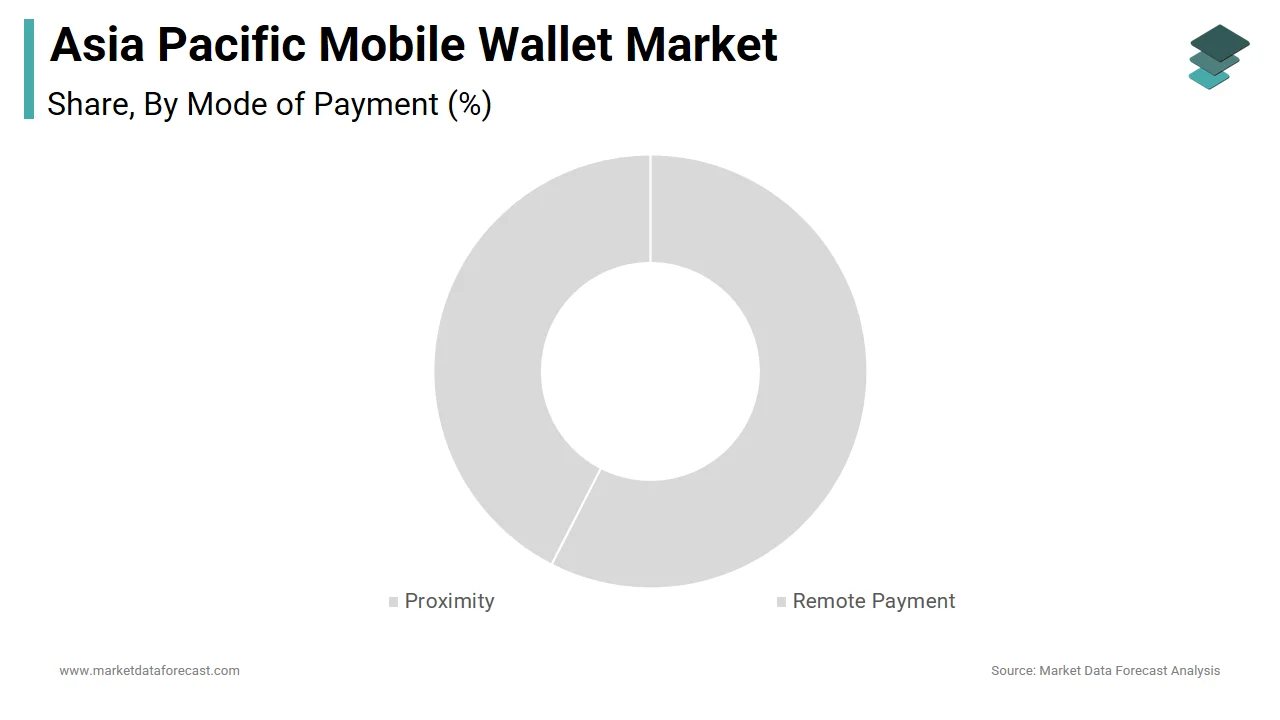
The remote payments segment dominated the Asia Pacific mobile wallet market by accounting for 68.6% of total transaction volumes in 2025. This segment includes online transactions conducted through e-commerce platforms, mobile apps, and digital services where physical proximity between the user and merchant is not required.
One of the primary drivers of this dominance is the rapid expansion of e-commerce across the region. As more consumers shift toward digital shopping, mobile wallets have become the preferred payment method due to their convenience, speed, and integration with major online platforms. Also, the rise of on-demand services such as food delivery, ride-hailing, and streaming platforms has significantly boosted remote payment usage. As per a report from McKinsey, over 400 million users in Southeast Asia alone transacted via mobile wallets for these services in 2023.
The Proximity payments are emerging as the fastest-growing segment in the Asia Pacific mobile wallet market, registering a compound annual growth rate (CAGR) of 19.4%. This category includes near-field communication (NFC)-based transactions, QR code scans, and tap-and-go payments at point-of-sale terminals.
The key driver behind this surge is the increasing deployment of QR-based payment systems and NFC-enabled infrastructure in both urban and semi-urban areas. In India, the National Payments Interface (UPI) introduced UPI QR codes that became widely adopted across small merchants, accelerating proximity payment acceptance. Similarly, in Japan and South Korea, mobile wallets integrated with transit cards and POS payment gateways are seeing increased daily use in retail and transportation sectors.
By Application Insights
Mobile commerce stood as the largest application segment in the Asia Pacific mobile wallet market by capturing 36.6% of overall usage in 2025. This segment encompasses all digital transactions made through mobile applications or mobile-optimized websites, including purchases of goods and services across e-commerce, travel bookings, and digital subscriptions.
A major factor fueling this segment's dominance is the exponential growth of online retail and digital consumption habits in the region. Platforms such as Alibaba, Flipkart, and Shopee have optimized their interfaces for mobile wallets, offering seamless checkout experiences and cashback incentives that encourage sustained usage. Moreover, the rise of social commerce, where mobile-based social media platforms facilitate direct product purchases, has further amplified mobile wallet utilization in m-commerce.
Public transport is currently the quickest advancing application of mobile wallets in the Asia Pacific, recording a CAGR of approximately 23.8% between 2025 and 2033. This segment involves the use of mobile wallets for ticketing, fare payments, and access to mass transit systems such as metro rails, buses, and ferries.
One of the main reasons for this rapid growth is the widespread adoption of digital transit payment systems in urban centers. Cities like Singapore, Tokyo, Seoul, and Mumbai have implemented mobile wallet-integrated smart card replacements, allowing commuters to pay fares using their smartphones without needing physical tickets or magnetic strips. Like, over 80% of daily commuters in Singapore now use mobile-based transport payment methods. In India, the Delhi Metro Rail Corporation launched a UPI-based mobile ticketing system that processed more than 20 million transactions monthly by late 2023. Similarly, in the Philippines, the introduction of mobile wallet-linked transport cards helped reduce cash dependency in the highly fragmented public transport sector.
COUNTRY-LEVEL ANALYSIS
India held the largest share of the Asia Pacific mobile wallet market by commanding 24.7% of the regional volume in 2025. This is leading position of the country’s aggressive digital transformation policies, widespread smartphone adoption, and the success of Unified Payments Interface (UPI). With a vast number of smartphone users and a growing digitally literate population, India has witnessed a massive shift from cash-based transactions to mobile wallets.
The Indian government’s push for financial inclusion through initiatives like Jan Dhan Yojana and BHIM App has fostered a robust mobile payment ecosystem. According to the Reserve Bank of India, UPI processed over 10 billion transactions monthly in 2023, many of which were executed via mobile wallets linked to e-commerce, ride-sharing, and food delivery platforms. Besides, the rise of homegrown fintech companies such as Paytm, PhonePe, and Google Pay has broadened access across tier-two and tier-three cities.
China is quickly expanding in the market. The country’s digital payment landscape is among the most advanced globally, driven by the widespread use of mobile wallets such as Alipay and WeChat Pay. These platforms have become deeply embedded in everyday life, covering everything from retail shopping and dining to utility payments and public transport. Like, over 900 million people used mobile payment services in 2023, representing almost two-thirds of the population. The regulatory support from the People’s Bank of China and the extensive merchant network accepting mobile payments have facilitated seamless digital transactions. Furthermore, the integration of digital wallets into super apps has expanded their functionality beyond payments to include banking, insurance, and investment features. As per McKinsey, mobile wallets account for over 85% of all digital transactions in China, highlighting the country’s pivotal role in shaping the future of cashless economies.
Japan maintains a strong presence in the Asia Pacific mobile wallet market. While traditional payment methods remain relevant, especially among older demographics, mobile wallets have seen significant adoption in urban areas, particularly for transit, retail, and digital commerce. The Japanese mobile wallet market is distinguished by its early adoption of Near Field Communication (NFC) technology, pioneered by Suica and Pasmo cards. These have since evolved into mobile-integrated versions such as Apple Wallet and Google Pay, which now support multi-application usage. Also, the government-backed "Digital Japan" initiative has accelerated digital payment adoption across SMEs and service providers.
South Korea occupies a prominent position in the Asia Pacific mobile wallet market. Renowned for its technological readiness and high smartphone penetration, the country has embraced mobile wallets as a standard mode of payment across multiple sectors, including retail, entertainment, and public transport.
Major local players such as KakaoPay, Samsung Pay, and Naver Pay have played a critical role in expanding mobile wallet usage. These figures underscore South Korea’s deep-rooted digital payment culture and its influential standing in the regional mobile wallet landscape.
Indonesia is a rapidly growing player in the Asia Pacific mobile wallet market. The country’s large unbanked population, rising internet penetration, and youthful demographic profile create a conducive environment for mobile wallet adoption. Otoritas Jasa Keuangan (OJK), the country’s financial regulator, issued clear guidelines for digital payment providers, contributing to a surge in licensed operators. Also, partnerships between telecom firms and fintech startups have expanded access in rural and semi-urban areas.
KEY MARKET PLAYERS
Some of the noteworthy companies in the APAC mobile wallet market profiled in this report are Apple Inc., Google LLC, Tencent, PayPal, and Samsung Electronics.
TOP LEADING PLAYERS IN THE MARKET
Ant Group (Alipay)
Ant Group, through its flagship platform Alipay, is a dominant force in China’s mobile wallet landscape and has significantly influenced mobile payment trends across the broader Asia Pacific region. Alipay pioneered the integration of digital payments into everyday life by embedding financial services within an expansive ecosystem that includes e-commerce, lifestyle apps, and financial technology solutions. The company has contributed to the global mobile wallet market by setting benchmarks for secure, seamless transactions at scale. Its innovations in QR-based payments, digital lending, and blockchain-powered cross-border transactions have inspired similar models in emerging markets across Southeast Asia and beyond.
Paytm (One97 Communications Ltd.)
Paytm is a leading mobile wallet provider in India and has played a transformative role in shaping the country's digital payment infrastructure. The company has been instrumental in driving financial inclusion by offering simple, accessible, and multilingual mobile payment solutions tailored for first-time digital users. Paytm’s influence extends beyond India, as it serves as a model for how mobile wallets can bridge the gap between underbanked populations and formal financial systems. Through strategic partnerships with banks, retailers, and government agencies, Paytm has helped redefine consumer transaction behavior, influencing mobile wallet adoption patterns across other developing economies in the Asia Pacific.
Kakao Corp (KakaoPay)
Kakao Corp, particularly through its subsidiary KakaoPay, holds a significant position in South Korea’s mobile wallet market and exemplifies the potential of integrating digital finance within a super app framework. As part of KakaoTalk, one of the most widely used messaging platforms in South Korea, KakaoPay leverages deep user engagement to offer a wide array of financial services, including peer-to-peer transfers, bill payments, insurance, and investment products. This model has inspired replication across the Asia Pacific, influencing companies in Thailand, Indonesia, and the Philippines to embed mobile wallet functionalities within existing communication and lifestyle applications to enhance user retention and convenience.
TOP STRATEGIES USED BY KEY MARKET PARTICIPANTS
A major strategy employed by key players in the Asia Pacific mobile wallet market is deep integration with lifestyle and utility platforms, enabling users to access financial services seamlessly within their daily digital interactions. By embedding mobile wallets into ride-hailing, food delivery, and social media apps, companies ensure high-frequency usage and sustained customer engagement.
Another prevalent approach involves leveraging artificial intelligence and data analytics to personalize user experiences. Leading mobile wallet providers analyze transactional and behavioral data to offer targeted financial products such as credit lines, insurance, and savings plans, thereby increasing monetization opportunities and strengthening consumer loyalty.
Lastly, forming strategic alliances with telecom operators and retail chains has become crucial for expanding reach, particularly in rural and semi-urban areas. These collaborations enable mobile wallet companies to use existing distribution networks, facilitate agent-assisted transactions, and promote trust among new users who may be hesitant to adopt fully digital payment methods without local support or guidance.
COMPETITION OVERVIEW
The competition in the Asia Pacific mobile wallet market is marked by a diverse mix of traditional financial institutions, homegrown fintech startups, multinational tech firms, and non-financial service providers entering the digital payments space. As mobile wallets evolve from mere transaction tools to comprehensive financial hubs, companies are increasingly focusing on expanding their service offerings, enhancing user experience, and building ecosystem integrations to differentiate themselves. Traditional banks are partnering with or acquiring fintech firms to remain relevant, while telecom companies and e-commerce giants are embedding mobile wallets into their platforms to drive user engagement and monetization. In this rapidly evolving landscape, innovation cycles are accelerating, prompting continuous product upgrades and localized adaptations to cater to the unique consumer behaviors and regulatory environments across different countries. Also, interoperability, security, and ease of use have become critical battlegrounds, with market participants striving to balance convenience with robust data protection measures to gain consumer trust and sustain long-term growth.
RECENT MARKET DEVELOPMENTS
- In January 2024, Paytm launched a suite of vernacular language features across its mobile wallet application, aiming to enhance accessibility for users in rural and semi-urban regions of India who are more comfortable transacting in local dialects.
- In March 2024, Kakao Corp expanded KakaoPay’s functionality by introducing embedded health insurance and micro-investment options, transforming the mobile wallet into a multi-service financial platform tailored for a digitally savvy Korean audience.
- In June 2024, Sea Group, parent company of ShopeePay, partnered with state-owned banks in Vietnam to integrate its mobile wallet with public sector payment systems, facilitating digital payments for utilities, education fees, and tax collections.
- In August 2024, Ant Group collaborated with several ASEAN-based banks to launch a cross-border QR payment network, enabling seamless digital transactions for travelers and businesses across multiple Asia Pacific countries without currency conversion hassles.
- In October 2024, Grab Financial deepened its presence in the Philippines by acquiring a majority stake in a local rural-focused digital bank, allowing it to extend its mobile wallet services into underserved communities with limited access to conventional banking.
MARKET SEGMENTATION
This Asia Pacific mobile wallet market research report is segmented and sub-segmented into the following categories.
By Mode of Payment
- Proximity
- NFC
- Sound waves-based payments
- Magnetic Secure Transmission (MST) payments
- Quick Response (QR) code payments
- Remote Payment
- Internet payments
- SMS payments
- Direct carrier billing
- Mobile banking
By Application
- Mobile Commerce
- Money Transfer
- Micropayment
- Retail
- Restaurant
- Public Transport
By Country
- India
- China
- Japan
- South Korea
- Australia
- New Zealand
- Thailand
- Malaysia
- Vietnam
- Philippines
- Indonesia
- Singapore
- Rest Of APAC