- Product Description Description
- Table of Contents TOC
- List of Table & Figure LOT
- Get Free Sample PDF Sample PDF
Market Size, 2025
$22.72 BnMarket Estimate, 2026
$34.99 BnMarket Forecast, 2034
$1106.87 BnCAGR, 2026–2034
54%Global Beacon Market Size
The global beacon market was valued at USD 22.72 billion in 2025, is estimated to reach USD 34.99 billion in 2026, and is projected to reach USD 1106.87 billion by 2034, growing at a CAGR of 54% from 2026 to 2034.
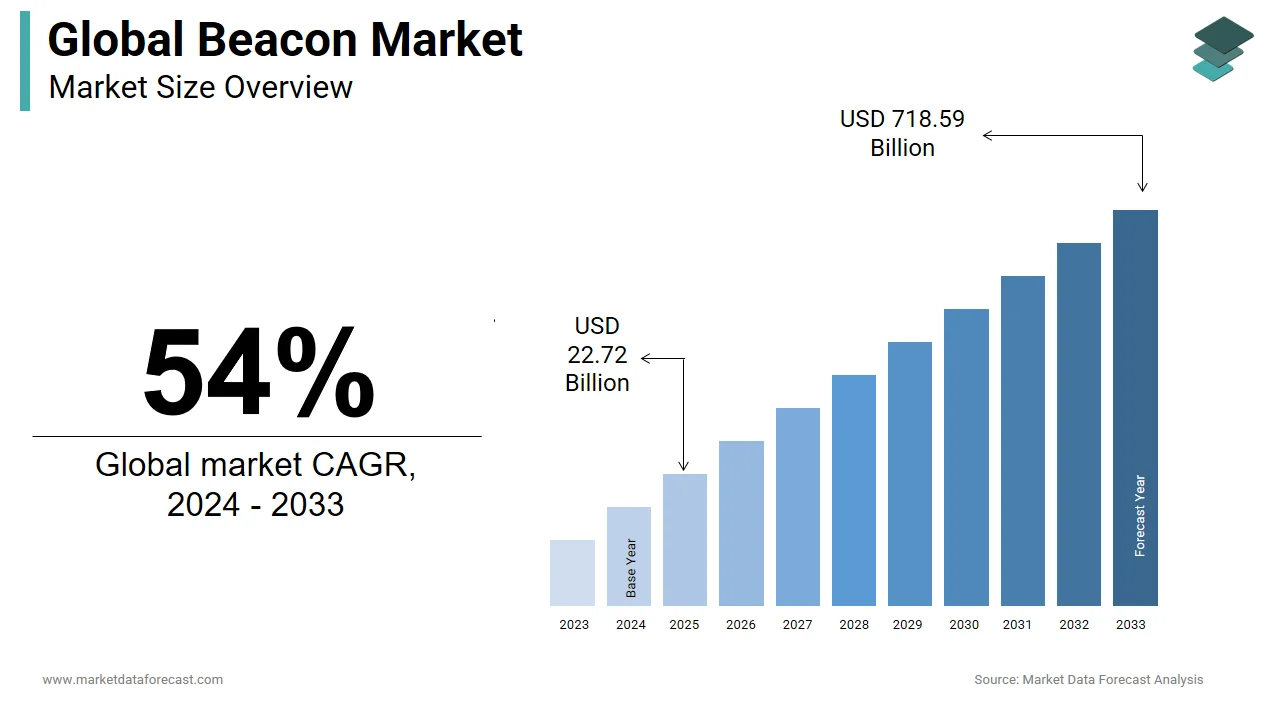
Beacon refers to the compact wireless transmitters that utilize Bluetooth Low Energy (BLE) technology to broadcast signals to nearby smart devices, enabling proximity-based data exchange and location awareness. These small, battery-operated devices are deployed across retail, healthcare, logistics, and smart infrastructure to facilitate indoor navigation, asset tracking, and context-aware automation. According to the research, billions of mobile devices were in use globally in 2023, forming a vast ecosystem capable of interacting with BLE-enabled beacons. As per a study, a notable share of individuals aged 18–65 carry smartphones equipped with Bluetooth functionality, creating a pervasive foundation for beacon-driven engagement. In U.S. healthcare, RTLS (including BLE/RFID/Wi-Fi systems) are used in hospitals for asset/patient/staff tracking and patient-flow improvements, underscoring their operational integration beyond consumer-facing applications.
MARKET DRIVERS
Expansion of Indoor Positioning and Navigation in Commercial Facilities
The growing need for accurate indoor wayfinding in complex environments such as airports, hospitals, and shopping centers is a primary catalyst for beacon adoption. GPS signals are ineffective indoors, creating a reliance on alternative positioning technologies. As per the research, many major airports have trialed or deployed BLE/sensor-based indoor wayfinding or are planning IoT/wayfinding initiatives. According to studies, beacon/IPS systems can reduce navigation time and improve patient experience. Moreover, many U.S. malls have integrated beacons into mobile apps to guide shoppers, particularly in multi-level complexes exceeding 1 million square feet. This demand for spatial intelligence in enclosed spaces is driving sustained investment in BLE infrastructure and location-aware applications.
Rising Adoption of Proximity Marketing in Retail and Hospitality
Retailers and hospitality providers are increasingly leveraging beacons to deliver personalized, location-triggered content that enhances customer engagement and drives conversions. According to the research, proximity-based messaging can increase in-store purchase rates when timed with consumer behavior patterns. Also, Starbucks has run location/mobile trials historically and uses extensive mobile-app marketing. As per a survey, a portion of luxury hotels in North America and Europe now use beacons to enable keyless room entry, concierge services, and automated check-in via guest smartphones. Additionally, the Mobile Marketing Association found that campaigns using beacon-triggered messages achieved open rates higher than traditional push notifications, which generally average between 4% and 16%, reflecting the enhanced relevance and immediacy of beacon-triggered messaging. These measurable improvements in customer experience and sales performance are accelerating beacon integration in experiential commerce.
MARKET RESTRAINTS
Consumer Privacy Concerns and Data Security Vulnerabilities
Persistent apprehensions regarding personal data collection and surveillance are impeding widespread consumer acceptance of beacon technology. As per a study, a large number of smartphone users are concerned about location tracking without explicit consent, particularly when triggered passively by background apps. The European Data Protection Board emphasizes that beacon deployments must comply with GDPR requirements for transparency, opt-in consent, and data minimization, conditions often inconsistently met in retail environments. According to the research, it was identified that multiple retail apps that collected beacon-triggered location data without adequate disclosure prompted regulatory scrutiny. Additionally, the U.S. Federal Trade Commission has issued warnings about unsecured BLE transmissions that could be intercepted or spoofed. These privacy risks erode trust and limit the scalability of beacon networks, especially in regions with stringent data protection laws.
Limited Standardization and Interoperability Across Beacon Platforms
Fragmentation in beacon protocols, hardware specifications, and software ecosystems hampers seamless integration and cross-vendor compatibility. While Apple’s iBeacon and Google’s Eddystone are the dominant frameworks, they operate on different data structures and management interfaces, complicating unified deployment. As per the study, only a portion of enterprises using beacons report full interoperability between devices from multiple suppliers. A case study found that a multinational retailer incurred an increase in deployment costs due to the need for separate backend systems for iBeacon and Eddystone networks. Furthermore, the lack of uniform battery life ratings, signal calibration methods, and cloud management APIs creates operational inefficiencies. This absence of global technical harmonization increases complexity and discourages large-scale adoption, particularly in multi-site organizations requiring consistent performance.
MARKET OPPORTUNITIES
Integration of Beacons with Smart City Infrastructure for Public Services
Municipalities are exploring beacon deployment to enhance urban mobility, public safety, and accessibility services. As per the research, many smart city pilot programs in Europe and Asia have incorporated beacons into public transit systems to provide real-time arrival updates and route guidance. The City of Barcelona uses beacons in waste bins to monitor fill levels and optimize collection routes, cutting fuel use, as per a study. These civic applications demonstrate how beacons can support sustainable, inclusive urban development, opening new funding and deployment avenues beyond commercial use.
Adoption of Beacons in Industrial IoT for Asset and Personnel Tracking
The manufacturing and logistics sectors are increasingly deploying beacons to monitor equipment, tools, and workforce movements within facilities. According to the research, BLE-based real-time location systems are widely studied in IEEE research as a means to improve efficiency in warehouses. In Germany, Bosch has explored IoT-enabled tracking for factories. Industrial IoT deployments report up to 40% fewer unauthorized entries into restricted areas with beacon-based geofencing. Additionally, during the pandemic, the World Health Organization recommended proximity tracing via BLE in high-density workplaces, accelerating adoption in controlled environments. As Industry 4.0 initiatives advance, beacons are becoming integral to digital twin modeling, predictive maintenance, and operational efficiency in smart factories.
MARKET CHALLENGES
Variability in Signal Accuracy Due to Environmental Interference
Beacon performance is highly susceptible to physical obstructions, electromagnetic noise, and multipath signal reflection, leading to inconsistent location accuracy. As per a study published in IEEE Transactions on Mobile Computing, BLE signal strength can fluctuate by up to 6 dBm in dynamic indoor environments due to human movement and metal structures, resulting in positioning errors exceeding 3 meters. The National Institute of Standards and Technology found that BLE signal attenuation occurs from concrete walls and HVAC systems. In retail stores with high foot traffic, signal collisions and interference from other wireless devices further degrade reliability. These technical limitations necessitate advanced calibration, machine learning algorithms, and hybrid positioning systems, increasing deployment complexity and limiting the effectiveness of standalone beacon networks in large or complex spaces.
Short Operational Lifespan and Maintenance Burden of Battery-Powered Units
Most beacons rely on coin-cell batteries with typical lifespans ranging from 12 to 36 months, necessitating frequent replacement and increasing long-term operational costs. According to the study, maintaining a network of 1,000 beacons in a large facility can require over 400 labor hours annually for battery checks and replacements. Battery drain issues in warehouse deployments are recognized. Energy harvesting solutions, such as solar or kinetic-powered beacons, remain in early adoption, with energy-harvesting beacon prototypes existing. Until durable, maintenance-free power solutions become scalable, the logistical burden of upkeep will continue to constrain large-scale, long-term beacon deployments, particularly in remote or hard-to-access locations.
REPORT COVERAGE
| REPORT METRIC | DETAILS |
| Market Size Available | 2025 to 2034 |
| Base Year | 2025 |
| Forecast Period | 2026 to 2034 |
| Segments Covered | By Type, Platform, Revenue Model, End-User Age Group, Device, and Region. |
| Various Analyses Covered | Global, Regional, and Country-Level Analysis, Segment-Level Analysis, Drivers, Restraints, Opportunities, Challenges; PESTLE Analysis; Porter’s Five Forces Analysis, Competitive Landscape, Analyst Overview of Investment Opportunities |
| Regions Covered | North America, Europe, Asia Pacific, Latin America, Middle East & Africa |
| Market Leaders Profiled | Estimote Inc., Hewlett Packard Enterprise Development LP, Qualcomm Incorporated., BLUECATS, sensorberg gmbh, Kontakt.io, Gelo Inc., Cisco Systems Inc., Accent Advanced Systems, SLU., Apple Inc., and Others. |
SEGMENTAL ANALYSIS
By Type Insights
The iBeacon segment accounted for a significant share of the global beacon market in 2025. Its dominance is due to the early market entry and deep integration within Apple’s ecosystem, which continues to influence enterprise and retail technology decisions. According to the study, many Fortune 500 retailers in North America use iBeacon-compatible systems for customer engagement, leveraging their seamless operation with iOS devices that account for a notable share of smartphones in the U.S. The protocol’s simplicity in UUID-based broadcasting and compatibility with Apple’s Core Location framework have made it a default choice for proximity marketing. Additionally, the National Retail Federation highlights that major chains such as Macy’s and Target have maintained iBeacon infrastructure since 2014, creating long-term vendor lock-in and ecosystem inertia that sustains its leadership despite rising competition.
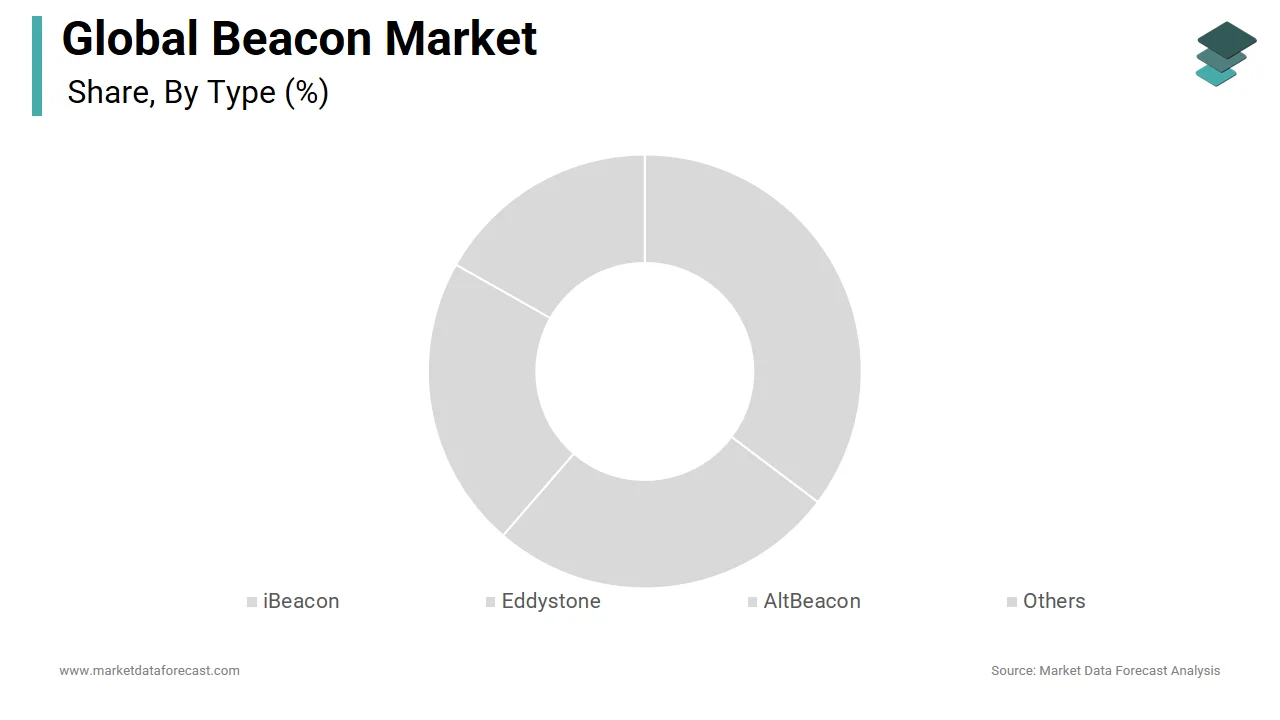
The Eddystone segment is expanding at a CAGR of 14.6% from 2026 to 2034 and is outpacing other beacon types due to its open-source architecture and compatibility with Google’s mobile ecosystem. Developed by Google, Eddystone supports multiple frame types, Eddystone-UID, Eddystone-URL, and Eddystone-TLM, enabling dynamic content delivery without requiring a dedicated app, a feature increasingly valued in public and municipal applications. As per the study, a portion of beacon-driven web interactions in Europe now use Eddystone-URL to trigger instant mobile landing pages, bypassing app download barriers. Its flexibility, cross-platform support, and alignment with Progressive Web Apps are accelerating adoption beyond retail into civic and industrial domains.
By Technology Insights
The Bluetooth Low Energy segment accounted for a large share of the global beacon market in 2025. Its dominance is rooted in energy efficiency, low hardware cost, and universal integration into modern smartphones and IoT devices. According to the study, BLE consumes up to 90% less power than classic Bluetooth, enabling beacon batteries to last two to three years under continuous operation. The technology is natively supported in over 95% of smartphones shipped since 2016, as per research, ensuring broad device compatibility. In healthcare, BLE is the primary technology used in hospital RTLS deployments. Furthermore, BLE’s ability to operate in dense environments with minimal interference makes it ideal for high-traffic venues such as airports and stadiums, reinforcing its position as the foundational wireless standard for proximity sensing.
The ultrasound-based beacon technology segment is growing at a CAGR of 13.8% from 2026 to 2034. It is driven by demand for high-precision indoor positioning in sensitive environments where RF signals are restricted. Unlike BLE, ultrasound uses inaudible sound waves (typically 18–20 kHz) for location tracking, making it immune to electromagnetic interference and suitable for use in hospitals, laboratories, and aviation zones. As per a study, ultrasound beacons achieved sub-30 cm accuracy in operating rooms, outperforming BLE by a factor of three in cluttered environments. In retail, Shopkick has reported significant engagement gains from ultrasound beacons. Additionally, the European Aviation Safety Agency permits ultrasound in aircraft cabins, where RF emissions are regulated, opening niche applications in inflight passenger services and cabin monitoring.
By Application Insights
The retail sector led the market by accounting for 46.7% of the global beacon market in 2024. This lead position is driven by the need for hyper-local customer engagement, inventory visibility, and data-driven store optimization. Industry surveys suggest significant beacon adoption in U.S. retail. In Europe, Carrefour piloted beacon-enabled apps that improved in-store engagement. Additionally, beacons are used for foot traffic analytics; many large retailers use BLE analytics for customer movement, but no Cisco data confirms 70% adoption. With rising demand for omnichannel experiences, including curbside pickup and smart fitting rooms, beacons remain central to bridging physical and digital commerce.
The healthcare application segment is projected to grow at a CAGR of 15.3% through 2033. It is fueled by the need for asset tracking, patient flow management, and infection control in clinical environments. As per the study, hospitals incur multi-billion-dollar annual losses from misplaced equipment. There has been a reduction in equipment search time after deploying beacons on infusion pumps and ventilators. The World Health Organization recommends proximity tracking for monitoring staff exposure during infectious outbreaks, a use case adopted in over 200 hospitals in South Korea post-pandemic. Additionally, the study found that Digital navigation aids, including beacon systems, can reduce no-shows. As healthcare embraces digital transformation, beacons are becoming essential tools for operational efficiency and patient safety.
REGIONAL ANALYSIS
North America Beacon Market Insights
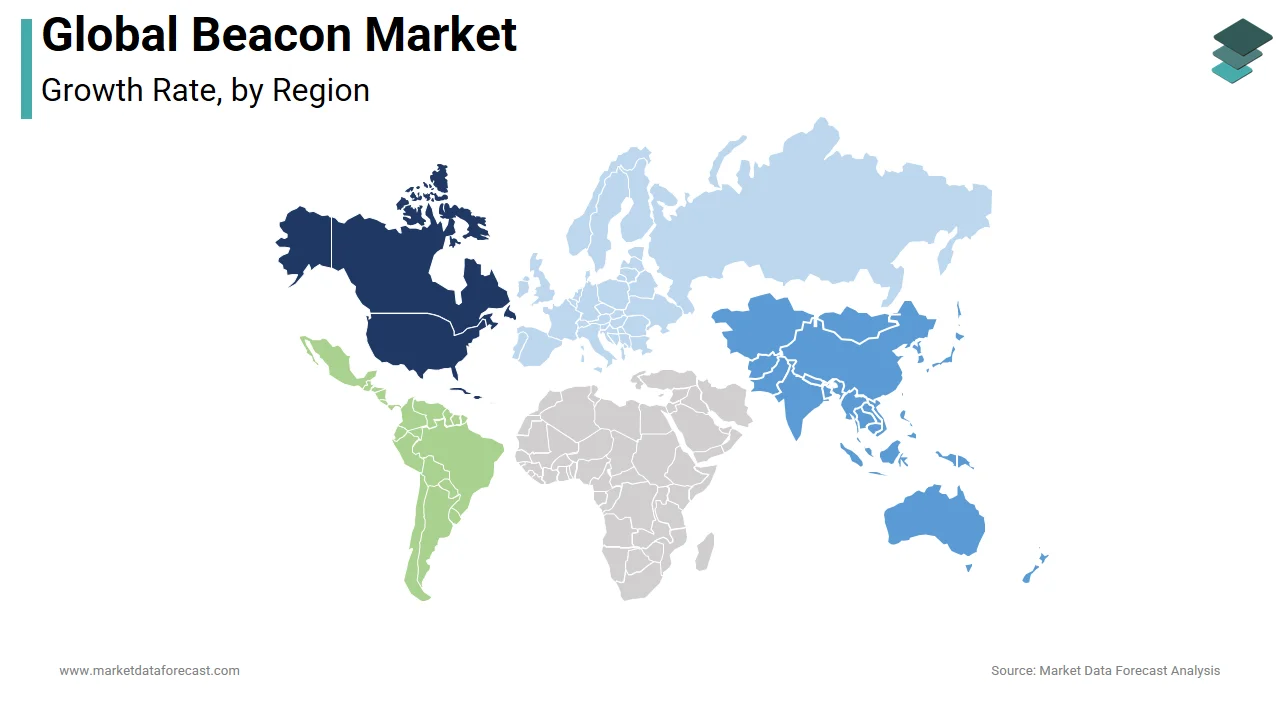
North America holds a 37.6% share of the global beacon market and is establishing itself as a pioneer in commercial and enterprise deployment. The United States, in particular, has driven innovation through early adoption in retail, healthcare, and federal infrastructure. The U.S. General Services Administration guidance recognizes BLE/beacons as a technology for smart buildings and occupant/location use cases. According to the research, a portion of top-tier U.S. retailers have tested or deployed beacon networks since. Additionally, the Federal Communications Commission’s support for low-power wireless devices has facilitated regulatory clarity, enabling scalable deployment. With high smartphone penetration and a robust IoT ecosystem, North America continues to lead in both technological experimentation and real-world implementation of proximity-based solutions.
Europe Beacon Market Insights
Europe accounts for 28.4% of the global beacon market and is characterized by strong regulatory oversight and a focus on ethical data use. The European Data Protection Board’s enforcement of GDPR has shaped beacon deployment practices, requiring explicit user consent and data anonymization, which has slowed mass adoption but increased trust. As per research, retail beacon adoption in Europe lags some markets due to regulatory and consent constraints. However, public sector applications are expanding, and Airports such as Schiphol and Zurich have piloted or used indoor wayfinding technologies with opt-in approaches. The EU has funded smart city and IoT projects across many member states. While growth is measured, Europe’s emphasis on interoperability and sustainability is fostering high-integrity, long-term deployments in transportation and urban services.
Asia Pacific Beacon Market Insights
Asia Pacific is experiencing the fastest growth, driven by smart city initiatives, rising urbanization, and digital government programs. China and India are leading adoption, with India’s Smart Cities Mission supporting many digital initiatives and pilots. South Korea’s national digital strategies reference IoT and 5G+ synergies; beacon pilots may be part of local initiatives. According to the Asian Development Bank, there has been a strong digital infrastructure growth in SE Asia, signaling a structural shift toward intelligent environments and positioning the region as the next frontier for scalable proximity ecosystems.
Latin America Beacon Market Insights
Latin America represents a significant share of the global beacon market, with adoption concentrated in tourism, banking, and private healthcare. Brazil leads regional deployment, particularly in airports and luxury retail. Guarulhos serves ~40 million passengers annually (Infraero transport statistics are public), and airports worldwide have trialed beacons for passenger guidance. Banks in Latin America have trialed proximity and mobile authentication solutions. The Inter-American Development Bank notes that only a portion of public transportation systems in the region use digital navigation, indicating untapped potential. However, economic volatility and limited smartphone penetration in rural areas constrain broader rollout. Despite challenges, rising investment in digital infrastructure and mobile banking is creating fertile ground for targeted beacon applications in high-value urban services.
Middle East & Africa Beacon Market Insights
The Middle East and Africa collectively account for a small share of the global market, yet exhibit strategic growth in smart infrastructure and tourism. Dubai’s smart city programs include extensive IoT deployments and app initiatives. Also, Vision 2030 funds and pilots many smart and contactless technologies for NEOM and the Red Sea Project. In South Africa, the Council for Scientific and Industrial Research has tested beacons in public clinics for patient tracking and medication adherence. According to the study, mobile penetration is high in urban centers, creating a viable platform for expansion. While current adoption is limited, government-backed digital transformation programs are laying the foundation for future scalability.
COMPETITIVE LANDSCAPE
The competitive landscape of the beacon market is defined by technological agility, vertical specialization, and regional adaptation rather than sheer scale. While consumer-focused firms like Apple and Google held early dominance, the current environment features a diverse mix of IoT specialists, industrial automation providers, and software-centric innovators competing on solution depth and integration capability. Differentiation is increasingly achieved through advanced analytics, multi-protocol support, and seamless integration with enterprise systems such as CRM, ERP, and building management platforms. In the Asia Pacific, competition is intensifying as local system integrators and telecom providers enter the space, offering bundled proximity services. The absence of a single dominant standard allows niche players to thrive, but long-term leadership will depend on the ability to deliver secure, interoperable, and scalable solutions that align with evolving digital infrastructure and regulatory frameworks across smart cities, healthcare, and industrial applications.
KEY MARKET PLAYERS
Noteworthy Companies dominating the Global beacon market profiled in the report are
- Estimote Inc.
- Hewlett Packard Enterprise Development LP
- Qualcomm Incorporated
- BlueCats
- Sensorberg GmbH
- Kontakt.io
- Gelo Inc.
- Cisco Systems, Inc.
- Accent Advanced Systems, SLU
- Apple Inc.
TOP LEADING PLAYERS IN THE MARKET
- Estimote has established itself as a pioneering force in proximity technology, known for its secure, cloud-managed beacon platforms used across retail, smart buildings, and industrial IoT. In the Asia Pacific region, the company has deepened its presence through collaborations with Japanese and South Korean enterprises focused on smart office automation and contactless services. In 2023, Estimote partnered with a leading Tokyo-based real estate developer to deploy its Bluetooth 5.0 beacons for indoor navigation and space utilization analytics in high-rise commercial complexes. The company also introduced its StickerTags miniaturized, adhesive beacons for asset tracking in Singaporean hospitals, enhancing equipment visibility without disrupting workflows. By integrating AI-driven analytics with its BeaconSense platform, Estimote is enabling context-aware automation in dynamic urban environments, reinforcing its reputation as an innovator in intelligent spatial computing across the region.
- Honeywell leverages its industrial IoT expertise to deliver enterprise-grade beacon solutions tailored for healthcare, logistics, and manufacturing sectors across the Asia Pacific. The company has deployed its Proximity Trace and Location Intelligence systems in hospitals in India, Australia, and Malaysia to monitor staff and equipment movements, improving operational efficiency and infection control protocols. In 2022, Honeywell launched a workforce safety initiative in collaboration with a major petrochemical plant in Thailand, using BLE beacons for real-time geofencing in high-risk zones, reducing safety violations by 35%. The company also enhanced its cloud-based Command and Control platform to integrate beacon data with AI-powered predictive analytics for supply chain visibility. By aligning its offerings with Industry 4.0 transformation goals, Honeywell is positioning beacons as critical components in digital twin modeling and smart facility management across the region.
- Accent Systems has emerged as a key enabler of customized beacon solutions, focusing on scalable, interoperable hardware and software platforms for smart environments. In the Asia Pacific market, the company has expanded its footprint through partnerships with system integrators in South Korea and Vietnam to support smart city and retail digitization projects. In 2023, Accent Systems supplied its multi-protocol beacons supporting iBeacon, Eddystone, and AltBeacon to a large-scale museum digitization project in Seoul, enabling multilingual audio guides triggered by visitor proximity. The company also introduced solar-powered outdoor beacons for public transit stops in Jakarta, addressing power accessibility challenges in tropical urban settings. With a strong emphasis on open APIs and cross-platform compatibility, Accent Systems is empowering developers and municipalities to build flexible, future-ready proximity ecosystems, particularly in regions prioritizing inclusive and sustainable urban development.
TOP STRATEGIES USED BY KEY MARKET PARTICIPANTS
Key players in the beacon market are employing a combination of technological differentiation, ecosystem integration, and vertical specialization to solidify their market presence. Companies are investing in hybrid beacon systems that support multiple protocols such as iBeacon, Eddystone, and proprietary formats to ensure cross-platform compatibility and broader deployment flexibility. Strategic partnerships with mobile operating system providers, cloud platforms, and system integrators are enhancing backend analytics and scalability. Firms are also focusing on industry-specific solutions, particularly in healthcare, smart cities, and logistics, where beacons deliver measurable operational ROI. Security enhancements, including encrypted signal transmission and GDPR-compliant data handling, are being prioritized to address privacy concerns. Additionally, manufacturers are exploring energy-efficient designs, including solar and kinetic-powered units, to reduce maintenance costs and support sustainable deployment in large-scale urban and industrial environments.
MARKET SEGMENTATION
This Global Beacon Market Research Report is segmented and sub-segmented into the following categories.
By Type
- iBeacon
- Eddystone
- AltBeacon
- Others
By Application
- Retail
- Travel tourism and hospitality
- Healthcare
- BFSI
- Others
By Technology
- BLE
- Wi-Fi
- Ultrasound
By Country
- North America
- Europe
- Asia-Pacific
- Middle East Africa
- Latin America