- Product Description Description
- Table of Contents TOC
- List of Table & Figure LOT
- Get Free Sample PDF Sample PDF
Market Size, 2025
$22.46 BnMarket Estimate, 2026
$26.79 BnMarket Forecast, 2034
$109.85 BnCAGR, 2026–2034
19.29%Executive Summary: Global Bioinformatics Market
- Market Scope: Comprehensive global bioinformatics market evaluation covering sector specializations, products & services, applications, and regional geographic frameworks.
- Market Valuation: Valued at USD 22.46 billion (2025), estimated at USD 26.79 billion (2026), and projected to reach USD 109.85 billion by 2034, registering a CAGR of 19.29% (2026–2034).
- Primary Growth Drivers: Heightened government funding and R&D initiatives for genomics, declining costs of DNA sequencing, rapid adoption of AI and big data analytics, and rising demands for integrated data in drug discovery and biomarker development.
Key Market Segment Metrics (2026–2034)
| Category | Leading Segment (2025 Position) | Fastest-Growing Segment |
|---|---|---|
| By Sector | Medical Biotechnology (leading share due to target drug discovery, validation, and cost-efficient pharmaceutical development) | Academic Sector (growing at a healthy rate driven by ongoing institutional research projects and genomics programs) |
| By Products & Services | Knowledge Management Tools (estimated to capture the largest overall share) | Bioinformatics Platforms (fastest-growing sub-segment) & Genetic Sequencing / Data Analytics (robust CAGR driven by high-performing sequencing data solutions) |
| By Application | Genomics (accounts for the largest market share owing to widespread gene sequencing applications) | Proteomics (expected to expand rapidly due to emerging technologies and specialized research initiatives) |
| By Region | North America (leads the global market, followed by Europe) | Asia-Pacific (fastest-growing regional market globally, with double-digit growth driven by China, India, and Australia) |
Major Market Players & Market Structure
Market Structure: Highly dynamic and technology-driven global landscape featuring major life science tech providers, software developers, and diagnostic corporations investing in cloud integration, AI-driven sequencing pipelines, and strategic acquisitions.
Key Companies: Agilent Technologies, Affymetrix Inc., Applied Biological Materials (ABM), 3rd Millennium Inc., Illumina Inc., Thermo Fisher Scientific Inc., Qiagen N.V., Biomax Informatics AG, DNAnexus, Inc., and Waters Corporation.
 Download Free Sample Report
Global Bioinformatics Market Size
As per our research analysis report, the global bioinformatics market size was valued at USD 22.46 billion in 2025. The global bioinformatics market is forecasted to be worth USD 109.85 billion by 2034 and USD 26.79 billion by 2026, growing at a CAGR of 19.29% during the forecast period.

The bioinformatics are intersection of biological science and computational technology by enabling the interpretation of complex biological data. This field has become indispensable as genomic sequencing costs have plummeted, while data volumes have exploded. The drastic reduction facilitates widespread adoption of genomic technologies across clinical and research settings. Concurrently, the global biological data production doubles every seven months by creating an urgent need for sophisticated analytical tools. Researchers now rely on advanced algorithms to manage and interpret this deluge of information. Institutions worldwide are integrating bioinformatics platforms to accelerate drug discovery and personalize patient care. As healthcare systems prioritize precision medicine, the reliance on bioinformatics solutions becomes non negotiable.
MARKET DRIVERS
Surging Genomic Data Volumes Fueling Computational Demand
The exponential generation of genomic data by necessitating robust analytical infrastructure is surging the growth of the bioinformatics market. Modern sequencing technologies produce terabytes of data per run, overwhelming traditional storage and analysis methods. The single whole genome sequence can generate up to 200 gigabytes of raw data before processing. This massive output requires specialized bioinformatics pipelines to ensure accuracy and speed. Hospitals and research centers cannot manage such volumes without advanced computational tools. The demand for scalable solutions grows, as more institutions adopt next generation sequencing protocols. Clinical applications further intensify this pressure by requiring real time analysis for diagnostic purposes. Bioinformatics platforms provide the necessary framework to handle this influx effectively. They enable researchers to identify genetic variants linked to diseases with greater precision. The integration of machine learning enhances pattern recognition within these large datasets. Consequently, organizations invest heavily in software that can streamline workflow and reduce turnaround times.
Precision Medicine Initiatives Driving Clinical Integration
The global push toward precision medicine by embedding computational tools into clinical workflows is another factor accelerating the growth of the bioinformatics market. Healthcare providers increasingly rely on genetic profiling to tailor treatments for individual patients. This trend necessitates detailed genomic analysis to match patients with appropriate therapies. Bioinformatics software enables the identification of these biomarkers with high accuracy. Regulatory bodies support this shift by approving companion diagnostics that require computational validation. The European Medicines Agency emphasizes the importance of genomic data in evaluating novel therapeutic agents. Hospitals implement bioinformatics platforms to integrate genetic results into electronic health records seamlessly. This integration allows clinicians to access critical information during patient consultations. Such financial support accelerates the deployment of bioinformatics tools in healthcare settings. Patients benefit from treatments that are more effective and have fewer side effects. Pharmaceutical companies also leverage these insights to design targeted clinical trials. The alignment of clinical practice with genomic data creates a steady demand for reliable analytical software.
MARKET RESTRAINTS
High Implementation Costs Restricting Market Penetration
The substantial financial burden associated with implementing bioinformatics solutions is hindering the growth of the bioinformatics market. Organizations face high upfront costs for software licenses, hardware upgrades, and specialized personnel. This expense includes high-performance computing clusters and secure data storage systems. Small research institutions and hospitals often lack the budget to make such investments. Maintenance costs further strain financial resources as software requires regular updates and technical support. The complexity of these systems demands skilled bioinformaticians, who command high salaries. Many potential users hesitate to adopt these technologies due to uncertain return on investment. Budget constraints force organizations to prioritize other immediate operational needs over computational infrastructure. This hesitation slows down the widespread adoption of advanced bioinformatics tools. Smaller entities may rely on outdated methods that compromise data quality and analysis speed. The financial barrier prevents equitable access to cutting edge genomic technologies.
Data Privacy and Security Concerns Impeding Adoption
The stringent data privacy regulations and security vulnerabilities is declining the growth of the bioinformatics market. Genetic information is highly sensitive and subject to strict legal protections worldwide. The General Data Protection Regulation in Europe imposes heavy fines for mishandling personal genomic data. Compliance with these regulations requires robust encryption and access control measures. The Health Insurance Portability and Accountability Act in the United States mandates rigorous safeguards for patient information. Implementing these security protocols increases the complexity and cost of bioinformatics platforms. Cybersecurity threats pose a constant risk as biological databases become attractive targets for attackers. Fear of data misuse discourages individuals from participating in genomic studies. Researchers face challenges in sharing data across borders due to varying legal frameworks. This fragmentation hinders collaborative efforts and slows scientific progress. Institutions must invest heavily in cybersecurity infrastructure to protect sensitive information. The lack of standardized security practices creates uncertainty for software vendors. Potential clients delay adoption until they are confident in the safety of their data.
MARKET OPPORTUNITIES
Integration of Artificial Intelligence Creating New Avenues
The integration of artificial intelligence is substantially to create new opportunities for the growth of the bioinformatics market. Machine learning algorithms enhance the ability to predict protein structures and identify disease patterns. This breakthrough accelerates drug discovery by providing insights into molecular interactions. Pharmaceutical companies utilize these AI driven tools to screen potential drug candidates rapidly. The efficiency gains reduce the time and cost associated with traditional experimental methods. AI also improves the interpretation of complex genomic variations linked to rare diseases. The Nature Biotechnology journal highlights that AI models can analyze multi omics data more effectively than conventional statistical methods. This capability enables a holistic understanding of biological systems. Healthcare providers leverage AI powered bioinformatics to develop predictive diagnostic tools. These tools assist in early detection of conditions such as cancer and cardiovascular diseases. The scalability of AI solutions allows for processing larger datasets with greater precision. Investors recognize the potential of AI integrated platforms and increase funding in this sector. Startups focus on developing user friendly interfaces that democratize access to advanced analytics. This trend broadens the user base beyond specialized bioinformaticians.
Expansion of Cloud Based Bioinformatics Platforms
The shift toward cloud-based bioinformatics platforms is also to elevate the growth of the bioinformatics market. Cloud computing offers scalable storage and processing power without the need for extensive local infrastructure. This cost efficiency makes genomic analysis accessible to smaller institutions and startups. Researchers can collaborate seamlessly by sharing data and tools on secure cloud environments. The flexibility of cloud platforms allows users to scale resources based on project demands. Major technology providers offer specialized bioinformatics services that simplify deployment and management. The trend reflects the growing preference for flexible and cost effective solutions. Cloud platforms also facilitate the integration of diverse data sources for comprehensive analysis. Users can access the latest software updates and algorithms without manual installation. This convenience accelerates the pace of scientific discovery and clinical application. Healthcare systems benefit from improved data accessibility and interoperability. The reduced barrier to entry encourages wider adoption of bioinformatics tools.
MARKET CHALLENGES
Shortage of Skilled Bioinformaticians Hindering Growth
The acute shortage of qualified bioinformaticians is a key challenge for the growth of the bioinformatics market. The interdisciplinary nature of the field requires expertise in both biology and computer science. This gap limits the ability of organizations to fully utilize bioinformatics tools. Universities struggle to produce graduates with the necessary combined skill set. Existing programs often focus on either biology or computing but rarely integrate both deeply. Employers face difficulties in recruiting staff who can manage complex data pipelines effectively. This lengthy timeline exacerbates the workforce shortage. Organizations may delay projects due to the lack of qualified personnel. The reliance on external consultants increases costs and reduces internal capacity building. High turnover rates further destabilize bioinformatics teams in research and clinical settings. The mismatch between educational outputs and industry needs persists despite growing demand. Companies must invest heavily in training existing staff to bridge the skills gap. This challenge slows down the implementation of advanced bioinformatics solutions.
Lack of Standardization in Data Formats and Protocols
The absence of universal standards for data formats and analytical protocols is also to impede the growth of the bioinformatics market. Researchers use diverse software tools that often produce incompatible output files. The fragmentation complicates data sharing and integration across institutions. Scientists spend considerable time converting data rather than analyzing it. The lack of standardization hinders reproducibility of research findings. Peer reviewed journals increasingly require standardized data submission to ensure transparency. The Bioinformatics journal reports that inconsistent metadata annotations affect the quality of public databases. These issues impede collaborative research efforts and meta analysis. Pharmaceutical companies face regulatory hurdles when submitting non standardized data for drug approval. Clinical laboratories struggle to integrate results from different sequencing platforms. The variability in analytical pipelines leads to discrepancies in variant calling. Efforts to establish common standards have been slow due to rapid technological advancements. Vendors develop proprietary formats that lock users into specific ecosystems. This situation limits interoperability and increases dependency on single providers. The market suffers from inefficiencies caused by incompatible systems.
REPORT COVERAGE
| REPORT METRIC | DETAILS |
| Market Size Available | 2025 to 2034 |
| Base Year | 2025 |
| Forecast Period | 2026 to 2034 |
| Segments Covered | By Sector, Products & Services, Application, and Region |
| Various Analyses Covered | Global, Regional & Country Level Analysis; Segment-Level Analysis, Drivers, Restraints, Opportunities, Challenges, PESTLE Analysis, Porter's Five Forces Analysis, Competitive Landscape, Analyst Overview on Investment Opportunities |
| Regions Covered | North America, Europe, Asia Pacific, Latin America, the Middle East, and Africa |
| Market Leaders Profiled | Agilent Technologies, Affymetrix Inc., Applied Biological Materials (ABM), 3rd Millennium Inc., Illumina Inc., Thermo Fisher Scientific Inc. |
SEGMENTAL ANALYSIS
By Sector Insights
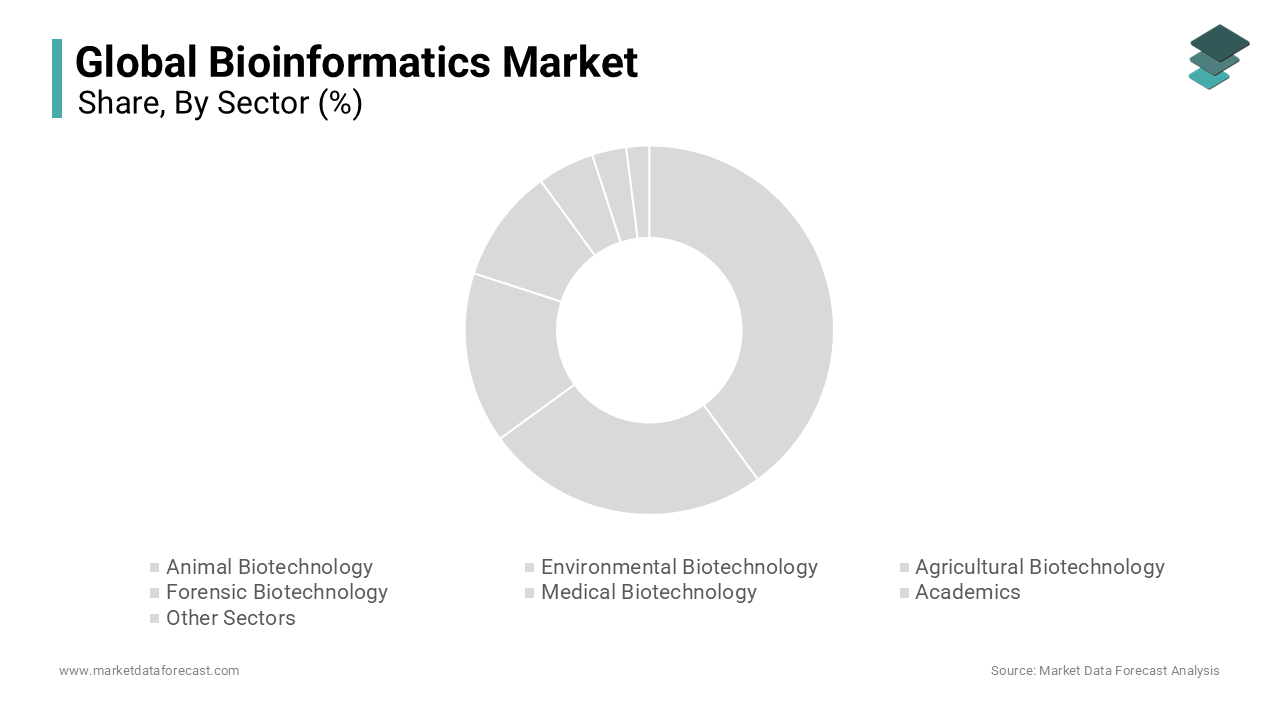
The medical biotechnology segment was the largest by holding 36.2% of the bioinformatics market share in 2025 due to its role in modern healthcare and drug discovery. Bioinformatics tools help mitigate this financial burden by identifying viable drug targets early in the process. This efficiency allows companies to screen millions of compounds virtually before conducting physical tests. The ability to predict drug toxicity and efficacy using genomic data minimizes late-stage clinical trial failures. Regulatory agencies increasingly accept computational evidence to support safety profiles. This acceptance encourages greater investment in bioinformatics driven drug design. The reduction in failure rates directly improves the return on investment for pharmaceutical firms. Consequently, medical biotechnology remains the dominant sector as it offers tangible economic benefits.
The proteomics segment is swiftly emerging at a fastest CAGR of 18.5% during the forecast period with the increasing recognition of proteins as key functional molecules in biological systems. Improvements in mass spectrometry technologies have revolutionized protein analysis, driving the need for sophisticated bioinformatics tools. The high throughput capability generates massive datasets that require advanced computational processing. Bioinformatics software automates the identification and quantification of proteins with high accuracy. Researchers rely on these tools to understand protein interactions and post translational modifications. The complexity of proteomic data necessitates machine learning algorithms for pattern recognition. Pharmaceutical companies use proteomics to identify novel drug targets and biomarkers. The ability to analyze protein dynamics provides insights into disease mechanisms that genomics alone cannot offer. The integration of proteomics with other omics data enhances biological understanding. Vendors develop specialized platforms to handle the unique challenges of protein data.
By Application Insights
The genomics segment was the largest by capturing 56.8% of the bioinformatics market share in 2025. The widespread adoption of next generation sequencing technologies drives the dominance of genomics in the bioinformatics market. These technologies enable rapid and cost-effective sequencing of entire genomes. This massive scale of data generation requires robust bioinformatics pipelines for analysis. The cost of sequencing continues to decline by making it accessible to more researchers and clinicians. The Broad Institute reports that whole genome sequencing can now be completed in under 24 hours. This speed facilitates real time diagnostic applications in clinical settings. Researchers use genomic data to study genetic diversity and evolutionary relationships. Pharmaceutical companies rely on genomic insights to develop targeted therapies. The integration of genomic data into electronic health records supports personalized medicine initiatives. Government funding for large scale genomic projects further boosts market growth. The availability of public genomic databases enhances collaborative research efforts. Genomics remains the leading application because it provides the fundamental data for biological discovery.
The chemoinformatics segment is likely to grow at a fastest CAGR of 19.2% during the forecast period with the increasing complexity of drug design and the need for efficient chemical data management. Researchers use computational methods to model chemical interactions and predict drug properties. This capability accelerates the identification of lead candidates for drug development. Bioinformatics tools help optimize molecular structures for better efficacy and safety. Pharmaceutical companies reduce experimental costs by prioritizing promising compounds digitally. The integration of artificial intelligence enhances the predictive power of chemoinformatics models. Machine learning algorithms identify subtle patterns in chemical data that humans might miss. The ability to predict off target effects improves drug safety profiles. Regulatory agencies encourage the use of computational data to support drug applications. Startups focus on developing innovative chemoinformatics platforms for specific therapeutic areas. The demand for these tools grows as drug targets become more challenging. Chemoinformatics enables the exploration of vast chemical spaces efficiently. This efficiency drives rapid adoption in the pharmaceutical industry.
REGIONAL ANALYSIS

North America Bioinformatics Market Analysis
North America was the top performer in the global Bioinformatics Market by capturing 33.4% of share in 2025 with a robust healthcare infrastructure and significant investment in life sciences research. The substantial financial support drives innovation and adoption of bioinformatics tools. The presence of major pharmaceutical companies and technology providers further boosts the growth of the market. The United States Food and Drug Administration actively promotes the use of computational methods in drug approval processes. Academic institutions in North America lead in genomic research and publication output. The region has a high concentration of skilled bioinformaticians and data scientists. Private equity firms invest heavily in biotech startups focusing on precision medicine. The adoption of electronic health records is widespread, facilitating data integration. Regulatory frameworks support the secure exchange of genetic information. Collaborative initiatives between industry and academia accelerate technology transfer. The demand for personalized medicine drives clinical adoption of bioinformatics.
Europe Bioinformatics Market Analysis
Europe bioinformatics market was ranked second by holding 21.2% of the share in 2025 with the strong government initiatives and collaborative research networks. As per the European Commission, the Horizon Europe program allocates over 95 billion euros for research and innovation. A substantial portion of this funding supports digital health and bioinformatics projects. The European Bioinformatics Institute provides essential resources and training for researchers across the continent. Countries like Germany and the United Kingdom have well established biotechnology sectors. The General Data Protection Regulation ensures high standards for data security and patient privacy. This regulatory environment builds trust among participants in genomic studies. Academic collaborations foster the development of open-source bioinformatics tools. The region has a strong tradition of public health research and epidemiology. Hospitals are increasingly integrating genomic data into clinical workflows.
Asia Pacific Bioinformatics Market Analysis
The Asia-Pacific bioinformatics market growth is expected to witness a fastest CAGR in coming years with the increasing healthcare expenditure and government support. Countries like China and India are investing heavily in genomic research infrastructure. This investment supports large scale sequencing projects and database development. The region has a large patient population, providing ample data for research. Governments are launching precision medicine initiatives to improve healthcare outcomes. The Japanese Ministry of Health promotes the use of AI in medical diagnostics. Local technology companies are developing cost effective bioinformatics solutions. The availability of skilled IT professionals supports the growth of the sector. Academic institutions are expanding their bioinformatics programs to meet industry demand. Collaborations with Western research centers enhance technical capabilities. The rising prevalence of chronic diseases drives demand for diagnostic tools. Pharmaceutical companies in the region are increasing their R&D investments. The market benefits from favorable regulatory changes and infrastructure improvements.
Latin America Bioinformatics Market Analysis
Latin America bioinformatics market growth is likely to grow with the improving healthcare infrastructure and regional collaborations. The digital health initiatives are gaining traction across member states. Governments are investing in modernizing laboratory facilities and data systems. Academic institutions are partnering with international organizations to build capacity. The region faces challenges related to funding and technical expertise. Local researchers are participating in global genomic consortia. The prevalence of infectious diseases drives demand for genomic surveillance tools. Pharmaceutical companies are expanding their presence in the region. Regulatory bodies are working to streamline approval processes for new technologies. The growing middle class increases demand for advanced healthcare services. Telemedicine initiatives are integrating bioinformatics data for remote consultations.
The Middle East and Africa Bioinformatics Market Analysis
The Middle East and Africa bioinformatics market growth is driven by government visions for healthcare transformation. Countries like Saudi Arabia and the United Arab Emirates are leading the way with significant investments. The Saudi Vision 2030 includes specific goals for developing a robust life sciences sector. The region is establishing genomic centers to study population specific genetic variations. The African Society of Human Genetics promotes research into local disease patterns. International partnerships help build technical capacity and infrastructure. The region faces challenges related to data connectivity and resource allocation. However, mobile health technologies are enabling data collection in remote areas. The prevalence of genetic disorders drives demand for diagnostic services. Governments are prioritizing healthcare modernization to improve population health. Academic institutions are introducing bioinformatics courses to train local talent. The market is supported by grants from global health organizations. Private sector involvement is increasing as the business case becomes clearer.
COMPETITIVE LANDSCAPE
The competition in the Bioinformatics Market is characterized by rapid technological innovation and a high degree of specialization among participants. Established life sciences giants compete with agile software startups that focus on niche analytical applications. Large corporations leverage their extensive distribution networks and brand recognition to dominate the clinical segment. Meanwhile, smaller firms often lead in developing cutting edge algorithms for specific research areas such as proteomics or metabolomics. The barrier to entry remains high due to the need for specialized expertise in both biology and computer science. Intellectual property protection plays a critical role as companies patent unique algorithms and data processing methods. Price competition is less intense than feature differentiation as users prioritize accuracy and speed. Collaborative ecosystems are forming where vendors partner to offer integrated end to end solutions.
KEY MARKET PARTICIPANTS
Some of the companies that are playing a dominating role in the global bioinformatics market include
- Agilent Technologies
- Affymetrix Inc.
- Applied Biological Materials (ABM)
- 3rd Millennium Inc.
- Illumina Inc.
- Thermo Fisher Scientific Inc.
- Qiagen N.V.
- Biomax Informatics AG
- DNAnexus, Inc.
- Waters Corporation
Top Players in the Market
Illumina
Illumina dominates the genomic sequencing landscape by providing integrated hardware and software solutions for biological data analysis. The company recently launched advanced sequencing platforms that generate higher quality data at reduced costs. These technological advancements enable researchers to process larger datasets with greater efficiency. Illumina actively collaborates with pharmaceutical companies to integrate its tools into drug discovery workflows. The firm invests heavily in artificial intelligence to enhance variant calling accuracy. Its cloud-based data management systems facilitate secure sharing of genomic information globally. Illumina continues to expand its portfolio through strategic partnerships with healthcare providers.
Thermo Fisher Scientific
Thermo Fisher Scientific strengthens its position by offering comprehensive bioinformatics suites alongside laboratory instrumentation. The company integrates its software solutions with next generation sequencing instruments to streamline workflows. Recent innovations include automated data analysis pipelines that reduce manual intervention and errors. Thermo Fisher supports academic and commercial researchers with scalable cloud computing resources. The firm emphasizes interoperability between its various platforms to ensure seamless data flow. It provides extensive training programs to help users maximize the utility of its tools. Thermo Fisher actively engages in regulatory compliance efforts to support clinical adoption.
Qiagen
Qiagen contributes significantly to the bioinformatics market through its robust sample preparation and data interpretation technologies. The company offers specialized bioinformatics software tailored for infectious disease research and oncology. Qiagen recently enhanced its digital PCR analysis tools to improve sensitivity and specificity. The firm focuses on user friendly interfaces that simplify complex data visualization tasks. Qiagen collaborates with diagnostic laboratories to validate its computational algorithms for clinical use. The company invests in machine learning models to predict pathogen evolution and resistance patterns. Its integrated workflow solutions reduce turnaround times for critical diagnostic results.
Top Strategies Used by Key Market Participants
Key players in the Bioinformatics Market, primarily focus on strategic acquisitions to expand their technological capabilities and product portfolios. Companies frequently acquire smaller startups specializing in artificial intelligence and machine learning to enhance their analytical engines. This approach allows established firms to integrate advanced algorithms quickly without developing them from scratch. Partnerships with academic institutions and research hospitals are another common strategy to validate tools and gain early access to novel datasets. These collaborations help vendors tailor their solutions to real world clinical needs and regulatory requirements. Investment in cloud infrastructure is crucial as providers shift toward scalable and flexible service models. Companies also prioritize interoperability by ensuring their software can integrate with existing laboratory information systems. Continuous innovation through internal research and development remains essential to maintain competitive advantage. Firms regularly update their platforms to support new sequencing technologies and data formats.
RECENT MARKET HAPPENINGS
- In 2020, Roche purchased Stratos Genomics to innovate Roche nanopore sequencing, which combines the electronics and biological components for fast and low-cost diagnostic testing of DNA sequencing.
- In 2019, Qiagen joined N-of-one to develop clinical bioinformatics services for complex genomic data management. Also, it helps to expand their decision-support solutions with consideration of software, content, and services. It provides clinical trials matching services and an oncology database of patients to the organization.
- In 2019, NEC acquired Oncommunity, an immune profiler that uses machine learning to sequence cancerous patients. The development will provide better cancer treatment in the global bioinformatics market.
MARKET SEGMENTATION
This research report on the global bioinformatics market has been segmented and sub-segmented based on the sector, products & services, application, and region.
By Sector
- Animal Biotechnology
- Environmental Biotechnology
- Alternative Energy Sources
- Waste Clean-Up/Bioremediation
- Climate Change Studies
- Agricultural Biotechnology
- Crop Yield Improvement
- Pest Resistance
- Improvement of Plant Resistance
- Biodiversity Informatics
- Nutritional Quality Improvement
- Forensic Biotechnology
- Medical Biotechnology
- Drug Development
- Clinical Diagnostics
- Molecular Medicine
- Personalized Medicine
- Preventive Medicine
- Gene Therapy
- Reproductive Biotechnology
- Academics
- Other Sectors
By Products and Services
- Bioinformatics Platforms
- Sequence Analysis Platforms
- Sequence Alignment Platforms
- Sequence Manipulation Platforms
- Structural and Functional Analysis Platforms
- Other Bioinformatics Platforms
- Knowledge Management Tools
- Generalized Knowledge Management Tools
- Specialized Knowledge Management Tools
- Bioinformatics Services
- Data Analysis
- Sequencing Services
- Other Bioinformatics Services
- Database and Management Services
By Application
- Proteomics
- Transcriptomics
- Molecular Phylogenetics
- Chemoinformatics
- Drug Design
- Genomics
By Region
- North America
- Europe
- Asia Pacific
- Latin America
- The Middle East and Africa