- Product Description Description
- Table of Contents TOC
- List of Table & Figure LOT
- Get Free Sample PDF Sample PDF
Market Size, 2025
$6.04 BnMarket Estimate, 2026
$6.59 BnMarket Forecast, 2034
$13.24 BnCAGR, 2026–2034
9.1%Global Bioseparation Systems Market Size
The global bioseparation systems market was valued at USD 6.04 billion in 2025 and is estimated to reach USD 6.59 billion in 2026. The market is projected to grow to USD 13.24 billion by 2034, registering a CAGR of 9.1% from 2026 to 2034.
Bioseparation is the isolation of biological substances such as molecules, cells, organisms, and cell components. Three types of systems are used in the pharmaceutical and biopharmaceutical industry: chromatography, membrane filtration, and centrifugation. U.S. food and drug administration primarily focuses on biological and biosimilar medication to treat cancer, rheumatoid arthritis, and other diseases. Several companies invest much more in the R & D division to develop biosimilar and monoclonal antibody drugs.The Centre Of Biologics Evaluation and Research also regulates the authority to develop new products. The bioseparation systems market is growing rapidly worldwide due to the purification of biologics drugs. Industries introduced advanced chromatographic facilities for the purification of human body proteins. Also, BCG vaccines and insulin analogues purification plays an essential role in the market of bioseparation systems. Chromatography is contained 50% of the bioseparation system in the pharmaceutical and biopharmaceutical industries. Most pharmaceutical sectors develop innovative launches in monoclonal antibodies to treat various diseases such as inflammatory disorders, cancers, and autoimmune disorders. In the past three decades, nearly 65 antibody products have been approved by the FDA.
MARKET DRIVERS
Y-O-Y growth in the population worldwide and developments in pharmaceutical and biopharmaceutical industries are propelling the bioseparation systems market.
The bioseparation systems market is driven by the increased demand for biopharmaceuticals, requiring separators to make biomedicines. Also, technological advancements in equipment used in bioseparation are expected to drive market growth. Furthermore, the global bioseparation systems market has benefited from several government programs to raise knowledge about the therapeutic uses of biosimilars. The regional biopharmaceutical bioseparation systems market is well-developed; thus, the biopharmaceutical bioseparation systems market is likely to be driven by product replacements throughout the projected period. Furthermore, the market is fuelled by the discovery of innovative vaccines and mAbs, technical developments in equipment, the expansion of biosimilars products, and a rise in demand for single-use goods.
Rapid product releases and increased mergers and acquisitions amongst medical device manufacturing companies are significant trends in the global bioseparation systems market. In addition, end-users will need to make more significant expenditures on equipment to meet the expanding research and analytical demands in dynamic disciplines, including genomics, pharmaceutical sciences, and biotechnology. Therefore, increasing investments are most likely to augment the market growth. Further, as people get more comfortable with automation, the demand for automated bioseparation systems that can handle many samples with high accuracy will rise. On the other hand, changing lifestyles and urbanization have increased the prevalence of lifestyle-related ailments such as cancer, diabetes, and heart disease in some areas. This has opened up various opportunities for expansion in the biopharmaceutical industry, including conducting research and allocating significant resources. The Asia Pacific is one of the most profitable markets for biopharmaceutical bioseparation systems due to the high adoption of newer treatment options and fast-expanding population, leading to increased healthcare expenditure.
MARKET RESTRAINTS
However, the availability of replacements for chromatography, such as magnetic separation, and the high capital cost of bioseparation, are expected to limit the global bioseparation systems market expansion. In addition, the market for worldwide bioseparation systems is being held back by strict regulatory requirements to approve equipment used in bioseparation.
REPORT COVERAGE
| REPORT METRIC | DETAILS |
| Market Size Available | 2025 to 2034 |
| Base Year | 2025 |
| Forecast Period | 2026 to 2034 |
| Segments Covered | By Type, Application, and Region |
| Various Analyses Covered | Global, Regional & Country Level Analysis, Segment-Level Analysis, Drivers, Restraints, Opportunities, Challenges, PESTLE Analysis, Porter’s Five Forces Analysis, Competitive Landscape, Analyst Overview on Investment Opportunities |
| Regions Covered | North America, Europe, Asia Pacific, Latin America, Middle East & Africa |
| Market Leaders Profiled | GE Healthcare Life Sciences, Sartorius AG, US Filter Control Systems, Inc., |
REGIONAL ANALYSIS
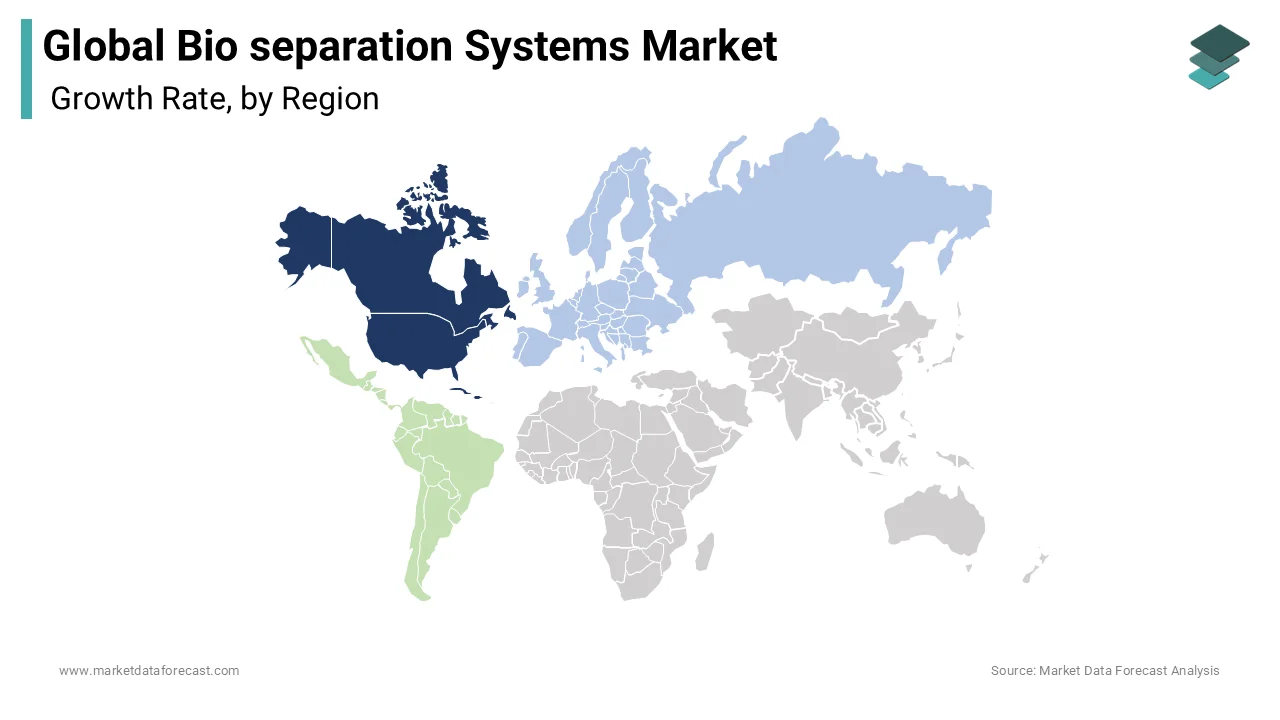
Regionally, the North American bioseparation systems market dominated the global market in 2023, while the Asia Pacific is anticipated to have the fastest growth owing to increasing demand for biopharmaceuticals. The North American market is driven by the region's strengthened life sciences research infrastructure and rising biopharmaceutical demand. Furthermore, technical advances in equipment used in bioseparation procedures have aided the market's expansion in North America. In North America, the United States has the most significant demand for bioseparation systems, led by Canada.
The bioseparation systems market in Europe is dominated by Germany, France, and the United Kingdom. However, the bioseparation systems market in Asia is projected to expand over the next five years. This can be attributed to the region's growing demand for biopharmaceuticals.
On the other hand, the APAC bioseparation systems market is projected to be growing at a CAGR of 11.08% from 2024 to 2032. Several biopharmaceutical manufacturing companies plan to develop production facilities in Asian countries, drawn by the region's less stringent regulations and low labor costs. The bioseparation systems market in Asia is expected to expand due to the growing population and economies of developing countries such as India and China. Moreover, the region's fastest-growing markets for bioseparation systems are projected to be India, China, and Japan.
The Latin American bioseparation systems market is expected to value USD 580 million by 2027.
The bioseparation systems market in MEA was valued at USD 250 million in 2023.
COMPETITIVE LANDSCAPE
KEY MARKET PLAYERS
Some of the notable companies dominating the global bioseparation systems market profiled in the report are
- GE Healthcare Life Sciences
- Sartorius AG, US Filter Control Systems, Inc.
- Asahi Kasei Corporation
- Pall Corporation
- Agilent Technologies
- Waters Corporation
- 3M Company
- Merck Millipore
- Bio-Rad Laboratories, Inc.
- Dow Chemical Company.
RECENT HAPPENINGS IN THIS MARKET
-
In 2019, the Sartorius stadium biotech collaborated with Novasep to develop a novel system for membrane chromatography. It provides various products and services to the pharmaceutical and biopharmaceutical industries. The new chromatography techniques are used to design and develop a resin-based solution.
-
In 2019, the AKTA launched a new liquid chromatography system to support researchers and biotechnology industries in introducing protein purification. In addition, the company has an agreement with GE healthcare for large-scale liquid chromatography.
- In 2018, Water Corporation introduced the LC platform and neutral bioseparations system that reduce the cost and decrease the time and solvent volumes.
MARKET SEGMENTATION
This market research report on the global bioseparation systems market has been segmented and sub-segmented based on the type, application, and region.
By Type
-
Centrifugation Technology
-
Cell Disruption Technology
-
Chromatography Technique
-
Extraction Technique
-
Filtration Technologies
-
Membrane-based Bioseparation and Precipitation
By Application
-
Food
-
Life Sciences
-
Pharmaceutical
-
Biopharmaceutical
By Region
-
North America
-
Europe
-
Asia Pacific
-
Latin America
-
The Middle East and Africa