- Product Description Description
- Table of Contents TOC
- List of Table & Figure LOT
- Get Free Sample PDF Sample PDF
Market Size, 2025
$7.86 BnMarket Estimate, 2026
$9.13 BnMarket Forecast, 2034
$30.36 BnCAGR, 2026–2034
16.2%Global Cell Therapy Technologies Market Size
The global cell therapy technologies market was worth US$ 7.86 billion in 2025 and is anticipated to reach US$ 30.36 billion by 2034, up from US$ 9.13 billion in 2026, with a CAGR of 16.2% during the forecast period 2026 to 2034.
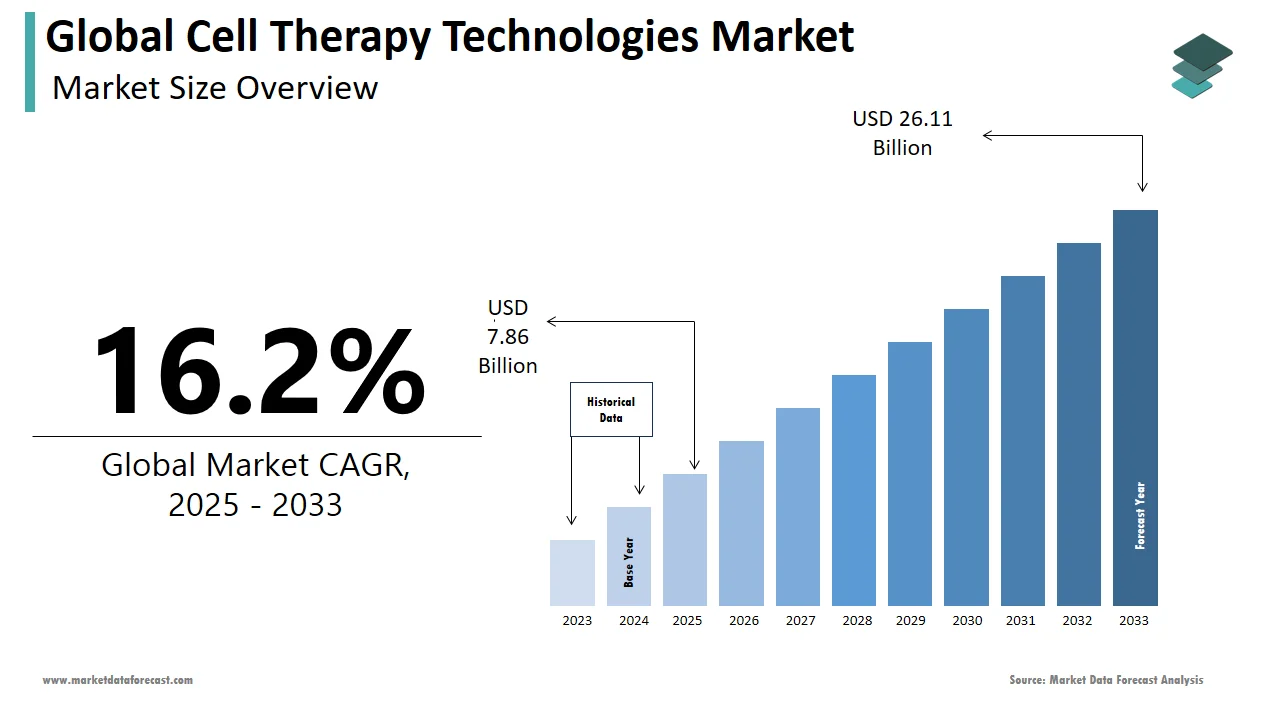
Cellular therapy is the transplantation of human cells to repair or replace damaged tissue or cells. Advanced and new innovative technologies, products, limitless imagination, and various types of cells are used in therapy and in treating specific diseases and conditions. Cell therapy technologies involve administering purified, propagated, or differentiated specific cell products from the human body to a patient for specific treatment. The global cell therapy technologies market has grown significantly in the past years and is anticipated to grow notably during the forecast period. The escalating investments by the major pharmaceutical and biotechnological companies in research activities for developing new cells and effective therapies will present prominent opportunities for market growth. The growing requirement of innovative therapies for reducing the prevalence of chronic diseases drives the market growth.
MARKET DRIVERS
The rise of government investments in cell-based research is the primary growth driver for the global cell therapy technologies market.
On-going R&D in multiple countries to find more effective treatment procedures for the ever-growing incidence of chronic diseases is estimated to support the cell therapy technologies market. Available funding for cell-based research that helps market key players develop innovative devices is a positive sign of the market growth rate. In addition, many governments are adopting innovative methods and therapies to support stem cell research, favoring the market during the forecast period. Additionally, a rising focus on personalized medicine is expected to boost the growth scope of the cell therapy technologies market. For the treatment and prevention of disease, precision medicine is needed by taking account of individuals in genes, lifestyle, and environment.
The growing technological advancements in the healthcare industry, such as the integration of automation and robotics in the manufacturing process, enhance efficiency, scalability, and reproducibility, which are the primary factors driving market growth. The increasing surge in closed-system bioprocessing technologies is gaining traction as they help address the critical challenges in cell therapy manufacturing by enhancing sterility and safety, providing market growth opportunities. The increased usage of advanced analytical tools in the quality control and optimization of the process fuels global market revenue.
MARKET RESTRAINTS
The need for more skilled professionals is the major restrain for the market's growth. Also, in the last few decades, a rapid increase in technology and product development affected the market growth due to a need for more trained professionals to operate complex instruments like multi-mode readers and flow cytometers. Expert professionals will be needed to perform complex instruments with a wide range of data outputs. Therefore, the need for more skilled professionals is a prime restraint in the market of cell therapy technologies. Another factor restraining the market growth is the limited adoption of cell therapies among people due to the experience of recurrence of cancer if the cells stop expressing the targeted antigen. The CAR T-cell therapies have shown limited efficacy towards solid tumors, which hinders market growth due to the restricted adoption rate. The expensiveness of the cell therapies for treatment where the stem cell technologies are costly and accessible to developed countries and people with high budgets impedes the market growth opportunities. Due to the high complexity, the presence of stringent government regulations for approval of the process and products will challenge manufacturers.
REPORT COVERAGE
| REPORT METRIC | DETAILS |
| Market Size Available | 2025 to 2034 |
| Base Year | 2025 |
| Forecast Period | 2026 to 2034 |
| Segments Covered | By Product, Cell Type, Process, End-User, and Region. |
| Various Analyses Covered | Global, Regional, and Country-Level Analysis, Segment-Level Analysis, Drivers, Restraints, Opportunities, Challenges; PESTLE Analysis; Porter’s Five Forces Analysis, Competitive Landscape, Analyst Overview of Investment Opportunities |
| Regions Covered | North America, Europe, Asia Pacific, Latin America, Middle East & Africa |
| Market Leaders Profiled | Thermo Fisher Scientific Inc., Merck KGaA, MaxCyte, Danaher Corporation, Becton, Dickinson and Company, Lonza Group, Sartorius AG, Terumo BCT, Fresenius Medical Care AG & Co. KGaA, Avantor, Inc., and Others. |
SEGMENTAL ANALYSIS
By Product Insights
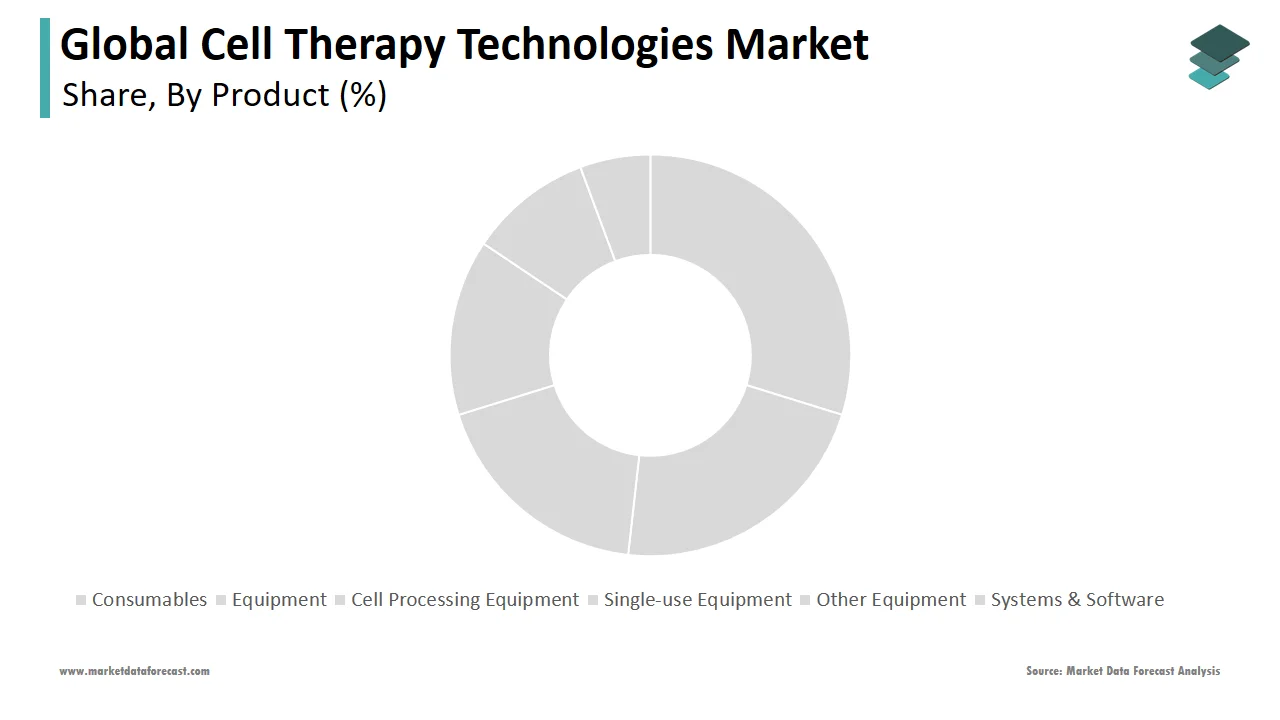
The consumables segment accounts for the most considerable market share of cell therapy technologies based on the product. Initiatives by the government to enhance cell-based research therapy and growing investments by companies to develop advanced consumables products are the leading factors that are hiking the growth of this segment. The growing demand for consumables owing to their broad utilization in manufacturing cell therapies propels the segment growth rate. The cell culture media, growth factors, extracellular matrices, and reagents play a crucial role in developing the cell therapies that contribute to segment growth.
The cell processing equipment segment is expected to grow significantly in the coming years. Cell processing equipment is an essential item of lab equipment for developing batch manufacturing processes, which augments the adoption rate. The growing demand for cell processing equipment from pharmaceutical and biotechnology researchers is boosting the segment's revenue growth.
By Cell Type Insights
The T-cell segment holds a significant share in the cell therapy technologies market based on cell type. An increase in demand for T-cell therapies and government initiatives are key factors driving this segment's growth. The CAR-T treatment is highly effective against some types of cancer where the treatment is challenging. This is enhancing the demand for the T-cell, leading to segment growth. The FDA's approval for treating various types of hematological malignancies, including leukemia and lymphoma, is escalating the demand for CAR-T therapy.
The stem cells segment is projected to have a notable growth rate during the forecast period owing to its wide applications in various healthcare sectors. Stem cells have gained traction in recent periods as they can be used in regenerative medicine, immunotherapy, wound healing, fertility diseases, liver diseases, cell deficiency therapy, and others, boosting the segment revenue in the coming years. The growing trend of personalized medicine positively influences stem cell therapies, expanding the segment growth rate.
By Process Insights
By process, cell processing accounts for the largest share of the cell therapy technologies market. During the forecast period, the cell processing segment records a high compound annual growth rate in the cell therapy technologies market. Cell therapy instruments and media use are major factors in significant growth. Cell processing involves equipment dedicated to batch manufacturing, which fuels the market growth. The operation performance of raw materials to produce final products or interims involves cell processing.
The process monitoring and quality control segment will expand significantly during the forecast period. The need to ensure the therapeutic products' safety, purity, potency, and consistency is a major factor escalating the segment growth. This involves specific procedures and processes that evaluate the product's efficacy as it meets the predefined quality standards and specifications.
By End User Insights
By the end-user segment, Biopharmaceutical & Biotechnology companies and CROs segment are accounting for the largest share and expecting a record high compound annual growth rate in the cell therapy technologies market in 2024. The attributing factors are the high burden of chronic diseases and increased R&D activities by biotechnology and pharmaceutical companies, which lead to segment growth. Most of the key market players invest more in R&D activities where they collaborate with the CROs to develop effective and safe cell therapies, which provide essential requirements for developing and manufacturing the product. These scenarios are increasing the growth opportunities for CROs and biotechnology companies.
The research institutes and cell banks segment is estimated to grow rapidly during the forecast period. Researchers and certain pharmaceutical companies' increasing focus on developing novel and innovative cell therapies and procedures is accelerating the growth opportunities for the segment. Public and private organizations' increasing investments in R&D activities are boosting the market growth in this segment.
REGIONAL ANALYSIS
North America Cell Therapy Technologies Market Analysis
Geographically, the North American region accounted for the largest share of around 60% in 2024 and was estimated to record a high compound annual growth rate in the global cell therapy technologies market during the forecast period. Many leading North American companies are in the U.S., like the Institute for Stem Cell Biology and Regenerative Medicine, Stanford University, and Yale Stem Cell Center, which fuels the market growth in the region. The presence of leading companies plays a significant role as a growth-attributing factor. In addition, there is regulatory solid and financing support from the federal bodies to expand the market in the U.S. and Canada. The emerging advancements in the region and growing collaborative research initiatives by research institutes and biotechnology companies are boosting the market revenue in the region.

Asia-Pacific Cell Therapy Technologies Market Analysis
Asia-Pacific region is estimated to grow faster during the forecast period in the global cell therapy technologies market due to the availability of affordable therapies and public awareness about healthcare entities. In the Asia-Pacific region, Japan is a leading country for cell therapy technology, attributing the fastest growth. Japan's government recognized that regenerative medicine and cell therapy play a vital role in developing development in the cell therapy technologies market. The growing awareness regarding the need for novel therapies, rising investments by public and private organizations in research activities, and favorable government initiatives are other significant factors contributing to the market growth rate across the region.
Europe Cell Therapy Technologies Market Analysis
The European region is expected to grow notably in the coming years owing to its well-established healthcare infrastructure and research institutes. European countries such as Germany, France, and the United Kingdom are widely known for their pharmaceutical and biotechnological companies, which positively influence market growth. The growing R&D advancements, investments, and government support augment the regional market growth opportunities.
KEY MARKET PLAYERS
Some of the companies playing a dominating role in the global cell therapy technologies market are
- Thermo Fisher Scientific Inc.
- Merck KGaA
- MaxCyte
- Danaher Corporation
- Becton, Dickinson and Company
- Lonza Group
- Sartorius AG
- Terumo BCT
- Fresenius Medical Care AG & Co. KGaA
- Avantor, Inc.
GLOBAL CELL THERAPY TECHNOLOGIES MARKET NEWS
- In October 2023, Nekarta, Inc. announced that the FDA had approved its IND application to investigate NKX019, its allogeneic, CD19-directed CAR NK cell therapy candidate, which is used for the treatment of lupus nephritis.
- In October 2023, Aurion Biotech announced the start of a phase 1 and 2 clinical trial of cell therapy for corneal edema in the United States.
- In June 2024, Vertex Pharmaceuticals and Lonza collaborated and aimed to streamline the manufacturing of Vertex's portfolios of stem cell therapies. These cell therapies are intended to help with Type 1 diabetes (TID).
- In May 2023, Johnson & Johnson announced the global collaboration and agreement with Cellular Biomedicine Group to improve the development of next-generation CAR-T therapies.
- In May 2023, Bristol-Myers Squibb Company received approval from the European Commission for Breyanzi, which is used to treat refractory or relapsed large B-cell lymphoma in adult patients.
- In 2020, Lonza (Switzerland) collaborated with IsoPlexis (U.S.) to develop the next generation of cell therapy technologies.
- In 2020, Danaher purchased the Biopharma unit of General Electric Company.
- In 2019, to expand global bioproduction capabilities with a large-volume liquid manufacturing capacity for cell culture media, an investigation was made by Therma Fisher Scientific in the Inchinnan site.
MARKET SEGMENTATION
This research report on the global cell therapy technologies market has been segmented & sub-segmented based on the product, cell type, process, end-user, and region.
By Product
- Consumables
- Equipment
- Cell Processing Equipment
- Single-use Equipment
- Other Equipment
- Systems & Software
By Cell Type
- T-cells
- Stem Cells
- Other Cells
By Process
- Cell Processing
- Cell Preservation, Distribution, and Handling
- Process Monitoring and Quality Control
By End User
- Biopharmaceutical & Biotechnology Companies and CROs
- Research Institutes and Cell Banks
By Region
- North America
- Europe
- Asia Pacific
- Latin America
- The Middle East and Africa