- Product Description Description
- Table of Contents TOC
- List of Table & Figure LOT
- Get Free Sample PDF Sample PDF
Global Complex Event Processing (CEP) Market Summary
The global complex event processing (CEP) market was valued at USD 10.96 billion in 2025, is estimated to reach USD 13.99 billion in 2026, and is projected to surge to USD 98.29 billion by 2034, registering an exceptional CAGR of 27.6% from 2026 to 2034.
Key Market Highlights
- 2025 Market Size: USD 10.96 Billion
- 2026 Estimate: USD 13.99 Billion
- 2034 Forecast: USD 98.29 Billion
- CAGR (2026–2034): 27.6%
- Largest End-User: BFSI (41.5% share in 2025)
- Fastest-Growing Vertical: Healthcare (15.2% CAGR)
- Largest Region: North America (38.5% share in 2025)
Quick Growth Drivers
- Surge in real-time data from financial trading systems
- Expansion of smart city infrastructure
- Growth of IoT and edge computing deployments
- Rising need for fraud detection & compliance monitoring
- Integration of CEP with AI & predictive analytics
Principal Restraints
- Complex integration with legacy enterprise systems
- Scarcity of real-time analytics & stream-processing talent
- GDPR and global data privacy compliance risks
- High deployment & customization costs
High-Value Opportunities
- AI-powered predictive event orchestration
- Edge-based CEP in Industrial IoT
- CEP-as-a-Service for SMEs
- Real-time healthcare patient monitoring systems
- Autonomous vehicle & smart mobility ecosystems
Key Market Challenges
- Maintaining event consistency in distributed systems
- Timestamp synchronization across multi-cloud networks
- Event overload from hyper-scale IoT data streams
- Ensuring low-latency processing without data loss
What Wins Commercially (Competitive Edge)
- AI-integrated predictive CEP engines
- Low-latency edge processing
- Cloud-native architecture compatibility
- Industry-specific solution accelerators
- Subscription-based scalable deployment models
Top Strategic Ask for Executives
- Invest in AI-driven event prediction models
- Expand edge-processing capabilities
- Build compliance-ready, audit-friendly architectures
- Develop low-code CEP tools for faster deployment
- Target healthcare & smart infrastructure verticals
Leading Players
Some of the companies that are playing a dominating role in the global complex event processing market include:
- IBM
- TIBCO Software Inc.
- Software AG
- Amazon Web Services
- Microsoft Corporation
- Google Cloud
Global Complex Event Processing Market Size
The global companion animal healthcare market, worth USD 10.96 billion in 2025, is forecasted to rise to USD 13.99 billion in 2026 and USD 98.29 billion by 2034, at a CAGR of 27.6%.from 2026 to 2034
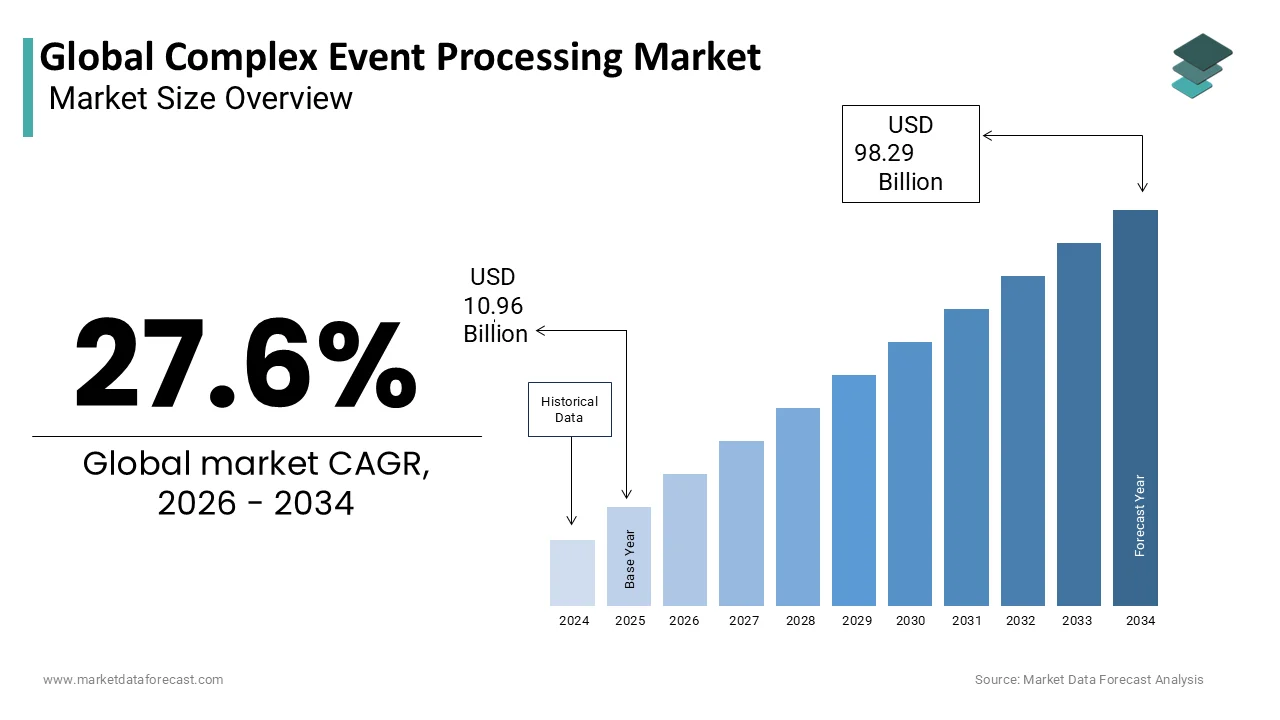
Complex Event Processing (CEP) is a computational paradigm that analyzes high-velocity data streams in real time to detect meaningful patterns and trigger immediate responses. Unlike traditional data processing systems, CEP evaluates multiple events across diverse sources, such as sensors, transaction logs, or network feeds, to infer complex situations from combinations of simple events. This capability is increasingly important in environments requiring instantaneous decision-making, including financial trading platforms, smart city infrastructures, and industrial IoT ecosystems. As per the study, a portion of large enterprises deploy event-driven architectures for operational intelligence, reflecting a structural shift toward proactive system responsiveness.
MAREKT DRIVERS
Proliferation of Real-Time Data in Financial Services
The financial sector’s escalating reliance on real-time analytics in algorithmic trading and fraud detection is driving the growth of the complex event processing market. High-frequency trading firms process millions of market data events per second, which necessitates sub-millisecond decision latency. According to the research, automated trading accounts for a high percentage of daily equity trading volume in the U.S., a figure that has steadily risen due to the competitive burden for speed and accuracy. CEP systems enable these institutions to correlate disparate market signals, such as price fluctuations, order book changes, and news feeds, into actionable insights within microseconds. For instance, major investment banks like JPMorgan Chase have reported an improvement in trade execution efficiency after integrating CEP engines into their trading infrastructure, as documented in their 2023 technology review. This operational transformation emphasizes the indispensability of CEP in maintaining market competitiveness and regulatory compliance in fast-moving financial ecosystems.
Expansion of Smart Infrastructure in Urban Environments
The global acceleration of smart city initiatives has significantly amplified demand in municipal operations, which is additionally to fuel the growth of the complex event processing market. Urban centers are deploying interconnected systems for traffic management, public safety, and energy distribution, all of which generate continuous and heterogeneous data streams. As per the study, the number of cities worldwide has initiated smart city programs, with expenditures on intelligent infrastructure expected to surpass a notable amount annually. In Singapore, the Smart Nation initiative utilizes CEP to integrate data from sensors across transportation and environmental monitoring networks by enabling dynamic traffic rerouting that has reduced peak-hour congestion.
MARKET RESTRAINTS
High Complexity in System Integration and Skill Scarcity
The legacy enterprise systems and the acute shortage of skilled professionals are restricting the growth of the complex event processing market. CEP deployment requires deep expertise in stream processing logic, temporal reasoning, and distributed computing architectures, skills that remain scarce in the global IT workforce. According to the study, there is a deficit of qualified data engineers and real-time analytics specialists across North America and Europe. Furthermore, integration challenges are exacerbated when CEP systems must interface with heterogeneous data sources such as SCADA systems, ERP modules, or proprietary databases, often resulting in prolonged deployment cycles.
Data Privacy and Regulatory Compliance Risks
The rising concerns regarding data privacy and regulatory risks are also hampering the growth of the complex event processing market. The real-time nature of complex event processing introduces substantial data governance obstacles in jurisdictions with stringent privacy regulations. CEP systems often aggregate personally identifiable information (PII) from multiple touchpoints, such as mobile devices, transaction records, or surveillance feeds, which raises concerns about unauthorized profiling and data leakage. The global data protection fines under GDPR exceeded a significant amount, with real-time analytics systems implicated in a portion of major enforcement actions. In healthcare, where CEP is used for patient monitoring, the U.S. pointed out notable data breaches in 2023 involving electronic health records, many linked to inadequately secured streaming platforms. These risks compel organizations to implement additional encryption, anonymization, and audit mechanisms by increasing both cost and complexity.
MARKET OPPORTUNITIES
Integration with Artificial Intelligence for Predictive Event Orchestration
The integration of complex event processing with artificial intelligence offers an opportunity for the expansion of the complex event processing market. Organizations can anticipate event patterns before they occur by embedding machine learning models within CEP pipelines, which enables preemptive interventions. As per the study, enterprises leveraging AI-enhanced CEP have achieved an improvement in predictive accuracy for equipment failures in industrial settings. This synergy allows systems to not only detect but also learn from event sequences by creating adaptive architectures capable of autonomous decision-making with a capability increasingly vital in autonomous vehicles, drone logistics, and digital twins.
Growth of Edge-Based Event Processing in Industrial IoT
The decentralization of data processing through edge computing is providing an opportunity for the growth of the complex event processing market. It is necessary in geographically distributed and latency-sensitive environments. Instead of transmitting vast data streams to centralized clouds, edge-based CEP enables real-time analysis at the source, which is important for applications like autonomous mining equipment or offshore oil rigs. According to research, a portion of enterprise-generated data will be processed at the edge, up from that in 2020, driven by the need for immediate responsiveness and bandwidth optimization. Similarly, BMW utilizes edge-integrated CEP in its assembly lines to monitor robotic workflows, achieving a reduction in production halts due to real-time anomaly resolution. This shift toward localized intelligence not only enhances operational resilience but also mitigates latency and connectivity constraints inherent in remote industrial operations.
MARKET CHALLENGES
Ensuring Event Consistency Across Distributed Architectures
Maintaining temporal and causal consistency in event streams across geographically dispersed systems remains a challenge for the complex event processing market. In distributed environments such as multi-cloud networks or global logistics platforms, events may arrive out of sequence due to network latency or clock skew, leading to erroneous inferences. According to a study, a portion of event misinterpretations in large-scale CEP systems is due to inconsistent timestamping across nodes. Achieving logical time ordering requires sophisticated mechanisms like vector clocks or Lamport timestamps, which increase computational overhead. As organizations scale their CEP frameworks across hybrid infrastructures by ensuring coherent event semantics without compromising performance, it becomes an important engineering barrier.
Managing Event Overload in Hyper-Scale Environments
Filtering signal from noise within CEP frameworks due to the exponential growth in event volume from IoT devices, social media, and automated systems challenges the growth of the complex event processing market. Modern industrial sensors can generate notable events per second per node, overwhelming processing engines with redundant or irrelevant data. Advanced filtering, event abstraction, and adaptive sampling techniques are required to mitigate this, yet their implementation demands precise tuning and continuous monitoring. Therefore, without efficient event throttling mechanisms, even high-performance CEP platforms risk degradation in real-time responsiveness, which affects their core value proposition.
REPORT COVERAGE
| REPORT METRIC | DETAILS |
| Market Size Available | 2025 to 2034 |
| Base Year | 2025 |
| Forecast Period | 2026 to 2034 |
| Segments Covered | By Type, End-user Vertical, and Region. |
| Various Analyses Covered | Global, Regional and Country-Level Analysis, Segment-Level Analysis, Drivers, Restraints, Opportunities, Challenges; PESTLE Analysis; Porter’s Five Forces Analysis, Competitive Landscape, Analyst Overview of Investment Opportunities |
| Countries Covered | North America, Europe, Asia Pacific, Latin America, the Middle East, and Africa |
| Market Leaders Profiled | Zoetis, Merck & Co. (MSD Animal Health), Boehringer Ingelheim, Elanco Animal Health, IDEXX Laboratories, Virbac, Ceva Santé Animaland e, Bayer Animal Health.
|
SEGMENTAL ANALYSIS
By Type Insights
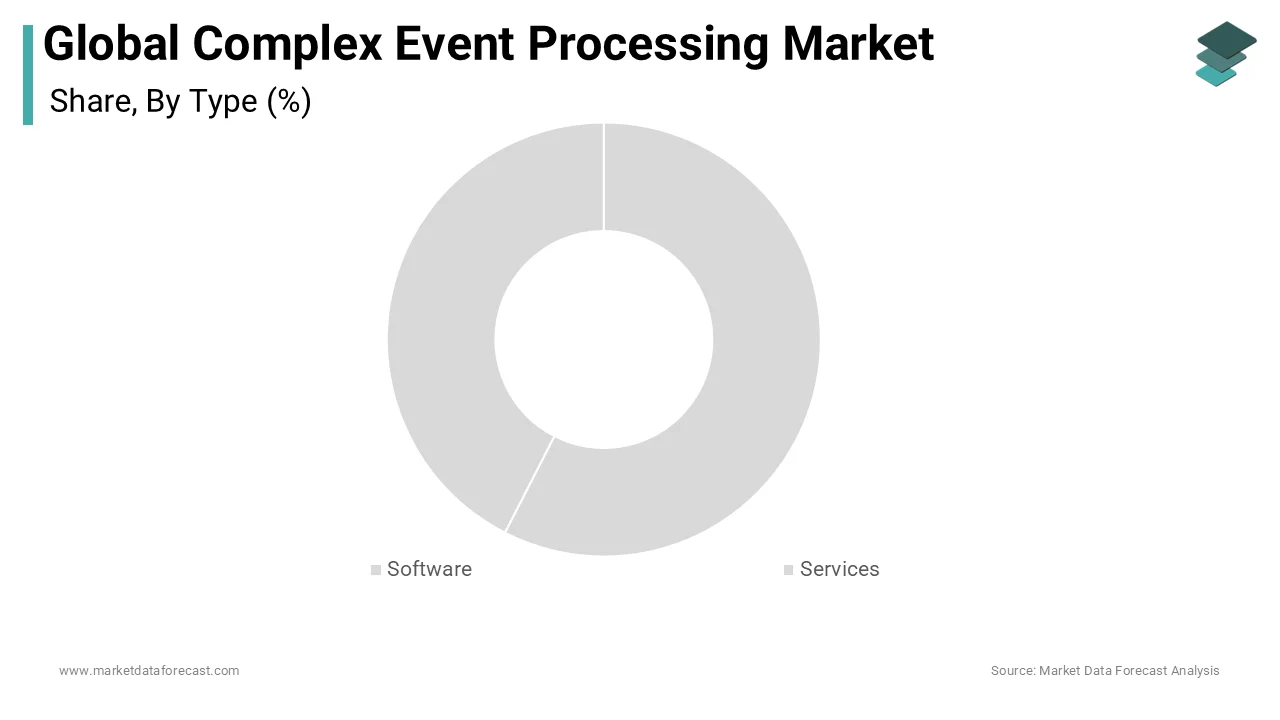
The software segment dominated the complex event processing by capturing a significant share in 2025. The growth of the software segment is primarily driven by enterprises prioritizing in-house deployment of real-time analytics engines capable of autonomous decision-making. As per research, global enterprise software spending surged, reflecting a structural shift toward embedded intelligence in operational workflows. In financial institutions, proprietary CEP software platforms process several market events per second, enabling microsecond-level trade execution, as per the study. Furthermore, the integration of CEP software into cloud-native architectures has accelerated adoption. Like, AWS and Google Cloud have observed a year-on-year increase in CEP engine provisioning within their platforms, according to research. The demand for customizable rule-based inference systems, particularly in fraud detection and network monitoring, continues to strengthen software’s central role in the ecosystem.
The services segment is predicted to witness the highest CAGR of 14.6% from 2025 to 2033 due to rising demand for specialized deployment, integration, and optimization support. Enterprises increasingly rely on third-party expertise to configure CEP frameworks within hybrid IT environments, where legacy systems coexist with real-time data pipelines. According to a study, a portion of Fortune 500 companies engaged external consultants for CEP implementation, citing a lack of internal technical proficiency. Apart from these, post-deployment managed services are gaining traction. The growing complexity of event correlation logic and regulatory compliance requirements further amplifies demand for audit, training, and system maintenance services, which positions this segment for sustained acceleration.
By Type of User Insights
The large enterprises segment led the complex event processing market by capturing a substantial share in 2025. The growth of the large enterprises segment is driven by their extensive digital infrastructure and need for enterprise-wide event orchestration. These organizations operate across multiple geographies and data domains, which necessitates sophisticated CEP systems to unify disparate operational signals. Moreover, regulatory mandates in industries like finance and healthcare compel large firms to deploy real-time compliance monitoring systems. The scale of data, operational complexity, and compliance burden collectively entrench large enterprises as the primary market drivers.
The SMEs segment is predicted to witness the highest CAGR of 13.8% from 2025 to 2033 due to the democratization of cloud-based event processing platforms and modular SaaS offerings. Unlike legacy on-premise systems, modern CEP-as-a-Service solutions eliminate high upfront capital expenditure by making real-time analytics accessible to resource-constrained firms. According to the study, many SMEs adopted cloud-based operational intelligence tools, including CEP-enabled platforms. In e-commerce, mid-sized retailers utilize lightweight CEP modules to dynamically adjust inventory pricing based on real-time demand signals. Apart from these, platforms like Microsoft Azure Stream Analytics offer pay-per-use CEP capabilities, reducing entry barriers. This shift toward scalable, subscription-based models is driving rapid SME adoption across logistics, digital marketing, and fintech.
By End-User Vertical Insights
The BFSI segment dominated the complex event processing market by capturing 41.5% of the global market share in 2025. The growth of the BFSI segment is driven by its reliance on real-time risk assessment and transaction monitoring. Financial institutions process vast volumes of time-sensitive data, where milliseconds can determine profitability or regulatory exposure. According to the research, global financial networks handle substantial payment messages daily, requiring CEP systems to detect anomalies and prevent fraud. In algorithmic trading, Goldman Sachs leverages CEP engines to execute trades within microseconds of market signal detection, maintaining a competitive advantage. Apart from these, regulatory frameworks like MiFID II mandate real-time transaction reporting, compelling firms to embed CEP into compliance workflows.
The healthcare segment is predicted to witness the highest CAGR of 15.2% from 2025 to 2033 due to the integration of real-time patient monitoring and clinical decision support systems. Hospitals are increasingly deploying CEP to correlate data from ICU sensors, electronic health records (EHRs), and wearable devices to anticipate medical events. As per the research, a portion of U.S. hospitals use real-time analytics platforms, with CEP at the core of sepsis prediction systems that reduce mortality. In telemedicine, platforms utilize CEP to analyze patient parameters per second, triggering alerts for important interventions.
REGIONAL ANALYSIS
North America Complex Event Processing Market Insights
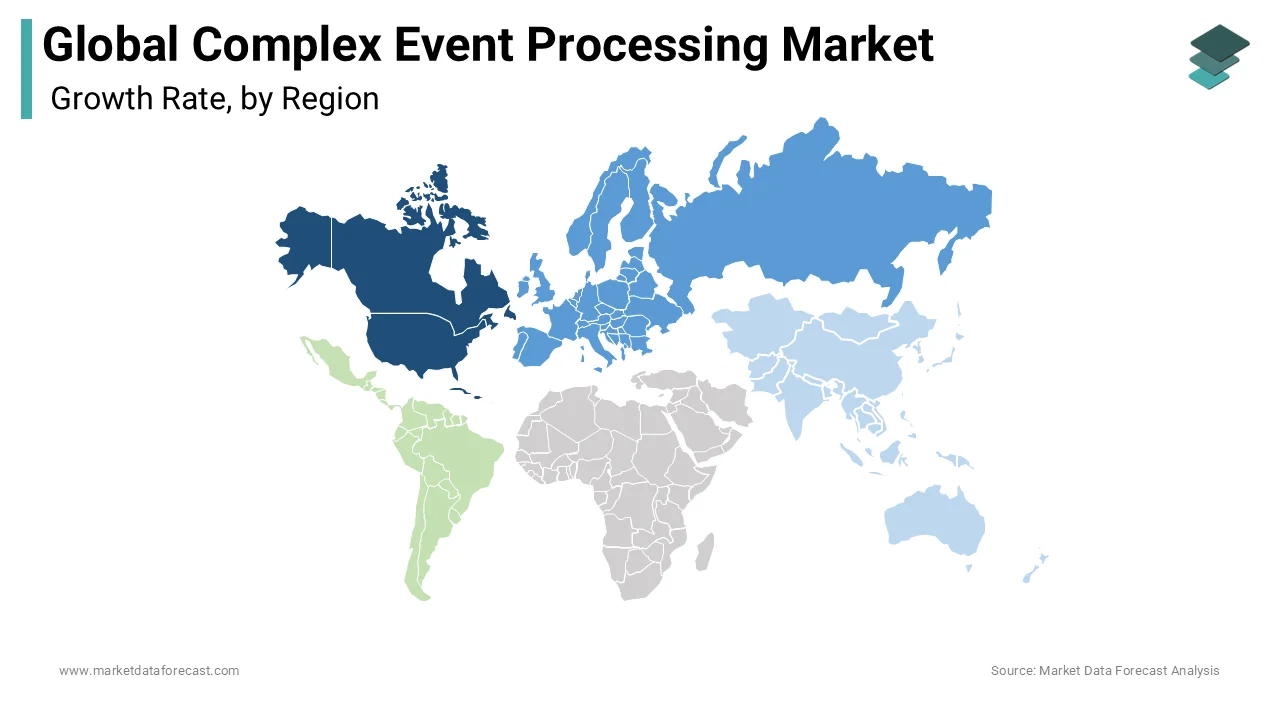
North America was the top performer in the complex data processing market in 2025 and accounted for 38.5% of the global market share in 2025. The domination of North America is primarily driven by its advanced digital infrastructure and early adoption of real-time analytics in important sectors. The United States, in particular, serves as a technological epicentre by hosting major CEP vendors such as IBM, TIBCO, and Software AG. As per the study, federal investments in AI and edge computing exceeded a notable amount, supporting CEP integration in defense and financial systems. Apart from these, healthcare institutions utilize CEP for predictive diagnostics, reducing patient response times. The region’s robust cloud ecosystem and high concentration of data-intensive industries sustain its market position.
Europe Complex Event Processing Market Insights
Europe is the second-largest in the complex event processing market and accounted for 27.8% of the global market share in 2025. The growth of Europe in the global market is attributed to strong regulatory frameworks and strategic investments in smart infrastructure. The European Union’s Digital Decade policy aims for a portion of important public services to be digitally automated by 2030, accelerating CEP deployment in transportation and energy. According to a study, some EU member states have implemented real-time traffic management systems using CEP, reducing urban congestion in cities. Stringent GDPR compliance also drives demand for auditable and transparent event processing, which strengthens Europe’s steady market position.
Asia Pacific Complex Event Processing Market Insights
Asia Pacific is expected to be the most lucrative region in the complex event processing market during the forecast period, owing to rapid digital transformation and government-led smart city initiatives. China and India are at the forefront, with China investing a substantial amount in 5G and IoT infrastructure, enabling large-scale CEP deployment. As per the research, smart city projects are underway across the region, which use CEP to simulate urban emergencies. In India, the Unified Payments Interface (UPI) processes a number of monthly transactions. Japanese manufacturers employ CEP in predictive maintenance, reducing equipment downtime, as per a study. The region’s expanding digital economy and industrial automation drive sustained CEP growth.
Latin America Complex Event Processing Market Insights
Latin America grew steadily in the complex event processing market, with Brazil and Mexico emerging as key adopters amid rising investments in financial technology and public safety. The region’s banking sector is increasingly deploying CEP to combat fraud. According to the study, digital payment volumes in Latin America surged, necessitating scalable fraud detection systems. The adoption remains uneven due to infrastructure disparities. Apart from these, the expansion of 4G/5G networks and fintech penetration is laying the groundwork for accelerated CEP uptake.
Middle East & Africa Complex Event Processing Market Insights
The Middle East and Africa are likely to grow in the global CEP marke,t with growth concentrated in Gulf Cooperation Council (GCC) nations leveraging CEP for economic diversification and national security. The UAE’s Smart Dubai initiative aims for government service digitization, integrating CEP into traffic, utilities, and emergency response systems. As per the study, real-time event processing has reduced average traffic violation response time. The South African financial sector monitors cross-border transactions for anti-money laundering (AML) and counter-terrorist financing (CFT) purposes. Strategic national projects are driving focused CEP expansion despite broader regional adoption being constrained by connectivity gaps.
KEY MARKET PLAYERS
A few of the notable players in the global complex event processing market profiled in the report are Zoetisis, Merck & Co. (MSD Animal Health), Boehringer Ingelheim, Elanco Animal Health, IDEXX Laboratories, Virbac, Ceva Santé Animaland e, Bayer Animal Health
TOP LEADING PLAYERS IN THE MARKET
IBM
IBM has been a pioneering force in complex event processing through its IBM Operational Decision Manager and integration with Watson AI and cloud-native platforms. In the Asia Pacific region, IBM has strengthened its footprint by collaborating with government agencies and financial institutions to deploy real-time fraud detection and regulatory compliance systems. IBM’s investment in quantum-safe encryption for event streams and its expansion of CEP capabilities within the IBM Cloud Pak for Integration have supported its position as a technology innovator by enabling low-latency decisioning across distributed financial and telecom networks in Japan, India, and South Korea.
TIBCO Software Inc.
TIBCO has long been synonymous with high-performance event processing through its TIBCO StreamBase and TIBCO FTL platforms, widely adopted in capital markets and industrial IoT. In the Asia Pacific region, TIBCO has deepened its presence by supporting real-time analytics deployments in India’s UPI ecosystem and Japan’s manufacturing sector. TIBCO’s recent enhancement of its event processing engine with machine learning inference capabilities allows clients like Toyota and LG to predict equipment failures in real time. TIBCO continues to strengthen its relevance in extremely important and high-velocity environments across the region by expanding its partner network across ASEAN and launching industry-specific CEP accelerators.
Software AG
Software AG’s Apama platform remains a cornerstone of its complex event processing offering, renowned for ultra-low latency and scalability in capital markets and smart infrastructure. In the Asia Pacific, the company has expanded its influence through strategic engagements with the energy and transportation sectors. Software AG also launched a regional innovation lab in Bangalore to co-develop CEP solutions with local enterprises. Its integration of Apama with ARIS for process intelligence enables organizations to align real-time event insights with business process automation, which enhances operational agility across APAC’s rapidly digitizing economies.
Top Strategies Used by Key Market Participants
Key players in the complex event processing market are deploying multifaceted strategies to consolidate their positions. Strategic partnerships with cloud providers such as AWS, Microsoft Azure, and Google Cloud enable seamless deployment of CEP engines in hybrid environments. Companies are increasingly investing in AI and machine learning integration to transition from reactive to predictive event processing. Product innovation remains central, with vendors enhancing low-code interfaces and pre-built industry templates to accelerate implementation. Geographic expansion, particularly inthe Asia Pacific, is being pursued through localized data centers and regional alliances with system integrators. Acquisitions of niche analytics and streaming data startups allow rapid capability augmentation. Apart from these, vendors are emphasizing managed services and subscription-based pricing models to attract SMEs. These strategies collectively enhance scalability, reduce time-to-value, and strengthen competitive differentiation in a rapidly evolving technological landscape.
COMPETITION OVERVIEW
The competitive landscape of the complex event processing market is characterized by technological differentiation, strategic agility, and vertical specialization. Established vendors like IBM, TIBCO, and Software AG compete with cloud-native players such as Amazon Web Services and Google through performance, integration depth, and domain-specific solutions. The market is witnessing intensified rivalry as AI-driven analytics become embedded within CEP frameworks, raising the bar for real-time inferencing accuracy. Smaller innovators are gaining traction by offering modular, open-source-based platforms tailored to niche applications in fintech and industrial IoT.
MARKET SEGMENTATION
This research report on the Global Complex Event Processing (CEP) Market is segmented and sub-segmented into the following categories.
By Type
- Software
- Services
By End-user Vertical
- BFSI
- Managed Mobility
- Government and Defense
- Retail
- Healthcare
- Telecom and IT Industry
- Media and Entertainment
- Manufacturing
- Others
By Region
- North America
- Europe
- Asia
- Australia and New Zealand
- Latin America