- Product Description Description
- Table of Contents TOC
- List of Table & Figure LOT
- Get Free Sample PDF Sample PDF
Market Size, 2025
$2.01 BnMarket Estimate, 2026
$2.30 BnMarket Forecast, 2034
$6.65 BnCAGR, 2026–2034
14.22%Europe 3D Scanning Market Report Summary
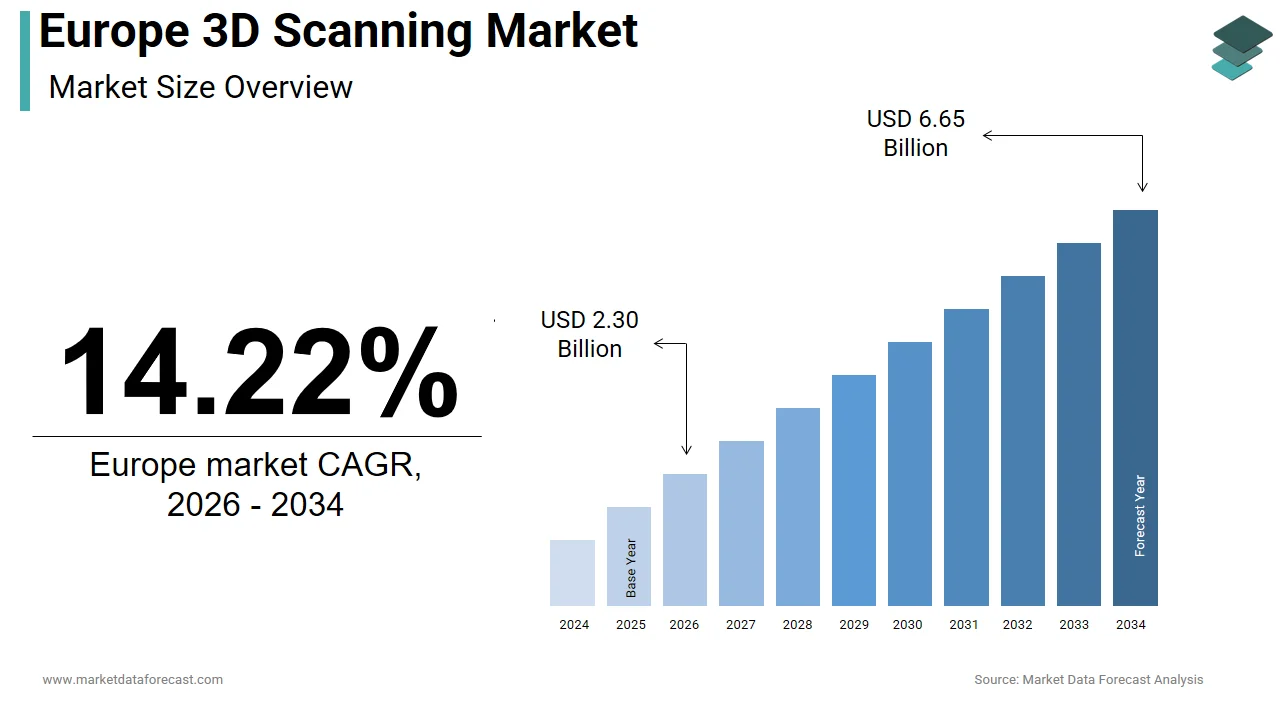
The Europe 3D scanning market was valued at USD 2.01 billion in 2025, is estimated to reach USD 2.30 billion in 2026, and is projected to reach USD 6.65 billion by 2034, growing at a CAGR of 14.22% during the forecast period from 2026 to 2034.
The growth of the European 3D scanning market is driven by increasing adoption of digital manufacturing technologies, growing demand for precision measurement and quality control, and expansion of 3D scanning applications in industrial design, healthcare, and construction. The integration of AI, automation, and metrology-based solutions in industrial workflows is further fueling market expansion across the region.
Key Market Trends
- Rising adoption of laser-based scanning systems for high-precision measurement and inspection.
- Growing use of 3D scanning in reverse engineering and product prototyping across manufacturing industries.
- Increasing integration of AI, machine vision, and automation in scanning and inspection processes.
- Expanding application of 3D scanning in cultural heritage preservation and architecture.
- Rising demand for portable and handheld 3D scanners for on-site industrial and field applications.
Segmental Insights
- Based on type, the laser scanners segment accounted for the largest share of 41.9% of the Europe 3D scanning market in 2024, driven by their high accuracy, rapid data capture, and widespread adoption in automotive, aerospace, and manufacturing applications.
- Based on service, the quality inspection segment occupied the major share of the European 3D scanning market in 2024, owing to the growing need for non-contact measurement and quality validation in advanced manufacturing environments.
- Based on range, the medium-range scanners segment held 41.4% of the Europe 3D scanning market share in 2024, supported by their flexibility, cost-effectiveness, and suitability for industrial and construction applications.
- Based on application, the industrial manufacturing segment captured the leading share of the European 3D scanning market in 2024, driven by automation initiatives, Industry 4.0 adoption, and rising demand for precision inspection and digital twin development.
Regional Insights
The European 3D scanning market is witnessing steady growth across major economies, supported by strong industrial digitization efforts, government-led innovation programs, and advanced R&D infrastructure.
- Germany dominated the regional market, commanding a 24.7% share in 2024, driven by its world-leading industrial base, extensive use of 3D metrology, and public investment in digital manufacturing.
- France accounted for the second-largest share of the European 3D scanning market in 2024, supported by advancements in aerospace, automotive design, and architectural modeling.
- The United Kingdom is projected to grow at a promising CAGR during the forecast period, supported by its excellence in aerospace and defense, digital health innovation, and adoption of 3D scanning in advanced R&D environments.
Competitive Landscape
The European 3D scanning market is moderately consolidated, with leading players focusing on innovation in laser scanning, structured light, and photogrammetry technologies. Companies are emphasizing portable and automated scanning solutions, data integration software, and partnerships with industrial manufacturers to expand their market presence. Prominent players in the market include Faro Technologies Inc., Hexagon AB, Creaform Inc., Direct Dimensions Inc., GOM GmbH, Konica Minolta Inc., Nikon Corporation, Autodesk Inc., Metrologic Group, Jenoptik, Renishaw, ShapeGrabber, and Maptek Pty Ltd.
Europe 3D Scanning Market Size
The Europe 3D scanning market was valued at USD 2.01 billion in 2025, is estimated to reach USD 2.30 billion in 2026, and is projected to reach USD 6.65 billion by 2034, growing at a CAGR of 14.22% from 2026 to 2034.
3D scanning is a non-contact digital capture of physical object geometry using laser structured light or photogrammetric technologies to generate precise point clouds or mesh models for industrial design, heritage preservation, healthcare, and manufacturing applications. Unlike generic digitization, 3D scanning delivers metrology-grade accuracy, often within microns, enabling reverse engineering, quality control, and digital twin creation. The demand for 3D scanning is growing significantly. The European Cultural Heritage Digitization Initiative has funded the 3D documentation of a large number of historical monuments, including the Colosseum and Notre Dame Cathedral, by using terrestrial and drone-based scanners. Furthermore, the European Medicines Agency now accepts 3D-scanned anatomical models for regulatory submissions in orthopedic and dental-implant trials. 3D scanning has evolved from a niche metrology tool to a foundational component of Europe’s digital-transformation strategy due to the regulatory alignment, industrial modernisation, and cultural-preservation mandates.
MARKET DRIVERS
Adoption of Industry 4.0 and Smart Manufacturing Frameworks
The integration of 3D scanning into Europe’s Industry 4.0 ecosystem is a primary driver of the European 3D scanning market growth as manufacturers seek real-time quality assurance and digital continuity across production lifecycles. According to the European Commission’s 2023 Industrial Strategy Progress Report, the EU manufacturing sector has significantly increased the adoption of advanced digital technologies, including 3D scanning to enhance quality control and precision in production processes. As per the European Automobile Manufacturers’ Association (ACEA), European automotive manufacturers are increasingly integrating 3D scanning and metrology systems to accelerate prototyping and reduce design validation costs across new vehicle platforms. In aerospace, Airbus employs automated 3D scanning systems at its Hamburg facility to inspect wing assemblies with high precision to ensure compliance with European Union Aviation Safety Agency (EASA) airworthiness directives. Similarly, as per the German Federal Ministry for Economic Affairs and Climate Action, many small and medium enterprises adopted 3D scanning technologies under the “Digital Now” subsidy scheme to support quality certification and digital transformation. This regulatory and efficiency-driven embedding of 3D scanning into smart factory architectures ensures sustained industrial demand.
Mandates for Cultural Heritage Digitization and Urban Planning
European Union and national policies mandating the 3D documentation of cultural assets and urban infrastructure are significantly accelerating scanner deployment across public and academic sectors, which is further boosting the expansion of the 3D scanning market in Europe. According to the European Commission’s Cultural Heritage in Action program, several EU initiatives have been launched since 2021 to support the digital preservation of at-risk monuments through 3D scanning and LiDAR documentation under the Horizon Europe framework. As per the European Environment Agency, a growing number of European cities, including Paris, Barcelona, and Warsaw, now require 3D-scanned “as-built” models for large buildings as part of their Urban Digital Twin programs aimed at improving urban sustainability and infrastructure management. In 2023, the Italian Ministry of Culture commissioned a comprehensive 3D survey of Pompeii using laser scanning technology to monitor structural stability and subsidence risks. Additionally, the Nordic Built Cities Challenge funded multiple municipal projects that utilized mobile mapping systems to generate city-scale point clouds for flood modeling and accessibility planning. This confluence of preservation, regulation, and smart city mandates creates a stable non-industrial demand stream for high-accuracy 3D scanning.
MARKET RESTRAINTS
High Equipment Cost and Limited Skilled Workforce
The high capital expenditure required for metrology-grade systems and a shortage of trained personnel to operate and interpret data are primarily impeding the growth of the European 3D scanning market. According to the European Association of Engineering Geologists, the average cost of an industrial-grade laser scanner with calibration certification exceeds 85000 euros, which is prohibitive for small workshops and conservation studios. As per the European Centre for the Development of Vocational Training, less than 9% of technical education institutions in the EU offer dedicated courses in 3D scanning or point cloud processing as of 2023. According to the German Engineering Federation, 61 % of manufacturing SMEs cite lack of in-house expertise as the main reason for outsourcing scanning tasks, which increases lead times and reduces integration with internal CAD systems. Furthermore, the European Commission’s Skills Panorama identifies 3D metrology as a critical emerging skill gap with fewer than 4500 certified professionals across the entire EU. Until costs decrease and curricula adapt, widespread adoption beyond large enterprises will remain constrained.
Data Interoperability and Standardization Gaps
The absence of universal data formats and workflow standards impedes seamless integration of 3D scanning outputs into downstream engineering and simulation environments across Europe, which is hampering the European 3D scanning market growth. According to the European Committee for Standardization, no EU-wide standard exists for point cloud accuracy classification or metadata tagging, which is leading to inconsistencies in multi-vendor projects. According to the European Space Agency’s Digital Twin Earth initiative, interoperability failures between scanned terrain models and simulation software often result in cost overruns for urban climate projects. According to the European Association of Automotive Suppliers, nearly 45% of OEMs require suppliers to deliver scans in proprietary formats such as GOM or PolyWorks, which increases conversion errors and validation time. Furthermore, according to the European Medicines Agency, lack of standardized DICOM extensions for 3D anatomical scans delays regulatory review of medical devices. This fragmentation forces users to invest in middleware and manual cleanup, which is reducing the efficiency gains promised by digital workflows and slowing cross-sectoral adoption.
MARKET OPPORTUNITIES
Integration with Augmented Reality for Remote Collaboration
The high-fidelity scans with augmented reality to enable remote expert collaboration in field service and maintenance are one of the potential opportunities in the European 3D scanning market. According to the European Telecommunications Standards Institute (ETSI), 5G private networks are being rapidly deployed across major industrial zones in the EU, which is enabling real-time streaming of 3D models to AR headsets with sub-20 millisecond latency. In 2023, Siemens Energy deployed this integrated solution at its gas turbine facility in Berlin, which is allowing field technicians in Romania to overlay scanned engine geometries onto physical units via Microsoft HoloLens and receive live guidance from Berlin engineers. Similarly, the European Maritime Safety Agency piloted AR-assisted hull inspections on tankers in Rotterdam, where scanned corrosion maps were visualized on-site to prioritize repairs. According to the European Defence Agency, such systems significantly reduced equipment downtime in military vehicle maintenance trials conducted in Sweden. With the EU’s Digital Europe Programme allocating €120 million in 2023 for industrial AR pilots, this convergence of scanning and immersive visualization is unlocking new service-based revenue models.
Expansion into Orthopedic and Prosthetic Personalization
The healthcare sector presents a high growth opportunity for 3D scanning through the customization of orthotics, prosthetics, and surgical guides driven by aging demographics and digital health policies. According to the European Federation of Orthopaedic and Trauma Associations, more than 400,000 custom prosthetic limbs are fitted annually across the EU, with a growing share using 3D body scanning instead of traditional plaster casting to improve fit and comfort. According to the French National Health Insurance Fund (Assurance Maladie), reimbursement codes for digital orthotic workflows were expanded in 2023, and this covers up to 90% of costs for diabetic foot insoles created from foot scans. In Germany, Ottobock’s clinics use handheld scanners to capture residual limb geometry in under 90 seconds, enabling same-day socket design. Furthermore, according to the European Commission’s Horizon Europe program, 14 projects were funded in 2023 that combine 3D scanning with AI to predict tissue deformation for craniofacial reconstruction. This shift from analog to patient-centric digital workflows enhances clinical outcomes and aligns with Europe’s value-based healthcare transformation.
MARKET CHALLENGES
Cybersecurity and Data Privacy Risks in Sensitive Applications
The increasing use of 3D scanning in defense, healthcare, and critical infrastructure raises significant concerns over the security and privacy of high-resolution spatial data, which is one of the significant challenges to the regional market expansion. According to the European Union Agency for Cybersecurity (ENISA), 3D scan files of military vehicles, energy plants, and human anatomy are now increasingly regarded as sensitive non-personal data under the EU’s Data Governance Act, but currently lack specific encryption or access protocols. According to the European Data Protection Supervisor, 3D facial and body scans can be reverse-engineered to identify individuals even when anonymized, violating GDPR principles. Furthermore, as per the European Defence Agency, no EU-wide standard exists for securing scan data in transit between NATO contractors, which is creating vulnerabilities in multinational programs. According to the European Commission’s Joint Research Centre, cyberattacks targeting industrial design and manufacturing data increased by over 20% in 2023 across the EU, underscoring the urgent need for harmonized protection standards. Until binding cybersecurity frameworks are established for 3D datasets, trust and adoption in high-value sectors will remain limited.
Fragmented Regulatory Landscape for Metrology Validation
The inconsistent requirements for metrological validation across member states that complicate cross-border deployment and compliance are further challenging the expansion of the 3D scanning market in Europe. According to the European Coordinating Committee of the Metrology Sector, only 14 EU countries recognize mutual accreditation for 3D scanner calibration under the EA MLA agreement as of 2023. As per the French National Metrology Laboratory, manufacturers exporting scanned parts to France must undergo redundant verification even if certified in Germany or Italy, increasing costs by up to 18 percent. In aerospace, the European Union Aviation Safety Agency requires all dimensional inspection data to be traceable to national metrology institutes, yet lacks harmonized uncertainty reporting formats. Similarly, the European Medicines Agency accepts 3D scan data for implant trials but defers to national bodies for scanner validation protocols, creating delays. This regulatory asymmetry undermines the single market principle and forces vendors to maintain multiple compliance pathways, which stifles innovation and scalability for European 3D scanning providers.
REPORT COVERAGE
| REPORT METRIC | DETAILS |
| Market Size Available | 2025 to 2034 |
| Base Year | 2025 |
| Forecast Period | 2026 to 2034 |
| Segments Covered | By Type, Services, Range, Application, and Country. |
| Various Analyses Covered | Global, Regional, and Country-Level Analysis, Segment-Level Analysis, Drivers, Restraints, Opportunities, Challenges; PESTLE Analysis; Porter’s Five Forces Analysis, Competitive Landscape, Analyst Overview of Investment Opportunities |
| Countries Covered | UK, France, Spain, Germany, Italy, Russia, Sweden, Denmark, Switzerland, Netherlands, Turkey, Czech Republic, and the Rest of Europe. |
| Market Leaders Profiled | Faro Technologies Inc., Hexagon AB, Creaform Inc., Direct Dimensions Inc., GOM GmbH, Konica Minolta Inc., Nikon Corporation, Autodesk Inc., Metrologic Group, Jenoptik, Renishaw, ShapeGrabber and Maptek Pty Ltd. |
SEGMENTAL ANALYSIS
By Type Insights
The laser scanners segment accounted for the largest share of 41.9% of the Europe 3D scanning market in 2024 due to their superior accuracy, long-range capability, and reliability in industrial and outdoor environments. According to the European Committee for Standardization (CEN), laser scanners are currently the only technology certified under DIN EN ISO 17123-8 for geodetic and large-scale metrology applications, which makes them the preferred standard for infrastructure and aerospace inspection. According to the European Space Agency, terrestrial laser scanning has been widely adopted in EU-funded urban digital twin projects, including city-scale flood modeling in Rotterdam and heritage documentation in Athens. In manufacturing, Airbus employs phase-based laser scanners at its Broughton and Hamburg facilities to inspect wing spar alignments within microns of tolerance as required by EASA regulations. According to the German Federal Agency for Cartography and Geodesy, national topographic surveys now predominantly use airborne LiDAR systems with point densities exceeding 16 points per square meter. This regulatory endorsement and performance consistency across sectors are contributing to the domination of the laser scanners segment in the European 3D scanning market.
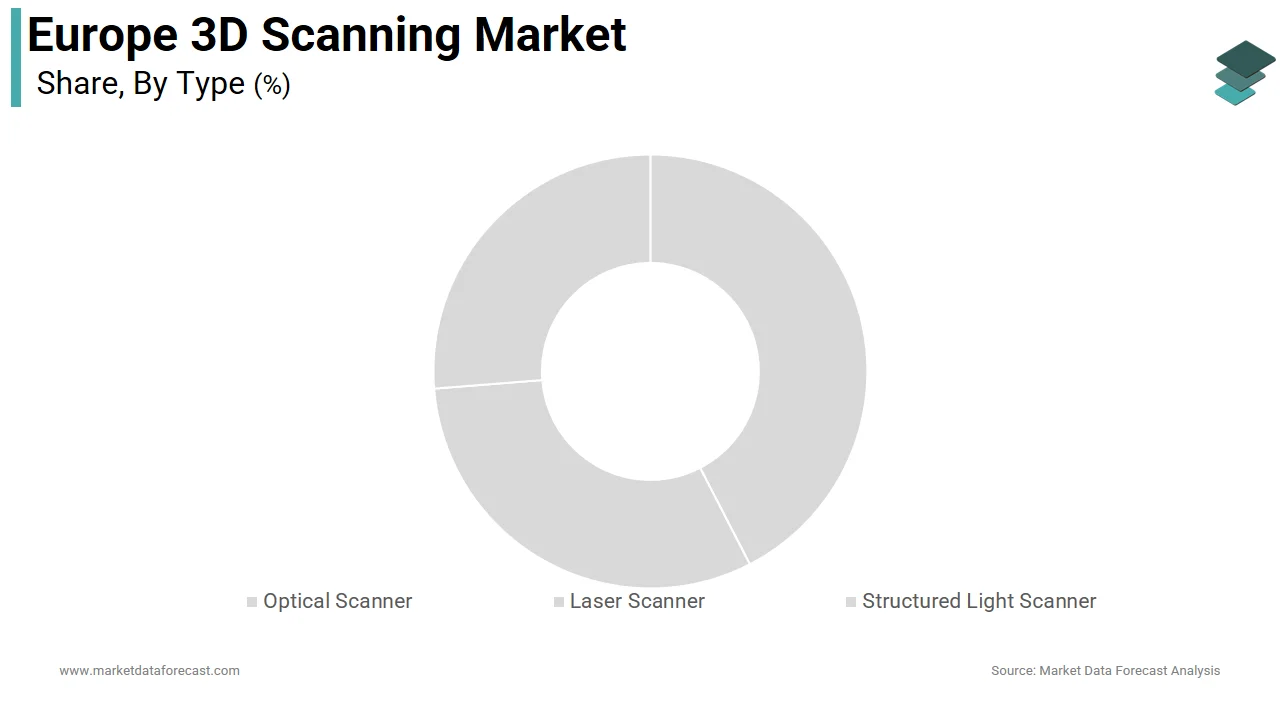
The structured light scanning segment is predicted to witness the fastest CAGR of 16.4% over the forecast period in the European market, owing to the unmatched speed and sub-10 micron accuracy for small to medium objects, making it ideal for healthcare orthotics and precision engineering. According to the European Federation of Orthopaedics and Traumatology (EFORT), a growing share of custom prosthetic sockets fitted in the EU are now created using handheld structured light scanners that capture limb geometry within seconds to improve comfort and precision. According to the European Association of Automotive Suppliers (CLEPA), tier-one suppliers such as Bosch and ZF employ blue light scanners for first article inspection of injection-molded components, which enables full surface comparison in a matter of minutes. Furthermore, the European Medicines Agency now accepts structured light scan data for dental implant submissions due to its ISO 12836 compliance. With costs declining and resolution improving, this technology is rapidly displacing tactile probing in high-precision applications.
By Service Insights
The quality inspection segment occupied the major share of the European 3D scanning market in 2024. The growth of the quality inspection segment is attributed to the growing preference of 3D scanning by manufacturers to replace manual gauging with full field digital metrology to meet zero defect mandates. According to the European Commission’s Industrial Strategy Dashboard, the adoption of 3D scanning technologies among large EU manufacturers has significantly increased across aerospace, automotive, and medical device sectors. According to the German Engineering Federation (VDMA), thousands of industrial quality labs adopted 3D scanning technologies in 2023 under the “Digital Quality Assurance” initiative funded by the Federal Ministry for Economic Affairs. Airbus uses automated scanning cells to compare every A320 door frame against CAD, with color-coded deviation maps accepted by EASA as proof of compliance. Similarly, Siemens Healthineers validates MRI housing dimensions using laser scanners to ensure electromagnetic shielding integrity. According to the European Association for Quality, digital inspection processes have helped reduce scrap rates across EU supply chains, which is reinforcing the shift from sampling to 100% inspection and ensuring quality inspection remains a core service driver.
The face body scanning segment is predicted to grow at a CAGR of 19.5% over the forecast period in the European market, owing to the digital health personalization and virtual fitting applications. According to the European Federation of Orthopaedics and Traumatology (EFORT), 3D foot scanning is increasingly being adopted across the EU for the production of custom orthotic insoles, many of which are covered under national health reimbursement schemes in France, Germany, and Italy. According to the French National Health Insurance Fund (Assurance Maladie), digital scanning has been shown to significantly reduce orthotic fitting errors compared to traditional plaster casting. In retail, Zalando and H&M have piloted virtual try-on kiosks in Berlin and Paris using full-body scanners that generate precise avatars to improve size prediction accuracy. Additionally, according to the European Commission’s Horizon Europe program, nine projects were funded in 2023 using facial scanning for early diagnosis of rare genetic disorders. This convergence of clinical care, consumer technology, and public health policy is propelling rapid adoption of face body scanning segment across sectors.
By Range Insights
The medium-range scanners segment held 41.4% of the European 3D scanning market share in 2024 as they optimally balance precision and coverage for factory floor inspection, heritage documentation, and urban mapping. According to the European Commission’s Cultural Heritage in Cloud initiative, the majority of monument digitization projects in 2023 used medium-range 3D scanning systems with effective ranges between 2 and 10 meters to capture architectural details at high resolution. According to the European Association of Automotive Suppliers (CLEPA), each new vehicle platform typically requires hundreds of medium-range scans for gap and flush analysis as well as assembly validation. In civil engineering, the Norwegian Public Roads Administration employs medium-range scanners to monitor tunnel deformation through regular scanning, achieving sub-millimeter precision. According to the European Space Agency, medium-range LiDAR is now standard for creating indoor digital twins of hospitals and airports under the Urban Innovative Actions program. This versatility across indoor and semi-outdoor applications ensures medium-range systems remain the workhorse segment in the 3D scanning industry.
The short-range scanners segment is estimated to register a CAGR of 17.7% over the forecast period in the European market, owing to the micro-manufacturing, healthcare, and electronics inspection. According to the European Medical Devices Coordination Group (MDCG), dental clinics across the EU are increasingly adopting intraoral short-range scanners for crowns and aligners, which is significantly reducing laboratory turnaround times from days to hours. According to Infineon Technologies, short-range blue light systems are now widely used for semiconductor package inspection to achieve micron-level precision in compliance with IEC 62396 standards. According to the German Engineering Federation (VDMA), micro injection molding companies report near-perfect quality yields when using short-range scanning for medical catheter validation. Furthermore, according to the European Commission’s Key Digital Technologies program, €45 million was allocated in 2023 to support innovation in micro metrology. This shift toward miniaturization and precision medicine is accelerating the adoption of short-range scanning technologies across industries and propelling the expansion of the short-range scanners segment in the European market.
By Application Insights
The industrial manufacturing segment captured the leading share of the European 3D scanning market in 2024. The dominance of the industrial manufacturing segment in the regional market is driven by Industry 4.0 mandates for digital thread integration and zero defect production. According to the European Commission’s Digital Europe Programme, thousands of factories across the EU have implemented 3D scanning technologies for in-line quality control, with the automotive and machinery sectors leading adoption. According to the German Federal Ministry for Economic Affairs and Climate Action (BMWK), the “Factory of the Future” initiative has supported extensive scanning deployments among SMEs to help them achieve DIN EN ISO 9001 certification. Airbus uses automated scanning cells for every A350 wing rib to ensure ±25-micron tolerance compliance with EASA Part 21G. Similarly, Bosch validates fuel injector nozzles using structured light scanners with full-surface deviation mapping, replacing manual coordinate measuring machines. According to the European Association of Automotive Suppliers (CLEPA), all new OEM platforms launched in 2023 now require digital first article inspection. This regulatory and efficiency-driven integration ensures the continued dominance of 3D scanning in European manufacturing and drives the domination of the industrial manufacturing segment by application in the European market.
The healthcare segment is estimated to witness a CAGR of 21.8% over the forecast period in the European 3D scanning market due to the personalized medicine regulatory acceptance and aging demographics. According to the European Federation of Orthopaedics and Traumatology (EFORT), 3D body scanning is increasingly used across the EU for the production of custom prosthetic and orthotic devices, many of which are now eligible for reimbursement in multiple member states. According to the European Medicines Agency, an expanding share of Class III implant submissions now include 3D scan-based anatomical models to support surgical planning. In dentistry, the European Dental Association reports that most prosthetic laboratories have adopted intraoral scanners, which is eliminating the need for physical impressions. Furthermore, according to the European Commission’s Horizon Europe program, 12 projects were funded in 2023 that apply facial scanning for craniofacial reconstruction using AI-driven tissue prediction. With digital workflows improving outcomes and reducing costs, healthcare is poised for exponential growth.
COUNTRY LEVEL ANALYSIS
Germany 3D Scanning Market Analysis
Germany dominated the European 3D scanning market in 2024 by commanding 24.7% of the regional market share due to its world-leading industrial base and strong public investment in digital manufacturing. According to the German Engineering Federation (VDMA), a growing number of quality control laboratories across Germany have adopted 3D scanning technologies under federal subsidy schemes aimed at supporting SMEs. Companies such as Siemens, Bosch, and Volkswagen use automated scanning cells for 100% inspection of engine blocks and body panels to maintain compliance with DIN EN ISO 9001 standards. According to the Federal Ministry for Economic Affairs and Climate Action (BMWK), €180 million was allocated in 2023 for metrology digitization under the “Digital Now” program. Additionally, the Fraunhofer Institute for Manufacturing Engineering and Automation operates one of Europe’s largest 3D scanning testbeds in Stuttgart, offering open access to startups. Germany’s combination of industrial rigor, public funding, and advanced research infrastructure solidifies its leadership in metrology innovation.
France 3D Scanning Market Analysis
France accounted for the second-largest share of the European 3D scanning market in 2024, owing to its aerospace, healthcare, and cultural heritage sectors. According to the French National Agency for Medicines and Health Products Safety (ANSM), 3D scanning has become a key requirement in regulatory submissions for Class III medical implants to ensure precision and traceability. Airbus uses laser scanners at its Toulouse facility to inspect A350 fuselage sections with sub-50-micron accuracy. According to the French Ministry of Culture, over 1,200 heritage sites, including Notre-Dame Cathedral, were digitally documented in 2023 using phase-shift LiDAR technology. Additionally, the French National Health Insurance Fund (Assurance Maladie) reimburses up to 90% of costs for digital orthotics created from foot scans. With strong state backing in both high technology and cultural preservation, France maintains a diversified and resilient 3D scanning ecosystem.
United Kingdom 3D Scanning Market Analysis
The United Kingdom is expected to grow at a promising CAGR in the European 3D scanning market during the forecast period, owing to the excellence in aerospace defense and digital health innovation. According to the UK Medicines and Healthcare products Regulatory Agency (MHRA), 3D scanning is increasingly used in custom prosthetic fittings across the country, many of which are fully reimbursed under the NHS. Rolls-Royce employs structured light scanners at its Derby facility to inspect turbine blades for microcracks with high precision. According to Historic England, 3D surveys of more than 300 heritage sites, including those captured using drone-mounted LiDAR, were completed in 2023. Furthermore, the UK’s Digital Manufacturing Centre in Coventry provides subsidized 3D scanning access to hundreds of SMEs. Despite Brexit, UK standards remain closely aligned with EU metrology frameworks, ensuring continued market integration and interoperability.
Italy 3D Scanning Market Analysis
Italy is expected to exhibit a prominent CAGR in the European 3D scanning market over the forecast period due to the luxury automotive, fashion, and cultural heritage digitization. According to the Italian Ministry of Culture, more than 900 historical sites, including the Colosseum and Pompeii, were digitally documented in 2023 using terrestrial and UAV-based LiDAR technologies. Ferrari and Lamborghini use structured light scanners for body panel validation, achieving micrometer-level tolerance for carbon fiber components. According to the Italian Ministry of Health, the National Health Service reimburses digital orthotics for diabetic patients as part of initiatives aimed at reducing ulcer incidence. Additionally, the Politecnico di Milano operates a national 3D scanning certification center for medical devices. Italy’s fusion of artisanal precision and digital preservation defines its distinctive market trajectory.
Sweden 3D Scanning Market Analysis
Sweden is projected to grow at a healthy CAGR in the Europe 3D scanning market in 2024 during the forecast period due to its advanced healthcare system and sustainable manufacturing ethos. According to the Swedish Agency for Health Technology Assessment and Assessment of Social Services (SBU), 3D scanning is increasingly being used for the production of orthotic devices across Sweden, many of which are fully covered under the public healthcare system. Volvo Cars uses automated scanning cells at its Gothenburg facility to inspect battery enclosures for electric vehicles, ensuring compliance with crash safety standards. According to the Swedish National Heritage Board, 3D documentation of more than 200 Viking sites was completed in 2024 using ground-based LiDAR technology. Furthermore, according to the Vinnova Innovation Agency, 14 scanning projects were funded in 2023, focused on circular economy applications such as reverse engineering for remanufacturing. Sweden’s human-centered approach to technology ensures ethical and inclusive adoption.
COMPETITIVE LANDSCAPE
Competition in the Europe 3D scanning market is defined by a triad of global metrology leaders, European industrial champions, and agile niche innovators competing on precision, interoperability, and regulatory compliance rather than price. Hexagon FARO and Zeiss dominate through end-to-end ecosystems that span hardware, software, and cloud analytics, while smaller players like Kreon and Shining 3D gain ground with cost-effective solutions for SMEs. The absence of unified data standards creates fragmentation, yet also an opportunity for middleware developers. Regulatory alignment with EASA, DIN EN ISO, and GDPR is a key differentiator as public and industrial buyers prioritize auditability and data sovereignty. Defense and healthcare applications impose additional security and validation hurdles, favoring established vendors. Unlike commoditized markets, innovation here is driven by domain-specific workflows such as turbine blade inspection or orthotic fitting. Geographic proximity matters as on-site calibration and training remain essential. Ultimately, success hinges on embedding scanning into validated digital threads that meet Europe’s exacting standards for quality, sustainability, and privacy.
KEY MARKET PLAYERS
Some of the companies that are playing a dominating role in the Europe 3d scanning market include
- Faro Technologies Inc.
- Hexagon AB
- Creaform Inc.
- Direct Dimensions Inc.
- GOM GmbH
- Konica Minolta Inc.
- Nikon Corporation
- Autodesk Inc.
- Metrologic Group
- Jenoptik
- Renishaw
- ShapeGrabber
- Maptek Pty Ltd.
TOP PLAYERS IN THE MARKET
- Hexagon AB is a Swedish multinational and a global leader in digital reality solutions with a commanding presence in the Europe 3D scanning market through its Leica Geosystems and Manufacturing Intelligence divisions. The company supplies high-precision laser and structured light scanners to aerospace, automotive, and heritage sectors across the continent. In 2023, Hexagon launched its Absolute Tracker AT401 with integrated photogrammetry for large volume metrology compliant with EASA inspection standards. It also partnered with Airbus to deploy automated scanning cells at its Hamburg facility for A320 wing validation. Through its open ecosystem approach, Hexagon integrates scanning data into its Nexus cloud platform, enabling real-time quality analytics. These innovations reinforce its role as a foundational enabler of Europe’s digital twin and smart manufacturing ambitions.
- FARO Technologies is a prominent provider of 3D measurement and imaging solutions with deep penetration in European industrial and public safety markets. Headquartered in the United States, the company maintains major European operations in Germany and the UK, serving automotive, aerospace, and forensic sectors. In early 2024, FARO introduced the Focus Core S terrestrial laser scanner with enhanced HDR imaging and 2 million points per second acquisition speed tailored for EU urban digital twin initiatives. It also expanded its Sphere cloud platform to support GDPR compliant data handling for public sector clients. FARO’s focus on rugged portable systems and regulatory alignment makes it a preferred partner for field-based scanning in complex European environments.
- GOM GmbH, a German metrology specialist and part of the Zeiss Group, is a key contributor to high-accuracy 3D scanning in Europe, particularly in automotive and medical device manufacturing. The company’s structured light scanners are widely used for first article inspection and reverse engineering in Germany, France, and Italy. In 2023, GOM launched the ATOS Q with blue light technology, achieving 5 micron resolution for micro component validation in line with IEC 62396 standards. It also integrated AI-driven defect detection into its GOM Inspect software to accelerate quality reporting for tier one suppliers. Through close collaboration with Fraunhofer institutes and vocational academies, GOM strengthens the metrology skills pipeline while advancing precision digitization across European industry.
TOP STRATEGIES USED BY THE KEY MARKET PARTICIPANTS
Key players in the Europe 3D scanning market are investing heavily in cloud-based data platforms that enable secure, real-time collaboration and AI-powered analytics while ensuring GDPR and NIS2 compliance. Companies are developing hybrid scanning systems that combine laser structured light and photogrammetry in a single device to broaden application versatility. Strategic partnerships with industrial OEMs, aerospace regulators, and public heritage agencies ensure solution validation and mandate alignment. Continuous miniaturization and automation of scanning hardware allow deployment in constrained or hazardous environments such as engine bays or historical interiors. Vendors are also embedding metrology software with machine learning to automate defect recognition and deviation reporting. Certification programs and academic collaborations are being scaled to address the critical shortage of 3D scanning professionals. These strategies collectively shift competition from hardware specs to integrated digital workflows and regulatory trust.
MARKET SEGMENTATION
This research report on the Europe 3D Scanning market has been segmented and sub-segmented into the following categories.
By Type
- Optical Scanner
- Laser Scanner
- Structured Light Scanner
By Services
- Reverse Engineering
- Quality Inspection
- Rapid Prototyping
- Face Body Scanning
By Range
- Short Range Scanner
- Medium Range Scanner
- Long Range Scanner
By Application
- Entertainment & Media
- Aerospace & Défense
- Healthcare
- Civil & Architecture
- Industrial Manufacturing
- Others
By Country
- United Kingdom
- France
- Spain
- Germany
- Italy
- Russia
- Sweden
- Denmark
- Switzerland
- Netherlands
- Rest of Europe