- Product Description Description
- Table of Contents TOC
- List of Table & Figure LOT
- Get Free Sample PDF Sample PDF
Market Size, 2025
$319.91 BnMarket Estimate, 2026
$331.01 BnMarket Forecast, 2034
$434.87 BnCAGR, 2026–2034
3.74%Europe Aerospace Parts Manufacturing Market Summary
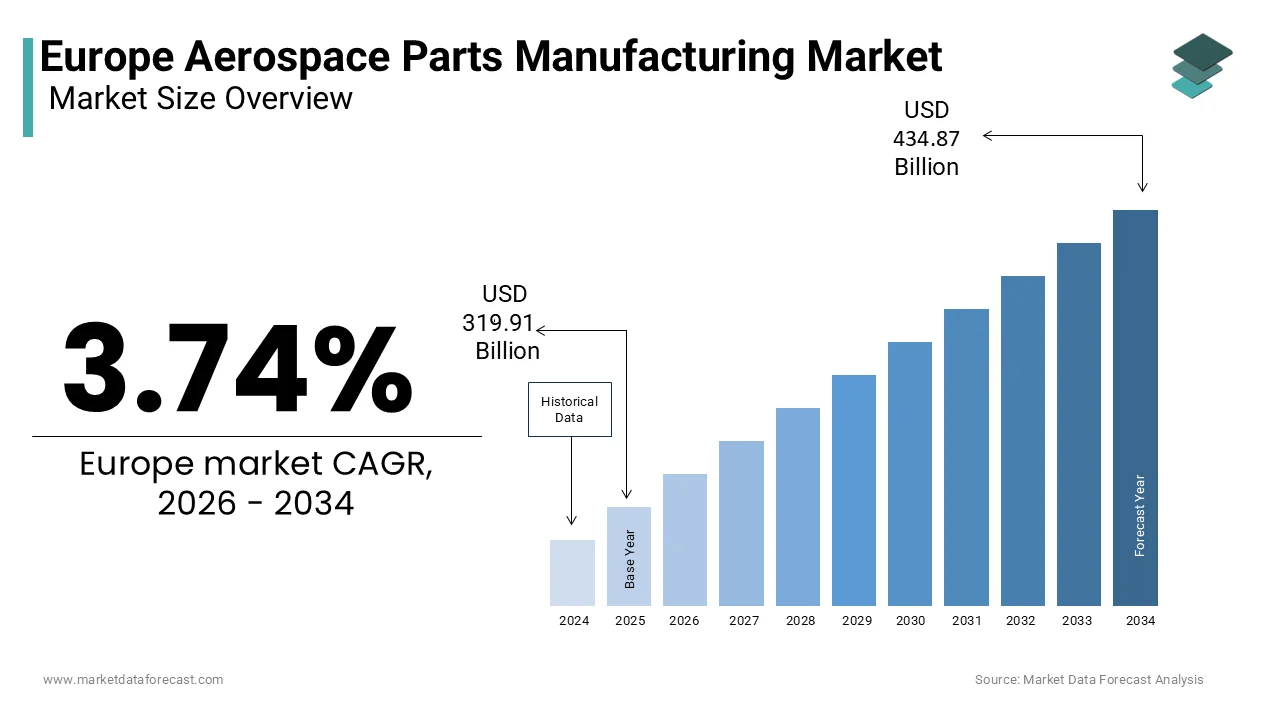
The European aerospace parts manufacturing market, valued at USD 319.91 billion in 2025, is projected to reach USD 434.87 billion by 2034, growing at a CAGR of 3.74%, driven by commercial aircraft backlogs, defense modernization, and sustainable aviation initiatives.
Key Market Insights
- 2025 Market Size: USD 319.91 billion
- 2026 Market Size: USD 331.01 billion
- 2034 Forecast: USD 434.87 billion
- CAGR (2026–2034): 3.74%
- Base Year: 2025
- Forecast Period: 2026–2034
Quick Growth Drivers
- Persistent commercial aircraft order backlogs, led by Airbus programs
- Strong recovery and long-term growth in European air passenger traffic
- Escalating defense modernization and sovereignty-driven procurement
- Increased production of fuel-efficient next-generation aircraft
- Rising demand for advanced aerostructures, avionics, and propulsion systems
- Long-term OEM–supplier risk-sharing partnerships
Principal Restraints
- Acute shortage of skilled aerospace engineers and technicians
- Aging workforce and limited pan-European certification mobility
- Lengthy and costly EASA certification and compliance timelines
- Dual certification burdens due to post-Brexit regulatory divergence
- High capital intensity is limiting SME scalability
High-Value Opportunities
- Expansion of sustainable aviation technologies (lightweight composites, hydrogen systems)
- Rising demand for hybrid-electric and low-emission aircraft components
- Growth in European space programs and launch services
- Increasing participation of SMEs in space and defense supply chains
- EU-backed funding under Clean Sky, ZEROe, and European Defence Fund
Key Market Challenges
- Fragmented cross-border supply chains and industrial policies
- Repetitive audits and certification redundancies across OEMs
- Vulnerability to geopolitical disruptions in critical raw material sourcing
- Dependence on imported high-performance alloys and composites
- Limited recycling and recovery of advanced aerospace materials
Fastest-Growing Segments
- Avionics digital cockpits, AI-enabled mission systems, secure communications
- Military Aircraft Components driven by FCAS and fleet modernization programs
- Space-grade Precision Components guidance, propulsion, thermal systems
Regional Leadership & Dynamics
- Germany's propulsion systems, engine modules, and Industry 4.0 leadership
- France aerostructures, landing gear, vertically integrated OEM ecosystem
- United Kingdom engines, composites, avionics, strong defense aerospace base
- Spain's cost-competitive aerostructures and composite subassemblies
- Italy helicopters, avionics, defense-focused SMEs
- Nordics & Netherlands niche high-precision and defense components
What Wins Commercially
- Long-term risk-sharing agreements with OEMs
- Advanced digital manufacturing and traceability systems
- Capability in composites, avionics, and propulsion technologies
- Proximity to final assembly lines and co-engineering hubs
- Strong compliance with EASA and defense-grade standards
Top Strategic Ask for Executives
Invest in workforce upskilling, digital certification readiness, and sustainable component innovation while strengthening sovereign supply chains to secure long-term positioning in Europe’s evolving aerospace ecosystem.
Leading Players
Some of the companies that are playing a dominating role in the Europe aerospace parts manufacturing market include:
Safran SA, Rolls-Royce Holdings plc, Airbus SE, Leonardo S.p.A., MTU Aero Engines AG, Thales Group, GKN Aerospace, Collins Aerospace, Diehl Stiftung & Co. KG, RUAG Aerospace, Spirit AeroSystems, Honeywell Aerospace, Parker Hannifin Corporation, and GE Aviation.
Europe Aerospace Parts Manufacturing Market Size
The Europe aerospace parts manufacturing market was valued at USD 319.91 billion in 2025, is estimated to reach USD 331.01 billion in 2026, and is projected to reach USD 434.87 billion by 2034, growing at a CAGR of 3.74% from 2026 to 2034.
Aerospace Parts Manufacturing is a highly specialized sector of the engineering industry dedicated to the design, production, and testing of precision components for aircraft, spacecraft, missiles, and satellites. This sector functions as a critical enabler of Europe’s strategic autonomy in aerospace and defense and is deeply integrated into global supply chains led by original equipment manufacturers such as Airbus and Dassault Aviation. According to research, the European Union retains a substantial share of global aerospace exports, cementing its position as a dominant force in high-value precision engineering. As per various sources, aerospace manufacturing constitutes a key industrial employer within the EU, with the majority of specialized suppliers heavily concentrated in Germany, France, and major European partner nations. The market is characterized by stringent regulatory oversight from the European Union Aviation Safety Agency, which mandates compliance with EASA Part 21 standards for all airworthy components. Unlike broader industrial sectors, this domain relies heavily on certified materials traceability and digital twin integration, reflecting its convergence with advanced manufacturing paradigms.
MARKET DRIVERS
Sustained Demand from Commercial Aircraft Backlogs
Commercial aircraft order backlogs continue to exert strong upward pressure on aerospace parts production across the region, which drives the growth of the European aerospace parts manufacturing market. Airbus concluded 2023 with a record-high, multi-year backlog of commercial aircraft, driven by strong demand for both narrowbody and widebody jets. This sustained pipeline ensures consistent demand for landing gear, turbine blades, and composite fuselage sections from tier one and tier two suppliers throughout the region. Airbus achieved high production volumes in 2023, while net orders for new aircraft significantly outpaced deliveries, reflecting substantial market confidence in their product lineup. European air traffic is projected to recover completely and exceed pre-pandemic levels by 2026, despite persistent capacity constraints, labor shortages, and geopolitical risks. The ripple effect extends to small and medium enterprises in countries like Spain and Italy, where specialized machining and surface treatment facilities have seen a significant capacity utilization since 2022. This demand inertia is not merely cyclical but structural, driven by fleet renewal mandates aimed at reducing fuel burn and meeting the European Union’s Fit for 55 emissions targets, which require airlines to phase out older, less efficient aircraft.
Strategic Emphasis on Defense Modernization and Sovereignty
The region’s accelerating defense modernization agenda has emerged as a pivotal accelerator for the European aerospace parts manufacturing market. This growth is particularly driven by the geopolitical realignments following Russia’s invasion of Ukraine. European Union member states have significantly increased their combined defense expenditures to historic levels not seen since the Cold War, driven by rising geopolitical tensions. A significant portion of this budget is allocated to next-generation air platforms, including the Future Combat Air System being jointly developed by France, Germany, and Spain, which demands advanced radar, stealth structures, and embedded sensor systems. According to research, a significant share of global arms imports is now concentrated in Europe, with European nations rapidly increasing their arms acquisitions. This shift has catalyzed investment in secure and sovereign supply chains for mission-critical components such as actuators, flight control surfaces, and encrypted communication modules. Large-scale, long-term national defense initiatives, such as special procurement funds and massive aircraft modernization programs, are fueling long-term, multi-year contracts that benefit both international suppliers and the local defense industry in Europe. These programs not only stabilize revenue streams but also incentivize co-development partnerships that embed European firms deeper into classified defense ecosystems.
MARKET RESTRAINTS
Persistent Shortages in Skilled Aerospace Labor
A shortage of qualified personnel is constraining the growth of the European aerospace parts manufacturing market. This lack of talent is limiting both its scalability and innovation capacity. According to sources, the regional industry faces a deficit of thousands of engineers and technicians by 2027 if current training pipelines remain unchanged. This gap is particularly acute in disciplines such as non-destructive testing, additive manufacturing, and avionics integration, where certification requirements limit the pool of eligible candidates. Vacancies within aerospace-related roles in Germany remain open for a considerably longer duration compared to the broader technical sector. The aerospace workforce in France is experiencing a noticeable demographic shift, with a substantial portion of employees approaching retirement age. These factors suggest a tightening talent market in the European aerospace sectors. You can read the analysis on the relevant government, industry, or news websites. The consequence is not only delayed production cycles but also heightened vulnerability to quality deviations, given the manual dexterity and procedural rigor required in tasks like composite layup or turbine balancing. Apprenticeship programs supported by companies like Safran and MTU Aero Engines have mitigated localized shortages but lack pan-European standardization, limiting workforce mobility. The failure to align vocational training and recognize credentials across borders will ensure that labor shortages continue to hinder production, despite strong order volumes.
Stringent Regulatory and Certification Timelines
The rigorous and time-intensive certification protocols imposed by the European Union Aviation Safety Agency significantly delay the introduction of new aerospace components into service, which acts as a major obstacle for the European aerospace parts manufacturing market. The regulatory framework requires that components, regardless of complexity, proceed through established certification procedures. The approval timeline for innovative designs, particularly those incorporating advanced materials or digital functionalities, can extend over a prolonged period. A high volume of design submissions is processed, reflecting a significant workload for regulatory oversight. The time required for approval has experienced an upward trend, suggesting increased scrutiny on integrated software and supply chain verification. This regulatory friction disproportionately affects small and medium enterprises that lack dedicated compliance teams and must rely on external consultants, increasing both cost and uncertainty. Moreover, post-Brexit divergence between UK CAA and EASA standards has introduced dual certification burdens for companies operating across the Channel, compounding delays. Rigorous safety standards, though crucial, inadvertently hinder the agility required for modern, sustainable aviation development.
MARKET OPPORTUNITIES
Expansion of Sustainable Aviation Initiatives
The region’s aggressive push toward sustainable aviation opens new potential for aerospace parts manufacturers specializing in lightweighting and alternative propulsion technologies, which is anticipated to boost the growth of the European aerospace parts manufacturing market. Legislative requirements for increasing the use of sustainable fuels in aviation are accelerating the demand for new fuel system components and thermal management technologies. Public-private partnerships in the region are driving a surge in the development and prototyping of new component designs centered on energy efficiency and reduced weight. Industry suppliers are actively delivering advanced, unconventional technologies, such as bleedless systems and hybrid-electric components, for new aircraft demonstration projects. Significant, ongoing research and development investments are heavily focused on accelerating innovation at the component level to support clean aviation goals. This policy-driven pivot is opening avenues for suppliers to transition from traditional metallic fabrication to advanced composites, hydrogen containment vessels, and cryogenic cooling interfaces. The resulting ecosystem not only enhances Europe’s technological leadership but also creates export potential as global regulators align with EU sustainability benchmarks.
Growth in Space Infrastructure and Launch Services
The rapid expansion of Europe’s space sector is providing new areas for precision aerospace components beyond atmospheric flight, which is likely to contribute to the expansion of the European aerospace parts manufacturing market. European space programs have secured significant financial backing, supporting major initiatives for both launch capabilities and secure communications. This influx of funding has spurred a notable rise in contracts awarded to smaller, specialized enterprises for components such as guidance sensors, thermal protection, and solar mechanisms. The rise of new private launcher firms is increasing demand for highly specialized, custom-machined components per vehicle. Revenue growth within the European space sector is being driven by the interplay between downstream applications, such as earth observation, and the demand for upstream hardware. Unlike traditional aerospace cycles, space programs often feature shorter development timelines and higher tolerance for iterative prototyping, enabling agile manufacturers to establish footholds without decades-long qualification processes. This dynamic is particularly beneficial for firms in Central and Eastern Europe, where lower overhead costs and strong technical universities are attracting venture-backed space ventures seeking reliable European supply alternatives amid global geopolitical tensions.
MARKET CHALLENGES
Supply Chain Fragmentation Across European Borders
Persistent inefficiencies stemming from fragmented national supply chains and inconsistent industrial policies constrain the growth of the EEuropeanaerospace parts manufacturing market. Despite the existence of the Single Market, cross-border logistics for aerospace components remain hampered by divergent customs interpretations, certification redundancies, and localized content rules. Inconsistent application of dual-use export controls causes delays in intra-EU shipments of regulated aerospace goods. These shipping delays often compel manufacturers to maintain buffer stocks in multiple countries to ensure production stability. Aerospace suppliers frequently undergo repeated quality audits from different original equipment manufacturers within the same operating period. This repetition results in increased administrative burdens and expenses related to inspections and documentation. The absence of a unified digital thread for part traceability across jurisdictions further complicates just-in-time delivery models essential for lean aerospace assembly. Despite initiatives like the European Defence Industrial Strategy aimed at harmonizing procurement, the reality is a patchwork of national preferences that breaks up economies of scale and discourages foreign direct investment, looking for a seamless continental market.
Vulnerability to Geopolitical Disruptions in Critical Material Sourcing
Supply chain volatility, in turn,n impedes the expansion of the European aerospace parts manufacturing market. This is due to heavy reliance on imported critical raw materials essential for high-performance alloys and composites. The aerospace industry depends on foreign supply chains for key materials, creating vulnerability to external disruptions. Significant portions of vital resources originate from regions with limited political stability or concentrated control. Geopolitical events have demonstrated that sudden restrictions on key material supplies can cause delays in manufacturing. The recovery and reuse of advanced aerospace materials are limited by technical complexities. Efforts to reduce dependence on foreign sources and improve domestic production are underway,y but require significant time to implement. Producers are facing ongoing cost volatility and supply risks that threaten price stabilization and delivery timelines, exacerbated by intense great-power competition for raw materials.
REPORT COVERAGE
| REPORT METRIC | DETAILS |
| Market Size Available | 2025 to 2034 |
| Base Year | 2025 |
| Forecast Period | 2026 to 2034 |
| Segments Covered | By Type, Aircraft Type, and Region. |
| Various Analyses Covered | Global, Regional, and Country-Level Analysis, Segment-Level Analysis, Drivers, Restraints, Opportunities, Challenges; PESTLE Analysis; Porter’s Five Forces Analysis, Competitive Landscape, Analyst Overview of Investment Opportunities |
| Countries Covered | UK, France, Spain, Germany, Italy, Russia, Sweden, Denmark, Switzerland, Netherlands, Turkey, Czech Republic, Rest of Europe |
| Market Leaders Profiled | Safran SA, Rolls-Royce Holdings plc, Airbus SE, Leonardo S.p.A., MTU Aero Engines AG, Thales Group, Boeing (European operations & suppliers), UTC Aerospace Systems (Collins Aerospace), Diehl Stiftung & Co. KG, GKN Aerospace (Melrose Industries), STELIA Aerospace, RUAG Aerospace, Magellan Aerospace, Fokker Technologies (GKN division), B/E Aerospace (Rockwell Collins brand), Spirit AeroSystems, Inc., Honeywell Aerospace, Parker Hannifin Corporation, GE Aviation |
SEGMENTAL ANALYSIS
By Type Insights
The aerostructures segment held the majority share of 38.7% of the European aerospace parts manufacturing market in 2025 because of the structural centrality of wings, fuselage,s and empennages in both commercial and military aircraft platforms, which require high volumes of precision-engineered metallic and composite parts. The manufacturing of aircraft structural components involves a highly distributed, international supply chain, with significant contributions from suppliers located throughout Europe. Production of the A320neo family relies on a vast network of components for its aerostructure, highlighting the complexity and scale of modern aircraft assembly. The export of aerostructures represents a substantial portion of the European aerospace industry's economic value, underscoring its role in global commerce. European-manufactured aerostructures are critical to final assembly lines worldwide, reflecting a high level of integration into the global aerospace market. Additionally, the push toward lightweight airframes under the Clean Sky initiative has accelerated adoption of carbon fiber reinforced polymers and thermoplastic composites, further elevating demand for advanced aerostructure fabrication. Germany and France alone host a significant share of Europe’s Tier 1 aerostructure production capacity, supported blong-term risk-sharingng partnerships with OEMs that guarantee stable order flows and technology co-investment.
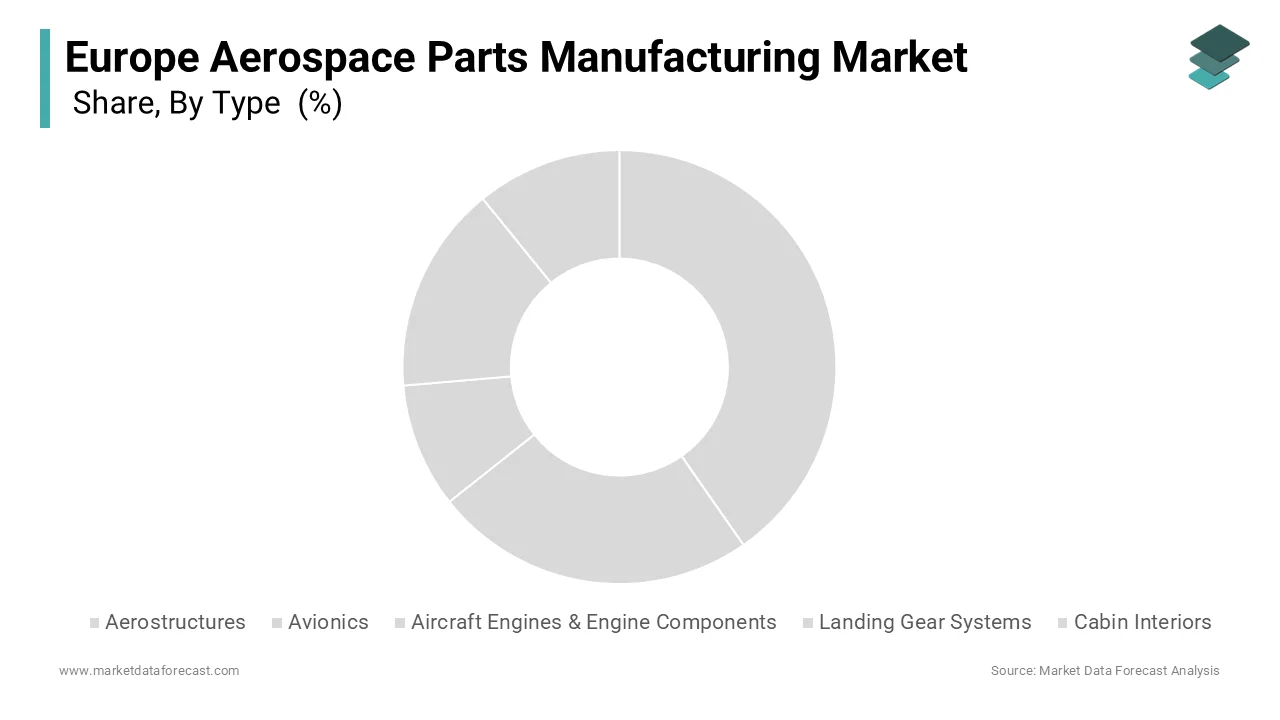
The avionics segment is estimated to register the fastest CAGR of 7.4% between 2026 and 2034 due to the digital transformation of cockpit flight control systems and communication architectures across both civil and defense fleets. A significant majority of recently delivered aircraft in Europe feature advanced, integrated avionics suites, increasing the demand for sophisticated computing modules and secure navigation components. Major European aerospace firms are playing a central role in enabling this technological shift, with rising demand driven by modernization efforts for older military aircraft fleets. European defense funding initiatives are increasingly prioritizing sovereign development of avionics, with a focus on artificial intelligence for mission systems and secure, encrypted communication links. Civil aviation also contributes significantly as airlines comply with the EU’s mandate for Performance Based Navigation capabilities, requiring upgrades to flight management and surveillance systems. These converging regulatory, technological, and strategic imperatives position avionics as the most dynamic growth vector in the European aerospace supply chain.
By Aircraft Insights
The commercial aircraft segment led theEuropeane aerospace parts manufacturing market by capturing a 62.2% share in 2025. The supremacy of the commercial aircraft segment is driven by Europe’s role as the home of Airbus, the world’s largest commercial aircraft manufacturer by deliveries, which alone accounted for a notable share of global narrowbody production in 2023, according to research. The persistent, high-volume order backlog for aircraft sustains a consistent demand for critical components, such as engines, landing gear, and cabin interiors, from a broad network of European suppliers specialized in aerospace quality standards. Commercial aerospace exports from the EU represent a significant portion of the region's trade, driven largely by specialized production clusters. Major contributions to this export volume are concentrated within key European nations, which leverage regional industrial clusters for manufacturing. Fleet renewal pressures further amplify demand as carriers replace aging A320ceo and A330 models with fuel-efficient neo variants to meet EU Emissions Trading System compliance thresholds. Additionally, the rise of low-cost carriers in Eastern Europe has spurred orders for standardized high-utilization aircraft, reinforcing the commercial segment’s manufacturing footprint. Unlike defense cycles, which are subject to political budgeting fluctuations, commercial aerospace benefits from long-term visibility and global passenger traffic recovery.
The military aircraft segment is anticipated to witness the fastest CAGR of 6.8% over the forecast period, due to an unprecedented alignment of strategic urgency, fiscal commitment, and industrial policy across European nations. Defense procurement spending for aircraft has seen a notable increase, driven by broader commitments to strengthen security capabilities. Long-term collaborative programs for future combat systems are generating increased demand for advanced technologies, including specialized materials, electronic systems, and propulsion components. The acquisition of modern fighter aircraft by nations in Central Europe is accelerating, creating growth for regional aerospace suppliers. Increased demand for new platforms is actively driving up order volumes for maintenance, repair, and component manufacturing in local markets. Moreover, the European Commission’s European Defence Industrial Strategy explicitly prioritizes the onshoring of critical military aerospace capabilities, reducing third-country dependencies. This confluence of security imperatives, industrial sovereignty,y and multilateral collaboration positions military aerospace as the highest growth corridor despite its smaller current market share.
COUNTRY LEVEL ANALYSIS
Germany Aerospace Parts Manufacturing Market Analysis
Germany holds a dominant position in the European aerospace parts manufacturing market due to its strong engineering base, advanced manufacturing infrastructure, and leadership in high-precision components. The country is a major hub for aircraft engine modules, gearboxes, turbomachinery, and high-temperature alloy parts, supported by a dense network of Tier-1 and Tier-2 suppliers. The presence of globally recognized players such as MTU Aero Engines strengthens Germany’s role in propulsion systems and engine component manufacturing. Additionally, Germany’s emphasis on Industry 4.0, automation, and additive manufacturing enhances productivity and quality compliance. Strong linkages with Airbus programs and rising European defense modernization initiatives continue to drive demand for domestically manufactured aerospace components, reinforcing Germany’s position as the primary value contributor in the European aerospace supply chain.
France Aerospace Parts Manufacturing Market Analysis
France represents a significant share of the European aerospace parts manufacturing market, supported by its vertically integrated aerospace ecosystem and strong OEM presence. The country plays a critical role in the production of aerostructures, nacelles, landing gear systems, and propulsion components, largely driven by extensive Airbus manufacturing operations and a robust Tier-1 supplier base. Companies such as Safran anchor France’s leadership in aircraft systems and engine components. Government support for strategic industries and rising defense expenditures further stimulate domestic manufacturing activity. France’s strong R&D ecosystem and close coordination between industry and public institutions enable rapid scaling of next-generation aerospace components, securing its long-term competitiveness in both civil and military aviation segments.
United Kingdom Aerospace Parts Manufacturing Market Analysis
The United Kingdom remains one of Europe’s most technologically advanced aerospace parts manufacturing markets, characterized by high-value production, strong R&D capabilities, and a well-established defense sector. The country specializes in aircraft engines, composite structures, avionics, and advanced subsystems, with a strong aftermarket and MRO presence. Major industry players such as Rolls‑Royce and BAE Systems underpin the UK’s role in both civil and defense aerospace programs. Despite regulatory changes following Brexit, the UK aerospace manufacturing sector continues to benefit from government support, defense procurement growth, and export-oriented production, positioning it as a high-value contributor to the European aerospace supply chain.
Spain Aerospace Parts Manufacturing Market Analysis
Spain has emerged as a key aerospace parts manufacturing hub in Southern Europe, driven by competitive production costs, skilled labor availability, and strong integration into Airbus supply chains. The country is particularly strong in aerostructures, including wings, fuselage sections, and composite subassemblies, with manufacturing clusters concentrated in Madrid, Andalusia, and the Basque Country. Companies such as Aernnova play a central role in supplying complex structural components to major OEMs. Increasing outsourcing by European aircraft manufacturers and investments in composite manufacturing capabilities continue to support Spain’s growing relevance, although margin pressures from lower-cost Eastern European markets remain a competitive challenge.
Italy Aerospace Parts Manufacturing Market Analysis
Italy accounts for a notable share of the European aerospace parts manufacturing market, supported by its strengths in helicopter components, avionics, and medium-complexity aerostructures. The country has a well-established defense and rotorcraft manufacturing base, led by Leonardo, which drives demand for domestically produced subsystems and structural parts. Italy’s aerospace supply chain is characterized by a large number of specialized SMEs that support both civil and military programs. Ongoing defense modernization efforts and increased focus on helicopter and regional aircraft platforms are expected to sustain demand, although fragmentation and capital constraints among smaller suppliers limit rapid scale-up.
Netherlands Aerospace Parts Manufacturing Market Analysis
The Netherlands plays a strategic niche role in the European aerospace parts manufacturing market, focusing on high-precision aerostructures, composite components, and engineering services. The country benefits from strong technological capabilities in automation, robotics, and testing, making it an attractive partner for OEMs seeking advanced manufacturing solutions. GKN Aerospace is a key contributor, supplying complex structures and assemblies for multiple European aircraft programs. While domestic production volumes are smaller compared to Germany or France, the Netherlands’ specialization in high-value components and new product introduction ensures sustained relevance within the regional aerospace ecosystem.
Sweden Aerospace Parts Manufacturing Market Analysis
Sweden and other Nordic countries contribute to the European aerospace parts manufacturing market through niche, high-technology components, particularly in defense aerospace and avionics. Sweden’s industry is strongly influenced by Saab, which supports demand for advanced subsystems, lightweight structures, and electronic components. High engineering standards, strong R&D investment, and export-oriented production characterize the Nordic aerospace sector. Although limited by smaller domestic markets, Nordic manufacturers maintain a competitive edge through specialization and strong integration into European and NATO defense supply chains.
COMPETITIVE LANDSCAPE
Competition in the European aerospace parts manufacturing market is characterized by a tightly knit ecosystem of tier one integrators, national champions, and specialized small and medium enterprises operating under stringent regulatory and technical standards. Dominant players such as Airbus, Safran, and Leonardo leverage decades of co-development experience with defense ministries and civil regulators to maintain preferential access to high-value programs. However, rising pressure to localize supply chains and adopt green manufacturing practices has intensified rivalry among mid-tier suppliers seeking qualification for next-generation platforms like the FCAS and ZEROe aircraft. Certification barriers and capital intensity limit new entrants, yet digital native firms are gaining traction through niche innovations in predictive maintenance and lightweight materials. The competitive landscape is further shaped by geopolitical imperatives driving collaborative procurement and export control alignment, which favor established entities with proven security clearances and cross-border operational footprints.
KEY MARKET PLAYERS
Some of the companies that are playing a dominating role in the Europe Aerospace Parts Manufacturing Market include
- Safran SA
- Rolls-Royce Holdings plc
- Airbus SE
- Leonardo S.p.A.
- MTU Aero Engines AG
- Thales Group
- Boeing (European operations & suppliers)
- UTC Aerospace Systems (Collins Aerospace)
- Diehl Stiftung & Co. KG
- GKN Aerospace (Melrose Industries)
- STELIA Aerospace
- RUAG Aerospace
- Magellan Aerospace
- Fokker Technologies (GKN division)
- B/E Aerospace (Rockwell Collins brand)
- Spirit AeroSystems, Inc.
- Honeywell Aerospace
- Parker Hannifin Corporation
- GE Aviation
TOP LEADING PLAYERS IN THE MARKET
- Airbus Defence and Space is a cornerstone of Europe’s aerospace parts manufacturing ecosystem with deep integration across military, civil, and space domains. The company designs and produces critical airframes, propulsion interfaces, and mission systems for platforms ranging from the A400M transport aircraft to the Eurodrone program. It also launched the Skywise Predictive Maintenance suite tailored for European operators, reinforcing its role beyond production into lifecycle support. These initiatives enhance supply chain transparency and reduce certification lead times, strengthening its position as both OEM and tier one supplier.
- Safran is a leading French multinational specializing in aircraft engines, landing gear, and avionics with extensive manufacturing operations across Europe. The company supplies key subsystems for the LEAP engine family and develops electric taxiing systems that reduce airport emissions. It also partnered with MTU Aero Engines on the New Generation Fighter engine demonstrator under the Future Combat Air System. These moves underscore Safran’s commitment to advanced materials and collaborative defense innovation, solidifying its influence in high-value propulsion and equipment segments.
- Leonardo is Italy’s premier aerospace and defense industrial group with major contributions in rotorcraft, avionics, and aerostructures. The company manufactures fuselage sections for the AW189 helicopter and provides integrated mission systems for NATO surveillance fleets. It also signed a strategic agreement with Thales to co-develop electronic warfare suites for European fighter programs. These actions reflect Leonardo’s pivot toward sovereign digital capabilities and cross-border defense industrial alignment, enhancing its footprint in both civil and military aerospace supply chains.
TOP STRATEGIES USED BY THE KEY MARKET PARTICIPANTS
Key players in the European aerospace parts manufacturing market prioritize vertical integration through long-term risk-sharing partnerships with original equipment manufacturers to secure stable work packages and co-invest in technology roadmaps. They heavily invest in digital transformation, adopting artificial intelligence-driven quality control, additive manufacturing, and blockchain-based traceability to meet EASA certification demands efficiently. Strategic consolidation via mergers and acquisitions enables firms to broaden product portfolios and access specialized engineering talent, particularly in avionics and composites. Companies actively participate in EU-funded research initiatives like Clean Sky and the European Defence Fund to align component development with sustainability and sovereignty mandates. Additionally, they establish regional innovation hubs near final assembly lines to shorten logistics cycles and foster co-engineering with customers, ensuring responsiveness to evolving platform requirements.
MARKET SEGMENTATION
This research report on the Europe Aerospace Parts Manufacturing Market is segmented and sub-segmented into the following categories.
By Type
- Aerostructures
- Avionics
- Aircraft Engines & Engine Components
- Landing Gear Systems
- Cabin Interiors
- Others
By Aircraft Type
- Commercial Aircraft
- Military Aircraft
- Business & General Aviation Aircraft
- Helicopters & Rotorcraft
- Unmanned Aerial Vehicles (UAVs)
By Country
- Germany
- France
- United Kingdom
- Spain
- Italy
- Netherlands
- Sweden
- Rest of Europe