- Product Description Description
- Table of Contents TOC
- List of Table & Figure LOT
- Get Free Sample PDF Sample PDF
Market Size, 2025
$1.59 BnMarket Estimate, 2026
$2.11 BnMarket Forecast, 2034
$19.97 BnCAGR, 2026–2034
32.47%Europe Artificial Intelligence in Education Market Report Summary
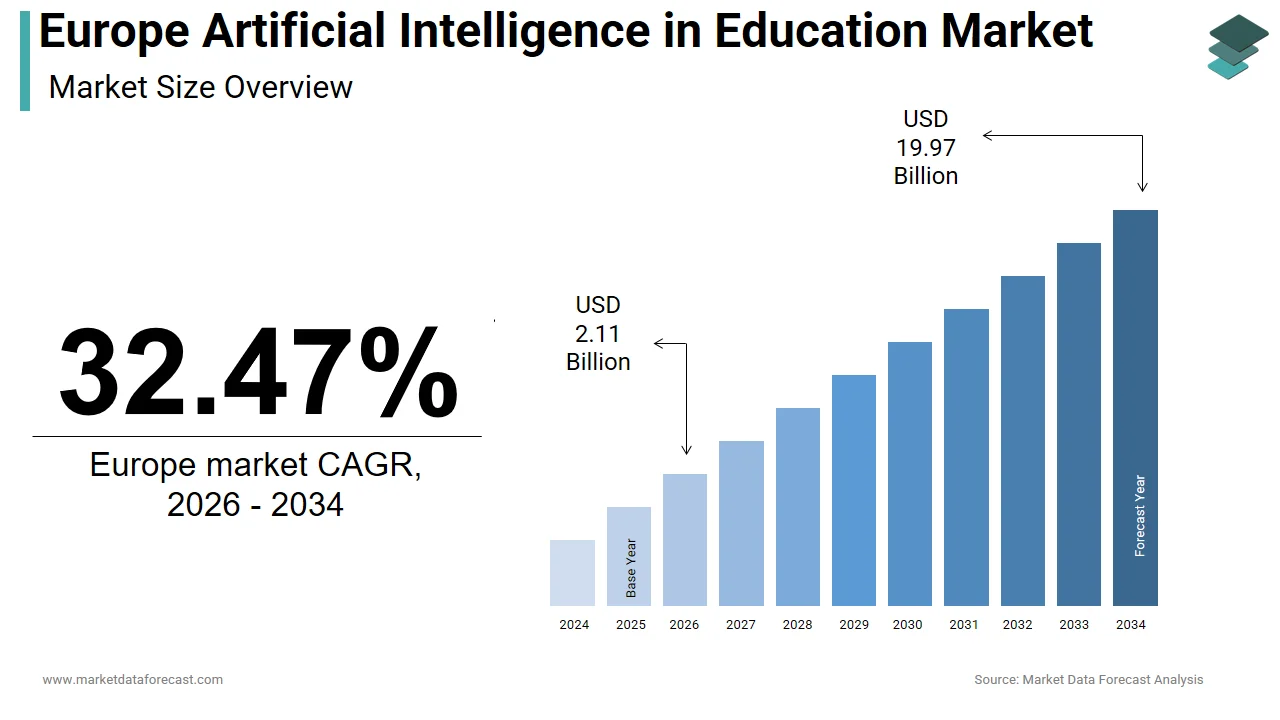
The Europe artificial intelligence in education market was valued at USD 1.59 billion in 2025, is estimated to reach USD 2.11 billion in 2026, and is projected to reach USD 19.97 billion by 2034, growing at a CAGR of 32.47% from 2026 to 2034. Market growth is driven by the increasing adoption of AI-powered learning platforms, rising demand for personalized education, and the rapid digital transformation of educational institutions across Europe. Artificial intelligence is enabling adaptive learning, automated grading, virtual tutoring, and data-driven insights to improve learning outcomes and operational efficiency. Additionally, government initiatives supporting digital education, expansion of e-learning ecosystems, and integration of advanced technologies such as machine learning and natural language processing are accelerating market expansion.
Key Market Trends
- Increasing adoption of AI-powered personalized learning and adaptive education systems.
- Rising integration of machine learning and data analytics in educational platforms.
- Growing demand for virtual tutors, chatbots, and intelligent learning assistants.
- Expansion of cloud-based education platforms and digital classrooms.
- Increasing government support for digital education and skill development initiatives.
Segmental Insights
- Based on component, the solution segment dominated the Europe artificial intelligence in education market in 2025, driven by the growing deployment of AI-powered learning platforms and software solutions.
- Based on technology, the machine learning (ML) segment led the market by capturing 62.9% share in 2025, supported by its ability to deliver personalized learning experiences and predictive analytics.
- Based on application, the learning platforms and virtual facilitators segment accounted for 35.4% share in 2025, driven by increasing adoption of AI-enabled digital learning environments.
- Based on end use, the higher education segment held the largest share of 45.7% in 2025, supported by strong adoption of AI technologies in universities and research institutions.
- Based on deployment mode, the cloud segment dominated the market by accounting for 59.3% share in 2025, driven by scalability, accessibility, and cost efficiency.
Regional Insights
The Europe artificial intelligence in education market is witnessing rapid growth across major countries due to increasing digitalization of education systems and strong policy support.
- Germany led the regional market in 2025 with 30.1% share, supported by strong investments in digital education infrastructure and AI innovation.
- The United Kingdom followed with 26.2% share in 2025, driven by advanced edtech ecosystems and widespread adoption of AI-based learning platforms.
- Italy is emerging as a promising market due to increased funding from European recovery programs and growing adoption of AI-powered solutions in vocational education and workforce development.
Competitive Landscape
The Europe artificial intelligence in education market is highly competitive, with the presence of global technology providers and specialized edtech companies. Market players are focusing on enhancing AI capabilities, expanding digital learning platforms, and delivering personalized education solutions. Strategic collaborations with educational institutions, investments in research and development, and integration of advanced technologies are shaping competitive dynamics across the region.
Prominent companies operating in the Europe artificial intelligence in education market include IBM Corporation, Microsoft Corporation, Google LLC, Cognizant Technology Solutions Corporation, Pearson PLC, Amazon Web Services, Inc., Carnegie Learning, Inc., Blackboard, Inc., BridgeU Limited, and DreamBox Learning, Inc.
Europe Artificial Intelligence in Education Market Size
The Europe artificial intelligence in education market was valued at USD 1.59 billion in 2025, is estimated to reach USD 2.11 billion in 2026, and is projected to reach USD 19.97 billion by 2034, growing at a CAGR of 32.47% from 2026 to 2034.
Artificial Intelligence in Education (AIEd) refers to the use of AI technologies, like machine learning, natural language processing, and data analytics, to enhance teaching, learning, and school administration. This domain integrates intelligent tutoring platforms, automated assessment tools, and predictive analytics to enhance pedagogical outcomes while maintaining alignment with European regulatory frameworks. According to the European Commission, the Digital Education Action Plan 2021 to 2027 establishes a strategic foundation for integrating artificial intelligence into teaching and learning environments across all member states. As per Eurostat data, 73.7% of individuals employed in the European Union with an information and communications technology education background attained tertiary level qualifications in 2024, reflecting a growing workforce capable of supporting advanced educational technologies. The Organisation for Economic Co-operation and Development (OECD) observes that generative artificial intelligence systems now demonstrate performance levels exceeding those of the average fifteen-year-old student in reading comprehension assessments across multiple European and OECD jurisdictions. Educational institutions throughout Europe are increasingly adopting cloud-based artificial intelligence infrastructure to support personalized learning pathways while adhering to stringent data protection requirements established under regional legislation. The convergence of pedagogical innovation and regulatory compliance defines the unique characteristics of this market within the European context.
MARKET DRIVERS
Escalating Institutional Demand for Personalized Learning Infrastructure
The region’s educational institutions increasingly prioritize artificial intelligence-driven personalization, which contributes to the growth of the Europe artificial intelligence in education market. This approach aims to address diverse learner needs across multilingual and multicultural classrooms. Adaptive platforms powered by intelligent algorithms have shown a measurable positive impact on student engagement, with schools reporting significant improvements in academic outcomes when using personalized tutoring tools. A significant majority of European teachers view the ability to provide individualized lessons as a primary hurdle, fueling the need for technology that can modify educational content based on student performance. Major national initiatives are providing substantial capital to modernize school infrastructure, with an increasing focus on software tools that allow for individualized learning speeds and progress monitoring. Dedicated national strategies are providing tens of thousands of students with early access to artificial intelligence applications, reflecting a commitment to building a more tailored educational environment. The convergence of pedagogical research validating adaptive methodologies and institutional budget allocations toward intelligent infrastructure establishes a robust demand foundation. Educational leaders recognize that artificial intelligence systems capable of analyzing learner patterns and adjusting instructional delivery represent essential components of future-ready educational environments across European jurisdictions.
Accelerated Policy Mandates Supporting Digital Competence Development
European Union policy frameworks increasingly mandate artificial intelligence literacy integration across educational curricula, which further propels the expansion of the Europe artificial intelligence in education market. This is creating structural demand for compliant technological solutions. Updated regional standards now recognize artificial intelligence and data literacy as essential skills for all students, encouraging schools to adopt the latest instructional technologies to meet these requirements. Several countries have begun introducing foundational digital concepts at the primary level to ensure that younger students develop a basic understanding of modern technology from an early age. New legal frameworks categorize educational software as high-risk, leading institutions to prioritize the purchase of certified and transparent platforms to ensure safety and fairness. High rates of technical adoption among private sector firms are putting pressure on the education system to enhance digital training, ensuring that the future workforce is prepared for an increasingly automated economy. National strategies such as France's AI for Humanity initiative and the Netherlands' National AI Strategy allocate substantial public funding toward educational artificial intelligence deployment. These policy-driven requirements establish predictable demand trajectories as institutions systematically upgrade technological capabilities to meet regulatory obligations and prepare learners for artificial intelligence-integrated professional environments throughout the European Economic Area.
MARKET RESTRAINTS
Stringent Data Privacy and Regulatory Compliance Requirements
Comprehensive data protection legislation and emerging artificial intelligence governance frameworks are hampering the growth of the European artificial intelligence in education market. According to sources, new regional laws classify many educational AI tools as high-risk, meaning developers must prove their systems are safe, fair, and transparent through extensive testing before they can be used in classrooms. Schools and technology providers must follow strict data privacy rules that require them to minimize the information they collect and clearly explain how student data is used, which can complicate the process of building and refining AI models. The requirement for algorithmic transparency and explainability under European regulatory frameworks creates technical challenges for machine learning systems whose decision-making processes may lack interpretability. Educational technology vendors report extended procurement cycles as institutions conduct thorough compliance reviews before adopting artificial intelligence solutions. Cross-border data transfer restrictions further limit the scalability of cloud-based artificial intelligence platforms serving multinational educational communities. These regulatory safeguards, while essential for protecting fundamental rights, introduce friction that slows market penetration and increases the total cost of ownership for artificial intelligence-enabled educational tools across European jurisdictions.
Persistent Educator Digital Competency and Training Gaps
The effective deployment of AI in the region’s education systems encounters substantial resistance stemming from insufficient educator preparation and professional development infrastructure, which hinders the expansion of the Europe artificial intelligence in education market. According to a study, a large majority of primary and secondary teachers remain cautious about the impact of artificial intelligence on the quality of learning, often feeling that they lack the necessary professional development to balance technology with traditional pedagogy. Many countries have yet to provide clear, standardized instructions for teachers on how to handle generative AI in the classroom, leaving individual schools to figure out ethical and practical rules on their own. The rapid evolution of artificial intelligence capabilities outpaces traditional teacher preparation programmes, creating competency mismatches that undermine adoption confidence. Institutional investments in artificial intelligence infrastructure often exceed available professional development budgets, resulting in underutilized technological assets. Rural and underserved educational communities face compounded challenges due to limited access to specialized training resources and technical support personnel. These human capital constraints represent significant barriers to realizing the transformative potential of artificial intelligence within European educational environments, as technology effectiveness ultimately depends upon educator capacity to integrate intelligent tools meaningfully within pedagogical practice.
MARKET OPPORTUNITIES
Expansion of Multilingual Artificial Intelligence Learning Assistants
The linguistic diversity characterizing the region’s educational environments offers substantial opportunity for artificial intelligence solutions capable of supporting multilingual instruction and assessment. This is likely to promote the growth of the Europe artificial intelligence in education market. According to European Commission statistics, numerous official languages operate within European Union member states, creating demand for artificial intelligence systems that deliver content adaptation, real-time translation, and culturally responsive feedback across language boundaries. As per research, artificial intelligence-powered language learning applications demonstrate particular efficacy in supporting migrant and refugee student populations, with institutions reporting improved integration outcomes when deploying intelligent tutoring systems offering native language scaffolding. The emergence of large language models trained on European linguistic corpora enables the development of educational artificial intelligence that respects regional dialects, educational terminologies, and cultural contexts. Cross-border educational initiatives such as Erasmus+ increasingly leverage artificial intelligence translation tools to facilitate student mobility and collaborative learning experiences. Commercial opportunities exist for vendors developing artificial intelligence assistants that support content creation, assessment generation, and learner support across multiple European languages while maintaining compliance with regional data sovereignty requirements. This multilingual capability represents a distinctive competitive advantage for European artificial intelligence in education providers seeking to serve both domestic and international institutional markets.
Growth of Corporate Training and Workforce Development Applications
European corporate sectors are showing accelerating demand for AI-enabled professional development and skills certification platforms, which provide fresh prospects for the expansion of the Europe artificial intelligence in education market. This surge is creating significant market expansion possibilities that go beyond traditional educational institutions. According to analysis by the European Centre for the Development of Vocational Training (Cedefop), a significant proportion of European employers identify skills mismatches as critical challenges, driving investment in artificial intelligence-powered upskilling and reskilling solutions to address recruitment difficulties. As per the European Commission's Skills Agenda, artificial intelligence systems capable of personalized learning pathway recommendation and competency gap analysis align with strategic workforce development priorities, supporting the broader adoption of flexible, quality-assured micro-credentials across member states. The corporate training segment benefits from fewer regulatory constraints compared to formal education contexts while maintaining substantial budget allocations for employee development. Artificial intelligence platforms supporting just-in-time learning, simulation-based skill practice, and adaptive assessment address enterprise requirements for scalable, measurable professional development. The convergence of artificial intelligence capabilities with European qualification frameworks enables portable credential recognition across national boundaries, enhancing labor market mobility. Vendors developing artificial intelligence solutions that integrate with existing human resource systems and demonstrate clear return on investment metrics position themselves to capture a significant share within this high-growth segment of the European artificial intelligence in education market.
MARKET CHALLENGES
Algorithmic Bias and Equity Concerns in Educational Artificial Intelligence
Algorithmic fairness and equitable outcomes across diverse learner populations negatively impact the growth of the European artificial intelligence in education market. The requirement for representative training data across European demographic groups creates data collection challenges, given privacy restrictions and fragmented national education information systems. Institutions deploying artificial intelligence for high-stakes decisions, such as admissions or progression, face heightened scrutiny regarding transparency and appeal mechanisms. The tension between personalization effectiveness and equitable treatment requires sophisticated technical approaches that many educational technology vendors struggle to implement consistently. Addressing these equity considerations while maintaining system performance represents an ongoing challenge that influences institutional procurement decisions and regulatory compliance strategies throughout the European artificial intelligence in education market.
Infrastructure Disparities and Digital Divide Across European Regions
Significant variations in digital infrastructure readiness across European regions create substantial challenges for uniform AIEd adoption and effectiveness, and thereby impede the expansion of the Europe artificial intelligence in education market. Artificial intelligence systems requiring real-time data processing, cloud connectivity, or substantial local computing resources may underperform or become inaccessible in infrastructure-constrained environments. The cost of upgrading institutional technology infrastructure to support advanced artificial intelligence applications exceeds available budgets for many educational authorities, particularly following pandemic-related fiscal pressures. These infrastructure inequalities risk creating a two-tier educational technology landscape where artificial intelligence benefits accrue primarily to well-resourced institutions, potentially widening existing educational achievement gaps across European jurisdictions. Addressing these foundational disparities requires coordinated public investment and policy intervention that extends beyond artificial intelligence-specific initiatives to encompass broader digital equity strategies.
REPORT COVERAGE
| REPORT METRIC | DETAILS |
| Market Size Available | 2025 to 2034 |
| Base Year | 2025 |
| Forecast Period | 2026 to 2034 |
| Segments Covered | By Component, Application, End Use, Deployment Mode, Technology, and Country. |
| Various Analyses Covered | Global, Regional, and Country-Level Analysis, Segment-Level Analysis, Drivers, Restraints, Opportunities, Challenges; PESTLE Analysis; Porter’s Five Forces Analysis, Competitive Landscape, Analyst Overview of Investment Opportunities |
| Countries Covered | UK, France, Spain, Germany, Italy, Russia, Sweden, Denmark, Switzerland, Netherlands, Turkey, Czech Republic, and the Rest of Europe. |
| Market Leaders Profiled | IBM Corporation, Microsoft Corporation, Google LLC, Cognizant Technology Solutions Corporation, Pearson PLC, Amazon Web Services, Inc., Carnegie Learning, Inc., Blackboard, Inc., BridgeU Limited, DreamBox Learning, Inc., and Others. |
SEGMENT ANALYSIS
By Component Insights
The solution segment held the majority share of the Europe artificial intelligence in education market in 2025. Integrated platform adoption drives the supremacy of this segment. European educational institutions demonstrate a strong preference for comprehensive artificial intelligence solution suites that consolidate tutoring, assessment, and analytics within unified interfaces. The European Commission's Digital Education Action Plan focuses on fostering high-performing digital education ecosystems through infrastructure and interoperability rather than setting specific AI deployment targets for higher education institutions. Germany’s DigitalPakt Schule directs federal funding toward physical digital infrastructure like cabling, Wi-Fi, and end-user devices for schools, rather than the procurement of artificial intelligence-enabled learning software. Research indicates that institutions favor solutions offering modular scalability, allowing phased implementation across departments while maintaining compliance with General Data Protection Regulation requirements. The convergence of pedagogical effectiveness, regulatory alignment, and total cost of ownership considerations establishes solution dominance within the European artificial intelligence in education procurement landscape. European artificial intelligence solution providers benefit from stringent regulatory frameworks that favor established vendors capable of demonstrating audit readiness and data sovereignty capabilities. Educational institutions processing learner information must adhere to complex GDPR requirements, including data protection by design in vendor solutions, and high-risk educational AI applications under the EU AI Act mandate conformities such as human oversight and transparency documentation. The requirement for algorithmic explainability under European regulatory frameworks creates technical barriers that favor comprehensive solution vendors over fragmented point solution providers. These regulatory dynamics establish structural advantages for solution providers who invest in compliance infrastructure, creating sustainable market leadership within the European artificial intelligence in education sector.
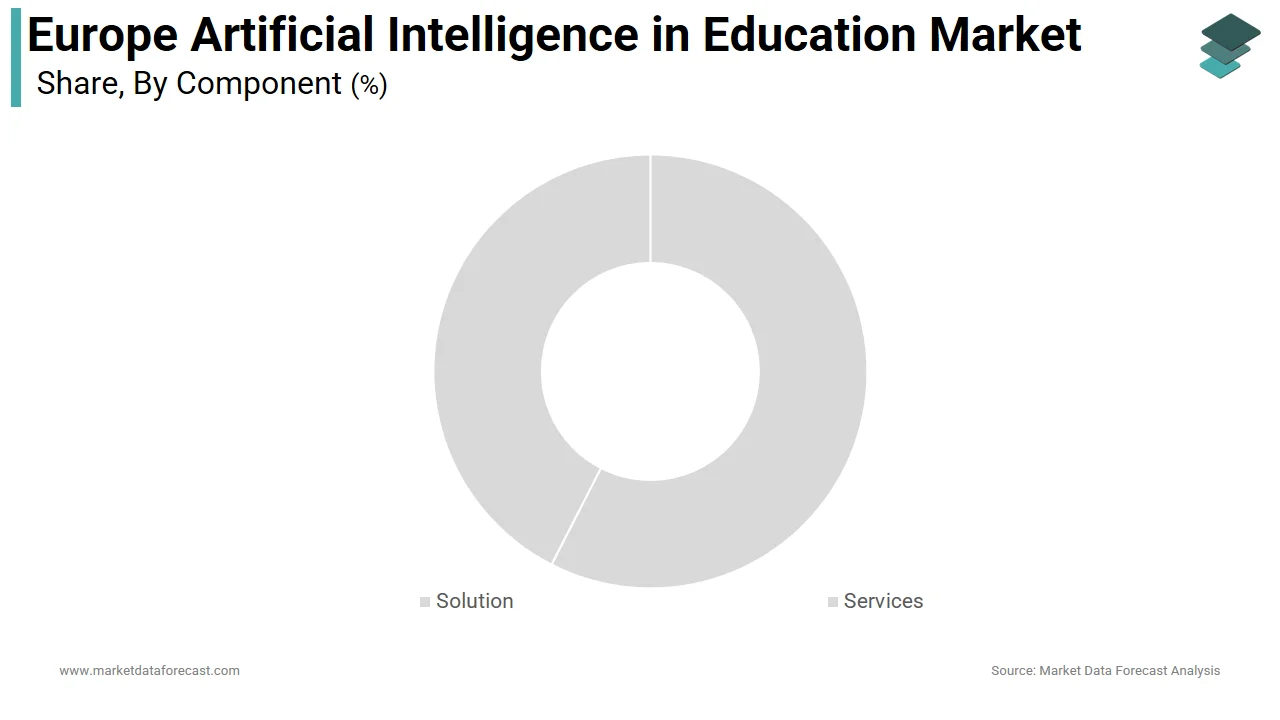
The services segment is predicted to witness the highest CAGR of 38.2% from 2026 to 2034 due to a professional expertise gap fueling advisory service demand and rising migration/optimization requirements. European educational institutions increasingly require specialized consulting support to navigate artificial intelligence implementation complexities, creating substantial demand for professional services encompassing strategy development, integration planning, and change management. According to multiple studies, a notable share of educators across member states report limited formal training in artificial intelligence applications, compelling institutions to engage external advisors for capability building and workflow redesign. The rapid evolution of artificial intelligence capabilities outpaces institutional internal expertise, creating sustained demand for advisory engagements that translate technological potential into measurable educational outcomes. Service providers report growing engagements focused on data governance architecture, algorithmic bias mitigation, and educator professional development, reflecting the multifaceted support requirements of European artificial intelligence adoption initiatives. The transition from legacy educational infrastructure to artificial intelligence-enabled platforms generates substantial demand for migration, configuration, and optimization services across European institutions. According to sources, significant disparities in digital infrastructure readiness across member states necessitate customized implementation approaches that service providers deliver through tailored engagement models. Cloud-based artificial intelligence platforms require specialized integration expertise to ensure interoperability with existing student information systems, learning management platforms, and assessment frameworks. Service providers report that post deployment optimization engagements represent growing revenue streams as institutions seek to maximize return on artificial intelligence investments through continuous performance tuning and capability expansion. The complexity of European regulatory compliance, multilingual support requirements, and diverse institutional architectures establishes sustained demand for specialized artificial intelligence implementation services throughout the forecast period.
By Technology Insights
The machine learning (ML) segment was the largest segment in the Europe Artificial Intelligence in Education Market and captured a 62.9% share in 2025. ML algorithms drive substantial value within European educational environments through predictive analytics that identify at-risk learners and adaptive systems that personalize instructional delivery. According to research, institutions deploying machine learning enabled adaptive platforms report improvement in student engagement metrics and measurable gains in competency acquisition rates. As per sources, predictive analytics capabilities support early intervention strategies that improve retention outcomes across higher education institutions throughout member states. Machine learning models trained on European educational datasets demonstrate particular efficacy in multilingual contexts, enabling content adaptation and assessment personalization across diverse learner populations. Educational technology vendors report that machine learning modules supporting competency mapping, learning pathway recommendation, and performance forecasting represent core differentiators within European procurement evaluations. The convergence of pedagogical research validating adaptive methodologies and institutional demand for data-driven decision support establishes machine learning dominance within the European artificial intelligence in education technology landscape. Machine learning technologies deliver substantial operational benefits to European educational institutions through automation of administrative workflows, assessment processes, and resource allocation decisions. The requirement for scalable solutions capable of serving diverse institutional sizes and types favors machine learning approaches that learn from institutional data patterns and adapt to local operational contexts. Educational technology providers report growing demand for machine learning modules that integrate with existing enterprise resource planning systems while maintaining compliance with European data protection requirements. These operational efficiency gains, combined with pedagogical effectiveness, establish machine learning as the foundational technology within the European artificial intelligence in education market.
The natural language processing (NLP) segment is estimated to register the fastest CAGR of 36.6% during the forecast period, owing to multilingual content generation and assessment support, as well as conversational interfaces and learner support systems. Natural language processing capabilities address critical European educational requirements through multilingual content creation, automated assessment, and real-time translation services that support diverse learner populations. According to research, several official languages operate within European Union member states, creating substantial demand for natural language processing systems capable of cross-language content adaptation and culturally responsive feedback. As per research, natural language processing-powered language learning applications demonstrate particular efficacy in supporting migrant and refugee student populations, with institutions reporting improved integration outcomes when deploying intelligent systems offering native language scaffolding. The emergence of large language models trained on European linguistic corpora enables the development of educational artificial intelligence that respects regional dialects, educational terminologies, and cultural contexts. Natural language processing vendors report growing adoption of automated essay scoring, grammar assistance, and content summarization tools across European educational institutions seeking to enhance instructional efficiency while maintaining assessment quality. Natural language processing technologies enable sophisticated conversational interfaces that provide scalable learner support, doubt resolution, and instructional guidance across European educational environments. The requirement for context-aware, pedagogically sound conversational interactions drives demand for natural language processing systems trained on educational discourse patterns and learning science principles. Educational technology providers report that natural language processing modules supporting intelligent tutoring, formative feedback generation, and collaborative learning facilitation represent high-growth opportunity areas within the European artificial intelligence in education market. The convergence of linguistic diversity requirements and scalable support needs establishes natural language processing as the fastest-growing technology segment within the European context.
By Application Insights
The learning platform and virtual facilitators application segment led the Europe Artificial Intelligence in Education Market and occupied a 35.4% share in 2025. This leading position of the segment is attributed to unified learning experience and ecosystem integration, and scalable personalization and adaptive instruction. Learning platforms and virtual facilitators dominate the European artificial intelligence in education application landscape by delivering integrated environments that consolidate content delivery, learner interaction, and performance analytics within cohesive user experiences. According to studies, institutions prioritize platform-based artificial intelligence deployments that support seamless data flow between instructional modules, assessment systems, and administrative workflows. Virtual facilitators powered by artificial intelligence provide scalable instructional support, enabling personalized guidance without proportional increases in human instructor capacity. Educational technology vendors report that European institutions favor platforms offering modular architecture, allowing phased capability expansion while maintaining interoperability with existing institutional systems. The convergence of pedagogical effectiveness, operational efficiency, and regulatory compliance considerations establishes learning platform and virtual facilitator dominance within the European artificial intelligence in education application market. Learning platforms and virtual facilitators deliver substantial value through artificial intelligence-enabled personalization capabilities that adapt instructional content, pacing, and assessment strategies to individual learner needs. Virtual facilitators leverage machine learning algorithms to analyze learner interaction patterns, identify knowledge gaps, and recommend targeted remediation strategies in real time. Educational technology providers report growing demand for platforms that balance personalization effectiveness with transparency requirements under European regulatory frameworks. The ability to deliver differentiated instruction at scale while maintaining pedagogical quality establishes learning platform and virtual facilitator applications as the leading segment within the European artificial intelligence in education market.
The intelligent tutoring system application segment is anticipated to witness the fastest CAGR of 25.3% over the forecast period. This rapid growth of the segment is propelled by delivering targeted instructional support that adapts to individual learner misconceptions and knowledge gaps. These systems leverage artificial intelligence algorithms to diagnose learner understanding, generate customized practice problems, and provide immediate formative feedback that accelerates skill acquisition. Educational technology vendors report growing adoption of intelligent tutoring modules that integrate with existing learning management systems while maintaining compliance with European data protection requirements. The convergence of pedagogical research validating adaptive tutoring methodologies and institutional demand for measurable learning gains establishes intelligent tutoring systems as the fastest-growing application segment within the European artificial intelligence in education market. Intelligent tutoring systems address critical European educational requirements through multilingual instructional capabilities that support learner mobility and cross-border educational experiences. Intelligent tutoring vendors report growing adoption of systems trained on European educational curricula and assessment frameworks, enabling seamless competency recognition across national qualification systems. The requirement for pedagogically sound, culturally appropriate instructional support drives demand for intelligent tutoring systems that balance technological sophistication with educational effectiveness. These multilingual and mobility supporting capabilities establish intelligent tutoring systems as a high-growth application segment within the European artificial intelligence in education market.
By End Use Insights
The higher education end-use segment dominated the Europe Artificial Intelligence in Education Market and accounted for a 45.7% share in 2025. This dominance of the segment is driven by research-oriented applications that leverage machine learning for data analysis, literature synthesis, and knowledge discovery. Higher education artificial intelligence applications extend beyond instructional support to encompass research administration, grant proposal optimization, and intellectual property management. Research shows that European universities favor artificial intelligence solutions that integrate with existing research information systems while maintaining compliance with open science and data sharing requirements. The convergence of research excellence objectives and technological capability advancement establishes higher education as the leading end-use segment within the European artificial intelligence in education market. Higher education institutions leverage artificial intelligence technologies to enhance administrative operations, student services, and resource management across complex organizational structures. Artificial intelligence applications supporting student retention, academic progress monitoring, and career pathway guidance demonstrate measurable improvements in institutional performance metrics across European higher education contexts. Educational technology providers point out growing demand for artificial intelligence modules that integrate with enterprise resource planning systems while maintaining compliance with European data protection and transparency requirements. The combination of operational efficiency gains and strategic decision support capabilities establishes higher education as the dominant end-use segment within the European artificial intelligence in education market.
The corporate training and learning end-use segment is likely to experience the fastest CAGR of 44.8% between 2026 and 2034. This swift expansion of the segment is fuelled by addressing urgent workforce development requirements driven by technological disruption and digital transformation initiatives. Corporate artificial intelligence training platforms leverage adaptive algorithms to deliver just-in-time learning, simulation-based skill practice, and competency assessment that address enterprise requirements for scalable, measurable professional development. Educational technology vendors report growing adoption of artificial intelligence solutions that integrate with existing human resource systems and demonstrate clear return on investment metrics. The convergence of workforce development urgency and artificial intelligence capability maturity establishes corporate training and learning as the fastest-growing end-use segment within the European artificial intelligence in education market. Corporate training applications benefit from artificial intelligence-enabled delivery models that support flexible, on-demand learning experiences aligned with contemporary workplace requirements. The requirement for learning solutions that integrate seamlessly with workflow environments drives demand for artificial intelligence applications offering mobile accessibility, conversational interfaces, and just-in-time content delivery. Corporate training vendors emphasize growing adoption of artificial intelligence modules that leverage learner interaction data to optimize content sequencing, assessment timing, and feedback strategies. These agile delivery capabilities, combined with measurable performance impact, establish corporate training and learning as a high-growth end-use segment within the European artificial intelligence in education market.
By Deployment Mode Insights
The cloud deployment segment was at the forefront in the Europe Artificial Intelligence in Education Market and held a 59.3% share in 2025. This prominence of the segment is supported by providing scalable computing resources that accommodate variable demand patterns without substantial capital investment requirements. Cloud infrastructure providers report growing demand for education-specific artificial intelligence bundles that combine compute capacity, storage services, and machine learning frameworks within unified procurement arrangements. The requirement for rapid deployment, simplified maintenance, and continuous capability updates establishes cloud deployment as the leading mode within the European artificial intelligence in education market. Cloud deployment enables sophisticated collaborative learning experiences and cross-institutional integration capabilities that align with European educational policy priorities. Cloud deployment vendors report growing adoption of multi-tenant artificial intelligence platforms that maintain institutional data sovereignty while enabling shared capability access and collective intelligence development. The requirement for interoperable systems that support European qualification frameworks and credential recognition drives demand for cloud-based artificial intelligence solutions with standardized application programming interfaces and data exchange protocols. These collaborative and integrative capabilities establish cloud deployment as the dominant mode within the European artificial intelligence in education market.
The on-premises deployment segment is projected to expand at the fastest CAGR within the Europe Artificial Intelligence in Education Market during the forecast period. Factors such as addressing stringent data protection and regulatory compliance requirements that govern educational information processing are primarily propelling the growth of this segment. Educational technology vendors report growing demand for on-premises artificial intelligence solutions that deliver advanced capabilities while satisfying institutional requirements for data residency, access control, and compliance reporting. The convergence of regulatory complexity and institutional risk management priorities establishes on-premises deployment as a high-growth segment within the European artificial intelligence in education market. On-premises deployment benefits from compatibility with existing institutional infrastructure and the preservation of operational autonomy that many European educational authorities prioritize. On-premises artificial intelligence vendors report growing adoption of hybrid deployment models that combine cloud-based capability updates with localized data processing to balance innovation access with control preservation. The requirement for institutional autonomy, legacy system compatibility, and customized operational governance establishes on-premises deployment as a rapidly growing segment within the European artificial intelligence in education market.
COUNTRY-LEVEL ANALYSIS
Germany Artificial Intelligence in Education Market Analysis
Germany was the top performer in the Europe Artificial Intelligence in Education Market and occupied a 30.1 % share in 2025. The growth of AIEd in Germany is driven by substantial public investment and institutional commitment to digital transformation. Initiated by the German Federal Government, the DigitalPakt Schule program allocated substantial funding primarily to modernize physical educational infrastructure, such as cabling and wireless networks, establishing the necessary technical foundation for digital learning tools rather than directly funding artificial intelligence platforms. According to Eurostat data, a vast majority of employed individuals with information and communications technology education backgrounds across the European Union possess tertiary qualifications, reflecting a trend toward a highly educated technical workforce in the region. Recent studies indicate that while a large proportion of university students frequently utilize artificial intelligence applications for their studies, German higher education institutions are still in the process of formally integrating these tools into official curricula and assessment procedures. Germany's strong manufacturing and engineering sectors generate demand for artificial intelligence-powered technical training solutions that support workforce development objectives. A study shows that German institutions prioritize compliance with General Data Protection Regulation requirements when procuring artificial intelligence solutions, favoring vendors with demonstrated data governance capabilities. The convergence of regulatory alignment, institutional investment, and workforce development needs establishes Germany as the dominant market within the European artificial intelligence in education landscape.
United Kingdom Artificial Intelligence in Education Market Analysis
The United Kingdom was the second-largest market for artificial intelligence in education in Europe and captured a 26.2% share in 2025 because of strong policy frameworks and institutional innovation capacity. The UK Department for Education provides guidance in its "Generative AI in education" policy, focusing on balancing pedagogical benefits with ethical safeguards. While AI literacy initiatives are growing, official data indicate that confidence in utilizing AI tools remains relatively low across the general population. The UK's Research and Innovation framework allocates substantial funding toward artificial intelligence education research, with universities leading European collaboration initiatives on adaptive learning technologies. Educational technology providers report that UK institutions demonstrate a strong preference for cloud-based artificial intelligence platforms that support scalable deployment across diverse institutional contexts. The convergence of policy support, research excellence, and institutional innovation capacity establishes the United Kingdom as a high-growth market within the European artificial intelligence in education sector.
France maintains a noteworthy share of the European market due to national strategy commitments and institutional modernization initiatives. France's AI for Humanity initiative prioritizes educational applications that support multilingual content delivery and culturally responsive pedagogical approaches. Educational technology vendors report that French institutions demonstrate a strong preference for artificial intelligence platforms that align with national curriculum frameworks and assessment standards. The convergence of policy support, institutional investment, and linguistic diversity requirements establishes France as a significant growth market within the European artificial intelligence in education landscape.
Italy Artificial Intelligence in Education Market Analysis
Italy is moving ahead steadfastly in the European market, owing to European recovery fund allocations and institutional digital transformation commitments. Italy's vocational education sector demonstrates particular demand for artificial intelligence-powered skills assessment and competency mapping solutions that support workforce development objectives. Educational technology providers report that Italian institutions prioritize artificial intelligence solutions that support multilingual content delivery across regional dialects and educational contexts. The convergence of European funding support, institutional modernization priorities, and vocational education demand establishes Italy as an emerging growth market within the European artificial intelligence in education sector.
Spain Artificial Intelligence in Education Market Analysis
Spain is anticipated to expand in the European market during the forecast period due to national digital education strategies and institutional innovation initiatives. Spain's vocational training sector demonstrates strong demand for artificial intelligence-powered skills development platforms that support labor market alignment objectives. Educational technology vendors report that Spanish institutions prioritize artificial intelligence solutions that support multilingual content delivery across Castilian Catalan and regional language contexts. The convergence of policy support, institutional investment, and linguistic diversity requirements establishes Spain as a high-potential growth market within the European artificial intelligence in education landscape.
COMPETITIVE LANDSCAPE
The Europe Artificial Intelligence in Education Market features a moderately fragmented competitive landscape characterized by established technology corporations, specialized educational technology providers, and emerging artificial intelligence startups. Global technology leaders leverage comprehensive platform ecosystems and substantial research and development resources to deliver integrated artificial intelligence solutions that address diverse institutional requirements. Specialized educational technology vendors differentiate through pedagogical expertise, curriculum alignment, and institutional relationship depth that support effective artificial intelligence integration within teaching and learning processes. Emerging startups demonstrate agility in developing innovative artificial intelligence applications that address specific educational challenges, though they face scalability and compliance hurdles within complex European regulatory environments. Competitive dynamics increasingly emphasize responsible artificial intelligence development, data governance capabilities, and multilingual support as institutions prioritize solutions that balance technological sophistication with ethical considerations and regulatory alignment. Market participants pursue growth through strategic acquisitions, partnership development, and geographic expansion while navigating varying national policy frameworks and institutional procurement processes across European jurisdictions. The convergence of technological innovation, regulatory evolution, and institutional demand establishes a dynamic competitive environment where capability depth, compliance readiness, and pedagogical effectiveness determine market success.
KEY MARKET PLAYERS
The leading companies operating in the Europe artificial intelligence in education market include:
- IBM Corporation
- Microsoft Corporation
- Google LLC
- Cognizant Technology Solutions Corporation
- Pearson PLC
- Amazon Web Services, Inc.
- Carnegie Learning, Inc.
- Blackboard, Inc.
- BridgeU Limited
- DreamBox Learning, Inc.
TOP PLAYERS IN THE MARKET
- Microsoft Corporation maintains substantial involvement in the Europe Artificial Intelligence in Education Market through its comprehensive portfolio of cloud-based learning platforms and artificial intelligence enabled productivity tools. The company recently announced new European digital commitments, including expanded cloud and artificial intelligence infrastructure investments across member states, as per Microsoft corporate communications. The company's European Collaboration Summit initiatives demonstrate a commitment to supporting educational institutions with artificial intelligence literacy training and responsible deployment frameworks. Microsoft's integration of artificial intelligence capabilities within Microsoft 365 Education and Azure cloud services provides European institutions with scalable solutions that align with regional data protection requirements.
- Google LLC demonstrates a significant contribution to the Europe Artificial Intelligence in Education Market through its AI Opportunity Initiative for Europe, which pledges millions of euros toward artificial intelligence skills development across member states. Google's partnership with the Council of Europe advances digital citizenship education through artificial intelligence-enabled resources that support ethical technology use across educational contexts. The company's investment in European linguistic diversity ensures artificial intelligence tools deliver culturally responsive content across multiple languages and educational systems. Google's commitment to responsible artificial intelligence development aligns with European regulatory frameworks while supporting institutional innovation capacity throughout the region.
- International Business Machines Corporation maintains strategic involvement in the Europe Artificial Intelligence in Education Market through its WatsonX platform and academic partnership programs that support institutional artificial intelligence adoption. IBM's support for the EU AI Act demonstrates a commitment to responsible artificial intelligence development that aligns with European regulatory requirements and ethical standards. The company's AI literacy initiatives promote employee skill development through tailored learning platforms that support continuous professional growth. IBM's focus on data management and application development capabilities provides European educational institutions with robust infrastructure for artificial intelligence integration while maintaining compliance with regional data protection frameworks.
TOP STRATEGIES USED BY KEY MARKET PARTICIPANTS
Key participants in the Europe Artificial Intelligence in Education Market employ strategic approaches centered on regulatory alignment, institutional partnership, and capability expansion. Leading vendors prioritize compliance with the General Data Protection Regulation and the EU AI Act requirements to establish trust with European educational institutions. Strategic partnerships with universities, government agencies, and educational technology providers enable market participants to develop solutions that align with regional curriculum frameworks and assessment standards. Investment in multilingual artificial intelligence capabilities supports content adaptation across Europe's diverse linguistic landscape while enhancing accessibility for underserved learner populations. Cloud infrastructure expansion across European data centers enables scalable deployment while maintaining data sovereignty commitments. Professional services offerings, including training implementation support and change management, address institutional capacity gaps that constrain artificial intelligence adoption. Continuous research and development investment ensures technological capabilities evolve in response to emerging pedagogical research and institutional requirements.
MARKET SEGMENTATION
This research report on the Europe artificial intelligence in education market has been segmented and sub-segmented into the following categories.
By Component
- Solution
- Services
By Application
- Learning Platform & Virtual Facilitators
- Intelligent Tutoring System (ITS)
- Smart content
- Fraud & Risk Management
- Others
By End Use
- Higher Education
- Corporate Training & Learning
- K-12 Education
By Deployment Mode
- Cloud
- On-premise
By Technology
- Machine Learning
- Natural Language Processing (NLP)
By Country
- United Kingdom
- France
- Spain
- Germany
- Italy
- Russia
- Sweden
- Denmark
- Switzerland
- Netherlands
- Rest of Europe